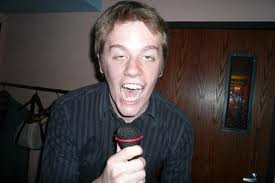
The Wicked Flames of the Weird


I get a perverse joy dancing in the wicked flames of the weird, but it has never been a calculated maneuver to draw people out from behind the barriers they erect for others. I just like the weird affectation.  I like the effect being weird has on people.  I like to see them think less of me.  I like to see that crinkled face that tells me that they don’t get it.  I like the confusion that asks the question, “Are you serious?”  I also like to get booed.

WeirdThese boos result from the fact that they don’t get the mental dance.  They’re never audible boos, but everything in their body language suggests that I just got booed.  People get uncomfortable when a joke you tell isn’t funny…Especially when it bombs.  They’ve been raised to be polite and laugh politely.  Little kids tell you when you’re not funny, point blank, but adults will usually try to soften the blow of your bomb.  Some of the times they can’t though.  Some of the times, they just don’t get it, and this frustrates them to a point where they may call you out on it.  It’s a perverse joy I derive from this dance, but it’s still a joy.

A funny thing happens to people when you start really grooving in this fire of the weird though. If you do it right, and you do it often enough, you’ll eventually run into the genuinely weird, the wacked, and the insane. You’ll find out a lot about your fellow humans by the way they react to your dance, for most of the truly weird ones can’t hide their reactions.  Like a dog that has its instinct to chase triggered when you start to run, the weird comes out of the weird when you start in on weird.  They accidentally start telling you where they stand on the various demarcation lines the separate the normal from the weird, and the insane.  They can’t help it.  It’s a biological function as indigenous to their makeup as sleeping and eating.

Most people have a view of where they stand that lacks true objectivity.  Their parents taught them where to stand in the world to avoid being perceived as weird, their friends and family ridiculed and bullied them into the knowledge of how to stand, and everyone else tells them where they stand when it’s all said and done.  The question that must be asked is what happens when everyone in their immediate world is weird.  Parents are the single, most prominent influence on our lives and our mental state, but what if they’re weird?  What happens to that kid who has those parents that have weird built into their DNA?  Their weird heritage is normal to their insular world but weird to everyone else.  What if all their friends and family members have lied to them, to be nice, for most of their lives?  The occasional potshot will come out, in reaction to a weird statement that a person makes, but for the most part most people are too polite to tell another when they are fundamentally weird.  Some may recognize these niceties for what they are and seek true definition that they can get nowhere else.  Some of these people may turn to TV, the movies, and other mediums, but most of these mediums exaggerate the true definitions of weird for entertainment purposes. Regardless where they think they stand, or where they’ve found solace for their definitions of what is weird and normal, one dance in the wicked fires of the weird will reveal them.

The key to my particular dance in the wicked flames of the weird is that I’m not afraid to follow the trails that lead to weird.  I know my way back to normal.  I’m so normal it bores me, and that’s why I do this dance in the first place.  I also do the dance because most of the people I know are normal, and I like to separate myself from them in varying ways.

Most people are normal.  If they weren’t, it would be weird to be normal and normal to be weird.  Most people see my dance for what it is, and they laugh, and clap, and encourage me on.  They’re the normal ones.  They have their own bread crumbs laid out on the trail back to normalcy, and they don’t mind watching a normal person occasionally act weird.  They think it’s fun, and they have occasionally added a few dance moves of their own to my performance, because they get the sense that that’s what it’s all about.

Some people think I’m a fool, and they have no time for me.  They’re the serious, normal people with serious and normal ambitions in life.  They have no time for my playtime and my weirdness.  I’m not going to tell you that I’m not a fool, for that would be an opinion you would have to shape based upon my performance.  Plus, if I were to show you the pictures of people who think I’m a fool, you would see that most of them are much better looking than I am, and you would be prone to side with them.

As I said, I’ve never started this dance of the weird to gauge people.  There has never been a calculated decision on my part to find out more about a person I’m talking to, but it has been very instructive nonetheless. “Why would a person would act like?” is a question an abnormal person asks when they see me dance.  They don’t go beyond that question, for doing so might reveal them.  If they did, it would probably go something like this: “Why would a person who is normal, act so abnormal?  Why would he enjoy dancing in the wicked flames of the weird if he is, as you say, normal?  Why would he dance in a fire we all try to avoid?  Is he making fun of us?  He must be weird, because no normal man would act like that on purpose would they Irene?

The completely rational types that grasp for mental health are usually my favorites.  These people are perpetually grasping at different rungs of the monkey bars, trying to determine if they’re abnormal, weird, or just as normal as you and I are.  Most of them choose math and science as their definition of normalcy, because it creates order in their otherwise chaotic minds.  Those who are truly adept at math and science can usually quash my attempts at bringing chaos to their minds, for I have never been a great student of these subjects.  I know just enough to know their basic order however, and I know just enough to funkify that basic order for the individual that clings to them like a life preserver.  I know just enough to remove one block of the order and twist it around and try to insert it in another part of the chain.  In other words, I take what I know of their rational world and present it to their rational mind with an irrational tweak, and I let them figure out the rest.  Also, and this is the important part, I phrase my question in the form of an answer.

As any propagandist will tell you, the best method of convincing another person of your point of view is to let them think they’ve arrived at your answer independently.  The best way to funkify a mind is to have them arrive at your irrational answer through the rational order of the subject. This dance involves me earnestly turning to them for an answer, “You’re good at math…” I say to introduce them to this irrational world, and they enjoy the compliment.  Then, when the heart of the question arrives, they are then eager to live up to that compliment I offered them.

As I said, those who know the schematics of math and science, would simply throttle me with their knowledge.  For those insecure individuals clinging to sanity through their limited knowledge of the mathematical order, my dance of the weird is not a pleasant experience, and there have been occasions when my little dance has nearly led us to the brink of physical confrontation.  They’ve worked hard to maintain their order, and there is a severe punishment waiting for those that dare to shake it up.  It’s been the only barrier they’ve been able to construct to keep the confusion of the random at bay, and they’ve worked hard at fortifying it.

Some of the weird ones have started out with laughter when I start this dance, but they usually stop when it dawns on them what’s really going on here.  Why did they start laughing?  Did they think they were being granted an opportunity to laugh at another weird person, to take a step up on them, and gain a greater foothold in normalcy among their more normal friends?  Why did they stop?  Did they stop, because they were in awe of my ability to step in and out of the weird with ease, and this frustrated them because they’ve never been able to do it with such ease? Or did they see how far out of the normal I chose to go for fun, and it frightened them in the manner it would frighten someone to see another laughing while dangling off a building?  Whatever the case is, they don’t like me after all this.  They can’t quite put their finger on it, except to say “He’s just weird,” and they leave it at that.

The insane ones are the scary ones. When I write the word insane, I’m not talking about the clinically insane.  I’ve never met a clinically insane person, so I know nothing of them.  If I met a clinically insane person, and they introduced me to their definition of the fire, I’m quite sure I would be so frightened that I would never dance in the wicked flames of the weird again, but I haven’t so it’s still a fun place for me to visit on occasion.  When I use the word insane I’m using a literary license to describe those fully functional, insane types that walk among us and take a point I’ve given them and use it as a launching point to dive deeper into the depths of the weird that my fun, weird brain could never understand.  When I use the word insane I’m using it as an extension on the word weird to describe those brains with cylinders so lubricated with pharmaceuticals that they aren’t the same person at noon that they were when they awoke to take their medicine.  There have been a few occasions where I thought they were purposely being weird to add a few steps to the dance, and I wanted to applaud their gamesmanship, until I realized this was no game for them.  This was the world that they woke to that morning and the one they would sleep in that night, and if I took their hand and followed them into the dark caverns of their mind I might never find my way back. My “what do you think of that?” smile quickly fades when they introduce me to their first shadow, and I realize it’s no dance to them.  I realize that this is their land, their home field advantage, and that they are welcoming me into it.  They’re just glad to have some company.

The Healthy Nature of Illusions and Delusions


“They’d listen if I complained,” a delusional friend of mine said moments after I told him I went to the boss man and complained, and that I didn’t think that my complaint would register. He said this in the midst of one of my fell-fledged rants, and he said it in such an egocentric manner that I felt he was in dire need of a reality check.

If you knew my friend, you’d know that he wasn’t the type to say such things to tweak people in a good-natured, competitive sense. He believed he was a more valued employee than I was. He believed that he was one of the most valued employees in the company.

t1larg.boss.gettyAnd if the world operated in a fair manner, my friend would’ve been an employer’s dream.  He was a hard worker, and an eager student for those that could inform him how he could do his job better today than he did yesterday. He was a quiet man who didn’t care for socializing on the clock, and he even tried to avoid drinking soda, not for health reasons, but to avoid taking too many trips to the bathroom on the company dime. He tried to avoid speaking in meetings, because he didn’t want to be perceived as a complainer, or trouble maker. He wanted to do the work he loved and be compensated accordingly.

He believed in the old adage that if you keep your head low, and your nose to the grindstone, they notice. They may not have said anything to him, but “trust me they notice. And if I ever did complain, all that hard work, and obeying the rules, would pay off. Trust me.”

I worked for too many corporations to trust him however, for I knew it was human nature for an employer to take model employees for granted. I did not have the temerity to tell him that his beliefs were delusional, however, and that he would one day have his unhealthy delusions shattered.

When I would later read, in a Psychology Today article, written by Merel van Beeren*, is that psychologists believe that the delusional are exhibiting greater mental health than I am.  This would prove to be a direct contradiction of the beliefs I’ve had about the unhealthy nature of the illusions and delusions we have about the power and control of our day-to-day lives.

“People overestimate their agency, but it’s for the best –those with an accurate sense of their own influence are often depressed. Participation in lotteries goes up, for example, when players can choose their own numbers, even though they are no more likely to win.”   

“I choose to stay employed at the company,” is something we might say to bolster this argument. “If the boss man changes the rules on me in a fashion I don’t care for, I can always quit. It’s not like I’m being held against my will, or locked into employment at this company. This is America, the land of opportunity, and there are numerous opportunities out there for someone like me.”

Fair enough, but how many of us do leave the company? How many of us get locked into the fear that we cannot do anything else? How many of us get locked into the “At least I have a job!” mentality that helps us deal with the changes the boss man makes that affect us in a negative manner?

“Well,” we say, “I guess I do have the option to leave the company I work for, and I guess I could drop out of the workforce altogether if I want to go live with my mom, but I choose to live free of those constraints.  I choose to live by certain constraints, beset upon me by my boss, so that I might be a self-sufficient individual who lives free based on the payment he gives me to live within his rules.”

The point, as I see it, is most of us do not view these matters in such constructs. We think everyone has to have a job. There is a “40-hour a week, paycheck on Friday, and put up with constraints” mentality that we have.  If you think this is an exaggeration, try quitting your job and going out on your own. Try existing in a realm that is free of constraints in a relative fashion. The first, and most prominent aspect of life that you’ll miss is the routine of a work day, and then you’ll miss the structure that that mentality provides. You’ll feel an odd sense of worthlessness that you cannot explain, because you’re used to being a drone, and you’ve trained yourself to be an employee and to accept what the boss man says.  You’re locked into this mentality.

In the freest country the world has ever known, we get locked into a mindset that this is all we can do, so we will put up with the boss man’s constraints.  In order to support ourselves, and continue to be free, and self-sufficient, we make compromises.  But Where is the Line? the singer/songwriter Bjork once asked.  Where is that line between the freedoms we give up and the freedoms we enjoy, and how much freedom are we willing to give up to be free?  As the writer of this Psychology Today article suggests, analyzing all of this can lead to depression, and it’s much healthier to delude one’s self into believing that we’re free and in total control of our own universe.

It’s much healthier, for example, to believe that we have some say in the rule changes that the boss man employs than it is to examine how valuable we are in lieu of the changes the boss man has made to affect our work dynamic in a negative manner.  It’s much healthier, to think that we are such valuable employees that there is some fear in the boss man that prevents him from making such drastic changes that would affect our decision to stay with the company than it is to acknowledge that the boss man often decides what is best for his company’s bottom line first, what is best for all of his employees second, and then what is best for the individual employee last, unless we fit into the second group of course.  If we don’t, the boss man will find a way to sell his change to us in a manner that satisfies our ego.

There is a great website out there that has a single joke on it.  It’s called Office Versus Prison, and it details how the office space mirrors the day-to-day activities of the prison.  The following are a few of my favorites:

IN PRISON…you spend the majority of your time in an 8×10 cell.
AT WORK…you spend most of your time in a 6×8 cubicle.

IN PRISON…you can watch TV and play games.
AT WORK…you get fired for watching TV and playing games.

IN PRISON…they allow your family and friends to visit.
AT WORK…you cannot even speak to your family and friends.

IN PRISON…all expenses are paid by taxpayers with no work required
AT WORK…you get to pay all the expenses to go to work and then they deduct taxes from your salary to pay for prisoners.

IN PRISON…you spend most of your life looking through bars from the inside wanting to get out.
AT WORK…you spend most of your time wanting to get out and go inside bars.

IN PRISON…there are wardens who are often sadistic.
AT WORK…they are called managers.

My friend lived with the delusion that if he ever decided to take the floor and complain, the higher ups would sit up and take notice.  Things would change.  ‘They may not listen to the average employee, but they’ll listen to me,’ was his mindset.

I would barrage him with a list of complaints I had about the way things were done on a week-to-week basis.  He would remain quiet, with a quiet smile on his face.  “Doesn’t that frustrate you?” I would ask.  Most of them time it didn’t.  Most of the time he had already developed a rationale for the way things were done, but some of the times he would get just as enraged as me.  “Too bad there’s not a darned thing we can do about it!” I would say to sum up our unified frustration on those occasions.  I would tell him that I complained to the boss man, and I was given some lame excuse for why things would continue to be the way they were.

“They’d listen if I complained,” my friend said.  Of course that statement bothered me, as it fed into my insecure belief that, in Merel van Beeren’s words, my friend’s agency was more valuable than mine in the company.  I told him that he, again in the words of van Beeren’s, overestimated his agency in the company.  I warned him that there would come a day when he risked letting people know his opinion of the way things were done, and he would find out that the boss man just wanted him to shut up and go back to being that face in the crowd that accepted his changes for what they were.

My knowledge was not theoretical.  It was firsthand knowledge that I gained by being a man that kept most of his complaints in check, until that moment arrived when something meaningful came my way.

I used to think that if you picked your battles for subjects that you had deep concerns about, the boss man would be more apt to listen.  I was wrong.  I learned that the boss doesn’t care for complaints, and he doesn’t give more weight to complaints that come from a person that doesn’t complain often.  They just want you, and the person that complains all the time, to shut up and learn your station in life.  Coming to that realization was, as Merel van Beeren pointed out, caused me a sense of depression that I wished I could walk back.

My friend did complain about the way things were done, after a time, and he found that he had overestimated his agency, and he quit the company.  My friend didn’t quit right away.  He loved the company, but his moment of epiphany was just as painful as mine.  He learned that by avoiding the complaint, you don’t gain the respect of the boss man, you slip into the favored status of rarely seen, never heard, and the minute you pop that delusion, you shatter everything you once held dear.

If Merel van Beeren is to be believed, and I must say he puts forth a pretty decent argument, my friend was the healthy one in our friendship, until I poked so many holes in his delusions that I brought my unhealthy skepticism to his life and depressed him.

* van Beeren, Merel.  The Skeptic’s Cheat Sheet.  June 2012. Psychology Today. Pg. 22.

The Notification that Should be Placed Outside Every Karaoke Bar


10) There are no A&R (Artists and Repertoire) men in the audience tonight.  It’s just a bunch of nobodies listening to you, so sing your song and get off the stage.

9) Don’t feel your way through a song.  There’s nothing we hate more than watching some fool “feel” their way through a song.  Feeling your way through a song involves closing your eyes to spiritually feel your way through a song, it involves swaying, dropping your head emphatically when a crescendo hits, rhythmically dropping the mic between verses, and smiling or waving at people in the audience in the manner Crystal Gayle would.  You’re not Crystal Gale, and there are no A&R men from any major record labels in the audience.  Just sing your song and get off the stage.

8) Don’t suck if you sing.  We’re not talking about you marginally talented people that are only on stage for fun.  We’re talking about the inebriated, tone deaf people that attempt to overcompensate for their inability to sing by yelling and screeching their way through lyrics.  You’re not Axl Rose or Kurt Cobain.  There’s nothing to be gained by finding an octave that would cause a dog to bash its head into a wall.

7) Stop grading people when you’re in the audience.  It’s all right to laugh at them.  That’s what they’re there for.  If you’re doing this from a point of superiority, however, you may need to reexamine your life for just a moment.  You may have a mutual respect society built up at this bar, based on the fact that you can do a mean Bohemian Rhapsody, but remember that the people who have that appreciation for your talent will no longer feel that way when the bartender says last call.

6) Karaoke is not an art form.  Most of you who will sing tonight have no artistic abilities.  I don’t care what American Idol and The Voice have done for this novelty, it is not artistic.  Most of you who will sing tonight cannot read music, much less write it.  We’ve all had people compliment us on our karaoke abilities, and we’ve all had that urge to consider it an artistic achievement.  Fight that urge.  Sing your song.  Have fun.  Get off the stage.  We’re all pretending here tonight.

5) No matter how much you drink, nobody cares what you think.  You know nothing about the music business, so quit pretending like you know talent when you see it.  You will see some good singers up on stage tonight, and you will see some bad ones.  There is very little discrepancy between the two.  No one cares that you can spot it.

The American Idol and The Voice shows have turned us all into Simon Cowell-style harsh critics.  Fight the urge to think you’re Simon Cowell.  Even Simon Cowell isn’t the Simon Cowell you think he is.  He brings on dupes that are terrible, and he tells you he thinks they’re terrible.  He does this so that you’ll give him credibility.  The golden rule in the bar tonight is: ‘No one cares what you think, no matter how much you’ve had to drink.’  No one cares that you used to hold some obscure job in the music industry, so you know what you’re talking about when it comes to talent.

You know as much about the music business, as I do about football…Even though I’ve watched it and read about it going on forty years.  I’ve listened to critics, experts, former players, former coaches, and former General Managers talk about the game of football in intricate ways, but the more I learn the more I realize I know little to nothing about the game.  Just because you were a sound guy for some local, cover band doesn’t mean you’re any more qualified to spot talent than I am, so quit pretending that your opinions on a karaoke singer are any more relevant than ours.

4) You’re not that much better than “that guy” on stage.  Hundreds of people enter onto our karaoke stage with the notion that they’re not as bad as “that guy” that took the stage before them.  The business of karaoke singing is built on the “at least I’m better than that guy” meme.  We have news for you here, that we’ll tell you for one night only!   It’s something that even your closest friends won’t tell you, you’re not that much better than “that guy”.  We’re not talking about some anonymous guy that reads this bill either.  We’re talking about you, even if we haven’t heard you sing yet.

*(A Side note for all dreamers.) Most artists featured in the Top 100 in Billboard are, in fact, as talentless as you are.  Labels hire people to hire other people to buy songs for “the artists”.  The labels then have the album’s producers arrange “the artist’s” music, digitize “the artist’s” voice, then sample other people’s music into the artists’ music, and the producers are then required to use all of the technology available to them to prevent you from hearing how talented “the artist” is.  They do all this, because some big honcho, at some big label, has deemed this “artist” a prized commodity.  Yet, these “artists” still don’t know how to read or write music.  There’s one minor distinction between you and them: no one is willing to invest millions into you becoming a star.  I know, you can sing better than Britney Spears, but so can 90% of the U.S. population.  No one cares.  Investors don’t care.  Investors want someone that one portion of the population wants to have sex with, and the other portion of the population wants to be.  Most of the business that you purport to know so much about isn’t even about singing ability anymore.  So you may be somewhat better than “that guy” but no one really cares.

3) Don’t massacre the song.  We’ve had plenty of “fun” singers get up on stage and just have a blast in the opening minutes of a song.  They got us all excited that they were going to be a “fun one” who did some justice to the song while making everyone laugh and sing along.  You don’t have to know all the lyrics, but you should know the song.  There’s nothing that makes us cringe more than a person who gets lost halfway through a song.  If you’re going to do a song, you should listen to that song like you’re going to do it.  Again, perfection is not what we call for here, but you should at least be able to murmur your way through a song to rhythmically pass it off, until you get to the part you know.

2) Don’t sing sad or meaningful songs.  Sad and meaningful songs are self-indulgent.  This is true of most songs, but it is especially true of karaoke singers’ songs.  Remember, we are not at this joint tonight to discover the next Crystal Gayle.  We’re here to have a good time and to hear some guy rock out in a fun way that causes us to laugh and drink more.  If you have had a sad week, either stay home, or go to a bar that allows you to sit in a corner and sulk.  No one cares that you feel like Karen Carpenter’s “I won’t last a day without you” perfectly captures the way you feel about your most recent breakup with your boyfriend.  Most of the sad and meaningful songs you sing will be forgotten the minute you step off a stage, or we’ll talk through your sad and self-indulgent moment until you leave the stage, and if we even notice you when you leave we’ll probably be laughing at you.  If you still want to sing these songs, you’ll have to do so before 9 P.M. when no one is here.  After 9 P.M. you’ll receive a second playlist that has all of the sad and meaningful songs removed from our playlist, because no one wants to drink anymore after they’re sung.

1) Sing fun songs.  We brought karaoke to this establishment to have dopes get up here and sing “Meet the Flintstones” out of key.  The patrons of our bar are not here to hear someone sound exactly like Kenny Rogers.  They want sing-a-longs and chanteys.  They want “The Theme from Gilligan’s Island” and “Grease”.    It’s why they go out to karaoke bars like ours in the first place.  If our patrons wanted to hear something closer to perfection, they’d go see the latest incarnation of the group Journey.  That guy has, at least, practiced more than you have.