The silliness and stupidity of the brilliant show Get a Life


Was the Fox Network’s television show Get a Life ingenious on all levels, it was not, but it was decidedly, and brilliantly, different.  Some equate the term brilliant with intelligent, but Get a Life would forever provide a concrete contrast that people could point to to illustrate the difference.  The show would also give new meaning to the Monty Python meme “something different”.  To properly understand the breadth of the “something different” meme that Get a Life redefined in the early 90’s, we can take a step back in a Chris Peterson time machine to the era that preceded it.  The 80’s were what many call one of the worst decades of TV comedy.  I could go through an illustrative list to point to all of the offending shows, but I won’t.  Suffice it to say that while there were some good shows in the 80’s, and some good episodes of the other shows, most of the shows of this era followed a successful formula that was established by an influential show, market research, and the producers and execs that paid the bills.  It got so bad, during this era, that many TV junkies started to go outside to talk to people, and develop human relationships.

If a show of this era wanted to be purchased, or renewed, they had to learn to adapt to one of the era’s successful formulas.  While research shows that Get a Life was not completely impervious to these permeations from outside influence, it maintained enough originality to satisfy those of us who didn’t buy into what TV comedy “should be”.  Some of us were so “outside the box” that we went in one of two directions to satisfy our lust for something different.  Some of us sought more intelligent fare, others went to the silly and strange, and some even went both ways.

The late eighties/early nineties cultural phenomenon Seinfeld was deemed, by the formula, to be “too intelligent” and “too sophisticated” for Middle America.  Network execs feared that the basis for the show, that being the standup routines of Jerry Seinfeld and Larry David, was geared more to an erudite, metropolitan audience, and that it wouldn’t play well with people who don’t care for reading…like those in Nebraska.  Larry David’s standup routines focused on material from an historical perspective, foreign languages, and to a Hodge Podge of material only the erudite could understand.  Jerry Seinfeld focused on the minutiae of life in ways that appealed to so many of us who thought too much about stupid, inconsequential matters, but again it was all too smart for us.  It was a show about conversation, a show about characters, and a self-proclaimed show about nothing.  Those of us in Flyovercountry, Nebraska, who we were tired of innuendo TV, not because it offended us, but because it had grown so tedious, ate it up.  We were also tired of the “stupid people” formula show, and Seinfeld gave us something different.  Seinfeld was smart TV for smart people, and it was a welcome relief to those of us who grew tired of sitcoms that spoke down to us by appealing to our base.

As silly as Seinfeld could be with Kramer’s antics, it wasn’t really weird enough for the perpetually weird that still needed to be fed.  Enter the silly shows.  Some of the sillier shows that broke the formula in this era could be called stupid or weird for the sake of being weird, but I prefer to think of them as simply silly.  Whether or not The Fox Network made prescient choices to corner the market on silly, or if silly was all they had left from the select group of shows the other networks took a pass on, they ended up with a silly lineup.  The Fox Network appeared to capitalize on this idea of silliness in ways it appears the other networks feared.  Buoyed by the success of the shows The Simpsons, In Living Color, and Married with Children, Fox execs decided that silly would be their niche…silly and different.

Fox execs also “decided” that they would let their talent to rule, but this decision was based on an unsuccessful battle with the creators of Married with Children to micromanage content.  The creators’ successful battle with these execs paved the way for shows like for weird and strange shows, like Get a Life, to have a little more control over their contnt.

Get a Life would only last two seasons, but it would influence TV and movies for decades to come.  It would give life to many careers including Chris Elliott’s, Charlie Kaufman (Adaptation and Being John Malkovich), Adam Resnick (Death to Smoochy), and Bob Oderkirk, (co-creator of the incredible Mr. Show), and it would change the face of comedy in ways that those who didn’t watch Get a Life would ever understand.

Chris Elliott’s career began as a writer and a side character “The Man Under the Seats”, among many others, on David Letterman’s Late Night show.  Most of these segments weren’t funny in the manner those of us who watched way too much TV understood funny, but while this new definition of funny confused most of us, it also excited us.  Chris Elliott, and his Late Show characters, (Tom Shales writes in the intro to the Get a Life DVD compilation) “proved Elliott was his own genre—not merely as the master of a domain, but a domain unto itself.”{1} Elliott would take these characters, or at least their influence, to the show Get a Life.

Prior to Get a Life, when a sitcom decided to get stupid, they sought to uniformly inform their viewers that something stupid was going on.  These shows also made a concerted effort to let you know one of the characters on the show was stupid, so that you were in on the joke, and if you didn’t get it the first time through, they repeated it over and over until you did.  These were simplified patterns designed to provide psychological rewards for those simpletons who could figure them out.  These patterns occurred consistently within a show, and throughout the comedic productions of the age.  Television viewers, like music listeners and movie watchers, want to be able to figure out patterns and be rewarded with the dopamine enzyme for doing so, and they tune into the programs that provide them this reward.  “People don’t want that art (stuff),” the esteemed Sean “Puffy” Combs once said.  “They want something they can dance to.”  It was a situational comedy, I’m sure many of those who called for the formula of this era would insist, it wasn’t rocket science or brain surgery.  You sit down after a hard day’s work, you pat your kids on the head, and settle in with a gawd damned bowl of popcorn and a carbonated beverage to watch a mindless marathon of market-tested humor.  If you don’t like it, change the channel.  Some of us did.  Some of us wanted something more and something different.  Even if that meant that weren’t going to get our dopamine fix for the night.

The networks weren’t concerned with us outliers though.  They wanted massive audiences, so they developed comedic formulas.  The thing of it is, most of us outliers didn’t realize how tired of the formulas we were, until we were introduced to something different.  We didn’t realize how brilliant it would be to have a character be so unaware of his stupidity, we didn’t realize that there was room for a bizarre trailblazer to never learn his lessons for his stupidity, and avoid normalization from the otherwise normal characters around him, until we met Chris Peterson for the first time.  Chris’s Dad on the show (and in real life as it turns out) pointed out his son’s stupidity, but he did it in a way we were not accustomed to.  This latter point apparently left some viewers confused regarding their role in the joke that you either got or didn’t get.  The jokes simply weren’t laid out for you in the usual, formulaic patterns in a show like Get a Life, and finding the humor was all up to you.  Some of the critics “got it”, as a 2008 Rolling Stone did when they called Chris Elliott: “His generation’s most underappreciated comic genius.”{2} TV Guide once labeled the Get a Life episode “Zoo Animals on Wheels” the 19th funniest moment in TV history.  But viewers weren’t as kind, as they failed to get the humor, or they simply didn’t think it was funny.  Humor, as they say, is relative, and Get a Life’s brand of humor definitely wasn’t designed for everyone.  It didn’t always work for me either, but when it did it achieved that rare air of brilliance.

With the recent release of the complete series of Get a Life on DVD, we can all look on the influence this forgotten and underrated show has had on the comedic landscape.   Some would say that the show’s “difficult to understand”, and inclusive, brand of silliness would later be adopted by actors Ben Stiller and Will Farrell, and that they owed a deep debt of gratitude to the ground that Get and Life and Chris Elliott broke.  Others would attribute this “new age of silliness” in movies and TV to the influential Airplane, Naked Gun, and Police Squad creators Zucker, Abrahams, and Zucker, but anyone who has watched those productions knows that Stiller and Farrell exhibited a degree of silliness that was different than that employed by Leslie Nielson.  It was similar, but different, in a way those who didn’t watch Get a Life would ever understand.

{1} http://moviemet.com/news/get-life-complete-series-arrives-dvd-sept-18

{2}http://www.indyweek.com/artery/archives/2012/09/20/get-a-life-the-surreal-chris-elliott-tv-series-comes-to-dvd
{3} http://hitormiss.org/2006/11/13/zoo-animals-on-wheels/

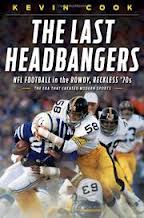
A Review of The Last Headbangers: NFL Football in the Rowdy, Reckless 70’s


Ken Stabler, Terry Bradshaw, “Mean” Joe Green, Steve Bartkowski, Jack Tatum, Jack Ham, Jack Lambert, Bob Griese, Larry Csonka, Franco Harris, Jim Otto, Roy Blount, George Atkinson, John Matuszak and Phil Villapiano gave birth to something in the 70’s that we call the NFL.  They didn’t start the league, of course, but by most definitions it is the premier league it is today based on the sacrifices they, and the many others who played the game, made.

last headbangeIt was an age of sloppy, weather drenched, and poorly maintained fields.  It was an age that involved “legalized” use of steroids, which involved some using horse testosterone that was equivalent in dosage to that which is given to a 1,200 lb. horse before a race.  The result of this is the now well-known ‘roid rage’ that most certainly affected the hits involved in the game.  Steroid usage was so prolific in the game, during these years, that some players admitted that they could tell who was on steroids and who wasn’t by the look in their eyes.

It was an era that not only allowed, but encouraged late hits, hitting receivers in a vulnerable position, and exacting head-to-head hits that caused massive migraines and concussions.  It was an age of stick ‘um, touchdown dances, and toothless, sweaty linebackers that would cause a normal citizen to walk to the other side of the street to avoid them.  It was a game that involved none of the genteel, poetic resonance attributed to the strategic nature of baseball.  Yet, prior to the 70’s, professional football was baseball’s broad.

In the 70’s, Baseball had Reggie Jackson and the Yankees, The Red Machine, the A’s, The World Series, and a tradition so rich it achieved the moniker “The National Pastime”.  The NFL players mentioned above, the Monday Night Football guys, Pete Rozell, Al Davis, Don Shula, and a number of others took professional football from a proverbial backyard sport to the heights of the national stage.  They were so successful that the number two sport is now football’s dejected broad.

GEORGE CARLIN: “Football has hitting, clipping, spearing, blocking, piling on, late hitting, unnecessary roughness and personal fouls. Baseball has the sacrifice.  Football is played in any kind of weather – rain, sleet, snow, hail, mud, can’t read the numbers on the field, can’t read the yard markers, can’t read the players’ numbers; the struggle will continue.  In baseball, if it rains, we don’t come out to play.”

Baseball played well to the prolific sports writer that could artfully and poetically lift its magnificence with an analysis that called upon its rich history and place in American tradition.  It has a subtle strategy that can be brought to life through careful and leaned analysis from a great play-by-play and color commentator team on radio. Newspapers also favor baseball in that they can provide a daily recap of each day’s games in a manner deemed almost inconsequential in other sports.  Football, however, has a special, visual quality that no other sport can match throughout an entire game.  Basketball may provide more visually tantalizing highlights, but the game of football has a more irresistible appeal from start to finish.  “It is for this reason,” writes author Kevin Cook, “that the rise of football occurred in conjunction with the proliferation of television sets across the country.”

This was proven out by a risky move that the NFL and the ABC network agreed upon called Monday Night Football.  What was once a rising sport, became “the” sport, the new national pastime, with dynamic personalities, such as Howard Cosell, selling it to millions.  Monday Night Football also produced the first moment of “must see” TV for one enthusiastic, young football fanatic in a city of Nebraska: “Halftime Highlights”.  Cook details, in his book, that Cosell’s initial “Halftime Highlights” were totally unscripted, and they were “by today’s standards” poorly produced.  Yet, anyone who was privileged enough to watch those 70’s, Cosell highlights, knows the profound effect they had on the game and the national psyche.  Some of us still run imaginary plays, calling them out in Cosell’s staccato.

Football also had one thing that baseball did not: scarcity.  This aspect is not covered in Cook’s book, but I believe it was one of the determining factors in the battle between baseball and football.  Baseball had 162 games, sprint training, the playoffs, and The World Series.  If a team was successful, they could’ve played 176 games a year at that point in history, and that’s a lot of games for one to maintain acute focus.  Baseball did have events; they had opening day; the All-Star game; a few weeks of pennant chase games for those involved; and The World Series, but for the most part baseball was/is basically a six-month marathon.  Baseball is equivalent to NASCAR in one aspect, as my friend said: “In NASCAR, everyone pays attention to the first five laps, and the last five laps, but you talk and eat dinner in between.”  One can forget about baseball for months at a time, in other words, but just about every football game means something.  The NFL only played fourteen times a year for most of the 70’s, seventeen times if one counted the playoffs and The Superbowl.  One game was played on television, on Sunday, between noon and three, fourteen times a year, and then there was Monday Night Football.  We now have Monday Night, Thursday night, Sunday night football, and Saturday night football once the college season is over.  But in the 70’s, the NFL only appeared on Sunday afternoons and Monday nights, and this provided a regular season NFL game an “event” status that baseball, basketball, and Hockey could only dream of attaining..

Author Kevin Cook expands: “It seems to me that things were accelerating so much, we were looking for something faster. The NFL was more the counterculture, more a rock ‘n’ roll kind of sport compared to sedate, old baseball. And I think that’s why it appealed to a generation that was looking for something newer and more exciting. And they found it in football, especially on TV.”{1}

Kevin Cook’s The Last Headbangers provides all of the details of the teams, and their games, that precipitated the rise: The Immaculate Reception; The Dolphins undefeated season, and the games involved in that season; and the instrumental battles between the Raiders, the Steelers, the Dolphins, and the Cowboys.  He also talks about the end of that era with “The Catch” by Dwight Clark in the corner of the end zone against the Cowboys.  The era began with a catch, the Immaculate Reception, and it ended with a catch “The Catch” in Kevin Cook’s narrative.  He talks about how that 49ers offense called the “west coast” offense took advantage of the many rules changes that favored the passing game and changed the game from the sloppy, smash mouth, and run oriented offenses to the clean, crisp, and almost machine like precision that modern day NFL teams have copied, revamped, updated, and instituted in their offensive strategies.

In a broader sense, The Last Headbangers brought a “nothing new” approach to those avid NFL fans who have been inundated with the rich tradition that the 70’s and the early 80’s produced.  ESPN, MNF, the NFL network, and others have all captured these elements hundreds of times before, but Kevin Cook does unearth some nuggets that we longtime fans didn’t know.  Shula’s competition committee, for instance, narrowed the hash marks from the traditional, college width to one they hoped would open up the passing game, but it only allowed running backs more room lateral room, and the running game flourished for a time.  Most football fanatics heard sketchy details about Larry Csonka leaving the NFL in his prime for the WFL, but when he was asked to summarize his tenure in the WFL, Csonka replied: “It was nice to make money playing football.”

On that note, Cook reports that most of the top NFL players of the early 70’s still had to have part-time jobs for their existence, as they only made between $18,000 and $22,000 a year on average.  Number one draft pick Terry Bradshaw had to sell cars in the offseason, and Franco Harris had to hitchhike to games.

It was also fascinating to learn that what drove Bill Walsh to accomplish much of what he did in the early 80’s, as a result of being passed over for the Cincinnati Bengals job by Paul Brown when Brown retired from that position.  Apparently, Brown had been damaging Walsh’s prospects throughout the league by calling every owner in the NFL to tell them that his assistant coach was inept and a trouble maker.  Another thing that Brown informed NFL owners about, a fact we learned from the NFL Channel’s exposé on Bill Walsh, was that Brown believed Walsh was too mercurial to handle the rigors of coaching at an NFL level.  His highs were too high, and his lows were too low.  After seeing what Walsh would accomplish with the San Francisco 49ers, most of these owners probably wish they had never listened to Brown, but Brown’s characterization of Walsh would eventually bear out.

When Walsh was passed over for the Bengals’ head coaching job, and he found out that Brown had muddying the waters for Walsh and his career prospects in the NFL, he was crushed.  Walsh would eventually exact his revenge, of course, by taking two Super Bowl trophies from his former mentor’s Bengals.  The book, The Last Headbangers, also details that Walsh had something of a Noll/Bradshaw relationship with his quarterback Joe Montana that culminated in Montana saying: “(F-bomb) you, you white-haired (person who sucks on … roosters).”

In the promotional interview with NPR for the book, author Kevin Cook talks about the suffering that a lot of the players are now enduring for playing the game, “A friend of mine calls them sport’s greatest generation, because they had an inkling that they were risking their futures.”  When we hear players, like former Rams DE Fred Dryer, say, “I would have to roll off the bed onto the ground in order to lessen the pain enough to be able to walk around for a day.” When we hear former Vikings running back Robert Smith say that he retired prematurely, after seeing the former Houston Oilers’ great Earl Campbell in a wheelchair, and when we read Cook document that some former NFL stars can’t drag a pocket comb through their hair, at the age of 45 or 50, we are forced to realize what these players foresaw and played through.  It’s a point Cook elucidates when he points out the few players, like Franco Harris and Phil Villapiano, that were able to escape prolonged and debilitating injuries in their post-football careers.

The thing is, as Cook’s friend said, these players did “have an inkling” that they were doing long-term damage to their bodies every time they took the field, every time they woke up the morning after and heard a doorbell that didn’t ring, and every time they covered up an injury, because they “weren’t injured they were hurt,” as Don Shula was known to ask the players who groaned on the sidelines that they couldn’t go in for the next play.  Very few twenty something males consider the long-term health consequences of their actions, so it’s debatable whether they considered this or not, but most of we naysayers haven’t put our bodies through a quarter of what they did.

Reliving the moments that made the NFL the premier game that it is today with Cook are thrilling.  The man describes the players, and the plays, with a flair that one cannot help but notice comes from the perspective of a fan.  This is the book’s great selling point for much of the book, but it is its downfall in others.  As Cook warns: “This book isn’t meant to glorify the uglier aspects of NFL football in the 1970s and early ’80s.  The drugs, the booze, the cheating and headhunting, the occasionally seamy sex, and the risks the game posed to players’ health.”  As that statement entails, there is some discussion that will satisfy prurient interests, but there’s not enough.  Don’t get me wrong, I’m not saying a book of this nature must delve into the seedier side of the game to satisfy me, but this book almost seems to respect the game too much.  It doesn’t feel rounded out enough.

The book Sweetness by Jeff Pearlman explored the entirety of Walter Payton’s career.  Some may say it was too negative and disrespectful, but that author complained that those who said such things simply haven’t read the entire book.  The point is that a writer has a duty to report both sides of the story to his readers if he is going to produce a worthwhile book.  We all hate to have our heroes diminished in any way, but a writer can do it in a responsible and journalistic manner to produce material that we didn’t already know, isn’t that why we purchase such books in the first place.  One gets the feeling that Cook saw how the NFL brotherhood ganged up on Pearlman, and he didn’t want any part of that.

Kevin Cook does conclude The Last Headbangers with some reporting, but he does it in an ESPN-style “Where are they now” human interest type stories on Franco Harris and Phil Villapiano.  As with all of those tedious, ESPN-style stories created to fill time, most readers don’t personally care that Franco’s son unsuccessfully ran for office and Phil’s son unsuccessfully trained to make a Division I football team, and we don’t care that Villapiano eventually gave Harris a noogie over the Immaculate Reception.

It is a well done book, and Cook has created a real page-turner for any avid fan of 70’s football, but you do finish the book with the feeling that there is something more to the story than we’re being told.

Would You Eat Someone Somebody Cared About?


Would you eat something someone cared about? Would you eat something someone whispered to sweetly?

On an episode of the brilliant, hidden camera show on TruTV called Impractical Jokers, the comedian Salvatore (Sal) Vulcano assumed the role of a worker at the counter of a bakery. In the course of his duties at the bakery, in an episode, titled “Who Arted?”, Sal spoke to one of the pastries a customer ordered before placing it in that customer’s take home pastry box. The implied joke, in this transaction, was that Sal developed a familiar bond with these pastries that went beyond the usual, professional association a baker has with his creations.

“I’m going to give you to this lady now, and she’s going to eat you,” he whispered to the pastry. In response to the confection’s purported plea, Sal Vulcano added: “I’m sorry, this is just the way things are.”

In reaction to this display, the customer on the other side of the counter, decided that she did not want that particular pastry. She didn’t reveal anything about her decision making process, but it was obvious that she was uncomfortable with the idea of eating that particular pastry. Without saying a word, Sal selected another pastry, and he proceeded to speak to that one too. The woman interrupted him saying:

“I don’t want one that you’ve spoken to.”

At the conclusion of the segment, all four comedians provided comment on the segment, and they admitted that they wouldn’t eat food that someone has spoken to either. Why, was my first question. I have no idea why, all things being similar, a person would prefer a pastry that hasn’t been involved in communication. We can only speculate why, because the show did not interview the woman after the segment, or if they did they did not air it, and the four comedians don’t say why they would reject the pastry either. My guess is that the four comedians wanted to let this woman off the hook. 

freee-range-turkeyIn this space of philosophical confusion, I put the question to a friend. He said that his decision would be based on what the person said to the pastry.

“Okay, but what communication would you deem so unacceptable you wouldn’t eat it? It’s not something we see every day, I’ll grant you that. It might be weird, a little creepy, and I may join you in giving the man an odd look when he does it, but I would then sit and eat it without any uncomfortable feelings or guilt.”

The obvious answer is that Sal’s presentation animated the pastries in a manner that this customer found disconcerting. In her world, presumably, it had always been socially acceptable to eat pastries, and she wanted to return that world. She didn’t want the guilt associated with eating a product that had a friend, or that someone cared about, or at the very least she didn’t want to watch their interaction, or in any other way know about it. She was so uneasy with the association that she made a boldfaced demand that Sal give her another pastry, one that hasn’t been spoken to in any manner, and she did this without acknowledging the lunacy of such a demand.

Proper analysis of the segment is almost impossible, since we don’t know what was going on in this customer’s head, but it appears to be an excellent portrayal, albeit incidental, of an individual who over thinks matters. She appears to be an individual who cares about what others think of her. She appears to be the type who makes informed, compassionate decisions about her dietary preferences. When she watches documentaries on food preparation, we can guess that they affect her dietary choices

An author wrote a book that awarded “light counts” to each being. In this book, the author suggested that some animals are more aware of their existence than another, and that that awareness could be said to be a non-religious soul. Humans, he wrote, are the barometer, as they are the most aware of their existence. In the next tier of his “consciousness cone” he lists the dog, the cat, and various other animals that he considers more aware of their existence. The human is at the top, and the atom is at the bottom. The purpose of his piece, the reader soon learns, is to inform the reader what the author considers acceptable to eat. A plant-based diet is entirely acceptable, for instance, to eat plants, vegetables, and fruit, because they have very few light counts, and little to no soul.

Some have suggested that talking to cats and dogs animates them in a manner that improves their life. Others have suggested that talking to plants can improve their condition. Does this affect the way we care for them, is it all a myth, or are we, in essence, transferring some of our light count to them? What if a human decides to transfer some of their light count to a piece of pastry? Is that possible? Is it possible that this woman believes this on some tangential level, and she prefers to eat a pastry with no light counts attached to them?  

If this woman knows about this multi-tiered philosophy, or thinks about it anyway, we can presume that prior to her interaction with Sal, she was always comfortable eating pastries, because she assumed they had no cognition or awareness of their own being. She is a woman who makes informed dietary choices based on similar compassionate bullet points. Thus, when Sal assigned the pastries such characteristics, it made her so uncomfortable that she asked him to give her one without communicating with it.   

Who would eat something that someone cares so much about? A cad would. Someone who doesn’t care about a person, place, or thing would. They might even worry that doing so could reflect poorly on them if they eat the pastry without a second thought. You’re saying you would eat such a thing without guilt? What kind of person are you? How do we sell ourselves to our peers in the aftermath?

Would we eat a small child’s beloved dog? Most would say no, to quote Pulp Fiction’s Jules Winnfield, “A dog’s got personality. Personality goes a long way.” If we agree with that sentiment, what are our parameters? Would we have any problems eating a small child’s beloved turkey? What if we met that turkey, and that turkey displayed some personality? What if that turkey displayed a little spunk that we couldn’t help but appreciate? What if that turkey befriended another turkey in a manner we found it endearing? What if the bird displayed an act of kindness that left an impression on us? What if it allowed us to fondle its wattle? What if that turkey had a name? How could anyone we eat a living being with a name? What kind of people are we? Would we rather eat a turkey that we’ve never met, that some individual in a factory farm slaughtered and packaged for us? We are informed, compassionate beings who don’t want to see anyone, any animal, or anything suffer, and when an individual does something that suggests they’ve bonded with something we plan on eating, do we consider how much pain that food might go through when we gnash it with our teeth, do we want to avoid thinking about that, and does it challenge what we think we know about light counts, the soul, and overall cognition. 

The different between a quality baker and a top-notch one is the care they put into it. Some top-notch state that they put love into the confections they create. They care about their creations in the manner any other artist might. Sal’s joke might have been a spoof on the love and care some bakers put into their creations, and he did not expect the reaction this woman gave. 

Once that reaction was out there, however, I would’ve been obsessed with drilling down to the woman’s philosophy behind rejecting the pastries to which Sal spoke. I would ask her if Sal redefined her philosophical stance on eating pastries in all the ways described above. If she said yes in any way, I would ask her why she considered another pastry acceptable. If he redefined it for her, wouldn’t that definition apply to all pastries? If she said no to this preposterous notion, I would ask her if she thought Sal transferred some of his soul, some of his light count to the particular pastry that she rejected. What’s the difference? Where is the line? It’s a pastry you say, and a pastry does not have the recognition of its own life in the manner a turkey does. 

If a person has difficulty eating a pastry that someone spoke to lovingly, they may be a little too obsessed with their presentation. They may be as susceptible to commercialization and suggestion as those people they claim to hate. They may take the line, you are what you eat, a little too literally. They may consult websites that contain modern intellectuals who detail who we are by what we eat. They might refrain from eating a pasty, because of what it says about them if they do. They might be so afraid of what is says about them that they cannot sleep at night after taking a bite out of something that Sal appeared to love. Do they think too much, do they have too much time on your hands, and are they a result of the problem or part of it. If this woman was a spectator of the joke, as opposed to the subject of it, would she think less of the person who could eat such a confection without guilt?

How do we make our decisions on what not to eat? Does a vegetarian, or a vegan, make their dietary choices based entirely on a love of animals? Some of the vegetarians and vegans I’ve encountered initially say something along the lines of, “I don’t care for the texture of meat.” Or, they tell a story regarding the moment they made their decision and how they experienced a moment that shaped that decision in some way. Some others will detail for us the health related benefits they’ve explored. All but the very few will openly address anything political about their decision, and even fewer will state that they did it to achieve some level of cultural superiority by becoming a vegetarian or vegan. The minute we deign to put a piece of meat before our mouth, we will learn about their politics on the issue. We will also learn of their feelings of superiority over meat eaters before we learn their last name. If neither of these are the case, or if my experiences could be called anecdotal, why would a seemingly reasonable woman reject a pastry based solely on the fact that a Sal whispered sweet nothings to it before placing it in a pastry box?

If Sal had a Snickers bar perform the Can Can to animate that candy bar in a realistic, non-comedic manner would that woman, a vegan, or a vegetarian, be able to then eat that Snickers bar without regret or guilt? I realize that Snickers bars and pastries are relatively inanimate, but with proper, serious characterization would it be possible to animate them in such a fashion that a person, with susceptibilities to messaging, could be made to feel guilty about eating them? If that was successful, could an enterprising young documentarian launch a well-funded campaign, steeped in political pressure, to lead a segment of the population into avoiding eating Snickers candy bars based on videos about the inhumane manufacturing process involved in the creation and packaging of Snickers bars? With the proper documentarian displaying the inhumane process through which the peanuts and caramel are adjoined with the nougat in a final process that involves what could be called a suffocation technique employed by the layer of chocolate placed over the top, would it be possible to substantiate this cause to a point where a person would not only stop eating Snickers but denigrate those that do and anyone who supports Big Candy to be in line with evil? It’s not only possible, in my humble opinion, the seeds of it were on display in the inadvertent brilliance of this comic sketch on this episode of Impractical Jokers.