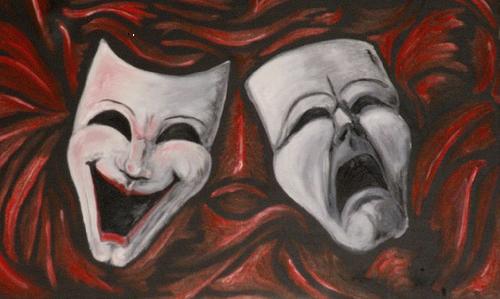
“Tragedy is when I stub my toe. Comedy is when you fall into an open manhole and die.” –Mel Brooks
I’ve never fallen down a manhole, but I have to imagine that it hurts. “Um, yeah,” Mel might say, “That’s what makes it funny.” So, to be truly funny, someone has to get hurt. “Well, you put it like that, it sounds sadistic. It’s not sadistic, it’s human nature. It’s the fuzzy line between comedy and tragedy that dates back to Aristotle and Ancient Greece.”
It might be a little humorous to see a faceless entity falling into a manhole on one of those video montages, but what if we know the guy? Does that make it funnier or more tragic, or is there a middle ground that reveals this unusual relationship between comedy and tragedy? If we find a tragic incident like that funny, what is funny, what’s tragedy, and what’s the difference?
Laughing at other people’s pain is just kind of what we do. We might not want to admit it, but in many cases it’s so funny that when someone calls us a heartless SOB, we can only laugh with acknowledgement. Is it our dark side coming out, or is it just human nature?
I’ve met the opposite, the few, the proud who don’t laugh, because they don’t think it’s funny. They don’t even smile or joke about it later. They’re not virtue-signaling either. They just don’t think it’s funny. One of the few I met was a first responder who she witnessed so much pain and sorrow that she no longer considered even trips and stumbles humorous. What’s the difference between a first responder and the rest of us, they run into a burning building, and we run away. There are very very few who would actually stand outside a burning building and laugh, but seeing another’s worst moment can be so shocking that some of the times we don’t know whether to laugh or cry, and laughter is our go-to. If we worked with tragedy as often as first responders, would it lead to a certain diminishment of this shock factor, or are those who deal with tragedy on a daily basis attracted to their professions because they are inherently more compassionate?
 I’ve never seen someone fall down a manhole, but odds are against them falling clean, in the manner Yosemite Sam does, and most of them aren’t mumbling comedic swear words on the way down either. Most of them fear that they are going to damage something severely by the time they hit bottom, and that fear will probably produce blood-curdling screams. They might not have enough time to fear death, but anyone who has fallen from a decent height knows that it’s scary, and they probably aren’t going to be able to laugh about it for quite some time. The question is will we, the witnesses of the event, be laughing? If we weren’t there, and our only attachment to their incident is their harrowing retelling of the moment, will we be laughing?
If our friend walks away from the fall with some superficial bumps and bruises, that might be funny, but what if he chipped a tooth? What if he took a nasty knock on the head, or broke an ankle? What if his injuries were so severe that he required first responders to free him? Does the severity of the moment, and the eventual injuries, align with the comedy, the tragedy, or does it brush up against our definition of the fuzzy line that we try to erect between the two to try to keep them separated?
Before you answer, think about how you might retell the story. When we tell a story, we might not always be looking for a laugh, but we want a reaction. To get the best reactions, standup comedians advise to always be closing. A great closing involves a great punchline of course. If punchline is the wrong word, how about punctuation, and what better punctuation would there be than adding that the subject of our story was forced to endure a prolonged hospital stay that involved tubes and machines to keep the victim alive? “They’re saying that the nasty knock on the head could leave him mentally impaired for the rest of his life?” That might be extreme, as few would find mental impairment funny, but where is the line or the lines of demarcation that define comedy and tragedy in this matter?
The initial sight of Jed lying at the bottom of the sewer might be funny, unless he’s screaming. What if he’s hurt? How can he not be? We laugh. We don’t mean to laugh. We don’t want to find this funny, but we can’t stop. Some of us might wait to find out if Jed’s okay before we laugh, and some of us might wait until he’s not around, so when we can retell the story of his fall and laugh with others. Most of us will laugh at some point though. It’s our natural reaction to something tragic.
Laughing, or otherwise enjoying, another person’s pain is so common, that the Germans, developed a specific term for it: schadenfreude. Is our laughter fueled by the relief that it’s not happening to us, is it human nature, or is it the result of comedies and comedians molding our definition of what’s humorous by twisting dark, tragic themes into something funny? The advent of slapstick comedy occurred long before we were alive, but I don’t think anyone would argue that comedy has grown darker and more violent over the decades. We now consider some truly brutal acts hilarious. Have comedy writers changed our definition of humor, or are they reflecting the changes in society? It’s an age-old question. Would the Abbot and Costello fan consider it hilarious if someone fell in a manhole, what would the Mel Brooks fan think, or a Will Farell fan? Are such incidents funny in a timeless manner, or have comedians upped the ante so much, and so often, that our definition has darkened with it? Whatever the case is, incidents such as these reveal the relative nature of humor, the fuzzy line between tragedy and comedy, and how we find comedy in others’ tragedies. The purposeful melding of the two even has its own genre now: tragicomedy.
Emergency: Tongue Stuck on Pole
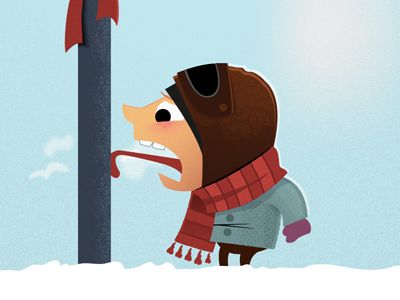 My personal experience with the fuzzy line between comedy and tragedy, didn’t involve falling into a manhole, but licking a pole. I was in the fifth or sixth grade, old enough and smart enough to know better, but young enough and dumb enough to do it anyway on one of the coldest days in February. I wasn’t old enough, or sophisticated enough, to consider the fuzzy, philosophical line between comedy and tragedy, but I knew everyone would be laughing uproariously if they saw me stuck on that pole. I also knew an overwhelming number of my classmates would not share a “Well, at least you’re okay” sentiment when it was over. I knew this wasn’t one of those types of mistakes. I didn’t know a whole lot about human nature, but I knew how much we all crave stories of pain and humiliation, because I did. I laughed harder than anyone else when Andy walked into a pole, and he hit it with such force that the impact broke his glasses in two. I just happened to be in the perfect position to see the incremental progressions of Andy’s instinctual reactions. I saw Andy’s eyes close on impact, followed by the scrunched expression of pain. In the midst of my laughter, Andy’s face turned from pained to embarrassed as everyone else attempted to soothe and coo him back to respectability. Andy’s embarrassed expression focused on me, the only person laughing, and I couldn’t stop. When his embarrassed expression evolved to one pleading me to stop, I just walked away, because for reasons endemic to my evil nature his mental emotional pain proved more hilarious to me than the physical.
Some might call it heartless, others might suggest that anyone who would even smile at such a thing is lacking some levels of compassion, but I think it’s just kind of who were are and what we do to one another, and we don’t always do it with malice either. Some of the times, we laugh because that’s just what we do.
I didn’t stand there and think about all this while stuck in the moment of course. The only things I thought about were how am I going to rip myself free and how much is it going to hurt? When I thought about the physical pain, though, I knew it would pale in comparison to the emotional and mental anguish that would occur soon after someone saw me like that. I ripped my tongue off the pole. I don’t remember exactly how long my it hurt after I ended up ripping several layers of my tongue off, but it hurt so bad that I thought I should’ve given more thought to an alternative. I also thought that even if I went on to accomplish historically great things, and I came back to my grade school to meet my classmates, one of them would’ve said, “Weren’t you the guy who was stuck on a pole when we were kids?”
I’ve since read local news stories of other kids stuck on a pole, and they always include a photo or a video of the kid from The Christmas Story in it. One of these stories involved a kid notifying his teacher, and the teacher, who presumably failed to consider the idea that a warm cup of water could free the kid, ended up calling first responders to set the kid free. I still cringe when I put myself in that kid’s place, and I think of all the people standing around this kid. I cringe when I think about the teachers who would never forget this incident, and while they may have been more compassionate in the moment, they probably couldn’t help but laugh behind a hand every time they saw him. This information would’ve eventually filtered out to the students, because how many times does a big old fire engine pull up to a school, and when it does everyone would want to know why, and someone would find out. The first and last question I’d have for this kid if I ever met him is, what were you thinking?
I have to imagine that this victim was either much younger than I was at the time, or that the severity of his incident was much worse. For if all of the circumstances were even somewhat similar, then I have to ask him why he didn’t just rip themselves free? My empathy goes out to him if he feared how painful that would be, but he had to consider all the ridicule, teasing, and bullying he would endure in the aftermath. Even if he feared the pain so much that he wanted an adult to come along and find a less painful solution for them, I would love to ask him if it was worth it.
Does getting a tongue stuck on a pole compare to falling down a manhole? It does not, when comparing the possible injuries, or other painful consequences, but I would submit that it does when it comes to the probability of embarrassment. I write that because the embarrassment of getting your tongue stuck to a pole has a storied tradition of humor, a tradition enhanced by the movie A Christmas Story. The humor is now an agreed upon universal, further enhanced by the relatively minor, but painful lessons attached to it.
One of the first faces I pictured when I got stuck to that pole was Steve’s. I knew Steve would be waiting with bated breath for any details of my tragedy, and I knew his audience wouldn’t be able to restrain themselves from laughing at his displays of cruel and clever creativity. I didn’t know what nicknames or limericks Steve would develop, but I knew he would develop something. Steve was our class clown, and he was always developing material on someone. I considered all the excruciating pain I experienced in the aftermath of ripping off layers of my tongue off worth it for all the reasons listed above, but most of all I knew Steve wouldn’t have this material on me.
We’ve all heard talk show guests talk about how they were the class clown in their school. We all smile knowingly, picturing them as children dancing with a lampshade on their head and coming up with the perfect sarcastic responses to the teacher that even the teacher considered hilarious. When we hear this, we nod, because we figure he was the class clown, because no one gets that funny overnight. They explain that they discovered an internal need to hear laughter, by whatever means necessary, at a very young age. Those of us who knew a class clown, like Steve, saw some of this good-natured humor, but we also saw what happened when Steve ran out of good-natured and fun material. We all knew the minute Steve ran out of material, he would begin looking around for victims, and I was always one of his favorite targets. Anyone who has spent time around a class clown, or a group of class clowns, knows that their stock and trade involves insults. I didn’t spend ten seconds stuck on that pole, but picturing Steve’s mean-spirited smile, after delivering a dagger that had its tip dipped in this material was the image that consumed me and convinced me that I made the right decision later.
We all enjoy making people laugh, but some of us have a deep psychological need to make people laugh, and they don’t care who has to get hurt in the process. Based on my experiences with class clowns, I can only guess that those who would fashion a career out of it, such that they were so successful that they ended up in a late night talk show chair talking about it, probably learned early on that no matter how you slice it, if someone falls down a manhole, or gets their tongue stuck to a pole, there’s comedy gold in there waiting to be excavated. They may be too young to know anything about the complexities inherent in the symbiotic relationship between comedy and tragedy at the time, but at some point they realized that anyone can get a laugh. To separate themselves from the pack of those vying for the title class clown, those who would use that title to future success in comedy learned that they would have to spend decades learning the intricacies and complexities of their craft, as everyone from the Ancient jesters to Mel Brooks did. They also learned that for all of the complexities involved in comedy, one simple truth they learned in fifth to sixth grade remains, if one wants to go from humorous titters to side-splitting laughter someone has to get hurt.
 Rilaly