“Sorry fellas, I’m just sooo competitive,” Mark said after yelling as loud as he could in a public bar. He yelled because the other team just made a basket to clinch a victory over our team in game we were watching on the television set. His yell temporarily silenced the bar, so I assume his apology was partly genuine and partly based on embarrassment.
Men are biologically predisposed to respect other extremely competitive men, so when he said he yelled because he was “sooo competitive” we felt biologically required to understand. The sticking point for me is that Mark is old. He is a couple generations removed from being so loaded with testosterone that it occasionally boils over the top into the public. He’s so old that employees at Arby’s give him the senior citizen discount without even asking, yet he’s still “sooo competitive” that he can’t control his impulsive need to scream indecipherables at images on a television set.
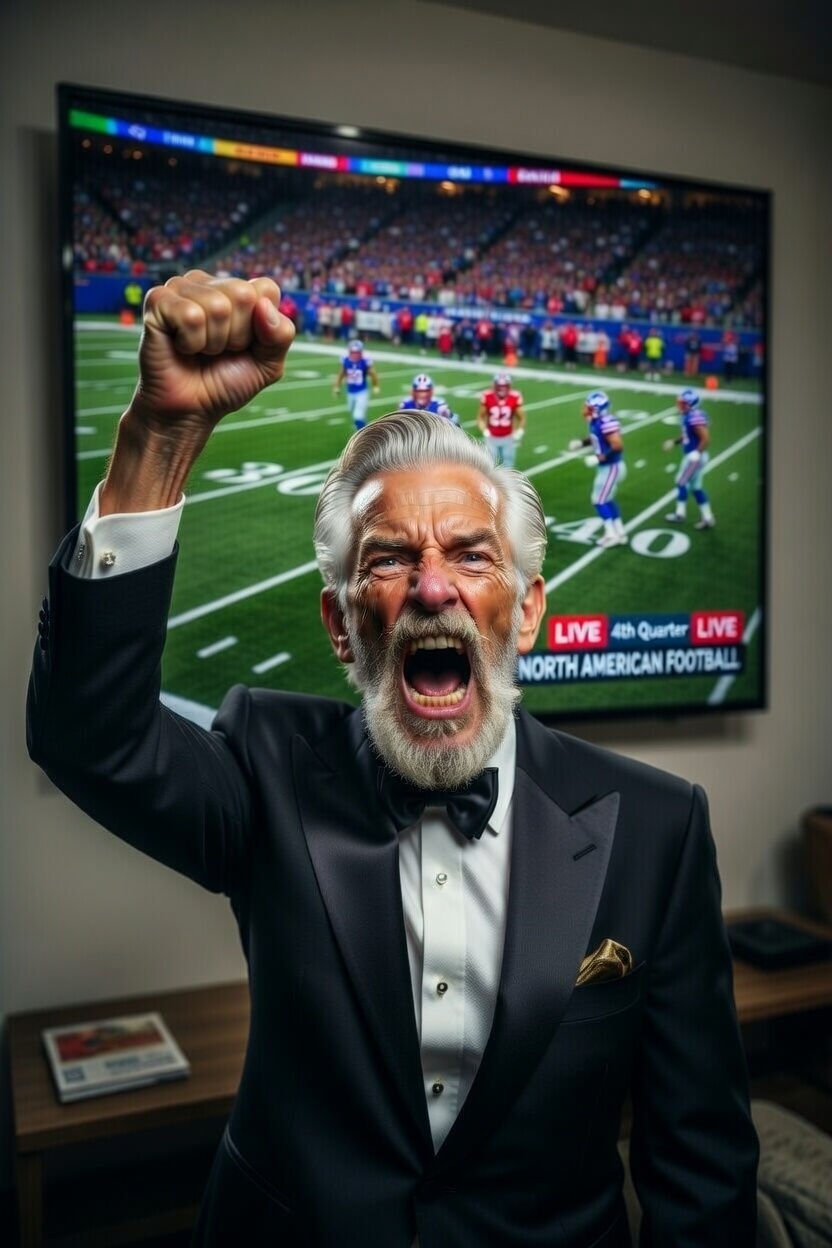 ‘Is that odd, or is it just me?’ I asked myself after Mark screamed. I didn’t care that everyone else acted like Mark just asked for extra cheese on his mashed potatoes, it was odd. I couldn’t accept this as a natural reaction to our favorite team losing. I couldn’t accept it as something we’ve all seen fans do, things I’ve done, so often that it’s become socially acceptable. I’m sure those who dismissed as an extra cheese considered it part of the package we all buy into when we decide to watch a game in public at a bar: We chose your bar to watch our game, we paid your cover charge, and we spent all this money on your alcohol, so if our team loses we reserve the right to scream like a lunatic in your establishment if we lose, because we’re “sooo competitive”.
Not only is Mark old, he’s so well put together. The women I know report that he is a good looking man who knows how to wear a shirt. He’s also well-spoken, successful, and he displays an otherwise healthy, happy demeanor. If we asked long time bar employees to bullet point the typical indecipherable screamer, there would probably be a lengthy, inconclusive list, but we can guess that Mark wouldn’t fit of any of them. Watching Mark do that, opened my mind’s eye to how foolish I must’ve appeared after screaming like an idiot the minute the fellas wearing my favorite laundry, fail to make as many baskets as the fellas in the other laundry.
At this point in my description, Gary, the line cook, would cut me off in a way he often cut me off to suggest I’m taking too long to get to the point: “It’s funny when someone makes an ass out of themselves in public.” It is still funny, and I don’t care how much societal and cultural pressure they apply, we’re still going to laugh when someone acts like that. It’s the ‘it’s funny, get over yourself’ level of comedy that will probably never be entirely vanquished. When Mark screamed like that, he silenced the entire bar of patrons momentarily, as they probably assumed it was a cry for help from someone having a heart attack. If Mark laughed after doing that, comedically implying that he was imitating a twenty-something reacting to a loss on TV, it probably would’ve been humorous. The fact that Mark genuinely had such trouble controlling his impulses that he felt the need to apologize for it, felt like another level of comedy. It felt like a level that unintentionally commented on itself with a sprinkling of irony and cleverness on top.
It is funny when people do foolish things, but when someone does something that informs us what we look like when we do foolish things, it’s a level of comedy that is so funny we don’t laugh or even smile in the moment. It’s a level of comedy that if a professional standup comedian properly deconstructed it and simplified into a three-beat punchline, it could change the manner in which all super sports fans react to soul-crushing losses by their team. The rest of us are better off trying to pretend it never happened, or ignoring it.
 So, I wondered if I accidentally silenced a bar with a loud, obnoxious scream, and they thought I was so old that I might be having a heart attack, would I say something like, “I’m sorry I’m just sooo competitive” as an apology for my over-the-top reaction.
The reaction I did not give voice to was, “Who cares if you’re sooo competitive? You’re not playing, and you don’t have kids playing in this game. No one cares if you’re watching this game with a sense of competitiveness attached to it, or if you’re just watching it passively.” What would I do if someone said that to me following a similar outburst? I would probably consider the idea that I need to seriously reevaluate how I react to watching my teams on TV.
The funny thing is when Mark and I watch our sons play baseball, Mark cautions me about going overboard when I react to my son’s errors. “They’re just kids,” he says. And he’s right, but the young men playing on our favorite basketball team are young enough to be his grandsons.
Any criticism I direct at mark should be asterisked with the notion that he and I are far too similar for my tastes. As I wrote, seeing someone act foolish is funny, but seeing someone mirror the manner in which we’ve acted foolish silences us because we don’t know if our laughter is self-referential, ironic, or a meta moment that circumvents our definition of humorous in a manner that makes fun of us.
I, like Mark, considered it a testament to my character that I refuse to accept mediocrity from the players on my favorite teams. “It says a lot about you that you’re willing to accept just being in a championship game. You should refuse to accept anything less than that ring.” Those are the type of things we super sports fans say to one another, and when I say we, I’m talking about everyone from my inner circle to talking heads on sports shows, to commentators on message boards. We all preach such platitudes so often that they became gospel to those of us watching sports on TV.
“You do understand that I was not playing in that game, right?” is a reply I learned too late in life to use against those who badger me about my team’s failures. I don’t know where I heard that, but I wish I learned it earlier. It would’ve saved me from the emotional turmoil I experience when someone calls me out. Anytime I watch a game, I want my team to win, but I also don’t want to face those who love to badger me when my team loses. I use this line now when some idiot confronts me with the fact that my team “WE” just lost a crucial game, and I’ve just recently added, “And I realized, with about two minutes left in the game, there was nothing I could do.”
Of course I want my team to win that championship game, I want my team to win every single game, but what are we supposed to do when they don’t? What do I do if they do? It turns out, I’m not playing in that game, so it really doesn’t matter what I do, it doesn’t matter what I think, and it doesn’t matter what I punch, who I insult, or what I scream in the aftermath. That score will not change. If you need this therapy as much as I did, repeat after me, “If my team is in a championship game, it’s the team I chose to support that is in there. It’s not me.” Some of us need to create some distance from the “WE” mind meld we’ve created with our favorite teams that nearly exceeds beyond the vicarious enjoyment and misery we experience watching sports. We need to mentally rewrite what we super sports fans say to one another when we’re watching sports on TV. “It says a lot about you that you’re willing to accept that your favorite team is in the championship game. You should want your favorite team to win that championship game.” If you’re on the outside looking in, and you see this article as so obvious that it’s kind of funny that it took us so long to see it, we applaud you for your happy, healthy outlook on watching sports. Some of us take far too long to get there.
I was already about 70% of the way there when Mark screamed indecipherables at the bar, but that episode absolutely clinched in for me that when we’re on the cusp of the senior citizen demographic, we should start to distance ourselves from the “WE” mind meld we have with our team. When the players on our favorite team are all young enough to be our grandchildren, it’s probably time to cut the frayed tendrils of the leash we have on the idea that we’re still a part of the team. “WE” can’t help it, because we’re “sooo competitive.” “WE” love our team so much that when we watch them on the screen “WE” know when we need to run the ball more often, “WE” know when we need to put the ball in the paint more, and “WE” know what everyone else knows … we really need a hit here.” As hard as it is to accept the realities of age, it’s probably time we stop wanting our team to win so badly that we scream gibberish, hundreds of miles away from the players, in a bar of unsuspecting customers after “WE” make a horrible mistake. It’s probably time we accept the fact that it doesn’t really matter how competitive we are while watching sports on TV? We don’t have to accept the idea that second place is good enough, or that our team had a “good” season, a “good” game, but if we have good kids and grandkids, and we’ve lived a great life, the idea that that some kid dropped a ball is no longer going to cause me to scream something in a bar. I honestly don’t remember doing that, but if I did that part of my life should probably be over now.
I did get that “NUTSO!” when one of my fellas “WE” dropped the ball, but I did it in the privacy of my home, and I now see that I did it in conjunction with how satisfied I was with the direction of my life. When things weren’t going as I planned, I was a rager. I never harmed myself or my appliances when watching the methodical destruction of my team, or when playing video games, but I was probably pretty miserable to be around. I scared my dog, and my wife no longer enjoyed watching sports with me. Now that I’m more satisfied with the general direction of my life, I’m finally starting to see how foolish it was that I got SO UPSET!!! over a group of guys young enough to be my grandchildren wearing my favorite laundry, losing a game on a television program. I love sports, always have, always will, but I don’t know if I ever really enjoyed watching sports.
“Ok, but if we’re going that deep into underlying psychology, we could say that screaming about a team losing a game is actually quite healthy,” this sports fan once said when called out for my unreasonable displays of frustration and anger. “As you said, we could probably draw hysterical reactions to matters we cannot control with the dissatisfaction he have with the life we lead that we ostensibly have more control over, but those reactions usually manifest in one way or another. Couldn’t we say that yelling at anonymous figures on a screen, be they characters in a video game or in an athletic contest, is actually a no harm no foul way to vent frustrations in life? It’s better than yelling at the wife, the kids, or the dog. If you think the universe is against you, and your favorite teams, beating the furniture, throwing the remote control across the room, or screaming out in public bars are examples of healthier ways to deal with our frustrations in life, at least when we compare them to the alternatives. If we do it right, it can be quite cathartic to be a silly, stupid sports fan.”
“If you do it alone,” I concede. The cathartic effect is all internal, so you might want to create a man cave, tell your family you don’t want to be bothered for three hours, pour your favorite drink, eat your favorite snack, and surround yourself with inexpensive fixtures to undergo your therapy. Or, you might want to consider a more nontraditional, modern method of watching sports: tape it. I know this violates a number of the commandments of the super sports fans bible, but if you have some issues dealing with your team losing that your wife characterizes as unhealthy at times, tape the game, wait until it’s over, find the final score before watching, and just enjoy watching the victories. This might defeat the whole purpose of pursuing therapy through hysterical tirades, but seeing final scores on a phone amounts to seeing numbers as opposed to the vicarious condemnations of character we experience when witnessing our team’s slow progression to failure. Mistakes and miscues during a game are also a lot easier to deal with when we know our fellas will eventually overcome them and prove victorious.
Needless to say, the reason Mark’s over-the-top reaction affected me so deeply is that if we dismiss the time and place argument, Mark and I are lot more like-minded than I’d care to admit, I admit. We are silly super sports fans who say and do some incredibly stupid things watching sports on TV. The man did give me perspective though, as I now see how foolish I used to be. I thought about some of my bizarre reactions, my hysterical tirades, and about the nonclinical periods of depression I’d go through in the aftermath of a disastrous defeat of my teams on television. The old talk show host Phil Donahue once asked how sports fans do it, “Isn’t it enough to have women break your heart? Why would you welcome more pain into your life?” That probably sounds hyperbolic to non sports fans, but I’ve had sports teams cause me far more pain than women have. Then, after one of my teams finally FINALLY won a championship, I remained purposefully and stubbornly unsatisfied, because I immediately began to focus on next year. If you know a true super sports fan, you know that “Next year” is their refrain. Win or lose, it’s all about next year. We might raise our fist high, scream indecipherables, and maybe cry a little when “WE” win a championship, but if you’ve ever been at a championship-winning table at a bar of screamers, you’ve seen those screams stop and talk about the natural attrition of losing talent, and how “WE” were going to replace them, if “WE” hope to have a chance at a repeat. Then, when “WE” repeated, “WE” wanted a three-peat, and “WE” were miserable when it didn’t happen. Being a super sports fan should be fun and enjoyable, but it’s not if you’re purposefully and steadfastly never satisfied, and you take it as seriously as I did, it can actually make you a little miserable. The only antidote is to understand that you’re not playing in the game, and in sports, no one can hear you scream…if you’re in a public bar that is 897 miles away.






 Rilaly