Drug Legalization: Arguments and Ramifications


Young minds are generally convinced that a drug-filled society is the proper course to pursue, but I think we can all agree that most young people don’t think long-term, and they aren’t equipped to gauge the ramifications of their actions well. Young people are also far more susceptible to group thought, and peer pressure, and the subsequent desire to be cool or hip. Most of the people that fall into the “other” category are not adamantly for legalization or against. They don’t want their kids to have easy access to it, but as long as it’s handled responsibly, they don’t get worked into a lather over the issue. Most of the “other” people are simply waiting for a persuasive argument that convinces them that legalization will somehow benefit society.

ProhiII1) The Debacle Argument. “The War on Drugs has failed …” some will say, and some of them will leave their rebuttal at that.  To which the normal reply would be “… and?”  The implied extension on that answer is, “So, the most prominent action we have taken on drugs was a failure, and we should therefore try nothing more, and finally make the necessary moves toward full legalization.”  This is the opening salvo that proponents for drug legalization usually put forth in their argument to legalize. The logical extension of this argument is that controlled-substances should eventually be available at local retail outlets, and that they should be heavily regulated and taxed in the same manner alcohol is currently heavily regulated and taxed. Each outlet would presumably have to vie for a “controlled substance” license from their local government, and they would receive strikes against them for any violations of those licenses in the same manner such outlets now receive strikes for any violations of their alcohol license. This “War on Drugs is such a debacle, so we should eventually make drugs available at retail outlets” argument is equivalent to saying if one fence didn’t keep the mongoose out, we should just load up the chickens and place them in front of the mongoose’s burrow for easier access.

“Legalizing drugs,” former New York City Mayor Ed Koch once said, “Is the equivalent of attempting to extinguish a fire with napalm.”

2) The Alcohol Argument.  The alcohol argument is, far and away, the most popular counterargument for the pro-legalization crowd.  This argument centers around the fact that marijuana is not as addictive, nor as destructive, as alcohol.  They say alcohol makes you aggressive and angry, but marijuana makes you peaceful and happy, but they have no answer for the idea that just because it’s not as bad, does that mean it’s not bad for the person?  They may calculate the damage that alcohol does to a person, and a society, by citing facts and figures, but they usually have no response to question, “Why would you want to make all those facts and figures worse by introducing yet another mind-altering intoxicant into the open market?”  They simply state that “their” preference for altering their mind is not as bad as the other, and they don’t understand why their preference is still deemed illegal.

As Charles Krauthammer has stated: “The question is not which is worse, alcohol or drugs. The question is, can we accept both legalized alcohol and legalized drugs? The answer is No.”

3) The cost-benefits argument. The cost-benefits argument is the second favorite argument of the legalization crowd. They state that all the evidence that you need to know regarding the failure of the War on Drugs can be found in the accounting books of your local, state, and federal law enforcement agencies. It has cost these agencies billions, in enforcement, that has produced results that can, by any measure, be called a failure. They also state that legalization, by contrast, will provide a boon to federal and state coffers through taxation.

As Palash Gosh quotes in a International Business Times article:

Cato Institute, Jeffrey A. Miron, senior lecturer on economics at Harvard University and a senior fellow at Cato, and Katherine Waldock, professor of economics at New York University, found that “Legalization would reduce state and federal deficits by saving approximately $41.3 billion annually on expenditures related to the enforcement of prohibition. Of those savings, $25.7 billion would accrue to state and local governments, while $15.6 billion would accrue to the federal government.

“Legalizing would also free up cops spending time arresting drug offenders.”

The Drug Enforcement Agency’s (DEA) response to such facts and figures is:

“Ask legalization proponents if the alleged profits from drug legalization would be enough to pay for the increased fetal defects, loss of workplace productivity, increased traffic fatalities and industrial accidents, increased domestic violence and the myriad other problems that would not only be high-cost items but extremely expensive in terms of social decay.”

Legalization proponents would probably say that these DEA facts and figures are arbitrary, and not quantifiable, and that they’re subjective to the argument against legalization.  If that is true, and we remain focused purely on economic figures, one would have to say that there is some merit to the argument that legalization could be a financial boon for state and federal governments.  Pro-legalization proponents rightly say that incurring such revenue could, by extension, retire the debt government agencies are now experiencing, and most of us would have to cede that point in the argument if it were followed by an asterisk that was footnoted with: “All other factors being equal or held constant.” The reason that such an asterisk would be necessary is that all other factors would not remain equal, or be held constant, in the aftermath of legalization, if the representatives, in our federal and state governments, were to remain constant.

If current federal and state coffers saw this boom of billions, they would increase their spending habits accordingly. It’s entirely possible that we could experience a boon for a couple quarters, or even a year, that resulted in surpluses and balanced budgets. If the representatives remained the same, however, they would find ways to allocate this “marijuana” money, until we eventually ended up in the same financial situation they are in today. Giving these representatives more money, to resolve the problem of their irresponsible spending, is equivalent to giving a heroin addict more heroin to cure their addiction.

Miron and Waldock’s final line also suggests that by legalizing drugs, “we would free up cops spending time currently arresting drug offenders.”  This implies that drug dealers simply made a career choice, at one point in their lives, to deal drugs, and if we legalize marijuana, cocaine, and heroin, this will prompt these dealers to simply move onto another career in, say, animal husbandry, dental assistance, or the numerous opportunities currently being offered at the Devry Institute.

Their final line suggests that those in the drug world are arbitrarily defined as criminals by a screwy law, and that there isn’t a violent subculture in the drug world that attracts violent people to it, and that legalization will change their nature in a manner that will remove them from the criminal logs, and free up finances and time for law enforcement agencies to pursue real criminals.

Drug dealers do not deal drugs based on a career choice, an ideological belief in the virtues of their drug of choice, or the fact that they found a niche in the marketplace that no one else in their area managed to capitalize on. They are dealers because it’s an easy way to make easy money. To suggest that the problem of drugs in America is more about antiquated, silly laws on the books, than the people getting arrested, is short-sighted.

Speaking to a Congressional subcommittee on drug policy in 1999, Donnie Marshall, then deputy administrator of DEA, said, “There is “a misconception that most drug-related crimes involve people who are looking for money to buy drugs. The fact is that most drug-related crimes are committed by people whose brains have been messed up with mood-altering drugs.”

Drug dealers may no longer be considered drug offenders, if the product they sell is eventually legalized, but that doesn’t mean that they will stop breaking the law, or eating up valuable time and resources that law enforcement agencies currently expend policing those that break current drug laws. All of the time, money, and resources currently being devoted to drug enforcement would have to be reallocated to all of the crimes that occur as a result of increased drug usage and addiction after legalization. Put bluntly, all of the gains that law enforcement agencies see as a result of legalization would be wiped off the books with all of the unforeseen consequences of legalization.
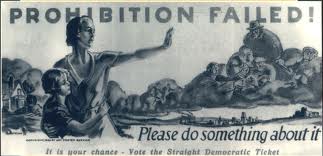
prohibitiom4) The Prohibition Argument. Some “legalize” proponents suggest that the current climate in America today, regarding crime and enforcement, is equivalent to America’s attempt to prohibit use of alcohol during Prohibition.

“Didn’t Prohibition result in more crime though?” drug legalization proponents will ask. Wasn’t Al Capone created by Prohibition, and weren’t numerous black markets created, and didn’t Prohibition result in widespread criminality that ended once we ended the “Great Experiment” of Prohibition? Weren’t homicides reduced, and wasn’t the reach and power of Organized crime syndicates, that sprang out of the market created by Prohibition, reduced once we ended it?

Most of the arguments that use Prohibition, and the Volstead Act, to bolster their argument for drug legalization, pick and choose specific statistics to bolster that argument, but they usually stay general when illustrating Prohibition’s general lack of success.

As a New York Times opinion piece, written by a professor of criminal justice at Harvard’s Kennedy School of Government Mark Moore, in 1989, points out:

“Close analyses of the facts and their relevance, is required lest policy makers fall victim to the persuasive power of false analogies and are misled into imprudent judgments. Just such a danger is posed by those who casually invoke the ”lessons of Prohibition” to argue for the legalization of drugs.”

Alcohol consumption declined dramatically during Prohibition. Cirrhosis death rates for men were 29.5 per 100,000 in 1911 and 10.7 in 1929. Admissions to state mental hospitals for alcoholic psychosis declined from 10.1 per 100,000 in 1919 to 4.7 in 1928. (Editor’s note: Prohibition, or the Volstead Act, was in place between 1920 and 1933.)

Violent crime did not increase dramatically during Prohibition. Homicide rates rose dramatically from 1900 to 1910 but remained roughly constant during Prohibition’s 14 year rule. Organized crime may have become more visible and lurid during Prohibition, but it existed before and after.

Following the repeal of Prohibition, alcohol consumption increased. Today, alcohol is estimated to be the cause of more than 23,000 motor vehicle deaths and is implicated in more than half of the nation’s 20,000 homicides. In contrast, drugs have not yet been persuasively linked to highway fatalities and are believed to account for 10 percent to 20 percent of homicides.

Prohibition did not end alcohol use. What is remarkable, however, is that a relatively narrow political movement, relying on a relatively weak set of statutes, succeeded in reducing, by one-third, the consumption of a drug (alcohol) that had wide historical and popular sanction.

The real lesson of Prohibition is that the society can, indeed, make a dent in the consumption of drugs through laws. There is a price to be paid for such restrictions, of course. But for drugs such as heroin and cocaine, which are dangerous but currently largely unpopular, that price is small relative to the benefits.

5) The libertarian argument. If the most influential minds of the libertarian movement, John Stossel, Ron Paul, and the late William F. Buckley are/were for legalization, how can any self-respecting libertarian be against legalization?  If you listen to their arguments, you have to maintain the belief that if a person wants to destroy their life, they should have the freedom to do that.

I agree with this, in theory.  I agree that what you do in the privacy of your own home should be nobody else’s business.  I agree that we should pursue decriminalization.  Even in a ‘decriminalized’ state like Nebraska, I would not be against further decriminalization, but there is an arbitrary line in the sand to be drawn where moving towards full legalization begins to harm society.  There is a point where the user becomes the abuser, and he’s not only affecting himself, but those in his home, his neighborhood, and the rest of society.  If a user could use, and only destroy his life, then I would be all for it.  It’s difficult to be enthusiastic about the destruction of a human being, in this sense, but if we’re going to have a society built on individual freedom, there is a price to pay for it.

6) The Medical Marijuana Argument.   

An article from Police Chief Magazine listed an article in which the Drug Enforcement Agency (DEA) stated that the “Clear weight of the evidence is that smoked marijuana is harmful. No matter what medical condition has been studied, other drugs have been shown to be more effective in promoting health than smoked marijuana.” They also believe that many proponents of the use of medicinal marijuana are disingenuous, exploiting the sick in order to win a victory in their overall fight to legalize drugs. The DEA cites the fact that marijuana has been rejected as medicine by the American Medical Association, the American Glaucoma Society, The American Academy of Ophthalmology, the International Federation of Multiple Sclerosis Societies, and the American Cancer Society.{3}

What the DEA is basically saying is that the entire medical marijuana movement is a ruse that has preyed on a compassionate society that wants to do whatever it can to prevent any of her citizens from suffering.  It has been rejected as medicine by all the largely non-political groups listed above, and it has been rejected as the optimal agent in promoting greater physical health. Other studies have suggested that it does have some pain relieving agents, and that provided the movement a loophole through which some forms of legalization to those that received all of the various, and in some cases laughable, prescriptions.

Ramifications of Legalization

The one ramification that the pro-drug legalization crowd doesn’t factor into the equation is the influence that corporate America, the Food and Drug Administration (FDA), and the Internal Revenue Service (IRS) would eventually have on these products were they legalized.

This is the realization that would probably have hip, young people, and hippies, pausing in their celebratory leap soon after legalization. For, if these controlled substances were legalized, as opposed to decriminalized, the government, and corporate America, would take control of the manufacturing process, the distribution, and the sale of the product. Most of this process would fall under the FDA’s purview. The compromise that led legislators to voting for legalization would surely require that the FDA set guidelines, and standards, so high that they could only “safely” and legally be handled by major corporations. The IRS would then step in and set taxes on production that are so high that the little guy could no longer compete. The little guy would probably still try to have a foot in the process, but they’d be hit by fines, and probable incarceration, that would result from selling the products without FDA and IRS stamps on them. These fines and incarcerations would no longer come from the DEA, or the various local law enforcement agencies, in other words, but the little guy would still be fined and incarcerated. It would just be other agencies complicating their sales with other charges.

At some point in the process, the influence of the FDA, the IRS, and corporate America, could push the demand to a point where the products are priced out of the budgets of the low income individuals that currently enjoy it, and only the affluent can afford it. It’s probable, at that point, that a black market would rise out of these ashes, and we would all be back in the exact same place we’re in today?

For those that claim that this piece provides evidence of a 180 degree turn from prior positions put forth in previous blogs, I can only write that if you live long enough, and read enough information on a given topic, you’ll inevitably find that you were wrong about a lot of things.  The empirical, and semi-empirical evidence I have found, and in some few cases witnessed, is simply too overwhelming compared to the adversarial reviews of the same information.  The adversarial reviews of the same information provide provocative strains of thought, based in equivocations and anecdotal information, that are appealing in the manner in which they counter traditional views on the subject.  This “What your parents don’t know” form of confirmation bias is very appealing to young people seeking to form an identity that stands in direct contrast to their parents, as it was to me.  As appealing as these arguments are, for all of the reasons outlined in this article, they don’t answer the questions regarding the destruction these controlled substances can have on the individual, the locales that legalize them, and society in general in a convincing, objective, and comprehensive manner.  Until that argument can be made, most of the quiet majority will probably remain quietly against total legalization.

Other reading: Most uses of medical marijuana wouldn’t pass FDA review, study finds

Here’s What Science Says About Medical Marijuana

Sons of Anarchy, and the war of words on violence in the media


What would cause a forty-seven year old man to become so enraged that he regresses back to his high school days, and his favorite high school swears, by calling another grown man “a f***ing douchebag”?  What would cause a seemingly brilliant mind —a mind that created six seasons of a highly rated television show— to become so desperate in an argument against a critical opponent he calls them “an idiot that is idiotic, unintelligent, not bright, and an angry white guy with an exclusionary plan, using fear and (G)od to spread a gospel of ignorance?”  What would then cause other men —men purported to be respected in the mainstream— to read such a letter and regard it as “widely respected”?

Founder of the Parents Television Council (PTC), and current Media Research Center (MRC) member, Brent Bozell, and Sons of Anarchy creator, and primary screenwriter, Kurt Sutter engaged in a war of words regarding the violent nature of that show’s September 10, 2013 season premiere for its sixth season. 

BZFBrent Bozell claimed, in a Fox Nation piece, that the show’s premiere was gratuitous with it’s depiction of violence.  Some of the scenes, that Bozell catalogued from the show include, a Columbine-style “School shooting, ‘milking a fictional Catholic school shooting for commercial gain,’ as well as two rapes, and a man drowning in a bathtub of urine.”{1} Sons of Anarchy creator, primary screenwriter, and showrunner, Kurt Sutter, claimed that he didn’t include any of those particular violent scenes for shock value, and Bozell responded to that, and a war of words was born.

Most of the back and forth that occurred between these two doesn’t interest me.  I’m not overly concerned with Bozell’s greater, moralistic fears for society, or the role of Michelle Obama in this matter… or any other matter.  I also don’t think Sutter’s “widely distributed, widely read, and widely praised” letter was effective, but the reason I deem this exchange newsworthy is Brent Bozell’s attempt to dissect the motivations for making violent TV shows today, by using Sons of Anarchy as a focal point for that argument.

Sutter wants people to believe that the larger plot point was how the biker gang, in this series, is going to (slowly, over many episodes) reap the consequences of their gun-running.  But we know what the “bigger objective of the episode” is: “Ka-ching.”  You load as much sensationalistic sludge in your debut episode to build some ratings momentum.  The “narrative arc” that follows may try to make some sense of that avalanche, but it doesn’t justify it.” 

The fact that the narrative arc may not ever justify the inclusion of violence is true, but for many of us that just doesn’t matter.  Most of us don’t care what happens in the aftermath of such scenes.  We don’t care if there is a greater moral message, or if the character learns from his depravity, we just want the scenes.  We want to rubberneck on that interstate accident to see that guy’s leg sticking out of the car, every night, in primetime, and in the comfort of our living room. We want to see a Mr. White cut off a policeman’s ear, as happened in the brilliant Reservoir Dogs, to speak into it.  He cut off the cops ear and said stuff into it.  Suh-weet!!!  What happened to Mr. White in the end?  Did he learn from his malfeasance?  I honestly don’t remember, because I don’t care.  We want to see blood fly, and we want to see the perpetrators of the violent act walk away like it’s just another manic Monday.  This, as Mr. Christopher states in the quote below, is what is called “torture-porn”.  Writers know all about torture-porn, as do screenwriters, and everybody that’s into this type of fiction, but it doesn’t advance their agenda to talk about it in this manner, so we don’t.  We call it art, we defend it as art, and we expect our audience to define it as art regardless how far down the pole we slide.

 (Sons of Anarchy) began as a well-produced, white-washed examination of morally ambiguous bikers,” writes Tommy Christopher for Mediaite, “But it has devolved into melodramatic torture-porn.”{2}

As Mr. Christopher alludes, most creators/show runners have one, maybe two, and possibly three seasons of a television show, in mind even before the production of the first season begins.  They have it all logged in what is called a show’s bible.  That bible contains tight scripts, motives for actions, reactions, characters, characterizations, beginnings and endings, and anything and everything showrunners can think of to pitch to the networks then make what they hope to be a great show.  If they are lucky, and that term may be considered relative over time, and their show gets renewed a couple times, the showrunner begins to realize that the material in his bible is finite.

Most showrunners don’t plan on making a season six when they begin.  They can’t.  They have to take it day by day, and season by season.  It’s the nature of the business.  If a showrunner is lucky enough to have a season six, one cannot blame them for feeling some desperation, and some pressure, be it external, or internal, to create a sixth season that is as great as his first or second.  The first couple of seasons of tight scripts that the showrunner pined over for years, and in some cases a decade, are gone, and they’re left with months to produce cutting edge material that keeps them atop the hip, cutting edge, cut-throat world of TV.

One has to guess that in place of those tight narratives, Sutter chose to supplant them with torture-porn, and murder-porn, scenes that kept his show cutting-edge and popular.  One has to guess that there was great deal of pressure on Sutter to make this season’s premiere the greatest ever made, just as there is immense pressure on every writer to do it, and possibly overdo it every time out, until “it” hopefully becomes unforgettable.  If Sutter were not under such pressure from the network, and their advertisers, one would think that Sutter would have been able to shrug off Bozell’s charges better, and say that the man doesn’t know what he’s talking about.  Sutter’s juvenile attack on Bozell, suggest that Bozell must have nailed Sutter’s motivations so well that Sutter had no defense for it.

The You-So-Stupid defense

“I would imagine these (PTC and MRC members) are not evil people,” Sutter says, in an attempt to be sardonic.  “But they are just not very intuitive or intelligent individuals.  It’s such a small and simple view of process.  The fact that people want to be monitoring what my children watch is terrifying.  There is no awareness of what is the bigger objective of that episode is, the bigger point of the narrative.”{3}

It’s not complicated, I would counter and Mr. Sutter knows it, and that’s what makes him so sensitive to Bozell’s charges.  Sutter wanted to have provocative, cutting-edge, timely, and popular scenes.  He got eight million viewers.  Do you know how many showrunners would kill for eight million viewers?  You did it Mr. Sutter.  Quit trying to make it seem more complicated than it is.  You won!?

Bozell countered Sutter’s charge:

“(Sutter and his team) are getting paid millions to offend as aggressively as they can possibly imagine.  They have nothing to discuss but their own “intelligent and intuitive” work and how outrageously hip they are.”

OUCH!  Placing myself in Sutter’s shoes —as a creative writer that writes scenes that are violent, based on the numerous violent scenes that I have enjoyed in fiction, movies, and TV— I have to say that Bozell’s insightful condemnations would wreck me.  I like to think that I’m a creative, intuitive, and intelligent writer, but when someone takes away my ammunition as thoroughly as Bozell did in two sentences, I would probably start making mean faces and throwing spitballs too.

The Censorship Defense

“Whenever that stuff crosses the line into censorship, it’s just scary … I’m not a social guru, I’m not a guy with an agenda politically, socially or morally.  I’m a f***ing storyteller.”

Most artists misuse the word censorship when someone criticizes their work.  It’s their desperate attempt to thwart criticism, for in the truest definition of the word, Bozell is not capable of censoring Sutter.  Bozell does not work for a government agency, he does not work for Sons of Anarchy in any manner, or for the network that airs it, and he does not have any direct pull with their advertisers.  He is simply acting as a critic, in the manner Brent Bozell has always offered criticism.  Anyone that pays attention to Brent Bozell knows who he is, and how and what he critiques.  If you don’t like him, don’t read him.  When Robin Williams denigrated religious preachers, was he censoring Jerry Falwell, or was he a righteous dude?  In this game, it all depends on which side of the stadium you’re sitting on.

The Start-A-Debate Defense

At one point, Mr. Sutter claimed that he just wanted to “start a debate” on the topics covered in the show.  He obviously picked that “start a debate” card out of the politician’s excuse hat that contains the cards “start a dialogue,” and “start a conversation”.  The problem with using such a line is that some of the times an actual debate breaks out, and you might encounter someone that takes the other side of that debate.  It appears that the debate that Mr. Sutter wanted to start was one that he was entirely unprepared for, and he was left with nothing more than personal attacks and swears.

The aspect of this debate that is utterly confounding is that anyone that reads Bozell’s actual blog on this topic, will probably have to re-read it about five times to figure out how this relatively benign criticism sent Sutter on such a tear.  You’ll wonder how such a relatively benign criticism could cause a forty-seven year old man to lose his mind and write a letter that calls another grown man a “Pathetic, f****ing douchebag.”  I’m not sure what school of thought Mr. Sutter currently calls home, but having nothing left but juvenile names and petty accusations says more to me about Mr. Sutter than it does Mr. Bozell.

In his letter, Sutter writes that Bozell is an “idiot” and his organizations are “idiotic”.  He claims that Bozell is about nothing more than his agenda, that is “desperately trying to create a lobby”, and that Bozell and “his hate club are flaccid and impotent”.  Sutter writes that Bozell is: “Not very bright, (that Bozell’s) message is archaic, and loving parents can innately sense that the PTC has no heart and no real interest in the betterment of children.  You reek of McCarthyism and holy water.  And right-minded folks can smell you coming a mile away.”  He writes that Bozell is “just an angry white guy with an exclusionary plan, using fear and god to spread a gospel of ignorance.”  Sutter then concludes his letter with: “I bet your kids hate you.” {4}

In a piece for the Washington Free Beacon, Sonny Bunch claims that this Sutter letter was: “Widely distributed, widely read, and widely praised.”{5}  I know that it’s written to denounce a conservative, and I’m sure that those on the receiving end of these distributions hate conservatives, but I’ve tried to read this “widely praised” letter with objectivity, and I can’t understand how anyone would consider it a “gotcha” moment for Mr. Sutter to celebrate.  It reads like a letter a teenage boy would send to a girl that just dumped him, and it makes the reader want to take Sutter aside and say, “There are other fish in the sea.”  Adolescent rage are the only words that come to mind when I read Sutter include “idiot” and “idiotic” in the same sentence.  When he criticizes Bozell’s attempts to lobby professionally, it sounds like the raging, teenage boy is trying to find the perfect punctuation to the letter, along the lines of, “and I hope that you don’t make the pom pom team either.”

I don’t understand why Sutter didn’t just let it go.  I don’t understand why Sutter didn’t just say, ‘Bozell is a religious, conservative, and he’s not my demographic, and the only people that read his column are religious conservatives.’  I don’t understand why he would want to give Mr. Bozell’s opinions more airtime.

At this point in the overall debate of artistic content, so many provocative artists have defended themselves in so many ways, that all of Mr. Sutter’s defenses now sound like clichés.  Sutter could’ve tried the “reflecting a culture” response that rappers give, but even that has become a cliché at this point.   He could’ve tried turning the responsibility back on the parents, with the cliché: “Hey, it’s their job to watch what their kids are watching not mine.”  The only response that is not cliché, and the one I would use if I had eight million viewers, is, “People watched it.  Scoreboard!  I provide a product in the same manner Budweiser provides a product, or Coke, or Hostess.  It may not be good for you, or the culture, as Bozell puts it, but that is a decision each household has to make.  That is what the free market is all about.”  The only thing that would prevent me from doing an “Eight million viewers” touchdown dance would be if I had some sort of insecurity about the material I created that attracted eight million viewers.

Bozell wrote: “The (FX) network and the “creative team of Sons of Anarchy” are getting paid millions to offend as aggressively as they can possibly imagine.”

This line, more than any other, probably provoked Sutter, because it called to mind all the pressure Sutter felt to do it, and overdo it, with more shock, and more violence than he had included before.  I’m sure he felt personal, and professional pressure to equal, and possibly top, the progression that began with Goodfellas, moved to Reservoir Dogs and Pulp Fiction, to The Sopranos, and finally to Breaking Bad, and that he hoped to carve Sons of Anarchy a niche somewhere in that lineup.  Judging by Sutter’s vitriolic response, I’m guessing Sutter feels he fell short, and Bozell’s commentary only intensified that feeling.

When Sutter tells you it’s not about the shock, I can tell you –as a writer of violent crime fiction– that it’s all about the shock.  To paraphrase Bret Easton Ellis, I try to write something that will shock my friends, and my friends are pretty jaded.  All the movies and shows listed above have jaded us, and we are always on the lookout for our own progression in that line.  We love to shock, we live to shock, and we probably wouldn’t be writing today if it weren’t for those inspirations shocking our sensibilities into this direction.

I would not be interested in writing a story about a quirky family in New Hampshire that happens to live in, and own, a Hotel.  All the power to John Irving, one of the greatest living writers, but that ain’t me.  I would love to achieve the fame, and sales, of The Bridges of Madison County, and Tuesdays with Morrie, but I’ll never write stories like those.  I need a little violence in my stories, to be intrigued.  I need a lot of violence to be interested, and I need this violence to reflect a culture that has the perpetrators walking away from these extremely violent scenes like it’s just another manic Monday.  I am not a violent person, but I think those movies listed above were monumental, and influential.  All of them bordered on being gratuitously violent, in a manner that shook my foundation and my fundamentals, and after viewing them, I decided that I wanted to write the progression, and I’m sure that it was Sutter’s goal too.

The problem with being this open and honest about your intentions, or your agenda, is that you’re allowing others to see your intentions, and your agenda, and that somehow minimizes your intentions, and your agenda in a manner that makes them too apparent.  If an author has a violent scene that is cool, very few of them will say that they just wanted to write a violent scene that was cool.  They’ll tell you that the character, and the plot, are driven by a myriad of complications that will become clear when the narrative arc reaches its climax.  Yet, if you watch these shows, and movies, as often as I do, and you read ‘the complications to come’ interviews from their author, you find that more often than not, it was all about the shock and awe of writing violent scenes that were cool.  You can’t say that though.  Saying things like that makes you feel too much like a carnival barker trying to get patrons to take a look at the bearded lady, and the problem with that is that there might be some critic that comes along and says it’s just another bearded lady, and you’re just another carnival barker.

{1}http://nation.foxnews.com/2013/09/21/bozell-newtown-amnesia-hollywood

{2}http://www.mediaite.com/online/brent-bozell-is-right-something-should-be-done-to-keep-kids-from-watching-sons-of-anarchy/
{3}http://newsbusters.org/blogs/brent-bozell/2013/09/19/bozell-column-newtown-amnesia-hollywood#ixzz2hztXmyLo

{4}http://www.mediaite.com/tv/youre-a-pathetic-fcking-douchebag-sons-of-anarchy-creator-goes-off-on-conservative-activist/

{5}http://freebeacon.com/blog/brent-bozell-kurt-sutter-and-cultural-relevance/

James Joyce: Incomparable or Incomprehensible?


Those of us who are always on the lookout for edgy, racy content have heard the term “Joycean” thrown about with little discretion over the years. If you’ve heard this term as often as I have, you’ve no doubt asked, what does it mean to be “Joycean”? To listen to critics, it can mean whatever you want it to mean? They appear to be more interested in using the term than using it properly, but how do we use it properly? What does “Joycean” mean? If James Joyce were still alive, we would love to ask him if his last two books were two of the most erudite, most complicated pieces of fiction ever written, or were they a great practical joke you played on the literature community to expose reference makers and elitist, scholars for who they are?

James Joyce
James Joyce

Readers who seek to up their erudite status by reading “difficult” books, have all heard of Joyce’s final two works of fiction: Ulysses and Finnegans Wake, as literary scholars list these books as some of the most difficult, most complicated works of fiction ever created. Those of us who were intrigued, decided to pick them up that as a challenge of the mind, others attempt to read them to gain entrance into their subjective definition of elite status. Most are confused and disoriented by the books, but some have the patience, the wherewithal, and the understanding of all of the references made, and languages used, in these books necessary for comprehension. Those readers either deserve a hearty salute, or the scorn and laughter that Joyce provided, as a gift to the havenots, who are honest enough to admit that they don’t know what was going on in them. Was Ulysses such an ingenious book that it’s worth all of the effort it requires for greater understanding, or was it a book about nothing?  

I don’t understand either of these books, and I have gone back numerous times to try to further my understanding. Some have said that Ulysses is the more palatable of the two, but I have found it too elliptical, too erratic, and too detail-oriented to maintain focus, and I have purchased three different aides to guide me through it. Some of the readers who claim to enjoy Ulysses, admit that Finnegans Wake is ridiculously incomprehensible.

Most people enjoyed Dennis Miller’s tenure as an announcer on Monday Night Football, but most of those same people complained that they didn’t understand two-thirds of the man’s references. I didn’t keep a journal on his references, but I’m willing to bet that at least a third of them were Joycean in nature (Ulysses specifically). Miller stated that his goal, in using such obscure references, was to make fellow announcer Al Michaels laugh, but any fan who has followed Miller’s career knows that he enjoys the motif of using complicated and obscure references to make himself sound erudite. There are, today, very few references more obscure than those that recall the work of James Joyce, a man who described his last book, Finnegans Wake, as “A book obscure enough to keep professors busy for 300 years.”

Andy Kaufman referenced James Joyce when trying to describe his method of operation. The import of the reference was that Kaufman wanted to be a comedian’s comedian, in the manner that Joyce was a writer’s writer. Kaufman wanted to perform difficult and complicated acts that the average consumer would not understand, and the very fact that they didn’t “get it” was what invigorated him. He wanted that insider status that an artist uses to gain entrée to the “in the know” groups. After achieving some fame, audiences began laughing with Kaufman in a manner that appears to have bored him, and he spent the rest of his career trying to up that ante. By doing the latter, we can guess that there was something genuine about Kaufman’s path in that he was only trying to entertain himself, and his friends, and if anyone else wanted on board that was up to them. Joyce and Kaufman, it appears, shared this impulse.

Anytime an artist creates a difficult piece of work, there is going to be a divide between the haves (those who get it) and the havenots. When Mike Patton formed the relatively obscure band Fantomas, he never did so with the illusion that he was going to unseat the Eagles Greatest Hits, or Michael Jackson’s Thriller, atop the list of greatest selling albums of all time. He knew that his group would playing to a very select audience.

What is the audience for such difficult subject matter? Most people seek music, as either background noise, something to dance to, or something to which they can tap their finger. Most people read a book to gain a little more characterization and complication than a movie can provide, but they don’t want too much characterization, or too much complication. Most people only buy art to feng shui their homes. Most people don’t seek excessively difficult art, and those who do are usually seeking something more, something more engaging, and something more provocative that can only be defined by the individual. The audience who seek something so different that it can be difficult generally have such a strong foundation in the arts that they reach a point where their artistic desires can only satiated by something different.

Yet, different can mean different things at different times to different people. Different can be complicated, and discordant, but it can also be limited to style. At this point in history, it’s difficult to be different, in a manner that cannot be called derivative of someone or something, so some people seek any separations they can find. When the latest starlet of the moment twerks in a provocative manner, has a construction worker find her pornographic video, or accidentally has her reproductive organ photographed, we know that these are incidents were created by the starlet, and her people, to get noticed after they have exhausted all other attempts to be perceived as artistically brilliant and different.

There are other artists who are different for the sole sake of being different. This is often less than organic, and it often disinterests those who seek a true separation from the norm, because we feel that this has been thoroughly explored to the point of exhaustion. Andy Kaufman created something organically different that can never be completely replicated, in much the same manner Chuck Palahniuk, Mike Patton, David Bowie, Quentin Tarantino, and Jerry Seinfeld and Larry David did. Can it be said that James Joyce’s final two books were different in an artistically brilliant, and cutting edge manner that all of these artists’ creations were, or were James Joyce’s writings more symbolism over substance? Put another way, was Joyce a substantive artist who’s true messages need to be unearthed through careful examination, or was he simply twerking in a provocative manner with the hope of getting noticed by the elite scholars of his generation after exhausting the limits of his talent in other works?

Judging by his short stories, James Joyce could’ve written some of the best novels in history. Those who say that he already did, would have to admit that his final two works were not overly concerned with story, or plot. Those who defend his final two works would probably say that I am judging Joyce’s final two works by traditional standards, and that they were anything but traditional. They would probably also argue that the final two works sought to shake up the traditional world of literature, and anyone who dared to take up the challenge of reading these works would probably say Joyce sought to confound us, more than interest us, and if they concede to the idea that the final two works were different for the sole sake of being different, they would add that he was one of the first to do so. Those who defend his final two works say that they are not as difficult to read, or as complex, as some would lead you to believe. These people suggest that reading these two works only requires more patience, and examination, than the average works. Anyone who states such a thing is attempting to sound either hyper intelligent, or hyper erudite, for it was Joyce’s expressed purpose to be difficult, complicated, and hyper-erudite.

To understand Ulysses, one needs an annotated guide of 1920-era Dublin, a guide that describes the Irish songs of the day, some limericks, mythology, and a fluent understanding of Homer’s The Odyssey. If the reader doesn’t have a well-versed knowledge of that which occurred nearly one-hundred years prior to today, they may not understand the parodies, or jokes Joyce employs in Ulysses. Yet, it was considered, by the Modern Library, in 1998, to be the greatest work of fiction ever produced.

“Everyone I know owns Ulysses, but no one I know has finished it.”  —Larry King.

To fully understand, and presumably enjoy, Finnegans Wake, the reader needs to have at least a decent understanding of Latin, German, French, and Hebrew, and a basic understanding of the Norwegian linguistic and cultural elements. The reader will also need to be well-versed in Egypt’s Book of the Dead, Shakespeare, The Bible, and The Qur’an. They also need to understand the English language on an etymological level, for one of Joyce’s goals with Finnegans Wake, was to mess with the conventions of the English language.

Some have opined that one of Joyce’s goals, in Ulysses, was to use every word in the English language, and others have stated that this is a possibility since he used approximately 40,000 unique words throughout the work. If this is true, say others, his goal for Finnegans Wake, was to extend the confusion by incorporating German, French, Latin, Hebrew, and other languages into his text. When he did use English, in Finnegans Wake, Joyce sought to use it in unconventional and etymological ways to describe what he believed to be the language of the night. He stated that Finnegans Wake was “A book of the night” and Ulysses was “A book of the day”.

“In writing of the night, I really could not, I felt, use words in their ordinary connections . . . that way they do not express how things are in the night, in the different stages – conscious, then semi-conscious, then unconscious. I found that it could not be done with words in their ordinary relations and connections. When morning comes of course everything will be clear again . . .  I’ll give them back their English language. I’m not destroying it for good.” —James Joyce on his novel Finnegans Wake.

This use of the “language of the night” could lead one to say that Joyce was one of the first deconstructionists, and thus ahead of his time by destroying the meaning of meaning in the immediate sense. Those obsessed with James Joyce could interpret the quote, and the subsequent methodology used in Finnegans Wake, to mean that Joyce had such a profound understanding of linguistics that normal modes of communicating an idea, bored him. He wanted something different. He wanted to explore language, and meaning, in a manner that made his readers question their fundamentals. Readability was not his goal, nor was storytelling, or achieving a best-seller list. He sought to destroy conventions, and common sense, and achieve a higher realm of perfect, in which timeless abstractions cannot be communicated to those who adhere to common sense. This makes for an interesting conversation on high art, and philosophy, but does it lend itself to quality reading?

“What is clear and concise can’t deal with reality,” Joyce is reported to have told friend Arthur Power, “For to be real is to be surrounded by mystery.”

In the modern age, there is much discussion of the widening gap between the haves and the have nots. That particular discussion revolves around economic distinctions, as it has for time immemorial, but in the Joycean world, the gap involves those who “get” his works, and those who do not. Those who get it usually prefer to have deeper meanings shrouded in clever wordplay. They usually prefer symbolism over substance; writing over storytelling; and interpretation over consistent and concretized thoughts.

The two schools of thought between the haves and the havenots can probably best be explained by breaking them down to the different approaches James Joyce and one of Joyce’s contemporaries Ernest Hemingway. Hemingway wrote clear and concise sentences. Hemingway stated that his methodology was to write something that was true:

“The hardest thing is to make something really true and sometimes truer than true.”—Ernest Hemingway.

Putting Joyce’s final two works through the Hemingway school of thought, one could say that Joyce’s methodology was: Some of the times, it’s more interesting to make it false and allow others to define it as true. 

“Though people may read more into Ulysses than I ever intended, who is to say that they are wrong: do any of us know what we are creating? … Which of us can control our scribblings? They are the script of one’s personality like your voice or your walk.” —James Joyce

Those of us who have had a deep discussion, on a deep, multifaceted topic, with a deep thinker know that sooner or later a declarative distinction will be made if we stubbornly insist that we are not wrong. “You don’t get it, and you probably never will,” is something they say in a variety of ways. We all know what it feels like to be summarily dismissed as an anti-intellectual by a deep thinker? Those who aren’t snobbish in an anti-social manner, often avoid openly dismissing us when we’re around, but even the polite snobs give us a vibe, a look, or a chuff that is intended to let us know our place.

“Well, what do you think of it then?” is the response some of us have given, after being backed into an anti-intellectual corner by deep thinkers.

If they are an anti-social, elite intellectual snob, they will say something along the lines of: “I simply choose to think deeper!” It’s a great line, and it purportedly puts us stubborn types in our place, but it’s a self-serving non-answer. Those of us who are more accustomed to interaction with deep thinkers, will then ask them to expound upon their complicated, deep thinking? Pushing deep thinkers deeper will often reveal a lack of substance beneath their piles of style, and the careful observer will find that the results of their deep thinking is no deeper than the deep thinker cap they wear to the pub.

A number of attempts at reading Joyce has led me to believe that he probably didn’t have much substance beneath his piles of style, so he muddied the waters of his message with puns, songs, gibberish, abstractions, foreign languages, and overly complicated complications. He did this, in my opinion, to conceal the fact that when compared to his colleagues, he didn’t have all that much to say. If that’s true, he was definitely artistically accomplished in saying it.

Who can forget the many sayings that Finnegans Wake dropped on our culture, such as the transcendental sound of the thunderclap that announced the fall of Adam and Eve from the garden of Eden:

“bababadalgharaghtakamminarronnkonnbronntonnerronntuonnthunntrovarrhounawnskawntoohoohoordenenthur-nuk!”

What about the mirthsome giggles we have had in social gatherings with the catchphrase:

“A way a lone a last a loved a long the riverrun, past Eve and Adam’s, from swerve of shore to bend of bay, brings us by a commodius vicus of recirculation back to Howth Castle and Environs.”

Or the ever present: 

“(Stoop) if you are abcedminded, to this claybook, what curios of sings (please stoop), in this allaphbed! Can you rede (since We and Thou had it out already) its world?”

If you just read those sentences three or four times, and you still have no idea what it says, and you just went back to read them again, because you want to be a have that “gets it”, you’re not alone. If these passages were merely anecdotal evidence of the difficulty involved in reading Finnegans Wake, that would be one thing, but these difficulties litter just about every sentence of every paragraph of the book, as evidenced by the exhaustive assistance provided at the site Finwake.com for readers who have no idea what this writer is going on about. 

Finnegans Wake is reported to be in English, but it’s not the standard version of English where words have specific meaning. The “language of the night” was intended for linguists who are tired of reading words that have exact meanings, and it was intended to be playful and mind-altering, and rule breaking. James Joyce made references intended to be obscure even to the reader of his day who may not have Joyce’s wealth of knowledge of history, or the manner in which the meaning of the words in the English language have changed throughout history.

“What is really imaginative is the contrary to what is concise and clear.” —James Joyce

James Joyce was a stream of consciousness writer who believed that all “mistakes” were intended on some level that superseded awareness. In the 500+ page book, Finnegans Wake, Joyce found 600 errors after publication. He was informed of some, if not all of these errors, and he was reported to have fought his publishers to keep them in. Later editions were written to correct many of these errors, and provide readers “the book in the manner Joyce had intended.” If Joyce didn’t believe in errors, however, how can those who corrected them state that the corrected edition is the definitive edition that “Joyce intended”?

“The man of genius makes no mistakes, his errors are volitional and portals of discovery.” –James Joyce

Throughout the seventeen years Joyce spent writing Finnegans Wake, he began to go blind, so he had a friend named, Samuel Beckett, take dictation over the phone to complete the novel. At one point in this dictation setting, someone knocked on Joyce’s door. Joyce said, “Come in!” to the knocker, and Beckett wrote the words “Come in!” into the narrative of Finnegans Wake. When this error was spotted by Joyce, and the confusion was sorted out, Joyce insisted that Beckett, “Leave it in!” On another occasion, when a printer’s error was pointed out he said, “Leave it. It sounds better that way than the way I wrote it.”

There are three different versions of the text: The first and second are the editions that Joyce submitted for publications with all of the errors intact. The third edition has the errors that the editors located, and the 600 corrections that Joyce spent two years locating, corrected. Some would have you believe that first two editions are the definitive editions, but you have to be a Joyce purist to appreciate them.

Can it be called anything short of egotistical for an author to believe that his subconscious choices and decisions, are somehow divine? If, as Joyce said, and Picasso later repeated in regard to his paintings, mistakes are portals of discovery, then we can say that’s great, and incredibly artistic in the process of creation. To leave it in the finished product, however, and subject your readers to the confusion, just seems narcissistic. “Here’s what I was thinking at the time,” Joyce is basically telling his readers. “I don’t know what it means, but this is a higher plane of thinking than simple conscious thought. Isn’t it magical? Maybe you can make some sense of it. Maybe you can attribute it to your life in some manner.” This method of operation may say something profound about the random nature of the universe, but when we’re reading a novel we don’t necessarily want to know about the randomness of the universe, unless it’s structured in a manner that leads us to your statement. 

Not everyone can write a classic, and some realize this after a number of failed attempts. Once they arrive at this fork in the road, they can either write simple books that provide them and theirs an honest living, or they can grow so frustrated by their inability to write classics that they separate themselves from the pack through obscurity. The advantage of creating such an alleged contrivance is that beauty is in the eye of the beholder, and the beholder can assign their own relative beauty to it. Some would say this is the very definition of art, but others would say even that definition has limits. Some would say that the most obscure painting is art, because they “see it”, where others see only schlock for elitists to crib note to death, until meaning is derived.

James Joyce is considered the exception to this rule, fellow writers have told me, and if you are going to attempt to write an important novel in the 21st Century, you had better be familiar with him. I’ve tried, and I now believe that I’m destined to be a havenot in the Joycean world … even with Ulysses. The question that arises out of those ashes is, am I going a long way to becoming more intelligent by recognizing my limits, or should it be every aspiring intellect’s responsibility to continue to push themselves beyond any self-imposed limits to a point where they can finally achieve a scholarly understanding of difficult material? If this is a conundrum that every person encounters when facing challenges to their intelligence, is Ulysses, or more pointedly Finnegans Wake, the ultimate barometer of intelligence, or is it such an exaggerated extension that it had to have been a practical joke James Joyce played on the elitist literary community to expose them as the in-crowd, elitist snobs that they are when they “get it” just to get it. Do they really “get it”, or are they falling prey to Joyce’s clever ruse to expose them as people that “get” something that was never intended to be “got”?