The Music That Chuck Klosterman Kind of, Sort of, Used to Dislike


To promote Chuck Klosterman’s new book I Wear the Black HatEntertainment Weekly (EW) provided their readers a sample chapter. There is no title to this EW installment, but one would think EW, and Klosterman, would go with some form of a modern meme that attracts young people. “Music Chuck Hates,” or “I Hate the Eagles, by Chuck Klosterman,” or some title that would attract young people in the manner the Facebook page has with the title: “I ——- Love Science”.

KlostermanReading through this sample chapter, however, the reader begins to believe that these titles would not work, as Klosterman is not as passionate, or as emotional, about the music in this chapter as such a title would suggest. A better title might be: “The Music I used to hate, but I’ve grown, and I’m a lot more thoughtful now, and I’ve realized that the people making this music aren’t so bad. And I may run into these people, or need them for an interview, so I am at least going to be more cryptic with my critiques.” The book has a theme regarding villains, so Klosterman presumably dismisses various bands as villains to give himself a reason to discuss them in a book about villains. Even with that proviso, Klosterman should’ve exhibited a more commanding tone when discussing his likes and dislikes in music.

In the paragraphs provided, Klosterman discusses the band, the Eagles. Klosterman claims that he hated them as much as anyone else for most of his life, and he says that this was based on the fact that they were/are limousine liberals, but he says that his tastes changed in 2003, when he was forced to re-listen to one of the Eagles songs:

“I listened to “Take It Easy” and I thought about its lyrical content, and I came to a mostly positive — but highly uncomfortable — realization about who I was and how I thought about art.”
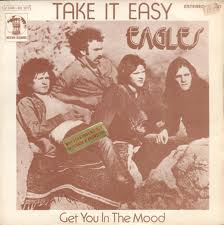
Take it easyYou gained a greater appreciation of art, or how you thought about art, from the lyrical content of a song by the Eagles? The Eagles? Lyrical content? Take it Easy? Chuck? What are you talking about? No one would say that the pop genre is without artistic merit. They’re out there, but they’re in the minority, and the Eagles are not in that minority. The Eagles didn’t even write Take it Easy, as Chuck Klosterman admits. Glenn Frey wrote one line of the song, and Jackson Browne wrote the rest of it.

In the midst of this article, there are some “Klostermans”. Klostermans, as I define them, involve Chuck Klosterman’s kitschy breakdown of the lyrics of a song as if they were profound literature, a writing tool he’s used so often in his career, and so well, that the act of doing so should be trademarked “a Klosterman”. For the most part, these breakdowns are hilarious, but when he does it with Take it Easy, it feels like a violation of the term. It almost feels as if he’s asking us to re-examine a song that we’ve all heard far too many times … in the bits and pieces we’ve heard on classic rock radio before we were able to change the channel. There are also moments in life when a person is not able to change the channel or in any other way skip a song, such as in a doctor’s waiting room, when it’s not in a person’s best interests to run screaming out of a room the moment after Take it Easy begins.

We don’t want to hear this song again, Chuck. We don’t care that a guy is having trouble juggling five women. No matter why or how. Let it die for criminys’ sakes. We enjoy it when Chuck analyzes old Billy Joel lyrics, that’s fun and kitschy, but the Eagles? Artistic? Chuck?

Throughout the course of the Eagles career, they’ve created safe, boring, liberal, touchy-feely music that our most simple-minded friends shush us over, and close their eyes, and have a spiritual moment, based on the fact that this particular song was playing on the radio during a seminal moment in their lives. For these people, however, music is largely background noise, until those songs reach the rarefied air of being on the radio so often that they can’t help but become monumental and a slice of Americana. This, in turn, leads the people that sang that song to believe that they are so monumental, and such a slice of Americana that they can wave a magic wand on stage and get audience members to live through their more important (their stress) lives.

The Eagles could be the greatest American band, if we base that scale on popularity, or sales, but suggesting that there is anything artistic about this simple-minded, clichéd, and ubiquitous music is a statement best left to the sycophantic staff of Rolling Stone magazine. Most of us cannot listen to an Eagles song, much less Take it Easy, without feeling a little dumber, more common, and less in touch with who we are as music aficionados, and it’s going to take more than a clever “Klosterman” to get me listening to it again.

On Bruce Springsteen, Klosterman writes:

“I just thought he was so fake, which is the most backward possible reason for hating Bruce Springsteen.

“Old people who read Newsweek believed Bruce was somehow different from everyone else making music, and his willingness to perpetuate that fallacy made me view his integrity as profoundly compromised. It seemed like the difference between acting in a play and lying in real life.

“Any time I meet someone who thinks Springsteen is overrated or artificial, I find myself thinking, this person is extra real. I immediately respect that person more. And yet I do sincerely believe Springsteen is (on balance) a great guy. I don’t hate him at all. So why am I still retroactively trolling him? It’s just something I can’t get over.”

When Klosterman states that hating Springsteen for being fake is, “the most backward possible reason for hating Bruce Springsteen”, this reader wonders if Klosterman is attempting to qualify the opinions that follow. Either that or Mr. Klosterman is attempting to dispel what he may believe to be a consensus on Mr. Springsteen. If that is the consensus, this reader didn’t find anything in the Springsteen section to dispel it. Klosterman does write that he believes Bruce is “(on balance) a great guy”, but isn’t that what fake people are … on balance? I have no idea if Bruce Springsteen is actually fake, and I don’t care enough to put as much thought into it as Chuck Klosterman has. If Springsteen is fake, an observer could say that he hits all of the bullet points. He seems like “a great guy (on balance)”. He gives us the formula he knows we want, to remain in our favor, then he goes on to live the life he wants to live, and no one calls him out for what could be hypocrisy. While it’s difficult to prove, or disprove, one’s authenticity, Chuck Klosterman writing, “I sincerely believe he is a great guy” doesn’t cut it for this reader. We readers don’t care what you think of him personally, Chuck, unless you can substantiate it in some manner.

Does it really matter if we think a musician is fake? Do we think Bob Dylan is fake? No one cares, least of all (it seems) Bob Dylan. Bruce Springsteen does care, or at least he appears to care. Bruce has built a musical empire around the idea that he’s real “extra real”. I co-opt that term from Klosterman, but Klosterman does not write the words “extra real” in the pejorative sense I did, and he does not attach the term to Bruce. Yet, we could attach the term “extra real” to the “generic-yet-kinetic” clothing Bruce Springsteen wears. Would we deem Springsteen authentic if he chose to sing his unionized, small town lyrics in a made-to-measure, custom-fitted Frank Sinatra suit with wide lapels? Springsteen is so big, because he’s managed (artificially?) to remain so small, and that’s what people love about him. Those of us who don’t think Bruce is “extra real”, think Bruce is overrated, and we see through the “great guy” image of the man singing about small town, unionized America, to the idea that once one strips away all the “extra real” layers of Bruce Springsteen, his music is not artistically complex or by any measure diverse. He just puts on “amazing” shows, and few break down how they are amazing.

Klosterman then examines the point of Springsteen being authentic in comparison to Mötley Crüe, when he writes:

“The difference was that Mötley Crüe did not pretend they were real (or at least not in a convincing enough manner). Vince Neil never led me to believe that any element about who he pretended to be was supposed to serve any purpose beyond “the act of being the singer in Mötley Crüe.””

Klosterman nails this point, but he backtracks it in an “aw shucks” manner that suggests he may have been too hard on Springsteen throughout his life writing that “Bruce is a great guy”, and that he “doesn’t hate him”, and that “it’s something he can’t get over”.

Anytime a person has beliefs they can’t get over, they probably have them because they know that there is a fundamental truth to them that they can’t get beyond now that they’re old and so many people are telling them that they’re wrong. I realize that, as Chuck climbs the ladder in corporate magazines, and newspapers, he’s entered a sphere of existence where he’s torn between the readers that put him where he is, and the editors that put a governor on his former “No one gets out of here alive” method of critique, but those of us who read this particular piece in EW were a little disappointed by the apparent need Chuck Klosterman felt to politically tight rope his way through genuine critique. Chuck Klosterman’s previous writings were what separated him from those rock journalists who were afraid to write anything negative about Springsteen, Clapton, Tom Petty, or any of the sacred cows of rock that rock journalists seem forbidden by their editors to write anything negative about. It could also be that I’ve exaggerated Klosterman’s previous writings in my own mind, and that he was never as daring as I considered him, but it seems to me that he was never this cautious either.

On Van Halen, Klosterman writes that he hated Van Halen (or as we called them “Van Hagar”) soon after David Lee Roth and Van Halen parted ways. Chuck then says that he had the same feelings for Mötley Crüe after they replaced Vince Neil.

“Within any group conflict, my loyalties inevitably rest with whichever person is most obviously wrong,” Chuck writes.

It’s a humorous assessment of Klosterman’s musical fandom, but I believe his loyalties are more superficial than that. Chuck and I were about thirteen and sixteen respectively, when the Van Halen split occurred, and neither of us knew much about music, but we knew their lead singers. I may have known the names of Nicki Sixx, Tommy Lee, Mick Mars, the Van Halens, and Michael Anthony, as I was a big fan, but David Lee Roth and Vince Neil were the bands as far as I was concerned. They were the front men, and they were the face of the band in public perception.

A true musician will inform a listener that the front men are the least vital components of the music, and the guitarist is the second least important when compared to the vital back beat of the bassist and the drummer, but in the land of public perception, it’s the exact opposite. Therefore, when the groups separated from these two front men, those of us in public perception land considered the band done. Chuck can try to lay groundwork that suggests that the loyalties of his teenage mind were more complex than that, but down deep, I think he knows that the music of these bands became karaoke after the groups replaced their charismatic lead singers. The bands became a group of guys trying to hold onto a franchise that they struggled so hard to create, and they wanted a few more years added to the legacy before they called it a day. The music of these bands lost their nihilism, their signature, and their “silly and fun arena rock” persona after their lead singers left. They became Pat Boone’s “In a Metal Mood”. They became a bunch of guys trying to play what the youngsters liked. They became a: “You guys gotta keep it together” paycheck their manager promised them after informing them how marketable the name of their band was, and how they would never achieve that kind of plateau again in any other incarnation.

The albums created, post carnage, Mötley Crüe and Van Hagar’s 5150 may have been the greatest albums anyone has ever created, but those of us in public perception land barely noticed, and more importantly didn’t care, when they came out. Those groups were over as far as we were concerned.
ACDCKlosterman does not cover the music of AC/DC, because this was a hate column, and he presumably never hated AC/DC, but their music was some of the most consequential music of our era, and it would be music that I would eventually come to hate.

I didn’t hate AC/DC at first, but I didn’t love them either. Their music was never “my” music in the manner music becomes “my music” to a teenager, but I did have some appreciation for what they did early on when the “cool kids” in my neighborhood introduced me to them. (I knew of their music to this point, in other words, but we had never been properly introduced.)

The album, Back in Black, was my formal introduction to AC/DC, and it blew me away. I did not know that other bands (bands other than Kiss) could make fearless music. The first song I heard was Back in Black, and from its intro on, I knew this was fearless music that my parents, most females, and chart makers would not appreciate. (I probably didn’t think of charts in the truest sense of the word, at that point, but I knew I wouldn’t hear AC/DC on my local, top 40-radio station.)

I also loved the album cover. It was black, nothing but black. I also loved the title, and the band’s name. As a Kiss fan, I thought that every band was required to have brilliant visuals on the cover. I found Back in Black’s lack of visuals brilliantly simplistic.

When I first heard Back in Black, I thought that I now had one other band that I could trust not to make a ballad. (I was still embittered over Kiss’s foray into ballads with the song Beth, but I had learned to forgive them by simply lifting the record player’s arm up over that misstep.) I thought I discovered the second greatest band in the land, in AC/DC, especially when this friend rolled out the other AC/DC album he owned: Dirty Deeds Done Dirt Cheap. I heard that album’s title song, and the balls song, Big Balls, and I swooned in a pre-teen male form of a swoon, looking for a way to catalog his machismo.

AC/DC had a way of singing lyrics, a way that had my adolescent stamp of approval that fit the music and nothing more. There were no self-indulgent, symbolic lyrics. Their lyrics were simple and in your face that fit the music in a manner, I would later term arena rock. The problem with arena rock, and the reason I came to loathe AC/DC, is the lack of variety. As I stated earlier, I never wanted AC/DC, Kiss, or any of the bands I listened to, to go soft, but every album after Black in Black sounded almost exactly like Back in Black. I never felt the need to purchase another AC/DC album, and I came to loathe those who did.

As I wrote earlier, Chuck Klosterman should trademark his kitschy method of dissecting lyrics, as if they were profound literature. He does this so well, and so often, however, that one can’t help but think some part of Chuck Klosterman believes that his favorite lyrics form profound, artistic statements. I’ve always considered lyric writing one of the most overrated art forms. They appeal to us on a certain level, I would argue, because of the musical background that accompanies them. If one were able to remove the music from their mind, and read most lyrics on a blank page, I would argue, we would see that most lyrics do not have the literary merit necessary for the profound literature moniker.

Most lyrics involve double-entendres and cryptic messages regarding how the casual use of controlled substances should be considered kind of neato! I never understood why so many people felt compelled to tell others that they have ingested drugs, and I really had no overwhelming desire to do it, so the descriptions of these cryptic messages always bored me a little.

Don’t get me wrong, I enjoy it when musicians attempt to speak the language of their demographic by mixing in the occasional curse word. I enjoy the general idea of messing with the mainstream, but I was unmoved when a teacher told me that John Lennon was communicating greater messages in his songs than I had realized in my casual listening experiences. I always thought Lennon (along with the rest of the rock community) was most likely a vacant individual who was trying to sound smarter than he really was by using clever lyrics. I’ve always thought lyrics should fit with the music, nothing more and nothing less. It should never be an arena for the college thesis that most lyricists never wrote, because they weren’t intelligent enough to write, but they were clever enough, or cleverly brilliant enough, to make you think they were within the convenient limits of a song.

REMOn R.E.M. Klosterman writes:

“I didn’t relate to the kind of person who related to R.E.M. and I didn’t like textured, nonheavy songs that made me feel like some dour weirdo was telling me I was living my life wrong. Over the next twenty years, R.E.M. would become one of my favorite bands of all time, which means a) the sixteen-year-old version of me would have hated the thirty-six-year-old version of me, and b) I probably was living my life wrong.”

Klosterman nails my feelings on R.E.M. almost word for word, except for that last line. The last line bothers me, because (I would later learn) that’s pretty much what the worldview of the songs of R.E.M. were all about. They were about telling the listener that they were living their life wrong. Those that question such an assessment need only read an interview with Michael Stipe. His answers contain the rantings of an obnoxious, self-involved narcissist. The reader will find that this narcissist does say narcissistic things in all the “right” narcissist ways however.

In one of these interviews, Stipe described Rod Stewart as “icky”. Not kidding he said: “Ick! Ick!!” Now, I’m not sure if Stipe knows Rod Stewart on a personal level, and his judgmental attitudes are based on personal experiences, but I’m guessing that this very personal condemnation does not adhere to what Stipe calls a beautiful refrain ‘Judge not, lest ye be judged’. An observer, hearing this condemnation of Rod Stewart could find Stipe’s supposed adherence to this beautiful refrain a hollow claim.

Stipe also deems those who espouse opposing points of view unacceptable, evil, and presumably icky. He would probably also deem those that consider his rants to be “from an obnoxious, self-involved narcissist” icky. The fact that Stipe may not be as informed as he pretends to be, has never mattered to those interviewing him, however, because, again, all of his icky rants are icky in the ways the journalist has presumably considered non-icky.

If Stipe is going to judge another person, in a public forum, then we can judge his judgment, if we listen to his beautiful refrain. As with most venial sins of this nature, Stipe judges Stewart to leave the reader of the interview, the impression that he, by comparison, is a wonderful guy. He wants the reader to think he has the correct views on all the right subjects, and he lives by the “mean people suck” bumper sticker philosophy that ostensibly declares the driver to be a wonderful. I may be alone in this assessment, but I tend to find such social Darwinist thinking to be icky.

We, music fans, shouldn’t kill the messenger for the message, however, and Stipe and company (R.E.M.) did make some beautiful music. Klosterman should not condemn the music of the Eagles based solely on their politics; Rolling Stone should not condemn Ted Nugent for his views; and we should not condemn R.E.M. or Springsteen for their views. We should just listen to their music with the idea that most musicians don’t know what they’re talking about, but they cannot keep quiet in their quest for a “more consequential” title than that musician guy that prances about on stage. The one thing I have taken from all of the interviews I have read from rock musicians over the years, in my quest to learn what drives them, is that if I want to continue enjoying their music. I should probably just stop reading such interviews.

 

Rilalities II


My Dog the Racist. My dog growled at a pedestrian walking up the block the other day. He then proceeded to bark two more times at the individual. The pedestrian was a black kid. Now you may say that my dog does not have the cognitive ability to be racist, but ignorance of the law is no excuse. You might believe that my dog doesn’t know the difference between a black kid, and any other kid, but I do. I know that any dog unfamiliar with the warnings of George Orwell needs to be taught that in their world, the black kid needs to be considered a non-person, as far as my dog is concerned. It does not reflect well on me, his owner, if he barks at anyone other than white males. I know barking at black people is tantamount to racial profiling, and that based upon my dog’s ignorant behavior he and I need to have an inter-species conversation on race if Dogswe don’t want to be considered cowards. In this inter-species conversation on race, I would tell my dog that it is not enough to say that some of the anuses you sniff are black dogs. Those are the excuses of scoundrels seeking a get-out-of-jail-free card on racial sensitivities. I would tell him that his barking could do great damage to that black kid’s self-esteem, and I would tell him that any future barking would be considered a hate-crime regardless of his intentions and motives, and that it could carry with it hate-crime punishments. I also know that no matter how confused my dog may be at a scolding, he will not be doing anything like this again in my home any time soon. 

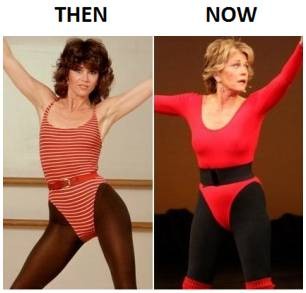
Then...now...who cares?
Then…now…who cares?

Haloed Hollywood.  A fawning Hollywood article fawned over the “Over forty!” bodies of some celebrities. The article focused its fawning on the bodies of Jennifer Aniston, Halle Berry, and Jane Fonda. One would think that a true feminist would read such an article and think that if these women worked half as hard on their minds, it would do a great deal to further the idealized image of a strong woman for those young females that look up to them. These same, young women will learn that if these women took that time to focus on cultivating their intellect, at the expense of their figures, fawning Hollywood writers wouldn’t care what they thought.

Those impish impoverished. It seems almost innate that those who receive some sort of government assistance despise those that assist them. Is this based on pride, or is it that if the assisted let up on the pressure, those who assist them won’t feel the need to assist them more?

Superior Inferiors.  Why is it that if an individual is struggling with a contraption, nine out of ten people would rather laugh than help the struggler in anyway? As an individual who has had more than his share of embarrassing moments struggling with contraptions, I’ve always considered it important to assist those that struggle in a manner I deem appropriate to the situation. The best thing I’ve come up with is to offer communal condemnation of the product:

“Those things are real sons a bitches,” I will say.

This subtle form of empathy seems to help the struggling individual far more than any physical assistance will, for most men don’t want physical assistance.  It often furthers their humiliation for someone to step in and fix the contraption for them in a manner that makes it look easy. My little subtle form of empathy not only lessens their feelings of public humiliation, but it keeps the hyenas —looking for any reason to start the laughing— at bay.

If that subtle form of empathy isn’t appropriate for the given situation, I will say:

“Hey, just to let you know, I could not have done that any better myself.”

The old adage: “Treat others the way you want to be treated” comes into play in situations like these for me. Others —the nine out of ten— get a lot of mileage out of watching another struggle … This is the case, more often, if the laughing hyena don’t like you in ways they won’t admit.

On that note, most find it more enjoyable to laugh at those they consider superior. Most people won’t laugh at an individual they consider inferior. It may increase their feelings of superiority to laugh at the inferior, but they often wait till later to laugh about it. If an individual is superior, in some ways, and they are struggling with a contraption, it is deemed acceptable at the time to laugh at them during their struggle. They can take it, the hyena thinks, they have an ego that might need to be diminished a little, and if they don’t, well, they’ll get over it. An inferior individual gains sympathy from onlookers for their difficulties not laughter.

Ah Hole Arrogance. It’s easy to spot arrogant, Ah holes in life, but what about the soft and squishy Ah holes? They’re out there. They just know how to conceal their nature better than arrogant types.

“Please call me Ernie,” they’ll say when they greet you in a formal setting.

‘Well, I wouldn’t be calling you Mr. Brubaker if it wasn’t my job to do so,’ I want to say.  I don’t say this, but to their utter frustration, I continue to call them Mr. Brubaker.

“Why do you continue to call him Mr. Brubaker,” fellow associates will ask me. “He said he prefers to be called Ernie?”

I can’t help but think that there is some kind of game being played here.  I can’t help but think my fellow associates are either excited that Ernie has allowed them to see themselves as an equal, or that they can’t wait until they have achieved Ernie’s stature in life, so they can copy his formula when they run into one they can deem subservient.

Whatever the case, Ernie is not trying to make you feel better about yourself so much as he is trying to lift his own stature by being ‘one hell of a good guy’ that decrees that you are permitted to be more casual around them … even if you’re not permitted to be by your boss.  It makes Ernie-types feel like a wonderful person to allow you this privilege, but it makes those that will call him “Ernie” look like a court jester that has just received permission to look the king in the eyes. At least arrogant Ah holes are in your face with their arrogance.

StefaniThe Confused Mind of a Cool Celebrity: We’re all fascinated with the lives and thoughts of celebrities. After achieving some fame in the group No Doubt, Gwen Stefani went back to her hometown in Orange County, the “OC”, California.  At one point in the concert, she shouted something along the lines of: “We’re happy to be back in the OC!” The crowd all leapt to their feet.  After allowing that applause to continue for a while, she said: “Settle down, it’s not that cool.” It was funny, in a nihilistic, apathetic manner, and the apathetic, cool kids in the crowd might have considered her off the charts cool for doing this, but I wonder how many of these kids had their minds changed by what Ms. Stefani said.  We’re all striving to be cool, and we don’t care who we have to diminish to get there.

I knew young people from Orange County, and while they were just as apathetic about their hometown as every other teen, they lived with this belief that, at least, they were cooler than all of those nerds from Omaha, Pocatello, and Morgantown. They lived with the belief that they were somehow superior, because they grew up in the hometown of the Beverly Hills 90210 and the “OC” television shows. They had L.A. and Laguna Beach, they were Hollywood, metropolitan, and they believed they knew things that hayseeds and hicks from the sticks could never know. So, like every teen, they had mixed and confused thoughts on the matter, but they told me that they were from the O.C. with a mixed measure of pride. So, when Ms. Stefani said this —in an obvious attempt to appear cooler than Orange County and all of its residents in a attendance— did she change any minds that night?

Most clear, rational thinkers know that Ms. Stefani is nothing more than a mindless celebrity who has a team of people around her that write songs, or complete the lyrics of those songs that she’s written, so that they come off as cool. She might be perceived as brilliant in some small corners of this society, but few of those outside the very young demographic would consider her to be an esteemed social commentator. Those that do, do so based on the fact that she’s so good looking, and we all want to know what it takes to be that good looking. She then takes advantage of this pedestal by crushing all of those that believe they have that affinity people feel being from the same locale. She rips them for believing that being from somewhere means anything, especially if you derive some sort of pride from it.

The import of Ms. Stefani’s message is that it’s not a hometown that makes a person cool is a good one, as it suggests that you’re going to have to work your tail off to create a niche. I believe that Ms. Stefani took this one step further, suggesting that  ‘you’re never going to be as cool as I am, just because you’re from the same place’.  I don’t know if Ms. Stefani is insecure in her status, if she feels a need to remind her fans that they are beneath her, or if she simply had some bad bacon that morning, but if she was able to convince a bunch of mindless twits that their hometown wasn’t as cool as they thought it was, how much of a reach would it be for these same people to vote for the person Gwen Stefani tells them to, based on the fact that the other guy isn’t cool? Before you say, “That’s a ridiculous leap,” scroll up and look at a photo of her again. She’s slender and very good looking.

What the World Needs Now is Another Calvin Coolidge


President John Calvin Coolidge Jr. said “No!” He said “No!” so often, through vetoes, that he’s still, nearly 100-years since he left office, ranked 9th among presidents for most vetoes. Does his unflinching, non-prejudicial ability to say “No!” so often make him the best president the United States has ever had? “No!” but his courage in the face of mounting pressure does land him on my personal Mount Rushmore.  

Before we categorically dismiss this as “The guy said no, who care?” Think about who he said “No!” to. If we became politicians, our first job would be to gather coalitions, or a group of other people to help us amass power. Calvin Coolidge became a governor because he was the lieutenant governor for a successful governor. He became president by being a vice-president to a president who died. If this happened to us, we would probably be overwhelmed by the idea of it, but Calvin Coolidge went back to bed moments after he learned he would be president. When he awoke, he went about saying no to powerful members of Congress, Senators, and the most powerful power brokers in Washington. In every session of Congress and the Senate, there are always those scary politicians and power brokers to whom everyone is afraid to say no, but the historical record shows that Coolidge was not intimidated. He dropped nos on everyone in a patient, reasonable, rational, and nonprejudicial manner.  

“No!” carries a lot of power, as any two-year-old, who is just learning the rudimentary power of language can tell you, but “That depends on who you’re saying no to,” the seasoned politician might argue. “Saying no to the wrong person in Washington could just as easily render you powerless.” President Calvin Coolidge didnt care. He was either one of the least ambitious president in terms of amassing a power base, or simply fearless, as the record states he said “No!” to everyone.

In the near one-hundred-years that have followed that great president’s tenure in office, our politicians-turned-presidents have fallen prey to the seductive power of “Yes!”, and they have found creative ways to say “Yes!” to other politicians and constituents. Even the most ardent supporters of “Yes!” would have to admit that the seductive power of “Yes!” has led to more centralized government with the strongest power residing in the office of the president. Before you say, “No, that’s not true,” is your party in power in the moment? Will your opinion change when the other party assumes power? We should all succumb to the power of “No!”

We want to hear our politicians, our leaders, and other authority figures to learn how to say “Yes!” more often, and we throw childish temper tantrums when they don’t. “Yes!” builds affinity and loyalty that can evolve into love when we hear it often enough, but what we want versus what we need are two entirely different hemispheres. Before we categorically reject “No!” we should consider what “Yes!” has wrought us, annual deficits that have lead to a federal debt that is currently spiraling so out of control that economic forecasters predict that an inevitable disaster could happen at some point.

Psychologists say that we not only do we learn to adjust to hearing “No!”, but as much as we hate having any authority figures dictate how we live our lives, we do adjust, and those adjustments can lead to a sense of appreciation for the structure and parameters “No!” provides.

Political scientists might admit that a world of “No!” might be idyllic in terms of economic survival, but modern Americans are too far down the path of “Yes!” to ever elect a Calvin Coolidge President of the United States. The modern United States, presidential election is now a battle of the yeses. Only an unimaginable economic disaster could turn that around, political scientists might agree, but even then, even then, the power of “No!” would hold no sway. At this point in our history, the only difference between the parties, on this issue, is in the creative ways their candidates can find to say yes.

Historians suggest that even as far back as 1918, Calvin Coolidge’s “No!” policies may not have resulted in election victories, as Coolidge ran for Governor of Massachusetts as the sitting Lieutenant Governor, and he ran on the previous administration’s record, and he later assumed the office of the President when the previous president died an untimely death. If he were a relative unknown in either of those elections, it’s probable he wouldn’t have won either of them.

President Calvin Coolidge’s claim to fame was that he was all about budgets. Budgets, creative accounting, and numbers might win you an article on Rilaly.com, but to win a presidential election Calvin Coolidge probably needed to be viewed as an incumbent in a prosperous time period. After reading a Coolidge biography, we get the idea that he was more at home in the company of numbers such as two and zero than he was a Senator, Congressman, or a power broker addressing him as “Mr. President”.   

“I believe in budgets. I want other people to believe in them. I have had a small one to run my own home; and besides that, I am the head of the organization that makes the greatest of all budgets, that of the United States government. Do you wonder then that at times I dream of balance sheets and sinking funds, and deficits and tax rates and all the rest?”  

Read that how you want, but it’s pretty hard to chant in a convention hall.    

Coolidge Enters Stage Right

Calvin Coolidge
Calvin Coolidge

Following the Warren G. Harding/Coolidge ticket’s 1920 victory for the office of the president, President Warren G. Harding’s inaugural address set a dramatically different tone from that of the outgoing Woodrow Wilson administration:

“No altered system will work a miracle,” President Harding said, “Any wild experiment will only add to the confusion. Our best assurance lies in efficient administration of our proven system.”

Harding’s ego-less approach was that he would be nothing more than a steward of the American system that worked just fine in the 130 years of America preceding his election. Harding’s stance —as opposed to Woodrow Wilson’s— was that his administration wouldn’t try to outdo the prosperous model The Founders created. Put in this light, what kind of ego looks at the model of America —that was, and is, the envy of the world— and thinks they can do it better? How many of them succeeded in this venture? Harding was basically saying that he didn’t regard himself as a “miracle worker” who would step into office with his think tank notions to tell the nation that he has a “new and improved” model to cure what ails us? Isn’t that what politicians do, yes, but is “Yes!” the solution to our problems or the source of it? If I were running for an office, I would build my campaign around no, “No, we can’t! We can’t, because of the miserable mess we’ve all created. We have to clean this (expletive delete) up!” That campaign probably wouldn’t help me get a job as a drive-thru attendant as Hardee’s, but I would go down with that ship with a righteous right fist held high.

Harding was basically telling the American public that he wouldn’t present what we now call the “New Coke” formula that no one has ever thought of before. The actual “New Coke” campaign involved the Coca-Cola Company attempting to gain greater market share in 1985, by essentially copying the formula of its less popular competition Pepsi-Cola. Similarly, numerous narcissist U.S. presidents, before and after Harding and Coolidge, have attempted to impose formulas that have been tried and tested by other countries in history. The idea that those formulas have failed in those other countries, and America’s is the envy of the world, doesn’t stop “New Coke” advocates from believing they are the ones who can administrate this failed formula to success. The legacy of Coca-Cola’s “New Coke” campaign, and the “New Coke” ideas in politics are influential as a cautionary tale against tampering with a well-established and successful brand. By saying that he would act as nothing more than a steward for the prosperous model The Founders created, Harding was displaying what some call the pinnacle of intelligence by stating that he was smart enough know what he doesn’t know. 

One of Warren G. Harding’s first steps was to shepherd through Congress the Budget and Accounting Act of 1921. This bill allowed Harding to create a special budget bureau— the forerunner to today’s Office of Management and Budget— where Harding’s director of the bureau could cajole and shame Congress into making spending cuts. Unfortunately, some of Harding’s privatization policies, combined with some ill-advised appointments, led to bribery and favoritism, and ultimately to something historians would call the Teapot Dome Scandal.

Coolidge as President

After the untimely death of Harding, Calvin Coolidge became the 30th president of the United States, serving from 1923 to 1929. Coolidge sustained a budget surplus and left office with a smaller budget than the one he inherited. Over the same period, America experienced a proliferation of jobs, a dramatic increase in the standard of living, higher wages, and three to four percent annual economic growth. The key to this level of success was Coolidge’s penchant for saying “no.” If President Ronald Reagan was “The Great Communicator,” Coolidge was “The Great Refrainer,” a title Reagan gave Coolidge. 

Calvin Coolidge separated himself almost immediately from Harding with his willingness to say “No!” to appointees, Congressman, and to various, other “New Coke” bills. (Coolidge ended up vetoing fifty bills, a total that ends up being more than the last three presidents combined.) Coolidge summed up his penchant for vetoing these bills saying:

“It is much more important to kill bad bills than to pass good ones.”

How many of today’s issues would be resolved with that mindset, that philosophy, and that president? Calvin Coolidge was the type of president, the type of person, that if you asked him what time it was, he would tell you. Modern presidents get their tongues so tied up with advice from advisers, pollsters, and focus group testing, that they’re almost afraid to tell you what time it is based on the fact that a direct answer might be taken seven different ways by seven different networks that appeal to a 24-7 audience.

Within 24 hours of arriving in Washington after Harding’s death, Calvin Coolidge met with his budget director, Herbert Lord, and together they went on offense, announcing deepened cuts in two politically sensitive areas: spending on veterans and District of Columbia public works. In his public statements, Coolidge made clear he would have scant patience with anyone who didn’t go along:

“We must have no carelessness in our dealings with public property or the expenditure of public money. Such a condition is characteristic of undeveloped people, or of a decadent generation.”

Perhaps reflecting his temperament, Coolidge favored what more modern presidents could use to veto a bill without the political consequences of doing so, the pocket veto. This is a method a president can use to reject a bill without actually vetoing it, while giving Congress little ability to override it. Grover Cleveland, whom Coolidge admired, used this type of veto in his day, as had Theodore Roosevelt. But Coolidge raised its use to an art form. The New York Times referred to it as “disapproval by inaction.” Perfect, I say, ingenious. It’s what the world needs now.

The words “perhaps reflecting his temperament” paint a nice portrait of President Calvin Coolidge, for when given the choice between grandstanding on an issue and quietly advocating or dismissing a bill, Coolidge opted for the quiet approach. The most illustrative story on this theme of restraint involved one of the greatest tragedies of Coolidge’s presidency. The great Mississippi River flood of 1927 was the Coolidge administration’s Hurricane Katrina. Rather than appear in a photo op, Coolidge chose not to appear on the grounds of the devastation fearing that doing so might encourage federal spending on relief. Another issue that might define the Coolidge administration in an historical manner involved the Klu Klux Klan. When faced with the problem of how to handle the then powerful Klu Klux Klan, Coolidge quietly avoided appointing any Klan members to prominent positions in his cabinet, and he thereby decimated the power of that group in America. When faced with the dilemma of what to do with farming subsidies, the man from farming country, chose to veto the subsidies. He also vetoed veterans’ pensions and government entry into the utilities sector. What current politician would favor vetoing farming bills and veterans’ pensions? The man had no qualms with vetoing bills he likely, personally favored, because he didn’t want to set a bad precedent. 

If a modern politician for any office even flirted with doing any of these things (the maneuver with the Klan excluded), and they listed one of them in their campaign, how many of us would laugh them off the stage? The party’s leaders wouldn’t even consider them for their nomination. The only obstacle for modern politicians is how to find a creative way to say yes that doesn’t tick off too many constituents who might want them to say no. 

Yet, how many tragedies does a nation as large as America face every day? How many constituents suffer as a result? The impulsive reaction for any person, politician, and president is to do whatever they can to end their suffering, yet how many unintended consequences arise from a president’s, and Congress’s decision to provide federal aid? Before you reveal yourself as a person somewhat addicted to federal spending, imagine if a President Calvin Coolidge denied federal aid for even “logical” and “heartfelt” expenditures? Imagine if a president said, “I’d much rather not set the precedent of the federal government coming in to rescue all of the people, places and things. I’d much rather leave such aid to the states and local municipalities.”

How many of these problems could’ve been avoided if we had more presidents do whatever they could to train the country’s expectations to be more limited when the subject involves the federal government’s ability to fix their problems. As many informed politicos will tell us, it’s too late now. The country, thanks to nearly 100 years of conditioning from ego-driven, narcissist  presidents, seeking praise and adulation for their administration, has come to expect the president to do something. It’s a fait accompli now, and there’s little to nothing anyone can do to roll that back now. All of this may be true, but what if Harding’s special budget bureau survived the politics of the 70’s, and the president and Congress conditioned the country to accept the idea that the federal government has attained from taxpayer’s is finite? Would the American public let the locale drown, or would the most generous people in the world, Americans, do whatever they can to help their fellow American out? Would the American citizen learn to look to their state, local, and even their own communities to aid them in times of crisis? It’s easier and far more popular for a president to just say yes, but I don’t think many objective, dispassionate observers would argue that America would be in a far better place if the presidents who followed Coolidge invested more of their political capital in his politics of no?  

“Four-fifths of all our troubles would disappear if we would only sit down and keep still.”

What came first the chicken or the egg? Did the “yes” politicians condition us to expect more yes from them, or did we condition our candidates for the office to say “yes” to everything? How many candidates stubbornly insist that we need to say no more often? Long question short, are we in unprecedented debt, because of the ruling class, or because Americans have the country we want? I don’t know about you, but I would love to see that specific flowchart with historical bullet points.

The current barometer of the presidency is not set on “Yes or no” but “When, how much and how often” they spend other people’s money, Coolidge exhibited a level of restraint politicians often reserve only for their own money.

Despite the budget surpluses the Coolidge administration accrued during his presidency, he met with his budget director every Friday morning before cabinet meetings to identify budget cuts and discuss how to say “no” to the requests of cabinet members, and other politicians up and down the ticket. Think about that for just a moment before reading on. Think about how a modern politician, on any level and both parties, would react to even a momentary surplus. The impulsive reaction, some might even say instinctive reaction politicians have to surpluses is to find the best way to allocate that surplus for greater political gain, and to reward those who played a pivotal role in securing the surplus by allocating funds for a bridge or a hospital in the Congressman’s district. How many politicians, by comparison, would meet with budget directors, Congressmen, etc., to find further ways to cut. Most presidents give in after a time —Eisenhower being a good example— but Coolidge did not, despite the budget surpluses accrued during his presidency. 

In a conference call with Jewish philanthropists, Coolidge explained his consistency this way:

“I believe in budgets. I want other people to believe in them. I have had a small one to run my own home; and besides that, I am the head of the organization that makes the greatest of all budgets, that of the United States government. Do you wonder then that at times I dream of balance sheets and sinking funds, and deficits and tax rates and all the rest?”

Speaking of tax rates, in December 1923, Coolidge and Treasury Secretary Andrew Mellon launched a campaign to lower top rates from the fifties to the twenties. Mellon believed, and informed Coolidge, that these cuts might result in additional revenue. This was referred to as “scientific taxation”—an early formulation that would later influence economist Art Laffer to develop what we know as the Laffer curve. Coolidge passed word of this insight on:

“Experience does not show that the higher tax rate produces larger revenue. Experience is all the other way,” he said in a speech in early 1924. “When the surtax on incomes of $300,000 and over was but 10 percent, the revenue was about the same as it was at 65 percent.”

The more recent egos who have occupied the tax payer funded seat of president would likely show a blush at the mention of the power and prestige they have achieved by attaining residence in The White House. That humble blush would be shown in the manner a 70’s comedian would show one hand to reject the applause he was receiving, while the other, jokingly, asked for more applause. Calvin Coolidge rejected congratulatory mentions of his power completely. When Senator Selden Spencer took a walk with Coolidge around the White House grounds, the Senator playfully asked the president, “Who lives there?”

“Nobody,” Coolidge replied. “They just come and go.”

For all the praise that authors like Amity Shales heap on Coolidge, some of his critics state that his policies caused The Great Depression and others say he did not prevent them.

“That is an argument I take up at length in my previous book, The Forgotten Man, and is a topic for another day,” Amity Shales said. “Here let me just say that the Great Depression was as great and as long in duration as it was because, as economist Benjamin Anderson put it, the government under both Hoover and Franklin Roosevelt, unlike under Coolidge, chose to “play God.”

Three lessons we can learn from the Coolidge presidency

Beyond the inspiration of Coolidge’s example of principle and consistency, what are the lessons of his story that are relevant to our current situation? One certainly has to do with the mechanism of budgeting: The Budget and Accounting Act of 1921 provided a means for Harding and Coolidge to control the budget and the nation’s debt, and at the same time give the people the ability to hold someone responsible. That law was gutted in the 1970s, when it became collateral damage in the anti-executive fervor following Watergate. The law that replaced it tilted budget authority back to Congress and has led to over-spending and lack of responsibility ever since. On this note, one could say that Congressional control of the budget is outlined in The Constitution, and that Congress is more representative of the American citizenry. As I wrote above, however, Calvin’s budget director’s primary job was to cajole and shame Congress into making spending cuts. That wouldn’t play in the 70’s, and it definitely wouldn’t play in the modern era. As such, Coolidge’s quote, “I don’t fit in with these times” would definitely describe a modern day Coolidge, as he probably couldn’t be elected dog catcher. The American people have stated that they prefer an out of control budget with massive spending.

A second lesson we can derive from the Coolidge administration concerns how we view tax rates. Our natural inclination is to believe that higher tax rates produce larger revenue. As Coolidge states, “Experience is all the other way.” The reason behind this is a complicated formula that current supply side economists suggest raising taxes results in more people and corporations engaging in less taxable activity. Coolidge’s experience with the code suggested that we should consider lowering taxes, until we find that sweet spot in the tax code that encourages greater taxable activity, and thus more taxable revenue arriving in the government’s coffers. Tax policy can also be a mechanism to expand government. The goals of legitimate government —American freedom and prosperity — are left by the wayside. Thus the best case for lower taxes is the moral one — and as Coolidge well understood, a moral tax policy does not demand higher taxes but tougher budgeting from paid employees of the state that we call our representatives.

Finally, a lesson about politics. The popularity of Harding and Coolidge, and the success of their policies — especially Coolidge’s — following a long period of Progressive ascendancy, should give today’s conservatives hope. Coolidge in the 1920s, like Democrat Grover Cleveland in the previous century, distinguished government austerity from private-sector austerity, combining a policy of deficit cuts with one of tax cuts, and made a moral case for saying “no.” A political leader who does the same today is likely to find an electorate more inclined to respond “yes” than he or she expects. {1}

The point, I believe, is that in the current climate of “yes” in Washington D.C., we could use a little “no”. In the event of a natural disasters, there will always be “unprecedented” disasters in a land mass as large as America, “yes” ingratiates the president to the people of the area, the media, the nation, and history, but it is also “yes” that ends up contributing to the national debt, and the idea that the federal government is a parent that should clean up the messes of her children. It could also be argued that federal intervention discourages smaller scale charity and communities seeing themselves through a disaster of this sort.

“Yes” also lends itself to the already massive egos of those who will sit in our most prestigious seat of representation, and it leads them to believe they can invent “New Coke” formulas, until we’re swirling around the drain in it. These massive egos can’t withstand one commentator saying negative things about them, so they start saying “yes” to everything, because “yes” doesn’t have the political consequences of “no”. Saying no to Congressmen and Senators can bruise egos and cause negative sentiments and statements; saying no to Governors who ask for state aid will lead to political fallout in the media as every story on that tragedy of the day would be accompanied by their “no”; telling a woman who asks for a car in a town hall debate the meaning of the word no, and telling her exactly what time of the day it is, would lead to utter devastation for that candidate’s campaign. Why would a politician, in today’s media cycle, say no and expound on that by saying that’s not the federal government’s role, and refrain from engaging in photo ops that might encourage Americans to believe that it is the government’s role? By saying no, a politician puts his or her nose out, and it takes courage and humility for a politician to risk everything by denying a power grab in this sense. While Coolidge never faced the 24-7 news cycle modern politicians do, a decent search of his history will reveal that his “no” policies did face a relatively intense amount of scrutiny, and he continued to stubbornly say “no” throughout.

It would probably be a fool’s errand to try and find another person in our current political climate who has the temerity and resolve to say no as often as Coolidge did. The nation has stated that they would much rather live in the fairy tale land of yes, even if that means that the New Coke ideas lead to greater complexities, long-term consequences, and probable economic turmoil. The greater question, that appears to be approaching closer every day, is not whether a “a great refrainer” is a better president than one who believes the nation can “yes” their way out of every problem, but if the nation will ever be ready for such an answer without the assistance of a cataclysmic economic incident that affects them directly.

Calvin Coolidge’s obituary states that his prestige at the time of his impending third-term* was such “that the leaders of the Republican Party wished to override the tradition* that no President should have a third term.” His response was, “I do not choose to run for President in 1928.” When a “draft Coolidge” movement arose to select him for the GOP ticket, Coolidge said no. When they attempted to override his desire, believing Coolidge’s refusal to run was a shrewd attempt to avoid revealing his ambition, he told them no again. President John Calvin Coolidge Jr. may not go down as the greatest president who ever served the public, and judging by the quote that he was one of the few who managed to be “silent in five languages” Coolidge will never go down as one of the most charismatic individuals to ever sit in the seat. No, I have Calvin Coolidge’s face on my personal Mount Rushmore for his ability to say “No!”

***

*Calvin Coolidge ended up serving six years, as a result of Harding’s death two years into his presidency, so his re-election would not have been a third term, technically.

*In 1928, the idea of a president serving more than two terms was still a tradition, until the 22nd amendment passed to Constitutionally limit a president to serving two terms. This “tradition” began with George Washington refusing to run for a third term, Theodore Roosevelt continued the tradition, initially, before running again, and some suggest Harry Truman could have run for a third term, because the 1947, 22nd amendment only applied to presidents after the then-current one (which was Truman), but Truman was deemed too unpopular to seek a third-term.    

{1}http://www.hillsdale.edu/news/imprimis/archive/issue.asp?year=2013&month=02

{2}https://en.wikipedia.org/wiki/New_Coke