Some people remember their first kiss, some remember the first dollar they earned, others remember when they first met their wife, the birth of their child. I remember the first time I heard Pavement’s new song Stereo. My irrational exuberance, after spending two years listening to Wowee Zowee, was such that Pavement could’ve released a three-minute single of Stephen Malkmus clearing his throat, and I would’ve been singing that for the next month, in anticipation of the release of an album they decided to title Brighten the Corners. My passion for them was silly, inexplicable, and embarrassing, but who can explain love?
 Before Apple Music, Amazon Prime, and Spotify, consumers had to take a shot in the dark on musical artists. In the early 90’s, there were no college radio stations in my area, and the radio stations we did have, played the songs their advertisers demanded. We could choose between Billboard top 40 and classic rock stations. The only outlet lovers of relatively obscure music was corporate music magazine music reviews, and most of them only reviewed top-tier artists. Every once in a while, however, the corporate chieftains would allow a reviewer to review some obscure album that didn’t help the sales of the magazine. I never cared about the names of album reviewers. I just read the review, and some of them clicked, 99% of them didn’t. When I read a review for an album called Slanted and Enchanted from a group of nondescript fellas I’d never heard of before, I liked it so much I bought the album. I don’t know why I bought the album, but the reviewer said something along the lines of “Slanted and Enchanted is an undiscovered gem from a band who will be making some noise in coming years”. Did this guy know what he was talking about? I didn’t know, and I really didn’t care, but for whatever reason, I decided to give these guys in a band called cement, concrete, or something like that, a shot.
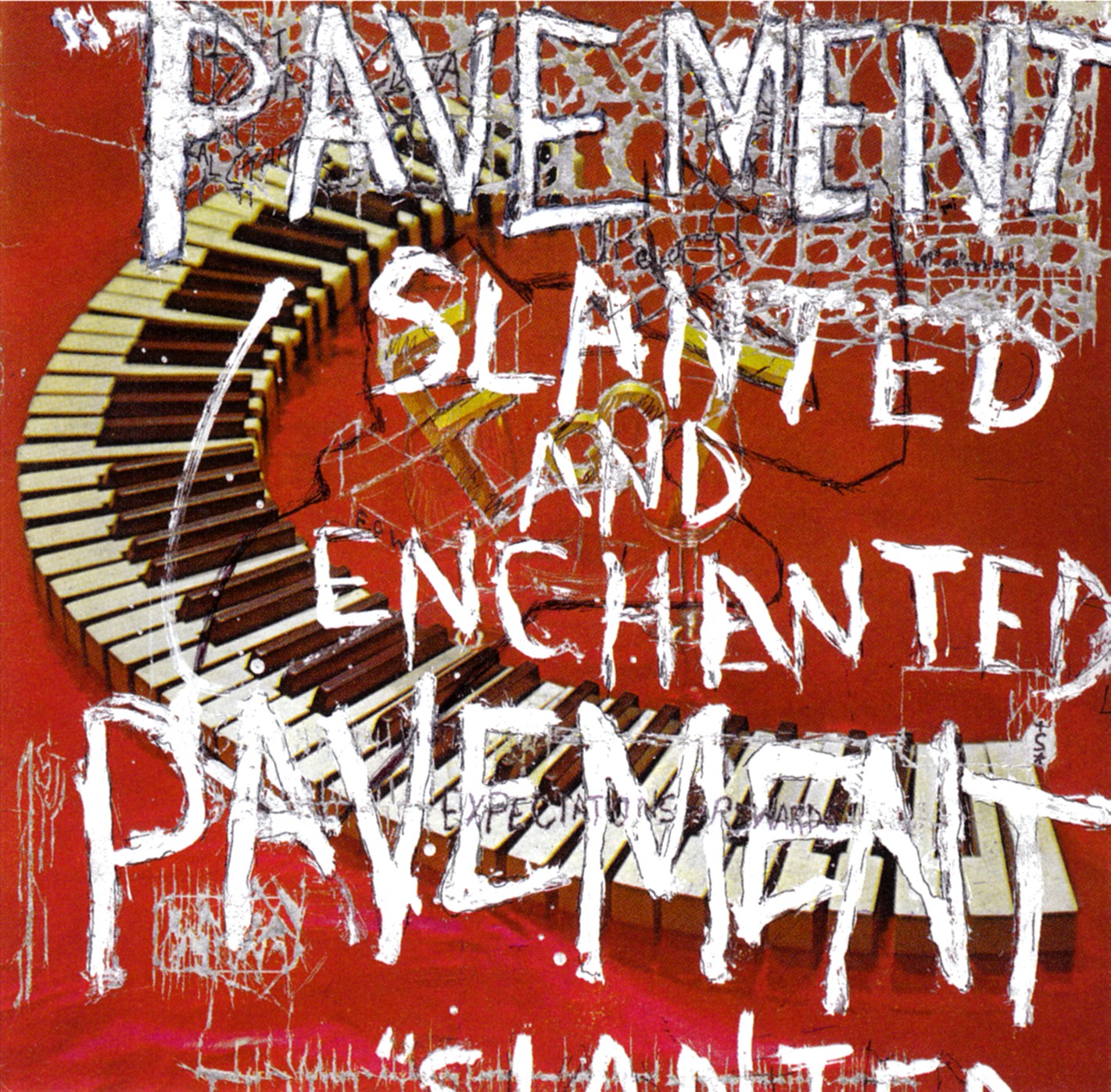 Whoever that guy was, he knew his music. I listened to Slanted and Enchanted as often as I did the Seattle bands of 1992. I wasn’t around the Cali scene, when Pavement were paying their dues, but I was one of the first person I knew to own a Pavement cassette tape. It was not love them at first listen however. Slanted and Enchanted was so different and so complicated that it took a number of spins to click. To my mind, the raw Westing (by Musket and Sextant) only reinforced the idea that these guys could piece together some of the most original music I ever heard. I’ve heard some suggest that Pavement, like all artists, were a culmination, or a compilation, of their influences. If that’s the case, these cats grew up listening to music I never heard before. They weren’t punk (by my narrow and uninformed definition), hard rock, or any genre I heard. They were something different, and to my mind that’s the greatest compliment we can give any artist in the crowded field of music.
“A genius is the one most like himself.” –Thelonius Monk.
 In 1994, Pavement doubled down on something different, when they released an album called Crooked Rain, Crooked Rain. I could go through this album and four-star and five-star the singles, but I won’t bore you with my narcissistic analysis. I will just say that I played this disc so often that almost all of the singles were playing during a seminal moment of my life between ‘94-’95. Crooked Rain, Crooked Rain cemented Pavement in the upper echelon of my favorite bands.
As brilliant as these two albums were, top to bottom, they did not prepare me for the “Holy ‘it, these guys are it” effect Wowee Zowee would have on my psyche. As lead singer Stephen sang somewhere, “Song is sacred.” The brilliance on this disc floored me. After hearing it the first 100 times, I decided that everything Stephen Malkmus and Scott Kannberg wrote to that point culminated in Wowee Zowee. Slanted was the seed, Crooked Rain was the fertilizer, and Wowee Zowee was the flower. This analogy might be oversimplifying the evolution, and it might unintentionally denigrate the brilliance that can be found on the other two discs, but what Stephen Malkmus and Scott Kannberg (Spiral Stairs) put together on Wowee Zowee reached me on levels those other albums couldn’t.
When I write that Pavement were different that should not be confused with weird or strange. Compared to the other cassette tapes housed in my wall fixtures, Pavement were mainstream pop. When I would play their albums in my home, in my car, and in other people’s homes and cars, they were confused by what they were hearing. “I can’t believe you like this,” they would say. They were so accustomed to hearing obnoxiously complicated, noisy and difficult music coming out of my car speakers that they couldn’t believe I considered Range Life an absolute classic. The more they listened, the more confused they grew as each lyrical and musical stroke of paint Pavement put on their audio canvases had their own accessible inaccessibility.
The question Pavement, more than any other band I listened to, asked was how does we explain appeal? Why does one listener enjoy weird and obnoxiously complicated music, while another prefers a smoother flow? Drilling down deeper, why do most Pavement fans prefer one of the first two albums and I prefer the third? “Because the other two albums are superior,” you might say, “and you choose to be different for all the mileage you think that gains you.” I can’t deny that provided some initial appeal, but I’m still chasing the dragon of those obnoxiously complicated, noisy and difficult musicians, and I still love Wowee Zowee more than the other two. I don’t search for weird for the sake of being weird, but when a group like Ween can create contextual oddities, I’m all over that. If Pavement were in any way weird, it was so contextual that the listener had to dig through the cracks to find it.
 Back when the sole, mobile unit for playing music was the cassette, I think I went through three different copies of Wowee Zowee, as many will attest cassettes, and their players, weren’t built for hundreds of repeated plays. I also bought a CD version of the album later (you’re welcome fellas). After exhausting the albums, I bought all of Pavement’s cassingles (cassette singles), EP’s, and any and every musical production that had the group’s name attached to it. So, when it came time for a new Pavement album to come out, two long years later, I thought it would be the next logical step in Pavement’s evolution. (Spoiler alert: It wasn’t) I never stopped to think of artistic peaks at the time, and how Wowee Zowee just happened to dot all my personal I’s and cross my T’s in a way no album ever had. I thought if Slanted was great, Crooked Rain was even better, and Wowee Zowee had such personal appeal, then Brighten the Corners had to be an end product of whatever gap great, better, and ingenious left.
Some people prefer to only listen to music outside the mainframe, some only listen to music that charts in Billboard top 40. There is a conceit relative to both parties, as the Billboard guy brags about his rock star’s record sales and top hits, whereas the obscure guy condemns the rock star’s audience for not knowing how deep to dig for true, quality music. I don’t know where Pavement sits in this paradigm, as I know they’ve had some record sales, some appearances on Billboard charts, and some play on MTV. I can’t deny dining out on the obscure side, but Pavement were one of the few bands that if everyone loved them, or no one did, I would continue to worship their art.
This statement might shock those in other parts of the country, but I’ve yet to meet a tangible person who listened to Pavement at any point, and I’ve only met a few outside of my inner circle who actually heard of them. In my locale, Pavement was so obscure that people wondered how I heard of them, and other groups like Mr. Bungle and Captain Beefheart. Someone once asked me where I find such obscure music. I told her they could be found at a place called a record store.
My frustration that no one had ever heard of these relatively obscure artists abated long before Pavement’s Wowee Zowee came out, and I put the whole “You have to hear these guys. They’re incredible” personal promotion machine behind me years prior. Very, very few people listened to my recommendations anyway, and on those occasions when I would loan my CDs out to them, they never came back saying, “You were right, these guys are incredible.” Between roughly 1992 and 1996, some Pavement album was spinning in a CD player, or spooling in a cassette player, and no one cared, and I didn’t care that they didn’t.
The only problem for me then was that it was far more difficult to know when a relatively obscure band was coming out with a new disc in 1997. The internet has changed that dramatically. We can now subscribe to their site, check their Facebook page, or search the name of their band to learn about a new release. In 1997, we had a dry erase board at our local mom and pop record store with dates of releases and names written in fluorescent ink. “2/17,”, the whiteboard said one day, “Pavement: Brighten the Corners.”
As a 27-year-old man, I was that kid who found out Santa was coming. I actually formed my own personal countdown that I would say to friends, “You know what today is?” I would ask, tongue-in-cheek. “Day 11, until the release of Brighten the Corners.”
The people I knew and loved craved career advancement, money, romance, or some other form of concrete, identifiable advancement that defined them as a greater man. My identity was wrapped up in music. It’s almost embarrassing now to admit how much music has meant to me throughout my life. I had nothing to do with the music, or course, and I didn’t prosper in any way when one of “my artists” came out with a new disc, but I felt some kind of personal glory when they came out with a spectacular, spine-tingling release.
When Pavement released the single Stereo, I grabbed a copy of it in the aforementioned record store in a manner that suggested I thought a melee might break out if others knew it was sitting on the shelf. When I listened to it, I thought it was a harbinger of the greatest album ever made. As I mentioned earlier, the progressive, five-year build up to that disc let my imagination go wild. I not only loved every album that built up to it, but their B sides were some of my favorite songs, and I dove deep into their EPs, particularly the Give it a Day/Gangsters and Pranksters EP. When one of Pavement’s songs appeared on a soundtrack or compilation tape, I snapped it up quickly, even if I didn’t care for any other artist on it. (My favorite single among those released in this manner was an R.E.M. homage called Unseen Power of the Picket Fence. It appeared on a No Alternative compilation, and it now appears on the Crooked Rain, Crooked Rain: LA’s Desert Origins anniversary edition.) With all that, I looked forward to Pavement’s next release as I would Quentin Tarantino’s next release after Pulp Fiction and everything that contained Mike Patton or David Bowie’s.
The question I should’ve asked myself, in preparation for the release of Brighten the Corners, is how could Pavement possibly top Wowee Zowee? I didn’t ask that question, because they already established a track record of constantly topping themselves the next time out. I had such a nebulous understanding of artistic peaks that I didn’t even consider it. The artists themselves don’t understand them. If they did, they’d know how to duplicate it.
Some suggest that artistic peaks are a time and place phenomenon relative to the fan. The idea behind the time and place phenomenon suggests that a band such as Green Day wouldn’t have enjoyed the commercial success they did, if they released their first album ten years earlier or later, and if Nirvana’s Nevermind were released ten years earlier or later, it wouldn’t have had the enormous sales it did. While I find the idea thought-provoking and fascinating, it also suggests that if we somehow flipped the release dates of Brighten the Corners and Wowee Zowee around on another timeline, I might’ve consider Brighten the Corners the masterpiece and Wowee Zowee the comparative disappointment, because of the place I was in, in 1995. I don’t see it. Wowee Zowee just hit too many of my personal touchstones, and it crossed every one of my T’s and dotted my I’s so well that I considered it such an artistic peak that my anticipation for its follow-up was unprecedented, and I never looked forward to another artist’s future release so much before or since.
As such, Brighten the Corners proved to be the most disappointed I’ve ever been in an album. Was it bad? No, not even close, but I didn’t know that at the time. I listen to the album now, and it has a number of classic Pavement songs on it. Aside from Stereo, the next three songs on the disc were, and are, really good, and Embassy Row might be one of my favorite Pavement singles. There really isn’t a terrible song on Brighten the Corners, but it had the unenviable chore of trying to follow one of my favorite albums of all time.
The fact that I still remember the time and place I first heard Stereo shouldn’t suggest that the song was that great either. It wasn’t. It isn’t. It was good, really good, but it couldn’t possibly meet my expectations. It was the album before that, and the album before that, and the album before that.
Some Johnny-on-the-spot, 1995 reviewers stated that with Wowee Zowee, Pavement seemed to be “self-sabotaging, of being afraid of success”. Prior to Wowee, Pavement were critical darlings, but the critics considered the disc a gigantic leap down from what they considered their legendary first two discs. I had to read those words three times to try to make sense of them. These critics weren’t jumping off the Pavement ship, but they thought it was a gigantic step down from five-stars to four and a half. Go to just about any site that reviews albums now, Allmusic.com in particular, and you’ll read unending praise of the first two discs, coupled with five-star ratings. More often than not, you’ll read that Wowee Zowee has a four and a half star rating. It doesn’t sway my opinion in the least of course, but it does lead me to wonder if the critics didn’t fall prey to the time and place theory or if I did, but I still view Wowee Zowee as the absolute pinnacle of Pavement’s artistic peak.
It seems to me that critics penalize Wowee Zowee by half a star for following Pavement’s epic releases. I also wonder if, in the critics’ minds, Pavement lost their indie/alternative cred by that point, and they viewed them as more established artists, even if they never managed huge sales. If the former is the case, should we penalize Slanted and Crooked for not being as good as Wowee. No, I still give all three five stars. I don’t know when it started, but many critics and fans have attempted to retroactively whitewash their initial reactions to Wowee Zowee by now calling it Pavement’s masterpiece. I honestly didn’t care why the critics slammed it then, and I don’t care how they try to clean it up now. I was so artistically moved by the album that I thought their next artistic adventure would break through whatever stratosphere Wowee Zowee didn’t. I never sat down and tried to imagine how it could, as I wrote, but Pavement did so much in such a short span that they made me believe anything was possible. If I were an obnoxious critic, I might retroactively assign Brighten the Corners four and a half stars, to assuage my guilt for initially calling it the most disappointing album I’ve ever heard.
As Pavement puts a cap on their career with a now 23-year retrospective release of Terror Twilight, called Terror Twilight: Farewell Horizontal, those of us who loved them can say they released three incredible albums, one great one, and another that put a really good exclamation point on their career. Pick any artist who seeks artistic adventure, and you’re going to be able to pinpoint an artistic peak. “They’re not as good as they used to be,” is a phrase we love to say to build up an artist and tear them down, so we can identify with them better. We also think it gives us some form of critical panache to say such things, but in retrospect it makes us all look a little silly.




 Rilaly