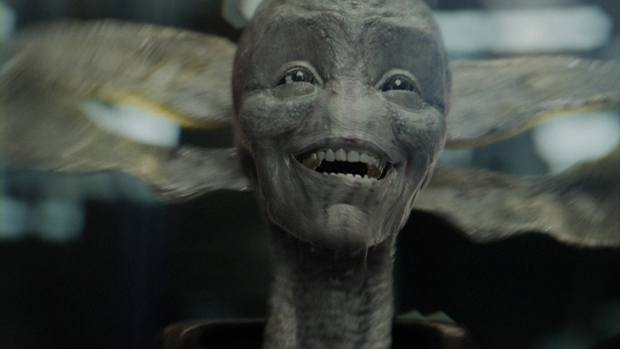
Defeating the Aliens


“The aliens are not evil, but they are here to eat us,” our main character replies to the first question the talk show host asks him. This contradiction draws some laughter from the studio audience, as they don’t understand the difference. “Do we consider the lion evil? Of course we don’t. When lions eat cute, baby antelopes, they don’t do it to satisfy some perverse love of violence. Anyone who thinks lions are evil is assigning their thought process to the primal actions of the lion, or they might watch too many cartoons. I agree with those who say that the aliens are not evil in the same vein, and I disagree with my colleagues on this note, but I can only guess that the lion’s prey don’t care what their intent is. We know the only reason lions kill is that they’re hungry. I think the aliens who landed on our shoes are desperately hungry, and they know we have meat on our bones. They just want to eat it. If you consider that evil, that’s up to you, but my bet is that the baby antelope doesn’t suffer their fate without, at some point, mischaracterizing the lion’s motive.”

The reactions the various players have to the main character’s appearance on the talk show ends up saying more about them than it does the main character, or the aliens. When the scientists and reporters attempt to interact with the aliens, soon after the shock and awe of their arrival subsides, they do so to understand why they’re here. They want to befriend them, and we follow their lead on the matter, because we want learn everything we can about them, so we can learn from them.

The aliens know their arrival is the greatest thing that has ever happened to us, and they know how much it excites us. They operate in good faith, in the beginning, and they focus on public relations to build trust with us to hide their real motives. When one of the reporters, assigned to cover the aliens, disappears, the aliens’ approval ratings suffers a dive. The public begins to suspect that the main character might be right when he suggested that the aliens captured her, filleted her and refrigerated her to take her meat back to their home planet.

“They had their eyes on that reporter,” the main character suggests, “because she had right combination of muscle and fat. My friends and I have studied all of the people who have gone missing since their arrival, and we’ve found no discernible patterns, other than they’re not too fat or too muscular. We think the aliens are eating those of us of a certain body mass index that contains a quality mix of fat and muscle. We think there are so many humans on earth that they’ve developed a finicky preference. They prefer those of us with a little fat to add flavor to our meat, in the manner a little fat flavors a ribeye steak. 

“Their initial landing was awe-inspiring,” our main character says on another talk show, “and I was as affected as anyone else by their initial messages, and their attempts to help us advance our science, but the number of missing people that followed alarmed me so much that I began studying them. It’s them, I’m telling you, they’re the reason we now have so many missing people. They’re filleting them, and refrigerating them to feed the starving population on their home planet. I don’t know why it’s so hard for us to accept this idea. Our water supplies have not diminished, nor any of our other natural resources, and I don’t think they’re here to build friendly relations between the planets, as they suggest. There’s no evidence to suggest that they’re here to breed with us, or any of the other things we’ve guessed aliens might want over the decades. So, what’s their motive? I don’t care what their public relations team says, we should still ask why they came here in the first place? We’ve heard them say they had the technology to come here decades ago, so why now? Why are they here? I think they regard us as food, and I’ve been trying to get that message out before it’s too late. As we sort through all these complex arguments regarding their intentions and motives, we forget Occam’s Razor, “All other things being equal, we may assume the superiority of the demonstration that derives from fewer hypotheses.” Simply put, the best answer is often the simplest.”

Most moviemakers line “alien attack” movies with hints of the adversary’s high-minded intelligence. The aliens, in these productions, are required to be of an intelligence we cannot comprehend, and they are of unfathomable strength and power. Our production would state that evidence suggests that power and strength usually counter balance one another in most beings. Is the lion smarter than the human is? No, but that wouldn’t matter in a one on one conflict. Is the body builder smarter than the average person is? Most are not, because we all focus on one pursuit to the usual detriment of the other characteristic. Thus, the alien cannot be of superior, unfathomable intellect and superior strength and power. Not only is it a violation of what I consider the natural order of things, it’s not very interesting.

Yet, even productions that try to have it both ways, be they sci-fi novels, movies, or otherwise eventually begin to train their focus on one of these attributes. If they depict the aliens as the literary equivalent to the bloodthirsty lion is this nothing more than a slasher flick? If they focus on the superior intellect, do they do so to achieve a level of complication that might lead to more favorable critical reviews? Whatever the case is, we now require our moviemakers to provide subtle hints of alien intelligence. The more subtle the better, as that makes it creepier. The moviemaker, as with any storyteller, might be feeding us the entertainment we want, but I don’t think so.

I think the quality moviemaker modifies his material in such a way that it provides subtle hints of the surprising and unusual intelligence of the aliens. They spool out hints of the aliens’ intelligence in drips to further horrify and mystify us. They do this to mess with our mind in a way that a slasher flick doesn’t bother doing. They want to creep us out and scare us somewhere deep in our psychology.

In our production, the aliens have developed powers that we cannot comprehend, but as with any decades-long reliance on a power, it comes at a cost. To explain this theory, the main character says, “Imagine if we could emit super gamma rays from our eyes, in the manner these aliens do. It would be a superpower to be sure, but it might lead us to neglect the intelligence we might otherwise employ in tactical and militaristic conflict. We might rely on those powers so much that it could result in a deficit of our intellect. I submit that even though these aliens employ some war-like tactics, they’re as intelligent as a lion and not as smart as we are. I think we can defeat them with our intelligence.”  

Every alien/monster movie eventually also eventually turns into an allegory about our inability to accept outsiders. In our production, the aliens would use our compassionate approach to outsiders against us. They are intelligent enough to put together a seductive war-like plan, and in doing so, they purport to support a cause that most humans adore. They don’t have a cause, but they know that we’ll follow them to our own demise if they cater to our heart correctly.

The reporters and scientists in every alien/monster movie are always correct in the designs they create for how we should approach and handle our relations with aliens. What would happen if they operated from a faulty premise? Everyone who employs the scientific method to resolve a crisis, approaches the situation with a question, does background research and eventually reaches a hypothesis. At what point in the attempts to prove or disprove that hypothesis, do we troubleshoot and find out if we approached the issue from a subjective or biased view? At what point, do we arrow back to the beginning on our algorithm and correct the question that led us to an incorrect conclusion? 

In our production, the reporters and scientists are operating from a flawed premise they develop as a result of their own biases and subjective viewpoints. The aliens enjoy that premise and begin building upon that narrative to sell it to all earthlings. These useful idiots inadvertently aid the aliens’ public relations campaign to soften us up. They discover, too late, that the less worldly main character’s simple truth that while the aliens are not as evil as their detractors suggest, they’re also not hyper-intelligent as the reporters and scientists theorized. The idea that they just want to eat us bears out, and we realize that if we all agreed to these facts earlier, we could’ve saved a lot more people. We all had a difficult time agreeing to the idea that we were of superior intellect, but once we did, we used it to defeat them. We used our intellect to nullify their superior force. We were elated with the victory, of course, but once life returned to normal, there was that sinking feeling that if we just ignored the reporters, the scientists, and all of the people who believed we should be more accepting of the aliens sooner, we probably wouldn’t have been victims of the worldwide slaughter that ensued. If we listened to the main character, and all of the people who supported his view, and we followed his simple strategy for attack, we could’ve saved a lot more lives.

Yesterday I Learned … VI


Yesterday, I heard a joke that suggested if we were to accept that the now decades old television show 24 as a realistic depiction of 24 hours of Jack Bauer’s life, we were going to need to see him go to the bathroom every once in a while. Everyone has to use the facilities every once in a while, this joke implied, and if we were going to accept the fact that Jack Bauer was truly human, the writers should’ve included a line like, “I know lives are on the line, Mr. President, and I’m well aware of the fact that every precious second counts, but I have to take a squirt.” The joke is funny, because it has an element of truth to it. We don’t need to know that Jack Bauer does this, of course, but if the show’s directors and writers seek a version of true reality, shouldn’t we see him relieve himself in some way?

It’s here now. Enterprising young directors heard that call, and they responded. Whatever remained of that artistic abstract, known as the fourth wall, is now coming down. These young and ambitious directors now force their actors to engage in the ultimate form of reality by relieving themselves on camera to indulge our desire for this ultimate form of reality.

Today, I realized that if a director asked me, twenty years ago, how far they should go to depict reality, I might have told them I’m all for injecting a sense of reality in various entertainment vehicles, and I might have encouraged them to pop whatever bubble they could find. I would’ve kept that advice general, of course, as I don’t know what I’m talking about when it comes to making visual productions, and I don’t know how to depict reality on screen. If that director then asked me what I thought an audience might think of seeing their favorite character squat on a commode, I would’ve told them that that’s probably a step too far. If they asked me if I thought hearing a character’s water hit the water might help audiences relate to their character better, I would’ve said, “No, I think most people accept the fact that the characters these actors are portraying are human, and while there are some elements you can introduce to provide some hyper reality on a cases by case basis, the idea that one uses the facilities is better left assumed. I also don’t think seeing or hearing bodily functions, adds to that sense of association or cements that bond any further.” It turns out some modern directors decided that I was wrong. When they depict a character vomit now, it’s not enough for them to provide the audio of the act or show the convulsions a body goes through in the act of vomiting. In the king of the mountain mentality of depicting reality, these directors decided that we need to see the chunks and fluid flow from the mouth. We can only guess that these ambitious directors heard the 24 joke, and they decided to heed the call that we need to see bodily functions if we are going to accept it as real. We’re not at the point, yet, where we demand to see waste move out of the body before we accept the fact it’s truly happening, but recent evidence suggests we’re probably not too far away.

Go to Your Room

Yesterday, I heard a great joke from Jerry Seinfeld. “The penal system we have is so American. ‘You do something bad, you go to a room. You think about what you did,’” Jerry Seinfeld said mocking the convention of our country’s archaic idea of imprisoning criminals. I don’t think I need to qualify my reply to Jerry Seinfeld by saying I think he’s a comedic genius. If the reader thinks I do, let me just say that I think there are but a handful of comedians who can put a clever spin on the conventions of daily life, or our societal conventions, on a level anywhere close to Jerry Seinfeld. How many comedians could take a large societal issue like the philosophy behind incarceration and associate it with the punishments our parents inflicted on us when we were naughty as kids?

Today, I thought about how much his clever and hilarious point misses the mark. Before I write anything further, let me also write that I understand that his comments are satirical in nature, and that satirists should not be required to debate their jokes or provide solutions. The first, obvious rebuttal I would make is that the idea of crime and punishment is not exclusive to America. Other countries, throughout the world in history, tried imprisoning those who committed transgressions against their fellow man, and that historical precedent worked so well that America adopted it. The second question I would pose to Seinfeld is, “If you were king for a day, how would you handle this whole idea of people committing crimes? And before you answer, remember that there are victims of crime, and there would be subsequent victims that could be harmed by your edicts.” The third, and related, point I would make is that lawmakers decide laws and appropriate punishments to provide cultural definition. We know we live in a ‘You do this, you go there for a certain amount of time relative to the crime and the nature of the crime.’ In a Representative Republic, we select lawmakers and judges to decide those laws and the subsequent punishments, and if we don’t like them, we vote them out of office and select another representative we believe better represents our views. Again, I know Jerry Seinfeld is a satirist who pokes fun at conventions, and this joke involves some healthy, insightful commentary on a situation that plagues our country, but I’d love to know how he might better fix what he calls our flawed system of punishment.

It’s Not about You

Yesterday, I borrowed a book from the library on the former Nirvana singer/guitarist Kurt Cobain, and his influence on music and society. About twenty pages in, I realized that this author was personalizing his narrative under the ‘Where was I when I first heard?’ theme. “I couldn’t believe it,” he wrote. “I was so shocked. We couldn’t believe it. I called friends I haven’t talked to in years, and we consoled one another.” Who cares, was my first thought, and I couldn’t shake that thought no matter how much further I read. I didn’t care about this author’s reaction any more than he would mine. 

I learned a valuable lesson, twenty pages in, if an author is going to write about someone or something we all know, their first job is to tell us something we don’t know. If an author is going to make it about the author to illustrate a point, that’s fine, as long as they employ the ‘get in, get out’ methodology to achieve a greater point. At some point in his long-winded narrative, the author made it obvious that his book was more about him than his subject. As far as I’m concerned, there is no fine line here. In this case, the author described his reaction to Cobain’s suicide to be part of the moment. I don’t care what the subject is, whether it’s fiction or non, I read with an ‘I don’t care what the author thinks’ mentality. A gifted storyteller might tell us what they think, but they should do so in a carefully structured method that leads us to think we thought it first.

As a reader, my advice to all authors is, don’t write about you until people care about what you think. Even then, the reason we might care about you is that you’re such a gifted writer that we never know it’s you telling us what you think. Today, I realized how difficult this is in the Twitter age. We make posts about our friends, our feelings about our friends, our feelings about our feelings, and the fact that we’re now at Arby’s. People tell us that they enjoy our posts, and we morph this into creative ways of telling everyone how everything is about us in one way or another. We continue doing so, until we are unable to make the separation necessary to write about our subject without including our feelings on the subject. Some suggest that it’s impossible to be objective, but there’s subjectivity and then there’s subjectivity. Some authors obviously think that when they begin writing about their feelings on a subject that their readers will appreciate their ability to be vulnerable on paper and that they will value their unflinching and refreshing honesty on the subject they’re addressing, and we might, if we cared about the author. If we cared about the author, we would’ve knowingly purchased their autobiography, their memoirs, or some catalog of their musings. If the author decides, instead, to write about someone that someone else might be interested in reading about, the author needs to remember that we purchased the book, because we thought it was about them, and no one is ever going to purchase a book about you, because not everything is about you.

The Media and the Coronavirus

Yesterday, I believed in a couple crackpot, Chicken Little conspiracy theories and some depressing doomsayer stories. I didn’t believe a majority of them, but I believed enough of them to recognize these theories for what they are. It took some embarrassment to reach that point. “You don’t really believe that do you?” friends and family would ask when I would repeat their drivel. It also took the humiliation of being wrong more often than I was right to help shape and form my beliefs system, but as I said in another post on this topic, I was eventually able to shed that skin.

We believe these theories because we’re afraid, and fear can be a good thing when we use it properly, as it can lead to self-preservation. A fear of heights, for example, can prevent us from going so high that we could get hurt. Some fears are irrational, such as a fear of alien attacks, sharks, and ghosts, but the brain uses fear to protect itself and the body. The 24-7 news outlets, and other companies that send out email blasts, also learned how to manipulate fear to get us to do what they want us to do, mainly tune in. They played on our fears to get ratings and clicks, and they did it so often that we were numb to it when they begin reporting on what we should fear for our own self-preservation.

How much of our time and fear did these networks and email blasters waste over the years on frivolous matters that would blow over by the end of the week? How many “News Bulletins” followed by exclamation points did they waste on stupid stories that had no relevance? How many people were afraid to invest their hard-earned dollars in the stock market? “Just wait,” rational minds advised, “this whole thing will blow over by Wednesday,” and so many of these Chicken Little conspiracy theories and some depressing doomsayer stories did. The market rewarded diligent investors, who ignored these stories, for their patience.

The job of various news outlets is to report on matters that require our attention. When they report on natural disasters, for example, we tune into their broadcasts for information on how to act and react. They know when we tune in, as do their advertisers, and the two of them join forces to develop, or enhance, subsequent stories to demand our attention. As any artist will tell you, a novice can enhance relatively meager paintings with shading and artistic framing. The 24-7 news networks often enhanced such relatively meager stories in this manner, until we begin believing every story is a national tragedy, and then we experienced burn out.    

I don’t know what difference it would’ve made, but I think we might have taken the coronavirus more seriously if they didn’t break us down with every over-hyped hurricane or political story that was going to end our country, as we know it. I also have a special place in the dark parts of my heart for the financial doomsayers who, for years, predicted the market would fall for whatever reason they dreamed up to get us to click on their emails.      

Today, I realized that the coronavirus is a full-fledged pandemic, and it took a lot of convincing to break through the thick, hard shell I developed to all of these Chicken Little, crackpot theories and depressing doomsayer stories. I don’t know about anyone else, but I had a threshold. By the time the coronavirus broke, some of my instincts told me that this might be different, but after being inundated by so many disaster stories that required my attention for so many years, I thought it would all blow over without too much pain. So, I direct some portion of the blame of my financial pain on all those crackpot, Chicken Little conspiracy theorist and depressing doomsayers who exaggerated every story to the point that they scared me. Over time, I found that the best course of action was to do nothing and to recognize conspiracy theories and doomsayers for what they are. If I believed one-tenth of them over the decades, there’s no way I would have invested my relatively meager savings into the stock market. I wouldn’t believe in America, and I probably wouldn’t have left my home. I didn’t believe the coronavirus was as bad as they were saying. I thought it was more 24-7 news bulletins on a story that would blow over like an over-hyped hurricane, and I now blame them for it.   

Yesterday I Learned … V


Yesterday, I learned that every job has its drawbacks. I learned this when I informed a group how much I now love green bean casserole, and one of my friends said, “I can never eat it again. The sight of it makes me want to hurl.” She explained to us that when she was a member of an Emergency Medical team, they received a call for an overdose. When on this call, she performed mouth to mouth on the victim, and the victim vomited into her mouth. He vomited the last thing he ate, of course, and that happened to be green bean casserole. Today I learned that while every job has its drawbacks, I don’t think I’d be able to become an EMT after hearing this. I come from a long line of strong stomachs. My dad spent a majority of his life eating Swanson’s Mexican TV dinners, and he lived a relatively long life. Yet, I have to imagine that if I was an EMT trainee, and one of the on staff veterans said, “This job has it’s drawbacks,” and they explained the possibility that while trying to resuscitate a victim I might get vomited into my mouth, “I’m out,” would probably my response. “It happens,” is something they might add, “and you have to prepare for that possibility.” If they, then, provided a visual anywhere close to the stomach-turning display in the season 2 finale of Amazon Prime’s Catastrophe, I think half the training class might politely stand and proceed to the nearest exit in an orderly fashion.

Yesterday, I thought about how many exciting opportunities I missed in life. I thought about how cautious I was, and I was cautious, too cautious at times. I probably didn’t have as many opportunities as I think I did, but some were undeniable. I didn’t cash in on them, I tried to avoid talking about them, and yesterday I tried to figure out why. Today, I realized that I based some of these decisions on the unique brand of crazy I knew they had deep inside their Cracker Jack box.

Some of us loved the unique taste of the molasses, caramel confection of popcorn and peanuts the Cracker Jacks company offered, but most of us did not. The flavor isn’t awful by any means, but if someone told the individual, who decided to package and ship the Cracker Jack product, that it would prove a sales juggernaut for over a hundred years, they would probably be surprised. When they heat the confection at a fair, or some outdoor venue that offers it fresh, the adoration for the confection is more understandable, but there was always a certain, stale taste to it in the Cracker Jack Box. Yet, as kids, we always asked for Cracker Jacks as a treat, because the prospect of a prize in each box was tantalizing. The prize often turned out to be as disappointing as the flavor of the super-sweet molasses-flavored caramel coated popcorn and peanuts, but the next time our parents offered us an open invitation to the store shelves, we chose Cracker Jacks again. “Candy-coated popcorn, peanuts and a prize” proved a provocative marketing slogan to those of us of a certain age who couldn’t wait for our surprise. Several other enterprises have taken the prospect of a “prize in each container” to greater lengths, but I don’t know if a company did more with less than the Cracker Jack Company and later Borden.

As we made our way out into the world, and we met a number of exotic and beautiful people, some part of our subconscious kept this disappointing allure of a surprise near the bottom of the package in some deep recess of our subconscious. We knew who these people were, and we found their special brand of crazy such a unique characteristic that we considered it engaging and endearing. Imagine, we thought, waking up to meet a new person, in the same person, every day. Chaos and unpredictability can be exciting in the short-term, and when we wrap it up in beautiful packaging, it can be difficult to remain rational. This idea that the surprises inside the box might be disappointing has always stayed with us. We don’t draw any correlations between this innate sense and the disappointment we experienced when we opened the Cracker Jack surprise, but Cracker Jack taught us this emotion well during the formative years of our life. If we ever have a chance to meet those exciting prospects, years later, it dawns on us why we decided to go with what we knew, as opposed to ceding to our impulsive desire to chase the prospects of exciting things. We learned that what makes us healthy, wealthy and wise in the long term is often more important than the prospect of surprising and exciting opportunities.

My kid said something political yesterday. He didn’t know what he was saying. He was repeating what he heard. Some might consider it cute when such a complicated thought comes out of a kid’s mouth. Some might not view statements with which they agree as political. I did, and I found it a little disturbing. Today I realized that I don’t want my kid to be political in any way. I’ve heard kids who have words put into their kid’s mouths by their parents, and it doesn’t sit well with me. Kids aren’t democrats or republicans, they’re kids, and I don’t think we should let our agenda get in the way of their childhood. We should consider it our job to make their childhood last as long as possible.

Yesterday I realized that some of us have problems answering direct questions with direct answers. “I’m going to place my question in the form of a question. Your job, if you choose to accept it, is to say yes or no. I don’t want to hear equivocations that contain sections and subsections of the “yes and no” answer. I don’t care if you’re right or wrong, or if I’m right or wrong. I don’t even care if your answer hurts my feelings. Just spit it out for the love of all that’s holy and unholy.” Today, I realized that when I answer direct questions in a direct way the recipient often misinterprets my answer. Their feelings get in the way, they dream up sections and subsections of my answer, and they think I’m wrong about everything all the time. After experiencing this a number of times, it dawned on me that most people answer our questions the way they want us to answer theirs.

Yesterday, I realized that other people don’t always have it better than me. My dad was one of those guys who thought everyone had it better than him. He could walk out of the most flea-ridden, dilapidated home with a week-long smile. “That’s the way to live,” he would say. Influenced by my dad’s thoughts, I revered his people. Even though most of them weren’t living the ideal life, I thought they had something going on that I wasn’t able to process yet. Today, I realized that most of those people were younger than I am now, and age tends to emulsify delusions. My dad believed in them though, so I believed in them.

Yesterday I realized my friend’s parents were younger than I am now when I first met them. I remember thinking that they had it all together, and they knew more about life than anyone I ever met. I believed my friend’s propaganda about his parent’s level of intelligence and success. Today, I realized I bought into all that because he did.

Yesterday I learned that when we have nothing to complain about we will find something. Today, I learned that one of the reasons we complain is that we’re not happy, and the idea that something new can make us happy often results in disappointment and more unhappiness. I also learned that buying things makes us happy, and when that happens begins to abate, we repeat the formula, until we realize we can’t buy happiness.

Yesterday, I learned that there is a blueprint to success, and it should be our goal in life to learn it and follow it. Some try to deconstruct and reconstruct that path in a contrived manner. They are rarely successful. Today, I learned that those who won’t follow it are afraid of the risks involved. “What if we fail?” they ask. I’m a firm believer in the fact that the greater the risk, the greater the success if one succeeds.

Yesterday, I learned that politicians are here to help us. Some of them devote their lives to serving in government. Today, I wondered how often we should be grateful for their lifelong devotion to public service, as it pertains to a representative sitting in one of our seats of government for 20+ years. Some might herald such a lifelong commitment, but I think we can all admit that serving in the federal government provides a representative an undue level of influence almost unparalleled in America today. I think we can also suggest that some 20+ year representatives fall prey to satisfying their own narcissistic will to power.

Yesterday, I learned how important it is to have a philosophy for just about everything we do. Today, I learned that we all have some advice to pass on. As someone who didn’t date as often as I could have, I’m probably the wrong person to turn to for dating advice. I didn’t enjoy dating, because I hated all the messy emotional entanglements. I didn’t want to get into a relationship, find out I didn’t like it, and end up hurting a girl’s feelings. On top of that, I avoided women I thought might end up hurting my feelings. My friends and family told me that I overthought the matter. I probably did. On the few dates I went on, I probably wasn’t very good at it. I enjoyed women learning more about me than I did about them. I have talked to enough people who loved to date and did it as often as they could, however, and the following is a list of advice I heard from them: 

1) Most of us are very insecure individuals and dating people reveals our flaws. The people we date will break our hearts and leave us as if we’re starting over, but it’s important to date as often as we can when we’re young.

2) Don’t marry the first person with whom you share a spark. The reason we love the stories of the high school sweethearts who stay married for thirty years is that they’re rare. I’ve heard some theorize that we’re so different every ten years that we’re almost completely different people. I’m not sure how true that is, but there’s enough truth to it that if we marry a person who isn’t willing to change with us, it can get messy and result in a messy separation.  

3) A friend of mine came from a culture of arranged marriages. She said she believed arranged marriages were the ideal way for young people to marry. We didn’t agree with her, but she had an interesting point, “We don’t make quality decisions when we’re young. Our parents not only view matters from a perspective outside romance, but they’re wiser and they have more experience.” Most of us stated we wouldn’t want to see what our parents pick for us, and we thought we were wiser and more experienced than our parents were. This conflict introduced the strange mixture of confidence and insecurity we had when we were young. We’re confident that we know more than our parents do, and we have a general sense of arrogance in this regard, but we’re so insecure about our choices that we tend to stick with the one who brought us.

4) We shouldn’t stay in a relationship for the sole reason that we’ve invested so much time, effort, and emotion into it that we don’t want to start over again. We’ve all been burned, and we remember that when things start to go awry with our current significant other. We don’t break up with them, because we don’t want to go through that turmoil again.

5) “I didn’t enjoy dating either,” one person said, “but don’t make the mistake I made of thinking that you might be letting the right one slip away.” Such an admission is always uncomfortable to hear, and we’ve all heard some people openly admit it, but we rarely hear it when the significant other is listening in on the conversation.

6) Date the good the bad, and the ugly. That trail will help us make an informed decision when we think we’ve met “the one”. When we date, we see qualities in another that we enjoy in some and those we don’t in others, and we learn a lot about ourselves along the way.

7) Date with the mindset that you know nothing about the other party. Those who experience success in any field learn to focus on what they don’t know as opposed to what they do. We should use this mindset when it comes to dating. We should enter into every relationship with the mindset that don’t know anything about the other party of a relationship, except the qualities that they enjoy sharing with us. Most of the people we date aren’t dishonest in the sense that they’re lying or being phony, they’re just their best self when you’re around.

8) Meet their friends and family and watch how they interact with them. How different are they around their people? Are we seeing the person they are around their friends, or are we gaining quality insight into who they are? What are the differences between the person we know and the person their friends and family know?

9) Introduce your significant other to your friends and family. When we’re young, we walk around with an “I don’t care what anyone thinks” mentality. Dump that in these encounters. If they find faults with our significant other, our initial instinct is to suggest they don’t know them as well as we do. That’s going to be true, but is there anyone who cares more about the decisions we make than our family? As someone who has lost a number of intimate family members who cared about me, I now know what a precious commodity they are in life. It doesn’t mean they’re right of course, but their perspective is one we should value. Also, know that most of our people are not jealous, and they aren’t overreacting. They know that we’re proud of this individual we selected, but they care about us, and they don’t want to see us make what they regard as a mistake. Is it a mistake? They don’t know, and we don’t know, but our best bet is to make an informed decision.  

10) If the relationship moves into a more serious phase, take a vacation with them to take them out of their element. Watch how they act around flight attendants, waiters, and hotel staff. How do they react to unnecessary delays, cancelled hotel reservations, hotel amenities, and all of the other mishaps that happen on vacations? 

11) The final, and perhaps most crucial question, who are we around them? Are we putting our best foot forward? We all develop a façade of sorts around the people with which we spend significant amounts of time. We are different around them than we are our mother, for example, or our best friend. Do we like the people we are around them, and if so why? If not, can we change that persona, and if we do, will they still like us?