Influences: John Irving, Stephen King, Chuck Palahniuk, Raymond Carver, Larry David, David Bowie, Mike Patton, and Ayn Rand.
Style: Short sentences, easily readable, and little in the way of description.
Genre: Information, humor, and psychological interpretation.
“Excuse me,” a customer calls out to a server. “I ordered a roast beef sandwich, and I believe my slices are insufficient.” Has this ever happened? Has a customer ever called a server back, with bread pealed back, to inform a restaurant employee that they need more slices? I know it has. I know if I interviewed a number of servers on this topic, they would tell me to sit down before they began their tales, but I’ve never witnessed it firsthand. The more common complaint occurs in whispers long after the server walks away, as most of us avoid confrontation and situations that could draw attention to us. Most of us quietly cede portion control to the restaurants we choose for our dining experiences.
“MORE? You want more?” a Dickensian character might say in a manner that drops a proverbial spotlight on us. When we go to an established franchise we’ve learned to accept their nationally accepted portion control, but do we accept the same norms from an upstart mom and pop’s deli at the end of the block? Anyone who has worked at a restaurant has heard a wide array of complaints from customers, but how many hear that the portion of meat on a sandwich is too small, or that there aren’t enough fries? Would we deem that so bold as to be obnoxious? It might seem like such a violation of sorts of our conditioning that we might view the complainant as gluttonous?
Franchise websites suggest that portion control is vital to establish a level of consistency in a national chain, and they discuss the health benefits of lesser portions for the consumer and the profit potential for franchise owners. “Customers don’t complain about more portions,” they write, “but they will certainly complain about less.” I realize that writers of such columns have franchise owners in mind when they write such things, but I’ve never heard customers openly complain about less.
How many ounces of roast beef should we expect when we purchase a roast beef sandwich? Is there a generally accepted or preferred amount? How much does it vary with each restaurant? We could look this amount up, but the actual number is relatively unimportant when compared to our expectations. It’s a ‘we know it when we see it’ amount that varies, and if the restauranteur violates that principle most of us simply go to a restaurant that meats (sic) that expectation.
If the restaurateur notices our absence and finds a way to ask us why we left, they might say, “Well, why didn’t you say anything? We could’ve provided you a couple more ounces of roast beef to make you happy.” The problem for most restaurateurs is that most of us are members of the silent majority who don’t complain. We don’t fill out suggestion cards or comment cards, then we tell the cashier that everything was fine when they ask how our meal was, and we never go back. We also whisper things to our friends that close restaurants down.
If it benefits all parties concerned to speak up, why don’t we? As with just about every adult predilection, it goes back to high school. We see the hungry patrons in line behind us at the deli, and we remember the groans, fidgeting, and ridicule we heard when we asked one too many questions in our Algebra II Trig class. Even if we still didn’t understand the teacher’s explanations, we learned to shut up and stop asking so many questions. Our peers’ audible fatigue conditioned us to stop asking questions, don’t appear difficult in any way, and avoid complaining. Thus, when we feel the hungry patrons behind us, who just want us to move along so they can get their sandwich, we do. Even though we’re not satisfied, we shut up and move along to avoid causing a scene, and some of us do this so often that we start ceding portion control to the restaurant.
How many customers prevent a waiter from leaving their table with the complaint, “I only have four broccoli florets on my plate, I’m accustomed to having five?” How many people would say, “I’m accustomed to a half a cup of mashed potatoes. Does that look like a half cup to you?” The more likely complaint would be, “I ordered the eight ounce steak, but this looks like six ounces to me.” I’m sure there are some who complain about this portion control restaurants have on us, but I have to guess that that percentage of the population is so small that it’s hardly representative. The rest of us know that they’re in charge, and we’ve learned to accept this facet of life.
Most complaints lead to a manager visiting our table, and that manager brings a proverbial spotlight with him. When that manager kneels before our table that we’re being difficult, and we experience the same anxiety we did in Algebra II Trig. “It’s not a big deal,” we say to attempt to soften the blow, “I just thought I should get a couple more slices of beef for my roast beef sandwich.” I’ve witnessed some go bold in the face of a one-on-one with a restaurant manager, but most people shrink from the magnitude. We don’t want to appear difficult. The manager might consult a franchise advisor, as I’m guessing that a person complaining about portions happens so infrequently that they don’t have a standard operating procedure, but my guess is that the manager does whatever he has to do, under the “customer is always right” imprimatur to make us go away.
The inclination most restaurants might have to avoid such stated and unstated complaints is to go “bigee” on the portions. I witnessed this as a deli employee at an upstart, now defunct bagel shop franchise. The national chain decided to allow an owner to open a franchise in our area, and they apparently believed that their key to success was bigger portions. They never said that they wanted to compete with the portions Arby’s provided, but that was my takeaway. They provided over-abundant roast beef portions on a bagel sandwich. I was a dumb kid who didn’t know anything about market testing, or any of the particulars franchises uses to establish themselves in a given area, but when I took my first bite of their roast beef sandwich, all of my fixins fell out the other side. The sandwich was excellent. The roast beef was so tender, and I thought all of the other fixins were fresh and tasty, but their portions were so large, on a comparatively weak bagel, that everything fell out the other side. I told the owner of this particular franchise that I thought it gave the sandwich a sloppy presentation.
The manager lifted an eyebrow on me, but he said nothing further. I thought he totally dismissed my observation, until the franchise advisor walked in the bagel shop, days later, to see how things were going. My manager encouraged me to ask my question. I repeated my question, and I added, “We’re a bagel shop. My motto would be if you want more meat go to Arby’s.” I said that the bagel shop didn’t have to say such things openly, but that it should be our M.O., and I said that I thought bagel shop patrons would understand that, even expect it, before they set foot in our restaurant.
We all enjoy eating out at restaurants, but how much of our enjoyment of the food centers around presentation? How many of us would be turned off by a sloppy sandwich at an otherwise clean bagel shop? I told the franchise adviser that I thought portion control, and the art of presentation were everything. I said that a patron of Arby’s might find a sandwich overflowing with meat more attractive, whereas a bagel shop patron is more likely to prefer a clean presentation that appears more structured, regardless of the portions. To me, it was all about demographics.
I’m sure that their insider information told the owners of the franchise that if they wanted to open a location in the Midwest market, they had to increase their portions, but my gut instinct told me that if you’re going to increase portions, make a larger, stronger bagel. The bagel they sold did not adhere to the illusory notion of portion control, and when the bagel shop went out of business in our area, I felt vindicated.
Before the Boston Red Sox won the World Series in 2004, Red Sox fans talked about something called The Curse of the Bambino, as if it was a real thing. Chicago Cubs fans talked about a billy goat and Bartman, and various other sports organizations’ fans developed their own myths for why the guys on their team couldn’t defeat the guys on the other team. No myth, in my lifetime, would prove as popular, or as profitable, as the The Curse of the Bambino however. Most people who watched baseball know of the sale of the greatest athlete of his generation, Babe Ruth, from the Red Sox to the Yankees, and it might be the one myth that has any merit, albeit in the short term.
At the point of sale, the Red Sox won five World Series, and the New York Yankees hadn’t won one yet. After the sale of Babe Ruth in 1920, and up until 2004, the Yankees won 26 World Series and the Red Sox didn’t win any. More important to this myth, the Yankees won four World Series between 1920 and 1932, with Babe Ruth, and the Red Sox weren’t even in contention. As anyone who knows anything about sports knows, winning breeds winning, and the Yankees went on an unprecedented run between 1936 and 1962 that some Red Sox fans attributed to the sale of Babe Ruth.
Was it a mistake to sell Babe Ruth, or do we fail to understand the logistics of the time? Most of us have experienced a bout of insomnia after making a crucial mistake, but how many of us have made a mistake so crucial that we couldn’t shake it? Most of us are blessed with a short-term memory, and we forget. We’ve all made mistakes though. We’ve made errors in judgment based on uninformed choices, and dumb decisions that seemed so right at the time. Most of us are able to move on in life, even after making decisions we deemed catastrophic at the time. Most of us have never made a decision, or series of decisions, that proved so catastrophic that people will be talking about them nearly one hundred years from now. Most of us have never had others characterize our mistake as one of the worst in human history. Other than those decisions made by the players involved in the Black Sox Scandal, there might only be one person, in baseball, who continues to be mocked, ridiculed, and derided over one hundred years after he made a series of historically poor decisions.
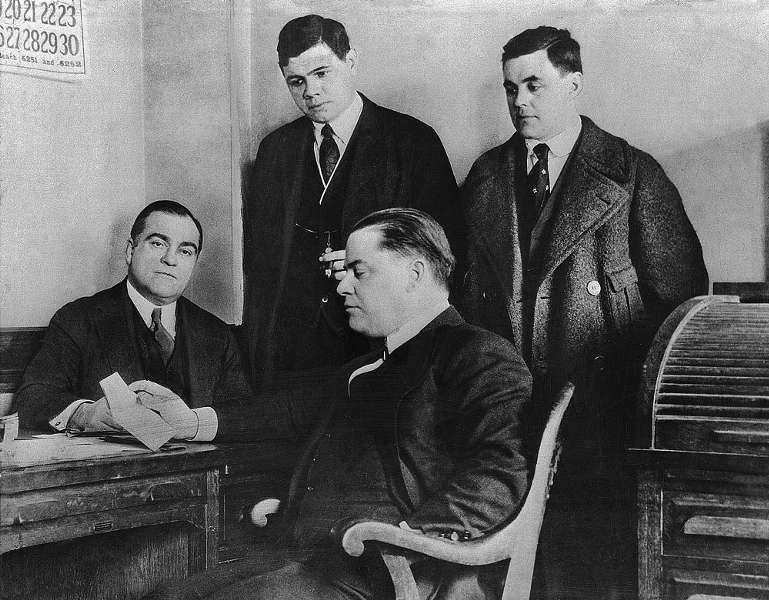
Ed Barrow, Babe Ruth, and Harry Frazee
Harry Herbert Frazee (June 29, 1880 – June 4, 1929) was an American theatrical agent, producer, and director, and he remained relatively successful in this field until the day he died. He also happened to be a successful boxing promoter who once landed one of heavyweight champion Jack Johnson’s matches. Harry Frazee then bought the 1915 and 1916 World Series champion Boston Red Sox, who won the 1918 World Series for him. After that World Series, Frazee sold a player who helped the Sox win those three World Series championships and the 1912 World Series championship. That error in judgement might’ve haunted any other normal man, but it was only the start for Harry Frazee. He proceeded down this road, selling and trading almost all of the best players on those teams. Yet, for all of those moves, and the successes of Harry’s life outside baseball, many believe his tombstone should read, “Here lies Harry Herbert Frazee, the man who sold Babe Ruth.”
Most writers love to write provocative articles from an angle no one has ever considered before. We enjoy taking a well-known story and providing a non-traditional angle on a story that opens our readers eyes to “the other side”. The other side of the story we now call The Curse of the Bambino involves a suggestion that the conditions surrounding Harry Frazee’s sale of Babe Ruth to the Yankees were a lot more complicated than most people know. The author of such a provocative article is then obligated to back up his assessment with data that supports his thesis. This thesis becomes more provocative when the author can provide data that most people don’t know.
The Curse of the Bambino, the book, suggests that the sale of Babe Ruth from the Red Sox to the New York Yankees prevented the Red Sox from winning the World Series from the point of sale in 1920 to the publication date of Dan Shaughnessy book of the same name in 1990 (the Red Sox finally won the World Series in 2004). Some of the authors, who attempted to write the other side of the sale of Babe Ruth and eight other players from the Red Sox to the Yankees, looked at the data from a baseball perspective, others chose a financial lens, and some had slide show presentations that suggest while history will never judge Harry Frazee kindly, the reactions to his sales and trades were evenly divided among fans and sportswriters at the time.
Anytime an author suggests a matter is far more complicated than we ever knew, our natural inclination is to weed through their narrative to find simple truths. One simple truth that permeates all of the articles written on this topic is that Harry Frazee made historical mistakes, and those mistakes led to the Yankee dynasty of the 1920’s and the early part of the 1930’s.
Another simple truth that is all but impossible to ignore is that the Red Sox won three World Series in four years before the sales and sale/trades, and they finished no higher than fifth in the thirteen years following the sales/trades. Other than a blip in 1925, a year in which Babe Ruth was injured, the Yankees finished no lower than third in their league, and they won seven pennants and four World Series championships over the same thirteen-year period, following the trades and sales. Another fact that’s impossible to ignore in all of the data is that among all the players involved, there were three people most responsible for this shift in the balance of power, Babe Ruth of course, Harry Frazee, and former Boston Red Sox manager-turned-New York Yankee business manager (general manager) Ed Barrow.
Those of us who enjoy reading authors take those simple truths and attempt to provide another perspective on them, enjoyed the article written by Glenn Stout titled Harry Frazee. In this article, Stout writes that TheCurse of the Bambino, and the subsequent demonization of Harry Frazee, was largely a myth created by writers to help Boston Red Sox fans explain their team’s disastrous loss to the Mets in the 1986 World Series. The thesis of the TheCurse of the Bambino was there was no other way to describe that inexplicable loss. Stout writes that 1986 Red Sox fans were looking for someone to explain the inexplicable to them. They wanted a scapegoat, and they found one in Harry Frazee. His actions, over sixty years prior, allowed them to think there was more going on than some clutch hitting by the Mets, and an error in game six of the series that led to the Red Sox defeat that year. It was, of course, the ghost of Babe Ruth haunting them.
Stout writes that Harry Frazee was not a greedy owner who wanted money more than a successful franchise. He writes that Frazee was independently wealthy from an early age, and he died that way. He also writes that Frazee was a wealthy and successful man before and after the trades that depleted the Red Sox and built the Yankees eventual dynasty. He writes that when Frazee died, a majority of the fan base, a majority of the sportswriters, and a majority in baseball didn’t hold him singularly responsible for the fall of the Red Sox. He states that while history might make Frazee appear incompetent, the reality of the situation that occurred during the 1920-1923 period was a lot more complicated than most people know.
To illustrate his point, Stout wrote a book with Richard A. Johnson called Red Sox Century, in which they provide a note Harry Frazee wrote to explain that the sale of Babe Ruth was based on Ruth’s contractual demands, and “[Ruth’s] disruptive influence on the team, and the fact that [Ruth] had “jumped the club” at the end of the 1919 season.” In the book, they also provide Frazee’s frustrations with The Bambino:
“While Ruth without question is the greatest hitter that the game has seen,” Frazee wrote in a 1,500-word statement. “He is likewise one of the most inconsiderate men that ever wore a baseball uniform.”
The Red Sox owner said Ruth had “no regard for anyone but himself” and was a “bad influence on other and still younger players on the team.”
He continued: “A team of players working harmoniously together is always to be preferred to that possessing one star who hugs the limelight to himself. And that is what I’m after.”
The sale of Ruth aside for a moment, Glenn Stout attempts to defend the fire sale of the other eight players by writing that the minor leaguers the Red Sox received in those subsequent trades didn’t pan out, as some of them suffered career-ending injuries.
Injuries are a part of the game, of course, and they can make owners and General Managers look bad when they make deals for players who were injured so early in their careers that they appear anonymous to history. This attempt to defend Frazee is valid, until one asks the question how many minor league prospects end up reaching their full potential? How many minor league prospects weren’t as talented as scouts projected, how many were unlucky with injuries, and how many simply didn’t have the drive to pursue their talent to its fullest extent? Whatever that answer is, it surely pales in comparison to the prospect of whether or not the players who played a primary role in at least one World Series victory if not three, might succeed. Stout does not specifically address this particular idea in his defense of Frazee.
Stout also writes, “no one could know that Babe Ruth would become Babe Ruth”. Fair enough, but at the point of sale in 1919, Ruth played six seasons for the Red Sox, and in that brief span, he set the record for home runs in a season twice, and he led the league in eight different batting categories in 1919, the year before Frazee sold him. He was also a dominant pitcher early in his career, before he switched to hitting.
As one of his peers, Rube Bressler said in his interview for the book The Glory of Their Times “[Ruth] played by instinct, sheer instinct. He wasn’t smart, he didn’t have any education, but he never made a wrong move on a baseball field. He was like a damn animal. He had that instinct. [Animals] know when when it’s going to rain, things like that. Nature, that was Ruth!”
Stout’s point that Frazee couldn’t know Ruth would be one of the top five players of all time is valid, but it sounds like if Frazee wanted to know the potential The Babe had to be great, all he had to do was ask around. Some of those who provide an alternative view of this story suggest that Frazee saw how undisciplined Ruth was, and how unintelligent he was, and he figured that Ruth’s 1919 season was a peak performance, and he wanted to receive peak value for his services.
Stout, and numerous others, state that the previous owner of the Red Sox was calling in Frazee’s loan, and that Frazee was in a tight spot financially. If Frazee didn’t pay the loan back that year, he might have lost the franchise. Yet, Stout and others assure us Frazee was never personally broke and none of the sales between the Yankees and Red Sox involved Frazee’s attempts to enrich himself personally. If that’s the case, and I appreciate the author’s attempt to dispel this notion, I cannot understand the deals Frazee made with the Yankees following the Ruth sale. If those latter deals involved Frazee’s continued efforts to save his franchise, one would think he might dip into his considerable personal finances and help the Red Sox over a temporary blip. I prefer to think, as Daniel R. Levitt, Mark Armour, and Matthew Levitt write, that Frazee became addicted to making deals with the cash rich Yankees to help him resolve the Red Sox short-term debts and help make the Red Sox franchise more profitable for him.
Those of us who know history, cannot put blinders on. No matter how many alternative “time and place” perspectives various writers put before us, we know that Frazee sold Ruth for money, and no matter how much money he received from that sale, it paled in comparison to the money Ruth would’ve eventually generated for Frazee, and the Red Sox, in the coming years. Stout’s argument that, “no one could’ve known that Babe Ruth would’ve become Babe Ruth” is a decent one when we think about how many could’ve been should’ve beens dot baseball history, but Frazee received $100,000 and a loan of $300,000 from the Yankees for the services of Babe Ruth.
At this point, and I think this is crucial to determining how Frazee sold Ruth to the Yankees, we can speculate that this wasn’t the initial offer from the Yankees, and we can guess that Frazee and his people tried to drive that initial offer up by detailing for the Yankees Babe Ruth’s current, 1920 market value versus a detailed prospective forecast on Ruth’s future and marketable prospects to drive that price up further. We can speculate that in those dark room negotiations, Frazee and his people displayed intimate knowledge of Ruth’s current and future market value to persuade the Yankees to pay more for Ruth than any major league franchise had ever paid for a single player before. Other reports from baseball insiders of the day state that many around the league considered the Yankees fools for paying that much money for one player, and we can only guess that the Yankees initially considered Frazee’s proposed price tag insane, how did the Harry Frazee and his advisors convince the Yankees to pay that much?
Harry Frazee tried to feed into this with his explanation for selling Ruth, “With this money the Boston club can now go into the market and buy other players and have a stronger and better team in all respects than we would have had if Ruth had remained with us.” Sportswriters and fans believed this at the time, for they probably shared the sentiment that one man does not a team make. With the amount of money the Yankees were paying, many inside baseball thought Frazee got the better end of the deal, but no one could’ve predicted how addicted Frazee would become to using the Yankees’ money to escape debt. No one, it seems, except Ed Barrow.
***
Ed Barrow
Authors Daniel R. Levitt, Mark Armour, and Matthew Levitt introduced this name Ed Barrow to us in an article titled Harry Frazee and the Boston Red Sox. Ed Barrow, they state, played a prominent role, perhaps the most prominent role, in the sales/trades the Red Sox made to the Yankees following the sale of Babe Ruth.
“[Glenn] Stout and [Richard A.] Johnson claim that Frazee made sound baseball deals with the Yankees and that he could not have foreseen what the trades would do for either club,” Daniel R. Levitt, Mark Armour, and Matthew Levitt write. “This argument does not hold up. Ed Barrow, manager of the Red Sox from 1918 through 1920, left the Red Sox to become general manager of the Yankees. Barrow knew the Red Sox players as well as anyone, and he spent the next few years grabbing all of the good players, like future Hall of Fame pitchers Waite Hoyt and Herb Pennock, catcher Wally Schang, shortstop Everett Scott, third baseman Joe Dugan, and pitchers Joe Bush and Sam Jones, among others. In fact[,] Barrow liked his former players enough that he got the Yankee owners to give Frazee $305,000, convincing evidence that both teams agreed that the talent [from the trades] was imbalanced. To argue that Frazee made good deals is to suggest both that Barrow and the Yankees somehow lucked into their dynasty and that the money was not the central piece of the deal for Frazee.”
In my opinion, the answer to the many questions we have regarding why Frazee sold so many players to the Yankees revolves around the question why Ed Barrow quit his job as Red Sox manager to become the business manager (general manager) of the Yankees? An answer to that question involves the insider information Barrow had about Harry Frazee, the debt the Red Sox were experiencing in those years, and how Frazee planned to resolve that debt.
Before Ed Barrow left the Red Sox in 1921, we can assume that for most of his three year tenure, he was satisfied to be the Red Sox manager, and that if it were up to him he would’ve spent the rest of his baseball career as their manager. He led the Red Sox to the 1918 World Series championship after all. When Frazee sold The Babe, it probably came as a shock to Barrow, but we can guess that Frazee sat him down and explained to his manager why the sale was necessary. When Frazee sold four more players, we can guess that Barrow required a more detailed explanation, as Frazee opened the books for him to show the manager the finite details of the debt Frazee incurred as owner of the Red Sox. This moment, right here, resulted in the changing of the tide in baseball more than any other. We can be sure that Frazee and Barrow had many such talks over the years, and that Barrow walked away knowing that Frazee desperately wanted to make the Red Sox financially profitable, and/or he fancied himself a wheel and dealer who could build his own winner, as opposed to inheriting one.
Ed Barrow also knew, as many did at the time, that due to the “Black Sox Scandal” and Frazee’s disputes with American League Bam Johnson and the other teams in the American League loyal to Bam that Harry Frazee was limited to dealing exclusively with the Yankees. (Note: There is a consensus among the writers of the articles I read on this particular topic that these circumstances forced Frazee to deal exclusively with the Yankees for that reason. The idea that Frazee and the Red Sox could have dealt with a team in the National League is not mentioned in any article I’ve found, and there is no reason listed for why this wasn’t a possibility for him.) Whatever the case was with Frazee, we can also presume that in his closed-door meetings with Barrow that Barrow saw the writing on the wall for the Red Sox franchise, and his owner’s willingness to sell his team down the river for large sums of cash.
As anyone who has experienced debt knows, if we find one way to resolve some of our debt, we are prone to follow that path wherever it leads to hopefully become debt-free. Barrow may have experienced some disgust when Frazee began selling his 1918 World Series Champions, but he was probably one of the few who knew the situation so well that when the Yankees general manager died in 1920, Barrow probably raced down to the Yankees front office to pitch them on how he, if hired as their next general manager, could persuade Frazee to sell more players to the Yankees and help them build a dynasty.
As the new business manager (later termed general manager) for the Yankees, Ed Barrow helped the owners of the Yankees engineer four subsequent trades with Frazee and the Red Sox that involved 12 players and $305,000 “to help Frazee recover from debt”. As the Levitts’ and Armour article suggests, the idea that Barrow convinced the Yankees to add $305,000 to the deal provides compelling evidence that both teams knew the Red Sox were getting the raw end of the deal. If we are to believe the writers who write from another perspective, it’s simplistic to say that Frazee made these maneuvers for the money, and “the reality of the situation was a lot more complicated than most people know”. If he didn’t need the money, as they write, and it was his goal in life to continue to own a profitable, winning major league baseball franchise, then he was either an incredibly poor business man, or someone who did not know baseball very well. Whatever the case was, Barrow knew who he was dealing with, and he knew how to convince Frazee to sell/trade twelve more players to the Yankees.
When Barrow’s new team, the New York Yankees, won their first World Series two years later, in 1923, four of the eight starting, position players were from the Red Sox, and four of the five starting pitchers on that championship roster were former Red Sox players. The Red Sox finished last in the American League that year, and “their skeletal remains would be the doormat of the league for years to come.” With this team of former Red Sox players, Barrow would oversee the Yankees win six more pennants, and three more World Series. During his tenure as general manager, the Yankees would win a total of fourteen pennants and ten World Series. This level of success, initiated by Barrow’s maneuvers with Frazee, would lead many to call Barrow an “empire-builder for the first quarter-century of the Yankees’ dynasty.” These sales/trades also landed Ed Barrow in the baseball hall of fame and Yankee Stadium placed a plaque of him in center field.
As Harry Hooper, the center fielder for the ‘15,’16, and ’18 World Series champion Red Sox, states in an interview, in the book The Glory of Their Times, “The Yankee dynasty of the twenties was three-quarters the Red Sox [dynasty lineup] of a few years before. All Frazee wanted was money. He was short of cash and he sold the whole team down the river to keep his dirty nose above water. What a way to end a wonderful ball club.
“Sick to my stomach at the whole business,” Hooper added, as he followed Ruth’s hold out with a hold out of his own just to get out of Boston before it all came crumbing down. After the holdout, Frazee sold Hooper to the Chicago White Sox.
It would be devastating to any franchise, of any sport, to sell one of the top players of his era, who would go on to become one of the top five greatest players to ever play the game. Yet, even selling a once-in-a-generation talent like Babe Ruth is not enough to sink a franchise for eighty-four years, in the manner The Curse of the Bambino suggests. It’s even difficult to believe that Ed Barrow taking advantage of Frazee to the point of selling/trading twelve other players over the course of three years can curse a franchise for that long, but winning breeds winning. In the course of those eighty-four years (1918-2004), the Red Sox did have some high quality, competitive teams. Various Red Sox teams won division titles, pennants, and they competed for the World Series in 1946, 1967, 1975 and 1986 only to fall short. The Yankees, of course, would win 26 World Series championships in the same time-frame, and they would appear in 39 World Series. Many of those Red Sox teams were unlucky, but unlucky is difficult to grasp when it occurs over the space of eighty-four years and the score with their cross town rivals is 26-0 in World Series championships. Some people need an explanation, any explanation that would explain the bizarre plays and unlucky events that lead to a championship drought, and the 45% of the population who believe in ghosts thought they found that reason in Babe Ruth, Harry Frazee, and The Curse of the Bambino. Now that it’s over, and the Boston Red Sox soaked the curse for all that it was, what do Red Sox fans talk about now that the franchise has won the World Series four times since 2004?
Why do certain chores feel more time consuming when we do them a different way? If we mow the lawn in a different pattern, chances are it will still take around 45 minutes if everything else remains constant. We thought if we mowed in a different direction, it might shave a couple minutes here and there, but it doesn’t. The perimeter equation of a rectangle remains constant regardless how we do it. Our primary goal was not to shave minutes. It was to do this tedious chore different. We don’t get too far into the mow before it dawns on us that this tedious chore appears to be taking longer. It isn’t, and some part of us knows it isn’t, but we can’t shake the perception. On those occasions when we mowed in our typical pattern, it flew by because we were probably sleepwalking through it. How many typical patterns and routines do we sleepwalk through in this manner? How many times do we wake up with the realization that it’s July, and we forgot to appreciate the beautiful month of June for what it was. How many times do we realize that we’re almost fifty, and we forgot to appreciate our forties for what they were? How much time do we lose following typical patterns and routines?
I saw a bunch of bright yellow bananas in a supermarket bin on Monday, and I couldn’t wait to sink my teeth into its brand-new solidity. I thought about that first bite a couple times in the store, and on the short drive home, but by the time Tuesday rolled around, I realized I slipped Monday’s banana into the routine of eating breakfast that Monday. I normally eat two eggs, toast, and I drink a glass of orange juice for breakfast. Then I top it off with a banana. I absently ate that banana as part of my breakfast routine, and I totally missed its freshness. When I bit into Tuesday’s banana, it was delicious, and I tried to appreciate it, but I couldn’t help but think about how much more fresh and delicious that recently purchased banana might’ve been if I remembered to appreciate it.
Most of us hate to admit that our lives have fallen into patterns and routines, but to those who might argue that they’re an exception, I say add a dog to your life. Dogs spend so much of their lives studying our patterns that when they peg them, they can often tell us what we’re about to do before we decide. On that note, my primary takeaway from the movie My Dinner with Andre was that we should try to break routines and patterns whenever we can. If we can break a couple of rituals one on day, we might feel more aware of one Monday before we turn fifty. In that movie, one of characters talked about opening the door with his left hand for a day or two just to break that routine in a way that might lead to other breaks. The gist of that exchange was that we have so many patterns and routines that some of the times we accidentally sleep walk through life.
One of the best ways I’ve found to avoid falling too deep into routine is a grueling workout. I’m not talking about a simple workout, because some of the times we workout so often that working out becomes nothing more than a part of our routine. I’m talking about a grueling workout that leaves the buns and thighs burning, and when the buns are burning, the brain cells are burning just as bright. This idea led me to believe that a grueling work out might provide a brief, temporary cure to what ails us.
When too many Mondays melt into Tuesdays without notice, the best way to break the routine is to push our body beyond our otherwise lazy boundaries. If we’re feeling excessive fatigue, we can burn our brain and body bright with a long and grueling workout. I’ve expressed variations of this cure so often that some people say it before I do, to mock me for routinely advising that this is the ideal way to break up routines. The footnote I now add to that routine advice is before we put our mind and bodies through a rigorous workout, we need to make sure we’re happy first. It doesn’t happen after one grueling workout, of course, and it might take a regular routine of three workouts a week, with at least one grueling workout mixed in, but after a while, we might start to become more aware of the choices we’ve made in life. We need to make sure we’ve attended to life’s matters, because the acute awareness grueling workouts provide can make us happier than we’ve ever been, but they can also make us angrier and more depressed. If we have dotted our I’s and crossed out T’s, a grueling workout can cause us to appreciate life a little more than we did yesterday, but it can also lead to some painful critiques.
I’ve snapped at people on a Tuesday for something that didn’t bother me that Monday, and the only difference was I had a grueling workout the night before. My various computer chairs were comfortable for years before I decided to discipline myself to working my buns rock hard. I’ve always liked Peanut M&M’s, but after a couple of grueling sessions, I considered the candy so delicious that I thought of eating them by the pound. I also realized how unproductive my job was in the grand scheme, how fraudulent my bosses were, and how I had little to no home life to look forward to once my excruciatingly slow workday ended. The grueling workouts made me more aware of the little things life has to offer, and some of them made me happier, but others made me so angry and depressed that I realized one of the reasons that people drink so much and smoke so often is to dull their brain to a point that they don’t question the choices they’ve made in life.
The mantra of patterns is, “If at first you don’t succeed try, try, and try again.” An addendum to this quote, that some attribute to W.C. Fields, suggests, “If at first you don’t succeed, try, try—and then quit! No use being a fool about it.” A quote by the Canadian humorist Stephen Leacock and published in 1917, suggests that, “If you can’t do a thing, more or less, the first time you try, you will never do it. Try something else while there is yet time.” My addendum to this line of thought is, “if one thing doesn’t work try another.” If you can’t jam a square into a round hole, there’s no sense in making a fool out of yourself by continuing to jam it home. Try something else, or look at the thing and realize that it’s never going home. How many people make fools out of themselves by screaming at the manufacturer of the shapes? We scream to gain distance from our personal failing, “It ain’t me. Don’t look at me. The instructions say do this and that should fix it.” We throw a fiery temper tantrum to distract from the fact that we’re incompetent. We just fixed something just last week with wonderful aplomb. There’s nothing different about us with this particular project. It’s the manufacturer. “That’s fine, but have you tried a way other than just jamming it home? Try another way.” We then paraphrase Albert Einstein, “The definition of insanity is trying one thing one way, over and over, and expecting different results.”
We’ve all heard the phrase life is short, enjoy every minute you’re alive, because before you know it you’ll be on the other side of fifty thinking about how much life you’ve missed. “I agree with that in principle,” a person in pain told me, “but, at times, life seems to take forever.” No one wants to be in pain, and when the conversation switches to that topic, most people say, “Pull the plug.” I don’t want to face that scenario, but if I do, I believe I might think that I want another 45 minutes of being alive in an otherwise pattern life of too many routines. Mowing the lawn might be a poor example for this scenario, for no matter how one mows a lawn, the results will always be the same. Unless we push a mower faster, it’s always going to take the same amount of time, and unless we change the levels, it’s always going to mow the same length. Nothing will change in other words, unless we realize that we’re not sleepwalking through it in the manner we normally do. On this particular mow, I thought about how much time we lose by adhering to the routines we develop. I was thinking about writing this piece too, and while writing this piece might not add much to my life, it’s different from anything I’ve written before.




 Rilaly