I am not a morning person. I don’t greet the morning to be “healthy, wealthy and wise.” I don’t cherish the sunrise, and I’m not happy to be alive. I want more sleep. Sleep is an inconvenient conclusion of the night, but a precious commodity in the morning. When I told a fellow waiter about this in the break room of a restaurant we both worked in. I expected him to find my analysis humorous. He didn’t.
“Don’t sleep your life away kid,” he said. He was old. He was happy to be alive.
The morning of my first paycheck was different, however, and I knew it the moment I awoke. There was no mid-morning delirium when I woke up that morning, and the first words out of my mouth were not a swear word. I threw my wonderfully warm blankets off and couldn’t wait to begin the day. I even had a mid-morning smile on my face, and that hadn’t happened since a certain someone ruined Christmas for me. I don’t remember the bus ride over to the restaurant, but I remember stepping off the city bus, knowing that my paycheck was waiting for me inside the restaurant.
A woman named Paula handed me my first paycheck. She didn’t last long at our restaurant for reasons endemic to her character, but she was the one who handed me my first paycheck, so her face is enshrined in my personal Mount Rushmore. It was just another payday for the workers at the restaurant, and I had to remember that. I had to conceal my squeal.
This now internal squeal was a result of never again having to ask my dad for money. I was as free as a teenager could be. That day was the day I learned the power of the dollar, firsthand, and it’s still one of the top ten greatest days of my life.
My first official purchase, with my money, was a hairbrush, and I considered it an argument against my father and grandfather’s claim that I would never learn the value of a dollar. My grandfather lived through The Depression and my father lived through the aftermath of it, and they knew the value of a dollar and the subsequent scarcity of it better than I ever could. They tried to teach me to value the dollar, products, and the economic system, but their words went in one ear and out the other, until I cashed that first paycheck. Buying products with my own money, introduced me to the power of the dollar, but the more profound lesson I learned occurred soon after the intoxication with my financial freedom led me to blow that first paycheck in one weekend. I went from being a power player, now in control of my financial fate to the vulnerabilities inherent in being dead broke in the course of one weekend, and the only thing I had to show for it was a hairbrush.
My father and grandfather informed me that when I purchased a product, I was to care for it in such a way that could extend its life cycle beyond generally accepted norms. “You should proactively care for your products to pay homage to the power of the dollar, and the men and women involved in the process of its creation. It was created for your convenience, and the care you display for it will show your appreciation.” If I purchased a meal with my money, “You should all but lick that plate clean in appreciation.” If I purchased a rake, “You need to create a peg in your garage to hang it, and you should hang it in such a manner that it doesn’t fall off its peg, and/or collect any water that might cause rust. There’s no excuse for a rusty rake,” they added, “and if one should fall off a properly secured peg, its rattling tone will reverberate throughout our genealogical tree.”
Their lessons also suggested that while I should care for the products I purchased, I should display greater reverence for the products another might lend me.”If a man lends you his rake, in your time of need, not only is it not yours, it’s not yours.” You not only return that rake in a timely manner, but you are to return it in the condition in which you received it, or replace it for the man if it was not.” Their dictums on borrowing stressed me out so much that I did not borrow rakes, hairbrushes, or anything else from my neighbors or friends. If I couldn’t find mine, or I failed to keep them in good condition, I just bought a new one. If I were to encounter a moment of desperate need, without the resources necessary to purchase another one, it was much less emotionally taxing on me to simply do without.
Purchasing a new rake is not easy for me either, for doing so is a condemnation of how I treated the previous one. As such, I would much rather use a rake that is not 100% productive than endure the personal embarrassment and remorse I feel when replacing one. Even if my standards and practices lead the productive lifespan of the lawn tool to last ten years beyond its life expectancy, I still experience a small scale Oskar Schindler dilemma when I throw away an old rake thinking there was something I could’ve and should’ve done better to extend the life of that old rake.
I know most people did not receive the philosophical training seminars on preservation and conservation I did, but when I decided to loan my beloved hairbrush to a friend, and he disrespected it, I considered him unprincipled. I worked hard for that hairbrush. It cost me approximately one and a half hours of manual labor. As a general practice, I didn’t keep that hairbrush in the family bathroom, fearing that others in my family might use it, ruin it, and alter its life expectancy. I knew where it was at all times, and I developed a spot for it that I hoped might prevent me from losing it. That was another lesson my father and grandfather taught me, “If you don’t want to lose something, or at least lessen the chances that you will, follow ‘the everything in its right place,’ model.” I did, and I still do with everything great and small, create a place for products I need. The lessons are so ingrained that an observer might call me OCD on such matters.
***
As a result of the drumbeat my grandfather and father placed in my head, I had these rules on continuous repeat, and I still do. I do not ask others if I can borrow things, and I’m notably uncomfortable when anyone asks me if they can borrow anything from me. Most of these people are good people who don’t want to borrow things from me, but they’re in a time of need, and they don’t know how it violates my constitution. I have nothing against them, but I can’t understand how they fail to view the stress of such transactions.
I loaned my precious copy of Queen’s Greatest Hits cassette tape to a friend. I was still young, at this point, and I had no marketable skills, so this cassette tape cost me approximately two hours of labor, and I valued it accordingly. Although this tape endured thousands of plays, over the years, its condition was excellent relative to usage. The friend I loaned it to managed to lose the plastic jewel case and the inner jacket sleeve within a week, and he had to spend another week locating the cassette tape. He never found the jewel case or the jacket, but he did manage to locate the tape. The friend didn’t offer to compensate me for my loss, or display any of the guilt that should’ve followed such an egregious violation. I would’ve considered this a reflexive response if the roles were reversed. He did not. When I informed him, in a heated argument, that he should compensate me accordingly, he said. “It’s just a cassette tape geez.”
“It’s my cassette tape,” I said, “and you do not dictate its usage.” He decided to compensate me for the loss later, much later, after I offered him a month’s long sampling of my father and grandfather’s many lessons on value, relative value, and the penalty of violating those standards in regards to his character. In the aftermath of this incident, my friend found it less stressful to buy the products he wanted, rather than borrow anything else from me. I felt no guilt stressing him out in this manner, as I considered that stress a natural law of the universe.
The thing that still grates on me is that the friend who borrowed my cassette tape knew all the details of my hairbrush, and the friend to whom I loaned it. He even joined me in condemning my hairbrush friend. So, “It’s just a tape geez,” was what I considered a violation of the values I assumed he and I shared. I wasn’t sure if I should continue to befriend him if our values were so disparate, and I told him so. “It’s just a tape geez,” he said, and he added my name at the beginning of this repetition to strengthen his case that I should rethink my whole line of thought on this matter.
There wasn’t a whole lot of clamor for usage of my beloved hairbrush, as it was as generic as a hairbrush can get. I don’t think it even had a brand name attached to it. I think it was one of those that a store puts out with the store’s name attached to it. I didn’t care if anyone else thought it was nice, fancy or extraordinary in any way, because I didn’t want people borrowing it. I often hid it, in its special place, to safeguard it. Anytime anyone assigns value to anything, even discreetly, people notice, and the unspoken, intangible qualities we assign seduce them to assign greater qualities to it.
When my friend asked if he could borrow the hairbrush, I was reluctant, and that reluctance accidentally revealed the value this hairbrush had for me. I tried to tell him that I consider the whole practice of loaning items out rife with unforeseen ramifications:
“I don’t think we should do this,” I said. “As I don’t think either of us will gain anything in such a transaction.”
He thwarted that with the “You loaned me this without argument, and you loaned me that without hesitation” argument.
“But if you return it in acceptable condition, it will be almost a relief to our friendship. The friendship will continue as is without any EKG style disruptions. Anything less could cause turmoil and tension between us that could damage the friendship,” I said as a friend who basically wanted to gently guide him out of this transaction. When I saw that I wasn’t successful, and he still wanted to borrow it, I began laying out stipulations of usage for him to consider before using it, but he cut me off halfway through.
“It’s a hairbrush,” he said, adding my name in the beginning to emphasize condescension, ” geez! I’m going to brush my hair with it a couple of times, and I’ll hand it back to you. I promise.” His intention was to make me feel silly for valuing a hairbrush in such an inordinate manner. When he added the words ‘I promise’ after evaluating me, it revealed how uncomfortable I was with the notion of lending out my beloved brush to anyone, even someone I considered a best friend. I felt foolish, and I begrudgingly acquiesced, but I watched him use it intently.
He watched me watching him use it, and he informed me that I have some hang ups that a psychiatrist might find fascinating. He then pretended to throw it, and my near hysterical reaction caused him joy. As anyone who knows anything about psychology can probably guess, my friend asked me if he could borrow my hairbrush as often as he could from that point on. He enjoyed watching me squirm. I lied at times, and told him I didn’t have it on other days. He spotted it, on one of those days, in my gym bag, as I was searching for a pen.
“I thought you said you didn’t have your hairbrush on you,” he said. “It’s right there.” He caught me cold, right there, in a lie. He didn’t care about the brush in the broader sense. He enjoyed catching his otherwise honest friend in a lie. He didn’t say, gotcha, but the effect as the same. The hairbrush, as you can tell by this point, took on a life of its own in our friendship. I didn’t value things as much as my grandfather and father taught me, as I loaned him everything I should’ve valued more without complaint or hesitation. I didn’t consciously assign the hairbrush value, based on the fact that it was the first product I purchased with my first paycheck. I wasn’t sentimental about it in a conscious vein, but I think that gave it some subconscious value.
My friend’s message was made clear throughout our friendship, “If we are going to be friends, you will lend me that hairbrush whenever I need it.” It was a powergame on his part.
He knew I was lying whenever I said I didn’t have it, and he often interrogated me. A part of him, I can only guess, enjoyed doing things that might cause me to lie, and he tried to force me to prove that I didn’t have it by opening up my school bag. I told him that I would not be emptying my bag to show that my hairbrush was not there and that he would just have to believe me. I also speculate that he knew I wouldn’t be able to use the hairbrush for the rest of the day, in fear of revealing the lie. When he knew I was lying, I think he enjoyed the idea that if I wasn’t going to allow him to use my brush, then he would develop a way to prevent me from using it too.
To avoid having to go through that again, I told him he could not borrow my hairbrush on another occasion, and I offered him a pre-planned explanation. I informed him about the hygienic concerns he should have when using another’s hairbrush. I wasn’t concerned about such matters, but I considered it an excellent excuse regarding why he shouldn’t want to borrow another person’s hairbrush. When he proceeded to rip that excuse apart, I endured that rant with the knowledge that my rationale was sound.
***
After a couple years, a piece of plastic splintered off the mainframe of that hairbrush. The splinter started as a simple fracture, but it grew over time, until it was sticking out from the brush at a length as long as the average person’s index finger. The splinter that became an embarrassing break was an eyesore, but I didn’t want to cut that piece off or try to fix it in any way, for it had been my experience that whenever I tried to fix something I only made it worse.
When I allowed him to use my hairbrush, he began fiddling with that splintered piece of plastic. His fiddling included twisting the splintered piece in such a manner that it would eventually fall off. I caught him in mid twist, “Wait a second,” I said. “What are you doing?”
“Oh, you want that left on?” he asked.
A brush is just a brush, and a rake is just a rake, but it seems common sense to me that when two parties enter into a social contract of lending, an unspoken stipulation accompanies that agreement that suggests the recipient of another’s largess has no standing when it comes to the condition of said product. This, it would seem to me, is an ancient rule that compels both parties to recognize the guiding principles of such a transaction, regardless of the relative value of the product in question. I realize that I might be over-schooled in this concept, relative to the rest of the world, but I would think that everyone would have a firm grasp on the elementary aspects of conscientiousness and respect.
I understand that a rake is just a rake, but if I was to borrow another’s rake, and I damaged one of its rake teeth, I wouldn’t say, “It’s just a rake, geez. Just favor the left side from now on.” I would consider such a statement an atrocious violation of my personal constitution that I wouldn’t be able to look the owner in the eye ever again, and I don’t understand how other grown adults, with presumed mentors teaching them about guiding principles, can violate them and absolve themselves of any guilt by commenting on how inconsequential the item in question is. It’s not your product. You have no standing in this arena.
I have tried to understand such matters in an objective manner, and I can report to you that these two friends do not engage in subterfuge. They might attempt to excuse their guilt away, but I do not believe they do so to insult me, or minimize my valuables. I think they genuinely believed that my tape and my brush were disposable items that would eventually be lost, broken, or in some way ruined. The fact that it happened while in their possession was simply the laws of chance occurring in that brief window of time. In the case of my friend who lost the Queen’s Greatest Hits tape, he wanted me to buy the idea that because I owned the product for ten years, it was bound to be lost sooner or later whether I loaned it to him or not. He did not say those words, but that was the gist of his reaction. He also inferred that I purchased a very popular album that had no value in the world of scarcity, and the actual tape inside the cassette was old and worn down, which would further diminish any value it might otherwise have on the market. “All true,” I said, “but you’re forgetting the inherent value it has for me.”
I could go into further details on this matter to break it down into the minutiae involved in such an agreement, but I consider them so fundamental that neither party involved should be required to undergo the near-militaristic training I received, in this field, to understand its fundamental role in a civilized society. Expressing such concerns in the hope of changing their mind, or opening it to the possibility that they should reconsider how valuable these products are to me, and that they should value them accordingly, is an exercise in futility.
Neither of these friends intended to damage, lose, or destroy my products. They did not seek to insult me by placing so little value on my possessions. They were just careless people who didn’t learn the same principles I did in this regard. In the case of my hairbrush friend, he was also an unconscious fiddler. He fiddled with everything he could get his hands on, and that fiddling often led to an unconscious destruction of everything he didn’t lose. I knew my friend’s habits, and I knew that the subtext of his condition involved a mother replacing everything he lost or destroyed.
My friend and I came from different sides of the track in this regard, for if I was a fiddler too. I fiddled with my Trapper Keepers, my pens and pencils and I wrote lists of my favorite bands all over my notebooks. I ruined my valuable possessions in ways that required replacements. I lost other things I needed, and I destroyed others. In order to have these things replaced, I had to provide what might amount to a ten point, oral presentation describing my careless act, and why a young man, my age, might want or need a hairbrush in the modern era. We also have the inherent value in the idea that I worked hard for that brush, as the busboy for a restaurant that was the busiest in the franchise, in our region of the country. My grandfather talked about blood, sweat and tears we shed for a product, and the sweat I shed for that hairbrush was literal, and all my friend had to do was turn to his mom and say, “Mom, I need a new hairbrush.”
Say what you want about the binary constraints my father and grandfather placed on me, but their stubborn, frugal ways led me to learn their lessons on value long before I was able to purchase products on my own.
If my friend and his mother valued their products in ways I could not see, they had no regard for the products of others. I knew if I loaned one of my products to my friend, and he destroyed it, it would take nothing short of a civil case to get his mother to replace it. I knew that if he destroyed my hairbrush, I would have to work another half hour to buy another one, and I would have to budget accordingly. He didn’t understand any of this, because he didn’t have to, and he considered my desire to have my hairbrush returned to him in the condition he received it, quaint and a little quirky.
I spent most of my teen years hanging around this friend, and I watched him blow through money like a high stakes Vegas gambler. He had no regard for the various components of power money wielded. He spared no expense when it came to having a good time. He didn’t make discerning choices with money in the manner one might to make his good times last as long as possible, but, again, he didn’t have to. I was the tightwad who made discerning choices.
I decided, for example, not to throw a softball at the target to win my girlfriend a prize at a fair, because I knew I would not hit the target. I also knew that when I didn’t hit it, I would play the stupid game until I could prove to everyone involved that I could. The idea that winning a girlfriend a prize at the fair is a time-honored staple of a relationship was not lost on me, but I knew my competitive instincts often overrode any good sense I might have. I knew if I started, I would end up blowing through whatever money I did have to win her a prize of minuscule value.
At various points in my life, I knew what it felt like to have money, and I knew what it felt like to have no money. I knew that the kid with money had a lot more power and prestige than the kid who didn’t. Even though I knew I would endure some abuse for it, I decided against playing the stupid softball game. I decided, instead, to spend my limited resources on tickets for her to ride the rides at the fair with me, and I bought food for her too. I thought the fun we ended up proving that I made wise, thoughtful choices with my money, but the only thing they remembered from that weekend was my refusal to play that stupid softball game.
That night at the fair, my hairbrush friend played every stupid game the fair offered, and he won his girlfriend prizes, and he ran out of money. He called his mom to inform her of this, and he chastised her for her lack of foresight. “I told you $20.00 wouldn’t be enough,” he said. Not only did my friend’s mom avoid commenting on my friend’s irresponsible spending habits, she accepted her role in the incident by not showing enough foresight to give him more than $20.00, and she felt guilty about it. She then drove from her home to the fairgrounds and handed him more money. One would think that that transaction would lead to some gratitude from her son. How many mothers would leave the comfort of their home and drive to the fairgrounds to apologetically hand their son more money? Not only was he not grateful, he continued to chastise his mother for making him look foolish in front of us friends for not having the foresight necessary to give him more than $20.00. This exchange was so foreign to my experience that the only reaction I could find was laughter.
One would think that at this point, we would start listing the ramifications of my hairbrush friend’s financial downfall. We might also detail, in some subtle manner, how the author wallowed in the glory of that man’s eventual realizations. This is not one of those stories. My grandfather and my father told me my friend’s story would end in financial ruin, or he would learn some painful lessons along the way. “One way or another he will learn,” they told me. “Every man does in his own way and on his own time.”
One might think that my friend learned this lesson after going broke a number of times, but it had little to no effect. After an employer fired him, the idea that he didn’t save a dime to prepare for such a moment led him to file for unemployment, then disability, and then welfare. “I don’t agree with the principle of government assistance,” he said, “but I can tell you they saved my tailbone.” After discovering a loophole in the bankruptcy laws, he found a way to file for bankruptcy twice. Subsequently, when he needed a loan from a bank, he knew his credit rating was such that they would turn him down, so he and his wife filed for it under his wife’s name. I thought our principles would reveal our relative characteristics over time, but they didn’t. The reader might suggest that falling to a point where he had to use such resources was a punishment in and of itself, but my friend had excuses all lined up for anyone who might condemn him for his irresponsible spending habits, and he believed every single one of them on some level. As for as any shame or remorse he might have felt, it took some time to understand how the system worked and how to manipulate bankruptcy laws, and all of the other systems that provided him more money. He took great pride in figuring all that out himself, and he loved telling others what he learned about how the system worked, and all of the loopholes he found “to get me some money.”
***
“So, why are you still friends with this guy?” people have asked when I tell various parts of this story. My first inclination is to say, he and I shared some values. We talked about values all the time, in all the indirect ways friends do. We talked on the same page so often that we became brothers. Yet, when I try to come up with a defense for why I’ve remained friends with him, the words “good friend” don’t come to mind. I want to say that, “For all his faults, he was a good friend,” but he wasn’t a good friend. He wasn’t always there for me. He wasn’t loyal or trustworthy. He wasn’t a good husband. His kid didn’t turn out too well, from my limited experience around the young man, and his parents ended up falling prey to some newsworthy charges. All I can say, in defense of our friendship, is that he and I became brothers in the formative years of my life, and we have been brothers ever since. I view friendship as a precious, limited quality that I value in a manner that reveals the strengths and the flaws in my value system. Anyone who has a brother understands that he can be 180 degrees different from us, and that might confound us considering that the two of us were born and raised in the same way, but we’re still brothers. We realize that shortly after our disagreements turn into fights, and our fights turn to animosity and grudges in the short term that the two of us can sit down together to strengthen the unbreakable, inexplicable bond between us. It’s not a quality answer for anyone looking for quality answers, but even the most rational minds often let emotion dictate their path.
The search for any lessons my friend taught me requires a deep, philosophical dive, and it has something to do with the fact that my friend never learned the basic definition of value. The objects involved in this discussion are of relative minuscule value, but if we do not value the relatively meaningless articles and aspects of life, it ends up forming an underlying layer of definition of our character that surfaces throughout our life.
Why didn’t he value any of the big stuff (friendship, marriage, and fatherhood) in a manner most of us do? Why didn’t he have any regard for the little stuff (other peoples’ hair brushes)? How does one learn to value people, places and things? As I wrote earlier, most of what our fathers and grandfathers say go in one ear and out the other, when they preach about values. When we find ourselves backed into a corner of desperation and desolation, however, we remember what they said, and we finally see some value in what they were saying. We also take stock of what we do have during such moments. A sense of desperation and desolation are relative to the person of course, and some might say that all of the problems listed here are first-world problems, but they still lead us to value everything we have a little more than we did yesterday. If we never end up in such a situation, however, it’s usually because someone stepped in and helped us avoid ever having to do it. Those who have always had someone come in and spare them from ever having to be backed into a corner of personal devastation never do.
“She always believed in me,” my hairbrush friend said at his mother’s funeral. “Even when she probably shouldn’t have, she always had my back.” I considered that sentiment a touching tribute to his mother, in the moment, and in my experiences with the two of them, it was 100% true. His touching sentiment was a testimonial to how much he valued her influence on his life. It was so touching that I spent a moment studying his face after he said it. I saw how genuine it was in his eyes and in his half smile, as he attempted to compose himself. ‘What does it mean that a person who values nothing values another person who taught him to value nothing?’ I asked myself on the drive home from that funeral. As someone who spent most of my maturation without a mother, I figured I probably valued her unconditional loyalty to him more than he did for most of his life, but she was the one who taught him those values, so how valuable was their connection? I did not see this at the time, of course. I just saw a man who had a loving, caring mother, and through comparative analysis, I thought he had it all. That jealousy blinded me to the idea that although unconditional loyalty can be a beautiful thing to watch, it doesn’t always serve the recipient well.
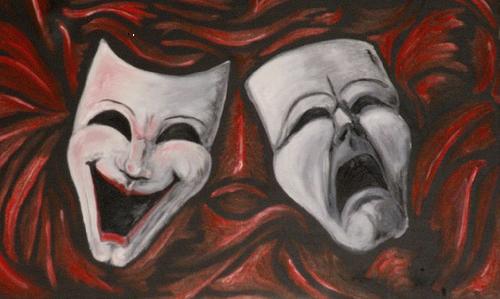
 I’ve never seen someone fall down a manhole, but odds are against them falling clean, in the manner Yosemite Sam does, and most of them aren’t mumbling comedic swear words on the way down either. Most of them fear that they are going to damage something severely by the time they hit bottom, and that fear will probably produce blood-curdling screams. They might not have enough time to fear death, but anyone who has fallen from a decent height knows that it’s scary, and they probably aren’t going to be able to laugh about it for quite some time. The question is will we, the witnesses of the event, be laughing? If we weren’t there, and our only attachment to their incident is their harrowing retelling of the moment, will we be laughing?
 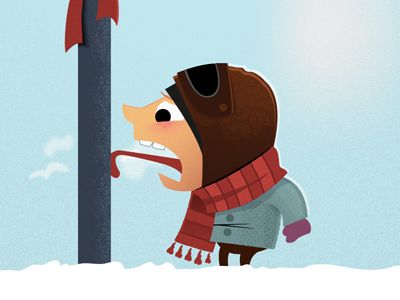 My personal experience with the fuzzy line between comedy and tragedy, didn’t involve falling into a manhole, but licking a pole. I was in the fifth or sixth grade, old enough and smart enough to know better, but young enough and dumb enough to do it anyway on one of the coldest days in February. I wasn’t old enough, or sophisticated enough, to consider the fuzzy, philosophical line between comedy and tragedy, but I knew everyone would be laughing uproariously if they saw me stuck on that pole. I also knew an overwhelming number of my classmates would not share a “Well, at least you’re okay” sentiment when it was over. I knew this wasn’t one of those types of mistakes. I didn’t know a whole lot about human nature, but I knew how much we all crave stories of pain and humiliation, because I did. I laughed harder than anyone else when Andy walked into a pole, and he hit it with such force that the impact broke his glasses in two. I just happened to be in the perfect position to see the incremental progressions of Andy’s instinctual reactions. I saw Andy’s eyes close on impact, followed by the scrunched expression of pain. In the midst of my laughter, Andy’s face turned from pained to embarrassed as everyone else attempted to soothe and coo him back to respectability. Andy’s embarrassed expression focused on me, the only person laughing, and I couldn’t stop. When his embarrassed expression evolved to one pleading me to stop, I just walked away, because for reasons endemic to my evil nature his mental emotional pain proved more hilarious to me than the physical.

 Rilaly