https://leonardodavincigallery.com/what-is-leonardo-da-vinci-sfumato-technique/

Da Vinci’s Sfumato and Chekov’s Razor


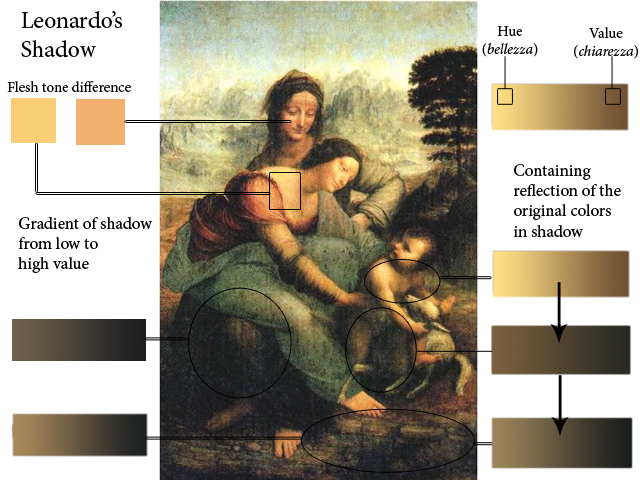
“Leonardo was so obsessed with using shadows and reflected light that he wrote fifteen thousand words on the topic, and that is probably less than half of what he originally wrote,” Walter Isaacson opined.

Using shadows and reflected light is a technique that doesnt have to be limited to painters or image creators, in my humble opinion. It can be used by article writers, novel writers, and just about every form of writing, if they’re not using it already. This mindset resulted from a technique da Vinci used in his paintings called sfumato, or “gone up in smoke”. I use it so often that I don’t think of it as a technique anymore, but I found it interesting to read the explorations of it by one most famous artists in history. The basic tenet of the sfumato technique, da Vinci made famous, was to avoid using specific and concrete lines in his paintings. This might not sound like a novel technique to the accomplished artist of the day, but it was groundbreaking in its day. Da Vinci did not invent this technique, as some evidence suggests it dates back to the chiaroscuro effects used by ancient Greeks and Romans, but da Vinci took it to another level.

When the writer begins writing a story, they characterize their main character with bold lines through unique, individualistic, and semi-autobiographical lines. The more an author explores that character, the more they chip away at strict characterization and allow their main character to breathe for themselves in a manner that adds dimension. They characterize with shading and reflection, or refraction through supporting characters, until they have done little to characterize the main character except through their interactions with others and events. Their main character becomes more prominent through these literary devices, until the central character becomes the literary equivalent to an eye of the storm.

A perfect example of this occurs in modern situation comedies. Most sitcoms have an “eye of the storm” character, we can characterize as the “us” character. The us character reflects us, but the us character also inadvertently defines the other characters as often as the other characters define him through interactions. The characters interact, and the us character is our way of dealing with all of their zany ideas and acts of the side characters, until we learn more us and all of the characters involved. Defining a character otherwise can leak into a term we want to minimize as much as possible. Think about that in terms of the sitcom. If the main character stood before the camera and told us about his likes, dislikes, and a little bit more about him, how boring would that be? It works in some cases, Larry Sanders, or The Office, but it doesn’t work in most cases. 

In most cases, we want to see characterization in action, we want to see what da Vinci called sfumato technique, or what we call the “show don’t tell” technique. The author uses supporting characters and setting to define their main character, and they use all of this to bring the events involved in their stories to bring them to life. The takeaway might be that the optimum characterizations are those characterizations that appear more organic to the reader. In other words, the author should be working his or her tail off to make the work appear so easy that the reader thinks anyone could do it.

Chekov’s Razor

Checkov’s razor is easy to understand. Write the first three paragraphs, pages, or whatever you need to familiarize yourself (the author) with your material and write the rest of your piece. Once the author is done with that piece, go back and delete the material that you had to write to start and start at the most compelling piece of your article. If you have germane sentences in that intro, save them, and work them into the body of the piece. Delete the chunk of exposition that it turns out was only written for you. Let the reader enjoy the rest. 

“But, wait, what if it’s brilliant,” we say to counter that argument. It could be, it might be, but it likely isn’t. Some of us get so locked in and locked up by the ‘we are a man of golden words’ notion. It’s the whole, ‘there’s no such thing as mistakes,’ philosophy, generated by artists the likes of Pablo Picasso and James Joyce. There are mistakes in writing, and leaving that big chunk of exposition at the beginning of your article is one of them.

“There’s no writer’s block. There’s lazy. There’s scared, but there’s no writer’s block. Just sit down and realize you’re mediocre and you’re going to have to put a lot of effort into this to make it good.” –Jerry Seinfeld

Writer’s block, according to Jerry Seinfeld’s definition, is the desire to start writing brilliantly. It’s the “If you can’t be the best, why do it?” block that inhibits writers from writing a single word, or the writing, deleting, writing, and deleting merry-go-round. It’s the dreaded, blank page, or the blinking cursor syndrome that prevents us from writing a single word. Jerry’s remedy is to accept the idea that you’re probably not half as brilliant as you think you are, and once you reach a point that you might be mediocre, it might be possible to write something that’s actually pretty good. My philosophy is similar, but I no longer think about greatness or mediocre distinctions. I just write until something good poops (and yes, I meant poops!) out.

We might call this the discovery phase. In the discovery phase, the writing is gibberish to everyone but the writer. This is the “all play no work” phase for most writers, as it allows us room away from our aspirations to true creativity. Some of the best room for creativity occurs when we have an ending in mind, as it’s fun to fill in the blanks. Filling in the blanks might also lead to a new ending. 

The takeaway for aspiring writers is to get the idea down before you forget it. Don’t worry about sequencing, chronology, grammar, spelling, or if this story is the base for the next great American novel. Just write it down and worry about all that later. Just write a bunch of gibberish down that only the writer understands, until the subject matter begins to open up to the writer. Once the author is in, the material might have the wherewithal to be in a near proximity to where a story lies, but the real story could take paragraphs, or pages, to develop.

Chekov’s razor focuses on threes, the first three paragraphs, and/or three pages of a manuscript, short story, or essay, but I’ve found this length arbitrary. When I begin a story, I think I have a full-fledged introduction on my hands. I don’t think anyone writes gibberish just to write gibberish, it feels like this could or should be the story at the time. I lock myself up when I try to determine if the writing is up to my standard, or if it’s going anywhere. I unlock myself by writing it all down, all of the important and unimportant that comes to mind, then I delete the unimportant.

Chekov’s razor comes into play when we go back and delete the unimportant. That is rough too, because all writers live with the “Golden words” mentality. Everything I write is not only good, it’s vital, and germane to the story. The writer needs to ask themselves am I a good writer or a good editor? The answer, if you’re going to try to write for others, is you’re going to have to be a little of both. Or, you can have a friend read it, or pay to have someone edit it for you. If you’re as megalomaniacal about your words as I am, you’ll either find a way or you won’t, and your work will suffer for it.  

In the course of writing past the blinking cursor stage, we discover pivot points that take us to the next stages of the story, but we don’t consider them anything more than what they are at the time. In the course of rewriting, however, we discover the pivot point is the story. The frustration falls on two tracks, the first is that we fell in love with that original idea, and it’s tough to just walk away. The other is that we “wasted” so much time writing “the other” story that we loved. When writers achieve the ultimate point of objectivity, when they realize story is sacred, they begin sacrificing all the information they love to leave information you will. 

Thus, I don’t believe there is magic in the power of threes in employing Chekov’s Razor to storytelling. A central idea, or pivot point arrives in the course of writing, but the point of Chekov’s razor is to dump and delete the useless information the writer used to write the story.  

An important note to add here is that if most authors work the same way I do, we do not write for the expressed purpose of finding the core of our story. Our perspective is, we think we already have the story, and that the only chore involves building upon it. The discovery of the core of story often humbles the author and slaps them back to the realization that no matter how many times we write a story, the art of writing involves mining the brain for ideas rather than having a brain loaded with brilliant ideas. That conceit eventually reveals itself to those willing to write a lot of material, and it’s up to the author to recognize the difference for what it is, if they want a quality story.

It happens in the course of writing it, editing it after we’re done, or in the daydreaming stage that can last for days, weeks, or months. I do not enjoy deleting the chunks of material I’ve written, and I don’t think anyone does, but the quality author will develop the ability to recognize what portion of the story is for them and which portion is for the reader, and they will crib note or delete the part of the story that is for them.

I don’t consider the revelation of these techniques a glamorization of my process. I think it demystifies the process by suggesting that anyone can do this, as long as they write as often as they need to discover what should become the central focus for the reader. Every author needs to move past their conceit of their self-defined brilliance to find the story they’re trying to tell, and learn how to work from within it.

As I’ve written elsewhere, the most prominent use of Chekov’s razor can be found in Franz Kafka’s Metamorphosis

Plumber: “That’s Not Dirt!”


“In my professional opinion,” my plumber said. “I think we’re stuck.” The plumber said after assuring me that the “power auger” on his truck would make “easy work” of clearing the lengthy sewer line from my home to the street. “My baby hasn’t failed me yet,” he said of his power auger. “Check that, once,” he added. “I couldn’t snake through once, but that plumbing line was just a mess. You should’ve seen it. It was a disaster.” After I informed him that he was the third plumber I’ve called in the space of about two years, he added, “You give us [he and his auger] fifteen minutes, and we’ll fix you.”
Prior to this call, I tried to stay away from the big guys. I much preferred the mom-and-pop operations that are filled with hungry, skilled workers who aren’t required to upsell me on the products I don’t really need. My frustrations with the little guys led me to call a Big Guy who had a never-fails power auger attached to his machine, a well-known reputation, and all the Big guarantees that Big Guys offer. I was so frustrated and desperate, and this Big Guy told me everything I wanted to hear. He assured me that “We will fix your mess for good.”   Most plumbers, big and small, do their job as if it’s a job. They often go from A to Z without changing expressions, and they don’t offer customers like me any of their personalties. This guy, a young twenty something, wasn’t burned out yet. He was not only a confident man, he appeared to really enjoy doing what he did.  I was also impressed when this employee of a big national chain informed me that his power auger could make a quick process of it, for that went against everything I heard. Everyone from the tree experts I talked to, to the plumbers who attempted to snake this drain before told me that the silver maple leaf trees were the worst possible tree a homeowner could have when it comes to plumbing. Our silver maple leaf was about sixty-feet tall, and the previous plumber informed me that that means it probably goes just as far, if not further, down, “And as I’m sure you can guess, a sixty-foot tree does not go straight down. It builds itself a foundation by spreading outwards infiltrating everything in its way.” I told this Big Guy what all the little guys told me, but he insisted that his truck’s power auger would make easy work of this task. “Just watch,” he said with his finger on the switch that powered the power auger connected, via cable, to a motor on his truck. “Just watch!” he shouted as it powered to life. And I was finally happy, relieved, and even a little excited with the surprising progress the Big Guy initially made. After about forty minutes, he and I shared a smile amidst the evidence of that auger’s progress lining my basement in the form of piles of debris on newspapers scattered throughout. The debris consisted of numerous examples of the silver maple leaf’s roots, twigs, and massive amounts of dirt that I assumed followed the twigs in the drain. “Well,” I said, looking down at these piles. “It should be easier to work through now that all of this dirt is wet?” “You’re kidding, right?” he said looking down at the mound of debris. “There is some dirt in there, no doubt, but most of that is not dirt.” I looked at him in confusion for about half a beat, until it dawned on me what he was saying. I, initially, considered that apt description quite embarrassing, and the plumber saw that embarrassment and smiled. After bathing in that embarrassment for about two seconds, I said, “Wait a second, isn’t that what we’re supposed to have in there?” “Sure,” he conceded, “but it’s not all dirt.” The plumber’s confidence turned out to be false bravado, as evidenced by the fact that the effort he and his power auger put into clearing the line failed to clear 100% of my drain. He and his power auger cleared 95% of it, but there was an annoying clump that he couldn’t clear.  After repeated efforts to assist the power auger, he flipped the switch off and attempted to physically free the one final chunk of filth over the lip of the drain cleanout inside our home. He didn’t say a word regarding his power auger’s failure, and how this might be only the second time he and the auger failed. He simply went manual, and he said he was “So close. Look at it,” he added the latter pulling the filth to the fore. We agreed that it almost looked like a rodent, teasing us, popping its head in and out of a hole. He couldn’t manage to get it over the lip though. He put forth a valiant effort, but that eventually, physically drained him. His hopelessness led him to call the home office. When they said they didn’t have anyone available to assist him, he put out personal calls to his professional colleagues. After they didn’t answer numerous calls, he called the home office back for advice. “I hate to ask you this,” he said, turning to me in a peak of frustration. “And I’ve never done this before, and I’m sure my colleagues would frown at this, but … would you mind helping me here?” After I agreed to do just that, he added, “I think the two of us should be able do this together, don’t you?” He put me on the lead, and he said he would be pulling the auger from behind. He said something about the art of tug-of-war, and how the guy at the end usually does most of the work. I agreed with that analogy, and I was already to start when he stopped me. “Before we begin, let me say two things. I want you to pull as hard as you can, but when I say stop. Stop! He asked me to look at him when he said this, and he repeated that line to assure him that I understood the importance of stopping, and then he asked me to repeat to him what he said. I repeated his instructions dutifully. As I began to pull, however, I began to make significant progress. It became pretty obvious to both of us that I, an ordinary citizen with no professional training, was making more progress than a certified plumber from a Big Guy corporation. I was proud. I was even more proud when he stopped pulling from behind, as I considered that a compliment to not only the progress I made but my surprising strength. That was my ego talking, of course, but when he said, “I think you’re getting it,” that fueled me to put every ounce of strength I had into it. I don’t know about anyone else, but when another fella tells me that I’m displaying feats of strength beyond his own, it invigorates me. When I’m outdoing a professional at his own profession, I try to live up to that compliment and expound upon it. As I sought to expound upon it, the primary source of our concern appeared in the sewer cleanout fitting built into the wall of our basement. I was excited, I thought I was accomplishing something huge, but the plumber informed me that working it through the fitting was often the hardest part. I had this in mind, coupled with the progress I made, and I decided to show him how strong I was. My first couple pulls were somewhat cautious, as I awaited the instruction to stop, and the glop continued to pop up to the lip and drop to continue our “rodent popping out of a hole to torment its predator” analogy.   After those first couple of tantalizing pulls failed, I let the snake go slack and regrouped for one final pull. I inhaled and grabbed ahold of snake line, with the no-slip grip gloves he provided, and I put everything I had into that one final pull.
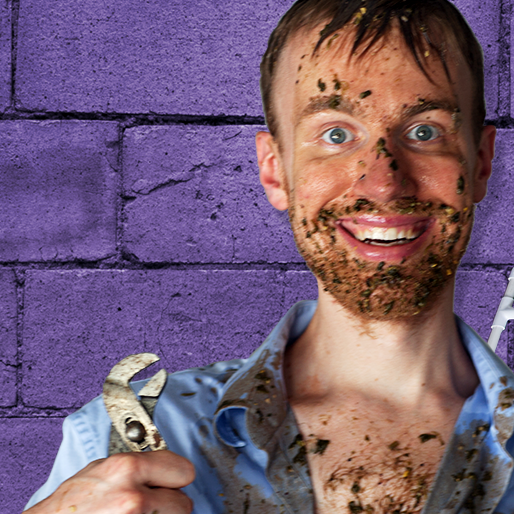
“Stop!” the plumber shouted, too late. The mass, that was not dirt, intertwined with silver maple leaf twigs, finally made it through the closeout fitting. Its release, combined with the force of my pull, caused me to fall backward until I was flat on my back. The result of that flat fall not only prevented the mass that was not dirt from hitting me, but it put me in a perfect position to watch the mass fly up over my toes, my body, and my head. I remember this occurring in slow motion, but as anyone with a fundamental understanding of physics knows, this did not happen in slow motion, and what goes up must come down. Yet, the glop did not go up by a significant measure, and it did not come down. It shot almost flat across the room, so fast, that I didn’t see the glop hit the plumber in the face. I didn’t expect it to hit the plumber in the face, of course, as I didn’t know its trajectory in reference to the plumber, so I didn’t wonder if  the plumber failed to duck, or if it happened so fast that he didn’t have time to, but we have to assume the latter. Regardless what his reaction was, most of the glop that was not dirt landed square on his face, dirtying his nose and eyeglasses. I heard a disgusted “Uh!” before I turned to see what caused it. When I turned to see the mess on his face, it took him about as long as it did me to completely digest what just happened. Once he did, the “Uh!” turned into a series of expletives. One of those expletives could adequately describe some of material that was not dirt, now on his face. He blamed me for not stopping when he told me to, he blamed himself for not waiting for a professional colleague to assist him, and he displayed some anger at the world, in general, for a moment. Throughout this understandable tirade, the plumber did not wipe the glop from his face. He just stared at me, and with me, in mutual disgust for what just happened. “This is, by far, the most disgusting thing that’s ever happened to me,” he said after he cooled down a little, “and I’m sure you can guess that as a member of my profession that’s a bold statement, as I’ve compiled a lengthy list in the last six years!” I considered that a great line, enhanced by the visual that he permitted me to enjoy. As a writer, I figure I probably appreciate great lines more than most, but everyone understands how visuals enhance even the best of lines. I wasn’t sure if he valued great, comedic lines as much as I did, but I wondered if he allowed this glop to remain on his face for a full five seconds, because he thought it might enhance the comedic value of that line.   I don’t know what he was thinking, or if I was assigning my values to his reaction, but my guess is his six years spent as a plumber raised his tolerance level for what others consider unspeakably disgusting. I decided that had to be the case, because I have to guess that some infinitesimal nugget below 100% of the non-plumber population wouldn’t allow the glop, that was not dirt, to remain on their face for a full five seconds, even for laughter. We can all agree that five seconds is a relatively short amount of time, relative to normal situations, but count out five seconds real quick, right here, and imagine leaving a glop, that was not dirt, on your face for that long. I still can’t understand why wiping this glop off his face wasn’t such an instinctual response that he’d have most of it off within two seconds of furious wiping. I now wonder if some part of him thought he was paying homage to the great comedians who proceeded him by physically agreeing to the principle that some of the times we have to suffer for our art. Whatever his reasoning, he delivered one final classic while wiping it all off his face and glasses, “All I can say, and I never thought I’d say this, but I’m glad that I need to wear glasses.” 

Dumb Guy’s Disease


“Taken care of me? Mike, you’re my kid brother, and you take care of me? Did you ever think of that. Ever once? Send Fredo off to do this, send Fredo to take care of that… take care of some little unimportant night club here, and there; pick somebody up at the airport. I’m your older brother Mike and I was stepped over! … It ain’t the way I wanted it! I can handle things. I’m smart. Not like everybody says, like dumb. I’m smart and I want respect!” –Fredo from The Godfather II

“What happened?” we ask ourselves. “I thought I was going to be one of the smart ones. I know, I was a disinterested student in school, and I probably cared too much about partying for far too long in the afterlife (the life after high school), but I thought I would’ve gathered enough wisdom by now that someone, somewhere would consider me wise, but I have to face it. I have a mean case of dumb guy’s disease.”

Dumb guy’s disease doesn’t necessarily mean that the carrier is dumb, but that they are not as smart as they thought they would be at this point. We all know dumb guys, those men and women who by social calculations don’t know enough to enter into the league of intelligence. We never considered ourselves one of them, until someone far more intelligent than us gave us a condescending “you don’t know do you?” smile. We would love to dismiss that look with the notion that they had an agenda, but we know we choked in crunch time, because we didn’t know. When enough of these moments happen, we conclude that we’re not half as bright as we thought we would be at this point in our lives.

To prove ourselves to us, we sought less structured forms of education. We thought this might result in us becoming what smart people call autodidact, or a self-taught person. (Yes, I had to look that up.). We might begin reading better websites and better books, we might watch more documentaries, and listen to a wide array of podcasts. No matter what venue we choose, we will focus our renewed thirst for knowledge on defeating the structured concepts we failed to learn in school. This is our way of putting all those poor grades behind us by rejecting traditional, accepted knowledge as a form of intellectual rebellion.

“Everything they taught you in school is wrong,” is click bait for dumb guys who hope to succeed beyond the fools in school who regurgitated accepted facts back to the teacher. We dumb guys learn the truth, but this version of the truth should not be confused with the truth, in most cases, but rather a subjective truth that various authors spend decades writing in various forms and incarnations. This is one of the many attempts dumb guys make to rectify the past.

***

“Too many lyricists attempt to write a song, as if it’s a college thesis,” a musician replied. “I just write lyrics that fit the music.”

That’s pretty much it, right there, I thought. We dumb guys spend the rest of our afterlives (those years after high school) focused on informing the world that we’re not as dumb as everybody thought we were in school or in the immediate aftermath where the focus of their life was partying. The musician’s quote informed me that when I injected politics and music appreciation into my fiction, I was writing my college thesis to impress upon my peers in high school the idea that I was not as dumb as they thought I was. Some big name fiction authors make political overtures to enlighten their readers, and they attempt to woo us into listening to their favorite groups with forays into music appreciation. I used to write about my main character’s appreciation for my favorite group of the moment, in the manner the big name authors do. My modus operandi was if they can do it, why can’t I? My second thought was they could get away with it, because they were big names in the fiction world, and I wasn’t. I knew their music, everyone did, it was ZZ Top, AC/DC, The Ramones, and just about every tired, formulaic classic rock group we hear every day on classic rock radio. The author’s point was to instill in our minds the idea that his character was risqué, because he enjoyed listening to rock and roll. I enjoyed the author’s brand of rock and roll back when I was trying to define myself by listening habits, but I grew tired of the classic rock monochromatic formulas. This author obviously didn’t, and it defined his work for me. In his attempts to appear hip, naughty, and rebellious through his rock choices, I also saw his attempts to appear meaningful, thoughtful, and intelligent for what they were, and I realized that he was writing his college thesis for ushis big name author didn’t introduce his political, or music, preferences as well as I thought he had when I was blinded by his big name.

In the years I spent trying to prove I was not a dumb guy, I never heard the notion that intelligence and brilliance should be considered different strains of intellect. (I realize that in the strictest sense of the terms, some might consider another so intelligent, in a structured manner, that they consider them brilliant, but for the sake of argument let’s say that brilliance and intelligence are parallel roads.) The two strains of intellect could be broken down to left-brain versus right brain, as in one type of brain has a natural aptitude for math and science, while the other is more of a creative type. One could also say that an intelligent person knows the machinations of a saxophone so well that they can fix it and tune it while the other knows how to play it brilliantly, and while both can learn how to accomplish the other’s feat, neither will ever do it as well as the other, for their brains work in decidedly different ways.

This idea applies to dumb guy’s disease, because some creative types do not discover their aptitude for creativity, until the afterlife, the life after school. We recognize some forms of artistic expression, such as an ability to draw or play an instrument, early on, while an aptitude for creative writing often occurs later in life. The math and science types discover an aptitude for the structured learning, memorization, and problem solving in school, and it puts them in the upper echelon of learners, whereas the young, creative types live outside the bubble, looking in with jealousy. Screaming, as Fredo did in The Godfather II, “I’m smart. Not like everybody says, like dumb. I’m smart and I want respect!”

***

“You’re not already there,” would be the first piece of advice I would give a younger me if I could go back in time and give my younger self some advice. “You’re not special,” I would add, “and you don’t know how to play basketball already.” These are the pathogens of dumb guy’s disease, and the bacteria reproduces and multiplies rapidly infecting every matter it comes across.

I would also advise myself to find a way to learn the structure of the system and succeed within it, but I was never adept at structured learning–I’m still not–so, that would be pointless. What I would say instead is learn more about yourself, who you are and how you can succeed with your gifts and talents while keeping an eye on your limitations. 

I would also ask myself to work harder to acknowledge that there’s nothing special about me. I wouldn’t tell myself to stop watching Tom Cruise movies, but I would suggest that I stop watching them, thinking that the theme of those movies applies to me. “You’re not the chosen one, or the one that shouldn’t have to accept mediocrity. Accept mediocrity. Learn it, love it, and live it, until you can surpass it.”

I wasn’t a better athlete, student or employees because I thought I already was, and the frustration I felt when faced with the fact that I wasn’t, was tied to that idea that I thought I was already there, or should’ve been. When I failed in athletics, it was such a mystery to me that I threw temper tantrums, because I was frustrated that I wasn’t as great as I thought I was. It was also a message I sent to my teammates that that wasn’t me. That was but a snapshot of my abilities, and I was so much better than that. The problem for dumb guys is that oftentimes the message is enough. We don’t feel the need to get better, because “We already know how to play basketball.”

We get in front of ourselves at times. We never learn how to slow our roll long enough to work within the confines of who we were to succeed within the constraints of who we are. 

If I could advise myself thirty years prior, I would say slow down, realize who you are when you’re doing it. Analyze your shot in basketball and try to figure out how to make the shot more often, and when some tries to give you some advice, don’t shoot them down by saying, “I already know how to play basketball.” 

You’re not the all star athlete you think you are,” I would add. You’re not a great employee, and you’re not near as smart as you think you are. You’re actually pretty dumb, because you refuse to listen to people, like that obnoxious 50-year-old waiter who nodded at everything you said, because he said he used to say those same things.

He was a waiter, a 50-year-old waiter, so what the hell does he know about life?” my younger self would argue. He was an oafish, avuncular type, who was always kind of a fool.”

“Until he got you alone, away from all your friends, and he turned all serious on us, saying, “You’re doing it wrong, and the only reason I know is because I was doing it wrong at your age, the same way as you. I was a dumb kid, just like you, but I knew better. I knew how to play football already, and I was good enough at Math to pass the stupid class that I probably would never use anyway. I didn’t get good grades, and I thought it was kind of funny, and I fell asleep in study hall too. I did just good enough in school to keep everyone off my back, so I could go out, enjoy my youth and have some fun in life, and here I am a 50-year-old waiter. If I could somehow switch places with you, right here, right now, I’d do my life differently.”

Now that the roles are flipped, what would we do differently? I’d drop the whole Tom Cruise “I could be the chosen one” mindset, because Michael Jordan wasn’t the chosen one, until he sculpted himself into it. I’d drop the whole “I already know how to play basketball” mindset and listen to those teaching me the “finger tips, rotation, follow through” tedious mechanics of the game. I know those mechanics now, now that it’s too late. I was never an adept student with all that structured learning, and I’m still not, but if I would’ve had more patience with myself and learned more about myself earlier, I might’ve been able to chip away at the granite stones I placed in my path to create something, as opposed to inviting that I’m already there’ pathogen that caused my dumb guy’s disease.