Falling for Fraud


This article is not a self-help, tips guide. I considered summing this article up with a long list of the tips I’ve learned over the years to help you avoid falling prey to internet fraud. My next thought was that I’m not smart enough to write a comprehensive list that could help you avoid falling prey to everything out there. Those lists are out there, and I encourage everyone to seek out, but I’m not brave, bold or brilliant enough to write one. This article will simply detail my personal and anecdotal experiences in this world. 
June 22, 2026: “Florida couple loses $141,000.00 to sweepstakes scam. The couple loses their car, their income, and their home after the dementia-suffering husband fell for a scam that informed him he won $4 million in a lottery.” Yahoo!news 

“The stupid things dumb people do,” was how one Yahoo commenter summed up their reaction to this story. I wouldve loved that reaction in my teens and twenties. “They’re just saying what we’re all thinking,” I wouldve said in-between giggles. Working as a fraud agent at a Fortune 500 company changed me. I talked to these dumb people, and if they’re dumb, then we’re all a lot dumber than we think.  

“I cannot believe this happened to me,” was the most common thing we heard from victims. They would tell us how intelligent and experienced they were. They would talk about how difficult their jobs were, and how their job required a high level of intellect that should never fall for something like this. “I thought I knew enough to know how to avoid something like this, but here we are,” they would add. 

Does that sound like you, and the shocked, embarrassed, and somewhat ashamed reactions you might have for falling for “The stupid things that dumb people do.” If you insist that only morons fall for online fraud, consider this: industry experts suggest that the total figures we have for cybercriminal activity skew low, because most victims are so embarrassed and humiliated that they fell for something so stupid that they won’t even report it to a fraud agent who is as low on the law enforcement totem pole as one could get. They’ll never meet me, so why would they care what I think? They do not want to go through the details, because they cannot bear having one person know how dumb they were. They just want to forget it ever happened. 

The fraud agents I worked with rarely characterized victims as dumb or stupid, because we heard from so many victims a day. We heard so many different stories that we knew the victims we were talking to weren’t in the minority. We usually spent the first couple minutes of every phone call talking these victims down. I may have considered these victims dumb or stupid when I first started working there, but I heard so much since that point that I knew I was as vulnerable as they were.  

I’ve heard from the prototypical little old ladies living on a pension, who had a little money set aside for a more comfortable living. I talked to hard-working joes who worked so hard their whole life and saved their 10% a year to allow their family to just barely escape lower middle class. I heard from so many representatives of age and economic demographic backgrounds that I progressed through a variety of emotional reactions that ended with sympathy and moved to empathy after I heard the wide array of schemes that our customers fell for. If I were to draw up a pie representing the typical victim, old people on a pension would represent the largest section, but that cut wouldn’t be as large as you might think. If you’re one of those who refuse to accept the idea that you’re a lot more vulnerable than you imagine, let me say that I was you, and you are me.   

Other than the ‘I’m too smart to fall for something so stupid,’ the greatest vulnerability I saw among victims was greed. The victims talked about how losing this money meant losing their comfortable lifestyle, which naturally led me to wonder why they would sacrifice that relatively comfortable lifestyle for the prospect of more. Is it an American characteristic, or is it human nature that we’re willing to sacrifice everything we have for the promise of something more? I don’t know the answer to that question, but I saw a wide array of victims put skepticism aside when they thought someone was offering them a pot of gold. The idea that something is too good to be true should require us to do our homework and use the tips that corporations provide to educate ourselves, or perform any checks of verification we can to reduce our risk. 

The theme of this article is that the moment after you think you’re general sense of judgement will prevent you from falling prey to one of their schemes will probably leave you vulnerable, but we saw some victims exhibit such poor judgement that it exacerbated what could’ve been a minor incident.

When we read, watch, and hear exposés about criminals, we often hear investigators characterize the criminal in their case as ingenious or brilliant. In my limited experience in this world, I haven’t found cybercriminals ingenious or brilliant. Most often than not, they just kept trying no matter how many times they fail. They exhibit some ingenuity and temerity, but I never saw one scheme that I considered brilliant or ingenious. 

If their first scheme does not convince us to part with the money we earned, these cybercriminals have a “no harm no foul” attitude. There was no crime committed, and thus no evidence of wrongdoing. Depending on the nature of their activity, we fraud agents might be able to restrict the cybercriminal’s access to their account, until they can prove their activity is not suspicious. If they can’t, they just open another account, and another, until they complete a fraudulent transaction. At that point, we can link up their accounts and activity to build a narrative. Long story short, most cybercriminals change, adapt, and tinker with their approach, until they can find a victim. The key word in that sentence is tinker. They might add a little something here or delete something there, “They are going to try hundreds of different approaches,” a fraud trainer once told us, “Because they only need one successful scheme to qualify as successful.” For example, professional fraud operations often use botnets, compromised servers, or spam-as-a-service tools that blast out millions of emails per day. Success rates are extremely low (often 0.01% to 0.1% click/open rates), so high volume is essential to generate enough victims to be profitable. How is that brilliant? My guess is that the investigators on the TV exposés on crime are the ones who cracked the case, so calling their case’s criminal brilliant enhances their profile for the audience. We should also note that I base my characterization of cybercriminals on the cases I investigated, and we could say I base my personal profile of them on anecdotal information. In my experience, cybercriminals aren’t ingenious or brilliant, they just tinker, adapt, and change their approach until they find the best way to prey on our vulnerabilities. 

Some fraudsters aren’t piece of junk who manage to distance themselves from empathy and sympathy, because their victim is some anonymous, faceless entity on the internet. (Their victims often have online nicknames, like rugrat, as opposed Peter J. Hansen, the electrician, who has spent his whole life saving this money.) This anonymous, faceless designation also permits us to characterize victims as “The stupid things that dumb people do,” because we don’t talk to them, see them, or feel their pain. Other cybercriminals are desperate people living in no hope situations, until they are employed by a shady outfit in their home country that exists to defraud victims out of our money. Their employees have quotas, and if they fail to hit their employers’ numbers, be they quantitative or qualitative, the employees are back out on their country’s desperate streets of abject poverty. These shady outfits provide their employees with tight scripts, but they also reward employees for creative improvising.   

When the shady enterprises from other countries are ‘caught’ engaging in fraudulent activity, some of the countries make it known they “don’t encourage such activity”, but the employees and the shady outfits receive little more than a slap on the wrist. The countries “don’t encourage it”, but the countries receive a Gross Domestic Product boost from the amount of money that the shady enterprises generate. We can only guess this doesn’t result in greater taxable revenue for the country, as most of the activity is “undetected” by the government, but we can guess that kickbacks are appreciated.  

One vulnerability we all share to ploys generated by cybercriminals is the ‘I’m too smart to fall for all that’ mentality. This is also where “The stupid things that dumb people do” line comes into play. In a manner somewhat similar to the original reason man created fictional monsters (vampires, werewolves, and mummies) to essentially zoomorphise the inhuman acts of sadistic murder that gives good men and women some comfortable distance between those who would commit mass murder. I think we label victims of cybercrimes as dumb and stupid to try to create a comfortable distance from the horrific possibility that this could happen to us too. The one thing I would tell people who scoff at the possibility that this could happen to them is I’ve talked to people like you every day. I talked to Midwesterners who appeared to know everything about the internet, fast-talking New Yorkers, Surfer dudes, and individuals with a pleasant, Southern Drawl. I talked to little old ladies on a pension, fathers with kids in private schools, and mothers who thought they could supplement the family’s finances. I talked to people who would remind you of your family members, your neighbors, and people who would remind you of you. The one thing they all had in common is they never thought they would fall for something like this. “I thought I’d be able to spot something like this,” they’d often say through tears. “I can’t believe I fell for it.” 

“This was my life savings,” was such a common phrase we fraud agents became numb to it. I loathe writing that all these years later, but it happens to us when we hear the same complaint, working on a phone line, forty hours a week. At lunch and on breaks, we would talk about the calls we took, and in the beginning, we talked about the heartbreak and devastation we heard, but it happened so often that our conversations switched to a callous competition about the dollar figures we witnessed. “I took a call today where a guy lost $50,000.” “That’s nothing, I took a call last week, where a guy lost $200,000.” It was our way of dealing with all of the sadness we heard.  

These victims called us to fix the devastation they put their proverbial foot in, and we could help them at times...if those victims called in in time. I wrote out a detailed description of process involved in our calls with customers, but I just … deleted it, because my guess is you don’t want to read the particulars the processes involved in these calls. Suffice it to say, I was able to help some of these victims, and I wasn’t able to help others.   

When these worst-case scenarios occurred, the resultant desperation I heard on the other end of the line still haunts me. “This was my life’s savings, my child’s tuition to a better life,” or “my family will be ruined by this,” were things I heard.  

When I first started taking these calls, I felt sympathy for the poor saps that fell for “Something like this.” It didn’t take long for that sympathy to evolve into empathy, as I began to see falling for these fraud schemes did not involve just the prototypical victims I imagined. I realized it could happen to anyone, including those I knew and loved, and a couple hundred more calls convinced me that this could happen to me. It wasn’t every call, of course, as some people did fall for some dumb tactics, but there were others, usually a couple calls a month, when I’d receive a call from someone who reminded me of myself, falling for something that I knew played on my vulnerabilities. I’d go back and investigate the history of the cybercriminal, through linked accounts, and I’d spot their tinkering.

Those of us who worked in this department also received death threats, but the more common reactions involved customers threatening to harm themselves. We heard these desperate people threaten to take their own life so often that our company developed a policy that instructed us to immediately contact their local law enforcement to do a wellness check on them, regardless if we felt we talked them down or not.   

To avoid hyperbole, most of the calls I received involved customers who got “A little ticked that they got got.” They got swindled, cheated, or tricked into paying for an item that was priced so low it was too good to be true. Most of the people I talked to paid twenty to thirty bucks for a product that should’ve cost four hundred to five hundred bucks. They were a little ticked, but “I should’ve known it was too good to be true”was their reaction. I took more than my share of calls from victims who were absolutely devastated by the amount of money these fraudsters tricked them into submitting, however, and “I really thought this was legit,” was their reaction. “I thought I was on the road to a better life.” What do we say to that? That guy probably couldn’t wipe the smile off his face one week, thinking about how he was going to spend all that money, and he then probably had trouble finding reasons to smile for a long time after this. 

When I was able to stop the money, the potential victims celebrated my name, and we laughed for a couple minutes, and they cried tears of joy at the end of our call. They said I was “Their hero.” One old woman wasn’t laughing or weeping with joy, she was bawling uncontrollably. She was so choked up that she couldn’t even speak. Her daughter took the phone from her mother and made me feel like the most special person in the world for one day of my life. 

There were times when the money was gone, out of our system, and the fraudster’s bank account. I instructed them that they would need to contact their local authorities. I instructed them what they should say, what evidence they should provide, and how I was going to provide notes on their account to detail the transaction(s) in a way that would bolster their case.   

These worst-case scenario calls would inevitably end with the victim saying, “Thank you, but let me ask you, based on your experience.” I would close my eyes with a lump in my throat, because I knew the back half of this question. “What do you think are my chances of getting my money back?” Im in so deep at this point that I’m almost incapable of answering this question. I should add here that I was forbidden by my company from offering my opinion on a case that reached this point (This was for my protection and the company’s). Yet, even if my company hadn’t protected me in this way, I still would’ve felt so bad for them that I would’ve found it difficult to find the right words to say. How do you tell a little old woman that her worst fears of losing her home, her car, and the independent lifestyle she’s enjoyed her whole life are likely gone.

“Your chances of recovering the funds increase substantially if you follow the standard procedures I’ve outlined for you,” is what I would say. This would start a back and forth that would involve them trying to break me down for my opinion. “I’m just asking you, based on what you see and what you’ve seen, what are my chances?” I understood their need to badger me of course, because I was their only point of contact at this point, and they were imagining a bleak future. Before they allowed me off the phone, they wanted to know if they should have some small nugget of hope, or if they should concede to the idea that some criminal managed to not only steal their money, but the life they knew, and the future they planned. These people were devastated, and they wanted some low-level employee on the phone to give them some hope. I froze up on more than one occasion when they made the full breadth of their devastation apparent to me. I was incapable of telling them that the hopeless nature of their situation was probably just beginning.     

We’re smart enough to spot a fraudster, and we know we wouldn’t fall for some piece of junk’s little games. We know how to spot a fraudster, because we’ve seen them on TV, and we’ve met them at our local, neighborhood liquor store. My experience as a fraud agent has informed me that I don’t know what to look for or how to spot a cybercriminal. There have no bullet point characteristics, and AND there are no bullet point characteristics of a victim either. Neither of them are more “worldly,” “street smart,” and it doesn’t matter if you “know how to play the game, because you’ve dealt with pieces of junk your whole life.” After dealing with both ends of the spectrum, receiving calls from victims and calling fraudsters, I didn’t grow more confident in my ability to spot a fraudster, I grew less confident. I became so uncomfortable with these situations that I became paranoid. I wouldn’t answer the phone from anyone I didn’t know, and on the rare occasion when I answered a call, I didn’t try to showcase my decade’s long experience. I hung up on them, or delete the email, or text as quickly as I could to avoid learning how vulnerable and susceptible I am. (I also avoid signing up for Customer Plus programs, petitions for local bills, and I now run from anyone associated with sales.) I provided a list of tips in the original draft of this article and I deleted it as I wrote earlier, but the best piece of advice I could provide anyone seeking how to avoid falling prey to internet fraud from cybercriminals is get paranoid. I write that knowing the cinematic phrase, “You’re not paranoid if they’re really after you,” and in my experience they’re all after you. Get paranoid!

The Habitual Howling Hierarchy


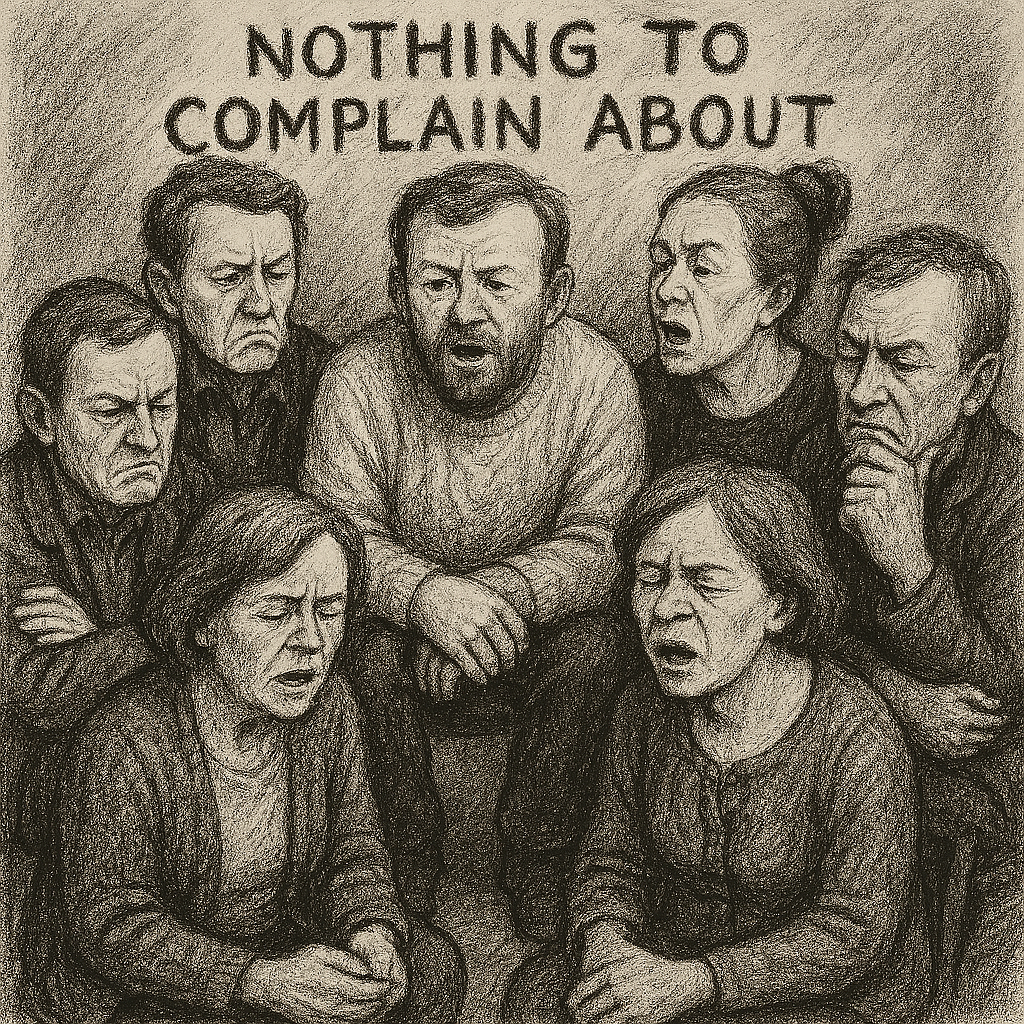
“I have nothing to complain about!” Melissa yelled as if volume made her grievance more grievous. She was employing irony, and she was winning! Complaining is what Melissa did. It’s what we all did, and if you wanted in you had to learn how to complain about something, even if that something involved the crushing burden of having nothing to complain about.

Our complaints often had something to do with the inhuman monolithic corporation we worked for that didn’t pay us enough, offer us enough benefits, or care that we were trapped behind a computer for ten hours a day, four days a week. Those of us in the inner circle of our inner circle learned to cycle out and complain about everything. There was no regular menu of complaints from which to choose, and there were no specials of the day. Complaining was just what we did. 

“Complaints are like orifices,” Brian said to try to ingratiate himself with the group, through ironic, observational humor that matched Melissa’s. “Everyone’s got them, but we complain about not having more.” Unfortunate to Brian’s legacy, his little joke didn’t land, because we had an unspoken rule that we don’t complain about complainers, until we’re complaining about their constant complaints behind their backs. 

Complaining is such a vital component of our being that it’s just something we do. We complain about how bored we are in the beginning, we complain about school, the workplace, and in our final decades on Earth, we complain about our lack of health, until it goes away.  

If there is an afterlife, and we are introduced to absolute, unquestionable paradise, we will probably be blown away by it, initially, but we’ll get used to it after a while, and we’ll find something to complain about. “Have you noticed that they provide Black Duck umbrella picks for our cocktails here? I hate to complain, but it’s just such a huge step down from the OGGI cocktail umbrellas to which I was accustomed.”

If we have nothing to complain about, our brain will make something up just to justify its existence.

How often do we think just to avoid boredom, and thinking about how to complain about something is far more interesting than realizing how good we have it. Thinking about how good we have it kind of defeats the whole purpose of thinking. 

“That sounds like first world thinking.” It is, but I’m guessing that there are plenty of third-world citizens who complain about stupid stuff too. 

*** 

My friends’ parents enjoyed complained about the state’s college football team, until the team started winning. At that point, they complained about having nothing to complain about. I didn’t realize it at the time, but we were all complaining about a college football team that proved to be one of the most successful programs for that span of time. Our complaint was that our team didn’t win the national championship every year. 

His parents did this, my dad did it, and we all grew up complaining about it. “We were so close!” we’d complain. “I’d rather finish 0-fer than get that close again,” was our common complaint. Their complaints were so unrealistic they were funny. I laughed at them from afar, but I also laughed at them from above, as I considered some of their complaints so foolish, until I watched my son’s second grade baseball team. 

When those seven-eight-year-old children played baseball, they made errors, and I had to stifle my snarky comments. “Of course he didn’t catch that ball,” I thought, “not when it was coming right at him, and it could’ve won the game for us.” I will provide this space right here (            ) for you to  criticize me, slam on me, and analyze the deficits of my character. I deserve it, but I just could not click that hyper-critical, “I could do better. Even at their age, I wouldn’t have done that” portion of my brain off. I wouldnt have done better, and I knew it, but I couldn’t tell me that, not in the moment.  

We’ve all seen videos of parents overreacting saying such stupid things at their child’s game, and what we see probably isn’t even one one millionth of the times it’s happened. We’ve all seen those viral videos of parents screaming their heads off over the dumbest things, and we found them disgusting, sad, and hilarious. And I would’ve agreed with every single one of your characterizations of these people, until I became one of them. I didn’t unleash any of these thoughts, and to my mind no one knew how unreasonable and unfair I was, but those thoughts were in there, percolating their way to the top.

I could take a couple of errors here and there, as I wasn’t so demanding of perfection that I ignited over every single error, but there was always that one error, that over-the-top error, that just broke the dam for me. I’d leap to my feet and take my dog for a walk to get as far away as I could from everyone. I didn’t want anyone knowing what I was thinking.

All I can say, in my defense, is I’ve been watching sports and screaming things at TVs for as long as I can remember. I learned that we fans don’t have to sit quietly in the comfort of our own home when athletes are engaging in inferior play. I took those unfair and unrealistic expectations of college-aged images on TV to seven and eight-year-olds trying to play baseball. I never said anything aloud, and I knew my thoughts were unrealistic, unfair, and obnoxious, but I couldn’t stop thinking them after all those years of conditioning.  

When our favorite college football team actually started to win so often that they won three national championships in four years, my friend’s family didn’t celebrate our victory, they were bored. Bored? Yes, bored by all that success. I knew this mentality so intimately that shortly after the Cubs won the World Series, I warned my friend, “This is really going to put a dent in your favorite team’s fan base.” Why? “Because the Cubs were lovable losers, and Cubs’ fans enjoyed complaining about them year after year. Every Cub’s fan could recite the rolodex of reasons why their beloved team hadn’t won a World Series for 100 years. The Cubs actually winning the World Series will turn out to be a poor business decision on their part. You watch.” I turned out to be wrong by a matter of degrees. Most Cubs’ fans are still loyal, more loyal than I thought they’d be, but they lack the fanatical fervor that the complaints about them not winning once fueled.

When our favorite college football team finally beat our inter-conference rival in resounding fashion, I celebrated each touchdown as if it was the first in a very tight ball game. 

“Why are you still cheering this game on?” my friend’s dad asked. “It’s a blowout.” 

“I don’t know,” I said, “But it might have something to do with all the pain they’ve caused us for decades. It feels like it’s finally over.” 

“It’s still a blowout,” he said. “It’s a boring game.” It took me a long time to realize if this guy couldn’t complain about a game, he wasn’t all that interested in watching it. That victory was so complete that he didn’t have anything to complain about, and he basically had no reason to watch it anymore.  

If I were to dig far too deep into this superficial element of life, I might say that complaining about sports so much that we’re screaming at the images on TV, and becoming so irrational about something we cannot control, is actually quite healthy in that it provides a non-confrontational outlet to unleash our anger and frustrations in life, as long as we don’t take it out of the home and into the public realm at our seven-to-eight-year-old’s baseball game. 

*** 

“You can change his name if you want, and I won’t be offended,” a breeder said after I drove nine hours to pick up the puppy I just purchased from her. I was so sure she was being sarcastic that I said:

“Well thanks, that’s awful nice of you to allow me to name my dog?” in a tone I considered equally sarcastic. The breeder gave me a look to suggest our connections weren’t connecting.

Wait, do people actually keep the name you choose for the pets they purchase from you?” I asked her. She said she didn’t know, but she wanted us to feel free to change it.  

I already had that eight-week-old puppy’s name picked out. I knew the name the breeder chose, as she listed it in the online listing, but I never even considered the idea that she might be offended by the idea that I would change it. She lived nine hours away, so we would never see her again. How and why would she be offended by this, and why and how would I care if she was?  

When we purchase a puppy, we plan on keeping it for 12-14 years. Why would anyone want to keep the name someone else chose for it? That is so foreign to my way of thinking that I just thought everyone but the rare exception changed the name. I was shocked to learn how wrong I was. Since that interaction with the breeder, I began asking my fellow pet owners how they arrived at their dog’s name, “How did you pick that name, I like it?” I’d ask in the most polite frame I could.

A surprising number of people said, “It was their name when we purchased them.”  

“You know you can change it right?” I asked. “Do you know how surprisingly simple it is?” Dog lovers know that dogs have unique personalities, but do they know that those personalities are not tied to their name? If we were to try to change a human’s name, say when they’re twelve-years-old, that would be a complicated procedure that would confuse the kid so much that we wouldn’t even think of doing it, except in rare cases.  

Dogs don’t cling to names the way humans do. They adapt so quickly that a name change can be accomplished quickly. We did it in about two days with that puppy we purchased from that breeder, and it took about a week for the eight-year-old dog we purchased a year before.    

“I know, I know…” my fellow pet owners said when I told them how easy it was to change a dog’s name. Some tried to explain why they felt the need to keep the name, but most just left it at “I know, I know…”  

I don’t know if people lack creativity, if they don’t want the hassle of being creative, or if they fear they won’t be able to successfully change their pet’s name, but I met a family who purchased a rabbit and kept that rabbit’s name. “Does a rabbit even come to you when you call it?” I asked within my ‘Why didn’t you just change its name?’ frame.  

“It does,” they said after debating among themselves. “But only when it wants to. He doesn’t come to you every single time you call him, as a dog would.” That debate involved family members who didn’t want to concede to the uncomfortable theme of my question that rabbits aren’t intelligent enough to know the difference.  

“So, why didn’t you change the name?”  

They never answered with thorough and complete conviction, but they did try to convince me that their rabbit was far more intelligent than I knew, which I interpreted to mean that they didn’t want to insult the beloved Binky the Bunny by arbitrarily changing his name to something they wanted it to be.  

I conceded that I didn’t know how intelligent a rabbit was, but I said, “Who chose the name Binky? Do you think that sixteen-year-old pet store employee had greater insight into Binky’s being, his personality, and how he wanted to be identified?” 

“He is Binky the Bunny,” they said. “That’s who he was when we purchased him, it’s why we purchased him, and it’s who he is now.” The other family members liked that answer so much, because it suggested that they, as a family, respected and liked Binky so much that by keeping the rabbit’s name it paid homage to his heritage and ancestry so much that they wouldn’t alter that by enforcing their will on him. There was also an implied notion that the move from the pet store to their home was so confusing and traumatic that they didn’t want to add to that by forcing Binky to adapt to their personal preference of a name. They didn’t say this, but they implied that they didn’t change the rabbit’s name, because they wanted him to know that his past mattered to them too.  

Twenty years ago, I may have continued to argue against what I considered holes in their argument with the tenacity of a terrier on an ankle, but the smiles of joy surrounding me that day suggested that not only was my war against Binky unwinnable, but if I did somehow achieve some definition of victory my only prize would be a diminishment of those smiles.  

*** 

“Why are you loyal to them?” a friend of mine asked. “They’re not loyal to you.” My friend said this when I told him that I just finished the year with no absences, no tardies, and the best quality scores I’ve ever accomplished as an employee. My uninformed guess is that this argument has probably been going on between employee and employer for as long as man has been employed by other men, but my Depression-era dad argued: 

“No, that’s new to your generation, and probably a generation before yours, but we felt lucky to have a job.” Subjective critics of the modern era back my dad, “Companies and corporations actually cared about people back then [during The Depression and in the immediate aftermath]. Back then, employers kept people fed, happy, and alive. Businesses cared about people more back then. They paid more and gave better benefits back then. Now it’s all about the shareholders.”  

‘So, you’re saying that The Depression-era companies and corporations didn’t have shareholders?’ I would ask those critics. ‘Or are you saying that they didn’t worry about them back then? Was that what led to The Depression? No, I know it didn’t, but did they worry about regaining the trust of the shareholders back in the aftermath of The Depression?’ My guess is the system was much more similar to the system we employ now than the subjective critics know.  

“If you’re lucky enough to gain employment,” my dad taught us, “You stay with that employer for life.” That obviously didn’t penetrate, as my brother and I had numerous jobs before we landed great ones, but we met several fellow employees along the way who bought into my dad’s philosophy. Yet, we also found that their decades-long tenure at the company was not formed entirely by loyalty as much as it was fear. There were some who were loyal, some who were extremely loyal, but most of them stayed at the job that was no longer rewarding because they feared that they couldn’t do anything else, they were just happy to have a job, and they adjusted their life to how much money they made in that job.  

The subjective, cultural critics examine the system from the position that most corporations are evil and selfish. They embody this argument with the comparisons of CEO salaries compared to the average worker’s salary. To which I ask who is more valuable, valued, and replaceable? They would avoid this argument by complaining that most CEOs are evil, selfish, and some even argue that CEOs aren’t truly the top figureheads in the corporate hierarchy. That’s right, most of the figureheads sitting atop the corporate hierarchy are inhuman monoliths that we call the corporation, and these inhuman monoliths don’t care about humans anymore. I’ll let others argue for or against that, and I’ll focus on the more rational argument that those in corporate hierarchy don’t care about us. How do you define care? The members of your corporate hierarchy care enough to fulfill their end of the bargain we agreed to when we decided to be employed by them. They continue to pay us for services rendered, and they give us all the benefits they promised when we were hired. They also give employees performance-based raises, bonuses, and stock purchase programs. 

If we don’t care for the various agreements we made with them anymore, we need to get competitive and see how competitive the other evil, selfish, and inhuman corporate monoliths are willing to get for our services. Before agreeing to that change, we need to focus in on what these other corporations have to offer us for our skills before we agree to work with them. Change, as we’ve all discovered, is not always better. 

As for companies not caring, I’ve worked with supervisors who didn’t give a crap about me, and I’ve worked with others who cared a great deal. Our relationship with an employer is often defined by our relationship with our immediate supervisor. If we go further up into the hierarchy, we find that those people do not, in fact, care about us, but it’s mostly because they haven’t met us, and they don’t know us. They are required to create comprehensive corporate policies that try to make us happy while making their bosses happy.

When I applied for a mid-management job in our huge corporation, my supervisor said, “If you’re hired, you’re going to get the stuff rolling at you from both sides. You have to make the employees under you happy, and you have to make the employees above you happy. You need to accept the fact that if you become a boss, you will still have a boss, because everyone has a boss.”

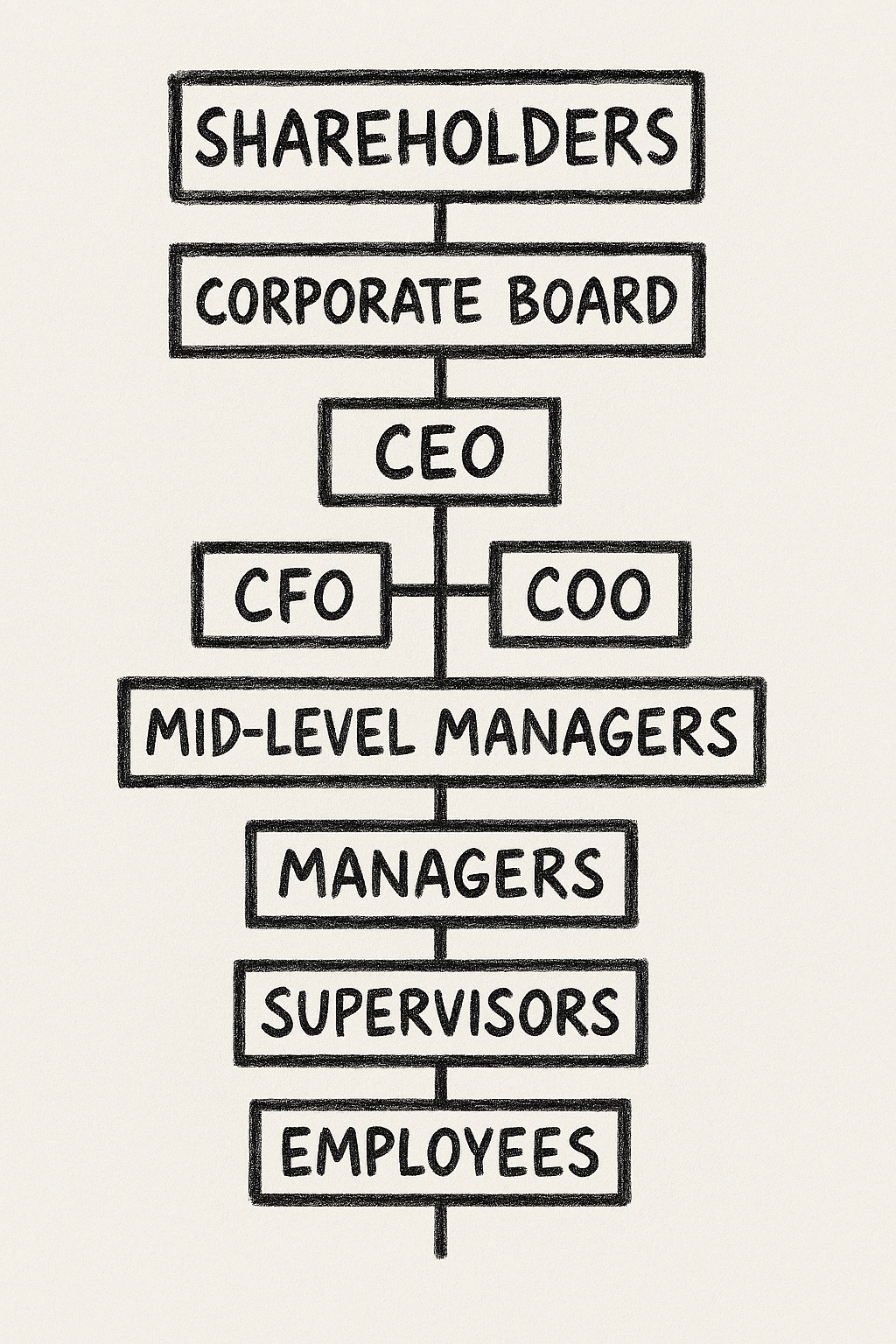
The thing the subjective critics don’t understand is that their supervisor has to make their manager happy, and that manager has to make their bosses happy, all while trying to make you happy at the same time. And they all have to make a CEO happy, who has to make the corporate board happy, and the corporate board has to make the shareholders happy. Everyone has a boss. To make the shareholders happy, the corporate board convinces the CEO to work with the hierarchy structure under them to make sure all of the machinations of the corporation are so finely tuned that they create the most evil word in the subjective critic’s dictionary: profit.

If you reach a point where you loathe that word as much as the subjective critics who believe there is no reward for company loyalty anymore, you might want to seek employment with a non-profit. Before we leave the for-profit for the non-profit, we should know that their will still be a hierarchal structure that mirrors the for-profit, corporate hierarchal structure, but we will be able to remove that evil shareholders brick (stressed with disdain). After deleting them, we will need to replace it with a brick designated for those who provide charitable contributions, and/or the funders who offer grants. Even though the names are changed, those in the hierarchal structure will still feel scrutinized to the point that they feel the need to perform for their bosses, and at some point in our tenure with the nonprofit we’ll feel disillusioned, because we’ll come to the conclusion that they don’t care about us either, they just focus on performance.  

*** 

There is one class of people who truly don’t care about us, criminals. Who are you? How do you define yourself? In ways significant and otherwise, we define ourselves by our stuff. We prefer to say the opposite at every outing, because we deem those who define themselves by stuff superficial and of diminished character. The moment after someone steals our stuff is the moment we realize that the stuff that defined us is now defining him, and we feel this strange sense of violation that informs us how valuable that stuff actually was to us. 

When criminals steal something of ours, it offends us, because it feels like they’re taking elements of our character. Criminals don’t care about our attachments to stuff, and they don’t understand why we care so much about things. If they take one of our things, those things are theirs now.

When they spot something they want, they take it. It’s really not that different from the typical purchasing agreement we make with stores. We saw something on the shelves, and we took it. We paid the store for the product, yet money is an agreed upon, but artificial construct, if we view it from the criminal’s perspective. We took it from the store, and now they’re taking it from us. They don’t buy into that quaint and somewhat archaic idea of ownership the way we do.

Renee, my seven-year-old friend introduced me to this concept of the thief’s mentality when I spotted one of my Weeble Wobbles in her toy chest. “Hey, that was mine!” I said. “You stole it from me!”

She tried to convince me that her mother purchased it for her, until I pointed out a very specific flaw that her Weeble Wobble shared with mine.“Fine!” she said when she decided to give it back to me. She said that in a tone that suggested he didn’t understand what the big deal was. “I never saw you play with it, and I didn’t think you were using it anymore.”

“What? Even if I wasn’t, it was still mine, and if you wanted to borrow it, you should’ve just asked.”

“I said fine! Here,” she said, giving it back. We were seven-years-old, but in my limited-to-no experience in this field informs me that the misunderstanding of how the system works remains constant when I hear adult shoplifters try to compromise with store security by saying, “Here. Fine. I’ll give it back.” They hope by doing so, they can enter into an agreement with the storeowner that permits the storeowner to drop all charges. If that doesn’t work, they attempt to enter into an agreement with the storeowner, or manager, by saying they’ll pay for it. If the storeowner refuses, the criminal walks away thinking the store had a personal vendetta against them. It’s the thief’s mentality (trademarked). 

At some point in this process, we’re taught to forgive and forget. “Everyone deserves a second chance.” If we refuse to forgive, our mothers, fathers, priests, and other authority figures teach us that holding onto anger, requiring retribution, and/or holding grudges have a way of darkening the soul. They say that learning how to forgive with all of our heart provides a spiritual cleansing that will pave the way for greater happiness. It’s true, and we know it’s all true. Yet, if we abide by the loving logic they teach us, and we decide to forgive the criminals for their violation, our relationship with the thief will arrive at another complicated definition of human interactions, when they steal from us again.  

Gomers’ Piles


The Gomer

Most of us have been insulted so often and in so many creative ways that it’s almost impossible and pointless to catalog. Nestled within those insults are a few jewels that are so colorful and intriguing that we cannot wait to use them. I’m not exactly sure why I latched onto this particular slang insult from the 90s, but when Ty said, “You’re such a Gomer!” it sounded so much like an insult I would use that if an insult can ‘fit like a glove’ I could almost feel the leather sucking on my contours.    

“Gomer?” I asked. “What is a Gomer?”  

“If you have to ask,” Ty said. “You’re a Gomer.” That reply wasn’t new to me of course, but it informed me that I was stepping into a kafkatrap in which I was The Trial’s Joseph K., accused of an infraction against cultural awareness, and any effort I put into clarifying the situation only deepened my apparent guilt and reinforced the accusation. It also created the perfect insult loop, because any questions I asked only further authenticated the insult and somehow brought the condition into being.  

Most subjects of this insult loop would recognize the kafkatrap for what it was and drop the line of questioning there, which would allow the accuser to bask in their glory. Yet, I found it so delicious that I thought I might want to test drive it on my own one day, so I wanted to fully understand its power base. “Does it date back to the 60s television show Gomer Pyle?” 

“I don’t watch TV.” It was cool back then, as it is now, to feign ignorance.  

“Well, what does it mean then?”

“I don’t know,” Ty said with impatience. “But it fits.”  

After obsessing over this, I discovered that the term began after the prophet Hosea’s wife, Gomer, acted unfaithfully, and it thus served to symbolize God’s relationship with unfaithful Israel, but I was pretty sure that didn’t form the basis of Ty’s insult. I was also sure Ty wasn’t referring to the emergency room jargon from a book called House of God by Samuel Shem that referred to them shouting, Get Out of My Emergency Room,” to annoying patients who repetitively took beds that should’ve been reserved for more deserving patients. No, I decided, the term was derived from the TV show Gomer Pyle, a character played by Jim Nabors, as a clumsy, unsophisticated fella who was folksy and awkward.

Even though the truth was somewhat anti-climactic, as I expected a more sophisticated and nuanced answer, I still enjoyed the sound of the insult “Gomer”. I don’t know if it was the syllabic nature of the word or the enunciation, but “You’re such a Gomer!” just felt like such an airtight insult that I couldn’t wait to use it on the unsuspecting. It just seemed so me. To my memory, I never got around to it. I know it’s not too late, but I forgot to use it back when it had the flamboyant style and battlefield visibility of prominent feather plumes (AKA panache), and it’s one of the great regrets of my life.

Dads

We all enjoy hearing about the father of an extremely successful person remaining stubbornly unimpressed by their son’s success. The rest of the world cannot believe how talented this man is, but his dad, the man he probably strove to impress more than anyone else in the world is, “Meh.” It’s your child, the little fella you could hold in one hand while you changed his diaper with the other, all growed up ruling Hollywood, and you’re, “Meh.” It’s funny and sad at the same time. 

After reaching the pinnacle of success in Hollywood, Jerry Lewis decided he wanted to share the wealth with his father. Lewis came up with what he considered the perfect way of doing it. He approached members of the General Motors corporation and asked them to build his dad the finest automobile they could possibly build. When the father, Danny Levitch, was presented with this gift, he said, “What you couldn’t get me a convertible?” That’s so cynical it’s funny, right? It’s Seinfeld funny. We can’t decide if it’s so funny it’s sad, or if it’s so sad it’s funny, but it strikes us as sounding so true that it is funny … and a little sad.   

This story provides a small window into Jerry Lewis’s relationship with his dad. Due to the comedic nature of it, we might consider it a highlight, but what happened in the days in between? What happened to Jerry Lewis when he was too young to understand it all, then old enough to know that he was being raised in a loveless home? The car story provides a laugh, but what happened on those boring Thursdays and during the Holidays in that home Jerry Lewis grew up in? According to Lewis, he was never close to either of his parents.

Danny Levitch was a failed vaudeville actor who may have been jealous of all of Jerry’s success, and he may have considered the car an example of Jerry Lewis rubbing his nose in his success. Hard to know what happened in the inner sanctum of the family dynamics, but Jerry and his parents never reconciled, and Jerry was later known to be a distant father to his own kids, as all six of them had a strained relationship with him throughout his life. He even went so far as to cut them all out of his will before he died. 

I don’t know if Mr. Levitch was a “tough love” proponent, who was constantly pushing Jerry harder, because he thought praise weakens, or if he did what he did to try to keep his wildly successful son grounded, but at some point he probably should’ve closed the loop. These loops are facades we create to force our children through for their betterment. Some parents create beautiful! and wonderful! facades of too much praise, because they believe it strengthens their child’s self-confidence, their morale and resolve, and some parents do the opposite to keep their kids grounded and to prepare them for the perseverance required for the rough world that awaits.  

My dad was an opposite. Whenever we accomplished what we accomplished, he spotted the possible fly in the ointment that no one considers while in the glow of accomplishment. He often talked about how luck always plays something of a role, and the lucky should always prepare for the times when they aren’t so lucky. “It’s great advice dad, but how about we take a moment to bask?”  

Whenever we saw an individual driving a high-priced vehicle, my dad would say, “We don’t know how much he owes.” When everyone else was buttering our bottom, our dad was warning us about the other foot landing a solid blow to the keister. It was what he considered “the real” side, which just happened to be the critical, cynical side. He did this throughout our maturation and into adulthood. The difference between my dad and Mr. Levitch, and all those negative Nancies who focus far too much on the dark side of life, is that he eventually closed the loop.

“I’m so proud of you and your brother,” he said one day, almost out of the blue. If someone threw out a hypothetical scenario, beforehand, in which my dad offered me unqualified praise without conditions, I would’ve said, “First of all, it will never happen, but if it did, it probably wouldn’t mean a lot to me.” Much to my surprise, it turned out to be one of the more meaningful moments of my life. I still remember the intersection we were approaching when he said it, and it’s been fifteen years since that happened.  

Did Mr. Levitch build a facade for his son by withholding praise, love and forgiveness for the expressed purpose of making his son a hard man who is invulnerable to insults and criticism? And did he maintain that facade, even on his deathbed? We don’t know, but we know Jerry Lewis did by cutting his children out of his will. While I’ve never been on a deathbed, I have to imagine that would be a pretty good time to let bygones be bygones and let our guard down to express love, pride, and forgiveness. It’s also an excellent time to close all the loops we’ve created for their own good, and … it’s actually hilarious when we don’t. Except to those who want to hear their loved one say one kind thing to them before they go to the great beyond. I didn’t have to go through this, because my dad eventually closed that loop, but if he didn’t, I can only imagine that all of the holes in my soul would’ve coalesced into one big, hilarious black hole. 

Mary

“You don’t like Mary?” I ask. “I can understand not liking Trisha and Natalie, they’re 50% people; 50% of us like them and 50% don’t, but Mary? How can you dislike Mary?” Mary has her flaws of course, and we all become qualified professionals when it comes to spotting other people’s flaws, but with Mary, we really need to dig deep to find them. The next question we will ask ourselves, soon after we find ourselves in the depths of Mary’s caves and caverns, is why am I here again? That’s right, we started this whole expedition because there was something about Mary that exposed something we didn’t like about ourselves.  

Funny is a Funny Thing

I knew a life-of-the-party type who could just dominate a room when he was “on stage” at various get-togethers and various shindigs, but he couldn’t even make you smile one-on-one. I knew “a quiet guy” who could drop you with a perfect comeback, a great one-liner, and an incredible story. Call him out at a party, and he clams up. He said things in those group settings, but they were all self-conscious. “I get nervous,” he’d say. He basically experienced stage fright in front of seven or eight people, even when they were just family members. I met a guy who was a hilarious writer, but in person he could never quite pound a joke home. He was one of those joke tellers who was always editing, and by the time he got to the punchline, we were basically exhausted, and we laughed sympathetically. As an amateur student of psychology as it pertains to humor, I’ve never met anyone who was funny in person, on stage, and on the page.

Your Fly is Down 

As a failed student of comedy, I cannot abide by the “Your fly is down!” joke. One character in the series Stick made a funny, insightful comment about how wolves must be embarrassed to see what we’ve done to manipulate their species into yorkies, pomeranians, and shih tzus. The other character says, “Your fly is down.” This is now so common that it’s a trope in most comedic productions, and I don’t understand how it became something we consider a pointed, substantive, or even clever comeback?  

If someone asked me my least favorite joke, I probably couldn’t come up with it on the spot, but if someone else said, “What about the ‘Your fly is down’ joke?” 

“That’s it!” I’d say. It’s one of those jokes that only works in-person. In a situation comedy, written in, presumably, a writer’s room, how does this get a thumbs up from a head writer? How does the head writer not say, “We can do better than that, c’mon guys. That’s a Friends joke. Surely, we can do better than recycling a Friends joke.” If I were writing this exchange, I would have the butt of this fly joke say, “Okay thanks,” as he zips his zipper up, “but that doesn’t take away from my observation.” The ‘Fly down’ rebuttal is somehow viewed as one character putting another in their place, and it must be viewed as effective in some quarters, because so many writers write it in as dialogue. Personally, I’d like to have a word with the world to have them help me finally put this insipid “Your fly is down” joke out of its misery. 

Tictacs de un Reloj 

The ticks of the clock in Mr. Harrington’s Spanish II class were so painfully slow that I still remember looking up at that clock with clenched teeth. When the second hand descended from one to six, that clocked performed its functions as we’d expect. When it ascended from six to twelve, the most important part, it struggled. It bounced a little, as if the mechanisms behind its ascent were lacking power. Even though I had nothing better to do at the time, I thought nothing was better than anything we did in that classroom.

As we age and look back at our schooling years, most of us regret not paying more attention in school. I’m as guilty of that as anyone else, but after crossing that bridge o’ regret, I now recognize that I would be just as bored in Mr. Harrington’s class today as I was as at sixteen-years-old. I now have corporate boardroom meetings to remind me how slow a clock can tock. 

Prison guards often say that after spending years in their profession, they often begin to feel held captive as much as the prisoners. Mr. Harrington was our warder, as he appeared to loathe being in the class as much as we did. He often joked about how many hours he was away from his retirement package, and he obnoxiously calculated that over the course of two years of in-class hours. 

Now that I’m old and happy, time ticks away so quickly that the only thing that makes me a little unhappy is watching how efficient our clocks are now. Yet, if I were on my death bed watching those clicks of the clock bounce by far too quickly, and an entity appeared offering me six more months of life, I would accept it of course, until he offered me the requisite “catch” of such offerings. “The catch is you have to go back in time and attend Mr. Harrington’s class for one hour of each day you’re being offered.” I would still eventually accept his offer, because life is life, and I have to imagine I would recognize its value in that moment, but I might ask the entity to explain the glory of the unknown to me to weigh it against my personal definition of earthly hell.   

Permission! Permission

“It’s pointless to give advice to young ‘un’s,” old people often say about the young. “They don’t listen.” True, but we didn’t listen either. We heard them, but everything they said went in one ear and out the other. Before it went out the other, however, it did hit a way station. We were teenagers, we had our first job, and we were cashing our own paychecks, so of course we weren’t listening.

I’m not going to say, “I never got nothing,” (triple negative) but everything I got, before those paychecks, came with a whole lot of begging, pleading and badgering. I’m not still complaining about that but illustrating that everything “I got” came with the most evil word in the teenage lexicon: Permission. 

Those first, sweat-drenched paychecks taught me about something I only heard about when I was a teen, purchasing power. Purchasing something without permission was the greatest high I received to that point in my life, a high no drug or alcohol could duplicate. To me, it was better than a girl’s smile. And the “Theys” in my life tried to coach me into being more responsible with my money. It didn’t happen right away, as the dizzying feelings of euphoria lasted long after I went broke displaying that power. It took a number of paychecks and repetitive feelings of embarrassment, humiliation, and feelings of utter powerlessness before I tried to find that way station again and the advice therein to try to put it back in the other ear. If that young ‘un you’re trying to advise is anything like I was, give them that advice and realize that “they won’t listen,” until they make their own mistakes so often that they try to remember what we said.  

The Relative Quality of Relative Quality

“That’s such an awful book (album or movie),” they say about the works with which I develop a relationship. “I can’t believe you liked it.” Tommyknockers is often deemed one of the worst books Stephen King ever wrote. The ending was so anticlimactic that I think it left a bad taste in everyone’s mouth, but there were moments, in the buildup, when Tommyknockers captivated mein a way few books ever have. Rock critics and KISS fans say that their Music from The Elder album was not only KISS’s worst album, but it might be one of the worst rock albums ever made. I’ll never know the truth, because my connection to that album is so strong I’ll never be able to analyze it objectively. I could be wrong, but I’m pretty sure the greatest divide between my friends and members of family and I arrived with a production called The Blair Witch Project. I’ve never watched the movie again, after seeing it at midnight on the night (morning?) of its release, but that movie reached me on a level no other movie has. “Isn’t that the whole point,” we ask critics and fans. To paraphrase Picasso, “The writers’ job is to create something and then give it away.” When they create it, it’s a nutshell of their passion, and they hope to give that passion away to us. Those of us who love these artistic creations cannot answer questions of quality in a dispassionate manner, because the authors of these creations reached us in a way that led us to fall in love with them in a manner similar to teenage, puppy love that is so irrational that it cannot be factually supported or refuted.  

Fix-It Man!

Some of us are perpetually caught between our inability to fix our things and not wanting to spend the money to have another fix them. It’s always kind of embarrassing to admit we were not born with the ability, or more importantly the patience, to fix things. I make a mistake, and it becomes clear to me that I’m a total screw up who can’t do things. Other people make the same mistakes, and they simply start over from scratch and fix it correctly. My inferiority complex leads me to panic when I don’t do things perfectly. 

The Conditional Secret

Just out of curiosity, I read Secrets to a Happy Marriage articles. I’m not going to write that they’re totally useless, but they contain advice that falls under the term The Forer Effect. The Forer Effect is most often witnessed in horoscopes, in which their writers apply descriptions, advice, et al. that could apply to everyone. Personally, I think the best advice I’ve ever heard is that relationships between adults are not unconditional. My guess is that most marriages end because the participants mistakenly believe that their marriage should be unconditional, and one or more of the spouses fail to express what their conditions are. Unconditional love should be reserved for the parent/child relationship. As fortune seekers often say, in their quest for treasure, more adventure and glory is found in the chase than in actually securing the pot of gold. If we want to make an individual, who happens to be our spouse, happy, we should know that there are super-secret elements to a happy marriage to be found every day. If you’re a great spouse who wants to have a happy marriage, you’ll seek those super-secrets and capitalize on them when they make their appearance, but there will probably be more glory found in the chase.  

Hiding in Hyde

In the movie Entourage, based on a TV series of the same name, the main character secures the rights to a movie called Hyde. The main character (of Entourage) informs his agent that for him to participate in Hyde, he wants to direct it. The agent begrudgingly concedes, and to make a long, boring story short, Hyde turns out to be: “Brilliant!” of course. If you watched the TV series, you know the main character is a leading man who has leading man, movie star good looks, and he gets everything he wants in life. No one, agents, directors, friends, family, or women, dare say no to the man. He’s the top of the list, king of the hill, and an a number one of the charmed life demographic. 

Those of us on the outside-looking-in know such people exist. We’ve met them, viewed them from afar, and we’ve even developed relationships with some of them. Some of them are athletically gifted, intellectually superior, and/or charismatic types who light up every room they enter, but in my experience, they’re almost never creative types.

The typical creative type is not born with the gifts of the charmed. Their creatively is honed through effort, failure, and the struggle to succeed. Failure is often the key, because the typical creative type starts out awful, laughably awful, and some of their beta readers are not afraid to laugh. The typical creative type perseveres, not because they want to prove their detractors wrong, but because it’s who they are, or who they’ve become.  

Those of us on the outside looking in must grapple with the idea that we’re jealous of “IT!” guys, because we are. Who wouldn’t want to live one day of their lives? If we can step beyond that argument and have a rational discussion, I don’t see how anyone can lead such a charmed life and be creative. We all know there are exceptions to every rule, but it just seems implausible that this charmed individual can create something “Brilliant!” in his directorial debut. (It should be noted that the Vincent Chase character did not write the screenplay for Hyde, but there are so many ways in which a director creatively shapes a script that requires creativity.) 

If Entourage: The Movie wanted to have a deep, psychological hook, it should’ve carried a central message that this main character could have it all, in all of the believable ways he did, but he could not achieve creative brilliance too. He’s never had to struggle to develop such skills, and he’s never failed to the degree that he scorched the earth of his initial plans, started over, and learned from all that humiliation and embarrassment to create something “Brilliant!” It should’ve carried the message that something “Brilliant!” is often created in the ashes of all that. 

The main character, as depicted throughout the eight seasons of the Entourage series, never had much of a struggle. The fictional film in the movie, Hyde, should’ve bombed critically and commercially, as a superficial film of no substance. It didn’t, of course, as the star proved his detractors wrong, which in effect made the film Entourage: The Movie, a superficial film of no substance.