Guiteau Gets Garfield


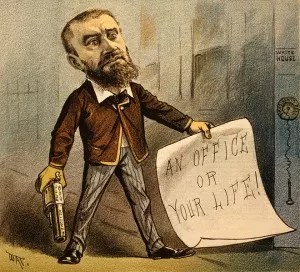
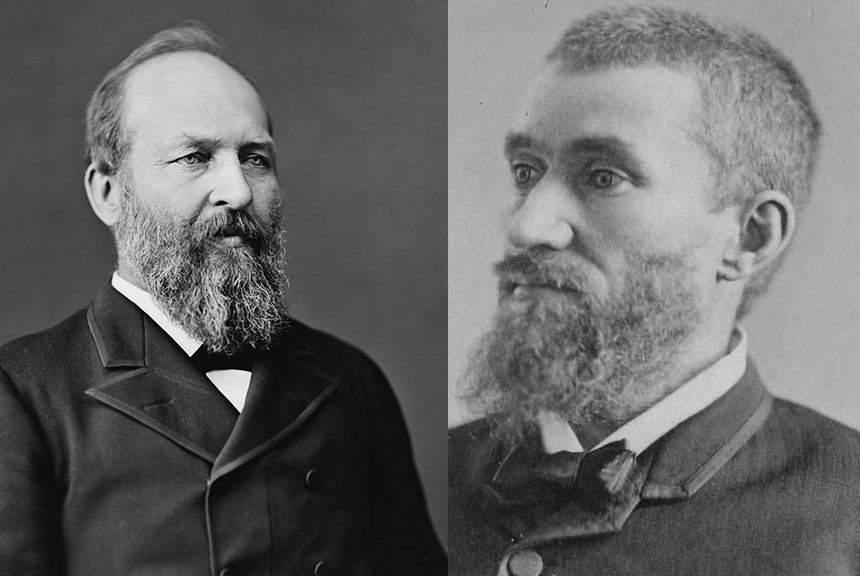
“I am a Stalwart of the Stalwarts … Arthur is President now,” an assassin named Charles Julius Guiteau said after shooting the 20th President of the United States, James Abram Garfield in the back at the Baltimore and Potomac Railway station in Washington D.C., on July 2, 1881. (New York Herald, July 3, 1881).  

Charles Guiteau believed he played an instrumental role in the presidential election of James Garfield, and he thought the administration owed him a job. He believed he was a Stalwart, a hard working, supporter of the cause, and when the administration decided not to reward him for his efforts, he decided to shoot the president. He dressed the motive up later, saying that he was on a mission from God to save the party and the country, but the motive that drove him to borrow money for a gun, practice target shooting, and stalk the president arose because the president wouldn’t give him a job.  

There are no records of a meeting between Garfield and Guiteau, so there were no personal rejections, but Garfield’s Secretary of State told Guiteau to “Never bother me again about the Paris consulship so long as you live.” There are also no records of a direct relationship between Guiteau’s annoying persistence and the Garfield administration’s decision to end the practice of offering positions to Stalwarts, also known as the patronage or spoils system. Ending this practice, encouraged Guiteau to believe he should assassinate a president.  

Why did Charles Guiteau do it? What drove this man to want to commit such a violent? What was his motive? Inquiring rubberneckers of history want to know. We could say people just have a natural curiosity, but that would suggest that once we have our answer, we all walk away. We’re obsessed with serial killers, mass murderers, psychopaths, sociopaths, and assassins. We want to know what drives them to violence. 

Is our drive to find out what drove them all about intrigue, or do we have a motive behind wanting to know the motive? Who cares why a man kills people? Who cares why a man tries to assassinate a world leader? Some suggest that if we know the motive, we might be able to prevent future incidents of a similar nature. To do that, we need to understand the criminal mind. To do what? What if the violent perpetrator has no motive? What if he lies? What if he realizes that assassinating a president, because that president wouldn’t give him a job is a pretty stupid reason to kill a man? What if he invents a motive to assign some level of importance to what he did? What if the truth is that he always wanted to commit a random act of violence?  

Do we appreciate it when a killer provides a specific motive for his actions? Does knowing a motive provide us some level of comfort? Some accept the fact that someone shot a bunch of people, because a dog told him to do it. It’s better to believe that than it is to think that they did it because they just wanted to commit a random act of violence.   

In service to his Stalwart duties, Guiteau gave poorly attended speeches on candidate Garfield’s behalf. The audience to these speeches suggest Guiteau thought President Ulysses S. Grant was going to seek a third term. They thought he simply crossed out the name Grant and replaced it with Garfield. They said this because Guiteau accidently attributed Grant’s accomplishments to Garfield. The mentally unstable Guiteau still believed he proved instrumental in Garfield’s victory, and he wrote numerous letters to Garfield, and he visited the White House and the State Department numerous times, to argue that they should reward him for his efforts with a position in Garfield’s administration. When these efforts failed, the narcissist Guiteau decided he needed to assassinate the president to save his party and his land. 

“[S]aved my party and my land. Glory hallelujah!” Guiteau wrote in a poem he recited, as his last words before execution. “But they have murdered me for it, and that is the reason I am going to the Lordy.”  

Before the assassination attempt [Guiteau] wrote an “Address to the American People,” making the case for Garfield’s assassination. In his address, Guiteau accused Garfield of “the basest ingratitude to the Stalwarts” and said the president was on a course to “wreck the once grand old Republican party.” Assassination, Guiteau wrote, was “not murder; it is a political necessity.” He concluded, “I leave my justification to God and the American people.”  

Guiteau wrote a second justification for his planned assassination or, as he called it, “the President’s tragic death.” Guiteau, claiming himself to be “a Stalwart of the Stalwarts,” wrote that “the President … will be happier in Paradise than here.” He ended his note with the words, “I am going to jail.” 

Guiteau arrived at the station about 8:30. He felt ready for the job, having practiced his marksmanship on a riverbank on the way to his destination. Garfield entered the nearly empty station at 8:25 with Secretary Blaine and a bag-carrying servant. They walked several steps into the carpeted “ladies’ waiting room” when Guiteau fired his first shot. It grazed Garfield’s arm. Guiteau moved two steps and fired a second shot. The bullet entered Garfield’s back just above the waist. The president fell as the back of his gray summer suit filled with blood. 

After shooting the president, Guiteau tried to calm the onlookers, “It’s all right, it’s all right,” he said before the police officer on duty arrested him. 

“I did not kill the President,” Guiteau said during his trial. “The doctors did that. I merely shot him.” Though a laughable defense in a criminal proceeding, historians suggest that when used as a defense against execution in a murder in the first-degree case, it might merit some consideration. Esteemed historians, such as Candace Millard, author of the excellent Destiny of the Republic, suggests that if President James A. Garfield’s doctors did nothing, Garfield might have recovered. Her assumption is based on the idea that the doctors who attempted to locate Guiteau’s bullet were untrained in Listerian antiseptic methods that would be in widespread use a decade later. Historian, and Garfield biographer, Allan Peskin disagrees. He stated, “That medical malpractice did not contribute to Garfield’s death; the inevitable infection and blood poisoning that would ensue from a deep bullet wound resulted in damage to multiple organs and spinal bone fragmentation.” An autopsy identified the cause of death as a rupturing of an aneurysm in the splenic artery. 

In the hours after his arrest, Guiteau acted strangely. On the way to city jail with a police detective, Guiteau asked the officer if the detective was a Stalwart. When the detective replied that he was, Guiteau promised to make him chief of police. In jail, he balked at removing his shoes, complaining that if he walked barefoot over the jail’s stone floors “I’ll catch my death of cold.” When a photographer snapped his photo, he demanded a royalty payment of $25.  

Prosecutor John K. Porter demanded to know whether Guiteau was familiar with the Biblical commandment, “Thou shalt not kill.” Guiteau responded that in this case “the divine authority overcame the written law.” He insisted, “I am a man of destiny as much as the Savior, or Paul, or Martin Luther.” 

Guiteau approached his hanging with a sense of opportunity, but he eventually abandoned his plan to appear for the event dressed only in underwear (to remind spectators of Christ’s execution) after being persuaded that the immodest garb might be seen as further evidence of his insanity. 

The problem for Guiteau, as it applied to a first-degree murder case, was that he displayed the characteristics of malice and forethought. He stalked President Garfield, he practiced shooting the gun he purchased at a riverbank, and he abandoned a previous attempt to assassinate the president, because the president was with his wife at the time, and Guiteau didn’t want to upset the wife.  

The trial of Charles Julius Guiteau was what some call “the most celebrated insanity trial of the century” with many alienists (psychiatrists) debating whether Guiteau was sane. Many historians, and almost all neurologists, now agree that, by today’s standards, Guiteau was clinically insane. After Guiteau’s execution, public opinion on the issue of insanity shifted.  

Although modern and future readers, who sit in the proverbial jury room, might sympathize with some of the antiquated measures used to determine sanity in 1881, but they might also calculate some of Charles Guiteau’s premeditated calculations into the equation. Months prior to the 100-year anniversary of Guiteau’s assassination attempt (March 30, 1981), John Hinkley provided a case similar to Guiteau’s, as Hinkley premeditated his assassination attempt (on President Ronald Reagan), and he did not kill the president either (reagan would live 23 more years, but Garfield died 8 weeks after Guiteau’s attempt). We might consider a stereotypical clinically insane individual to act on impulse, but the more modern jury of his peers, declared Hinkley clinically insane, and he spent 35 years in a psychiatric institution before being released. Hinkley now uploads love songs on YouTube. 

Further Reading

The Young and Stupid Clause


“Everything I did before the age of 25 should be wiped from my personal record.” I say this now, not to void a criminal record of youth, because I didn’t have one, but to suggest that we enter into a communal agreement to expunge from our impressions everything we hear about a person before they turned 26. I’m talking about enhancing the social contracts that we all have with one another. I’m talking about developing a social contract equivalent to the state’s procedure of expunging our criminal record as a minor, depending on the charges. If we commit an egregious transgression that goes on our permanent record, socially and criminally, but I say we forgive and forget the minor transgressions a person tells us from their life before they turned 26. I propose that we develop a personal, social, and cultural young and stupid clause that states, “Anything and everything we do before the age of 26 is officially off the record. We will not think any less of you, based on what you did before that tender age, and because I was as as young and stupid as you were at the time.”

We can laugh at one another. We can picture their mini-mes making character-defining decisions, and we “I just can’t picture you doing that!” one another with some judgment. When the laughter dies, however, I propose that we forget it all under the “but you were young and stupid” umbrella, because we were all young and stupid once, and most of us became old and wise as a result.

We naturally excuse any actions that occur before 18, because that’s when most of us were truly young and truly stupid, but neurologists write, “brain development likely persists until at least the mid-20s – possibly until the 30s.” Based on that theory, I say we personally extend that agreed upon consideration we have for one another to all actions that occur before age 26.

I still cringe when I think about how incredibly stupid I was. I’m no award-winning intellect now, but I’ve come a long, long way since my 26th birthday. I managed to disprove the state’s idea that a 16-year-old is responsible enough to sit behind the wheel, and every weekend thereafter, I proved that a 21-year-old is not old enough, or mature enough to handle alcohol. Thanks to the statements neurologists make on this subject, I cringe a lot less now, and I feel less shame for the things I did before 26, under the umbrella that my brain was far less developed and mature than I thought it was.

Age is a relative concept, females generally mature quicker than males, and some males mature quicker than others will. When I look back now, I tend to think I’m looking back at another person, and in many ways I am. I am almost completely different than I was then. If 180 degrees is completely different, I might be 170 degrees different.  

When the Mental Health Daily (MHD) website cites the earlier statement from a group of neurologists, it lists a number inhibitors that further delay brain development until “possibly the 30s” including alcohol abuse, chronic stress, poor diet, relationship troubles, social isolation, and sleep problems. The 25-30 me might raise my hand to all of the above, as I don’t think I explored the advantages of maturity until I approached my 29th birthday. One other inhibitor they don’t add, but I do, is parental stress. Some of us had parents who mercilessly pounded maturity, responsibility, and overall development into our heads, and we naturally spent our teens and twenties spent rebelling against those edicts.

I still don’t know what I was rebelling against when my dad wasn’t around, but my beacon revolved around the line, “What are you rebelling against?” “Whaddya got?” from the movie The Wild One and the George Costanza line, “You wanna get nuts? Let’s get nuts.”

“The prefrontal cortex doesn’t have near the functional capacity at age 18 as it does at 25,” the MHD website adds, and the writer of the article includes, “Adults over the age of 25 tend to feel less sensitive to the influence of peer pressure and have a much easier time handling it.”

I try to convince myself that I wasn’t as susceptible to peer pressure as I was. “There’s no way I did that,” I tell myself, when I know I did. I know I was young and stupid.

Those of us who were lucky enough to survive the stupidity eventually achieve a form of stair-stepping acceptance of how stupid we were that mirrors the stages of grief in some ways. These stages are relative, of course, as we all go through these stages in different ways and different times. There’s the “There’s no way I did that,” period of denial. The “Shut up, there’s no way I did that,” anger directed at people who remind us of how stupid we were, followed by a “Well, if I did that, you did this,” level of denial, and it all culminates in some depressing acceptance, “I know what I did, but I was young and stupid.”

We try to convince ourselves that we were never so stupid that we did things for the sole purpose of impressing our peers. Our thoughts go to a form of confirmation bias that permits us to view such incidents in favorable terms that highlight when we did face peer pressure down during seminal moments in our life, and we conveniently forget those moments when pleasing our peers motivated us to do some pretty stupid things. We also infuse our current, more adult ideas on peer pressure with those of our youth.  

Psychologists say that we conveniently forget horrific, tragic moments for the purpose of attaining quality mental health. Anyone who has relived the horrific details of a tragic moment in their lives, thanks to a powerful drug such as a quality dose of morphine in the hospital, knows how and why the mind selectively remembers for proper mental health. Does the mind selectively selectively misremember stupid decisions we made in our youth in the same way, so that we can live with the belief that we’ve always made rational decisions? Does this power to forget help us progress toward a final outcome of improving the ego, the self-esteem, and what have you? Is it important that we forget if we want to progress?? If that’s the case, why do we remember it one night, staring up at the ceiling at three A.M., during a mean case of insomnia. Is it as simple as we can handle it now, or does it have something to do with this idea that we’ve reached a point, in our progress, where we need to grapple with the stupidity of our youth before we continue to progress. We know we might be reaching here, and over complicating matters, but we don’t understand why we remember how stupid and vulnerable to suggestion we were, at three A.M., after conveniently forgetting about our failures for decades. 

Perhaps it has something to with another clause we should invoke whenever we hear otherwise responsible adults tell tales of utter irresponsibility and outright stupidity from their youth, the “What doesn’t kill you can only make you stronger” clause. Perhaps we need a reminder every once in a while that we should be grateful we weren’t maimed in some mental or physical ways as a result of our stupidity. Perhaps we should be grateful that we’re here to tell these tales with a relatively sound mind and body. If we have a relationship with God, perhaps we should take a moment to thank Him that we survived. Regardless who we thank, we should think about the circumstances we survived, and think about how easily they could’ve gone the other way. When we hear about young kids doing stupid things that cost them their lives, we shouldn’t dismiss them solely on the basis that they were stupid. Dismissing someone as stupid allows the purveyor of such a proclamation a pass on everything they did in their youth, without accounting for all the incredibly stupid things they did, and they just happened to survive. We should consider ourselves lucky that we didn’t suffer a similar fate, and we should tell the otherwise responsible adults as much after they’re tale is complete.  

***

I know this is going to be an unpopular statement, but a part of what kept me from ruining my faculties with an exclamation point were the state and local laws. I was not scared of police in the truest sense, but I feared what they might do to me if I did something to deserve it. If a judge asked me if I had a problem with alcohol, I would’ve said no, and I would’ve believed it. If the judge asked me if my family had a history with alcohol. I would’ve said no. Both would’ve been lies, but I would’ve said them out of fear. Why would I lie, under oath, to a judge? Look at me, do you think I’d do well in jail, and I’ve probably added forty pounds in the last twenty-five years.

“Hey, you’ve put on some weight,” a former co-worker once said, after about a decade of separation.

“In the pantheon of greetings,” I joked, “that might’ve been one of the worst I ever heard.”

“No seriously, you look like a man now,” he said. “You used to be so skinny. You used to look like a little boy.”

Can you imagine a 21-year-old, 40-lb skinnier me walking past a yard of hooting and hollering inmates? I know, child molesters receive a penalty worse than death in jail, but can you imagine if a grown, legal-aged man with child-like, waifish features walked into cellblock among convicts wrestling to control their daily urges to violate purity? The fear of what could happen if I violated those state and local laws, combined with the fictional depictions I saw of life in prison, kept me in close proximity to the straight and narrow.

I was still so out of control and stupid with non-jailable offenses that I can’t believe I’m writing to you now with something in close proximity to a sound mind. We’ve all witnessed those who whose weight is so out of control that the flap that covers their zipper has been pushed back to expose their zipper. That was me, except my struggle didn’t involve weight. It was testosterone. I had testosterone all but pushing out my pores, and I never sought a proper channel for it. How many young men, 20-25 years-old, have the good sense to channel their energy and testosterone properly?

Now, our voting public, and our state and federal representatives are dissolving and diminishing laws that might otherwise control 20-25 year-old males, who struggle to control their testosterone-fueled dreams of ruining whatever remains of their relatively immature brains.

I’ve spent the better part of this article asking that we forgive and forget the shockingly immature things we did before age 25, but we’re deciding how to vote on ballot measures, it might be better for our nation, state, and locale to remember that respect and fear of the law we had that might be one of the primary reasons why we’re here to discuss these matters. Depending on what we did in our youth, the fear of an ultimate authority figure declaring us unfit to walk around with the law-abiding citizens might recede depending on how we vote. 

Ultimately, I was the good kid and the good young man in my group who didn’t want to harm anyone but himself. Even in my small cadre of friends, I was the exception. Punching other people who deserved it, and teaching them whatever lesson they could dream up was part of the party for my friends.   

This leads to a duality some of us have on law enforcement. We don’t want our law enforcement officials wasting their precious time chasing minor offenses minor offenses around, but we don’t want young people damaging themselves any more than we damaged our minds and bodies. Those of us of a certain age no longer think the law constitutes a nefarious plot to criminalize certain behaviors to prevent young people from having a good time, but we know how far we went to have a good time, somewhere just a smidge below what we knew the law allowed. We consider most state and local laws equivalent to a governor on an accelerator to prevent young people from crashing into the walls they erect for themselves. The argument some make is that some laws make no sense anymore, but I would argue that they’re making such a declaration as a fully developed, mature adult, who is no longer as interested in skimming just under the tentative line of lawbreaking. Some argue that one law is just as bad as the other, and in some cases they’re worse, so let’s do away with a number of them, or redefine them. That argument is equivalent to suggesting that we should start our grills with white gas, because it has a flashpoint of 25 degrees, and to really get the flame going, we should add some diesel fuel, because it has a flashpoint of 126 degrees.

Some advocates of such laws worry about the children, but that’s an argument for another day. I worry about the 21-25 year-old youngsters who pursue the idea of doing whatever they want, now that they’re old enough.

This article isn’t about one law, because there are now so many of them with which I now have some concerns. This isn’t about a series of laws devoted to one topic, for it were the advocates of the behavior might pop out of the woodwork to to focus on that topic. They would probably declare me a hypocrite for indulging in the very topic for which I now oppose. I’ll say it for them, I am now a full-fledged hypocrite, and I feel fine. I still feel the pull of my anti-law youth all the time, but I know that certain laws help us define borders. If the themes of the parties I attended in my youth continue to this day, there is a lot of talk of laws. There is a lot of talk about the vague language of such laws, and how they can be exploited. We talked a lot about local, state, and federal laws, so we could know how far to push it. We wanted to live just under that line. We also knew that there was a range of violation that most law enforcement officials weren’t going to waste their time processing. Increase the range, and we increase the level of violation.  

***

As a product of permissive parenting, I could do pretty much whatever I wanted from about 15 on, but when my friends reached the age where they could do whatever they wanted, I went into overdrive.

“Are you going to the bar tonight?”

“Does the pope attend religious services?”

Our definition of being a man involved going out to the bar with the buddies and getting hammered. We didn’t invent this rite of passage. When we were young, we learned of the correlation between being drunk and being manly, don’t spread the word. We were expected to test our tolerance level every week, and we didn’t concern ourselves about failing too much, because we knew there would be a make-up test next weekend, and every weekend thereafter. Our part-time job, if we chose to accept it, and everyone we knew did, was to increase our tolerance level to the point that we might one day be like Sam Nigro in the corner over there.

“Sam can drink a gallon of beer and show no effects,” we whispered to one another, as if he was the warrior Achilles. “I saw him do it over at Pete’s house about a month ago. He drinks MD 20/20 like it’s Kool-Aid.” Sam was our Jabba the Hut. He would just sit on his proverbial pedestal with an aura of invincibility that no one could define, but no one dared challenge. He was also invulnerable to our drunken powers of suggestion, because no matter how many juicy frog drinks he downed, he never had so much as a buzz.    

No one got so hammered that a fight broke out at one of my parties. There was no sex that weekend, and no DUIs. We were all very disappointed. The next time I tried to plan a party I received polite non-committals. There was just something about the atmosphere of my apartment, the climate, or something that just didn’t invite a level of insanity to which we all grew accustomed.    

The older, more responsible citizens of various states see no problem with updating and modernizing archaic laws, because they’ve grown out of various stages. They can live their lives responsibly no matter how many temptations they update, modernize, and legalize, but as a byproduct of that they help pass laws that now allow the 21-25 year-old maniacs with testosterone dripping out of their pores, all the freedom they seek. They do make an exception for driving an automobile while intoxicated. Those are the only laws that are much stricter than they were when I was young. So, we’re now allowing our 21-25 male demo to indulge beyond their wildest dreams, and when I say dreams I’m talking literally staying up at night imagining at the ceiling that one day (like Jiminy Cricket sang) all of our dreams can come true. We’re talking about a 22 year-olds indulging beyond capacity and having the good sense not to drive home.

Now that I’m boring, old, and unflinchingly hypocritical, I hope that you’ll join me in helping me ease the decades long cringe I’ve had regarding all of the incredibly stupid things I did to tarnish my good name. Having said that, I don’t think we should help the 20-25 demographic do dumber things by diminishing and dissolving more laws that might destroy them. We tell our old people to update and modernize their thinking, and they do, but the final argument I make on this topic is to ask these modern, old people if they’re making their country, state and locale better by updating laws and choosing modern representatives? Other, older people, who have sowed their wild oats, fear being called old fogies and hypocrites, but I ask them what they would do if these new laws were passed when they were young, destructive, and self-destructive? It’s tough to remember the mindset, but if any sort of anatomical, or financial, destruction did enter my mind at the time, it wasn’t even a tertiary concern. I always thought I knew what I was doing, but now that I’m old and un-apologetically hypocritical, I now know I didn’t. I’ve now gone full circle in acknowledging that I was young and stupid.

The Simpson’s Fraudster


Tim Heidingsfelder was a nondescript, mousy little feller who had no charm, but he found a way to channel those characteristics into some real money. His physical flaws eventually led to a fatal flaw to Tims’ plans, when he successfully attracted the attention of a young, attractive, and unusually charismatic woman.

Tim Heidingsfelder probably considered his unremarkable characteristics a curse for much of his life. He was not an ugly person, not even during puberty. He never had acne, freckles, or notable blemishes on his face, but there was something about his bone structure that just wasn’t strikingly attractive. He had no chin, no discernible cheekbones, and no attributes we would call remarkable. As he grew into a man, Tim probably found his dating opportunities somewhat limited. They weren’t non-existent, but the rejections he received in high school surely helped shape the man Tim Heidingsfelder would become. 

When Tim Heidingsfelder decided to commit his first act of fraud, however, he found his unremarkable characteristics conducive to thwarting capture. As a fraudster who planned to live the high life and buy the most expensive items he could with other people’s money, he didn’t want people to notice him. He didn’t want people to remember or recall his features. 

No one remembered Tim Heidingsfelder when he checked into our hotel, but the entire front desk staff was skilled in making guests feel welcome. We would welcome every guest with a hearty, “Hello!” when they check into their hotel. We learned how to strike up a casual, fun conversation with every guest who walked in, “Hey, you’re from Michigan? Go Blue!” Our fellow, front desk employees did whatever they had to do to make every guest feel welcome and special. Yet, if those Michiganders ran into that friendly employee, hours later, even the best hotel employees probably wouldn’t remember them. We were just so good at making our guests feel welcome that they were shocked when we didn’t remember them. The problem for a hotel employee working at a large hotel is that there are just so many faces we saw in a day and so many conversations we had that if a guest didn’t say or do anything remarkable, chances are we wouldn’t be able to pick them out of a police lineup. It’s the perfect climate for anyone seeking anonymity. 

Tim Heidingsfelder wasn’t an outgoing type, but from what I heard, he wasn’t a quiet, loner either. (I only had one interaction with him, as I’ll detail below.) No one noticed Tim Heidingsfelder in the course of that day, and his daily routine allowed him to remain as anonymous as every other guest in our hotel. Throughout his elongated stay, however, Tim Heidingsfelder couldn’t help noticing how attractive the young women working behind the front desk were every time he passed.

It’s all about the money, is the first cardinal rule of fraudsters, and those who attempt to try to catch them. A fraudster needs to keep their crimes small and unremarkable, so they don’t hit the queues of investigatory agents. As most fraud investigators will tell us this might seem relatively easy, but it’s hard for a fraudster to fight greed. The second cardinal rule for fraudsters, based in part on the first one, is don’t bring unwanted attention to oneself. For Tim Heidingsfelder, and his unremarkable features, this was a relatively easy rule to manage. The man could slide in and out of just about any room unnoticed. Yet, when a late 40’s/early 50’s man stands face to face with an extremely attractive young woman, and that young woman looks through him, it can cause that man to do things he may not otherwise do.

The traveling businessman is the bread and butter of most hotels. Depending on the needs of their business, some businessmen can stay at a hotel 100 days a year. “First of all, you can forget the idea of having a family,” a traveling businessman informed me one day as we discussed the plusses and minuses of his profession. “Why?” he asked, repeating my question. “What kind of child would I raise being on the road an average of 100 to 150 days a year. What kind of marriage would I have? The life of a traveling businessman has its perks of course, but those of us who have done it for any length of time know it’s a lonely, sometimes grueling lifestyle.” I witnessed the effects this lifestyle could have on a person secondhand, and I saw them gather at the front desk to have conversations with front desk employees just to have some normal, non-business conversations in a day. I also noticed most of them centered their focus on the attractive women behind the front desk. It dawned on me, after the traveling businessman told me about the pratfalls of the profession that making an attractive young woman laugh could provide them a needed respite from their empty, relatively meaningless existence.

Tim Heidingsfelder was not a traveling businessman, but he was apparently as lonely as they were, and this otherwise unmemorable man needed to try to make one of these young women behind the front desk laugh. Based solely on his appearance, we later guessed that Tim Heidingsfelder probably had few opportunities in life to do so.

When he stopped by the front desk for whatever reason he dreamed up, Tim didn’t just stop to say hello, he didn’t just pick up a fax, or engage in the various business-related conversations that occur between hotel employees and guests. Tim Heidingsfelder stopped to chat. He stopped to shoot the stuff with some of these attractive, young women. He stopped to get to know them, so they could know him.

The best looking young employee at the front desk also happened to be the friendliest. Cheri Lee was so attractive and so skilled at engaging in short, friendly conversations with guests that she quickly became a favorite among the hotel’s businessmen and long-term guests. It took some of us naively stepping into these conversations —to do our job and add to the guest’s enjoyment– to realize they weren’t stopping by to chat … with us. They only wanted to chat with Cheri Lee, to impress her, and hopefully, one day, make her laugh. After a few of these chats, Tim Heidingsfelder asked the other front desk employees where Cheri was one day. When they told him that she had the day off, he was visibly disappointed.

As with most of the lonely, nondescript, and homely looking traveling businessmen who stayed at our hotel, Tim Heidingsfelder’s sole focus in life became Cheri Lee. According to the law enforcement officials on the scene, he spun a decade long, elaborate web of fraud and deceit. They couldn’t elaborate on the details, of course, but the little tendril he dropped to impress Cheri Lee proved a fatal flaw to his scheme. 

He probably didn’t fully appreciate the fact that the hotel paid Cheri Lee, and everyone else on their staff, to laugh at guests’ jokes. Some of the guests we talked to on a daily basis were genuinely funny. Some of the times, we laughed politely to fill the void after their punchlines, and some of the times, we laughed because it was good customer service to let guests think they were funny. Cheri had a gift for making all of her laughs sound the same. Tim Heidingsfelder enjoyed this so much that he pursued their professional relationship to its fullest extent. We don’t know if he had romantic plans with her, but after a couple of conversations with Cheri, he did everything he could, every day, to leave an impression on her.

“I’m a writer for The Simpsons,” Tim told her one day. “The Simpsons creators sent me to your city to scout it as a probable location for a future episode.” Was this lie something he dreamed up before he made the hotel reservation? Did he scheme it out beforehand with an algorithm of answers should anyone question him, or did he develop it for the sole purpose of impressing Cheri? How many lies did he think up before he landed on this one? Did he nix some, because they weren’t impressive enough? Did he nix others, because they were too grandiose and subject to fact-checking. We don’t know, but we think he locked in on The Simpsons’, Goldilocks lie, because it didn’t violate the cardinal rule of bringing too much attention to himself. He dropped the line matter-of-factly, and he didn’t elaborate too much. Yet, this seemingly harmless lie would eventually prove to be a depth charge that once detonated would expose all of his plans. 

Cheri Lee was undeniably attractive and charming, but if Tim was better looking, richer, more successful, or more charming he may not have tried so hard with Cheri Lee. A man who looks like Tim just doesn’t make people who look like Cheri laugh very often, and when they do they want to do it more often. A man like Tim doesn’t know what it’s like to impress women who look like Cheri, and when they do it’s intoxicating, and it becomes the sole focus of their life.    

When Tim dropped that line on Cheri, he accomplished his shortsighted goal of impressing Cheri. When I arrived at work the next day, Cheri was all a twitter about it. “Did you know we have a celebrity in the hotel today?” she said artfully spooling out the scoop she had. “I know you’re a fan of The Simpsons, and I know you’re a writer,” she told me. “Well, we just happen to have a guest who is both a writer and a writer for that show.”

“Seriously?” I asked.

“His name is Tim Heidingsfelder,” Cheri Lee said. She told me that he was at the hotel on an elongated stay to scout our city as a probable location for a future episode.

“You’re kidding me?” I said. “That is so cool.” I thought about how cool it might be to meet him. I thought about how cool it would be to see our city depicted in animation, and I thought about how cool it would be to talk to a paid writer to learn from his path to success.

When I finally met Tim Heidingsfelder days later, he didn’t look like a writer, but what does a writer look like? Do they all look like James Joyce, professorial and bespectacled with patches on their elbows? Tim Heidingsfelder didn’t look that way, but either did Ernest Hemingway. I was not the least bit suspicious in other words. I talked with Tim Heidingsfelder with a co-worker standing over my shoulder listening. He unsuccessfully hid his laughter while two writer nerds talked craft.

“This is just so cool meeting you,” I said, “and I love what you, and the Simpsons’ higher-ups plan on doing for our fair city.” The man was cordial and apparently as impressed with me as I was with him. Throughout our introductory conversation, I told him that I was a writer and a huge fan of The Simpsons. “As a writer, I always pay attention to the credits that list the writers of the show,” I said proudly, “and I don’t remember ever seeing your name.

“Well,” Tim said. “You probably pay attention to the opening credits. Right? Yeah, I’m what you call an uncredited writer. I have yet to have one of my episodes aired,” he said with some chagrin.

“Shows, like The Simpsons,” he furthered, “have a number of staff writers, and most of us have never had one of our episodes picked up.” That was a great answer, because I read and watched a number of “behind the scenes” and “the making of …” stories about my favorite TV shows. I knew about writers’ rooms and head writers, and it wasn’t much of a leap for me to believe that most writers on staff don’t receive accreditation. I figured that if I really wanted to find his name, I could look at the long list of names that appear at the end of the show. I never did. I was never that interested or suspicious.

While Tim and I talked about the craft of writing, I could tell he wasn’t as into our conversation as I was. I figured that was the natural order of things. I figured he was one of the lucky few who someone paid to write, and I wasn’t. I also figured that by the time I met him, he had been a paid writer for so long that it was no longer special to him. Tim Heidingsfelder gave me no reason, at this point in our conversation, to suspect that he was anything less, or anything more than a writer for The Simpsons.

At one point in our conversation, I feared that I was playing the role of the fan, an annoying, uninformed and pathetic fan. I thought my end of the conversation was mundane, in other words, and I searched for a way to impress this man. I wanted a knockout blow. I wanted some little nugget of information that would prove I wasn’t just a fan. I don’t know what I hoped to see this man do, raise an eyebrow, smile an appreciative smile, or what, but I didn’t think my question would gain me anything. I just wanted to make an impression. 

I searched for that knockout blow while asking him other, insignificant questions, such as what he thought was the best joke he submitted, and he said, “Oh, there have been so many. It’s hard to pick one.” I asked him what it was like to be in a writing room, and I thought of a couple other nerdy, fanboy questions, but I couldn’t come up with that one big question that would blow him away. After a few more exchanges, it hit me. 

What I didn’t know in the moment I spent waiting for him to stop talking was that the question I had would eventually reveal Tim Heidingsfelder’s harmless lie for what it was. The moment after it dawned on me, I couldn’t wait to ask it, as Tim continued to answer my previous question in a congenial manner. The moment he finished, I launched into what I considered a knockout question that I thought might lead to one of those curious/impressed smiles that allowed him to launch into a discussion of his memories of the years he spent writing next to Conan O’Brien.

“Do you know Conan O’Brien?” I asked him. “Do you know him personally, or have you worked with him in any capacity?”

I don’t remember what he said, or if he decided to leave it blank, but I remember he began backing away to the elevator. That should’ve raised a red flag, but it didn’t. I didn’t think there was anything suspicious about that at the time. He was a guest at our hotel, and he had to take the elevator to get to his room. I thought he was signaling that his interest in our conversation was beginning to wane, or he had to get back to his room for a phone call or what have you. This happened on a daily basis at our hotel. With the benefit of hindsight, I now remember how uncomfortable that question made him. I remember his face turning three sheets of red in the aftermath of that question, but it meant little-to-nothing to me at the time.

My co-worker, who had been listening to this conversation throughout, noted the uncomfortable silence between Tim and I following that question and he capitalized on the moment to embarrass me.

“Conan O’Brien? He’s a talk show host, on an entirely different network,” my co-worker said. “What do you think all Hollywood people know each other?” He began laughing at me. He thoroughly enjoyed the moment. Tim Heidingsfelder joined in on that laughter, in a good-natured way.

“No,” I said looking Tim in the eye, seeking to have him join me in informing my irritant friend of Conan’s early days. “Not many people know this, but Conan used to be a writer for The Simpsons.” This might be common knowledge now, but in the nascent days of Conan’s talk show, it was knowledge only fans of both parties had. 

Unbeknownst to either of us, this innocent question spelled out a cautionary tale for all fraudsters and potential fraudsters. A fraudster might think they’ve worked hard to prepare themselves for every scenario. They might think they’ve built a mental algorithm to prepare for any scenarios that might come their way. They might even sit down and write out an algorithm out to prepare for anything and everything that might expose them. As even the most gifted fraudsters will probably tell anyone who’s interested, a fraudster cannot prepare for every situation. “You just have to learn to roll with the punches, but if there’s one thing you take from our discussion today let it be this, don’t create your own situations to unwind. Don’t create your own spider webs.”  

Tim Heidingsfelder could’ve said something as simple as, “No, Conan O’Brien and I never worked together,” or “No, we never crossed paths.” He could’ve said something simple as, “I don’t know what years he worked on the show, but I never had the opportunity to work with him.” It wouldn’t have taken much to throw me off a trail I wasn’t on in other words. I thought I was in the vulnerable position, trying to impress a man I never met before. If he characterized my question as one coming from a nerdy, fan boy, I would’ve slinked off with my tail between my legs, but he didn’t know enough about The Simpsons, or his lie, to throw me off a trail I wasn’t on. Knowing everything I know now, this would’ve been a perfect place for The Simpson’s character Nelson Muntz to say, “Haw Haw!” as Tim Heidingsfelder all but sprinted to the elevators.

Most fraudsters are smooth talkers, and we think that a late 40’s/early 50’s fraudster should know when to push and when to pull out of a conversation. We think that every fraudster, but particularly a seasoned fraudster, should know how important it is to say something, some of the times. Some of the times, we have to fill the blank before others do. Some of the times, it’s just as important to leave the blank alone, to allow the other party, or parties, to fill in the blank for them, as my co-worker did when he attempted to portray me as a Simpson’s nerd who knew more about the show than the actual writer.

Fraudsters learn how to fool people at a very young age. Deceiving the people who know and loved them most is excellent training. Salesmen learn such things in training classes. Trainers tell trainees to try to sell the product to their intimate friends and family first. “Not only are they great potential customers,” trainers say, “but the interaction allows you to work on your sales pitch.” Fraudsters follow the same methodology, as they try to see if they can fool their good friends, their aunt Gladys, or their own mother first. Doing this, is a way to practice the art of deception to see if they have any talent for it.

As a former liar, I often wonder what separates those who lied, stole and deceived in their preteen years and those who continue to do so well into their adult years. Lying, stealing, and deceiving those who loved me most almost felt like a rite of passage in my early teen years, but I hated it when they caught me in an act of deception. The embarrassment and shame that followed proved almost physically painful to me. No one trusted me. They called me a liar and a thief, and the only way I found to avoid that was to stop lying and stealing. It sounds so simple, and it is, but some people enjoy deceiving people so much that they keep doing it. Perhaps I’m approaching this from an autobiographical stance, but I believe that caring provides a dividing line between those who lie, cheat, and steal in their youth and those who will make a career out of it. Do you care what your friends, your mother, or your aunt Gladys think of you? How much do you care? Lying, cheating, and stealing will test what they think of you, and how you react to their findings will define you. 

Lying, cheating, and stealing are almost a rite of passage. Most kids do it just to do it. They want to fabricate to boost their self-esteem, they want to cheat to win, and they want to steal so they can have more items or money. They also want to test those around them to see if they’re good at it, or if they can get away with it. We’re awful at it, in the beginning, but we learn, from trial and error, the various nuances required to pull them off. We learn from getting caught, and what we do after that defines us. Fraudsters don’t want anyone to catch them, of course, and they don’t want to go through the embarrassment and shame of their acts, but if they don’t find a way to deal with the shame, in their youth, it will impede their progress. “I only steal from the rich,” thieves say in the movies to rectify their immorality. This keeps the audience on their side throughout their depravity, because the rich are a disembodied boogey man that we’ve been conditioned to hate. Is that the excuse fraudsters use to defeat the guilt and shame of stealing money from others, ruining their lives financially, and depriving them of the greater joys of life. How much did you steal, and what happened to the victim in the aftermath of your crime? How many of your victims were so loaded that they were largely unaffected by your crime? Most fraudsters not only wouldn’t know the answers to those questions, they wouldn’t ask them. They prefer that we join them in their disembodied characterization. 

If the fraudster doesn’t use the movie characterization to disembody their victims, they need something, some sort of mechanism that permits them to avoid caring about what their initial victims, their loved ones, think of them, and once they clear that hurdle, they will feel free to lie to and steal from total strangers. The proficient fraudster will combine that lack of concern with some effort put into covering their trail. No matter how prepared the fraudster is, no matter how smooth they are at fooling their mother, their aunts, and all the men in their life, a situation for which they are unprepared will find them.

Those who discover they have some talent for deception, but find that can’t go on knowing what others might think of them, use whatever talent they have in ways that are more productive. They might use that knowledge or talent to catch other fraudsters and liars for law enforcement, or they might go to work for a fraud department in a fortune 500 company. They might even become magicians, actors, or writers. These three crafts call for a mutually agreed upon level of deception and lying. Some unusually good liars never search for a productive way to deceive people, but they still have a need, a compulsion to feed the need for the thrill of it all, and anyone who has successfully lied, cheated, and stolen from another knows that thrill. They probably went through everything we did with the guilt and the shame, when they weren’t very good at it, but like a great wine, or a great bottle of scotch, they got better at it through will and desire.

The man who called himself Tim Heidingsfelder engaged in larger acts of fraud, and in doing so, he probably had prepared answers for larger questions, but he didn’t do his homework on the meaningless lie he told a young, naive front desk employee. Who would? We could say that what a fraudster does in that moment for which they are unprepared defines them, but who would think that a simple lie about writing for The Simpsons to impress a young, naive woman might start unraveling a complicated yarn of deception they worked years to build?  

The only thing I knew in the aftermath of my interaction with Tim Heidingsfelder was that the man was not sufficiently impressed with my knowledge of The Simpsons that day in the foyer of the hotel. I didn’t think about it too much, until I began seeing him in the foyer of the hotel. I had numerous opportunities to correct the record, but this man ducked me, constantly. I didn’t think he heard me a couple times, and I didn’t think he saw me a couple others. Over time, a troubling pattern began to emerge, until I found his evasion somewhat noteworthy.

“Why does he always do that?” I asked Brian, the front desk manager at the hotel. Just prior to that question, Brian was speaking with Tim Heidingsfelder. The moment Tim spotted me coming to the front desk he moved the elevators.

“Because you’re a nerdy fanboy, and no one wants to talk to nerdy fanboys,” Brian said. It was a great answer, as Brian unknowingly tapped into my vulnerability on the manner, and he put the onus back on me.

“Ok, but I thought he and I had a great conversation a while back,” I said. “I was beyond polite to the man, and I think he should enjoy talking about how jealous I am of him, but every time I walk into the room, he runs away.”

“Well I know you pretty well,” Brian asked, “and if I saw you coming, I’d walk away too.”

“I’m serious here,” I said.

“You think it’s suspicious?”

“It’s odd,” I said. “That’s all I’m saying. It’s odd.”

“Does everyone have to love you?” Brian said. “Maybe he just doesn’t enjoy talking to you.”

“Fair enough,” I said, “but you know me, I’m not the type who has to be involved in every conversation. As you said, I’m kind of a quiet guy, and when I walked up to this desk tonight, I had no plans of saying anything. I was just going to stand here and let you two talk. If I was rude, or an overbearing person, perhaps I could see it, but this guy jets like I have a communicable disease any time I enter the room?”

Brian did not begin investigating Tim Heidingsfelder that night, but Brian did not view the man with the least bit of suspicion before our conversation, and soon thereafter, he began spotting some unsual dots that he thought might lead to come connections. I might have initiated the suspicion, in other words, but Brian did all of the investigative work. He dotted the I’s and crossed the T’s to find Tim Heidingsfelder’s alleged criminal activity. Brian examined the credit card history on Tim Heidingsfelder’s account history, and he found that Tim Heidingsfelder switched credit cards a number of times. That, in and of itself, was no reason to call in the cavalry. Guests, particularly business travelers, regularly put a number of business cards on their account. At times, and for a variety of reasons, those cards max out. This is particularly the case with extended stays such as Tim Heidingsfelder’s. The company furnishes their business travelers with a number of cards, and some of the times businessmen puts their personal cards on the account and the company reimburses him. Long story short, a guest switching cards in the middle of a stay is no reason to investigate on their account. When Brian analyzed Tim Heidingsfelder’s account, however, he found that an inordinate number of the previous credit cards placed on his account that were declared stolen, but he probably wouldn’t  have investigated Tim Heidingsfelder’s account if Tim didn’t initiate the chain of events that led to his downfall by trying to impress an attractive, young woman. 

When I saw Tim Heidingsfelder sitting in the manager’s office, I knew he wasn’t there to discuss his stay at the hotel. His face was three sheets of red again. Brian caught him. Seeing those three sheets of red, I recalled the look Tim gave me after my Conan O’Brien question.

The local police soon followed and frog marched Tim away in handcuffs, and I sensed the script flip from a Simpson’s episode to one of Scooby Doo as I watched the police walk him off in handcuffs. I waited for a “And I would’ve gotten away with it too, if it wasn’t for you, the meddling fanboy” exit, but it never arrived.   

The police later informed us that Tim Heidingsfelder was a pseudonym he used, and they managed to locate his real name. They informed us that two other states wanted him on credit card fraud.

If he could’ve avoided the fatal flaws in the design of the human being, the need for attention, and the need to impress our fellow humans, particularly the cheerleaders and football players of life, Tim Heidingsfelder probably could’ve engaged in fraudulent activity for years. He could still be doing it, but for his need to have someone notice him and take note of him. The line on Tim Heidingsfelder is that he stole tens of thousands of dollars from unsuspecting victims, but that could’ve been nothing more than a good start for the man. He could’ve increased that total exponentially. He could’ve destroyed people, and left true carnage in his wake, if he could’ve just managed to control his need for human contact a little better.