The Primal Instincts of Dog and Man


We love our kids unconditionally, and we would love to love our dogs just as unconditionally, except for one nagging asterisk, the dog-eat-poop thing. “Why does he do it? How do I get her to stop?” It’s so gross that it’s tough to watch, tough to stomach, and even tougher to get over when it’s over, and we smell it on his breath. We’ve tried shaming them, using our words and those tones, and we’ve even reached the last resort of inflicting pain as punishment. No one I know wants to strike their pet, but it’s so gross that we’re desperate. Two minutes after we do that, we know that wasn’t the solution, but what is? The answers for why they do it are so wide-ranging that it’s safe to say no expert has a definitive answer, nor is there a definitive answer on how we can stop it. The best answer I’ve heard for why they do it is that their wild ancestors ate their puppy’s poo to prevent predators from knowing where they were, and if that’s the answer then the answer to the second question is that it’s almost impossible to get them to stop. It’s bred into them by their ancestors to protect their young. 

Even if we had one definitive answer everyone agreed on, and we knew how to train them to stop doing it, it wouldn’t change the fact that it’s just gross. When long-time dog handlers are asked what’s the one drawback to their job, they’ll almost immediately go to the dog-eat-poop thing. They might go on to list other matters that are just as difficult and more challenging, but most of them will say that the poop-eating thing is still, after decades of working with dogs, something they cannot get passed. 

“The grosser the better,” does seem to be the answer for the general practice of dogs sniffing material on the ground. If they spot an old, white and mostly crumbly piece of excrement in the grass, they might give it a whiff and move on, but a fresh, steaming pile flips some sort of an ignition switch in the need-to-know aisle of their brain. Their desire to learn every little nugget of information possible about that turd can require a muscular tug on the leash to get them away from it. Depending on the size of our dog, it might alter our preferred ninety-degree angle with the earth when they find a rotting, maggot-infested opossum corpse nearby. Our beloved little beasts can’t help it, it’s the way they were wired, but our hard wiring leads us to find the act of sniffing, sometimes licking, and even eating excrement so repulsive that it can temporarily alter our perception of them.

The Scene of a Car Accident

Most of us won’t sniff, lick, or eat the steaming carcass of a car accident victim, but we will slow our roll by the scene of the most horrific car accidents to satisfy our sense of sight and curiosity. Coming to a complete stop is beyond the pale for most of us, but how slow do we roll by, hoping to catch a little glimpse of something awful? The grosser the better.

To curb our enthusiasm, first responders assign some of their personnel to traffic control. They have to to prevent oblivious drivers from hitting the personnel on the scene, of course, but they also know that our desire to see something awful will cause traffic jams and accidents.

“I could put together a book of some of the things I’ve seen drivers do, some of the dumbest things, to see the horrors of a car accident,” a friend of mine, often assigned to traffic control, said. “I’m not talking about a top ten list either. I’m talking about a multi-layered, illustrative, instructional, and sad-but-true comprehensive book on the things I’ve seen.”

I realize that 20-30 minutes is a relatively minor traffic jam, compared to most cities, but the reason some of us live in big towns and small cities is to avoid the perils of over population. So, when we incrementally creep up on the scene of an accident, and we see no other obstructions in our lane, or the other three to our right, we realize that the sole reason we’re going to be twenty-to-thirty minutes late is that every other driver ahead of us had to slow roll their way by the scene to see if they could see something awful.

We get so frustrated with all the drivers driving so slow that it’s obvious that they hope we misconstrue their slow roll with a respectfully cautious approach to an accident. They just want to see something, and they hope they time it just right to see the first responders pull the bloody and screaming from the wreckage. 

As with the quick sniff in passing that dogs give a hard, mostly white and crumbly piece of excrement in the grass, we might give a “Nothing to see here folks, everyone’s fine” fender bender a glance, but we won’t even slow to survey for carnage. We won’t, because in our drive up to the accident, we saw no evidence of twisted metal, plastic shrapnel on the street, and no spider glass. We pass by without slowing, knowing that it’s not worth our time.  

When we see evidence of a catastrophic accident, we become what my great-aunt used to call lookie-loos. Lookie-loos feed this morbid curiosity so often, that we’ve developed a term for it, rubbernecking. Rubbernecking, the term, was developed in America, and the strictest definition of the term involves the straining of the neck to feed a compulsive need to see more of the aftermath of an incident.

A 2003 study in the U.S., suggested that lookie-loos rubbernecking was the cause of 16% of distraction-related traffic accidents. If you’ve ever been involved in a major accident, you know the scene attracts a wide variety of lookie-loos. Some of them do everything they can to assist, but most pull to the side of the road just to look, just to see. They, in their own strange way, want to be a part of the worst day of somebody else’s life. If you’ve ever witnessed this, you’ve seen some similarities between them and the information-gathering dog sniffing poo on a neighbor’s lawn.

I’m going to go out on a limb and say almost no one wakes up in the morning, hoping to see something awful, and we don’t purposely put ourselves in position to block emergency vehicles, or get so close to an incident that we run the risk of being a part of the carnage if the fire hits a gas line. We just sort of drift into a position for the best view of something tragic. These moments help us feel fortunate, because it isn’t happening to us, and how often do we have the opportunity to feel grateful and fortunate? 

Intra-Office Drama

On a much lower scale is the “Did you hear what Jane did to Jim last night?” intra-office drama. Until I saw the damage this gratuitous grapevine could cause, I must confess that I was a conduit of such salacious information. I heard it, I lifted an eyebrow, and some element of my storytelling nature couldn’t wait to pass it along. It’s embarrassing to admit now, but we’re all tempted by the siren of salacious information that someone doesn’t know, and we strive to have others view us as as a font of fun and interesting info. We have all heard people say, “I’m not one for the drama.” Yet, they’re often the first ones to pass these stories on. I love it, you do, and we all love a little drama in our lives. It’s sort of like our own little reality show in which we intimately know all of the players involved.

Then it hits us. We have to work with these people. We have to see, hear, and feel the aftermath of spreading this information, and the drama we so enjoyed yesterday can make the next forty hour work week so uncomfortable it’s almost painful. They can’t look us in the eye, and we have to live with the fact that we played a role in damaging their reputation. We realize that we inadvertently diminished our work space to feed into this need to know too much information about our peers.      

The Need to See

We also “need to see” videos of others doing awful things to others. As with the dog that is innately attracted to the steaming pile, we want grosser-the-better videos. Even our most respected journalists, in major and minor broadcast fields, feed the need, and they know they have to, but they dress it up with “a need to see it.” Why do we need to see it? “We’ve deemed it important to keep you informed,” they say. I read the article, I got the gist of it, someone did something awful to someone. I get it. “But it’s news, and it’s important.” This is a complete crock, I say as a person who has never worked in a news room. My guess is that they go behind closed doors to discuss the video of an atrocity. They weigh the business need to feed our desire to sniff the steaming pile of humanity against the journalistic code to not stoop so low as to air something just to get clicks or ratings, and the compromise they reach is to dress it up with a “need to see” tagline. Nobody is saying we should try to put the genie back in the bottle on this unfortunate side of humanity, but how about the broadcasters and podcasters be a little more honest. “Tonight, in our Feed the Need segment, we have the latest stranger doing awful things to other strangers video.”

Those of us who enjoy being happy, content, and feeling some semblance of safety don’t understand the “need” we all have to sniff the steaming pile of humanity. We understand that some of the times ignorance is bliss, but most of the time we don’t need to whiff of the worst of humanity to know it exists. Yet, I will concede that there are some who need to see it because they say, “It didn’t happen the way. Not the way they say it did.”

The dog can be a surprisingly complex animal, both intellectually and emotionally, we’ve all witnessed some inspiring feats in both regards, but they still have that primal wiring and structuring that define their needs. The human might be the most complex and intelligent animal in the animal kingdom, but we’re still animals. We have complex needs, desires, and thoughts, but no matter how much we’ve evolved, modernized, and advanced, we still have some primal needs and wants that we’ll never be able to rid ourselves of no matter how advanced we become. Some humans have achieved some incredible things over the course of human history, but one has to imagine that if a genius the likes of Leonardo da Vinci were alive today, he would be a lookie-loo if he saw a horrific, yet visually appealing car accident, and he would probably rubberneck the scene to the point that he delayed all of the drivers behind him. We can be the greatest species ever created, but in other ways, we’re no better than the chimpanzee, the dolphin, or the dog.  
Feed the Breed: The Beagle


“Ask not what your Beagle can do for you. Ask what you can do for your Beagle!” 

When we purchase a puppy, any puppy, and bring them into our beloved home, it’s our natural inclination to focus on what that puppy can do for us. Some say that it’s a puppies job to bring love, happiness and an overall sense of joy into our home. We paid to bring him home, after all, and as with the purchase of a loofa, a barcalounger, or a toothbrush, we expect them to perform certain functions for us. If the puppy doesn’t perform to our expectations, we might even think of returning it. (Talking to certain employees at kennels, I’ve learned that this is a part of the business, as they offer a 90-day return policy to customers who aren’t happy with their purchase.) 

His job is to play with us, cuddle with us, provide a general sense of companionship, and do all the things a puppy should do. If he fails to comport with how we think a puppy should act, we see it as a failure on his part, and we might seek professional assistance and advice for him. Most of us do not consider what we can do for the puppy to make them a happy, more well-adjusted dog who doesn’t mind comporting to our standards. We might give him a big backyard to run around in, toys galore, chew sticks, treats, companionship and love, and anything and everything we can think of that would make a dog happy, but we don’t think beyond all that to what we should be doing to build a symbiotic relationship with our new puppy. 

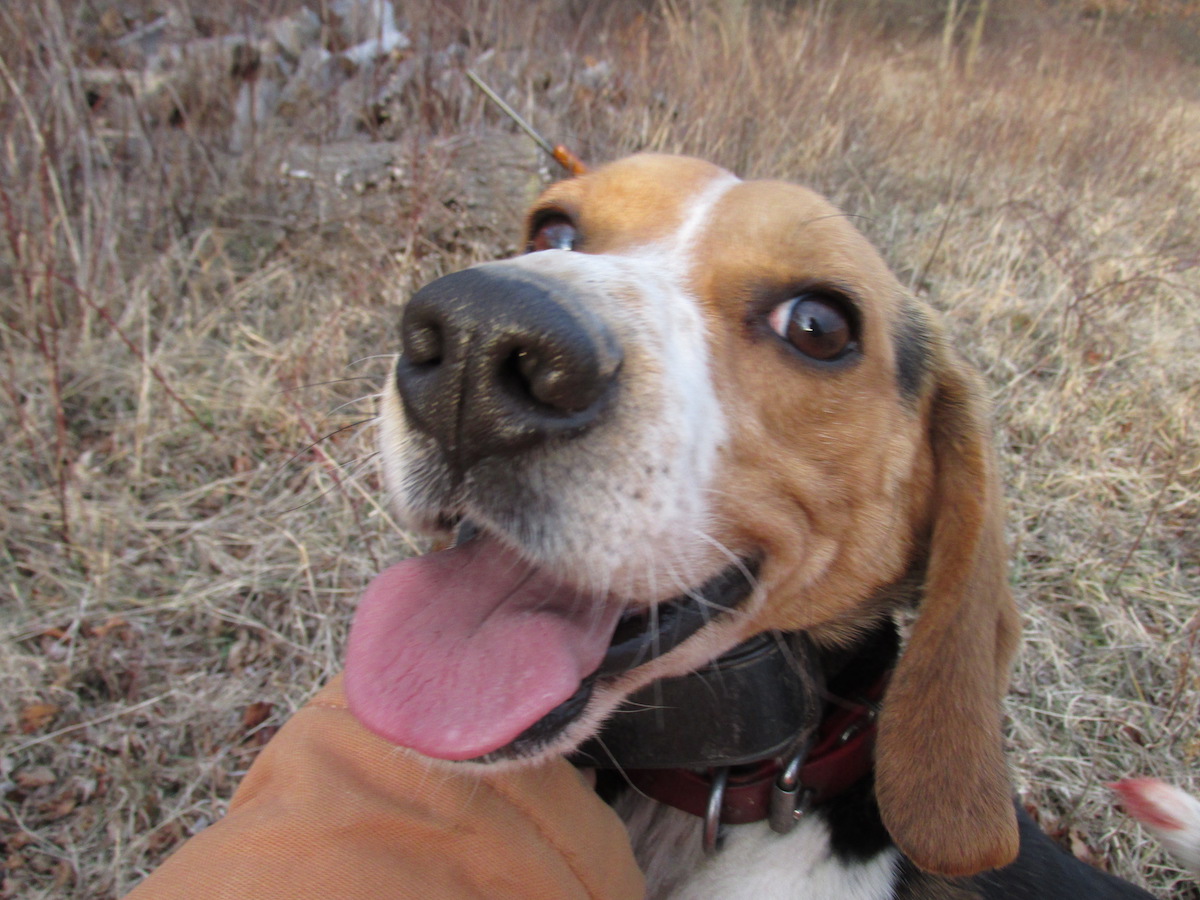
“Feed the breed,” I now say. “Feed the breed.” I list this as a consideration for all dog owners to consider, but it’s specifically tailored to Beagle owners, because I have a Beagle, and I love Beagles. I write this for all dog owners who now see that that beautiful, little puppy they just brought home, who now plays in what we might consider an almost mean-spirited manner. There were times when my Beagle, Max, bit a little too hard during playtime, chewed up some of my precious items, wouldn’t leave the other dog in our home alone, and he was a naughty little boy so often that he added to some of the wrinkles and the grey hair we now sport. My puppy acted as if he was almost (and I normally hate to assign human characteristics to a dog) frustrated. 

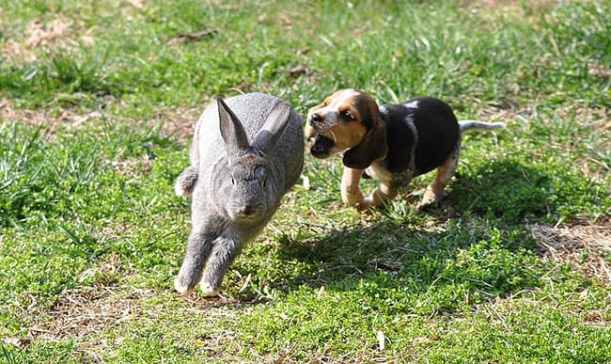
When I write, “Feed the breed,” I’m not suggesting that you feed your Beagle bunnies, or that you need to let them catch and devour bunny. When I suggest that you feed the breed, it doesn’t necessarily mean that you have to watch them feed. If you’re anything like me, it might make you uncomfortable to watch your beloved Beagle actually catch and devour a rabbit. I’m suggesting that you do some research on the breed you purchased and feed into the breeding of your dog.

When I went online, searching for answers to my naughty, little Beagle, I kept seeing this short characterization, “Beagles were bred to chase bunnies.” I didn’t think too much about it at the time. Prior to purchasing a Beagle, I owned a Puggle (part Pug, part Beagle), and that Puggle loved chasing rabbits. Among all the other things he enjoyed, he enjoyed chasing rabbits. So, when I saw that line, “Beagles were bred to chase bunnies,” I continued to skip it with an “of course” in mind.

Friends and family told me Beagles were hunting dogs, and I saw some evidence of it, but Max was purchased to be a family dog. I didn’t want a hunting dog. I wanted a cute cuddly, overly playful dog, and the fact that he happened to be a hunting dog, bred to chase rabbits, was to me an asterisk on the list of characteristics I found. I read it, and then I went onto reading all of the other characteristics I wanted to learn about more. Notice the emphasis on “to me” and “I wanted”. I wanted him to be what I wanted him to be, and I failed to consider what he might be in a larger context. I failed to consider the idea that a Puggle might love to chase rabbits for the sport of it all, but a Beagle needs to chase bunnies in a way that is (again, I cringe when I assign human characteristics to dogs) fundamental to his constitution.  

We took him on those small, daily walks, fifteen minutes a day that every Beagle owner prescribes for those who want a happy dog, I noticed that he huffed every inch of ground beneath him. (A Beagle doesn’t sniff the ground, he huffs on it.) He still exhibited signs of frustration. We took him on more walks in other areas, and in those other areas there was some evidence of bunnies. Even with that, he remained the dictionary definition of a high maintenance dog. I could go through all of the various characteristics and incidents to illustrate how high maintenance Max was, but I think I can summarize my mindset with a comment I began making, “I think I made a huge mistake purchasing this dog.” I walked him constantly to get some of his energy out, and he spent a majority of the rest of his time outside, in our big backyard, running around playing and barking with the neighboring dogs. A human, knowing the general characteristics of a dog might think Max landed in a canine version of nirvana, but he was still always on, and he continued to be somewhat frustrated.  

When I walked him, I walked him through our neighborhood, and the idea that he was bred for hunting rabbits was obvious. He would freak out when he occasionally caught some stray scent of a bunny, and I saw that, but I still didn’t catch on entirely.

It wasn’t until I made the decision to take a long walk into areas with a large bunny concentration that I saw the other side of Max. When he’s in rabbit-infested arena, Max develops tunnel vision. If humans approach him for a quick pet, Max doesn’t even acknowledge their existence. He’s in the zone. Other dogs run to the fence barking and wagging their tales, ready to play. They might as well be on another planet as far as Max is concerned when he’s on the hunt. When he catches a scent, he begins huffing the ground (as opposed to his usual sniffing), and there are times when he huffs the ground so hard that he begins sneezing (as often as twelve-to-fifteen times in a row, some of the times, blowing mucus and excess saliva all over the place). He pulls on the leash to continue to huff every inch of that select ground, and he pulls with all his strength on the leash to signify that he’s far from done with this area. On frequent occasions, he lays out on all fours to anchor himself to the ground, until he’s done covering every square inch of that scent. 

One of the websites devoted to dogs wrote, “Beagles can tell us where bunnies were, but they’re not as proficient at telling us where they are.” This, in my humble opinion, is because they obsess over the ground where “they were” to the point that they might not be as concerned with where that trail leads.

When Max hits a trail that he knows a bunny has spent some time on, he yips, barks and howls en route to the suspected location. (Have you ever heard a Bloodhound’s howl? It’s that.) Max gets so loud that it can prove embarrassing, at times, as we might fear that unsuspecting and uninformed onlookers might think we’re beating our poor, little puppy. “Is he okay?” a concerned neighbor asked from the foyer of her backyard door. I saw her standing there seconds before, and I think she was watching my actions to see if I was beating my dog. The near-screams coming from Max were that intense.

“Thank you for your concern,” I waved. “He just caught the scent of a bunny.” She smiled politely and all that, but I could tell she wasn’t thoroughly convinced, and she slowly re-entered her home watching us to try to spot a reason to call the Humane Society on me.  

My advice to the dog owner who might want to explore the extent of the characteristics of the Beagle, is make sure you carry dog water bottle on these walks, because your Beagle will obsess over these little areas to the point of excessive exhaustion and dehydration. The typical dog owner will want to move on after a while, but it can prove difficult, and almost impossible to convince your Beagle to move on. (Our new ritual of walking in bunny areas, can take a forty-five minutes to an hour.) 

Prior to these long walks in rabbit-infested areas, we tried everything we could think up to make this dog happy. We even went so far as to consult his veterinarian, who told us that he was a puppy, and you should start to see these puppy characteristics subside around aged two. Well, aged two came and went, and he was still high-strung, mean-spirited, and he exhibited some levels of frustration. After these walks, which we do on average three times a week now, I’m happy to report that when I am eventually able to convince Max to move on and begin the long journey home. He returns to our loving home a more normal, less unstable, satisfied and less frustrated dog. By feeding into his breeding, I now have a dog who doesn’t get into things, bite too hard, or display any of the other naughty characteristics I’ve listed above. He’s now an exhausted, less frustrated, and satisfied dog. 

Read the Breed

It’s human nature to expect a child, a dog, an entertainment system, or a loofa to perform according to our expectations. Unlike a loofa or an entertainment system, children can be complicated, frustrated, or dysfunctional in some minor ways that require attention or treatment. We know that, and that’s why we developed the aphorism, “Parenting is one of the hardest jobs in the world.” We don’t expect raising a dog to be as complicated. Yet, like children, to a far lesser extent, all dogs are different. Some are naughty, highly intelligent, and bred different. 

Having written everything I have thus far, let me say that the idea of returning a dog, even one as obnoxious, high-strung, and even mean as Max could be on occasion, was the furthest thing from my mind. I know I’m different, but I would’ve considered that an epic fail on my part. I did my research not to find information to support my thesis that I made a huge mistake by purchasing him, but to find out how I failed and how to rectify it. I have heard tales of bad dogs though. If you have what you consider a bad dog, you think there’s something wrong with your dog, or you pointed your finger at the word frustrated and said, “It’s that,” or “I’m not sure if it’s that, but it’s something like that, that we’re dealing with here.” Bad dog, or something wrong with your dog, can be a description relative to the dog, their owners, or some complex combination thereof. Nobody is saying you’re wrong. There are bad dogs, just like I’m sure zoo keepers can probably tell us there are bad meerkats, bad, mean, or otherwise obnoxious butterflies, and otters. There are also, believe it or not, some bad humans, but with humans we often do extensive research before reaching a final conclusion. That’s the advice I would give all Beagle and dog owners, read the breed and feed the breed. Do some research on your dog, read through their characteristics to find out what makes them tick and feed into that to see if you might be able to use some measure to ease their frustration and make them happy before you reach some final conclusion on them. The best thing I ever did was learn more about my Beagle, and how I could feed into his breed to make him happy, because he’s done everything in his power to return the favor ever since. 

The Good, the Bad, and the Beagle


“Your dog is a hunting dog,” some men say when they see a Beagle. “Seriously, they’re bred to hunt.”

“Really,” I say. “That’s interesting.” I found the characterization, or categorization, interesting. I heard it before, as I watch cartoons, but I dismissed it based on the fact that I’m not a hunter, and I didn’t think I’d witness those characteristics.

I owned a Puggle (part Beagle, part Pug) for over eleven years, and I named it Mr. Fehrley after the landlord on Three’s Company. Mr. Fehrley was the best dog I’ve ever owned. Loyal, obedient, easily trained, affectionate as all get out, and as fun as a dog could possibly be. If anyone is looking for a great dog, I don’t think you can do much better than the Puggle. I could be wrong, but I think Mr. Fehrley took the best of the Beagle traits and combined them with the cute, cuddly traits of the Pug.

I loved that Puggle so much that I wanted another one right after Mr. Fehrley’s tragic demise. My wife said that I would forever unfairly compare the new puppy to Mr. Fehrley. She was right, of course, as no dog could live up to the lofty plane I put Mr. Fehrley on.

The Cute Beagle

If I wanted another Mr. Fehrley, the question was should I go Pug or Beagle? I’ve met some pugs, and I read about a whole lot more. While they are one of the more attractive dogs the consensus on them is that they are cute and cuddly lap dogs. They are characteristically loyal and affectionate, but their preference (according to the various websites on dogs) is to sleep. They enjoy sleeping by your side, on your lap, but they are just as content to sleep by themselves, as long as they’re sleeping. They will occasionally chase a ball around when they’re puppies. Older Pugs fall routinely fall into the 20-hour plus sleep routines of the normal dog.

The best dog I’ve ever owned napped a lot, but most of his characteristics lined up with the playful Beagle traits. If you loved those traits so much, I thought, why not go one step further and find out what a purebred Beagle might have to offer?

Over a year in, I’ve seen the documented loyalty of the Beagle in Max. He’s no Mr. Fehrley, but he’s probably as close as I could get with all of the other characteristics thrown in.

Max, while still a puppy, had boundless energy. Just when we thought we drained every ounce of energy out of this tiny dog, he regroups. He takes a break. He drops to his belly and pants it out, and then he’s ready to go all over again, usually within minutes.

As I suspected I didn’t see the hunting side of Max, and I never thought I would, until we took a trip to grandpa’s house. Grandpa’s house is in a small town, surrounded by acres of forested region. On the outskirts of that forested region, we spotted a deer.

Anytime Mr. Fehrley spotted something wild, his motto was “I’m game!” He spent his eleven-and-a-half-year existence chasing anything and everything just to do it and just to see what it was. He loved “the chase”. (He chased an opossum once, and he caught up to it, but he didn’t know what to do with it when he did.)

We could see Mr. Fehrley’s Beagle characteristics in the course of a chase, but the Pug characteristics appeared when he was easily dissuaded from pursuing it by our arbitrary definition of “too much”. If I decided this would be a fun hunt, and I did more often than not, Mr. Fehrley was game. He was all-in, as it were, but after a while, humans get tired, bored, or in other ways disinterested in the chase. A Puggle follows suit. “I get it,” they basically say. “It’s time to move on.”

The Hunter

A Beagle, as evidenced by this trip to the grandparents, and a couple of instances since, cannot flip the switch of their internal mechanism off as easily.

The quote “Your dog is a hunting dog” came back to me when I saw Max’s internal mechanism go primal. Mr. Fehrley whined and barked after squirrels, rabbits, deer, and any other being we saw through the course of his life, but his emotions dictated that he enjoyed chasing things more than anything else. He was a very curious dog and highly intelligent. Max’s reactions suggest he doesn’t want to just chase prey, he wants to rip the throat out of whatever is on the other end of this scent. His whining and barking are more of a primal, desperate cry to satiate the characteristics bred into his DNA.

It’s difficult to describe the distinction between a dog who enjoys the hunt, as if it were a game, and one who displays an internal, primal switch. To illustrate the difference, Mr. Fehrley chased hundreds of rabbits under chain link fences. He then dug fastidiously under the fence, and he whined while doing it, but after a time, Mr. Fehrley recognized the pointlessness of the exercise. It was cute and funny to see him display all of these characteristics. Max did all of the same things, but at the point when Mr. Fehrley would recognize the pointlessness of it, Max attempted to bash through the fence, headfirst, twice. If I didn’t pull him away, I suspect he would’ve harmed himself in the pursuit.

The men who told me Max was a hunting dog said it was why humans bred them. We all knew this. We know this about our German Shorthairs, our Pointers, and the various retrievers we call our best friends. We know some dogs are bred for hunting, but until we see it firsthand, we don’t truly know it.

The Beagle Smile

Mr. Fehrley ran to the extent of his talent to capture the goal, but he never came close to achieving it. Max is so fast and so quick with his change of direction speed that if I let him off the leash, I can only guess that he wouldn’t stop until he ended the life of whatever it was he was chasing, and he’ll come back with a bloody beard when he’s done. 

I let Mr. Fehrley off the leash to chase his intended victims, because I knew he’d stop when I ordered him to, and he’d always come back. I’m almost positive that the moment after I let Max off the leash, I’d never see him again.

I flirted with letting him off the leash once, but there was a fairly busy thoroughfare a quarter of a mile away. Just seeing what I saw that day at the grandparents’ home, I know Max would go to that thoroughfare and beyond it if that was required to catch his game.

The Passion of the Beagle

Dogs love their masters in a general sense, defined by the way they greet us at the door, the way they enjoy being pet, and in all the ways a dog expresses love. If we were to define love, in this sense, we would define a Beagle’s love as passion. The French have a term joie de vivre, which basically means to express a cheerful enjoyment of life, an exultation of spirit, and a general sense of happiness. To watch Max go through life, one gets the feeling that they’re not enjoying life to the fullest. Everything is the greatest thing that ever happened to him. When he greets you at the door, it’s as if you’ve been gone for a year, and he curdles under your touch when you pet him. When you pick him up, he wears a full doggie smile, coupled with a quick lick to your nose, and a wriggling that suggests he wants you to put him down. If you abide by what you consider his wishes, he tries everything he can to get back up. He wants to sleep with some part of his body touching you, and he even sleeps passionately, which you learn if you move your leg. “I’m sleeping here,” he growls. Most dogs love to play chase the ball, but of all the dogs I’ve owned, no dog plays chase with more zest, zeal, and passion than the Beagle. When he greets a stranger that you’ve acknowledged in some way, he passionately pursues their affection in ways that can, at times, prove embarrassing. If you watch him in your backyard with seemingly nothing to play with, he races around in the yard, in a manner some call the zoomies. I’ve watched him chase nothing for a good ten minutes as top speed with no break. I’ve watched him flip a stone up in the air and chase it around for a couple minutes, then he rolls his back on it, flip it up and repeat for an unusual amount of time.   

Max is the most passionate and affectionate dog I’ve ever owned. He’s as loyal as any in-the-home, domesticated dog I’ve ever encountered, much less owned. After a year of ownership, I thought I knew him as well as any dog I’ve ever spent every day with for a year. I’ve owned a Cain Terrier (a Toto) who surprised me by digging so deep into a ground squirrel’s hole that I was reminded my cute, little fuzzy buddy was a carnivore. I owned a Puggle who showed me what he was bred to do, but neither of those two dogs could prepare me for what the Beagle wants to do, how badly he wants it, and what he might do if he catches it.

If you’re in the market for a dog, the Beagle is one of the most beautiful dogs you’ll ever see, and they’re one of the best family dogs on the market, but they’re also listed as one of the best hunting dogs by many other outlets. If you want to buy a Beagle for evidence of the former, but you don’t want to see evidence of the latter, my advice is never take them out of your city neighborhood. Doing so, might lead you to see a side of them you don’t care to see. I enjoy it all to a limited extent. You can call me a soft, city-dweller if you want, but I must admit that I was not ready to see the extent of my Beagle’s ability as a hunter. Now that I see it to the extent that I know it, I’ve learned how to feed the breed to make him happy.