“Aww, look at the little fella, how can you call him the spawn of Satan? He’s so cute!”
Max is a beautiful Beagle. He is well-marked with long, thin legs, and he has that award-winning Beagle arch. He has a dog-smile on his face almost twenty-four seven, and he has an excellent disposition.
The idea that a breeder would sell him for a third of what his brothers and sisters were going for confused us? The breeder said she could only guess that most Beagle fans want a female, or they want a Beagle that was more white than black coloring. She said she was as confused as we were. My best guess, four months in, is that the potential buyers knew more about Beagles than we did. My guess is they know, like we all do, that although all Beagles are high energy, very intelligent and stubborn, there’s always one in the litter who is a little more of all of the above. My guess is that they sensed that Max might be a little crazed, and they know to be wary the runt of the litter. My guess is they know that the runt of a Beagle litter, more than any other type of dog, might just be the spawn of Satan.
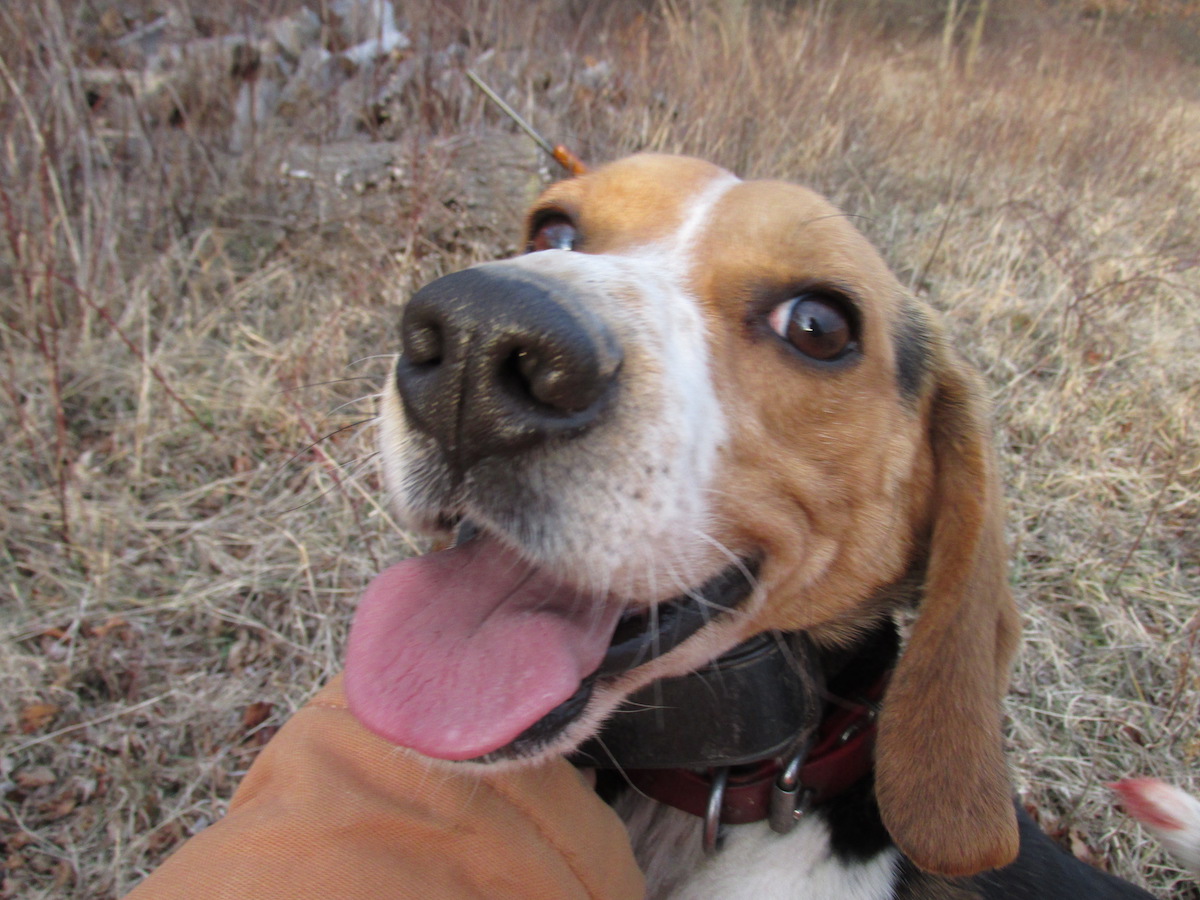
Those in our house who don’t close their bedroom door know that something they hold dear will be ripped to shreds within the hour. We know that it’s in our best interests to keep him on-task, interested and engaged, because if he grows bored in any way, he’ll fill the void.
“Give a Beagle little to no exercise at your own peril,” Beagle experts warn. Okay, but how much exercise does the average Beagle need? Whatever that number is, go ahead and triple that for Max. We walk him twice a day, play with him constantly, and we have a huge backyard that he spends most of his day in, zooming back and forth in at top speed, and it’s never enough. If you don’t know what the zoomies are, get a Beagle
After he spends a good ten minutes zooming back and forth, you might think, as we did that he’d come back in exhausted, spent, or physically satisfied. He comes in jacked up, jamming a toy in our face, ready to play for the next half-hour. A half-hour doesn’t seem like that much, until we learn that it’s a minimal requirement for him on a daily basis. Four months in, we’ve yet to see him pant with exhaustion. My high energy, high functioning child can’t keep up with this dog.
“They’re hunters,” experts say. “They’re have a strong sense of smell.” Most dogs walk with their heads up, but Beagles walk with their head down because they don’t want to miss a scent. I’ve yet to see Max take more than ten steps with his head up. When I leaned over to watch his schnoz in action, the rapid speed of his nose touching ground reminded me of a hummingbird’s wings, moving so fast it’s almost hard to see. If we dabbed some paint on the end of his nose, we could probably use it to find our way back home.
We’ve had him roughly 120 days, and I’ve probably pulled 100 things out of his mouth. A sample includes hair scrunchies, innumerable COVID masks, already been chewed gum (more than six times), other dogs’ waste matter (more than ten times, and one of them was stomach churning long!) a wide variety of plastic items, coins, candy, various parts of whatever carcasses he finds along the way, and day’s old, rotting rice. That’s a very small sample of what I can recall pulling out. He’s like the bull shark of dogs, he’ll eat anything and everything, and he growls angrily when I pull it out. He also bites at the hand that feeds it, or unfeeds it by pulling trinkets out.
 I know a dog’s sleeping patterns are probably as relative as humans, but this dog rarely sleeps. I can count, on one hand, the number of times that he wasn’t up for at least nine hours straight. Nine hours doesn’t seem like much in human terms, but imagine trying to entertain a high energy, high functioning dog for nine straight hours. When he’s up, he’s not watching TV, looking out the window, or playing with his toys. Max knows how to play by himself, and he does, but he gets bored easily and very quickly. The time between one stretch of playing time and another, takes about as long as your sigh of relief. When he gets bored, he gets into things, causing trouble, and doing anything and everything he can to gain our attention. One day, he was up for eleven straight hours without a nap. Needless to say, it can be exhausting and frustrating, and it can consume your life.
Most dogs are on our schedule. When we’re ready to play with them, or entertain them in any way we dream up, they respond eagerly. I understand and appreciate the fact that puppies are more energetic than adult dogs, but even most puppies sleep until you’re ready to play with them. Not this guy.
When I searched for a new puppy, I put together a mental checklist. I wanted a playful dog (check), I wanted him to be high energy (check, check), I wanted him to always want to be around me (check), and I wanted a dog who wanted to sleep on my lap while I watched TV (check). I got everything I wanted in this dog and then some, but it’s the “and then some” that I’m writing about today. The “and then some” portion occurs after we’ve played ball for 15-20 minutes, and he’s racing the ball back to me with as much speed and energy as he had when we started. I know, I know, the puppy thing, but it’s impossible to exhaust this dog. I’ve yet to see him run out of energy.
I read all of the “read this before you buy a Beagle,” warning lists. I read literature stating that due to their high level of energy, their nose, and their heightened sense of adventure that the owner will need to keep them leashed them at all times, and that they will want to kennel train them immediately after bringing them home, because a Beagle needs to be kenneled when they sleep and when their owners leave. Doing anything less is just asking for trouble. I read all that from what I considered a knowledgeable perspective. I owned a Puggle (part Beagle, part Pug), so I thought I knew what I was getting into. I don’t know if the Pug characteristics softened the Beagle traits in my previous dog, but I wasn’t ready for this fella.
He is a good puppy, and he will eventually be a great dog. He runs and plays keep away with the neighborhood kids. He greets every new person as if they’re the greatest person on Earth. He loves meeting kids and other dogs, and he has a very sweet disposition, but he is CONSTANTLY on.
Walking him is an excellent workout for anyone who wants to focus their workouts on their forearms, as he wouldn’t know a straight line if he tripped over it. Every dog I’ve owned went from two pulls on the leash, as a puppy, to one pull as a full grow adult dog. The average walk with Max reminds us of a dance step, “It’s one step, two step, pull, pull, pull, three step, four step, pull, pull, pull.” If he’s mildly interested in something, it might require three tugs on the leash, but if he’s intensely interested in something, and this usually happens two to three times a walk, I have to pull him from it with great force. At this point in his puppyhood, I am the only one in the neighborhood who can walk him. No one else is focused enough to distract him, when necessary, as often as it’s necessary to prevent him from ingesting something he shouldn’t, and no one is strong enough to keep him in line when required. And it’s not as if he’s heavy, because he’s not, but even twenty pounds becomes taxing after the rigors of repetitive motion begins to kick in. He exhausts kids as easily as adults. A discarded, half-full milkshake cup required so much pulling that I almost considered calling for assistance.
I’ve read some Beagle owners write, “Toughen up buttercup!” when a Beagle owner complains. And they add, “You should’ve known what you were getting into. You should’ve done your research!” I thought I had. I read all the literature I could find on the breed, and I prepared my friends and family for him, but I now think I was the least prepared of all because I thought I was.
Maybe Max is an anomaly, and that might be my fault. I love playing with dogs, and I can get rowdy, so it’s possible that I jacked him up to another level. From what I read now, from my current perspective, I don’t think so. Maybe I’m not disciplined enough to keep Max disciplined. Maybe I’m just not a very good trainer. This is not only possible but plausible, but I ask the novice, dog enthusiast how many of us have the time, patience, and discipline necessary to train such a dog?
“My college roommate had a beagle,” a friend, who purchased a Freagle (French bulldog, Beagle mix) told me. “I said I would never buy a Beagle after what I saw that dog do. That dog got into everything. Every day there was something new with that dog.” I wish I would’ve talked to her first before purchasing this one. I might not have listened, but I probably would’ve been better prepared.
This warning is being sent out to those who are interested in purchasing what I consider the most beautiful, friendly, and loyal breed of dogs, be careful what you wish for. You might have more energy than I do, and you might love dogs so much that you’re willing to spend hours with that dog entertaining him, and if you do, you’ll absolutely love the experiences you have with your new, little pooch 80% of the time, but you will run out of gas eventually. They won’t.
Chapter Two: Emotional Intelligence
“Dogs just want to make their owners happy,” a friend of mine said one time when I was complaining about my dog (a cairn terrier named Tyler).
“My dog doesn’t give a turd if I’m happy, he does what he wants” I said. “I appreciate what you’re saying, as I think you’re right with most dogs, but some dogs do whatever they want.” Through the three dogs I’ve owned I maintained that argument without a good argument. I just knew that the three of them responded to me differently, and I maintain that saying ‘all dogs just want to make their owners happy’ is a simple argument that suggests that all dogs are simple. I developed an argument based on an article I read that suggested, “Dogs, like humans, have varying degrees of emotional intelligence.” It sounds like something your stoned uncle would say at the campfire, or that thing your lunch bucket co-worker said after he read a book.
If you believe her argument I would ask, have you ever tried scolding a dog for misbehaving? I’m not talking about physically disciplining a dog. I’m talking about verbally scolding them. Their theory holds that if you’re happy, they’re happy. I challenged that theory when I first heard it, but I kind of believed it for most of the decade I owned Tyler. Then I met a Puggle named Fehrley. When I scolded Fehrley, it appeared to hurt his feelings. For the most part, Fehrley’s self-esteem appeared based on what I thought of him. If he did something wrong, and I was disappointed in him, he not only displayed feelings of shame, he never did that thing again. My current dog Max, like Tyler, doesn’t appear to care too much what I think.
Both Tyler and Max put their heads down and stopped doing what they were doing in the moment, but they forgot about it soon after the drama/trauma concluded. Fehrley remembered. Does this mean that Fehrley was more intelligent than the other two? I don’t think so. I think Max might be the most intelligent of the three, but he’s clearly not nearly as sensitive as Fehrley was.
If you told me that dogs are sensitive, I might’ve agreed with you to an extent. I probably would’ve said that I think you’re overplaying your hand, but I’ve seen evidence of what you’re saying. After owning three different dogs, however, I now have a fully-formed and well-informed opinion on the matter. Mr. Fehrley was clearly the most sensitive of the three. He was more proud when he did something that earned a reward. He got far more excited over the prospect of going bye-bye, a treat, and the prospect of experiencing something new. He was more ashamed of doing something wrong, and as a result he learned how to comport himself accordingly for more freedom and more happiness. He was also less impulsive and more calculating based on rewards and punishment. Was he more emotionally intelligent than the other two dogs I’ve owned?
As a writer who tries to avoid foo foo as often as I can, I hear people say that we underestimate the intelligence of animals. “Foo foo,” I say. I think we overestimate their intelligence so often that we begin to believe it. In movies, we see dogs respond to complex human conversation, and we laugh, and we believe that dogs can understand human conversation. So, in real life, do they pretend they can’t. We see dogs in cartoons act in a very human manner when we’re not around, and we wonder if they do that in real life. We say it as a joke, over and over, until someone says, “That’s funny, but you don’t believe it do you?”
“Well, why not?” they ask. “Who’s to say dogs aren’t far more intelligent than we can conceive?”
I don’t believe dogs are more intelligent than we think, but I reserve some space on every issue for fallibility.
We hate to compare animals to children. It’s unfair, inexact and tedious. Yet, we all do it. As I wrote, Max appears to be the most intelligent with his ability to create his own situations, the ability to adapt, and the way he pays attention to things. I’ve never owned a dog who heard a plane fly overhead and watched it, and he’s done that more than twice. He appears to be trying to figure it out. I’ve never owned a dog who looked up. They might stop whatever they’re doing and look out momentarily, but then they go back to what they’re doing. Max looks up and continues to look up for about three seconds. Is he trying to figure out what it is? Who knows, but he’s definitely more curious about it than any other dog I’ve owned, and I equate curiosity with intelligence. He watches TV longer than any dog I’ve owned. He saw images of dogs on the set run right to left, and he looked at the spot beyond the TV to see what, if anything, would come out. He also studies me and my reactions longer than any dog I’ve owned, but he doesn’t appear to care near as much as Mr. Fehrley did what the end result of my reactions are.
As evidenced by Max, I think our relative definition of their intelligence is based on how acutely they study us. If you are the head master, lead dog, or alpha in their lives, their emotions are dependent on yours. I know now what subtle cues I give when I’m angry over relatively innocuous things, like a driver waiting too long to turn right on red, by how Max reacts to my subtle displays of frustration, impatience, and anger. When it’s obvious it’s obvious, but most of us offer subtle cues of emotion, and Max is acutely attuned to all of mine. He looks back at me, ears slightly perched, waiting for me to inform him that my display of emotions have nothing to do with him. Is that a display of general intelligence, emotional intelligence, or a greater sense of awareness. I don’t know, but some dogs have it more than others.
My evidence for the intelligence of dogs is based on the last three I’ve owned. Mr. Fehrley was the most sensitive of the three, but where does sensitivity rate on the intelligence scale? Max is by far the most curious and aware, but where do these traits rank on the same scale? Are dogs more intelligent than other animals. Some suggest that the inability to train/domesticate an animal is a sign of intelligence. If that’s the case, the cat is smarter than the dog, but part of training involves praising and/or scolding. A cat, generally speaking, does not respond to training, so are they more intelligent or less sensitive? I don’t know the answer to any of these questions, but prior to owning three dogs of varying intelligence, I must say that I’m more interested in this discussion and more open to hearing the various where, when, and why’s of how I’m wrong.


 Rilaly