Platypus People Need to Watch TV


When my best friend’s mother pushed her husband down the stairs that wasn’t the only strange event I saw over the course of the years I spent in their household, but it was the exclamation point I needed to develop a new species to describe them. I called them Platypus People. They weren’t just weird, strange, and just plain different people. To my mind, they defied scientific categorization in the same manner the duck-billed, amphibious Australian mammal does. They were a housefire of strange, and I was the fireman, running into what everyone else fled. Yet, as with any veteran fireman who has run into so many fires that they become commonplace, I didn’t see their aberrant behavior for what it was back then.

When Ellis Reddick entered the room wearing his wife’s tattered, old wig and a pair of vampire teeth, I didn’t understand why it was so important to him to terrify us. He would walk slow, real slow to punctuate the terror. As a likely result, my favorite horror movies involve slow, subtle psychological terror that allows the viewer to fill in the blanks. 

His daughter, someone who knew him as well as anyone, was terrified too. If he did this on occasion, say on Halloween or something, that might make it funny, but he did this to us almost every weekend. When we grew too old to be terrified, he turned the show on my brother. We knew my brother was terrified, because he didn’t know what was going on, and that made it funny somehow, sort of, and in a roundabout way. We knew Ellis better than my brother did, but for reasons endemic to Ellis’ character, we were still a little scared. I don’t know what was going on in his daughter’s mind, but I always wondered how close he was to hurting us all. We would laugh when this was directed at my brother, as I said, but there were moments between the giggles when my mouth would freeze in a worried smile. I would look over at his daughter, with this look on my face, and she would have the same concern on her otherwise laughing face. We would take everything we knew about Ellis Reddick and put those facts and concerns in a hypothetical puzzle, and we would wonder how much truth there was in the in the otherwise comical horror we were witnessing. The pièce de résistance occurred soon after his daughter and I found his hiding place for the wig and the vampire teeth, and we tried to use them to scare my brother. He was so disappointed that he was angry. He chastised both of us, because he knew, kids being kids, we would overdo it and ruin the joy he experienced terrifying  us every weekend. 

The Carnelias were another strange brew. I met low-lifes before the Carnelias, but I never knew anyone who whole-hogged it. The philosophy of most of the low-lifes I knew was equivalent to that of cryptozoologists and conspiracy theorists. They believe some of what they say, but they form most of their ideology around the idea that the other guy is wrong. They define their rightful place in the mainstream by exposing their peers to try to push them outside the fringe. The Carnelias didn’t waste their time with individuals, they were out to get the world. I also met angry, bitter, and resentful people before, but I never met anyone who enjoyed pain so much. Painful mistakes exposed the fraudulent nature, and they delighted in it like no people I’ve met before. The Germans invented the word schadenfreude to describe the act of enjoying another’s pain but the Carnelias personified it. Most of us know about the fuzzy line between comedy and tragedy, but there was never a fuzzy line for the Carnelias. They considered all tragedy comedic. I never saw them happier than when someone else was falling, temporarily confused, stupid, and in pain. It was their reason for living, or as the French would say, their joie de vivre. 

“Your family is just plain weird my friend,” I told Matt after he apologized for an incident I witnessed in his home the day before.

“Oh, and your dad is normal,” Matt said. He was defensive. Why wouldn’t he be? I was insulting his family, and in some ways him, because some part of him knew that the peculiarities of his family would one day become his. The struggle to avoid familial institutions was best captured by the Alice in Chains lyric, “All this time I swore I’d never be like my old man, but what the hey it’s time to face, exactly what I am.”

“At least my dad knows he’s weird,” I said, “and he’s been fighting it his whole life. Your family doesn’t even see it.”

It was a harsh condemnation, and it was true. Matt’s family institutionalized their peculiarities in an inclusive manner that Matt would never be able to see without comparative analysis. Institutionalized peculiarities are as difficult for an insider to see as an accent for a native speaker.

“Everyone has an accent down here,” my very young brother innocently commented when we took a trip to see extended family members in Tennessee.

“Son, down here, you’re the one with the accent,” our cousin said.

Everyone laughed uproariously, until I innocently added, “No, you still have the accent. Don’t you watch TV? Everyone talks like us.” I don’t know what I expected them to say, but I wanted pushback. I didn’t mean it as an insult. I sincerely wanted someone to say, “Oh, and you think you speak without an accent? Just because you were born and raised in a certain locale, where everyone sounds alike, doesn’t mean you don’t an accent?” I wanted one of them to explain to me how they could think we have an accent.

They didn’t say anything.

An internet rambler said, “Middle Americans always try to say they have no accent, but …” After that but, they provided some anecdotal evidence that proved otherwise. It’s a natural inclination of ours to counter a generalized statement with extremes. If I say I don’t have an accent, you naturally point out some words or sounds to suggest I do in some cases. That’s fine and all, but I don’t think the argument is do Middle Americans speak without accents, but do they have the least? Is their language the most neutral, the most homogenous, and perhaps the most boring? An article I found, some years back, stated that actors who strive to appear in American movies and on American TV shows are taught to speak as Middle Americans, from a section of the country that stretches across Eastern Nebraska, Iowa, and Western Illinois. Most producers and directors want as little accent as possible in their productions to try to achieve mass appeal, so this is the most neutral form of speech they’ve found.

“You go around saying that everyone else is weird, but I could probably come up with about 100 people who think you’re weird.” Again, I wouldn’t say I’m not weird, but between the two of us, I would say I’m less weird. If you’re from areas of the country, such as Boston, Fargo, and Nashville, you might think you don’t have an accent, because everyone you know and love speaks the same way. There’s a certain inclusivity that prevents comparative analysis. As the old analogy suggests, they can’t see the forest for the trees. My innocent and naïve question asked our cousins if Tennesseans truly fail to recognize that they’re the ones with the accent? If they do fail in this regard, have they ever watched TV? I had a similar, unspoken query for the weird families I spent so much time around in my youth regarding their peculiarities.

I spent so much time around the Finnegans, the Reddicks, and the Carnelias that I recognized their familial peculiarities. They were some weird people. I can write that now, because I have decades of comparative analysis to back up that statement. At the time, however, I grew so close to them that I absorbed their peculiarities and developed my own lack of objectivity, until that conversation with Matt. When he pushed back with, “Oh, and your dad is normal.” I probably should’ve introduced him to the elusive baseline.

How do we compare one individual to another to derive a relative definition of weird. How do we compare A to B? Who’s the weirder of the two, and who’s closer to normal. We might take our question out to a third party, who establishes themselves as an agreed upon, baseline level of normal or relatively normal, on a day-to-day basis. Every region of the United States has some accent in their speech, indigenous to the area and the most common nationality of the settlers of the area, and everyone has quirks, but what person, or group of people, have the fewest quirks in the group we know, so we can establish an agreed upon baseline? We might say that B is definitely closer to C’s definition of normal than A is, and the best third-party, baseline barometer we have is TV.

I could see how someone might adopt a certain way of thinking, if that’s the way their parents and everyone else they knew thought, but at some point, they should’ve developed their own baseline and said, “Our whole way of thinking just isn’t right. I’ve seen the truth, and this ain’t it.”

These three families were weird, and they often failed to note anything unusual about their thought process, such that it leads to a philosophy, or their way of life. They couldn’t see it for what it is, because they were too close, and because their thought patterns were so institutionalized in their families they were  ancestral. I saw their weird, strange, and just plain different behavior at the time, so often I compartmentalized it and incorporated their reality into who they were. The Finnegans just did things like that, because they were the Finnegans. It’s just what they did, same with Carnelias, Reddicks, and my family. We all did what we did, and our actions and philosophies were reinforced by cousins, uncles, aunts, and our grandparents. I threw our big, old world soup recipes into a pot and arrived at what I thought explained the world.

My broken home was just as dysfunctional as theirs, but we had a big asterisk in our favor: my dad. Though he never said such things, and he abhorred analysis of any form, it was obvious to those of us who knew him intimately that he knew he was something of an oddball. If we sat him down and asked him piercing psychological questions about his mental DNA, we wouldn’t find it, because he would tell us everything we wanted to say and what he wanted us to hear. His oddball philosophies and psychology could only be found when he thought no one else was looking, and in the effort he made to appear normal.  

I went to receive Holy Communion one time, and my dad dressed me down psychologically for appearing in that line without a coat on, “Everyone else had their coats on, why didn’t you put a coat on?” That’s but a snapshot that I found quite humorous.

What difference does that make?

“You stood out like an oddball,” he said.

Thats but a humorous snapshot that provides some insight into the daily travails of my dad trying to fit in and be normal. I laughed about it then, and I laugh about it now, but I find myself examining the apparel of my peers before going out now. “All this time I swore I’d never be like my old man, but what the hey it’s time to face, exactly what I am.”

How many of us are able to objectively examine our way of thinking only to realize that we’re a bit off the track? How many of us can examine the way we’ve thought our whole lives and realize that we have some weird, strange, or just plain different ideas about the world? Due to the fact that just plain different people fascinate me, I’ve known more than my share in an intimate manner, and I can tell you that it’s rare for anyone to have substantive objectivity on these ideas and philosophies, because they’re often familial institutions. It often takes a number of people, a number so overwhelming that it becomes impossible to deny, from people we respect, to realize our thoughts are just plain different. By the time I was old enough to examine my dad with some perspective, it was obvious so many people told him “That ain’t what people think” that he knew he was an oddball. 

I didn’t think my dad had perspective when I was growing up, but I knew that term just crushed him. I don’t know if so many people he loved and respected called him an oddball, but we were raised to believe it was one of the the worst things we could call someone else. Most of us say, “You’re such an oddball” with a cringy smile, but my dad said it with the meanest face he could find. He also said, “That ain’t the way,” whenever I approached him with a relatively original thought. “That ain’t what people think.” He developed an unwavering trust of experts, and he repeated their lines word for word. By doing so, he probably hoped to mirror their baseline normalcy.

Original thoughts were outside his gameplan. He didn’t trust them, and he didn’t want to have them. Again, this reaction might have resulted from the pain he experienced whenever he tried one out and others told him that was oddball thinking. My guess is he lost those battles so often that he feared there was no hope for him, but he didn’t want his sons to have to go through what he did. He never said why it was so important to him that we fit in, and be normal, but he might have thought if his sons could turn out relatively normal, perhaps he could enjoy a legacy of normalcy posthumously. It’s possible, even probable, that his fears of others considering his sons oddballs altered the trajectory of his lineage.

The Finnegans, the Carnelias or the Reddicks obviously never had such fears, for they not only continued their institutionalized, familiar philosophies, they propagated them as the way, the truth, and the light. 

I had so many stories of these families lost to history, because I didn’t consider them noteworthy at the time. “Do you remember the time when the Reddicks did this?” I asked my brother decades later. He was there for much of it, as the Reddicks babysat us on weekends, and he remembered the stories. He spent time around the Carnelias too, and we both forgot more than we remembered about these people, but we both criticized each other for accepting their ways as commonplace.    

I didn’t tell the stories of the Finnegans, the Carnelias or the Reddicks the way I do now, because I didn’t see them the way I do now. Decades helped me remove myself from the limited perspective of seeing it so often that it felt somewhat normal to do them.

“I’m sorry you had to see that,” my friends would say the next day, following an eventful evening in which his family exhibited exaggerations of their weird, strange, and strange behavior.

“See what?” I would ask. They would explain what they meant. “Oh yeah, that’s fine. So … what are we going to do tonight?”

Kids accept, adapt, and absorb most realities they’re forced to endure, and as my brother and I learned, they can easily forget most drama and trauma. I don’t know how my friends, the children who were forced to accept these realities on a daily basis, turned out. We’ve only had brief get-togethers since, but my guess is they were unable to correct the weird, strange, and just plain different course their parents put them on. My guess is that they didn’t see the odd thought patterns, strange philosophies, and just plain different ways of viewing the world, because their parents didn’t see it when their parents taught it to them, until it became institutionalized in the family tree. I could see how children born in ancient eras, Biblical eras, or even the William McKinley-era might fall prey to believing they don’t have an accent, or act in institutionalized, familial ways, as most of them didn’t travel more than thirty minutes from their home, but we have easily-accessed modes of transportation now, mass communication, and TV and movies to provide a baseline normalcy and comparative analysis for our family’s ways of thinking. I understand that parents provide the greatest influence on a kid, and how extended family members might reinforce that influence, but how can you still try to maintain that your family is normal? Don’t you watch TV?
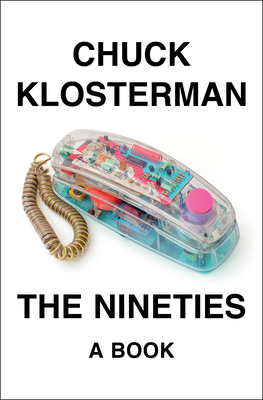
Klosterman’s The 90’s: A Book. A Word Salad.


“What’s historically distinctive about the [Generation] X era is the overwhelming equivocation toward its own marginalization,” Chuck Klosterman writes in his book The 90’s: A Book. We understand Klosterman’s point, but we would write it another way. We would write that the art of equivocation may have led to Generation X’s marginalization. As evidence of this, Klosterman then writes, “The things uninformed people said about who Gen Xers supposedly were often felt reductionist and flawed, but still worthy of examination and not entirely wrong.” 

No one in my inner circle said anything bold in the 90’s. There were exceptions of course. We called them the “say anything” crowd, because they’d say anything. The rest of us were either scared, or conditioned, to qualify, equivocate, or obfuscate the meaning of everything we said to try to jam our thoughts into every square hole before us. We edited our thoughts in real time, so that no one could accuse us of generalizing. I talked to other generations, and they didn’t worry about generalizing, stereotyping, or any other accusation our crowd could dream up. They said bold things, and they could back them up, some of the times. Some of their opinions were controversial, and some of them weren’t. Some of their opinions were wrong, and some of them weren’t. They didn’t care. They weren’t afraid to share. They’d say anything. How do they get away with that, we wondered.  

Someone accused me of generalizing once, as if it were the ultimate condemnation of my assessment. By that time, we were all sick of the accusation. Being so careful became tedious after a while. I turned to my accuser and said, “I am generalizing, because I find this to be generally true.” She was shocked, presumably because no one ever fought back against her charge. Had she pressed me, I would’ve added, ‘When we generalize, we say things we believe are generally true. If something is true 50.0001% of the time, it is generally true, in general, and that is a generalization.’ “There are no absolutes,” the absolutes crowd say. We might try to argue that line, but the idea they loft is because something is not 100% true 100% of the time, then we should not discuss it until we qualify it to make considerations for the 49.9999% times it might not be true. How does anyone think, talk, or formulate conversation if they’re worried that some statement doesn’t account for the 23.1% of the population to which it doesn’t apply? You don’t. You sit back, in marginalized and intimidated corners to allow the unintimidated to continue unencumbered. The fear of condemnation leads us to say things like, “reductionist and flawed, but still worthy of examination and not entirely wrong.” We enjoyed saying such things initially, as it led to some level of “intellectual status”, but we eventually discovered how discombobulating and tedious it could become.      

2) “The most compelling aspect of The Gen X Reader is not what the writers got right or wrong, but the intensity of their search for meaning,” Chuck Klosterman writes of Douglas Rushkoff’s compilation of essays Gen X Reader (an anthology devoted to dissecting Douglas Copeland’s book Generation X). 

If all theory is autobiography, and all analysis is self-analysis, Klosterman reveals his raison d’etre in that sentence. If he did this to himself, in a public park, in the state of Alabama, they would probably ring him up on at least a half-dozen misdemeanors. 

3) “[The book Gen X Reader is] a fossilized example of how understanding the present cannot be achieved until the present has become the past,” Klosterman further writes. 

What? 

He writes, “Times, change, because that’s what they do.”  

In another space, on another subject, Klosterman asks, “Now … were these assessments accurate?” He answers: (Yes.) (No.) (Sometimes.)” 

The first thing that comes to mind when reading these particular lines is, the only person who might be more exhausted in a conversation with Chuck Klosterman, other than the audience to his conversation, is Chuck Klosterman himself. Those unfamiliar with Klosterman’s style might think he is trying to add words to fluff his word count, or they might think he’s trying too hard to be inclusive or sound intelligent. Those of us who read his books, listen to his podcast, and/or watch interviews with him know this is Chuck Klosterman. It’s the way he writes, and it’s the way he talks.  

I tried to come up with an assessment of these particular elements of Klosterman’s writing. “Word Salad,” I whispered. What’s a word salad? Wikipedia defines word salad thusly: “A word salad, or schizophasia, is a “confused or unintelligible mixture of seemingly random words and phrases”, most often used to describe a symptom of a neurological or mental disorder.” This is not Chuck Klosterman in total. He is very intelligent and insightful, but he has moments.

I recommend just about every book he has authored. Klosterman’s writing is not a word salad in this sense, but some of his sentences contain iceberg lettuce. I love iceberg lettuce. I always have. I love it as much as I do Chuck Klosterman’s work. After decades of eating the leaves, I found out that iceberg lettuce has little nutritional value. It provides vitamin A and K, and some fiber, and it has a high-water count, but compared to other lettuce leaves it is very low in nutritional value. 

Many Klosterman essays have living lettuce, oak leaf lettuce, and other leaves with nutrients, but he adds black olives. “You can never have too many black olives,” his writing says. Yes, we can. Then he adds far too much cheese, a half-pound of bacon bits, and everyone knows you don’t need that many cucumbers and croutons to make a salad, but Klosterman wants to make sure readers get value for their money.     

4) One interesting insight Klosterman writes that aligns with thoughts I’ve explored is: “[Older generations] perceive the updated versions of themselves as either softer or lazier (or both). These categorizations tend to be accurate. But that’s positive. That’s progress. If a society improves, the experience of growing up in that society should be less taxing and more comfortable; if technology advances and efficiency increases, emerging generations should rationally expect to work less. If new kids aren’t soft and lazy, something has gone wrong.” 

For most of my life I wanted others to consider me weird, strange, or just plain different. Whatever I achieved in this regard, it wasn’t enough. I wanted more. I wanted it all. I never realized what an enviable position this was, and I had no idea that it was an offshoot of my dad’s ability (financially and otherwise) that led me to a varying degree of certitude that I belong. My dad grew up in a location just south of the “other side” of the tracks. He grew up, and spent the entirety of his adulthood, trying to fit in. A portion of my desire to engage the minds of the weird, so that I might become one, could have been borne through rebellion to my dad’s obsessive desire to have others consider he and his son’s normal, but I now think he laid a foundation of norms at my feet by raising me in a normal climate that I desperately tried to escape. 

5) Klosterman also has a unique gift for making seemingly irrelevant (to me anyway) events in history cultural touchstones that either influenced, changed, or revolutionized the culture. Klosterman writes that Nelson Mandela going from jail to the Nobel Peace Prize and then to the presidency of South Africa as “the most momentous global event of the nineties.” Klosterman lists the cultural influence as initiating the art of the conspiracy theory, as conspiracy theories suggested Mandela died in a prison cell. I don’t know if Klosterman ran around in different circles, or if he is attempting to rewrite his past and assign his thoughts greater significance, but I don’t know anyone, personally, who ever talked about Nelson Mandela in the 90’s.  

6) Klosterman is a few years younger than me, and we share some similarities in our background, so when he writes what he considers the cultural touchstones of the last sixty years, I’m intimately familiar with almost everything he discusses save for one: Reality Bites. I was that Blockbuster guy we now see in retrospective videos of a guy who stood in their aisles far, FAR too often, in the 90’s, trying to find something unique and entertaining, but I never selected Reality Bites. To read Klosterman, the idea that someone who paid a ton of attention to the culture, through entertainment venues, the idea that a man my age never saw this movie is his equivalent of an American never hearing the name Babe Ruth. This isn’t the first time, and I’m sure it won’t be the last he writes of this movie, as he believes it either captured the narrative of the 90’s in America, better than any other movie, or drove it. I wouldn’t know, because I never saw it.  

Regardless what I’ve said above, I respect Mr. Chuck Klosterman. I think he’s an excellent writer, and a challenging intellect. When one of his books come out, I’m one of the first in the intangible line to pick it up. If anyone thinks I’m too negative, or cynical, I am. Whenever my friends and I would walk out of a quality movie, we would dissect it, and we were always negative and cynical. We would criticize the acting, the plot, elements of the dialogue, and anything else we could think up. If the movie just sucked, we didn’t waste any more of our lives on it. We just said, “Well, that sucked!” The great ones were the ones we picked apart. Our conversations went something like this: “I hated it when he did that!” “Oh, I know it. What about that time he did this?” “Great movie though.” “Yeah, it was.”  

The Sellout, Fraud, Fake, Phoniness of Keeping it Real


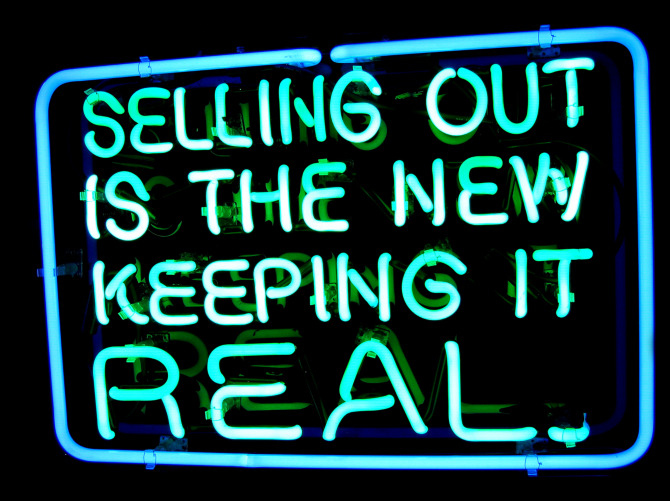
“You’re a sellout!” We would say when we wanted our fellow teens to cower. It’s what we did in the 1990’s. Back then, sellout, and its various derivatives, were the most powerful words in the English language. No one could pinpoint what those relative and arbitrary terms meant, but everyone could. Everyone knew how to move the couch to suit their situation, but no one knew where the grooves in the carpet were. We didn’t know what keeping it real meant either, but to paraphrase a Supreme Court Justice’s statement on porn, “We knew it when we saw it.” The only thing we knew for sure was that our favorite musicians, actors and writers were all about keeping it real.  

The term sellout was not as ubiquitous in the halls of our high school, but its derivatives haunted us. Calling someone a suck ass, kiss ass or phony was as damaging to us as calling a punk rocker a sellout. We did everything we could to avoid someone dropping these terms on us. It was our equivalent to the cinematic portrayals of the red scare from the 1950’s in which everyone did everything they could to avoid being called red. We avoided superficial conversation, for example, fearing that someone somewhere might unload a derivative on us.  

There were several shows and movies that taught us how to be real. We had iconic figures who could teach us how to be real, and the prototypes also lived among us. It was up to us to find our role models, but they were out there, keeping it real. If you haven’t spotted the flaws inherent in our system, we didn’t either. We were were scared, confused young people in the 90’s, and just like every kid of every other era, we sought some form of identity to escape that confusion that we hoped others might accept.

Jennie and I worked for an online company. She informed me that she had utter disdain for our boss. I found her screed funny, righteous, and all that. Then that boss (who was actually a nice fella, but he was the man) walked by our desk and dropped a polite, somewhat humorous anecdote on us. Jennie nearly fell out of her chair laughing. What a fraud, I thought. I maintain that she failed to act in a consistent manner, but who cares? Jennie was constantly getting in trouble for falling asleep at her desk. She probably feared losing her job, and she probably thought a little laughter would ingratiate her to the man, or she might have thought the polite, somewhat humorous joke was a lot funnier than I did. Who cares? To my mind Jennie was a sellout, a phony, and a fraud for sucking up to the man. Her laughter shaped what I thought of her forever after, because I thought she wasn’t being real. I thought her laughter was for sale, and she was commodity.  

One of the job duties of my new job as a front desk employee at a hotel was to engage our guests in polite, superficial conversations. I was to make them laugh, feel comfortable, and make them feel at home. “I’m not going to talk to every guest,” I said, believing the boss was shredding my integrity.  

“Well then, you’re fired,” she said.  

“What?”  

“It’s one of your job duties,” she said. “When a guest tells you a story, you are to respond in a way that makes them feel interesting. If they tell a joke, it’s the funniest damn thing you ever heard. If you’re not willing to make an effort in this regard, tell me now, and we’ll start looking for someone who is.”  

It was difficult to shed the artistic personae I spent so much time manufacturing, but I learned to tap into the superficial side of my personality for eight hours a day, five days a week. No one was paying me for my artistic personae anyway, so why was I clinging to whatever arbitrary definition of what it means to be real? No one really cares either. No one dropped to a knee when they heard me pontificate the virtues of the real. They probably considered me a scared little kid who was looking for pointers on how to be a cool individual in an otherwise dark, unmapped location of my life. The breadth of that took me a while to fully appreciate. I thought they appreciated my ability to stay true to the Keeping it Real commandments. They didn’t. When we were sitting at a breakroom table of real people, and someone expressed real virtues, people yawned and moved the conversation forward. If we dared express a view that they might view as the fraudulent, phony view of a sellout, all conversation stopped. We could hear the clinking of glasses and the sizzle of a griddle in the wake of such comments, but no one knew why it was so important that a service employee at a restaurant keep it real during the Sunday breakfast rush.  

I learned to start chit chatting up every hotel guest about every stupid thing I could dream up, and it wasn’t that hard. In some dark recesses of my mind, I would never reveal in closed locations, I actually enjoyed it. My high school buddies probably would’ve turned seven different shades of red if they witnessed it. They would’ve been embarrassed for me, and angry that I sold my soul for a buck, or they might not have noticed it at all. It’s possible that no one was paying half as much attention to me as I thought, and I dreamed up all these elements and definitions of those elements in my head.  

I initially refused to take this newly manufactured ability to tap into the “chat chat, chit chat!” part of my personality out into the real world. My initial vow was to “keep ‘em separated”, until I saw my friends engage in superficial conversation with strangers who weren’t female. They just enjoyed superficial chit chat, talking about nonsense, and they appeared to be having a whale of a good time. “Wait a second!” I wanted to scream. “Didn’t you guys see that one movie, with that real, cool one who refused to chat nonsense? He said that Americans talk too much, and he said that we should all learn to shut up for a minute. Who cares?! What are you talking about? You are in violation my friend!”   

That composite character of our movies, shows, and songs removed himself from pedantic concerns, and he was the quiet, cool prototype dragon we all chased. He effortlessly managed the center of attention by letting his supporting actors fill in the blanks for him and fluff his image. We wanted one person, somewhere, to confuse us with this archetype.  

There was no specific actor, movie, or show we consciously mimicked, but if we built a pyramid, Matt Dillon’s role in The Outsiders might have sat somewhere near the top. It might have been the initial spark, but we didn’t consciously mimic him or any of the other actors who played similar roles. We absorbed these undefined, intangible qualities, however, movie and movie, show after show, song after song, and book after book, until we thought we created something others might buy. When no one did, we probably should’ve put together a different sales strategy, but what would Matt Dillon, Kurt Cobain, and Johnny Depp think? We were brooding shoegazers who didn’t care what anyone else thought, and we repeated that so often that we revealed ourselves as composite caricatures.   

One of the most famous quotes of all time from the Old Testament of the Keeping it Real bible occurred in the movie The Wild One. In that John Paxton, Ben Maddow script, the Mildred character reads the line: “What are you rebelling against Johnny?”  

The Johnny character reads the line: “Whaddya Got?”  

In the real world Mildred would not say anything to preserve Johnny’s reply in a cool liquid that real worlders might want to bathe in. In the real-world Mildred says, “I’m sorry to say I got nothing Johnny.” 

“If you got nothing, don’t say anything Mildred,” the real-world Johnny might say. “You saying something just killed my whole mystique. Imagine if you said nothing. Imagine how powerful that line would’ve been.”   

“I’m sorry Johnny,” Mildred says, clearly shaken. “I’m just a bit actress in this scene.”  

“You don’t understand! I coulda had class. I coulda been a contender, I coulda been real, instead of a service industry worker, which is what I am.”

Tag lines such as keeping it real, selling your soul to the highest bidder, and the more concise sellout are evergreen, of course, but those of us who were hit with them way back when now see the illustrative and inconsistent dichotomy of trying to become real.