Figurative Schemes of Thought


“Teachers teach to the dumbest kids in class,” a former student said to try to explain why we all found school so boring. It felt like truth when I read that, unvarnished, “the stuff they don’t want you to know” truth, because it explained so much. Some of my teachers were so slow and boring. I used to be a quick thinker, which shouldn’t be confused with a quality thinker. My brain operated in hyper-drive, both literally and figuratively, and I often had trouble slowing it down long enough to soak in details. Details drove me nuts, they still do, and when you ask me to slow it down to make sure I get all the details, I shut down. When storytellers focus too much of their presentation on detail, I want to yell, “Just go to it! Get to the point!” When I read what this former student wrote, I wanted to believe it because I thought it explained why my teachers talked so slow, repeated themselves so often, and why they focused so much on inane and insipid details. That truth, it turns out, has no basis in fact. It’s much closer to a myth that we all want to believe.

When I read that truth, I should’ve reminded myself of the line I gave my conspiracy theory friend, “Just because it’s the most negative and cynical idea you can find, and it sounds like something the status quo doesn’t want you to know, doesn’t mean it’s true.”

My guess is that if we polled 1,000 teachers, 950 of them would say that that snarky assessment is false at best or an excuse poor students develop to explain why they did so poorly. They would probably add that while a quality teacher would never abandon a struggling student, it doesn’t mean they would slow the lesson plan down so much that they fail to cover the material they are required to cover in a semester. Schools provide teachers so many different avenues to explore with struggling students that there would be no need to slow the lesson plan down. That makes sense and all that, but the idea that the teachers I had were so boring, because they were trying to slow it down for Wally just explains so much to me. After sorting through various teachers I’ve had, I dismissed this idea as not only unprovable but inconsequential.

The more I tossed the idea of this assessment around, the more I thought every subject, every lesson plan, and every presentation is one quality teacher away from being interesting. I experienced that when a teacher made Economics so interesting to me that I entered college an Economics major, until I took some classes with poor teachers, and I realized how boring the subject was. I even had a teacher who could make Shakespeare fascinating, another who made World History exciting, and I have to imagine there’s an individual out there who could make Anthropology interesting, hard to believe, but I have to imagine that it’s possible. 

Most of my teachers weren’t the type of people we would follow into a fire to save people. They slogged through the material as much as we did. We shared the idea that they probably chose the wrong profession with them. We knew this because we had those charismatic types who could make a lecture about the Sumerians interesting.

For most of the teachers I had there was obviously no prerequisite placed on the ability to craft a quality presentation to attract an audience. There is, however, for  politicians, podcasters, and other entertainers. They have to craft a presentation that appeals to a wide-ranging audience. The same holds true for an advertising agency that hope to sell their presentation to a corporation.

“If you want to know anything about a culture,” someone once said. “Watch its commercials.” There might not be an institution that pays more attention to the cultural mores of society than the average advertising agency. They spend millions studying the culture through sociological and psychological research, and they market test all of their commercials before airing them to understand us better. They pay for this, because they know if they’re going to be able to convince a corporation to give them money, they need to prove that they know us better than we know ourselves. The one obvious fact they know is funny sells, but funny has all sorts of constraints around it, so they pack their commercials with the most common, least offensive jokes they can find to appeal to the lowest common denominator. I appreciate all the time and money they devote to crafting the perfect pitch for a product, but when one of these insults to my intelligence runs through my home I realize there is hatred in my heart, and if the Catholic Church is right about the progressions involved in Judgment Day, I could face obstacles. 

“It says here that you do had hatred in your heart,” St. Peter might say with the pearly gates in his backdrop.

“That is absolutely not true,” I would protest.

“It says you hate beets, the Dallas Cowboys, and commercials.”

“Commercials?” I would say. “How can a hatred of commercials affect my standing in the afterlife?”

“Hatred in the heart is hatred in the heart,” he might say while thumbing through my life.

“I’m sorry, but that just doesn’t seem fair,” I would protest. “Commercials are a non-entity. I didn’t hate the players involved in making commercials. I know they have a job to do and all that, but I just found them such an insult to my intelligence and my sense of creativity, and the repetitive nature of them drove me mad, but you’re telling me that I face eternal damnation because I hated commercials?”

“What? No, you’re probably looking at three-to-five in purgatory for the general sense of hatred in your heart, but you’ll probably get out in eighteen months with good behavior.”

MacPhail’s MacGuffin

If entertainers and statesmen fashion their presentation to try to appeal to the lowest common denominator, and commercials employ dumb guy jokes, how do movie makers and TV show producers craft their projects for greater appeal? 

Have you ever watched a movie with an excessively complex plot? We’re not dumb, and we’ve probably watched a million movies, but some screenwriters and directors fall in love with complexities that involve weaving tangled webs of intricacies with various twists and turns. I might be a lot dumber than I think, but I prefer to think that I never cared about a character, or a plot, so much that I’m going to follow them through the laborious labyrinths that “brilliant” screenwriter create.

A screenwriter named Angus MacPhail (apparently a real person and not a pseudonym) developed a device for dumb people like me who don’t care as much about complex plots as much as “brilliant” writers think. He called it: The MacGuffin. MacPhail and Alfred Hitchcock teamed up on several MacGuffin projects. The very basic definition of the MacGuffin concept is that it doesn’t really matter to an audience what the characters of a story are after as long as the chase is compelling.

The most interesting element of this MacGuffin concept is how true it is, even to a movie buff like me. After watching several MacGuffin movies, I realized that I could watch such a movie, thoroughly enjoy that movie, and love it so much that I memorize certain chunks of dialog from that movie without ever thinking about what the movie was really all about. I’ve read some Reddit discussions about what the characters in the movie Pulp Fiction were after. I loved that movie, and I consider it one of the most memorable movies ever made, but when they broke the movie down, I realized that I didn’t devote a thought to what the characters were actually after in that movie. Pulp Fiction is a movie that many movie freaks consider one of the best examples of a MacGuffin, because it never explains what the characters are actually after. When the Redditors explained their theories, I found them fascinating, and I realized that not only were their theories better than mine, I never even developed a theory, and I LOVED that movie so much that I saw it numerous times, something I rarely do.

The next question I ask those who employ the MacGuffin device is, is it an attempt to dumb the movie down for the dumbest kids in the class? The answer to that question might involve the overly complex and condescending, “Yes and no.” Yes, in the sense that we dumb guys can’t or won’t follow all of the complexities, and no, in the sense that the MacGuffin device helped moviemakers in their negotiations with producers. 

The primary reason moviemakers “dumb-down” their beloved productions is to appease investors. The primary investors are called executive producers, because they often either fund the movie themselves, or they play a major role in securing funds for that movie. Some producers are so involved in the process of making movies that they offer notes: “This particular concept requires too much explanation, and that other idea needs more explanation.” Moviemakers mostly hate these notes, but they know that if they are going to make a multimillion-dollar production, they need to follow their producers’ notes. Hitchcock and MacPhail believed that using the MacGuffin device satisfied both parties by offering no explanations at all. They believed that if the chase was good enough, the audience wouldn’t care what the characters were actually chasing. We have to imagine that they experienced pushback, as the producers surely dropped a note that read, “We need some explanation, or the audience will feel lost.” Hitchcock and MacPhail were right.

“I’m From the Future. How is ya’?”

One note producers drop probably drop on moviemakers during productions that involve speculative themes is how to introduce foreign concepts in a more seamless fashion that appeals to all moviegoers without confusing them or belaboring the point with too much exposition. “How do I follow your notes without ruining my production?” is probably the reply most moviemakers send back.

The 1927, German film called Metropolis provided an example that movie makers now use to resolve the tricky dilemma of introducing characters from the future. The moviemakers could’ve simply had one of the actors say, “Maria is a robot from the future.” They could’ve also had the year of Maria’s introduction on screen, or on set somewhere (and they may have at some point.) The producers and moviemakers ended up creating a figurative scheme of thought by suggesting that everything in the future will be silver-metallic. Robots, like Maria, will be silver-metallic in the future, and the rest of us will follow suit by wearing silver-metallic clothing. Metropolis was so influential, in this regard, that for the next fifty-some odd years, movie makers forced actors, playing characters from the future, to wear silver-metallic costumes to symbolically represent their tense. Did any of them think we’d all be wearing silver-metallic clothing in the future, no, but they did this to conform to the figurative scheme of thought Metropolis developed. 

Why did they choose silver-metallic? I think we can all agree that silver-metallic just looks futuristic. Either that, or this image might be so ingrained that that’s just the way we see it now, but my guess even if Metropolis was never made, some futuristic, speculative movie would’ve come up with the idea. The colors silver-metallic and the color white, are those we most closely associate with space and time travel, and most people in the present and past rarely wear/wore silver-metallic clothing. 

My guess is, more than anything else, the silver metallic clothing solved the movie maker’s tricky dilemma of how to introduce a man from the future? Again, they could’ve simply had the character say, “Hi, I’m Arnie, and I’m from the future. How is ya’?” And that line might work in a quirky Wes Anderson movie, but it would prove awkward and stilted in others. How many of us introduce ourselves by saying, “I’m Arnie, and I’m from the present.” Even if we traveled back to the past, we would still regard our tense as the present tense, as in we’re presently in the past. Thus, the movie making world decided the best way to inform the audience that their character was a man from the future was to present him in an outfit no one from the present would wear. Once this symbolic representation was established by Maria, we either began thinking everyone in the future will wear silver metallic clothing, or the movie makers engrained the image in our head through repetition. 

This symbolic image is so ingrained now that if we went into a supermarket with a silver-metallic outfit on, people might begin hounding us for Lotto numbers, sports predictions, prognostications on world affairs, or stock tips. If silver-metallic suits are becoming more common, we probably wouldn’t immediately assume that their silver-metallic clothing means they’re from the future, but what if they spoke in an emotionless monotone? 

Speculative movies have long speculated that human emotions will no longer drive us in the future, on our next evolutionary plane, a concept most notably explored by Star Trek. They imply that we will no longer be as sad, angry, or happy in the future, and their implicit suggestion is that that will be a result of taking us all off the money standard. 

Taking humans off the money standard is, at the very least, an interesting thought experiment. Some suggest that if we did away with the cultural, social, and worldwide reliance on money, it could diminish sadness, feelings of hopelessness, anger, jealousy, and it could eliminate most of the crimes those emotions inspire. That’s possible, but it’s also possible that we might not aspire to be better today than we were yesterday without some kind of reward. The pursuit of money is widely regarded as a soul-less venture, and we’ve all heard the line money is the root of all evil. Yet, depending on how we earn it, money is also the best reward we’ve developed for hard work. If money is the root of all evil, it’s also at the root of some feelings of purpose, a sense of fulfillment, and it can promote feelings of definition and identity. Money has tangible qualities, of course, but so many of its complex intangibles make us who we are today, and the unforeseen consequences of doing away with money could be an article unto its own.

The Aliens are Turning

Movie characters from the future no longer wear silver, metallic outfits, as we’re all past that silliness now, but we still have numerous figurative schemes of thought in our movies that we fail to see them, because they’re so ingrained.  

‘Who is the alien?’ we ask while in the audience of one of those aliens from another planet movies. “I don’t know. We’ll have to wait until one of them turns their head,” they say. ‘What?’ “Just watch.” Most movie aliens either have a different musculature structure, or they haven’t learned the mechanics behind a full shoulder/torso turn well enough to mimic a full human turn properly. In the 1978 version of The Body Snatchers, a movie I believe set the symbolic representation, the aliens only turn their head, and they fail to incorporate the shoulders and torso in that turn. The turn is also so slow that it appears eerily mechanical and menacing. Their stiff, unnatural motions, dictate their inhuman nature to us. “He’s the alien!” we all scream. The sudden switch in music helps, but only to accompany the visual. 

If we’re trying to locate movie aliens in other social situation, we should note that if these movies are correct, the evolution of most aliens from another planet also failed to provide them casual conversation sounds, as they tend to communicate in a lexicon of roars, high-pitched squeals, or creepy, slither sounds that humans find unnerving. If movies are correct, aliens from another planet do not have mundane interactions. If we were to witness one of them in a transaction at a Walmart franchise, from their home planet, it would probably involve a series of various roars and slithering sounds that we would find so unpleasant we wouldn’t shop at that location. 

Monsters Only Eat Non-Believers

If we find ourselves a character in a monster movie, we should also know that believing the raving lunatic in our production could save our lives, as movie monsters, humanoid and otherwise, have a particular, dietary preference for non-believers. If we survive that first round, we should then avoid thinking that they’re mindless, bloodthirsty beasts, yet we cannot doubt their ferocity either. Failure to do any of the above will lead the monster to zero in on us to prove us wrong. “Why does a monster of blind bloodlust care if we doubt its existence?” we might ask. ‘They just do,’ the raving lunatic will inform us with dramatic repetition. ‘They do just do.’

When we first witness the monster, we see it in its more natural setting. In the second scene, we hear the roar, and just about every roar suspiciously mimics the ferocious roar of the lion. They roar in a projectile manner with their spines bent in an S-shape formation, and they do it in a manner that shows us nearly all of their teeth. We might even notice that their saliva is thick and gelatinous. Even some individual species of sharks have evolved a lion’s roar, and we don’t question that, because we know that that means they’re just that ferocious. 

Another sync-up we have with modern moviemakers is our fascination with motive. Why does a killer kill? Why does a monster kill? Nonbelievers suggest that it/he just has a blind bloodlust. Believers know better. They know that it’s too simplistic to believe that anyone, or anything, has a primal lust for killing. They know it’s complicated, and figuring out its primary motive is the best method to finding a way to eventually pacify it. 

In early movies, monsters had no motive, they were built on blind, bloodlust and destruction, but modern moviemakers know that their monsters/aliens don’t necessarily need a motive, but we do, and it’s usually political. Modern audiences require complex motives that call for scientific research. It’s just too simplistic for us to believe that a beast would harm or kill another being, because the idea that any beast acting in an instinctive manner when encountering something foreign is reductive. It’s also reductive and simplistic to explore the idea that a foreign entity might act in a reflexively defensive manner, or that they might view humans as a source of food. These speculations suggest that foreign entities are relatively primal, and as we all know, suspect, or fear, foreign entities have an intelligence that we cannot comprehend.

Even some slasher flicks, with human monsters, now feed into our need to know what motivates someone, or something, to kill us. “If they were just nicer to it, perhaps it wouldn’t feel the need to kill them all,” we now whisper in theaters. “They just need to understand it better.” Thus, scientists and reporters are often the sole survivors of the monsters, because the monsters appreciate their desire to understand them better. 

Indicators of an Infernal Influence

Most of us don’t pay attention to these figurative indicators, but thanks to the image provided by The Exorcist, we now know that one of the ramifications of undergoing a possession is that it will damage our daughter’s complexion. In its place will be the ruddy complexion of the meth head, that is accompanied by a creepy green hue. It also won’t matter if we instructed her to use conditioner that day, because her hair will go instantly scraggly and oily when the demon infiltrates. Possession movies teach us that demons know how to manipulate our vocal cords in such a way that it doesn’t matter if we’re a young woman during a possession, all victims of a possession will assume a deep, rich demonic voice. What is a demonic voice, we don’t know, but if our child is possessed and her new, demonic voice reminds everyone of Bob, the electronics department employee at Best Buy, we’re probably going to have a tough time convincing anyone to help us exorcise that demon from her system. That’s because everyone knows that demons come out growling and speaking some antiquated language in a hissing whisper that is punctuated by a lion’s roar.

“I know she sounds like Bob from Best Buy, but I’m telling you that my daughter is possessed by a demon named Gerty, which I know makes no sense either, because Satan usually gives his minions more creative, multi-syllabic names, but this is an actual possession Larry. We either need to run or find a Bible written in a language other than English, like Latin or Aramaic.” 

There comes a point in everyone’s existence when they’ve read too many books, listened to too much music, and watched too many movies. When we reach that point, it becomes difficult to avoid spotting the indicators that moviemakers use to abide by our figurative schemes of thought. They can insert a wide variety of creative inserts to their production, but there are certain touchstones that the audience needs to follow along without confusion. When we witness the agreed upon touchstones, we know exactly what they mean, and we know that the producer forced the moviemakers to incorporate agreed upon symbolic representations to get the audience from point A to point D. 

Most of these touchstones are so ingrained and expected now that we don’t even see them for what they are. If you’ve ever watched a movie with a child who hasn’t watched the hundreds of thousands of movies you have, you’ve probably heard, “How did you know that guy was from the future?” If you recognized that it was all about the silver-metallic suit, you probably opened up a can of worms that you couldn’t answer until you began thinking about these figurative schemes of thought that you didn’t even know you absorbed until they asked you about them. Once these touchstones enter our mind’s eye, it’s difficult to separate them from the mostly fallacious theme that teachers teach to the dumbest kids in the class. 

“We need to rewrite this scene, so the dumbest kids in the class can get it,” the producer’s note says, and the creative types probably argue with their proposals, saying we want to introduce a new way to introduce a man from the future, an alien, a monster’s mindset, or a product of a demonic possession. “Too much exposition,” the producer might reply, or “the characterization is too complicated, just give them meth face, have them make a head-only turn, or put them in a silver-metallic suit. Even the dumbest kids in the class will get that.” The moviemaker might fight back with righteous indignation regarding their creative interpretation, but they know most ideas won’t get off the ground without the producer’s check.

“Fortune favors the brave and the bold,” is a phrase we’ve learned through the years, and we all want to be the renegade, the maverick who bucks the trends set by others. We don’t want to follow the rules, we want to be the exception to the rule, but if we’re going to attract a wide audience, we learn that no one appreciates the exception until they become successful. We also learn that the irreplaceable become the replaceable when they refuse to follow the rules.
Mike Patton: Maestro del Differente


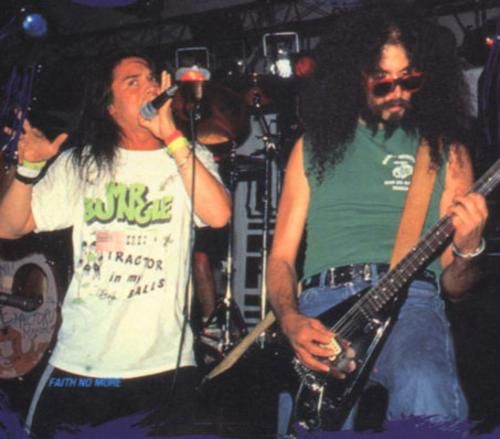
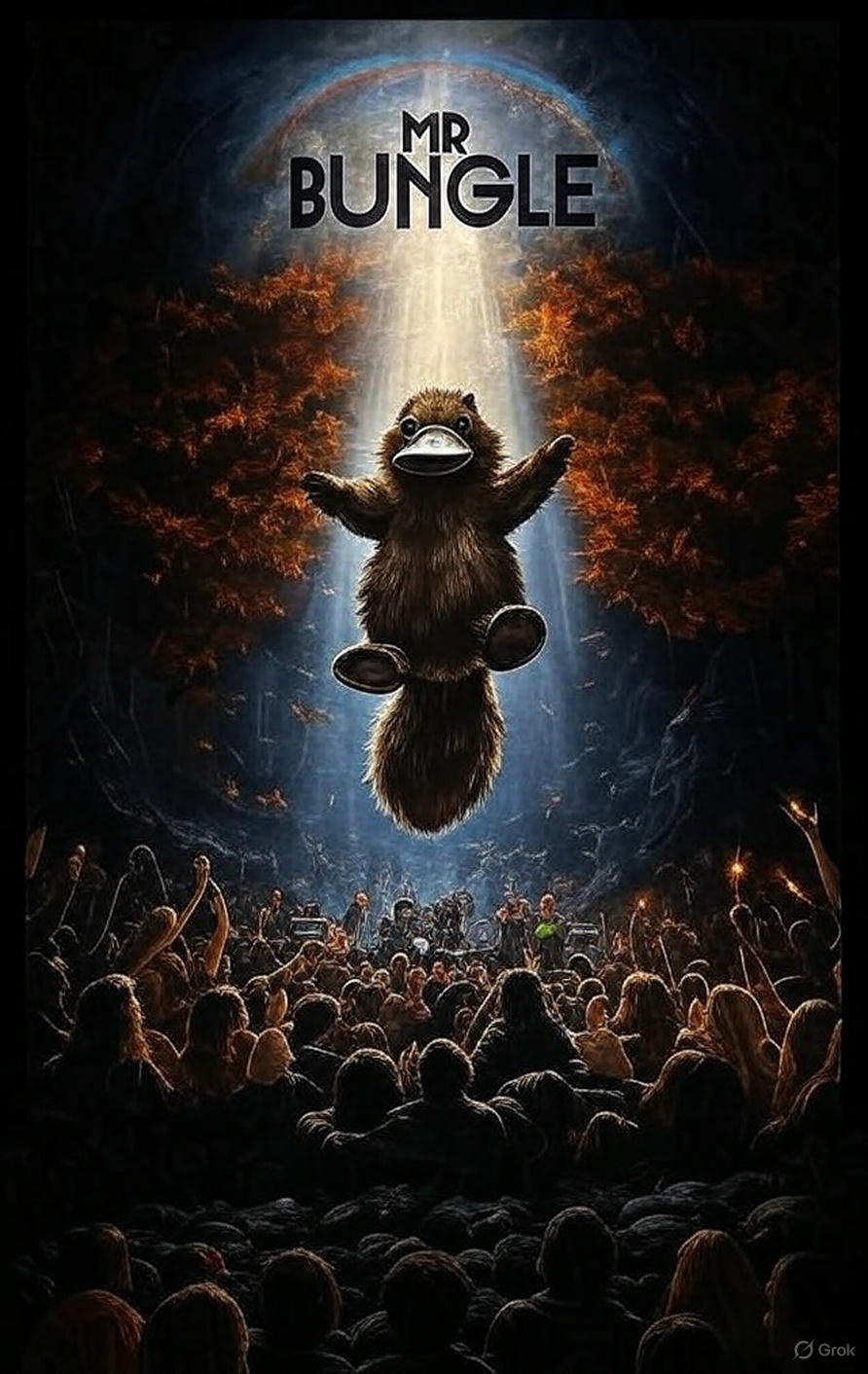
You want to get weird? I’m not talking about the weird music our aunts and uncles might chuckle at or say, “Hey, that’s kinda neat-o.” I’m talking about a strain so close to normal that they might be a little concerned about our mental health when they hear it. “If you think that’s quality music, then I’m probably going to have to edit my perception of you.” I’m talking about a definition of different carved out in a band called Mr. Bungle, then chiseled into with Fantômas, and ultimately destroyed and reconstructed in a project called Moonchild. If you don’t know who I’m talking about, let me introduce you to the outlandish innovations of a bizarre brainchild named Mike Patton.  “Isn’t he a one-hit wonder?” a friend of mine asked, decades after Mike Patton became Mike Patton. “Isn’t he the “It’s it what is it?” guy?” I was so stunned that I couldn’t think up an appropriate term for cluelessness. Then, VH1 went ahead and confirmed his uninformed characterization, by listing the band Patton fronted, Faith No More as one of their one-hit wonders of the 80s. I knew most didn’t follow the career of Mike Patton as much as I had, but I was stunned to learn how even those with purported knowledge in the industry could dismiss him in such a manner. I had to adjust my idealistic vision of the world to reconcile it with the reality that if Billboard is your primary resource, Mike Patton and Faith No More were one-hit wonders. To those of us who live in the outer layer, seeking the sometimes freakishly different, “It’s it what is it?” or the single Epic, was only the beginning.  Mike Patton discovered he had a talent at a young age, he could mimic bird calls. He found that he could also perform some odd vocal exercises on a flexi disc that his parents gave him. The idea that he could do that probably didn’t separate him much from the four-to-five billion on the planet at the time, and I only include that note to suggest that Mike Patton probably didn’t even know how talented he was at the time either.  Yet, the young Mike Patton knew he loved music. He loved it so much that he and his buddies in school, including Trey Spruance and Trevor Dunn, decided to form a band they called Mr. Bungle. They were all around fifteen at the time, and anyone who listens to their early self-produced demos, Bowel of Chiley (1987) and The Raging Wrath of the Easter Bunny(1986) can hear how young and inexperienced they were. These demos were a chaotic blend of metal, funk, and juvenile humor. It’s so chaotic that it’s as difficult to categorize as it is to listen to, but suffice it to say whatever general definition we might have of traditional music, the music found on those demos is likely the opposite.   While devoting himself to Mr. Bungle, and studying English literature at Humboldt State University, Patton worked at a local record store, immersing himself in everything from punk to classical. He obviously kept himself busy during this period, and we can only guess that he was probably as surprised as anyone else when, in 1988, a man named Jim Martin invited Patton to audition for the role of lead singer in Martin’s band Faith No More, after seeing Patton perform in a local gig as the lead singer of Mr. Bungle. Patton won the job after displaying his raw energy and his vocal range for the band.  If this were one of those always disappointing biodocs, the moviemakers would depict Martin and the other members of Faith No More as being blown away by Patton’s audition, and they would say something like, “This is obviously the man to lead us into the 90s.” I understand that these movies are often constrained by formulas and time constraints, and they often take shortcuts just to get a point across. I was all prepared to dispel that movie trope by writing that while the members of the band, their management, and the execs thought his audition was great, they heard the demos, and they didn’t think his talent would translate to Faith No More’s furthered success. It turns out, they were so blown away by the talent he displayed in that audition that they did consider him the man to lead them into the 90s. After hearing Mr. Bungle’s early demos, firsthand, all I can say is that must’ve been one hell of an audition. 
Mike Patton and Jim Martin
When he first “discovered” Patton, I imagine Martin returned to his FNM bandmates and said, “I found the guy!” and he handed them the demos. As musicians themselves, I imagine they heard Patton’s talent, but they couldn’t reconcile it with Faith No More’s sound and image, until he auditioned for them. Again, that must’ve been one hell of an audition to blow them away like that.   When Patton joined FNM, the music for The Real Thing (1989) was 80-90% written, primarily by keyboardist Roddy Bottum, guitarist Jim Martin, bassist Billy Gould, and drummer Mike Bordin, but Patton wrote all of the lyrics for the original tracks on what happened to be Faith No More’s third album, often crafting those lyrics quickly to fit pre-existing music. Patton contributed vocal melodies and arrangements, that ended up shaping the songs’ final sound. Patton’s contributions transformed the album, and some suggest his input proved instrumental in this album’s eventual success.  As popular as FNM’s The Real Thing proved, there’s evidence to suggest that at least some of Patton’s motivations for joining this Epic band was to expand and amplify his beloved Bungle’s reach. If we stop right here, we all have to thank Jim Martin for taking a chance on this nineteen-to-twenty-year-old singer, because at the time, Mr. Bungle was nothing more than a local act in Eureka, California. They had a couple of almost unlistenable self-produced demos to their name, but how many starving artists had that in late-80s California? How many of those same starving artists dreamed of Billboard Top 100 hits, stardom, and vast amounts of money to follow? Anyone who says this is what motivated Mike Patton doesn’t know his ethos or his outlook, yet he was quite proud of what he and his Bungle bros created, and he wanted us all to hear it. In a 1992 Kerrang! interview, Patton admitted he initially viewed Faith No More as a “means to an end,” hoping their success would open doors for Mr. Bungle. As evidence of that, Patton wore a Mr. Bungle T-shirt in the video for Epic, and he handed a Bungle demo to Faith No More’s label, which led to Warner Bros signing Mr. Bungle to a deal in 1989. Again, those of us who heard those demos, in their raw form, would have a tough time believing Warner Brothers would’ve signed Mr. Bungle if Patton didn’t have some standing as the frontman for Faith No More.  This isn’t to suggest that Mike Patton didn’t devote himself to Faith No More, as he devoted an overwhelming amount of his time and energy to the band during their recording and touring of The Real Thing and Angel Dust (1992). He wrote the lyrics and melodies for both albums, toured extensively (over 200 shows for The Real Thing alone), and handled media duties. Mr. Bungle, meanwhile, was more of a side project during this period. Their self-titled debut (1991) was recorded in gaps between Faith No More’s schedule, with Patton contributing vocals, lyrics, and some production alongside bandmates Trey Spruance and Trevor Dunn.  In 1995, Mike Patton basically proved that a man could toggle between two bands and produce two great albums for each outfit. He played a pivotal role in both Faith No More’s King for a Day and Mr. Bungle’s Disco Volante. Patton wasn’t the first to play in two bands at once, by any means, but it wasn’t commonly done in this era. He stated that his daily routine consisted of recording King for a Day at Bearsville Studios, during the day, then driving down to record Disco Volante late into the night and repeating the same process the next day. “It was insane,” he told the Alternative Press in a 1996 interview. He admitted he barely slept while juggling both bands’ demands.  Patton never claimed to be a trailblazer in this regard, but he’s acknowledged the strain. In a 2001 Kerrang! interview, he called 1995 “a blur,” saying Mr. Bungle was his “heart” while Faith No More paid the bills. If you haven’t heard him interviewed, this is Mike Patton. He is a humble man who often downplays moments the rest of us consider groundbreaking. King for a Day was another great FNM album, not as good as Angel Dust, but better than The Real Thing, in my humble estimation. Disco Volante was, and is, an incredible album that any serious artist would consider a career achievement, better than the self-titled disc but not as great as California. Most Bungle fans disagree on the latter. After spreading himself so thin in 1995, Patton went and got bored after Faith No More’s 1998 breakup, which the band “officially” stated was due to the fact that Faith No More had run its course creatively. Anyone who thinks that Patton would devote himself entirely to Mr. Bungle at this point just isn’t following along. He gets so bored that he ventures out and creates other artistic enterprises that take that definition of weird out to “Here, there be Dragons” locations on the map. He takes it to the ‘if you think Faith No More was outlandish in places, you should check out Mr. Bungle, and if you think Mr. Bungle stretches the boundaries of genre, you should check out a band he created called Fantômas.’ Fantômas became Patton’s new passion project while devoting an overwhelming amount of his time to what I consider the Mr. Bungle masterpiece 1999’s California. We write all of this, and we don’t even get to Patton’s role as the lead vocalist in the five albums of Tomahawk, and then there’s his varying roles in the bands Peeping Tom, Dead Cross, Lovage, and the killer role he played in one of The Dillinger Escape Plan’s albums. He has two proper solo albums, two works with Kaada, various film scores, and over 60 collaborative efforts, various ensembles, and guest appearances on other artists’ albums, including John Zorn and Björk. The overall brilliant catalog this “one-hit wonder” has amassed can be so overwhelming to the uninitiated that they may not even know where to start. 1989’s The Real Thing might, in fact, be the place to start, but I am so far past that starting point that I can’t even see it any more. That’s the problem with true fans of artists, they’ve listened to the artist for so long that they don’t know where to tell you where to start.  Those who like Mike Patton, but don’t have an unusual, almost concerning adoration of him, tell me that Faith No More’s Angel Dust is probably the best starting point, as they say it’s probably the best, most mainstream album he took part in. If that’s the case, I would add Mr. Bungle’s California, Tomahawk Mit Gas, and Patton’s work with the X-Ecutioners as the second class of the Mike Patton beginner’s course. If you make it past that point, and you might not, I would submit Tomahawk’s Anonymous, Fantômas’s Suspended Animation, and Disco Volante as great second-level albums. A trend in Patton’s music I’ve noted, is the 2nd album trend. The first albums are great, but they seem to set a template from which to explore the dynamic further, and Patton and his various crews seem to peak with the ideas germinating around in their heads concerning what more can be done with this band. He helps build on the base idea of that first album, and they usually create something of a creative peak with those second albums. Don’t get me wrong, I love the third albums, as in King for a Day, Suspended Animation and Anonymous, and as I wrote I think California is better than Disco Volante, but the second album peak seems to be a standard for most of Patton’s ventures. (Most true Bungle fans would say Disco Volante is superior to California.)  I imagine those with some authority in the conventional music world might begrudgingly admit that they once considered Mike Patton one of the most talented singers in rock music. They probably all acknowledged that he possessed one of the most versatile and dynamic voices in modern music, characterized by an extraordinary vocal range, stylistic adaptability, and emotive depth. His voice spans six octaves, reportedly from E1 to E7, though some sources conservatively estimate around five octaves (approximately C2 to C7). This range allows him to seamlessly shift from guttural growls and primal screams to operatic falsettos and silky crooning, often within a single song. The experts who admitted all that might also add, “At some point, it didn’t matter how talented he was, because he wasted that incredible voice on music so abrasive that he basically alienated so many of us. In 1995, we all loved the underappreciated King for a Day, but when he hit us with Disco Volante, we shook our heads trying to figure out what he was doing. Most of us dismissed the initial Bungle album a one-off side project, then he doubled down with an even weirder album, and he topped it all off with an album we considered career suicide with the vocal experiments on Adult Themes for Voice (1996). That led us to dismiss him, because we realized he had no interest in becoming a marketable talent.”  If you’ve read the writings of mainstream rock critics for as long as I have, you know that they have a difficult time understanding why someone would pick up a pencil and musical instrument and not try to do everything they could to sound like Springsteen, Dylan, or Joey Ramone. They don’t understand why someone would use vocal effects, as opposed to writing meaningful and important social commentary to help us reshape our world. We could excuse this with the idea that musical tastes are relative, but their blanket dismissal of anything different led me to start reading periodicals like Alternative Press and Decibel, who recognized what artists like Patton were trying to do. They praised Patton for his risk-taking, and they hailed his fearless innovation. As for the “marketable talent” comments we’ve heard, some fans and critics note that while he abandoned whatever mainstream potential awaited him, Mike Patton did develop a substantial cult following with each progression into the weird, strange, and just plain different.    The next question any gifted artist must ask themselves soon after they discover they have a talent for something is what do I do with this? Patton, and Faith No More, could’ve followed up 1989’s The Real Thing with some version of The Real Thing Part Deux, and they could’ve gone onto develop a template, or a formula, in the ZZ Top, AC/DC vein. The mainstream music critics often eat up commodification of a brand as a cash grab. Mike Patton, and all of the musicians he chose to surround himself with in his numerous ventures, could’ve made a whole lot of money, enjoyed all the trappings of fame as rock stars. We can saw all we want about artistic integrity and all that, but it can’t be easy to turn away from the prospect of making truckloads of money. Contrary to what detractors say, money and fame can bring a us whole lot of happiness … if we love what we’re doing. If Mike Patton, and all of the musicians he chose to surround himself with in his numerous ventures, followed the formula of “building trust” with listeners, they would’ve been so bored and unsatisfied artistically. Patton obviously chose to use whatever gifts and talent he had to confound us and obliterate our boundaries in his pursuit of his version of artistic purity, and he chose projects and players who shared his philosophy. If the young Patton had a career path, or a place he “wanted to be in twenty years,” he obviously grew so bored with the “current” direction of his career so many times that he needed to do something decidedly different and out of his comfort zone so often that I don’t think he has any comfort zones left to destroy.

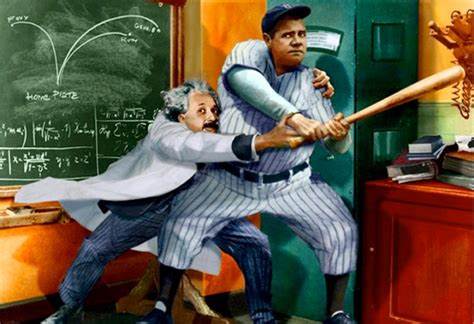
The Chosen Ones? Jordan, Einstein, and “The Babe” Defy the Myths


Genius Chronicle: April 30, 1992, game three of the first round of the Eastern Conference’s playoffs, and Michael Jordan is nearly trapped in the corner of the three-point arc by Kiki Vandeweghe and John Starks. Jordan moves left and Kiki Vandeweghe drops off. Starks then baits Jordan into a trap, leading him into one of the most feared defenders in the NBA, Charles Oakley. Seeing those two Knicks narrow in for a trap into the corner would’ve led 99% of the NBA brightest stars to pass the ball. Jordan gambled. He faked left, and Starks fell for it, almost literally falling to the Madison Square Garden floor. Jordan then tucked under Oakley to take advantage of a sliver of real estate that existed between Oakley and the baseline. He straddled that baseline and dunked on arguably the most feared defender in the game at the time, future Hall of Fame inductee Patrick Ewing. If this wasn’t one of the greatest plays in NBA history, it might’ve been one of the most memorable. Jordan himself claimed it was his personal favorite dunk. Some said it was “Michael being Michael.”

Michael wouldn’t have been able to accomplish that play, against those guys, without incredible natural abilities. Yet, how many NBA stars, past and present, have been blessed with similar abilities? Jordan fans would say no one, but what separated Jordan from his peers was his ability to achieve the spectacular and the comparatively routine. He did both so well, so often, that he helped the Bulls achieve a 65.9% winning percentage in the regular season and a 66.5% in the playoffs, and six NBA Championships. Those of us who marvel at highlight reels often forget about that other half. Yet, a Michael Jordan, an Albert Einstein, or any of the geniuses of physical and cerebral accomplishment couldn’t have accomplished half of what they did without outworking their peers.

Genius Chronicle: June 30, 1905, Albert Einstein drops the first of four major contributions to the foundation of modern physics special relativity (later expanded into general relativity). The other major contributions included the photoelectric effect, and Brownian motion. In doing so, he helped fundamentally transform physics by redefining space, time, gravity, quantum theory, and atomic behavior, shaping modern theoretical and applied physics. Those who knew Einstein probably marveled at Einstein’s findings, but others probably said, “That’s just Albert being Albert.”

A line like that sounds like a compliment. It sounds like we’re saying that they’re so talented that they make the miraculous appear mundane, and we just came to expect that from them in their prime. Yet, I consider such lines reductive, because they fail to recognize their struggle to get to the point that their continued greatness was just “them being them”.

Dealing with Failure

Those who drop the “Michael being Michael” line should know that Michael Jordan wasn’t always Air Jordan, or Black Jesus, as some called him. He was cut from the Laney High varsity team as a fifteen-year-old sophomore, due to his height (5’10” at the time), his physical immaturity, and his lack of experience. Yet, how many fifteen-year-old sophomores make the varsity team? Prodigies do, and Michael Jordan thought he was just that. The coach, Clifton “Pop” Herring, later said he spotted Jordan’s potential, but that he didn’t believe the fifteen-year-old was ready to face varsity level competition. Herring basically told Jordan, he wasn’t a prodigy, not yet, and that crushed Jordan. He was so crushed that according to Roland Lazenby’s Michael Jordan: The Life by Roland Lazenby, Jordan kept that publicly posted tryout list as motivation. The young Jordan obviously sulked about it, but then he went to work. Over the decades that followed, Jordan developed a relentless work ethic that he double downed on anytime he experienced defeat.

“I’ve missed more than 9,000 shots in my career [12,345 regular season and 2,309 post-season for a total of 14,954],” Michael Jordan is famously quoted as saying, “I’ve lost almost 300 games [380 regular season and 60 in the post season]. 26 times I’ve been trusted to take the game-winning shot and missed.” This number, twenty-six, is the best-known estimate, attributed to Jordan himself, but it’s not independently verified by modern statistical databases. It likely includes shots to tie or win games in the final seconds of the fourth quarter or overtime, across both regular season and postseason. Bleacher Report estimated Jordan’s clutch postseason shooting percentage at 50% (8 of 16 attempts through his first 16 clutch shots), but this doesn’t specify total misses.

Einstein was asked to leave his school at fifteen. The school’s administrators informed Einstein, “Your presence in the class destroys the respect of the others.” He failed an entrance exam at Swiss Federal Polytechnic, and then he struggled to find work postgraduation, leading him to experience some level of poverty firsthand. His initial attempts at academic recognition fell flat when all of his early papers were either ignored or rejected, as his peers deemed his work unremarkable. Yet, how many young scientists, with no connections, are accepted into the scientific community in their initial attempts? Prodigies, or the “chosen ones” who can remove the proverbial Sword in the Stone are. Like Jordan, the idealistic, young Einstein knew he was destined for greatness, but no one else did. They were both faces in a crowd of idealistic young people who knew they were destined for greatness. 

When we read such stories about geniuses, we can’t help but think of ourselves as faces in that crowd. We thought we were destined for greatness when we were young, and it would’ve meant so much to us to be recognized as the geniuses we were, back then. Is that irrational, considering that we probably didn’t have the remarkable talent we thought we did, and if we did have any talent, we didn’t put in the work necessary to hone it? It is, but we were young, idealistic, and a little delusional back then. When we attempted to remove the proverbial sword from the stone, we realized that we weren’t “the chosen one”. Learning this hurts, but the notion that we are a lot more common than we ever thought stings. Even when it was obvious to everyone around us that we weren’t ready, we resented the guardians at the gate for not recognizing our genius. We became bitter, and we sulked. I don’t care what any eventual recognized geniuses say, they sulked too, and then they achieved greatness by using that rejection as fuel to prove their detractors wrong. Most of them had no shortcuts through nepotism, or anything else to ease their rise, and their only recourse was to just work harder than the similarly gifted.

Dealing with Rewards

The question those of us who will never be invited into the historical halls of greatness would love to know is, was your eventual, hard-won invitation just as meaningful as it would’ve been when you were an idealistic, and perhaps a little delusional, young teen? We’ve all been taught to think that success is the reward for hard work, but how much hard work is too much? When we devote so much of our time and energy to achieving greatness, sometimes we sacrifice the ability to develop normal, human relationships, we might accidentally ignore family members, and we could employ a level of tunnel vision that effectively ruins what could’ve otherwise been a happy life. Is that moment of acceptance as euphoric as we think it would be, or is it almost, in way that’s “tough to describe” anti-climactic?

Our knee-jerk response is that instant recognition would’ve stunted their growth, and the great ones probably wouldn’t be as great if bitterness, resentment, and all that inner turmoil didn’t fuel their drive. Yet, we can also imagine that there had to be some measure of “Where were you when this really would’ve meant so much more to me?” involved in their acceptance.

Michael Jordan hugged and cried on the Larry O’Brien Award the first time he won it, but those in his inner circle say that his almost ingrained sense of bitterness and resentment drove him to win five more. This bitterness and resentment could also be heard after his retirement, in his Hall of Fame induction speech.

Einstein harbored a similar sense of “smoldering resentment” toward the gatekeepers who dismissed him. In a 1901 letter to his sister, he wrote of “fools” in academia who favored conformity over originality, implying that if they weren’t so rigid he wouldn’t have had to work so hard to gain acceptance. The two of them both had chips almost biologically attached to their shoulders throughout their lives, and we can speculate that they may not have achieved half of what they did if they weren’t rejected early. They both used those early rejections to fuel their inner fire to prove their respective communities were wrong about them, but even when they did, my guess is it didn’t remove the pain of those early rejections.

The Supernatural, Natural Abilities

We’ve since limited the idea that Einstein was a genius as Einstein being a genius, as if he didn’t achieve that status. He was just different, so different he may have been a slightly different creature. We’ve studied his brain to see why he was so much smarter than everyone else, to see why he was so different that he was special or supernatural. We discovered that his brain had what they called “a unique morphology, and abnormal Sylvius Fissure, increased glial cells.” We also found that his brain “was actually smaller than average (1,230 grams vs. typical 1,400 grams), contradicting the assumption that larger brains equate to higher intelligence.” Even though speculative estimates suggest less than 1% of the population might have neurological enhancements comparable to Einstein’s, based on neurodiversity research, I still find it reductive to limit his incredible accomplishments with the idea that he had an unusually efficient brain. Why can’t we just say that all of his findings could’ve been the result of a lifetime of intense research into general and specific areas of physics? Why can’t we say that he spent so much time studying physics, persevering through the failures inherent in trial and error that he ended up developing some incredibly creative theories? Why can’t we say while he may have been biologically predisposed to intellectually brilliant findings, many others had the same cranial gifts, and they didn’t do anything anywhere close to what Albert Einstein did with these advantages. Why can’t we just say he worked harder, and more often than his peers?

We know there was nothing supernatural about what Einstein or Jordan did, but it’s just not very interesting to talk about all the hard work they put into it. We’re interested in the origins of genius, and we’re interested in the results, but everything in between is the yada, yada, yada portion of that discussion. We’d rather ask “How did they do that?” than learn about how they actually did it. It’s far more entertaining to think in terms of a “natural talent fallacy” or a “the genius myth” than breakdown the hundreds of hours they spent in a gym, or in a lab, honing their ability, or dedicating so much of their mind and energy to their profession, or craft, that when they happened to be “around”, they probably weren’t much fun to be around.

The Babe

George Herman Ruth (AKA “The Bambino,” “The Sultan of Swat”, or “The Babe”) may have been the opposite of Einstein and Jordan in that he appeared to enjoy every step of his gradual ascension to greatness. The Babe didn’t face the same substantial levels of rejection Einstein and Jordan did, but that may have been due to the fact that The Babe never felt entitled to it. I don’t think anyone would accuse Jordan or Einstein of being entitled, but whatever vagaries we apply to the term entitled in these cases, The Babe was the opposite when he was but a babe.

Babe Ruth was born into poverty, in a rough working-class neighborhood well known for crime and violence. His parents were hard-drinking saloon owners, who provided their son a chaotic, unstable, and troubled environment that led him to commit petty crimes and truancy. His overwhelmed parents sent to a St. Mary’s Industrial School for Boys, a reformatory school. While attending this school, a Brother Matthias taught him baseball, but Ruth’s talent was confined to the school’s teams, unseen by wider audiences. Students of St. Mary’s were not expressly forbidden from playing in youth baseball leagues, but his confinement to the school’s isolated campus and strict schedule prevented participation in other organized, external leagues. Thus, while Ruth excelled, he toiled in obscurity, playing on St. Mary’s team.

Ruth’s luck changed when an owner/manager of the then minor league team the Baltimore Orioles, Jack Dunn, just happened to spot The Babe’s talent in 1914, and by 1916 he was a twenty-game winning pitcher for the Boston Red Sox who pitched a one-run, fourteen inning complete game (still a World Series record) to help the Red Sox win the World Series. Every talent has his or her story on the rise to fame, and they’re littered with personal motivations, including others seeing their raw talent that needed development and those who underestimated how talented they were, but compared to Einstein and Jordan, Ruth’s rise to fame was relatively quick and smooth.  

Based on Ruth’s upbringing, we can only speculate that he didn’t view rejection in the same way an Einstein or a Jordan would. Prior to being “discovered” Ruth likely viewed himself as nothing more than a poor, dumb, reform school kid. As such, we can guess that Ruth didn’t have the social awareness or the levels of expectation they did. As a poor, dumb, reform school kid, The Babe probably viewed anyone giving him a chance, someone paying him to play baseball, and all of his numerous accomplishments thereafter as gravy. In his autobiography, The Babe Ruth Story (1948), he describes his St. Mary’s days fondly, focusing on baseball and Brother Matthias’ mentorship, not on being overlooked. His 1914 minor league struggles (doubts about his discipline) were met with defiance, not despair, per teammates’ accounts. Therefore, we can say that bitterness and resentment never drove The Babe to accomplish rare feats in the beginning, or throughout his illustrious career, but something unusual drove him on the tail end, the very tail end, of his baseball career.

Genius Chronicle: May 25, 1935, George Herman Ruth is five days away from retirement. Did The Babe know 1935 would be his last season? He may not have at the beginning of the year, but his performance was so bad (he hit .181 that year, with thirteen runs batted in, and most importantly, only three home runs prior to 5/25/1935), and his 1935 Boston Braves were so awful, and that he knew. By the time he stepped to the plate in 5/25/1935, the accumulation of twenty-two years, and 2,503 games, of Major League Baseball play were also catching up to him, as his knees were so bad that he ended up only playing 28 games for a team that didn’t even know the definition of the words in-contention. He probably spent the 1935 season depressed with the knowledge that the natural talents, the grit, perseverance, and everything that made the man who changed the game into what he know today, were all gone. He was a shell of his former self, and he was only forty-years-old, relatively young for the average human but ancient for an athlete, particularly in his era.

Even with all that George Herman Ruth stepped to the plate on May 25, 1935, against the Pittsburgh Pirates. The Pirate pitchers he faced were “respectable but not dominant”. The days when Ruth dominated headlines were long-since passed, and I’d be willing to bet that most casual baseball fans probably didn’t know Ruth was still playing by this date. This was probably best reflected by the attendance of Forbes Field that day, was a mere 10,000 attended a game in which Babe Ruth played in a 25,000-seat capacity. Few wanted to see a man many considered one of the greatest to ever play the game of baseball, because it’s always sad to watch a broken-down, old horse gallop around the track in his final days. How many of them regretted that decision afterwards when they learned that Babe Ruth managed to put everything that made George Herman Ruth “The Babe” one final time, and in one final blaze of glory by hitting three home runs, which just happened to be the 712th, 713th, and 714th of his storied career.

Hitting three home runs in a game is still a remarkable feat for any Major League Baseball player, but at the point when Ruth did it, professional baseball was roughly sixty-five years old, and this feat had only been accomplished seventeen times by thirteen different players, including Ruth, who only accomplished it twice before in his lengthy and storied list of home runs. Ruth would go onto only have five more at-bats in the five games left in the season, before he retired. This entry is included in this article because Babe Ruth was often called the “Most naturally talented athlete of his generation.” Fans and players alike appreciated his talent and domination of the game of baseball, but there had to be some temptation to reduce his natural talents as supernatural, as if he  just picked up a bat on a Thursday and by Friday he basically invented the home run that we all celebrate today. Some fans probably marveled at the fact that this celebrated athlete put it all together in one final blaze of glory, but others probably laughed and reduced it to “The Babe being The Babe”.  It’s just kind of what we just do. It’s human nature.

Even with all the information we have about the rise of Jordan, Einstein, and The Babe, we still attach this The Sword in the Stone characterization to them, because we love the idea of superheroes. The three of them may have been blessed with superior natural abilities, but they weren’t supernatural abilities. Yet, belief in the latter permits us to worship them, and it gives us comfort to think “they’re just different”. We prefer to avoid thinking about all the “yada, yada, yada” of true grit, unusual levels of perseverance, and all of the work they put into honing their abilities. We prefer to focus on “natural talent fallacies” and the “genius myth” that suggests their Creator was so generous with them and comparatively stingy with us when it came to dispersing talent. I have news for you brothers and sisters, the idea of a chosen one being the only one able to remove the sword from the stone is a fictional tale, and there’s no such thing as a chosen one. Gifts require honing, dedication to craft, and a level of tunnel vision that would lead many of us to grow so bored with the mind-numbing hours of practice and work these men put in. We also wouldn’t be able to deal momentary, temporary embarrassment that arrives with the level of failure they dealt with under the scrutiny of white, hot lights. Those of us who admire these geniuses from afar often characterize them as the chosen ones, and ourselves as the character Sir Kay of that book, who attempted to pull the sword and failed, because it gives us comfort to think if we were as blessed as they were, we would do the same. It’s a compliment that we deem them different, of course, but it’s also uninformed and reductive.

To my mind, the greater details of the stories of Jordan, Einstein, and Ruth remind us that greatness and genius aren’t a gift bestowed at birth, but a fire forged through rejection, toil, and unrelenting drive. From Jordan’s high school cut to Einstein’s academic snubs and Ruth’s reform school obscurity, their triumphs—whether a baseline dunk, a revolutionary theory, or a final three-homer blaze—were built on the ashes of doubt. We marvel at their highlights, but their true legacy lies in the unseen hours of grit, proving that greatness belongs to those who dig deep enough to find that elusive “other layer” so often that we develop creative theories about how it’s all so unfair.