The Quest for the Great, First Sentence


This sentence, right here, is so difficult to write that it’s been known to cause stress, anxiety issues, depression, alcoholism, and in some prolonged cases even suicide. Why is the first sentence so important to writers? If that first sentence wasn’t intriguing or alluring in anyway, you might not be reading this sentence. The subject matter, combined with a great title, are vital to attract, developing a level of consistency will keep them coming back, but they might not read an article from the greatest writer who ever lived if their first sentence isn’t engaging enough to keep them wanting more. 

I wrote a great sentence once. After I wrote it, I couldn’t believe I wrote it. I kind of wrote it on auto-pilot, but when I was done, I took some time out of my day to stare at it and appreciate it. I was so proud. Wow, I thought, what a great sentence, and I wrote it. It can take writers hundreds to thousands of words to say what we want to say. Every once in a great while, we do it in one clear and concise sentence. When that sentence falls out of our head, no matter how hard we worked to achieve it, it almost slips out the witty womb.

The problem, I realized soon after I spent a minute appreciating it for what it was, was that that great sentence didn’t happen until I was all but done writing that article. I put in so much work into writing the article, that when the sentence arrived, I was mentally exhausted. Nearing the end of an article gives the writer as much a sense of completion as reading it does the reader. I’ve said what I wanted to say, and now…I’m…done with it. Wait a second, that was pretty good. That’s really good! 

As great as it felt to write such an incredible sentence, I felt like I was wasting it by putting it in the conclusion. Writers know that if we’re lucky enough to have a reader click on my article, most of them aren’t going read all the way through to the conclusion. With that in mind, I tried something revolutionary, for me anyway. I put that glorious sentence in the intro, and I rewrote the entire article to retrofit it. I rewrote an entire, 2,000 word article to show some sense of appreciation for whatever forces led me to create one great sentence. I also did it because great sentences don’t come along every day, and when they do, we need to build a proper shrine to them. Even though I worked my damn tail off to showcase this sentence, I’m still not sure if I paid it proper homage.  

***

Wait a second, I know what you’re saying about the difficulty of finding Great Sentences and all that, and the glory that follows, but you’re suggesting that I put a conclusion into the intro? “Is it a Great Sentence?” I understand, but don’t you agree that intros and conclusions have decidedly different feels and beats. “Is it a Great Sentence?” Yes, but certain beats and feels have a welcome mat feeling to them, some act as a quality bridge from on paragraph to another, and others just have a wrap up, parting feel to them. “Is it a Great Sentence? Just answer the question. 

“You get what I’m saying here, but your internal struggle will not permit you to put a conclusion into an intro.” It just feels like it would be breaking some kind of cardinal rule of writing to do so. “You don’t waste a Great Sentence by putting it in the back nine, and to every question you ask now, until the end of time, I’ll put, “You don’t waste a Great Sentence!” on repeat, in the manner of the refrain Chuck Palahniuk built for Fight Club: “You don’t talk about Fight Club!”    

The basic definition of a sentence is a string of words used to express a complete thought. There are only so many words an author can use in the English language an author can use to express a thought, some guess that that number is somewhere below 800,000. So, how does a writer achieve the difference between a proper sentence and a great one? It’s an impossible question to answer, as it’s so relative to the subject matter, the goal of the piece, and the manner in which we build a shrine to it after it occurs to us. The difference, in my humble opinion, is more clever than humorous. Humor is great, and it makes your article engaging and memorable, but clever, unique, insightful, and provocative are the crown of the realm. If you can achieve all that with a sharp level of brevity, the world will click a path to your door. “Brevity is the soul of wit,” as the bard once wrote. Seven words is better than eight, and if you can accomplish a profound, provocative point in fewer words all the power to you.  

Your definition of a Great Sentence you wrote is no better than mine, and vice versa. It’s not a competition. It’s an internal excavation process. As opposed to most other areas of life, I don’t view the creation of a Great Sentence in terms of competition. The best, and somewhat flawed analogy, I have for this is golf. 

I don’t know how anyone else analyses their frustratingly infrequent great shots in golf, but I don’t watch my shot thinking that, right there, was so much better than Larry’s. I just wallow in the glory of my great shot, and all of the horrible shots I took prior to that one won’t permit me to view that shot with any level of arrogance. All of the horrible shots I’ve taken in life have also beat me down to the point that it would be almost silly for me to think I might be a good, competitive golfer. I have had some really good shots though, and when they happen I might take a second to admire them, internally reward myself for finally getting one right, and I will then relive it as often as I can. 

There might be some level of competition in golf when it comes to comparing scorecards, but there are no members of a defense trying to curve that golf ball on the tee before we hit it, no one is trying to block our shot, and depending on how we golf, no one will try to tackle us to prevent us from getting to the ball. As with writing the Great Sentence, golf involves the struggle to synthesize the mind and body for the perfect hit. 

No matter how much experience, or training golfers and writers have, a great drive or putt, like a great sentence, surprises us as much as it does everyone else. We know when we hit it perfect, but if we knew how to perfect the mechanics of the shot, we’d do it every time out. 

A great sentence is a relative term, defined by the writer, as the perfect way of summarizing and synthesizing everything we want to say in a few words. It is also the payoff for all the hard work we’ve done leading up to it. When we put in all the hours of reading others’ works and writing our own, we hope that there will be some kind of payoff, or an ultimate clarification. Writing, or at least my writing, is as much about discovery as it is for readers, and the payoff for all the hard work I put into writing the article is that one Great Sentence that clarifies everything I was trying to convey, wraps it up, and puts what I consider a not too tart, not too sweet, Goldilock’s strawberry atop the pie.   

Some call the quest for the great first sentence, The Blinking Cursor Syndrome (cue the foreboding piano keys), others call it conquering the blank page and punching the plain parchment. It is a block, but I think it differs from the infamous writer’s block. I think writer’s block is more a movie contrivance, a trope if you will, than a reality. It portrays the character of the story, who happens to be a writer, as a complicated genius, or someone who’s lost it. We do have to be sympathetic to moviemakers for it wouldn’t be very interesting to watch a writer write. It’s much more dramatic, complicated and intriguing to watch a writer who lost it or can’t find it. True writers, I think, write through blocks, but the difficulty of finding that great, first sentence is real.

The quest for a great first sentence proved humbling for even the best writers. They sorted through hundreds to thousands of words to find the best combination of words before they find something they think hits it just right. Some of the most seasoned writers talked about the difficulty of writing great sentences, and how if they write one great sentence a day, it’s a good day, and most of them figure that about 1% of the sentences they write are great sentences. If that’s the case, what percentage of that percentage proved great enough to be a provocative, engaging first sentence? Some of the most famous writers have admitted that they spent so much time trying to find that perfect combination of words to start a new book that they turned to chemical enhancement as an aide. Before we condemn this for what it is, it does make sense in that they’re trying to approach the material from a fresh perspective, even if it is an altered state. By doing so, they’re also admitting that they couldn’t find it in their normal state, something with which we can all empathize, so they sought the altered state for assistance. They must have had precedent for this, or why would they continue to do it?  

Even for them, the greatest writers who have ever lived, I suspect that the Great Sentences did not arrive in the early gestation periods of the birthing process. Every writer has probably arrived at a great sentence or two in the first draft, but it happens so rarely that they can’t remember it.

Great sentences, in my experience, arrive after the framework is complete. In the beginning, we’re reporters. “Just the facts ma’am.” We’re reporting research, or just reporting our idea. There’s very little room creative writing, until we reach a point where we’re somewhat satisfied with the foundation we’ve laid for our story. This part of our process involves self-imposed stress, anxiety, and whatever we have that drives us to get it right. Once that is accomplished, and we start the cumbersome, and never-ending process of editing, revising, deleting, and rearranging, we relax intomore creative and more emotive state of mind, until we achieve a perfect conjugal symbiosis of a physical and chemical peak that  produces life.

In the final stage, we’re done with all the work, and we think, “What’s the perfect way of wrapping all this up?” That search is so much more relaxed, and when that “Aha!” moment finally arrives, and the writer writes a sentence that could be one of the best lines they’ve ever produced, it can change the theme and the entire scope of a project. It can also lead us to believe that every hour we spent writing to that point was a waste, unless we use it to help us find a better story or article than the original one we wrote.

“Was it a Great Sentence?” I know it when I see it, and yes, that was a great sentence. “Then rewrite the whole article accordingly.” I was done though, or so close to done that I felt done. Now, you’re saying I should rewrite everything? “If you write it, they might read.”

The internet is a blessing and curse for modern writers, as we now have greater access to more readers than anyone in history. The curse is that everyone else knows that same luxury. How do we separate ourselves from the pack, that overcrowded pack, and write a quality article that attracts some attention? A remedy, as opposed to the remedy, might be to take that one Great Sentence you wrote and worked your tail off achieve and put it into the most attractive spot in your article, the beginning. 

The problem arrives after we supplant that first lede with the original conclusion, and we need to create a new conclusion. What would happen if we arrived at a better sentence in that second conclusion, better than the first? Should we supplant the new lede with this second conclusion? Should we rinse and repeat, in other words, and keep repeating this cycle until we have a 2,019-word article of overlapping conclusions? I’ve yet to encounter such a problem, but if my next, edited conclusion is better than my first, I would go back and do it all over again, as often as it works. This process doesn’t always work, of course. As I wrote, some conclusions assume too much to be quality intros, but I think that in the age of hyper AD-HD, internet readers, writers have to do whatever we can to attract readers and keep their attention, and this was but one way I found to do it when I was writing an article and I created one beautiful and intoxicating Great Sentence. 
https://leonardodavincigallery.com/what-is-leonardo-da-vinci-sfumato-technique/

Da Vinci’s Sfumato and Chekov’s Razor


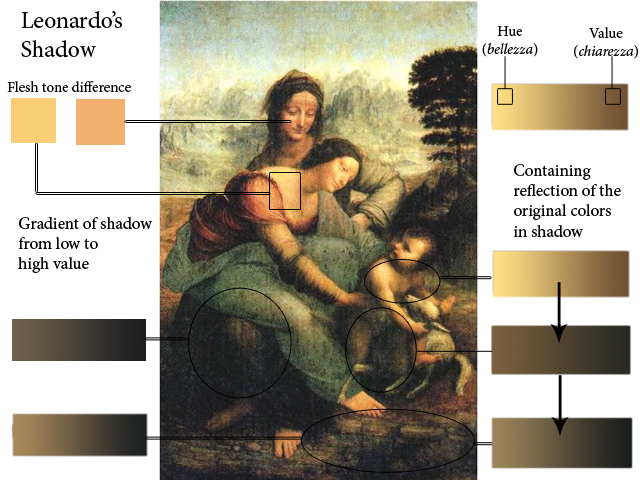
“Leonardo was so obsessed with using shadows and reflected light that he wrote fifteen thousand words on the topic, and that is probably less than half of what he originally wrote,” Walter Isaacson opined.

Using shadows and reflected light is a technique that doesnt have to be limited to painters or image creators, in my humble opinion. It can be used by article writers, novel writers, and just about every form of writing, if they’re not using it already. This mindset resulted from a technique da Vinci used in his paintings called sfumato, or “gone up in smoke”. I use it so often that I don’t think of it as a technique anymore, but I found it interesting to read the explorations of it by one most famous artists in history. The basic tenet of the sfumato technique, da Vinci made famous, was to avoid using specific and concrete lines in his paintings. This might not sound like a novel technique to the accomplished artist of the day, but it was groundbreaking in its day. Da Vinci did not invent this technique, as some evidence suggests it dates back to the chiaroscuro effects used by ancient Greeks and Romans, but da Vinci took it to another level.

When the writer begins writing a story, they characterize their main character with bold lines through unique, individualistic, and semi-autobiographical lines. The more an author explores that character, the more they chip away at strict characterization and allow their main character to breathe for themselves in a manner that adds dimension. They characterize with shading and reflection, or refraction through supporting characters, until they have done little to characterize the main character except through their interactions with others and events. Their main character becomes more prominent through these literary devices, until the central character becomes the literary equivalent to an eye of the storm.

A perfect example of this occurs in modern situation comedies. Most sitcoms have an “eye of the storm” character, we can characterize as the “us” character. The us character reflects us, but the us character also inadvertently defines the other characters as often as the other characters define him through interactions. The characters interact, and the us character is our way of dealing with all of their zany ideas and acts of the side characters, until we learn more us and all of the characters involved. Defining a character otherwise can leak into a term we want to minimize as much as possible. Think about that in terms of the sitcom. If the main character stood before the camera and told us about his likes, dislikes, and a little bit more about him, how boring would that be? It works in some cases, Larry Sanders, or The Office, but it doesn’t work in most cases. 

In most cases, we want to see characterization in action, we want to see what da Vinci called sfumato technique, or what we call the “show don’t tell” technique. The author uses supporting characters and setting to define their main character, and they use all of this to bring the events involved in their stories to bring them to life. The takeaway might be that the optimum characterizations are those characterizations that appear more organic to the reader. In other words, the author should be working his or her tail off to make the work appear so easy that the reader thinks anyone could do it.

Chekov’s Razor

Checkov’s razor is easy to understand. Write the first three paragraphs, pages, or whatever you need to familiarize yourself (the author) with your material and write the rest of your piece. Once the author is done with that piece, go back and delete the material that you had to write to start and start at the most compelling piece of your article. If you have germane sentences in that intro, save them, and work them into the body of the piece. Delete the chunk of exposition that it turns out was only written for you. Let the reader enjoy the rest. 

“But, wait, what if it’s brilliant,” we say to counter that argument. It could be, it might be, but it likely isn’t. Some of us get so locked in and locked up by the ‘we are a man of golden words’ notion. It’s the whole, ‘there’s no such thing as mistakes,’ philosophy, generated by artists the likes of Pablo Picasso and James Joyce. There are mistakes in writing, and leaving that big chunk of exposition at the beginning of your article is one of them.

“There’s no writer’s block. There’s lazy. There’s scared, but there’s no writer’s block. Just sit down and realize you’re mediocre and you’re going to have to put a lot of effort into this to make it good.” –Jerry Seinfeld

Writer’s block, according to Jerry Seinfeld’s definition, is the desire to start writing brilliantly. It’s the “If you can’t be the best, why do it?” block that inhibits writers from writing a single word, or the writing, deleting, writing, and deleting merry-go-round. It’s the dreaded, blank page, or the blinking cursor syndrome that prevents us from writing a single word. Jerry’s remedy is to accept the idea that you’re probably not half as brilliant as you think you are, and once you reach a point that you might be mediocre, it might be possible to write something that’s actually pretty good. My philosophy is similar, but I no longer think about greatness or mediocre distinctions. I just write until something good poops (and yes, I meant poops!) out.

We might call this the discovery phase. In the discovery phase, the writing is gibberish to everyone but the writer. This is the “all play no work” phase for most writers, as it allows us room away from our aspirations to true creativity. Some of the best room for creativity occurs when we have an ending in mind, as it’s fun to fill in the blanks. Filling in the blanks might also lead to a new ending. 

The takeaway for aspiring writers is to get the idea down before you forget it. Don’t worry about sequencing, chronology, grammar, spelling, or if this story is the base for the next great American novel. Just write it down and worry about all that later. Just write a bunch of gibberish down that only the writer understands, until the subject matter begins to open up to the writer. Once the author is in, the material might have the wherewithal to be in a near proximity to where a story lies, but the real story could take paragraphs, or pages, to develop.

Chekov’s razor focuses on threes, the first three paragraphs, and/or three pages of a manuscript, short story, or essay, but I’ve found this length arbitrary. When I begin a story, I think I have a full-fledged introduction on my hands. I don’t think anyone writes gibberish just to write gibberish, it feels like this could or should be the story at the time. I lock myself up when I try to determine if the writing is up to my standard, or if it’s going anywhere. I unlock myself by writing it all down, all of the important and unimportant that comes to mind, then I delete the unimportant.

Chekov’s razor comes into play when we go back and delete the unimportant. That is rough too, because all writers live with the “Golden words” mentality. Everything I write is not only good, it’s vital, and germane to the story. The writer needs to ask themselves am I a good writer or a good editor? The answer, if you’re going to try to write for others, is you’re going to have to be a little of both. Or, you can have a friend read it, or pay to have someone edit it for you. If you’re as megalomaniacal about your words as I am, you’ll either find a way or you won’t, and your work will suffer for it.  

In the course of writing past the blinking cursor stage, we discover pivot points that take us to the next stages of the story, but we don’t consider them anything more than what they are at the time. In the course of rewriting, however, we discover the pivot point is the story. The frustration falls on two tracks, the first is that we fell in love with that original idea, and it’s tough to just walk away. The other is that we “wasted” so much time writing “the other” story that we loved. When writers achieve the ultimate point of objectivity, when they realize story is sacred, they begin sacrificing all the information they love to leave information you will. 

Thus, I don’t believe there is magic in the power of threes in employing Chekov’s Razor to storytelling. A central idea, or pivot point arrives in the course of writing, but the point of Chekov’s razor is to dump and delete the useless information the writer used to write the story.  

An important note to add here is that if most authors work the same way I do, we do not write for the expressed purpose of finding the core of our story. Our perspective is, we think we already have the story, and that the only chore involves building upon it. The discovery of the core of story often humbles the author and slaps them back to the realization that no matter how many times we write a story, the art of writing involves mining the brain for ideas rather than having a brain loaded with brilliant ideas. That conceit eventually reveals itself to those willing to write a lot of material, and it’s up to the author to recognize the difference for what it is, if they want a quality story.

It happens in the course of writing it, editing it after we’re done, or in the daydreaming stage that can last for days, weeks, or months. I do not enjoy deleting the chunks of material I’ve written, and I don’t think anyone does, but the quality author will develop the ability to recognize what portion of the story is for them and which portion is for the reader, and they will crib note or delete the part of the story that is for them.

I don’t consider the revelation of these techniques a glamorization of my process. I think it demystifies the process by suggesting that anyone can do this, as long as they write as often as they need to discover what should become the central focus for the reader. Every author needs to move past their conceit of their self-defined brilliance to find the story they’re trying to tell, and learn how to work from within it.

As I’ve written elsewhere, the most prominent use of Chekov’s razor can be found in Franz Kafka’s Metamorphosis

How to Succeed in Writing XI: The Stages


“It is (the writer’s) job, no doubt, to discipline his temperament and avoid getting stuck at some immature stage, in some perverse mood; but if he escapes from his early influences altogether, he will have killed his impulse to write. –George Orwell

We’ve all read authors who write from what Orwell calls the “immature stage”. They get locked in a stage of life they will not, or cannot, escape. They hate their parents, they cannot get over the fact that someone of the opposite sex has dumped them in an unceremonious manner, or they cannot get past the fact that their political party cannot win, and those mentalities are reflected in their writing. If, on the other hand, as Orwell states, a writer is afforded the ability to completely forget the transgressions and tragedies that made him miserable in his youth –that which may otherwise diminish their mental health– they may not be the writer they could’ve been if they learned how to embrace those demons. A quality writer, if Orwell’s thesis is to be believed, is one of those rare individuals who is cursed, and blessed, with the inability to forget, while capably moving to the next stage of maturity, coupled with the ability to recall all of those sentiments and mentalities they struggled with in their effort to achieve more mature stages.

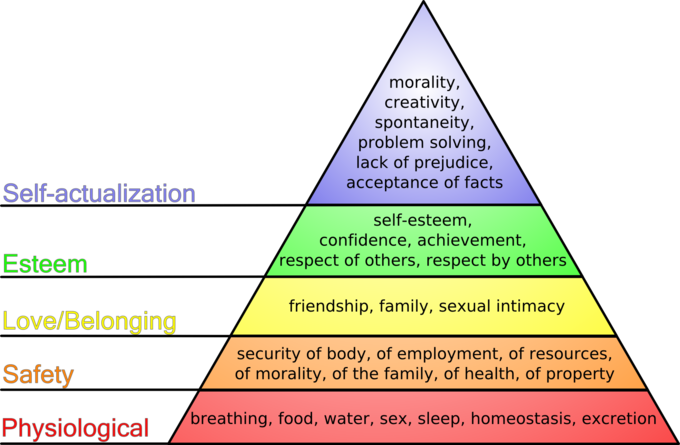
Maslow's_hierarchy_of_needsWe’ve all heard of Abraham Maslow’s Hierarchy of Needs that lists the various needs a person must satisfy to achieve a sense of completion.  The initial stages of the hierarchy concerns basic needs (food, water, and breathing) that we take for granted, until they are not met. As this hierarchy progresses to completion, the needs become more complex, and the need to satisfy them more profound. There is also an idea that that person may take one level for granted –such as the need for friendship, and the need to be loved– and they may regress back a level. The basic structure of the Hierarchy of Needs suggests, however, that one cannot progress to next level, until the needs of the prior level are satisfied. Every person is different, of course, but the basic tenets are such that most people are not immune to the needs of a level you are currently on, and our stubborn refusal to accept the idea that we need more of whatever you currently have, has us stuck at that level.

Orwell’s addendum to Maslow’s Hierarchy of Needs pertains to writers. His quote basically states that while writers are not immune to the need to progress in all the ways Maslow outlined, and that their progress is elemental to better writing, it’s just as vital to the quality of the writing that they be able to tap into the angst that drove them to want to be a writer while mired in a previous stage.

The best, most stark example, may be the starving artist that wrote something while mired in a premature stage. The piece they wrote may have been beautiful on one level, but it was generally regarded as being on the cusp of brilliance. The beauty of their piece may have been contained its raw exploration of their vulnerabilities, but it was also considered a snapshot of what this artist might be capable of ultimately, as it offered no solutions. Their piece was more of a list of complaints with no end in sight, a characteristic that can be compelling in its own right.

As we’ve witnessed, in all crafts, some starving artists never reach their full potential. Some of them become trapped in the starving artist mindset, or elementary stage of need, and they never gain a complete enough understanding of themselves, and thus mankind, to achieve a greater, or more complete artistic piece. Or, they may have progressed through the channels of their needs so completely that they’ve lost their need to create artistic pieces. It’s also been the case that a starving artist’s original piece was so successful that the person became successful and lost the starving artist mindset that gave them fame, and every piece they write thereafter is retread. This lack of artistic progression may be as simple as the artist never progressing to the self-actualized stage.

The website Simple Psychology states that “Maslow estimated that only two percent of people will reach the state of self-actualization.”

Is Maslow wrong, or are we? Are we a member of the ninety-eight percent, and does this affect our writing in such a manner that we don’t have the objectivity necessary to write a compelling fictional character, much less conduct our lives in a self-actualized manner?

As one that has progressed through a stage fairly recently, I can tell you that that progression served my writing well. I would not say that I’m a member of the two percent, but I have progressed, and I didn’t wake one day with the realization that I had progressed either. It was only upon reflection that I realized that only after one of my fundamental needs was met did my writing progress. I look back on my “immature stage” and I realized how much better my writing has become. I realized that my inability to complete a piece was more of a commentary on my inability to progress through my personal hierarchy of needs than it was my artistic abilities. I’ve also managed to keep in touch with all of the angst that drove some of my earlier works to bring them to completion in a manner I may not have if I hadn’t progressed.