“I’m Just Too Dumb!” 


“Hey Patrick come over here and check out our sinkhole,” Hector said when he spotted his neighbor walking outside. Patrick walked over and looked, because who wouldn’t want to look in a sinkhole? He looked from a careful distance, made a comment that I can’t remember, and he began walking away. “Wait, Patrick, you really gotta see this thing,” Hector urged. “C’mere.” 

“I saw it,” Patrick said. “It’s a sinkhole Hector. I’ve seen sinkholes before. It’s not a circus exhibit.”

“C’mon,” Hector said, “I’ll hold your hand, if you’re afraid of falling in.”

“You don’t understand, I will fall in. I’m just that dumb,” Patrick said, dropping his new favorite line on those of us standing around the sinkhole.

“No, you won’t. They’ve cordoned off the dangerous spots, so we know how close we can get,” Hector said, noting that he already called the police, and they put yellow tape around the weak spots. “Just don’t cross the tape.”

“Trust me,” Patrick said. “I’ll fall in. I’m just too dumb.” 

Patrick loved that line. He dropped it so often, in so many situations, that it kind of  became his catch phrase. Why did he love it? I wasn’t there when he first heard it, but I wonder if he thought it was so hilarious that he would start using it. Did he think it was so hilarious because he could relate to it? Did he think it applied to him so well that he thought he should start using it? He might have started using it because he found it funny, but he began using it so often that I think he now believes it. 

“Be careful what the brain hears you say,” a friend of mine said when I told her this story. “It might start to believe it.” 

Others can convince us of just about anything, if they repeat it often enough, but can we convince ourselves of something if we repeat it often enough? If we hear someone else’s schtick, and we love it for being such a great, self-deprecating line, can we accidentally convince ourselves that of something like being so dumb that we might do something that could cause ourselves irreparable harm? It’s possible of course, but is it probable? I would say this is not a joke, but it probably started out that way to Patrick, until he accidentally convinced himself that not only is he dumb, he’s so dumb that if he doesn’t check himself, and his brain, he’s probably going to end up in an emergency room saying, “I told you. I told you how dumb I was. Why didn’t you listen? Why didn’t I?” 

I’m not exactly sure why I considered Patrick’s “I’m too dumb” joke so funny. He dropped this line on me several times, in casual conversations, and I always enjoyed it. We’ve all heard people drop variations of self-deprecating humor, but Patrick’s delivery was so pitch-perfect that I can’t but think he believes it on some level. He was so flat and straight, and nothing about his presentation suggests that he’s seeking laughter. Does that make his joke better, yes it does, but does he deserve credit for his ability to deliver a joke, and is it possible for someone to deliver a joke that well without some belief in it?  

To arrive at answers that plagues us, we need a control group. When research scientists attempt to arrive at answers regarding psychological complexities, they divide their group into subjects and a control group. Patrick is a jokester, always telling jokes, and he’s a pretty funny guy, but he has one flaw. He laughs harder at his jokes than anyone else does. To understand if he is kidding, and by how much, we need to study the methods, patterns, and reactions he has when telling his other jokes. Following his other jokes, he drops a “I mean, C’mon, right?” followed by laughter. He pumps his head back, and his eyebrows go high on his head as he laughs. When he drops his “I’m too dumb” jokes, however, he doesn’t laugh, and his head goes down in the manner a dog’s might to signify submission. Is this part of his schtick? Does he do that to sell the joke better? Patrick is funny, but he’s not that funny. He does not apply such subtle intricacies to any of his other jokes, even the other self-deprecating jokes he tells. I don’t think it would take a team of research doctors to find that the reason Patrick tells this joke so well because he believes it. 

For all the reasons listed below, reasons I imagined later, this instance at the sinkhole struck me as particularly hilarious. Patrick added to the comedic nature of his joke by putting greater distance between he and the sinkhole. He walked away from Hector’s home, and off Hector’s lawn, and he then went into his home. I don’t know if he locked the door, but my guess is he did to presumably place one more obstacle for him to cross to get back to the hole. I presume Patrick did this, because he no longer trusts his brain to help him avoid an impulse that might cause him harm. Those of us standing around this sinkhole in Hector’s lawn could only presume that Patrick lost all faith in his brain’s ability to protect him from harm.  

I flashed to Patrick falling in the hole, a near bottomless pit in Patrick’s imagination (it was about three feet deep), looking up at us saying, “See, gawdangit, I told you how dumb I was.”

“Listen, I have two kids to raise, and they count on me to be there for them in so many ways,” I imagine Patrick pleading if Hector pressed him further. “If I start following whatever impulses my insufficient brain provides, I’m going to leave my wife a single-parent, and I’m not going to do that to her or my beloved children. I have to learn to reject whatever temptations I encounter to protect my body, so I’m there for them throughout their maturation.” 

We’ve all heard psychologists talk about a person being at war with their brain. It’s a deep, complex topic they use to describe those with seriously troubling psychological issues. Patrick doesn’t have those, but he does appear to be in conflict with his brain on a level that he describes with repetitive jokes. At one point in his life, I think Patrick decided to wage a cold war against his brain. A cold war, by our definition, involves “threats, propaganda, and other measures employed just short of open warfare.” Or, as others put it more succinctly, “Waging war without firing a shot.” At some point, Patrick’s internal forces decided to mount an internal coup against the brain, because those mechanisms decided that the brain no longer had their best interests in mind. 

One of the primary directives of the brain is to protect us. It protects us from heights, guns, and the prospect of encountering large, man-eating animals through chemical compounds that induce fear. When we fear, we learn to employ various defensive measures, including creating distance from the temptation, to prevent what the brain suspects could cause bodily harm. Over the years, we learn what to eat and drink, and what we do and think to prevent bodily harm. The brain instinctively knows, and learns, what can cause death. What isn’t so obvious are the irrational fears we develop for the dark, ladybugs, and inanimate objects.
Why are we so afraid of insects, even relatively harmless insects such as the ladybug, at a young age? We don’t know what a ladybug is when we’re young, or if we do on some rudimentary level, we don’t know the extent of their abilities. This is the fear of the unknown. As we age, we learn that most animals and insects have an instinctual fear of humans, and it  provides us a level of comfort when we’re walking down the sidewalk, and they clear the way for us. Some of the times, insects occasionally land on us in their confusion, and our young, fantastical mind can interpret that as purposeful, especially when the ladybug begins to crawl up our leg in a manner we could further interpret as a purposeful violation of the parameters we thought we had with insects. We convince ourselves that they’re not afraid of us anymore. They’re crawling up our legs with a specific purpose in mind that we don’t even want to imagine, and that leaves us paralyzed with fear.  

At some point in our maturation, our brain learns the parameters of threats against the body. There’s nothing to fear from ladybugs, even those that appear to violate the parameters of the relationship we have with insects. We’re quite sure that there are some anecdotal tales of a ladybug causing human deaths, but they’re so few that we know there’s little to fear from them. There are, however, a number of tales told of spiders causing death, but not as many as those from the mosquito archive. Yet, the number of people who fear spiders far outweighs those who fear mosquito. The whole world of fearing spiders involves their creepy nature, their physical appearance, and the techniques they use to poison their fellow insects and eat them.     

At some point in our search of what to fear and what we learn is relatively harmless, the brain plays tricks on us. We fear the relatively harmless, clowns and cotton, yet we don’t fear some of the things that can actually harm us, and kill us, like driving ninety miles an hour down the interstate. 

“I like to tease my fears,” a friend told me. “I prefer to live dangerously. It’s a rush to put your life on the line by skydiving from a plane, or bungee jumping, and bungee jumping is actually a lot more dangerous than people know.”

“So, you consider jumping from 50 to 500 feet with nothing but a cord tied to your ankle dangerous?” I asked sarcastically. The fact that she felt the need to tell me that bungee jumping was dangerous suggested to me that most people she knows have tried to argue against her position, and if that ain’t the brain messing with people, I don’t know what is. 
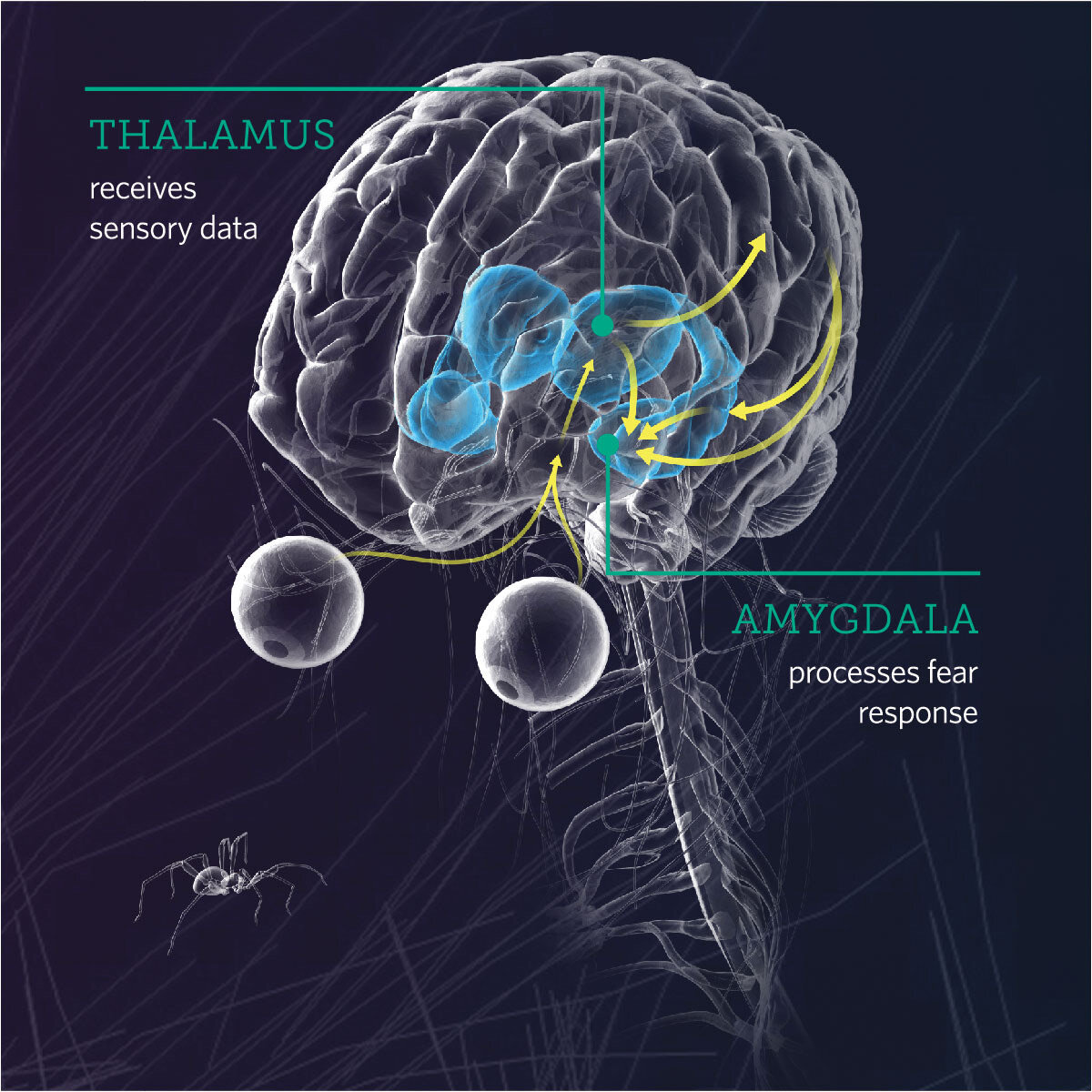
Patrick’s brain has obviously spent a lot of time messing with him in this manner, trying to convince him that nothing is as dangerous as they say, and his brain has obviously done this so often that Patrick just doesn’t trust it anymore. We’ve all heard that those working a police beat believe half of what they see and none of what they hear, but I’ve always assumed that was intended to illustrate their trust of what others do and say. Others can deceive us into accepting what we know is not true, but can we do this to ourselves? Are we at war with our own brain in relatively benign situations such as our approach to a sinkhole? There’s knowing and not knowing, of course, but as Patrick said he’s seen sinkholes before, so he presumably knows how to approach it. He just doesn’t trust his instincts, and he’s skeptical of what he might do. 

We all engage in self-deprecating humor, and we all enjoy the fruits of a person showing that he doesn’t take himself too seriously. As I’ve written many times and many ways, be careful with this comedic tool, because your audience might begin to believe it. Patrick’s use of self-deprecating humor seemingly adds another layer of caution, be careful how often you use it, because you might start to believe it.   

Patrick is not a dumb man, and if we are ever tempted to join him in the belief that he is, all we have to do is talk to the man for about forty-five minutes to learn how knowledgeable he is on so many different and diverse topics. Somewhere along the line, Patrick heard someone say that they were “so dumb” that they might not be smart enough to prolong their health and well-being. Patrick obviously considered that so funny that he began using it, and he saw how this exaggeration of the typical self-deprecating joke comforted his audience. It obviously comforted him too, to a degree, to think that he wasn’t all that. At some point, he began to fear that he might actually be “so dumb” that he could find a way to convince himself that he might cross that yellow, police tape to end up in a bottom of a sinkhole without knowing how it happened or why he did it, because his brain is now so deficient that it might lead him to him harming himself in some life-altering manner. Faced with such internal strife, Patrick decided that it was just safer for him to walk away, enter his home, and lock the door to try to prevent his kids from being fatherless children. “Trust me, I will fall in,” he warns us, and presumably himself, “because I’m just that dumb.”  

Hi, I’m Larry, this is my brother Darryl, and this is my other brother Darryl


“Hi, I’m Larry, this is my brother Darryl, and this is my other brother Darryl,” the actor William Sanderson, playing Larry, would say to introduce he and brothers Darryl played by Tony Papenfuss and John Voldstad on the Newhart show. With the passing of the actor Bob Newhart, and all of these retrospectives on his career, one would think someone, somewhere would break ranks and tell the story behind one of the most iconic and oddest running gags in television history. So far, nothing, silence, crickets!

It feels a little odd to call this line a catchphrase, because it’s not a phrase, and it’s not catchy, but it was repeated so often that we could at least call it a running gag of one of the most popular shows of its era. It was such an odd part of the show that one would think that everyone from the studio execs to the cast members themselves would demand some sort of explanation, backstory, or point of origin for the audience. (To my knowledge, there was never an in-show explanation.) We also wonder why, thirty-years since the show last aired, no one has ever taken credit for the line, told the insider story on how many hurdles it surely had to cross to before making it on air, and how it evolved from a simple introduction to a cultural staple. (My guess is it was a throwaway line someone threw in as a lark, and test audiences reacted so well to it that they decided to keep it in.) 

Newhart aired from 1982-1990, so it came about in an era where the demand for catchphrases, from sitcoms, was just starting to wane a little. This isn’t to say that the catchphrase died, because it probably never will, but prior to Newhart, every sitcom was almost required to have a catchphrase, but this was no longer the case when Newhart aired. My assumption is that the writers never intended for this to be the show’s catchphrase, and my guess is they probably didn’t want a catchphrase at all, but if you even mentioned the show Newhart to a bunch of people, during this era, someone said, “I love Larry, his brother Darryl, and his other brother Darryl.” The intro to the eccentric woodsmen caught fire, and before I knew it, everyone I knew was saying it in one way or another. 

Most shows from the 70s to the early 80s developed catchphrases to help audiences quickly identify with the characters on their show. Just about every popular show from this era had a catchphrase, and rather than try to list them all, we suggest you go to Flashbak.com for a top 25 list of the best catchphrases from the 70s, or you can go to Ranker.com for a list of the top 80s catchphrases. Characterization can be difficult and time-consuming of course, depending on the character, but screenwriters of TV shows needed something more immediate to help audiences identify quickly. Some of the times, networks only bought four-to-six episodes after the pilot to see if these shows could establish themselves, so the writers, the cast, and all of the others involved in the production knew they had to develop and characterize quickly, thus they created a word or phrase to help audiences relate to their characters quickly.  

They also had to use these words and phrases to accomplish a wide variety of things, other than characterization, quickly. They had to sum up everything about the character, they needed it to be fun and silly, and the phrase had to be a malleable word or phase that the writers and actors could use to match a wide variety of situations.

We all attached these shows to their catchphrases, and we all repeated them, because we all watched the same shows back then. Even if we didn’t watch the shows, we knew the phrases, because everyone we knew said them. The actors responsible for reading these lines said they couldn’t go anywhere in the United States without someone dropping the catchphrase on them, and some of them have tales of traveling to remote, third world locations where the locals would drop an ‘Aayyy’ or a ‘Kiss my grits’ on them.

If someone dropped the phrase on you, and you never heard it before, their response was usually laced with ridicule, “How could you have never heard this phrase before? Do you not watch TV, leave your home, or talk to other people?” We had three channels back then, and if we wanted to know what other people were talking about, or have friends of any kind, we knew we had to watch these shows.

For those who weren’t around during the 1982-1990 era, we all tried to come up with our own variations of “Hi, I’m Larry, this is my brother Darryl, and this is my other brother Darryl”. I had three friends named Adanna, Madonna and Lisa. When they hung out together, they decided to mess with the strange fellas they would meet in bars by introducing themselves, “Hi, I’m Adanna, and this is my friend Madonna, and my other friend Donna.” It was funny at the time, but it was probably funny because I was there, and I knew them. It might be one of those ‘you had to be there’ jokes for which you had to be there, but the point of retelling this is that this ‘Hi, I’m Larry, this is my brother Darryl, and this is my other brother Darryl’ joke was everywhere for a time.

With the passing of Bob Newhart, we might read writers of various publications attempt to eulogize him by placing his shows The Bob Newhart Show and Newhart in the upper echelons of quality programming. They weren’t, in my opinion. They were occasionally funny shows that weren’t extremely influential. Bob Newhart played the straight man to the silliness around him, and silly and funny gags and lines developed around this premise, but neither show was groundbreaking in situational comedy, and neither of them were headline stopping influencers. They were just occasionally funny sitcoms.

‘Hi, I’m Larry, this is my brother Darry, and this is my other brother Darryl’ also managed to have an insider/outsider quality attached to it. We all repeated the joke, and tried to develop clever ways of twisting it to those who would ‘get it’, and those who ‘got it’ were insiders, but the show was so popular for a time that everyone got it. We considered it a slightly quirky, clever way of describing salt of the earth type characters that added some backwater qualities to those who exhibited some physical characteristics that matched the three brothers. The question we never asked back then is who came up with this line, and what was their thinking? Was there an origin story, or some kind of backstory behind it? Was it a result of success, failure, or success through failure?

Was the joke a result of some typo in the original bible the head writer wrote for the show? We don’t know. Was there an original third brother, who had a name like Elmer, but the two actors were both mistakenly cast as the character Darryl, which led to an argument between the actors? Did one of the writers note the confusion and decide to pacify both actors by calling them both Darryl, and it turned into an inside joke that eventually leaked into the script? We don’t know. Did an original writer come up with an equally banal name, like Elmer, and the writers decided that name might be too on-the-nose for a backwoods hillbilly? Did the writers want a different, subtle, and unstated characterization of the brothers’ parents that illustrated the family’s backwoods nature by giving the same name to two different sons? Or, did some ingenious writer just spontaneously shout out, “Let’s just name the other brother Darryl too?”

“That is the ultimate taboo,” I imagine the head writer saying. “You can’t have two characters have the same name in a production. It will prove too confusing to the audience. We’re not even supposed to have characters names start with the same letter, much less the same name. What if we have one Darryl do something one week and the other do something else next week? How will people refer to them at the watercooler at work the next day, and how do we have the other characters refer to them? Do we label one Darryl one and the other Darryl two, or do we eventually call them one and two in some subtle homage to Dr. Suess? If we don’t do something like this, it will prove too confusing for the audience.”

“We keep the actors on the show for the sole purpose of this one joke,” one of the writers responded. “They don’t do anything themselves. They’re a trio, and Larry does all the talking for them, and he answers any and all questions for them.”  

“It is kind of funny, in a taboo breaking, offbeat, and weird sort of way,” the head writer would respond, “but no family gives two of their sons the exact same name?” (George Foreman would later name all five of his sons George.)

“Like everything else, it could be funny,” another writer adds, “through repetition.”

In any song, TV show, or movie, we eventually learn the long-held secret behind lyrics, lines, and why things in the production were the way things were, but to my knowledge, based on some research, no one has broken ranks to tell the tale behind ‘Hi, I’m Larry, this is my brother Darry, and this is my other brother Darryl’. The best explanation I’ve found is it just “became a recurring gag throughout the series”. The first time it happens, we’re kind of, ‘What did he just say? That’s odd.’ The second time through, we remember it from the first time, and then it builds and builds until it eventually catches on.  

We can only imagine that ‘Hi, I’m Larry, this is my brother Darry, and this is my other brother Darryl’ was a tough sell in the beginning. We have to imagine that it was not part of the original pitch of the show, and that it had to be a tough sell in subsequent production meetings. “We think it will be funny, eventually,” one of the writers probably said, early on, “and who knows how or why these things catch on, but we think this will eventually catch on.” We have to think that such a line required some big-time backing, “Besides, Bob [Newhart] loves it, and he wants it kept in.” We have to think it was not the make-or-break hill anyone on the production team were willing to die on. “We like it a lot, but we’re not married to the idea.” This is all speculation, of course, but the staff obviously did whatever they had to do to get the green light from the network. 

Now imagine how shocked everyone involved in the early stages of the production was when this line eventually caught on. Imagine how shocked they are now, when these retrospective articles come out and this line, and the final episode, are the two things most people remember about their beloved series, thirty-plus-years later. The cast had to be shocked that it proved so popular, the writer who wrote the line was probably stunned, and the studio execs who surely offered notes that it was a dumb joke that would have to be clarified, were probably the most stunned of all. I was not a huge Newhart fan, but I watched it a lot. If there was ever an in-show explanation of the parents naming the two siblings Darryl, I never heard it, and if anyone on the production offered an explanation for this catchphrase, after the fact, I haven’t heard that either. My current searches, through all the venues offered today, turned up no explanation.

Whatever the case was, everyone I knew repeated this line, tried to use it in their own context, and they tried to further it in some sense, but even though we all greeted these references with a giggle, they never worked as well as it did on that show.

In the age of the internet, talk shows, podcasts, and DVDs with commentary added, we’ve grown accustomed to answers to every question we could possibly have. If Newhart were more popular, we might have that answer by now. If it carved out a niche in the zeitgeist, similar to Seinfeld, Frasier, or Friends we have to imagine that fans would badger the stars, creators, or writers for some kind of answer. There might be five-to-ten people who know the origin story, or some sort of backstory, but no one has badgered them for it. My best guess is if the story behind the recurring gag was half as funny as the line, somewhat interesting, or it hinted at the creativity of the originator, we’d all know it by now. The backstory is probably one of the best examples of how the explanation of a joke is almost never as funny as the actual joke, so you take a step back and leave it as a standalone.

The actual explanation probably involves the fact that one of the writers knew a family that gave two brothers the exact same name, a family name that was given to the siblings as an homage to another family member, but to avoid confusion they addressed ‘the other brother’ with a nickname. Whatever the case is, the writers probably considered the origin story so unfunny that it undercut the perceived brilliance of the idea so much that they decided to never tell it. I searched through search engines, Bing’s Co-Pilot, and I even left the open-ended question on a chat platform for anyone who might know how this recurring gag was born. I expected some internet searchers, or some huge fan who saw the commentary edition of the series to offer up some explanation they heard. So far, no takers. I was a little surprised to learn that it doesn’t matter how much research we do, in the Information Age, some of the times the truth is not out there, because some of the times, the arbiters of truth won’t give it up.   

The Patient Predator


Those of us from an an agricultural area have all heard the tales about a parent, usually a mother, preparing a chicken for dinner. When we city-dwellers think of the preparations necessary for a chicken dinner, we think of the five-minute drive to the local supermarket, the time it takes to select the best frozen chicken, and choosing a batter (if it’s not pre-battered). We then sit down for our chicken dinner about a half hour later. That’s been the process for so long that most generations have never heard that for farming families, past and present, there are other steps involved that they’ve never heard about when mothers prepare a chicken dinner.

Disclaimer: Some might deem the following Not Safe for the Workplace, and if you are in anyway squeamish, I suggest you locate the ‘X’ in the upper righthand corner of this screen and exit stage right. Some might deem ‘the other steps’ violent and brutal, but they are a way of life on a farm. “It was just the way we did it,” they say. They way they did it, involved a mother entering a chicken coop to retrieve a chicken or rooster for that day’s meal. Once she catches it, she chops its head off and releases it to allow it to run around, headless, until the life runs out of the body, and it unceremoniously falls to the ground. It usually runs around, crashing and smashing into whatever is around it for about ten seconds without a head, until whatever nerves or final vestiges of their muscles finally run out of power. Some find this funny, others consider it sad, and still others find it so funny that it is kind of sad. Whatever the case is, the next time your mother says that you were “Running around like a chicken with its head cut off” you now know the origin of that phrase.

These chicken/rooster post-mortem displays prompt the question, do all animals do this? Do human bodies run around, crashing and smashing into things for ten seconds after the head gets chopped off, until the lifeforce drains out? There is no evidence that suggests human bodies run around in this manner, but there is some dubious evidence that suggests some consciousness remains in the head. The scientific data is about as far from conclusive as possible, but a researching physician in the French Revolution claimed, based on his observations, that a severed head could retain consciousness for 25 to 30 seconds.

As many times as I’ve heard these chicken preparation stories, over the decades, Ken’s version of this practice involved a twist I’ve never heard before. In his retelling, he remembers his mom stalking roosters in the coop. She would enter the chicken coop with a rooster in mind for their meal before she entered. We could write, “At one point, she caught the rooster,” but this does a disservice to the art of catching rooters, as they are notoriously difficult to catch. We could put them in the smallest of pens and coops, and they will still find ways to elude capture with exceptionally quick movements, tricky maneuvers, and some flying involved in their quest to escape. We could also write, right here, that they’re unusually crafty or surprisingly smart when it comes to eluding capture, but they’re not. They just have what athletes call quick-twitch muscles. As usual with animals at the bottom of the food chain, like the rabbit, roosters have quick-twitch muscles that allow them that first-step quickness and that quick change-of-direction speed and agility that athletes prize. These animals obviously need these abilities to avoid faster predators to sustain the species.

Ken’s mother knew this all of this course, and she knew she wasn’t fleet of foot. She knew she wasn’t quick enough to catch a rooster, because no one is. She knew her only path to success involved a patient pursuit. She could have a rooster cornered several times, in corner after corner, and she knew he would continue to successfully escape until eventually he tired out. “She never grew frustrated by her inability to catch the rooster,” Ken said. “It’s very difficult to catch a rooster, and she knew that.”

It would prove a difficult chore even if it were just she and the rooster in the coop, but what makes it even harder are all of the other eight to ten chickens in the coop running around and flying in short bursts to try to avoid their own capture. As such, Ken’s mother would have to watch her step in pursuit, to avoid stepping on any chickens. We can also imagine that with the effort she put into the pursuit, combined with the heat outside, she would sweat profusely throughout her chase, which would lead to all of the feathers flying around the coop to stick to her face. We have to imagine that this would only add to the frustration and anger of even the most seasoned rooster stalker, but she never showed it. “She never grew frustrated or overly impatient,” Ken said. “She knew all that was just part of it.” There were probably occasions when she caught the rooster fairly quickly, but for the most part she had to engage in this patient pursuit, until the rooster eventually tired out, stood in place and fell asleep. At that point, she grabbed it and twisted its neck.

This is the “Wait a second, what?” twist in story. When someone tells a story that is consistent with everything we’ve heard before, we tend to drift a little. We don’t mean to be rude, but we’ve heard this story so many times, and we all know how it ends. Every time I’d heard this story, it ended with an ax, a knife, or some other sharp instrument applied to the member of the fowl family. The entertaining part, if that’s what you want to call it, usually involves the portion of the tale that describes the rooster running around with its head cut off. So, when Ken added the following, the glaze over our eyes lifted, and we said, “Wait a second, what did you say?” to help the rest of our senses catch up. 

“She would hold the rooster over her head, by the neck, and spin it, until she felt its neck snap,” Ken said. “She then released it and allowed it to run around the coop until the life drained out of it. Then she picked it up, stripped it of its feathers, put it in water, and took it inside to continue preparing it for our meal.” 

“Wait a second, what did you say about spinning?” his open-mouthed audience asked. Ken repeated the bullet points of it. “Did she do that to be … theatrical?”

“My mom didn’t do anything to be theatrical. That was just the way she did it.” When asked if he considered her method in any way inhumane, violent, or brutal, Ken added, “Again, that was just the way she did it. My guess is that that’s probably the way her mother and her grandmother taught her to do it. If you asked her if she considered it theatrical, violent or brutal, she wouldn’t understand why you do. It was just the way it was done as far as she was concerned.

“All you need to do is give the neck a quick jerk,” Ken clarified. “Something to snap the bone. It’s really not as difficult or as violent as you might think.”

***

Flash forward, a couple years, and Ken is a teenager. Ken admits that he was a particularly naughty kid, in his youth, and he met the back of his parents’ hands “More times than I can count. My parents were never ones to spare the rod.” As a teenager, it had been a number of years since any of his punishments were physical, but he upped the ante on one particular occasion. “I can’t remember what I did, but it was above and beyond the typical teenage tests of parental patience.”

“I’m going to have to give you the switch for this one,” his mother informed him. “You have to learn your lesson.”

“That’s all well and good,” Ken said, “but I’m a teenager now mom, and I’m a lot faster than you now.”

“You do what you have to do, and I’m going to do what I have to do,” she said, “but we both know how this ends.”

“We’ll see,” Ken said, as he eluded her and sped out of the house. Out on the farm, we can imagine that Ken found so many hiding places that he had a few favorites that he couldn’t wait to use on this day. He probably heard her calling out to him from his favorite hiding place on the farm, and he probably giggled when he heard the frustration in her voice, but she eventually found him. When she did, he managed to elude capture again, and he hid in another one of his time-tested hiding spots. When she found him again, he ran away and hid again. “I don’t know how long this lasted, but it lasted a pretty long time, hours I think, until I eventually got tired of running.  

“I had it coming, and we both knew it. I didn’t fall asleep, like the rooster, but at some point, I just tired out. To be honest with you, I didn’t see the correlations between her patient pursuits of the roosters and me until much later in life, and when I did, I realized it was pretty funny. She never gave up, she was like a patient predator, and I saw it with the chickens and the roosters. She just never gave up. It was just her way.” Ken’s mother did not further Ken’s punishment by lifting him over her head and spinning him, but Ken never forgot that day with the switch. “It hurt like hell. I still remember how bad that hurt to this day, which was kind of the point. She only swatted me a couple of times, and she was done when she thought I learned my lesson.”