You Don’t Critique Another Man’s Meat


“I love grilling,” Leonard said. “Absolutely love it. Some people do it, and some just do it, but for some of us, it’s a passion.” 

If someone said this from behind one of those sleek, compact, Three-Burner, Liquid Propane grills that feature porcelain-enameled, cast-iron cooking grates, you’d scream, I’d scream, we’d all scream for red meat. Check that, I probably wouldn’t scream, not anymore. I’ve been beat down, brothers and sisters, by all them grill-at-the-parkers hollering about how salvation is near. I’m here to testify that those Willie “the wunderkind” types who man the grill, and who, by all appearances should be the chef du jour, are false prophets.

You’ll be disappointed too, but you, the patron of the park, the family and/or friend of the chef, keep in mind that you ain’t paid a dime for that meat, the seat, or anything in between. You are to be grateful, always grateful, when someone hands you a plate, telling you to “Dig in!” on what you’ve been smelling and salivating over for the past ten minutes. You go grateful and stay grateful, because they paid for that meat, and they’ve been slaving over the fire, and you ain’t paid a dime. 

It’s that smelling that gets us, and it leads us astray, my friends. I’ve been there, you’ve been there. We believed in that smell, and our expectations went sky high. We tried to listen to Niece Maggie talking about her volleyball matches, but we don’t hear her, because of the symphony of sizzles going on behind our back.

When the moment of truth arrives, and I mean that in the most literal sense, we don’t even notice the au gratin potatoes when our plate hits that table. All we see is meat, all we hear is sizzling, and if the Promised Land smells anything like this, we might not mind going there a little sooner than expected. Then we get a taste, our first taste, finally, after all that waiting, and our sky-high expectations hit a gut-destroying, roller coaster dip.

“Is it just me or is this … bad?” we ask ourselves, and we’re all asking ourselves that question. You can see it at the table, especially on Cousin Teddy’s face. Do you have a Cousin Teddy? He can’t hide it? He has an eyebrow raised, but-I-ain’t-saying-a-word look on his face, but that face is just saying what we’re all thinking. Is the meat that bad, or are we all just that picky, and do we have a right to be picky, seeing as how this was all free? “But I had such sky high expectations. Doesn’t that warrant disappointment?”

“No, here’s what you do,” a friend of the family once informed me. “You shut your trap, and you keep it shut. That’s what you do. You open it long enough to put the food in it, then you close it to chew, and you keep closing it, until you’re headed home, whispering it to your wife on the drive home. You wanna be starting something? No, there’s nothing to be gained, at a family picnic, by critiquing another man’s meat.”

And when we talk about meat, we’re not talking about pork, brothers and sisters, because pork is tough to screw up. You know it, we know it, because we all done it, and we know it takes a whole bunch of stupidity to mess pork up. Brats, and all of the other meats that fall under the wiener umbrella, rarely knock our socks off or sadly disappoint, and we’ve had an absolutely horrible piece of chicken, what once? Twice, maybe twice. Red meat is the all-knowing meat. Red meat exposes a man’s under belly. It tells us who we are, who we really are. It tells us something about our attention to detail, the vulnerabilities of our spatula, and the frailties of our fork. Red meat does not forgive and forget, and it’s all about red meat.

Red meat is the reason we just drove thirty minutes to this park. We love our get-togethers, spending time with friends and family, and all that, but red meat is special. Can I get an amen, brothers and sisters? A soft, juicy hamburger is sublime, but a properly prepared steak is divine. I don’t care where they cut it, steak is the meat.  

I don’t keep a ledger on my disappointments in life, but when it comes to steak, I’ll throw out a whopping 95%. The fellas with the finest forks have disappointed me 95% of the time. The gas-grilled steak is edible, most of the time anyway, but it’s not Oh!-I-gotta-have-it scrumptious. It’s usually about two notches above edible.

I’ve seen them roll the most beautiful, top-of-the-line, stainless steel, propane gas machines into the park, and I’ve seen who’s ready and who ain’t. I’ve heard the grillers-in-the-park talk about those machines and how their top-of-the-lines can distribute heat so evenly across the grate, and how their four stainless steel burners can produce incredible amounts of BTUs that enhance heat retention so all that cooking “is not only more efficient, it’s convenient and quick.” And I know nothing about their world. I know nothing about all the knowledge they’ve attained from their research. But I’ve done my own research. I’ve researched what they generously produced for me with all their time and effort, between my teeth and gums, and I can’t remember eating a gas-grilled piece of red meat that’s earned those blue-ribbons. It’s quick, your propane grills with all their fixings are quick, but blue-ribbon? What are you smoking son?

So, we all giggle when Terrance rolls in with his $89.00 charcoal grill that he says he bought on sale at Walmart. We join in the giggles with the fellas-in-the-park, with a beer in our hands, because we know that they know, because they’ve been grilling for thirty-some-odd-years, so we trust they know their ins and outs. When the unassuming Terrance reveals his charcoal chimney starter, his flipper, his forker, and some tongs, the very, very basic three-tool set, that he purchased with the grill “all for a little over a hundy,” we join their public chiding, their gentle public shining, and we even join in on their private, and less gentle, scorn.
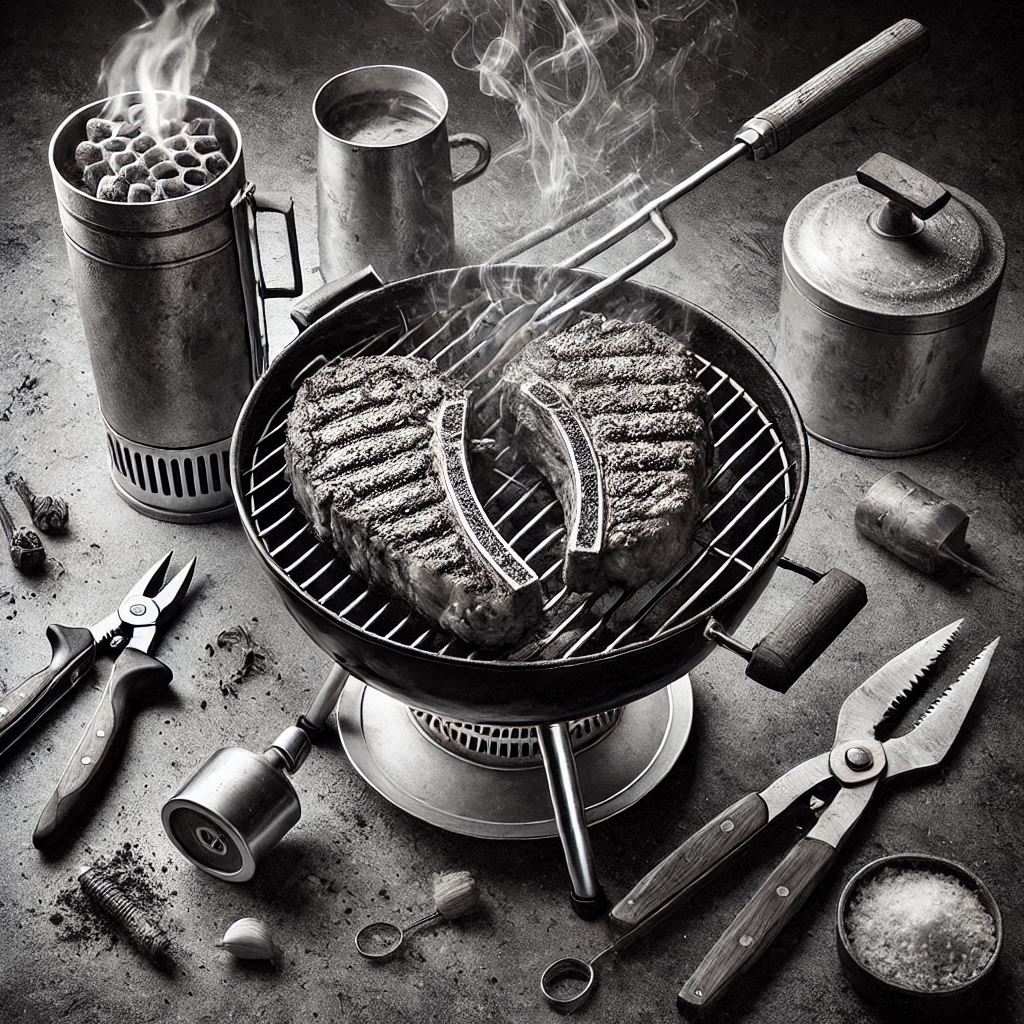
Terrance doesn’t talk the talk or walk the walk, because he don’t know it. He lived in an apartment and worked in an office for most of his life. Terrance is the type who prefers to eat out. He prefers restaurant food, and we all whisper that while he’s cooking, and we do it in the most condescending manner you can imagine. Terrance is the “doesn’t get it, and he probably never will” type of chef, because he started grilling late in life. If we talk about grilling with him, we started the conversation, not him, and we find he’s pretty insecure about his ability to cook a meal for the entire family.

“I let you guys do it for so long, because you love it. You all love doing this far more than I do,” Terrance whispers to me. “But I got a wife, and I got a life, so I decided to what-the-hell it.” So, it was the wife who talked him into grilling for the whole family. She also told him he was pretty good at it.

“But, for the whole family?” he complained.

“You’ll be fine,” she said.

We don’t think he’ll be fine. We wonder what she was smoking. I mean, Terrance doesn’t even own an apron that says something funny about the chef on it. He’s so insecure about his abilities that he doesn’t even join the joke Aunt Pat is telling about the time “Terrance couldn’t find the anus on a trout for cleaning.” He doesn’t know what he’s doing behind a grill, so he ain’t got time for her playtime. He needs to concentrate on trying to cook a fairly decent meal for the whole family. He also doesn’t want to make anyone sick, so he keeps plugging his “Walmart temperature gauge thinger-diller” (a term he uses because he can’t remember the word thermometer!) in the meat, and upon grilling, the verbal kind, we find he isn’t “totally sure what’s the difference between a sirloin and a ribeye”.

The “Oh, boy” we give is not kind. “Oh boy, we might need to get someone else to man the grill Helen,” our brother Jerry says about halfway through. “I’m not sure if Terrance is da man,” he adds, and oh boy do we laugh.

That “Oh, boy” consensus quietly turns kind, about twenty seconds after we sink our teeth and gums into Terrance’s finished product. “Oh, boy!” we want to say, but when no one else says a word, we quietly devour this tender and soft piece of meat that quietly changes everything we thought we knew about grilling-red-meat-in-the-park.

A hint of crisp on the outside is expected, but nothing can prepare us for the soft and chewy 145 degrees of medium-cooked insides that informs us how much dopamine the brain can reward a human being for the sense of taste. Everyone has Aunt Phyllis’s green bean casserole on their plate and Aunt Donna’s au gratin potatoes, but no one has touched any of that yet. There is no talk of trout anuses, fishing trips with our recently-deceased Uncle George, or any of the other great times we’ve had at this park over the years. There’s also no talk about how Terrance and his “under a hundy” arsenal just upended thirty years of grilling research the fellas attained with their top-of-the-line materials. We just quietly devour what Terrance made on his “one healthy sneeze and that thing’s going down” piece of junk, Charcoal grill that he purchased, on sale, from Walmart ten years ago.

Now that our course has been corrected on grilling at the park, we love hearing Leonard go on about how he knows his way around a grill, and how it’s all about love and passion for him. He has all of the latest and greatest cooking utensils, coupled with his ‘Kiss the Chef!’ apron. His stainless steel, propane gas grill has a brand name with numbers behind it that Leonard spouts as if it’s a limited model Lamborghini, and the aesthetic design of it is an absolute feast for the eyes. His wife further amplifies whatever Leonard says about himself and his new grill, and you watch him to see if there’s anything you can learn from a bona fide master. Leonard has a wide variety of wood chips, and he “ain’t afraid to use them”, and he “ain’t afraid to season neither.”

“Delicate and measured,” he says. “I know it’s verboten among the smoke whisperers, but if you keep it delicate and measured, seasoning enhances as opposed to overwhelming.”

When we finally sink our teeth and gums into the finished product of Leonard’s decades of fine-tuning, through trial and error and research, we find a truth about his marvel of science and engineering. We didn’t want to find it. That’s the most important note I want to leave you with today. When Leonard started going on about his passion for grilling, we thought we were going to be rolling around in it minutes later. Our only concern was that we would love it so much that we might make noises when we eat, and some of them might not be human noises. 

We didn’t want him to be wrong. We didn’t want him revealed. We wanted a savory slab of steak between our teeth and gums. When Leonard graciously gave us one of his steaks, we were grateful, but we couldn’t help but notice that it produced a flavor so close to steak that it was edible, but compared to Terrance’s amateur production, Leonard’s steak was anything but we we call a tour-de-force.

“It was actually pretty bland,” we whisper to our wives on the ride home. We don’t say this to Leonard, however. We lie to him, as any respectful guest who just ate the product of another’s effort and generosity will. We whisper that Terrance, and his piece of crap $89.00 cooker, “Actually grilled up a better steak.” We whisper that because we don’t want anyone to know what we don’t. 

“I know,” she whispers back, “But shhh!” We’re in the privacy of our own car, and we’re whispering, and she’s shushing me to try to prevent me from carrying on to the point that someone might hear us and know that we don’t know what we’re saying. We don’t know anything. We know so little that we don’t even know what we don’t know, but we know what we know, and we know you don’t critique another man’s meat.   

Rilalities XIII


“80% of success is showing up,” Woody Allen once said.

“So, what you’re saying is if I want to succeed, I should show up?” you ask. To answer that question, we ask another question, how many people don’t? How many apathetic and self-destructive types didn’t show up for the opportunities-of-a-lifetime Woody Allen received? Was Allan Stewart Konigsbeg (Woody Allen) the most talented person in his troupe, or did he show up so often that he got the job, the jobs, and the career that the apathetic and self-destructive did not, because they weren’t there.

In his book I’m Dying Up Here, author Arthur Knoedelseder suggests that Woody Allen’s 1978 Annie Hall winning numerous Academy Awards that year opened up all kinds of opportunities for standup comedians, comedic actors, and writers of comedy. Most of those who would land multiple picture deals would go onto be the faces of comedic humor in the ’80’s and beyond. The question is was Woody Allen funnier than those peers, or was he in the right place and the right time in Hollywood history?  

To listen to modern screenwriters tell their tale, Woody Allen’s story isn’t the type of story we enjoy. We’d much rather hear the story about “the kid,” “the natural,” or the one everyone agreed was the most talented person in the room who finally got his big break, and in the next scene, they’re asleep or dead with a heroin needle hanging from their arm. It happens so often on screen, that it’s a trope, but is it true? We’re sure it’s happened, but has it happened so often that it’s a truth, or do we just love to cringe so much that screenwriters feel compelled to write about it.

I can only imagine that the screenwriter tries to sell his script pitching about “the kid,” “the natural”, and the potential Hollywood producers asking “Okay, but where is the arc? What does the American public love more than anything else, the rise and fall. We build him up as the kid, the natural, and then, on the cusp of him finally realizing his talent on a national, worldwide scale his dysfunctional, self-destructive traits rear their ugly head. It’s the Freddie Prinze story. People love that story. They love to cringe.”  

It can be a little scary to put all of our potential to succeed, and all of our hard work, on the line. How many of us have the potential to succeed, and how many can stand before others, relatively anonymous and proverbially naked, to showcase our potential? Are you a fraud, or are you so confident that you’re just waiting for an opportunity to show your talent? Are you the type who creates your own opportunities, or do you wait for them to happen? If you’re the latter, will you not show up, because you’re afraid you’re not ready? Even if you’re “not ready” in a relative sense you’ve defined, that might just be your opinion. If Woody Allen’s quote holds any weight, it might redound to your benefit to show up anyway to see what happens.   

Some of us cringe when we hear tales of the dysfunctional and self-destructive types, others laugh, and we all feel sorry for them, but they’re the ones we replace. We’re the ones who show up and do it so often that we might overcome whatever relative level of talent we might have.

Showing up is also starting up. How many of us think about doing something, how many of us daydream, and how many of us actually do it? Showing up suggests that you’re ready to make it happen. You’ve surpassed the dream stage, and you’re there. You’ve shown up and you’re ready to work with others to make it happen.  

Stop Letting Your Bullies Bully You

There are few things that bother me more than watching a victim of bullying make their problem worse by the manner in which they deal with a bully. When I hear, read, or see a member of an audience become so offended that they’ve become outraged at something a standup comedian says, I say, “You’re going about it wrong! You’re doing it all wrong!”

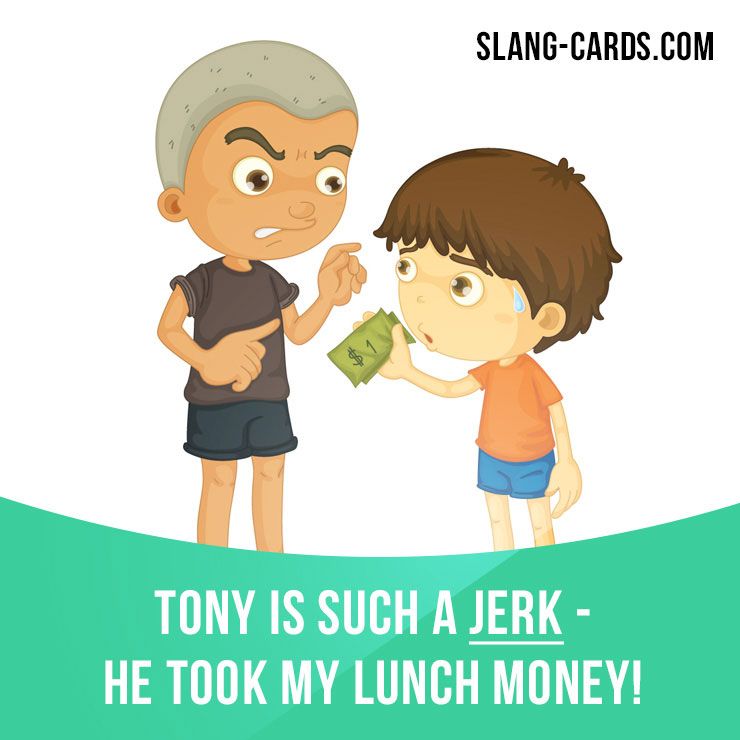
There might be some exceptions to the rule, but my bet is every standup comedian was a former class clown/bully. The essence of the craft is such that it attracts guys and girls that someone, somewhere once called a class A jerk. (A class A jerk is someone other than the class D jerk who pokes fun at others for sport and backs down if anyone informs them they’re offended in anyway.) 

When real life darkened their door, most standup comedians admitted they didn’t know what to do. They were as lost, or more, as the rest of us. “I don’t know what I would’ve done if my predecessors didn’t do what they did in this craft to make it what is it today. Not only am I not good at anything else, I didn’t particularly like doing anything else.” What is it they’re doing, on stage, every night? What is it they enjoy doing so much that it saved them from the depths of despair? If we dig through all the particulars of the craft, we find that making fun of other people is the core of standup comedy. Where do you think they discovered their talent, and how did they hone it? They did it on your back, and your delicious tears told them they might be onto something. It’s what they do. It’s who they are.

One other special ingredient that defines the difference between most great comedians and the ones who never made it to the main stage, pushing boundaries. What does that mean? We think pushing boundaries is about filmmakers teaching us what we don’t want to hear, and it is, but it’s also about standup comedians telling us what we don’t want to hear. They’re mutually exclusive, diametrically opposed, and the same. Tell a standup that they can do anything they want except this, and this will be the only thing they want to do. Tell them that they can make fun of everyone, except these people, and a joke about those people will probably make it into their intro. My problem is not with standup comedians. We all know who they are. They’re bullies. The problem is with the offended. If the standup comedian is wrong, tell them why, and do it from a position of power not weakness.

If we ever effectively find a way to diminish, deter, or defeat bullies as a whole, the one detriment might be our inability to deal with bullies. The only solution we’ve found at this point is to inform them that we’re offended by something they’ve said. Who cares if you’re offended? Some do, of course, and there are probably more now than ever before who aren’t afraid to say that they’re offended, but I can tell you one person who doesn’t care, the offender. I’ve been offended by something a comedian said, and I always think that’s just one man’s opinion, and it’s not an informed one. (I use the term offended, here, for the purpose of illustrating a point, because I can’t think of any comedian who has ever offended me.) You getting offended is exactly what the offender wants. It’s what their audience wants too. How many nice guys finish first in the world of standup? What is it .0001% The nature of the beast is such that if a comedian goes clean and tries to avoid offending anyone, the audience might chuckle politely, but the chuckle will be soft and almost internal, as they wait for that hurtful haymaker to punctuate the joke. Most good guy, clean comedians are widely regarded as too safe to be truly funny. We, as a whole, want our standup comedians risqué, we want them to push boundaries, and we want them to speak out against unsafe targets. Who are the unsafe targets though? That’s the question skippy, and that’s the point Howard. The unsafe targets have shifted from my guys to your guys, and from my issues to yours. We didn’t handle it well, claiming offense and outrage, and now you’re doing the same. 

If this is true, wow do we stop the mean-spirited comedian then? I don’t think you do. I think they love it so much there’s nothing we can do or say to stop them. You can see it on their face. They were born to do this, they love it, and they wouldn’t want it any other way. They define your offense as effective penetration. Their audience, comprised mostly of former bullies and class clowns, love it too. Do we get in their face and try to mow them down? Have you ever been bullied by a class A jerk? They’re unusually very good at what they do. They’re often unusually smart, and not only are they smart, they’re quick, and not only are they quick, they’re funny. It’s often that final nugget, funny, that just tears into our soul. They come up with material quick, and how do we defeat them? If it’s a class A jerk, we’re on their turf when we’re trying to outfunny them. The only way to defeat them is to switch the playing field to our internal home court and outdo them there. If we can convince them, there, that they’re not getting in, we’ll take all their fun out of it for them. That’s all I got, and I know it’s not great, but it’s obviously better than everything you’ve come up with thus far. You’re encouraging them and making them think they’re onto something when you declare that you’re offended. You’re making it worse.   

Crazy Joe Davola

Crazy Joe Davola (actor Peter Crombie) has died, and Fox News reports that his friends suggest that even though “he was cast as a bad guy on Seinfeld, and he played numerous interesting and complicated characters, including Bernard Goetz, he was very sweet in an old-school way. When not working as an actor on stage or in front of a camera, he was genuinely humble, preferring others to talk and take main stage.  He was always helpful, giving and funny. He was one [of] the kindest, soft-spoken, loving and caring people I have ever met. A gentle giant.” It’s a fitting tribute, but it’s not funny? We might not want funny to be on site forever more, but in private, on stage, I think Peter Crombie would’ve loved it if someone, someone like Lewis Black, offered Crombie a comedic sendoff. “It wasn’t much of a challenge for Peter Crombie to play the awful characters he did, because he was awful. He was an awful human being. I remember one day he saw a kid with ice cream, and he stole it. He didn’t want their ice cream. He didn’t even like ice cream. He would pitch it in the nearest receptacle. He did it just to do it. Just so he could say he did it. He said that he liked to hear kids cry. “The younger the better,” he said.”   

Review of Self-Reliance

If there’s one thing an aspiring writer can learn from the movie Self-Reliance, it’s that your audience doesn’t want anything bad to happen to the fictional characters of your stories, until they nothing does. Leaving out all of the other particulars of the plot, the primary plot of this movie is that a bored, lonely man is offered a proposition. If you can survive for thirty days, with murderers trying to murder you, we will give you $1 million dollars if they are unsuccessful. There is a catch for the murderers, however, they cannot kill him if he’s within three feet of another person. The need to have someone near him, leads the character to realize that in his life before the contest he forgot to make real, human connections throughout his life, and he forgot to live life to the fullest. That underlying theme would’ve been engaging if, IF, it was properly balanced with the character narrowly escaping harrowing threats. The problem with this movie is that this viewer (you might be different) never feels the threats are anything more than an excellent plot device to sell the movie. There are some threats made on the character’s life throughout the movie, but they are easily, too easily, vanquished. This reveals to us that the threats on the character’s life are basically ancillary to the underlying theme. It’s as if the writer said, I want to write a post-COVID script that reminds the audience of the need for human connection and companionship. The problem is how do we go about writing about that without getting too gushy? I got it. Let’s develop a contest for the character in which he needs to have people around him. All of that would be fine, except the writer/director forgot to concentrate enough on the threat therein. 

Anyone who watches this movie will realize as much as we don’t enjoy cringing, we enjoy cringing. We want to see scenes where the character stupidly gets into harrowing situations that he can’t possibly escape, until he does, and we’re awash with relief when he does. We want to experience the ups and downs of what it must feel like to have people trying to murder you. We want to scream, “Don’t go in there!” when he approaches the wrong door. We want to see pianos fall behind him while he’s talking on the phone, comically unaware of what just happened. We want to grip the arms on our chairs when a gigantic ball comes rolling after him, as he runs through a cavernous region in which there’s no lateral escape, and we want o see a poison-tipped arrow hit a guy standing somewhat near the main character after the main character bent down to pick up a piece of garbage that some rube just threw on the ground. “Hey, it’s called littering man!” The main character shouts at the litterer, as the man with the arrow in his neck, behind him, slowly falls gurgling to the ground. There can be humor intermingled in the tension, but we want/need the tension. What we get from Self-Reliance are all of the hypotheticals a man who must survive a scenario might have to go through to insure his survival. The movies is really about the social interactions a person might not go through if there wasn’t an ever-present, or in this case never-present, threat of death. My takeaways are that the movie accomplishes two things: It teaches writers what not to do with a thriller, and it leaves you with the weird, uncomfortable feeling that you actually want bad things to happen to fictional characters. Those of us who know and enjoy so many of Jake Johnson’s projects, enjoyed this one too. He’s a funny, interesting actor, and Self-Reliance is not a bad movie in anyway, except for that lack of threat, and the ending is more of a wrap-up than an exciting conclusion. The character basically tells us what happened at the end, and he shows us some shots that visualize what he’s saying. 

The Origins of the Pejoratives


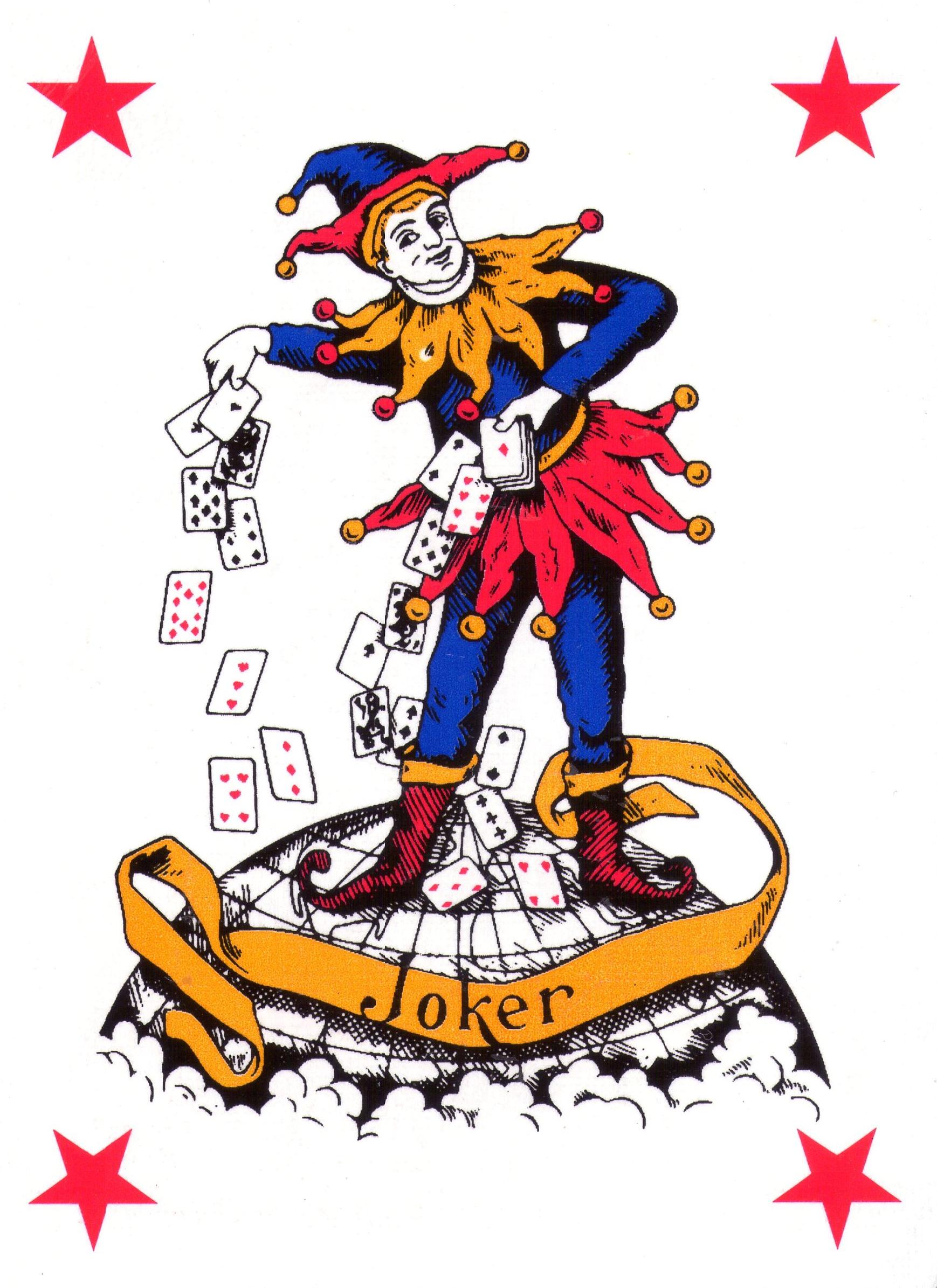
“You, my friend, are what they call a joker,” I told Shelley Macintosh. “A real joker.”

“A joker?” Shelley asked. “What’s a joker? Did you mean a jokester? Do you mean joker, as in the playing card, or the bad guy from Batman?”

“A joker,” I said, measuring her reaction to see if she was playing with me. “A joker. A person who jokes around a lot. I don’t know. Everyone says it. It’s a common phrase everyone uses it to describe a person who jokes around a lot. Are you messing with me? You’ve never heard of the term joker before?”

After some back and forth, we established the fact that Shelley never heard the word used in that context before. As incomprehensible as I considered it that a woman who was roughly my age, who grew up in the area I did with all the same colloquialisms, and watched the same shows growing up, never heard the word, I then wondered where I did. 

Etymologists trace the historical origins of words, but their professional focus remains on more formal and serious words. There is some less serious research into the history of vulgar vocabulary, but a term that is nestled somewhere in  between, like joker, doesn’t receive much focus from either party. Joker might not be a great example of a pejorative, as it doesn’t really belittle anyone, put anyone in their place, offend anyone, or hurt their feelings, but put in a certain context, “You’re a real joker, aren’t you?” it could be confrontational. Those words could be fighting words, but we’d have to frame them up with the right face to get that done. 

We know that the Ancient Egyptians had court jesters, that could be called jokers, to entertain their pharaohs dating back to the Fifth Dynasty, and the Romans employed them to provide comic relief for their leaders, but how did the term joker weave its way through the timeline to my mouth in the 20th Century?  

How does a word, any word, travel through time? Some are fascinated by this, as evidenced by those who choose professions in various professional language specialist arenas, but to those of us who choose more common professions it’s so boring we don’t want to devote any of the precious time we have left on Earth to it. In principle, it’s interesting to wonder how a word might travel from Ancient Greece to modern English, but the research is not as fascinating as readers might think. I’ve had friends drop words and phrases I found fascinating. “Where did you hear that word?” I wondered aloud thinking that that word was exclusive to the first person I heard use it. I did my research, and I found it personally fascinating to learn that some of these words and phrases predate me by hundreds to thousands of years. Fascinating, right? Wrong, people don’t go so far as to yawn in my face, say “who cares?” or drop a playful characterization of my bookishness on me, but they don’t find the history of words nearly as fascinating as I do. 

In my research, I found that a large number of the words and phrases we use every day derive most often from various stages of Latin, English, Ancient Greece, The Bible, and Shakespeare. Look up your favorite word, and you’ll find that most of the words and phrases you use every day are derived from one of those sources, and the reason we stress derived is that as these words travel through time they modify slightly in meaning, totally transform, and on some very rare occasions remain somewhat in tact, in spelling and meaning, for thousands of years.  

Most don’t call their peers out on their word choices in the manner Shelley did, because why would we? Unless it involves a swear word, or some unique way of expressing emotions, it’s just not that interesting to us. We also don’t call each other out on the origin of the more common words and phrases we use, because we operate on a certain, unspoken and conditional quid pro quo. “I’ll tell you what, I won’t call you out on these words and phrases you use,” we say without saying, “if you don’t call me out, because I don’t know anything about their origin either.” 

One important note, before we continue, is as Etymology.com points out, “etymologies are not definitions; they’re explanations of what words mean, what they they sounded 600 or 2,000 years ago, and how they’ve traveled through time. Etymology is a science that studies the history of a word. It is a subfield of linguistics, philology, and semiotics. Etymology also studies the word’s progressions from one language to another, how it changes from one language to another, its changes in form and meaning, and some semblance of its origins.” The best and most succinct definition of etymology is that it’s the history of a word. 

If this entire article is nothing more than retread for you, and you’re not only familiar but intimately knowledgeable about the general idea of etymologies, and if you have an unusual love of language and all of the manipulative power of a clever lexicon, my bet is someone, somewhere has already called you a nerd, a nincompoop, or a total nimrod.  

Nimrod: A slightly dim-witted individual, a dolt.

Etymology: There are more professional, professorial, and well-researched theories on the etymological origin of nimrod out there, and their tracings are all over the place, but we prefer the more childish, amateurish word-of-mouth theories that appeal to those who prefer Buggs Bunny to long-since deceased authors monkeying around with a term. The idea that one of our favorite Saturday morning cartoons had some influence on the language we share is just far more entertaining. 

The etymology of nimrod begins with The Great Nimrod (a name that can, apparently, only be mentioned with computer-enhanced reverb and some form of trumpet accompaniment). The Nimrod of Biblical lore was either the great-grandson of Noah (a man who built an ark), son of Cush, or Ham (depending on the source?), and the King of Shinar. Nimrod is also reputed to be the leader of the people who built the Tower of Babel in Shinar.  

Nimrod was considered “the first on earth to be a mighty man”. He was also considered one of the great hunters of his day and “a mighty hunter before the Lord”. Nimrod was such a mighty character in the book of Genesis 10:8–12 that there are some references that declare subjects of the kingdom of Assyria called it, “The Land of Nimrod” 1 Chronicles 1:10. 

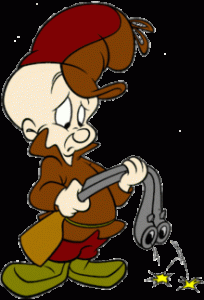
Having said all that, we could assume that most considered Nimrod, the man, the myth, the legend beyond reproach, but anyone who knows anything about Looney Tunes knows that only made him prime for a satirical representation. For them, the rich tradition and folklore surrounding Nimrod made him the perfect analogy for their fumbling, stumbling hunter, Elmer Fudd.

In a 1948 episode called What Makes Daffy Duck, the brilliant and underrated comedic actor Daffy Duck refers to Elmer Fudd as “my little Nimrod”. To show how much the writers loved the characterization, they did it again, in a 1951 episode entitled Rabbit Every Monday in which they had Buggs Bunny refer to Yosemite Sam as “The Little Nimrod”. 

A young child, who knows nothing of the King of Shinar, or the first mighty man of Earth, might hear this term and decide to use it against her brother, the next time he he does something foolish. Her erudite parents might overhear this and ask her if she realizes she’s calling her brother a mighty man. To clarify, they might tell the tale of the great Nimrod, and she might pause while soaking all this in. My guess is the next time her brother messes up, however, nimrod will be the first word out of her mouth, because there’s something uniquely satisfying about the sound of the word, and its unique power might derive from its uniqueness. Not many people place nimrod in their regular pejorative rotation, but when they do use it, it just feels deliciously degrading.

Chances are the daughter didn’t know where she heard the term nimrod, but everyone from my era knows that not only did we watch Looney Tunes a lot, but our local programmers ran the cartoon so often, showing so many reruns, that we could almost recite each short in real time, and we all know the conscious and subconscious power of repetition. 

The brilliance of these particular Looney Tunes’ shorts lies in the idea anytime a duck or a rabbit are confronted by a human, or a hunter, they should experience fear and intimidation. As animals at the the bottom of the food chain, they know that their lives are always on the line. The humor lies in their mockery of that principle, in general, and Elmer Fudd in particular, for his stature as a mighty hunter before the Lord. Thus, the writers of Looney Tunes almost single-handedly, redefined the term nimrod for an era and beyond as someone who has an unusual belief in oneself in principle, only to show he is actually so bad at it that we question his mental acuity. 

So, the next time someone attempts to belittle you with the pejorative nimrod, ask them if they’re referring to “The mighty hunter before the Lord,”, the King of Shinar, or Elmer Fudd. As much as we all loved Elmer Fudd growing up, regardless his foibles, we might not be insulted either way.

Dunce: A slow-witted or stupid person. A pejorative term that refers to one’s inability to learn. Generations ago, a student who failed to learn, or exhibited a lack of discipline was often forced to sit in a decidedly prominent corner of the room, wearing a dunce cap, or cone. Dunce was, at one time, one of the worst pejoratives one could call another.

Etymology: Once seen as one of the most brilliant philosophical theologians of his day, John Duns Scotus’ philosophies, and teachings, garnered such a substantial following that his followers called themselves Dunsmen, or Dunsers, after the theologian’s middle name. Unfortunate for the Subtle Doctor and his followers, the Renaissance happened. The Renaissance was a cultural movement that sought to render all of the ideas and achievements of classical antiquity obsolete. The Renaissance involved so many changes in so many fields that it evolved into a cultural movement that eventually rendered Scotus’ teachings obsolete by “modern” standards. Those who ascribed to the new theories of the Renaissance developed such loyalty to the “modern” ways of thinking that they derided anyone who refused to modernize. As one of the most prominent adherents to classical modes of thought, John Duns Scotus and his followers, were singled out for ridicule. As such, proponents of the Renaissance called anyone who refused to modernize to the cultural changes happening around them, Dunsers. As anyone who knows about the history of words and pejoratives knows, some words are either purposely or accidentally mispronounced or altered over time for a variety of reasons, and Dunsers became dunces.   

Nincompoop: A nincompoop is foolish, an idiot, a bonehead, or a dope. This word is decidedly out-dated, old-fashioned, and rarely used anymore. If you’ve ever had someone call you a nincompoop, chances are that person has been eligible for Social Security for at least ten years. It’s not a compliment, but in the pantheon of pejoratives, it is not a wounding insult either. If you ever decide to use the pejorative on someone, the backlash might prove greater than the intended insult. Some suggest that the more common pejorative ninny derived from nincompoop, because people felt weird saying the complete word nincompoop. Although ninny wields far more power than nincompoop, it should be used judiciously, as the backlash could be just as severe. Although most of us have never heard of these two pejoratives, and even fewer have experimented with them in a pejorative sense, we caution people who might use such terms in the hopes of achieving some sort of retro-feel, because neither of them sound right, and there’s just no way that nincompoop can achieve the desired effect.   

Etymology: Some suggest this word is derived from the Latin legal phrase non compos mentis “insane, mentally incompetent” (circa 1600). Others deny this, because the Latin phrase lacks the second “N”. They say that nincompoop was probably derived from Nicodemus, which was used in French for “a fool”. Still others, suggest that it was probably just an invented word at some point.

That’s it, the latter. There’s no solid evidence on the etymology of this one, and the only time I remember hearing nincompoop delivered as an insult is when my great-aunt dropped it on me after I did something stupid. She said it with obvious exclamation points all over her voice, and she made the meanest face she could think of, but all she got out of me was laughter. I don’t know if hearing the last syllable coupled with the mean face drained it of all effectiveness, but it obviously achieved the opposite affect.  

Dolt: 16th century, Old English. Derived from dull, or dol. Middle English word dullen, meaning “to dull, make or become dazed or stupid.”

The progression to modernity has led dolt to mean a person who lacks common sense or the intelligence necessary to make good decisions in life. A dolt is different than a fool, however, as The Content Authority points out, as a fool is often educated and/or wise enough to make quality decisions but continues to do otherwise.

Bedlam: A scene or state of wild uproar and confusion. An outbreak of crazed insanity, that is not a riot. “We went to the concert the other night. A couple fights broke out on the floor, and it evolved into absolute bedlam before the authorities to regain control.” The housing unit of the pejoratives of yesteryear.

Etymology: Bedlam is a colloquial pronunciation of Bethlehem. Bethlehem, as in the name of the Hospital of Saint Mary of Bethlehem. The hospital began as a priory, in 1247, changed to a hospital by 1402, and ultimately became a civic lunatic asylum by 1547, where it housed the insane. Most of the inmates, as they were called, were starved, shackled, and exhibited to the public in wild and frenzied states. Thus, bedlam became synonymous with frenzied, psychotic behavior. 

The proper name might be caught in transition in the title of John Davies’ 1617 publication of humorous poetry, “Wits bedlam —where is had, whipping-cheer, to cure the mad.”

The pejoratives on this list all have interesting, unusual, and noteworthy twists and turns throughout their history. Other pejoratives such as idiot, moron, imbecile and others are noteworthy not for their changes or meaning, but for their consistency through time. Some of these pejoratives existed in the B.C. (Before Christ) era. Think about that for just a second, before you yawn with fatigue, that pejorative you just called your sister was similar, if not the exact same word, a boy called his sister thousands of years ago in Ancient Greece. To my mind, the twists and turns and evolutions of words, through time, are just as interesting as the consistency of the pejoratives through thousands of years.