Some Rules of the Modern Workplace: Elon Musk


1) It’s very important to like the people you work with, otherwise life and your job is gonna be quite miserable. – Elon Musk

I learned the hard way that when we get into an argument with a co-worker, it can make the work life miserable for as long as that argument lasts. Depending on the work we do, and how often we do it, employment situations can trap us into spending more time with people we can’t stand than those we love. With that in mind, if we get into an argument, we need to forgive and forget with strength.

“I won’t back down,” we say, “and I have a very difficult time admitting I’m wrong, especially when I’m not!” In interoffice squabbles, it really doesn’t matter who’s at fault. No matter how great people are, they will make mistakes, and if we want to be happy in the office, it’s important that we recognize that, especially when we enjoy the work we do.

It can make matters even more difficult when it’s the other party’s fault. If it’s our fault, and we’re living in absolute misery, all we have to do is apologize to end the stupid, irrelevant argument. When the other party refuses to apologize, it lengthens and strengthens the tension. I’ve done the wrong thing so many times that I learned that the best way to end relatively benign interoffice squabbles is to apologize, forgive and forget, and do it with a noteworthy level of strength.

I got into an interoffice squabble with a co-worker, and in this instance, she was in the wrong. She immediately called me to apologize. “I’m going to forgive you and forget this ever happened.” I said that with an unusual (for me) level of anger and force, “and I don’t want to hear your excuses or explanations, so I’m now going to hang up on you now.” I heard her say, “Wait, I just want to say …” before I hung up.

Who says, “I’m going to forgive you” with strength? The source of true power, we all believe, lies in refusing to forgive. We can lord their slip-up over them for weeks, months, and even years, if we do it right. Anyone who has tried to maintain an angry facade knows it can be foolish and a little exhausting. I’m not going to talk to this person at this time when I always do, we think, and when it comes to that party, I’m going to purposely walk by them without saying a word. That will get her. We have to teach people how to treat us, and this is going to extremely effective. There are only so many punctuation marks we can put at the end of a sentence. Do we pound the point home with three proverbial exclamation points, and how often do we do it before they truly understand that we’re mad!!! We’ve all been through these mistakes, and we’ve all missed out on the good times we witness across the party room floor when we see her laughing with the group we’re normally in, but we won’t step foot in because she’s there, and we’re mad at her. A simple, powerful acceptance of an apology can be so shocking that the recipient might repeat what you said in their head a number of times.

This co-worker was a very sweet, young woman who messed up big time. We both knew it, and we both moved on to have a very good relationship in the aftermath.

In another situation, I messed up bad. I was 100% to blame for committing an almost unforgivable transgression against a very sweet co-worker. I called her up the next day and apologized. She, being a very sweet person, offered me all sorts of outs and excuses. “I appreciate what you’re doing here,” I said, “but I’m not going to accept that. I want you to know that what I did was wrong, and I apologize. Full stop.” I allowed a few seconds to tick by, “Now that I’ve apologized in an unequivocable way, let me tell you what I intended to say.” I then told her that, and how it was intended to mimic what she said about herself previously, and how I mangled it up so badly. I told her how I would’ve interpreted what I said, if someone said the same thing about me and how horrible I would’ve felt. She agreed with my summation, and she offered me total and unequivocable forgiveness, and we are good friends to this day.

One of the biggest mistakes I’ve made, in such situations, is to enter into it from a position of weakness. Strength in the face of what should be a weak moment can be surprising, but if we remain strong throughout, we’ll experience long-term dividends for our actions.

Our relationships with our co-workers are just as important as our other relationships. If we want to have a happy work life, we need to work as hard at them as we do all of our other relationships in life, and accepting an apology with force and strength can be as effective as offering a strong, unequivocable apology.

Having said all that, there is a small percentage of horrible people in every walk of life, and some of them seem to enjoy making our lives a living hell. There are some people, as the quote from Cool Hand Luke says, “You just can’t reach. So, you get what we had here last week, which is the way he wants it; well, he gets it.”

2) Failure is an option here. If things are not failing, you are not innovating enough. – Elon Musk

What a great antonym to “failure is not an option.” That famous quote, I think, refers to ultimate or final failure, and I think it fails to leave room for small failings that teach us as we go. Musk’s “Failure is an option” almost liberates those who fail. As with the famous quote, it gives room for some failure, as long as we learn, but some of the times we read “failure it not as option” as a threat to avoid trying new things. Imagine being an employee in an innovative tech company, and your boss has a “failure is not an option” plaque on his desk. We might not try that adventurous idea, because we know it’s fraught with failure, so if failure is not an option, we might not explore the possibilities of our idea. It’s a subtle difference that might not deter a strong mind, but we’re all subjected to the opinions of authority, and we all try to please them in a way that creates vulnerabilities. Am I the right man for such a bold, adventurous idea? What if I fail? Try, fail, learn. How will we ever learn, if we don’t try. How will we ever learn if we don’t fail in the beginning and on the trail every once in a while?

The bassist from The Who, John Entwistle, once said of Jimmy Page’s idea of a New Yardbirds group, “That’s going to go over like a lead balloon.” Jimmy Page loved that condemnation so much he changed the name of his new project to match it. Instead of calling his new project the New Yardbirds. He called it Led Zeppelin.

3) Pay attention to negative feedback and solicit it, particularly from friends. Hardly anyone does that, and it’s incredibly helpful. – Elon Musk

How many of our friends and family tell us that our ideas are destined to fail. Some of them don’t know why we’re destined to fail, they just know a screwy idea when they hear it. Some of them know don’t know what we did wrong, but they know how to fix it. Rather than dismiss them entirely, because they’ve never tried anything so unique, weird, and adventurous, listen to them. In my experience, there’s usually a nugget, a 10% of the 10% advice they give that actually could, slip into your round hole and come out the other side looking quite different and more beautiful.

There is a certain percentage of people who are cheering you on in life. There’s a percentage who envy us, dislike us, and think we’re fools and morons for believing in ourselves in a way they can’t. Our job in life is to find that percentage who believe in us so much that they offer us the type of constructive criticism they think we need. They’re not always right, but their head and heart is in the right place, and if we listen to them often enough, we might find something we can use. It rarely happens in the moment, and some of the times it takes so long to see the merit of what they’re saying we can’t remember who said it, but every once in a while we can find a nugget to chew on.

4) Any product that needs a manual to work is broken. – Elon Musk

As with a joke, if a story requires too much explanation, then it probably wasn’t the Great American Classic we thought it was while writing it.

As someone once said of the great Russian authors. “Yeah, they’re great and all that, but some of the times I read them and think, ‘Just get to the point already.’”

I appreciate the need for character development and setting. Writers need to help us empathize with their character, and we have to be there, but as with everything else there is a tipping point. I’ve read 1,000+ page books, but I’ve rarely read one that couldn’t use at least a little trimming.

5) You shouldn’t do things differently just because they’re different. They need to be… better. – Elon Musk

I began my writing career, trying to be weird for the sole purpose of being weird. My favorite books, music, and movies were weird, and I wanted to explore the deep dark caverns of my mind for the weirdest possible plot lines I could think up.

The problem was no one understood it, and I enjoyed that. It felt great to say, “You just don’t get it,” because that made me feel like a complicated, misunderstood artiste. Yet, I’ve found that if no one understands it, then no one is going to understand it. If this is you, then you’re just writing for yourself. “Right, that’s what I’m going for.” The authors I love all said that, so I said it. Unfortunately, I neglected to learn how to intertwine writing for myself and writing for others. The authors I loved already conquered the latter, so they could go forward writing for themselves.

My advice, don’t forget the context. Context makes your writing so much more entertaining for the reader.

As John Hughes wrote for Steve Martin in Planes, Trains, and Automobiles:

“[In me you’ve] got someone who will listen to your boring stories. I mean, didn’t you notice on the plane when you started talking, eventually I started reading the vomit bag? Didn’t that give you some sort of clue, like hey, maybe this guy is not enjoying it? You know, everything is not an anecdote. You have to discriminate. You choose things that, that are funny or mildly amusing or interesting. You’re a miracle. Your stories have none of that! They’re not even amusing accidentally! “Honey, I’d like you to meet Del Griffith. He’s got some amusing anecdotes for ya. Oh, and here’s a gun so you can blow your brains out. You’ll thank me for it.” I-I could tolerate any, any insurance seminar, for days. I could sit there and listen to them go on and on with a big smile on my face. They’d say, “How can ya stand it?” And I’d say, “‘Cause I’ve been with Del Griffith. I can take anything.” You know what they’d say? They’d say, “I know what you mean. The shower curtain ring guy.” It’s like going on a date with a Chatty Cathy doll. I expect you have a little string on your chest. You know, that I pull out and have to snap back. Except that I wouldn’t pull it out and snap it back, you would. And by the way, you know, when, when you’re telling these little stories, here’s a good idea. Have a point. It makes it so much more interesting for the listener!”

6) I think that’s the single best piece of advice: constantly think about how you could be doing things better and questioning yourself. – Elon Musk

I see articles that provide updates: “Edited on May, 6.” Are we supposed to do that? If I did that, my articles would all be 10,000 words, and most of those 10,000 words would be the notations on all the updates, edits, and revisions. I change everything from the big to the small. I rarely read one of my articles and think that’s just complete. There’s always something to delete or add. I take time away and re-enter with a fresh perspective.

I went to another blog on the subject of errors, rewrites, and editing. Most of the writers wrote that their readers will accept a certain error rate, so they don’t go back to fix their article and correct every stupid, little thing. “Every passionate writer is going to commit some errors, so I don’t go back and edit,” they write. “I leave it raw, as is, and I think my readers understand.”

My first thought was that these people must be way smarter than I am to survive the fear of everyone seeing our there, their and they’re type errors. I see errors in big time writers’ articles every time, and I’m mortified for them. I see errors in my own work, the ones I catch anyway, and I shudder. How many readers saw this, I think. They’ll probably never be back. Every time I write an article, it’s edited at least ten times before I hit publish, then I go back and try to catch whatever errors I missed the first 309,000 times through, and I always find something. I don’t know how these writers, who presumably write something once and never go back, live with that fear that someone out there knows that they’re less than intelligent. All the power to them for being so strong, but I could never do it.  

7) People work better when they know what the goal is and why. It is important that people look forward to coming to work in the morning and enjoy working. – Elon Musk

I went to work for two promising, young companies at different points in my life. The only thing these companies had in common was they didn’t know what they were doing. I found this confusing and exciting when I was younger. I was on the ground floor of a ground-breaking company that would eventually become a Fortune 500 company. The rules would change on almost a weekly basis, and our method of operation, as employees, would have to adjust accordingly.

“This customer is telling me I’m doing it wrong,” I would tell the help desk operator. I called them for nothing more than confirmation of my knowledge.

“You are doing it wrong,” the operator would say. “Check your email from May 23.” The changes were so drastic, so often, that an employee could get dizzy simply sitting in their cubicle desk. Every supervisor and manager said, “The minute you get comfortable with a standard method of operation, it will change.” Working in various cubicles for as many years as I did, I got used to that overused line, but I never worked for a company where that was actually true. It was, as I said, confusing, dizzying, and a little exciting.

I went to work for another promising, young company again, later in life, and I quit quite early on. The sentiment in Musk’s quote was a primary reason why. I didn’t want to go through all that humbling humiliation all over again.

Talk to Food, Like Lovers Do


“He thinks we should talk to our food, to develop a relationship with it that he thinks will ease and aide digestion,” we say. “On the face of it, that seems crazy, but let’s break it down.”

“Who sits there and thinks about how they feel about their food that much?” she says. “I mean, you either eat it or you don’t.”

“You might know how you feel about your food,” we say, “but how does your food feel about you?”

As ridiculous as that joke sounds, neuro-gastroenterologists are now suggesting that our relationship with food is in dire need of an upgrade. How do we enhance our relationship with food? It could be said that we’ve been eating for so long that we forget to appreciate it for what it is. We eat most of the food on auto-pilot. We might appreciate eating a hot, juicy ribeye, our reward for eating fairly well for weeks, but do we appreciate the ham in a ham sandwich? Generally, no, because the only reason we eat a ham sandwich is to quell hunger. Anti-meat eaters have a point, in this sense, when they suggest that we don’t appreciate that an animal had to die for our self-serving desire to nourish ourselves. Some anti-meat eaters say not only do we fail to appreciate the fact that an animal died, we choose to disassociate the slab of meat we eat from the animal. We call a piece of cow beef, a piece of pig is pork, and a domestic bird is poultry. Poultry might be the exception in common parlance, for we rarely ask for poultry from a butcher or a restaurant. We usually say chicken, duck, etc. The point of this disassociation, say anti-meat eaters, is to relieve ourselves of the guilt of eating animals. It might sound foolish since most people over six-years-old know what they’re eating, and we here at Rilaly.com are not suggesting that anyone end or cut back eating meat, but more knowledge about the food we’re eating might serve to aid in digestion.

One of the biggest problems for those who develop such an unhealthy relationship with food to the point that it can lead to an addiction is we need food. We need food to sustain life, we enjoy it so much that we look forward to it, and it’s part of our routines and patterns in life. As such, food provides comfort, and it can ease suffering, but food can also cause suffering. If we eat the wrong things too often, or we eat too much of a good thing, we can experience everything from IBS to constipation, diarrhea, bloating, pain and upset stomach after a night out at the Greazy Dog.

We also link food to relationships in subconscious ways. What did we eat growing up? Did our parents provide us a wide variety of meals on a regular basis, or were they primarily meat and potatoes people? How much do you love that first bite of a quality burger? Is it all about the immediate satisfaction of taste, or are there a big mess of associations going on inside your head? I always wondered why I had an almost romantic relationship with Kentucky Fried Chicken. I’m not going to join the throng who trash on fast food, now that they’ve aged out of it. KFC is not horrible chicken, but I’ve had better. I can’t eat it now without paying dearly for it later, but when I see those iconic red stripes on a bucket, they lead me to feelings of nostalgia. I couldn’t pinpoint it for decades, until one of my relatives informed me that my step-dad used to purchase a big bucket of chicken for my mom and I to woo us. We would go to the park, and I would play after those picnics. I was so young that I don’t remember it, but it was obviously the source of my romantic association with chicken from KFC. I obviously associated that food with a great moment in my life where a man came along to assure us that everything would be ok after my father passed.

***

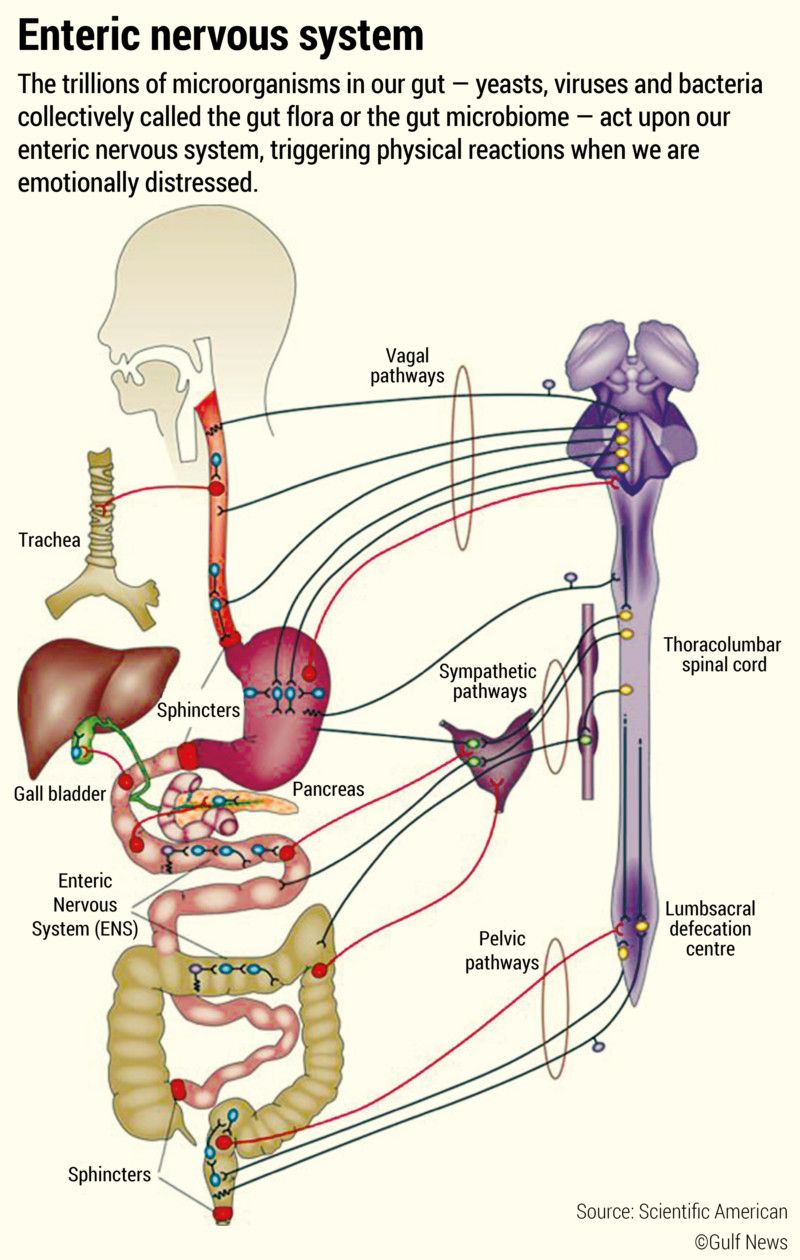
Researchers at John Hopkins suggest that we have a more conscious relationship with food dictated by our two brains communicating in a biological language on the best ways to use or discard the food.

Our second brain, their research suggests, controls our digestive system. “[It] involves two layers of more than 100 million nerve cells that line our gastrointestinal tract, from our esophagus to our rectum.” They label this second brain the enteric nervous system (ENS).

“The enteric nervous system doesn’t seem capable of thought as we know it, but it communicates back and forth with our big brain—with profound results.”

“[Our two brains form two separate] paths to govern two separate areas of the body. This is where the material changes to form our brain, the central nervous system, and the stomach, the enteric nervous system.

“The interesting aspect of this split revolves around the Vagus Nerve. The Vagus nerve connects the two nervous systems for life. Because of this connection, both the brain and the gut share neurotransmitters and hormones.”

The profound results, they suggest, could lead to anxiety or depression.

“For decades, researchers and doctors thought anxiety and depression contributed to [gastrointestinal] problems. But our studies and others show that it may also be the other way around,” director of the Johns Hopkins Center for Neurogastroenterology Jay Pasricha says. “Researchers are finding evidence that irritation in the gastrointestinal system may send signals to the central nervous system (CNS) that trigger mood changes.

“These new findings may explain why a higher-than-normal percentage of people with IBS and functional bowel problems develop depression and anxiety,” Pasricha adds. “That’s important, because up to 30 to 40 percent of the population has functional bowel problems at some point.”

Some suggest we have a heart brain too, and other specialists suggest the complexities in the system they specialize in might have another brain. Regardless, some scientific research suggests the terms “go with your gut on this one,” “gut-instinct”, and the ever popular “Spidey sense” might have real biological origins.

The ENS (Enteric nervous system) is [also] the reason why you can sense danger. The stomach naturally sends these signals to the brain.”

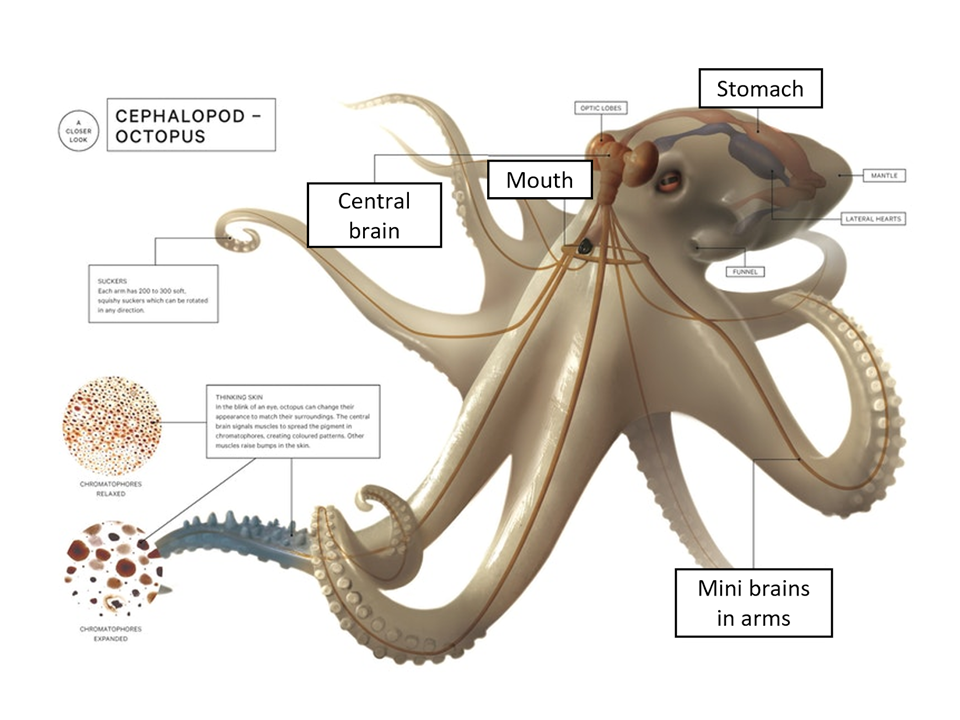
The first association we made, when learning about our second brain, a third, or numerous brains working in complex orchestral harmony to control and regular basic functions was the octopus. The octopus has a central brain, and each arm is loaded with nerve cells that form a brain of their own, so the octopus technically has nine brains. The latest research suggests that these nine brains have no autonomy. They act in conjunction with the Central Nervous System (CNS) brain, and they are subservient to its cause, but research scientists leave the door open to possible future research findings dictating otherwise. If future findings dictate otherwise, will we find that it’s possible for an octopuses’ seventh arm to refuse the CNS brain’s prime directive in the course of a hunt? “I’m not going into that hole after that crab. Six did that, last Thursday, and he’s experiencing the complex functions in the eel digestive system now. Find another arm to do it.” The nerve cells in our ENS appear subjected to CNS authority in our system, but how would our relationship to food change if we found out that everything from IBS to constipation, diarrhea, bloating, pain and an upset stomach are the ENS brain’s autonomous attempts to rebel against the CNS brain? “We know you love the taste of Indian food, but we’re going to make you pay long-term for your short-term thinking.”

Current research suggests that that does not happen, but disruptions in the gastrointestinal system can affect mood in many ways and vice versa. One such disruption can be caused by the ribeye steak. The instantaneous rewards of taste from the glorious hot and juicy cut of cow are one of the primary reasons some of us enjoy life so much, but it is also a luxury we dare not indulge too often. Why do we limit our ribeye intake? The digestion process can make us miserable.

After we eat a big, huge ribeye, we don’t want to do anything but sit on our coach and watch TV, and we don’t know why. Dieticians suggest that our two brains might not know what to do with it, immediately. “I can feel it,” we say, in the midst of our gastrointestinal misery, “sitting like a rock in my gut.” Gastroenterologists and neuro-gastroenterologists suggest this might not be a bad description for what’s happening, and its connection to our overall misery might be more direct than we ever considered before.

With all these relationships between us and food, and between our two brains trying to complete complex functions, how do we upgrade our relationships? The first thing they suggest we try is slowing down. No matter how beautiful that sizzling slab of meat on our plate appears, we need to slow down when we eat it. Cut off one small bite, and chew it thoroughly while doing something else. We might want to take one small bite and finish cutting the rest of the meat, or we might want to eat something else for a little bit, before indulging. Every suggestion we’ve found is that we don’t have to wait long. Our two brains know the sights, sounds, and the smell of the ribeye has us slobbering out the corners of our mouth, but they’re suggestion is that we slow down just a little. We need to give our brains enough time to develop an attack plan of easier digestion.

Do the brain(s?) need enough time identify the food, process the information, and develop a proper plan for digestion, or could this be an exaggerated, overly detailed description they use to try to convince us to slow down while eating.

The process, regardless how we choose to interpret it, falls under the intuitive eating umbrella. Everyone knows we need food to sustain life, and that certain foods can provide greater health than others. Those of us who have been eating for a while now have noticed that the better food tastes the worse it is for you and vice versa. There are no direct correlations that we can graph, of course, but it feels like a pretty substantial, and general, rule of thumb.

While the incredibly tasty ribeye steak has healthy benefits, including protein, fat, vitamins and minerals, it’s taxing effects on the digestive system can be extreme. Ask anyone who has accidentally eaten a hot, juicy ribeye too quick, because they were so excited, and they’ll tell you how miserable their next couple hours were. Ask anyone who attempted to play a sport after eating a ribeye, and they’ll tell us it’s almost impossible to achieve a peak performance.

That’s due in part to the digestive system having such a tough time digesting it. The process can prove so difficult, at times, it saps our energy, and it can even prove painful. Perhaps this is why Lions on the Serengeti sleep for about 12 hours after devouring a wildebeest.

A little bit of mindfulness can aid in the process of digestion. What are we eating, are we employing a disciplined measure of moderation, and how slow are we eating it? To this point, the information these sites provide is relatively rational and thought-provoking, but as with every discussion of this nature, some take it to extremes.

Talk to our food? The idea of talking to it for any reason, seems so silly that this has to be a comedy. Unless, the question they’re trying answer for us involves building a better relationship with what we put into our body?

“Who sits there and thinks about how they feel about their food that much?” my friend asked. “I mean, you either eat it or you don’t.” I might’ve said the same thing as a knee-jerk reaction to people speaking to food, learning more about it, and the various relationships we’re discussing here. Yet, our greatest attempt at nonpartisanship on this particular question asks if we can better inform our ENS and CNS brains on proper digestion. Do we say the same things to the muffin and the asparagus? We assume they speak English, but is that assumption akin to some form of jingoism?

There are probably people who actually speak to food, but what are they saying? Are they talking to the food to find out about it? Are they trying to make better food choices? Or, are they discussing the benefits of slowing down? Regardless, I do think there are benefits to learning more about food, slowing down, and thinking about the various relationships between the ENS and CNS brains, even if this involves, for most of us anyway, a one-way conversation.

Conquering Casual Conversation


“Talk,” is one of the many pieces of advice I would give my younger self if I could go back in time, “and not every conversation has to involve deep, impactful, and important subjects. Some of the times, you just talk for the pure enjoyment of talking to people. Listeners don’t have to be cool or beautiful either. They can be old, young, smart, dumb, boring and fascinating. Talk about matters consequential and inconsequential. If we talk long enough, we might find, we just might find, that the boring are far more interesting than the interesting.”

The musicians told me to avoid the “chitter-chatter, chitter,-chatter, chitter-chatter ‘bout schmatta, schmatta, schmatta”. The movies told me to be the quiet, mysterious type everyone looks to for reaction. They told me if I wanted elusive charisma, I should be silent.

“Don’t listen to them,” The Ghost of Present Rilaly would whisper into my ear. “Silence doesn’t make you look cool. Silence makes you look silent.” Silence lands you in the corner of the room not knowing what to do with your hands. No one remembers you when you are silent.

There’s a reason former athletes and the beautiful are silent. They don’t have a lot to offer.

“How do you know so much about such stupid stuff?” the beautiful might ask. If we’re bold enough to answer, they’ll say, “Huh, well I was much too busy getting busy in high school to learn about such nonsense.” If we’re then bold enough to remind them that high school was a long time ago, we’ll realize that that persona we tried so hard to attain didn’t accomplish half of what we thought it would. “You think everyone is looking at the guy shaking his head in the corner? Nobody remembers that. It might seem so pointless in the beginning, but developing the skills necessary to talk about absolute nonsense actually adds something to life.”

1) Learn how to be superficial. My best friend enjoyed talking to people. I found that so confusing that I was embarrassed to be around him at times. When he talked to a fella, I had no problem with it. When he started up a conversation with a young woman, I kind of envied it, but this guy would talk with old people about old people stuff. Their conversations were absolute nonsense. He didn’t care, and he was having one hell of a good time doing it. I thought he was a fraud, and when I called him out on it, do you want to know what he said? He had the audacity to say, “I was enjoying myself.”

“Where’s your integrity my man?” I asked him.

“I don’t know anything about that,” he said. “I just want to have a good time.”

“It goes against code,” I said, in whatever terminology I used at the time. He didn’t care. He didn’t tell me he didn’t care. He wanted to be cool, like Matt Dillon, and all that, but some part of him enjoyed the art of conversation so much that he couldn’t control himself. When some old man got angry about the cost of a Hershey’s chocolate bar, my friend turned to him and encouraged the rant. What? Why? When an old person starts in you’re supposed to walk away. When he first started doing it, I thought it was a bit. I thought he was trying to pull a thread on the old man to get him going. After numerous interactions of this sort, I realized my best friend was respectful and deferential. He just enjoyed talking to people of all stripes. He wasn’t smarter than me, and he wasn’t one of those types who knows a little bit of something about everything. He just knew how to talk to people. He learned how to put the important, artistic personae aside and tap into the superficial side to just talk to whomever happened to be near him in the moment.

It took me a long time to see that my friend might be onto something. It took a job where my employer forced me to engage with customers that I realized I could and should tap into my superficial side. I got all tied up in the shoe-gazing, grunge virtue that suggested you were all a bunch of fakes, and I was living real. As usual, when you accuse someone else of being fake too often, it’s usually because you are. I was a nice Midwestern kid trying to pretend like I was a Northwestern rock star. At that point in my life, I still believed that the artistic persona was an important one to maintain, but I learned to maintain that persona while tapping into a superficial side. I did that to remain an employee with high scores, but I learned to tap into that persona in my off work hours too, and I found that I had a lot more fun in life doing so.

2) Be confident. I know this is easier said than done. Most of us are insecure, and we all have moments when we’re not sure of ourselves. If most of us are unsure of ourselves, then most of us are unsure of ourselves. Unless our listener was an athlete or a beautiful woman in high school, chances are they’re as uncomfortable in their skin as we are. The trick is spotting it. I was on a date with an incredibly beautiful woman. I was as nervous and unsure of myself as ever. I pulled out of the parking lot and circled back. I wanted to back out. When I finally stood before her, she blushed. My confidence soared as I realized she was as nervous as I was. It taught me the simple and emboldening fact that most people are as nervous about meeting new people as we are. If we watch them long enough, we’ll spot it. It might be a blush, a stutter, or an uncomfortable look away, but everyone has a tic of some sort. If we’re observant, we’ll see something that informs us that most people are just as inferior as we are. They’re just normal people living normal lives, and they enjoy engaging in casual conversation.

3) Pretend to be interested in what they have to say. How often are we so interested in being interesting that we forget to be interested? Conversations are a two-way street, and if we’re able to convince them that we’re interested in what they have to say, we’ll receive a return on our investment. One of our favorite conversation topics is us, and when we show them we’re interested in them, they are going to be more interested in us. One of the keys to this is to avoid testing it out too early. If we begin speaking too early, their smile fades, they become distracted by anything and everything around them, and the minute we finish speaking, they start in again. Displaying an acute focus in what another person has to say is one key to making friends, but some might find our interest so intoxicating that they’ll want to compound it without a return on our investment. We can deal with that element later, if the two of us develop a sustained friendship, but if our goal is to make more friends, the key is to overwhelm them with interest.

One thing we covet more than being interesting is being funny. Some people aren’t funny, but if we want to be friends with them laughter is the best medicine. No matter how common or dumb their joke is, laugh. Laugh about how dumb their joke is if that’s what it takes. Laugh if they messed the joke up. They won’t know why we’re laughing if we do it right. If we do it right, we’ll find them coming up to us with their jokes over and over again. If we do it right often enough, we could become their go-to person with their jokes.

If you’re anything like me, when you meet someone new for the first time, you’re so insecure and nervous that the go-to is to try to be so over-the-top interesting and funny that you forget to be interested in what they have to say.  I write pretend we’re interested, because if we pretend well enough and long enough we might accidentally convince ourselves that we are interested.

4) Tell self-deprecating humor, but don’t overdo it. If something works, and self-deprecating humor almost always does, we have a tendency to do until it doesn’t. There is a tipping point, however, where we might accidentally affect their impression of us. Everyone loves the “But what do I know, I’m a dummy” conclusion to a provocative thought. If we do that too often, though, they might walk away thinking we’re dumb. Why wouldn’t they, it was the impression we gave them one too many times.

5) Find a Through Line. One of the many reasons the show Seinfeld was so popular is that nonsense is funny and fun. Some of the best friendships I have in life were based on nonsense. Example, Michael had a habit of making a drink face before he even reached for his can of soda. He reached out for the soda with an ‘O’ already on his face. He grabbed the bottle and inserted its contents into the ‘O’. I never knew we had a drink face, until I met Michael. I never thought about the proper timing of a drink face, until I met him.

“Michael, you need to wait until the drink is almost on your face before you make a drink ‘O’,” I said. “You make your drink faces way too early.”

“Women don’t like a man who makes a drink face too early,” Cole added. “It freaks them out.” A lifelong friendship between Cole and I was born that day.

Another friend and I loved the comedic stylings of Don Knotts, and we both hated caramel apples, because we hated the feeling of caramel on our nose. On that note, another bonding agent can be hating the same things. You both might hate beets, accidentally stepping in puddles, or people who make old man sounds when they sit. Whatever the case, there’s always some nonsense you can bond over. It’s your job to find it.

6a) Be a Great Listener. Some suggest that listening is a lost art. I’d argue that it never was. I’d argue that people in Aristotle’s era, Shakespeare’s, and every just about every dot in human history had the same complaint about human nature. “Nobody listens to anybody anymore.” Are you listening to people when you say that? I’ve been called a great listener in enough venues that I’m starting to think it’s true. I am fascinated by the people around me, and why they think what they do, and I have to tell you that it’s a great way to make friends. The one problem with being a great listener is when you’re known as a great listener, people don’t want you to talk. They much prefer that you listen to them, be fascinated with them, and find them funny. As I’ve written throughout this piece, those of us seeking to make friends will have to work through this in their own way, but if we lay the foundation of being a great listener people will be drawn to us.

6b) Ask Active Listening Questions. Asking active listening questions not only prompts the speaker to launch or continue, it makes them feel interesting. There are few things people enjoy more than an active listening question about the story they’re telling. The questions we ask are relative to their conversation, but some of the times, a simple “Why did you do that again?” can do wonders to show we’re not just following along and that we’re interested, but that we want to hear more. Some listening prompts might feel so obvious to be almost stupid, but soon after we drop them, the speaker picks the ball up and eagerly runs with it. As I wrote earlier, people love it when we make them feel interesting, and they might love being funny more, but the final leg of my version of making friends and influencing people might endear the speaker to you more than any other. If we phrase our question just so, it makes them feel like your resident expert on the subject in question. Active listening prompts not only shows that you’re listening it suggests that you trust that they know the truth of the matter.

These little tidbits seem so simple that they couldn’t possibly work, and they may not. As someone who has, at times, suffered from situational stage fright, because I wanted to be more entertaining, funnier than everyone else in the room, and so over-the-top everything else, I realized that I had a tendency to lock myself up by over-complicating the situation before me. Some of the times, these situations are complicated and tough to read, but some of the times they’re relatively simple. Getting a read on conversations can be similar to making reads in sports. Some of the times, depending on the level of competition, we can win a game all by ourselves, but most of the time, we damage our team’s chance of victory by trying to do too much. When we experience the latter, we learn to let the game come to us. It’s all confusing and situational, and the best advice, for anyone who asks the five questions regarding how to implement them, comes from the immortal lyrics from You’re the One that I Want by John Farrar, for the movie Grease: “Feel your way.”