“What is funny?” I asked the laughers at the tail end of our discussion. “Glenn just said he went to the post office, and the clerk didn’t give him enough stamps. Why is that funny?” If the laughers were honest, they would say, “I don’t know.” If they study the rhythms and beats of humor to the point that they drain all of the fun out of it, they know it’s all about the swear words. “If I told the exact same story without the swear words, do you think it would be just as funny?” Everyone knows the answer but no one wants to say.
Some will venture into the field with an, “Spare me your outrage.” When I clarified that I’m not interested in the moral quality of the joke, “I’m only interested in your definition of humor.” The guy knew me and my peculiar focus on tone, word choices, and emphasis, so he backed away from the charge. “I’m fascinated with how you think a story is funny when a Glenn drops swear words into it, and Mary doesn’t.”
“When Glenn complains, his complaints are the same as ours,” I added, “but we give more weight to Glenn’s complaints, because he swears.”
“He just tells it like it is,” someone said.
The obsessive language nerd, who studies the effects and affects of swear words, knows swear words are one of the best vehicles we’ve ever invented to properly convey exaggerated emotions, and hard-core truths. As George Carlin once said, “They offer excellent punctuation.”
 We don’t know much about linguistics, but we know our swears, naughty words, and vulgarity. We know them, we love them, and they are ours in a way that defines us, as much as we define them. We didn’t know a whole lot about them when we were younger, but we were eager to meet them. And when our rascally uncle Jim introduced us to them, we laughed harder than anyone in the room, because we wanted him to think we were all too familiar with them. We also thought our uncle Jim was the coolest person in the room, because he wasn’t afraid to swear in front of children. We thought that meant he was treating us like adults, and we loved him for it.
Repetition eventually breeds familiarity, yet we know nothing about their history. We don’t care where they came from or how old they are, and we still don’t. We might grow to know a lot about how to use them now, how they permeate and penetrate, but most of us have no idea that our favorite swears are probably the same ones our authority figures used to tell their authority figures off. Depending on our age, they might be the same words that our great-grandfather used to tell his authority figures off. Does that matter? It doesn’t. They may have been theirs then, but they’re ours now.
We don’t rent them, or lease them with a plan to buy. We own them. Yet, when we assumed ownership, we didn’t look under the hood, examine the tires for wear, or notice the ‘as is’ sticker. They felt new to us, or new enough. The idea that they were used didn’t matter to us then, and it doesn’t matter to us now, because they’re ours now, and putting our own miles on them provides intrinsic ownership qualities.
We use these words to shock and offend our authority figures into recognizing that we’ve arrived, and we have some power now. We want them to know that we know these words now, and we’re not afraid to use them anymore. We find these words rebellious and liberating, and we plan to use them in a manner our parents have never heard before. Check that, we know they’ve probably heard them before, but they’ve never heard us say them, not like this … (kapow!) We’re not afraid to use these words to inform them that we now reject everything they hold dear, and we’re no longer afraid to violate how they once viewed us. We might understand, on some level, that their provocative nature contains evergreen qualities, but does the idea that our grandparents knew them, and probably used them in the same shocking, offensive manner give the words more power or less? Is it all about their provocative, shocking qualities, or does it have something to do with the foundational familiarities that we all have with them?
That bomb you just dropped on your mom to express your intense rebellion to her matriarchal constructs was probably the same word she used on her mother to try to accomplish the same thing. When we attempt to shock her with our provocative use of offensive words, are we smashing the matriarchy, or are we carrying on a family tradition?
We have a relationship with these words, and we know our relationship isn’t monogamous. We’ll use whatever word comes to mind to suit our needs, and we don’t mind it when someone else uses and abuses them in the same manner. We might even bond with that straight-laced, church-girl, from a neighboring cubicle, who just causally dropped a big bombastic word on her co-worker. “I didn’t know you cussed,” we say, leaning over the cubicle wall with a gleam in our eye. Now, we may not become besties over one swear word, but it could open the door to respect that could lead to a level of bonding that probably wouldn’t have happened without that swear word.
Dropping the perfect swear word in the perfect place, with learned intonation, can also provide excellent punctuation. Proper usage can garner the attention and adulation from those listening to an otherwise boring story about our trip to the post office. They can provide an interesting or funny comma, if we know how to pound our point home with a more offensive and exciting exclamation point. The proper technique involves a one-step, two-step, shock, shock, shock! series of steps that we should follow with a casual, blasé open turn that suggests this isn’t half as meaningful to us as it is to you.
I have an almost inbred need to seek the countervailing winds, and when I saw everyone begin swearing as often as they could, I joined in. Hey, even a rebel needs to fit in when we’re all young and vulnerable, and we need them to pay attention to us, and we savor their laughter.
I learned the way of the words from a sweaty, greazy, and hairy Gary who worked the line at a restaurant where we worked. Gary was twenty-five, I was fifteen, and in our little world, he was the master chef of comedy. Yet, Gary’s recipe of comedy was so effortless that it appeared almost unintentional. He had some unique internal wiring I’ve only met a few times since that could make a trip to the post office to buy stamps not just funny, but knee-slapping hilarious, and he, and his stories were not vulgar-reliant.
Gary swore, but he used them as a master chef might use paprika or oregano, knowing how powerful a subtle burst of flavor can be when using them as a topical ingredient, or garnish. The problem for the rest of us is that once we develop a taste for spice, we can’t help but add so much that we all but kill the meal. When it became obvious to me that few of my peers followed Gary’s recipe of subtle, judicious use of spicing, I noticed that swearing in a joke or story was not just expected but required for laughter, and I began to reevaluate.
The Reevaluations
Having a child led to another level of reevaluation. If we don’t want to hear swear words coming out of their mouth, we have to be more careful about what words we use around them. Some don’t agree.
“It’s a word,” parents, say. “I can think of a thousand other things, right here and now, that I don’t want to hear coming out of their mouth. That was just a word. Quit being so stuffy.”
In this second reevaluation, I became more aware of the situation specific nature of my lewd lexicon. If we’re building something with our kid, and we hammer our index finger, what do we say to effectively express our temporary but excruciating pain? If we experience situations that call for exaggerated emotions of urgency, anger, disappointment and frustration, how do we express these exaggerated emotions if we’re not going to swear? How do we move our audience in an offensive way to properly convey disdain, and inform the world that we have a painful bobo, if we’re not going to swear? If we’ve ever had such discussions with ourselves, we’ll realize that we’ve been cursing and swearing so often and for so long that somewhere along the line we became vulgar reliant. When this need to express ourselves meets our desire to influence others through language, we realize that we need to fill our situation-specific gaps with something.
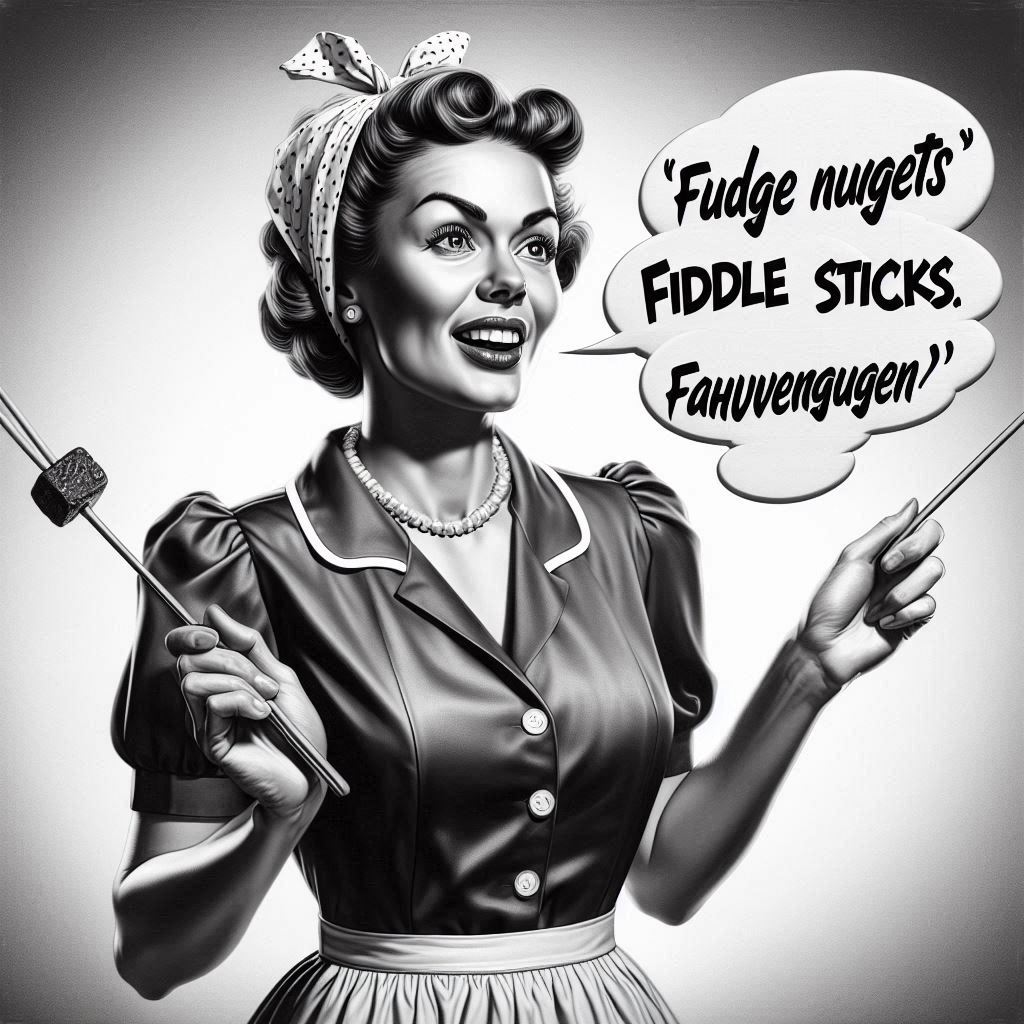
My solution was to sarcastically invent my own swear words to convey these emotions. Some, like fooey monsters and fudge nuggets, worked, but most didn’t. In the midst of this pursuit (which increased tenfold when the offspring, my little demon, announced his entry into the world), it dawned on me that playful substitutes always hit roadblocks.
I never considered the value of swear words, until I tried to introduce playful substitutes, but I found that traditional swear words provide pitch-perfect stress that we need to provoke and offend. It’s the way of the words. In order to replace the traditionally shocking and offensive words, I realized we need replacements that can shock or offend slightly before the confusion sets in. Even as I was playing with this whole dynamic, I realized the the words I would use needed to be spat in anger, disgust, or whatever emotion I deemed specific to punctuate that situation to lead everyone within earshot to recognize my reaction. To arrive at a suitable replacement, I knew I needed to study the irreplaceable swear words our ancestors chose to convey emotions.
The study was brief and not very thorough, but I found that most of these words are so much older than we thought. The next thing we find, when we try to invent new, offensive words, is that our ancestors obviously knew what they were doing when they chose those offensive, therapeutic, and therapeutically offensive words. For some reason, using hard consonants, such as a hard (‘F’), an enunciated (‘T’), or the unpleasant (‘K’) sounds, work surprisingly well in certain situations. The (‘K’), in particular, can prove to be quite the crowd-pleaser, if we hit it hard and hold it for a second.
I don’t know if it’s all about the ingrained tradition of seeing and hearing older, cooler kids use them so often that we copied them, or if it has something to do with the machinations occurring in the back office of our brain, but it just feels a little better to yell a word that begins with a hard (‘F’) that is punctuated with a hard (‘K’) when we accidentally strike our index finger with a hammer.
We also discover some of their internal, medicinal benefits, when a lover dumps us. It feels so good to tell our friends what we called our ex- a name that they agree is excessive and deliciously harsh on his way out, so everyone will view it as retribution for everything he did to us. If we do it right, our friends might even give us a high-five.
“So, he dumped you on the curb, like a sack of rancid cranberries, and you called him a name?” I asked her, sitting between the two parties, “And you think you’re even now?”
The Indelicate Index
There are so many different, and somewhat boring, theories on the etymologies of these words. Some suggest the origins are very specific, and that the power and definitions simply snowballed over time. Others suggest that they started from vague and difficult to determine origins. No matter what I read in my research, I concluded each reading with a big, fat “Who cares?” Who cares what they meant in Ancient Rome, the Middle Ages, or whatever sources of antiquity the researchers discovered. If our ancestors didn’t really know what they were doing, and these words were, for whatever reason, chosen at random, it just doesn’t matter now. The only thing that matters now is what matters now, because we’ve built our own iconographic walls around these words.
 Most of us don’t remember the first time we heard our first swear word, but we remember hearing them at their best … at the movies. The scripts that called for the actors to say something awful to punctuate their acts of violence were so cool. We can try to diminish their effect, as we age, and we can say, “That seems so 6th grade now,” but we cannot deny how cool it was when we were in 6th grade. “That swear word punctuated that scene so well, and they were so pitch-perfect that I gotta get that in my next situation.”
Do you remember that first time you told that perfect joke that involved the perfect swear word? I tried it early on, and no one laughed. Why? I don’t know, but I think it had something to do with the idea that I sounded like a little kid trying to use swear words for the first time. I learned, through trial and error, how to perfect my tones and stresses, until I eventually learned how to upgrade a relatively adequate joke into the perfect joke. I did it in front of my uncle Jim and his friend, and their laughter made me feel like I finally arrived. I’ll never forget that feeling.
Some jokes and stories just don’t feel complete without quality swear words peppered throughout, particularly in the punch line. We develop a personal history with these words that feels so intimate they’re almost familial. If we feel a need to replace them how would we do it without relying too much on the tried and tested models?
We so remember the first time we dropped a big one on our primary authority figure, because we felt a peculiar sensation that is difficult to describe. We know that that sensation was all about power though. We gave them a small, knowing smile that would have made you proud, and with that, we made an announcement that “We don’t care anymore. We’re no longer children. We now have these words in our arsenal, and we’re not afraid to use them.” We learned that the strategic use of profanity can turn a period into an exclamation point. We also learned how to use tones, rhythms, and stresses to maximum effect. Then, we learned the proper facial expression to wear when delivering a haymaker to rattle our ancestors down to their foundation. We learned how to convey emotions early on when no one took us seriously, by learning how to articulate swears!
After we discovered how to use these words properly, we discovered that using profanity also requires a level of balance. When our goal is displaying a rebellious truth, too much energy and too much intent can shift the balance of power in such a way that dilutes our meaning. When we swear, we hope to vent, as opposed to internalizing our anger, but doing so too often can lead to laughter, as it shows the profane character might not have the confidence to know when and how to use profanity properly. If swearing provides excellent punctuation, in other words, excessive punctuation can lead to a clumsy presentation. The power of profanity, we find, comes with great responsibility. Excessive profanity can also lead the audience to believe the speaker is profane, and thereby unable to properly express themselves due to a lack of quality education. As we age, we learn that Gary the line cook was right on the mark, swearing should be oregano and paprika, as opposed to the main course.
The Dysphemism Treadmill
It doesn’t matter how awful the swear word is, every single one of them will eventually run its course, individually, culturally, even sociopolitically. Our individual experience is such that we enjoy saying and hearing these words, as they define our breakout, we incorporate them into our lexicon, and we expect our peers to also do so, until we arrive at a place where everyone we know expresses themselves through a variety of the same situation-specific swear words. The selection of certain swear words eventually becomes so agreed upon that it’s expected, and when it becomes expected, it becomes commonplace.
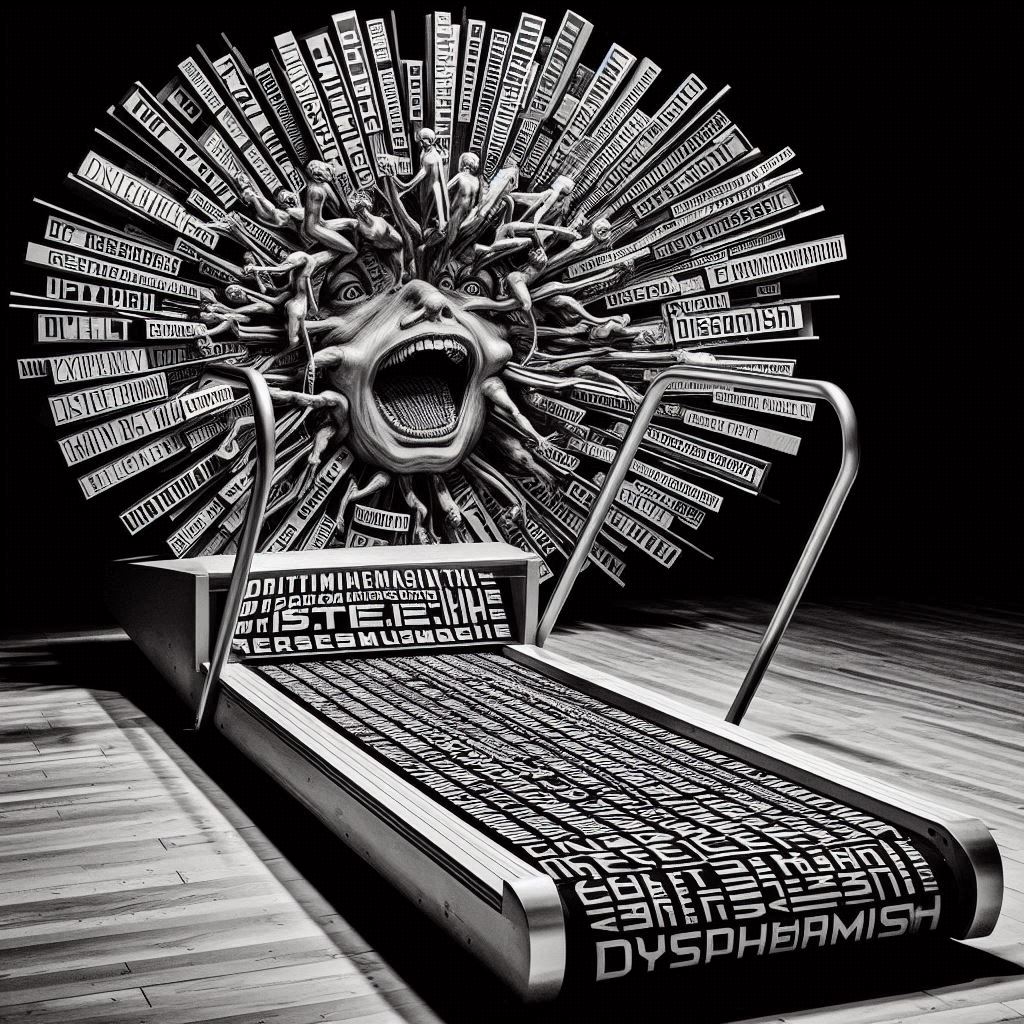 Someone far smarter than the author of Rilaly.com developed a term for this cyclical experience that he called the dysphemism treadmill. The dysphemism treadmill, as opposed to Steven Pinker’s euphemism treadmill, suggests that what we consider profane in one frame eventually becomes commonplace. A euphemism is an innocuous word used to replace a derogatory term, a dysphemism, by contrast, is a derogatory expression. The use of the treadmill suggests that a profane word has a life cycle for each party involved. They/we regard it as an offensive taboo in the beginning, with a here, there be dragons designation, until it becomes so commonplace among our peers, and in the culture, that we begin to use it. At some point further down the road, it becomes so commonplace that extensive use drains it of any power it once wielded. Then, I add, when our kids use these terms, and use them against us, they start the cycle all over again. It’s the dysphemism treadmill. Prior generations started this cycle, we joined it, and the next one will too.
We probably didn’t know someone developed a term for it, but we know it when we see it. We hear it too, until we don’t hear it. When we’re younger, and we hear people swear in movies or TV, it’s exciting, fun, and funny. “He just said, what?” LAUGHTER “Yay!” “That movie had seven swears, two ‘F’ bombs, an MF, and four ‘S’ words!” The older we get, the older they get, until they go from an acceptable form of communication to commonplace, to a final stage where we don’t even hear them anymore. The kid was in bed but obviously not asleep in the back bedroom. The next day, he reported that he heard “everything they said” on the TV show we were watching. What did everything mean? “They said some awful awful things.” It shocked us, because we didn’t hear it, because we don’t hear it anymore. It goes in one ear and out the other. It’s such an accepted form of communication for us now that we don’t know if we still consider using offensive language a question of morality anymore, but we do not want our children hearing such language from us.
 “Well, he’s gonna hear it somewhere,” people reflexively say whenever they accidentally swear in front of our kids.
“And I think we both know, there’s nothing I can do about that,” I reply. “I can only control what I can control. I cannot control what he hears at school, or among his friends. I have some control over the shows he watches, but I recognize the limits there too. I can only control what I can control, and as his primary influence in life, I can control my language when I’m around him, and you can too, Grandpa!” When his friends say them, it’s funny, naughty and rebellious. When parents say them, however, it can lead to a premature sense of commonplace on their treadmill, and they’ll learn to use those words accordingly. I also think language is a staple of youth, and by cleaning up my language when I’m around him, it might help make some small, seemingly insignificant elements of his youth last just a little bit longer. My meager efforts in this regard might be so relative as to be insignificant, but as they say every little bit helps.
Hundreds of Years Old
Those who study the origin of words suggest that some of the words, most famously listed in George Carlin’s Seven Words you can Never say on Television, are at least hundreds of years old. They question whether these words had the profane power they do now, but they state that the words are a lot older than most would believe. My guess is that this study was put forth to suggest that these words aren’t that bad, and I would flip that around and say, “Words don’t have power, until we assign them power. If they’re not that bad, why are they our go-to when we’re extremely angry, frustrated, and sad? Why do we use them on a sliding scale to properly convey extremes, if they aren’t that bad?”
When they suggest that they didn’t have the same power hundreds of years ago, in Chaucer’s or Shakespeare’s day, I cede that notion, but they’re currently as powerful as they were in the 60s and 70s when standup comedian Lenny Bruce was getting arrested for saying them on stage, and when George Carlin wrote the Seven Words you can Never say on Television. Did my great-grandpa use one of these words when he hammered a finger, probably not, but I’m pretty sure my grandpa either used them or tried to avoid using them based on the power they amassed in his era. So, the modern young people who want to carry on the tradition of burning everything that came before them to prepare the world for their new generation are probably using the same naughty words that their grandmothers and grandfathers, or great-grandparents, from the 60s and 70s, used in similar situations.
Put in that frame, it’s noteworthy that no generation, after the mid 60s to the early 70s generation, took the taboo to another level. Those who used foul language from the Carlin/Bruce generation expressed themselves in a radical manner, and audiences walked out on their shows aghast and shocked at the profanity they used in their shows. Does that still happen?
Young people and teenagers might still be fascinated with offensive language, but adults place them on the commonplace portion of the treadmill. They don’t leave these shows, they aren’t offended anymore, and they’re probably in the same place I am in hearing these words so often that they don’t even hear them anymore. We obliterated those taboos so often that the trend in modern, comedic movies that the taboo progressed to swearing in front of children, and that only happened after the little old lady with a foul mouth ran its course. When swearing in front of children ran its course in comedic movies, they moved with the taboo to having children swear in movies. It’s the dysphemism treadmill.
Bruce and Carlin not only expressed themselves with profanity regardless what “the man” said, they fought any and all censorship of expression, and they faced legal consequences for doing so. Some might call them trailblazers, but when that generation crossed the Rubicon of thirty years of age, and they became parents, why did the next generation follow the exact same trail they blazed? Most generations speak of torching the trail of the previous generation, to build a new one, rather than follow it obediently. Why did the successive generations copy these particular words for future use?
A Profane Concept
Are the concepts behind vulgar and profane words so revolutionary that they’re evergreen and immune to change? If an enterprising social critic started trying to change the fabric by using new and different words to offend and shock parents, would they be laughed out of the building? How could anyone update such concepts? What words would they use to better, or uniquely, describe lewd activities and disgusting bodily functions without being subject to ridicule? It would be an almost impossible chore, but the one thing we love about enterprising young souls is their ability to make the impossible possible.
 The avenue to doing it in such a way that reaches young people, now, would be through YouTube. The first question this provocateur would have to answer is why do it? Is there some financial reward for changing the language in this manner? The second question would be why do it? Curse words are beloved in their own way, and they’re familiar. If we are going to revamp, revolutionize, or just tweak the lewd lexicon, we better prepare for the backlash.
“I’m not giving up on my swear words that easily,” a YouTube commenter, named Smurfette’s Rainbow, adds in the reply section. “They’ve served me well in moments of frustration and angst, and they have managed to make some of my otherwise lame jokes pretty (expletive deleted) funny.”
If the influencer wanted to provide proper alternatives, he would need to understand the science of swear words. Among the many things they find will be the psychologically pleasing, offensive qualities of certain hard consonants. The hard (‘F’) is the most obvious consonant to use, but they would also have to incorporate hard (‘T’s) and (‘K’s) in their new words. They would also have to abide by our need for syllables. A simple expression of anger requires one hard consonant syllable, but an elevated level of anger requires three, sometimes four syllables to properly express ourselves, and these revolutionaries would have to be mindful of that.
“The best swear words I’ve found have hard consonants,” the influencer might say, soon after he lays out his mission in the intro. “Spraken ze Deutch (German for do you speak German?), for example, is one of my favorites. After listening to German friends of mine speak, I realized that many German phrases make great cuss words, because almost all German phrases have hard consonants. Try it out the next time you drive a hammer into your thumb. Spraken ze Deutch. There are probably too many syllables for required punctuation, but I think you’ll find using it in some contexts quite therapeutic.”
“My friends simply won’t accept any of the alternatives you’ve listed here,” Tripping the Light Fantastic replies in the comments section, “and I don’t care how many hard consonants or syllables you mix in. Our reputations are on the line here fella. Why don’t you go mess with someone else’s vocab (insert influencer’s name). We got nothing for you here.”
“How are we supposed to tone these words?” a third, somewhat eager commentator, named Fertilizer Spikes, asks. “You provide us with some situations, and I appreciate that, but we need more situations, so our tones suit the situation better. I’m all for introducing a new paradigm, through a new set of swear words that describe reproduction, our reproductive organs, and the movement of our bowels, but you have to remember how many years of practice it took us to learn how to use and tone the more traditional swear words properly.”
“You’re right, Fertilizer Spikes,” Uncle Shemp agrees, “swearing isn’t innate. It’s learned behavior, and our influencer here doesn’t seem to recognize that.”
As with all efforts of this sort, this first influencer would probably hit an epic fail, as their audience might view it as some sort of spoof ridiculousness. His failure wouldn’t be absolute however, as he would sprinkle the seeds for the second influential voice to take the baton. The second enterprising young entrepreneur might follow many of the steps laid out for the first, but he would find a unique, individualistic way of offending the other generations. Some guys are just offensive. We don’t know why, and we don’t know how they do, but our parents say, “I just don’t like him.” That’s the type of guy who could convince the next generation that his words are the “new words you cannot say.” It would likely have to start out tongue-in-cheek, but if they do it right everyone will be using the words and repeating them, whether they get it or not. How many movements started out a joke that accidentally caught on? What if the next generation believed their parents genuinely found words like “Funderbunk!” or “Fudge Crackers!” offensive? What if it caught on so well that they used one of the second influencer’s words when they hit their index finger with a hammer? Let the revolution begin!
The first answer to “Why do it?” can be answered by typing the word of choice in a search engine followed by “How old is it?” Once we learn that these words were probably used by famous radio broadcasters, before the advent of TV, wouldn’t that characterize future use as redundant? The moment after my dad or my grandma informed me that they liked a musician or band I did was the last time I “officially” listened to them. I hated meatloaf growing up, butter brickle ice cream, Neapolitan ice cream, and anything and everything my dad liked. I did not set out to loathe everything my dad liked, it was just what I did, and it’s just what we do when we’re carving out our own identity. This might fall under the umbrella of rebellion, because it is, but we don’t do it with righteous fists held high. It’s just kind of what we do. Yet, if their brand of music makes our skin crawl, and the sight of butter brickle ice cream and those little neapolitan ice cream bars causes us to gag almost involuntarily, because they remind us of our parents, why doesn’t their vulgarity have the same effect on us? We do everything we can to be different from our parents when we’re young, and we consider our grandparents so irrelevant that they’re not even worth rebelling against. Yet we still use the swear words they used when swearing at the three channels they watched on black and white TVs. When we’re brand new adults, we’re dying to break the shackles of the matriarchal and patriarchal constructs that define and confine us, so why are we still using the same offensive words to shock our ancestors with the same taboo language that they used to shock theirs?




 Rilaly