Pretentious Absorbers


“You’re what’s called a pretentious absorber.” Stewart Griffin

“What’s that?” Brian the Dog

“You remember how Madonna lived in London for, like, a month and then started talking with a British accent? It’s that.” Stewart Griffin
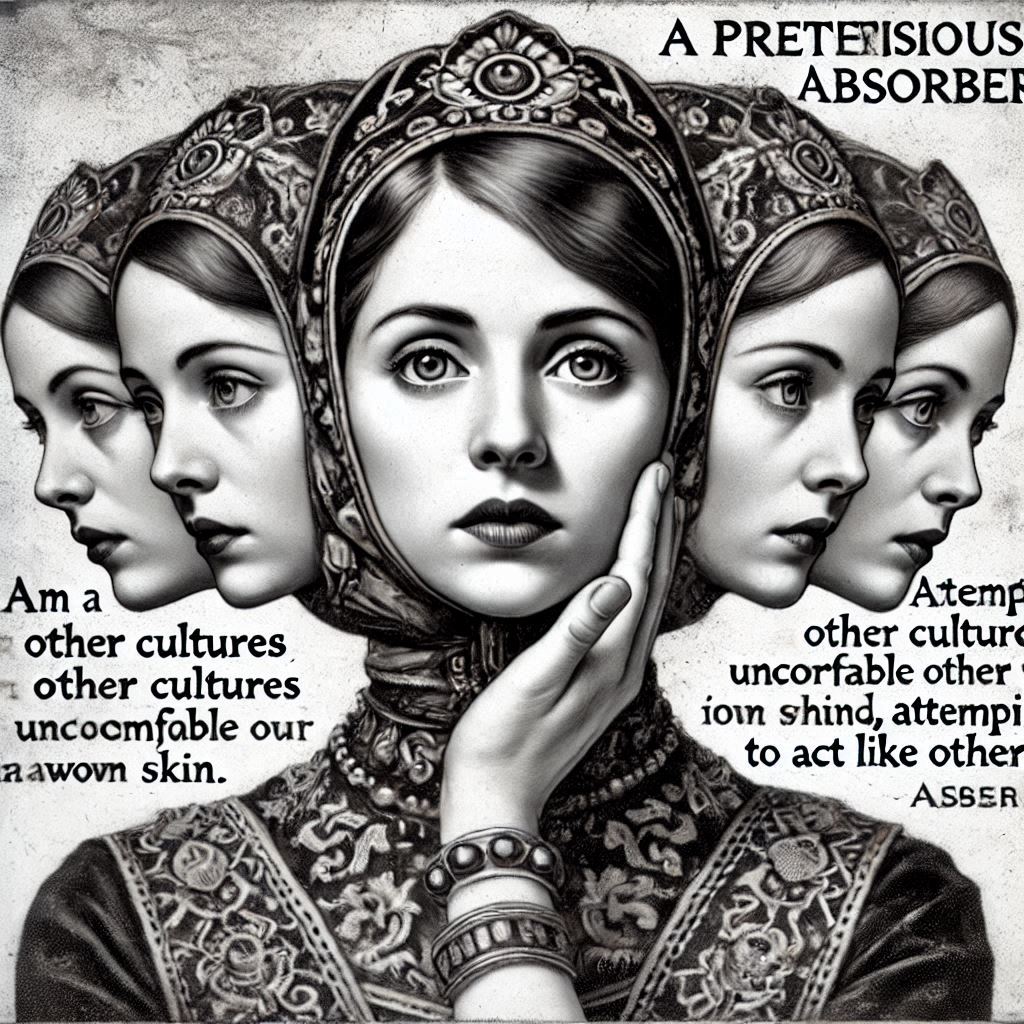
The easy life?” Betty Bettle asked her friends in college. “You think I led an easy life? My family had a small, family farm. If you know anything about farming, you’d know what a stretch it is to call that the easy life.” It was probably her fault they thought that. She told them too much about herself. She complained about how her overprotective dad strongly encouraged his daughters to stay home most nights. She made the mistake of confessing that her brother helped tend the farm, while she and her sister helped their mom in the home. She then compounded her mistakes by complaining about being cooped up, “I never experienced the world.” The idea that they didn’t see that life as an awful experience didn’t shock her, but she couldn’t see how anyone might mistake that for an easy life.

“I’m free,” Betty whispered to someone she didn’t even know at her first college party. Throughout that first year, she met so many different people from so many different backgrounds that she grew to love college parties. Betty got wasted at the first couple parties she attended, but she didn’t enjoy those nights the way those who unleashed did. She didn’t enjoy getting drunk or stoned, but she attended every party she could find. Betty found that she could be whoever she wanted to be at these parties, because no one knew her. She eventually ruined that by telling them everything about her, but she developed so many friends before doing so that they still welcomed her to every party they had.

These college parties introduced Betty to a slice of life she never knew, and she didn’t to just want to nibble at this newfound freedom, she wanted to explore it as much as she possible could. She wanted to meet more people, different kinds of people, have more experiences, and grow, but the problem was she never had any money. Her family never had any money, and even if they had, there was too much work to do at the homestead to travel. When her new, college friends introduced her to their friends from other countries, Betty thought she found something of an end around to her desire to travel.

For a variety of reasons, Betty was more attracted to people from other countries than she was anyone else she met in college. She wanted to be there when they dropped tales about life in other countries, because she wanted to learn everything she could about the world outside the Bettle homestead.

It confused her when her foreign friends began accusing her of living the easy life. She was so confused that she found herself becoming defensive. She lost those arguments so often, with so many foreign-born people, that she became convinced that they were right. No matter how many hardships the Bettles experienced on the farm, they paled in comparison to what some of these people had to go through. Over time, she found the best way to avoid being so defensive all the time was to go on offense. She found herself becoming so sympathetic to their plight that she became empathetic. She learned their plight so well that she joined her foreign friends in arguments they would have with any newcomers.

“You don’t understand how that offends my people,” Betty said when she returned home on a break. We knew nothing about her foreign-born friends at college, but we knew something changed her. We assumed that she heard that line so often that it became a reflexive response to her. The offensive statement she was addressing had nothing to do with the Irish, the Germans, Americans, farmers, or the Bettles. The statement was referring to involved the home country of her new foreign friends. When she informed us what she was learning in college, we assumed that this Irish/German woman was falsely attempting to assume the characteristics of her new friends, but we knew her so well that we couldn’t believe this was the case.

The only thing we could assume was Betty heard so many of their tales, and learned so much about their culture and customs that she began adopting them as her own. She learned how to prepare their dishes, and she eventually learned how to speak their language on a less than fluent basis. She did everything she could to have them accept her as one of their own, and when they did, she felt like she was one of them.

“Aren’t you Irish and German?” one of us said, in the midst of one of her rants. It shocked her. She said yes of course, and she blushed a little, but it was obvious that what shocked her was that anyone would call her out. One might suggest that she enjoyed the company of her foreign-born friends so much that she bonded with them, and that bond was so strong that she considered any offense made against them as an offense against her.

At some point, the revelations she learned led Betty to believe that her parents lied to her. Either that, or she believed her small-town parents just didn’t understand enough about the plight of human existence. When she learned “the truth”, she thought anyone who approached the issue from a different perspective was either as passively uninformed as she used to be or willfully ignorant. To further their knowledge, she used a “must” or “should” pulpit to help us all view matters from her new perspective as a foreign-born citizen.

Betty Bettle graduated near the top of her class, and she immediately entered into a career that paid her relatively well. She saved every dollar she could to travel to experience the world in ways she never could as a kid. She hoped to use the college degree and the extensive travel to establish a status in life that might lead to a station. From this station, she developed an approach, based on a level of pretentiousness she didn’t intend, whenever someone argued with her. “How do you think you know so much?” she said one day. “You haven’t traveled.” Her book smarts proved a little intimidating at first, and she sought to round up whatever street smarts she might lack due to her upbringing, by traveling.

As intelligent as Betty was, she wasn’t a great debater, particularly on this topic. When someone scratched at the surface, just a little, Betty crumbled. Most of her conviction was tied up in the talking points her foreign friends, books, and TV provided. She had no firsthand experience being a foreigner of course, so she could not answer follow up questions or challenges to her newfound passion, and we walked away from her thinking she was someone who did what she was told.

Betty’s sympathy for citizens from other countries and cultures was genuine, but it was also conditional. The foreign-born citizens she met in college provided her a prototype. Betty met foreigners who strayed from that model, later in life, and she developed narratives for why some might succeed where others didn’t, but she preferred to focus on those who required sympathy, and she developed a certain criterion of musts for them. She also developed a list of shoulds that they should exhibit. She considered successful immigrants anecdotal evidence of the foreign-born experience.

Betty Bettle always knew she was of Irish and German descent, but she ignored this fact so often and thoroughly that she viewed reminders as unnecessarily confrontational. As odd as it sounds for someone to try to convince themselves they are another lineage, how often do we become so convinced of something to the point of developing convictions? How many of our convictions are based on personal experience? How many of us use literature or philosophical text as a conduit to conviction? By doing so, aren’t we, in essence, using another’s experiences to modify our thoughts from theory to fact? How many of us absorb so many of our parents’ ideas and platitudes that we accidentally become them? Betty didn’t agree with her parents’ worldview, and she didn’t want to model herself after them. She agreed with her foreign-born friends in college so much that she ended up adopting their culture and characteristics as her own. Cultural appropriation was not a widely recognized term back when Betty was in college. As a person who abides by the prevailing winds, we can only guess that Betty now has a tough time squaring everything she did back then. She might suggest that she views her approach as complimentary, as she only sought to understand other cultures better, and if she accidentally adopted some of their customs and characteristics, it was unintended. To which the cultural appropriation crowd might say, “That’s what everyone says.”

Betty didn’t intend to be a pretentious absorber. It just sort of happened. It was an accident. It was something that happened in that way we incidentally mimic and imitate our parents, our teachers, and anyone else we admire. Betty never admired anyone to the point that she would mimic or imitate them, until she met those foreign-born students in college. She was so fascinated by their ways and customs that she hung out with them almost exclusively. She met their parents, and partied with their aunts and uncles, until she eventually gained acceptance among them. She never felt so accepted by a group of people before. She never truly believed she could change her ethnic heritage. It just sort of happened.

For reasons endemic to their upbringing, people like Betty Bettle choose to imitate and emulate sympathetic characters, and they do this so often that they begin to absorb their traits and characteristics until they exhibit them. The first question that runs through our mind when we watch this happen is how does an otherwise intelligent person begin to believe they are different? The next question is why do they do it? Are they trying to achieve some level of superiority? If that’s the case, why would they imitate and emulate people they regard as sympathetic? Are these sympathetic characters flawed, or in some ways relatively inferior? If they weren’t, why would Betty feel sorry for them? Most of us spend most of our lives trying to emulate and imitate the successful. Our desire to find some relative measure of success through money, love, or some other form of happiness drives us to imitate those who experience some measure of success in that regard. It has given birth to numerous multi-million-dollar industries online, in seminars, and in the book industry. Do we do it to one day achieve some level of superiority? Perhaps, if we consider it superior to conquer our personal flaws better, quicker, or in some ingenious ways others haven’t considered before. Pretentious absorbers believe that by imitating and emulating other cultures, they derive virtue. If we ask how they can abandon their own customs, tradition, and culture, they might provide a wide variety of reasons, but those answers won’t be clear or direct. Their answers won’t revolve around what it says about them that they do what they do but what it says about you that you don’t. They are pretentious absorbers.


The Pit Stops of Life


The Pit Stop

The destination is the destination of our planned vacation. We pack the belongings, the kid, and the dog with a destination in mind. When someone suggests that we take a pit stop, we say, “Why? We’re making good time here. At this rate, we should arrive at our destination by four p.m., with plenty of time to do much of what we planned.” The fun and frivolity we dreamed up, when we dreamed up this vacation, all took place at the final destination. Pit stops seem like a waste of the precious time we could spend having fun. The dilemma arrives when we arrive at our destination, and we have nothing to do for the first couple of hours.

“[He] never made pit stops,” a woman said of her now deceased husband. “He thought pit stops were a waste of time. He wanted to get there.” 

Well, he’s there now, I thought of joking. He’s at his final destination. It would’ve been an awful, cruel joke. No one would’ve laughed, of course. No one would’ve so much as smiled. How many pit stops did he make to his final destination? Did he go quickly? He wasn’t the type to stop at a lakeside pit stop. “He wanted to get there.”

I didn’t say any of that, but in the midst of my scheme to drop that room-silencing, reputation damaging joke, I realized that I’m a no-pit-stops destination traveler too. I don’t stop to smell the flowers, look at a lake, or carpe diem the moment. I get there, wherever there is. I want to have fun, and I don’t want something like a pit stop to get in the way of it. 

When we map out our vacation, it often involves lengthy travel times. Even on paper, we know we’re signing on for a long journey, even when they’re all interstate miles. It doesn’t get any better when we’re doing it. As the miles click by, it begins to feel like a Sisyphean trial of humanity to sit in a small car for that many hours in a row, and it doesn’t matter how large the interior of an automobile is, they all feel small after eight hours. The family might want to smell the flowers and look at a lake, but I’m the “Let’s just get there for all that’s holy. Let’s get this drive over” type of traveler. 

The volume of the consensus breaks us down, however, and we take a pit stop. Their primary goal, after such long car ride, was to get out and stretch the legs a little, go to the bathroom, get the kid out of the car for a while, and let the dog pee. We’re not for it, but we strike a deal with those who are dying to get out of the car. We decide we won’t stay long. We’ll look at stuff, we’ll walk down to the lake and throw some stones in it. We’ll talk to some of the other people who made a similar pit stop, we’ll let the dog run around with whatever joy he always runs around in, and the kid can have some spontaneous kid fun. Then we’ll take that almost cinematic portrait with that crystal blue lake in our background, and we’ll all get back in the car for another three hours. 

I don’t know if I needed the break more than I knew, but I was peaking at this particular pit stop. Some of the times, we have mental peaks, some of the times, we have physical ones, but every once in a great while they come together. Before we turn 25, our whole life is one peak after another. The only stories we tell involve those moments when we weren’t peaking. After 40, we are so impressed with our peaks that we tell everyone we know. Everything in between involves noticing peaks after the fact. I was peaking at that little pit stop. I was in the moment, the moment I stepped out of the car. I wasn’t thinking about the car ride ahead of us, how this pit stop might hamper our pre-planned schedule, or anything else for that matter. Once I stepped out of the car, I wanted to make this stupid, little pit stop as fun as it could possibly be. 

We had so much fun at that little pit stop that it proved one of the best we have ever experienced on vacation. When we finally arrived at our proposed destination, we had all the fun we planned to have, and I remember that vacation as one of the better ones we’ve had. We may have spent four days at our proposed destination, and we only spent 30 minutes at that non-commercial pit stop, but the time we spent there will forever stick out in my memory.

City on a Hill

I love a great line. A great line can make a movie (90 minutes long, on average) or a series (roughly 47 minutes per episode, with ten episodes on average) seem worth it. Anyone who reads this will probably say that it says a lot about me, but my favorite lines are the obnoxiously offensive and repugnant lines of vulgar cruelty. Some heart-warming, positive lines, reach me, but nothing causes me to pause and rewind more than an awful line from an awful character. 

I also prefer shows and movies that depict people doing and saying awful things to one another. There are exceptions, of course, as some shows are awful for the sole purpose of being awful. The great shows, about awful people doing awful things to one another, The Sopranos, Breaking Bad, and Mad Men always managed to preserve some relatable integrity in their characters while doing and saying awful things to other characters. We learn to cheer the main characters on, and when they did awful things to other characters, we cheer that on too. 

The Showtime series City on a Hill is not as great as those shows, of course, but it did have one great, repugnant, moment of vulgar cruelty. 

“I can hear it now. The eulogies, the hymns, the bagpipes, everyone forgetting what a lousy piece of [dung] you’ve been your entire life,” the Jackie Rohr character says to his rival J.R. Minogue, on an episode of the TV show City on a Hill. The Minogue character lies in the ambulance, and we know he’s not going to live long enough to see the hospital. We know Rohr’s cruel sendoff will be the final thing the Minogue character hears. “Your wife’s going to be upset [after you die] for about five minutes, and I will … eventually, but this should be a comfort to both of us. There’s no hell. There’s only this life, right here, right now, and the last thing that you’re going to see in your lousy life is my ugly face.”

Seconds before this scene, Rohr eagerly leapt into the ambulance that carried J.R. Minogue, before the EMTs could close the door. We know this scene. We’ve seen it all before. The main character, a law enforcement official, leaps into the ambulance to hold a fellow cop’s hand, as the man succumbs to death. Even though they’re bitter rivals, Minogue’s a fellow cop, and that goes along way to forming some solidarity between the two. That’s the typical scene, in the typical cop movie, but the writers of City on a Hill had other plans for Rohr. They have him mock his rival on his deathbed, and he lays into Minogue with vulgar cruelty.

Ever since Sopranos, and perhaps beyond, viewers have come to accept the idea that their favorite main characters on their favorite productions can be morally ambiguous, if not downright awful people. Through a dizzying array of scenes, we accept the idea that Jackie Rohr is one such character. Yet, what motivates this character to be this spiteful? We’re to read into it. We’re to wonder if we could ever be that spiteful. We’ve all had people we dislike in a competitive manner, and we dislike others in a more personal manner, but have we ever hated someone so much that we wanted to taunt them into death? Most of us haven’t. I obviously considered this scene an interesting nugget to chew on, and I wanted a more thorough psychological exploration of why, or how, even a Jackie Rohr could be that spiteful and that hateful. Scenes like these remind me why I prefer books to movies.

We understand that when Rohr says, “This should be a comfort to both of us. There’s no hell,” he does so to inform the viewers that he knows that he’s as awful as J.R. Minogue is. That line sets up the next line well, but after I paused the series at that point and rewound it a number of times, I thought up a better line. 

“There is no heaven, and there is no hell. There’s no such thing as an afterlife.” If the writers seek spite, this might be an altogether different level of spite, because as awful as J.R. Minogue apparently was, he likely tried to counter those evil deeds with some good ones throughout his life. It might be even more spiteful to inform him that those good deeds he performed, and any other attempts Minogue made at good and honest living, were a waste of time, because “there is no heaven.”

Rohr then alluded to the idea that his main point for jumping in the ambulance was to make sure that Minogue’s loved ones weren’t the faces he remembered. Rohr wanted his face, Minogue’s most hated rival, to be the last face he saw. I see the writer(s) working here. I know that they’re vying for one of the more spiteful moments in TV history, but if there is no afterlife, and J.R. Minogue turns to dust, there will be no way for Minogue to remember the final moments that Rohr hoped to ruin. He’ll turn to non-existence, and Rohr’s awful sentiments will die as soon as Minogue does. A better line might have been, “There is an afterlife, and we don’t know where you’re going yet, but if they somehow determine in their mysterious ways, that a piece of [dung] like you is worthy of eternal paradise, I’m here to ruin all that for you by providing you your own personal definition of hell, knowing that my ugly face was the last thing you saw in your time spent on Earth.”

I read an interesting complaint regarding individuals who follow religious philosophies. The complainant suggested that religious people fail to appreciate their lives on earth as much as they should, because they place inordinate focus on achieving eternal paradise in the next life. Whether there is an afterlife or not, even if it involves a level of paradise beyond our wildest imagination, something tells me that we’ll look back on our lives on earth with some regret if we don’t make more time to enjoy the pit stops in life, en route to our final destination.

Mr. Fehrley was not Just a Dog


“It’s just a dog,” he said. “We can’t help but grow so attached to dogs that we end up loving them, but in the end, they’re just dogs.”

Just a dog? Just a dog?!” we say. “Do you have any idea how much I loved that dog?” In their reaction to our defensiveness, we see that while we all grieve in own ways, some of us console in our own ways too.  

Years prior, I took a vacation. I had another dog that I had to kennel him for that time. “What if he comes back different?” I asked in a rhetorical manner. “I’ve heard it happens. I’ve heard that some dogs don’t want to play as much when they come back from a kennel stay. What if my dog is different when I pick him up?”

“Get a different dog,” he said. When I argued, he added, “What is a dog’s job? Their job is to play with you, let you pet them, and provide some companionship. If you pick up your dog, and he’s not doing his job anymore, get another one.” This unemotional, almost mathematical response did not come from Siri or Alexa, but from a living, breathing human.

“When your child begins to turn on you, in all of the rebellious ways our offspring will, are you going to get another child?”

“A child is a complicated human being,” Alexa and Siri, disguised as a human, said, “but a dog is just a dog.”  

In science, a dog is just a dog, and he shouldn’t matter as much as human do in our pack. In mathematical principles, a dog has a lesser denominator. When they remind us of the equations involved, it should console us to know that math and science offer more permanent and indestructible solutions that contain order and eliminate the random matters that are so difficult to control, and chasing an emotion like happiness is a messy, chaotic proposition that never ends well.  

Contrary to his anthropomorphic name, Mr. Fehrley was nothing more than a dog who managed to carve out a prominent role in our lives, our family, and a prominent and permanent place on my list of best friends of all time. As painful as the shock and awe of his demise was to us, we all knew we would have to move on in life. As Franz Kafka once wrote, “Everything you love will probably be lost, but in the end, love will come back in another way.”

Denial, anger, bargaining, depression, and finally acceptance are the traditional stages of grief. Everyone grieves in their own way, and some of us go through reeling, feeling, dealing, and healing. In the dealing stage, we accept the idea that “Everything [we] love will probably be lost,” and that it’s the nature of existence for survivors to be left behind, but for some reason the math doesn’t make it any easier to sort through all of the messy emotions involved in trying to achieve the healing stage.  

We’ve all experienced loss of loved ones, and as painful as the reeling stage is of it is, we know we’ll recover. We’ll never forget, but we will move on. When we make some strides to move through the reeling and dealing stages, the pain of routine takes its place. The immediate memories strike us during the reeling period, but when we encounter the little moments of routine, they can prove just as emotionally crippling in the healing stage.

We had a morning routine with Mr. Fehrley, a treats routine, the routine of the “bye-bye” car rides, the long walks to the fence, and the night routine. When the morning after arrived, it dawned on us that there was a gap in our being that we never knew existed until he filled it by resting between our legs on the ottoman. When the time for the other routines arrived, and the new dog didn’t respond with puppy-like glee, we realized that we made those routines so exciting. When the wound is still fresh, our routines of life feel just a little more empty, and boring. If we explain this to anyone outside our home, they might smile politely, and they might recognize the power of routine through those they have with their own dog, but they’ll never understand how important these little routines were to us.  

Mr. Fehrley was just a dog, but I never realized how affectionate he was. I never realized what a luxury it was to have a dog who always wanted to be around me, leaning on me, and touching me. I sit on the couch now, and no one leaps into my lap anymore. I go out to the backyard, and no one wants to join me, and no one even notices when I’m gone. I return home, and no one is overjoyed to see me. These are but examples of what a dog can add to a person’s life, and if the reader has a dog who is so affectionate that it can be annoying at times, I tell you to appreciate it for what it is. It doesn’t last forever, as we all know, but we should all take a moment to create a memory we’ll wish we created when they’re gone. 

We had a basketball routine. Every time we went to play basketball at the park, we almost always brought Mr. Fehrley along. Mr. Fehrley stayed on the outskirts of court, sniffing everything available to him, running in circles for no apparent reason, peeing, pooping, and playing with imaginary friends.

“Aren’t you afraid he’ll run away?” an observer asked when he noticed that Mr. Fehrley wasn’t leashed, and that he stayed within certain parameters. There was no accusation or condemnation in the man’s voice. He was in awe of the discipline Mr. Fehrley displayed by not running off. 

“He ran off before, numerous times, and we had a number of reactions. One of them was to leash him up. Another was to take him home and not take him on such outings again for a while. After a number of these incidents, he learned that if he wanted to go along with us and remain unleashed he would stay within certain defined parameters.”

It might seem far-fetched to say that a dog can learn lessons in this sense. Most people don’t think a dog can associate not going out with us as a punishment for a momentary, small transgression. Most people don’t think a dog could make that type of connection, especially when an amount of time between outings occurs, but I’m telling you, as I did the observer that day, Mr. Fehrley did make those connections.

A friend of mine once said, “A dog spends their whole life trying to make us happy.” Based on the actions and behavior of my dog at the time, I disagreed with her. Mr. Fehrley taught me that he learned when we’re happy, he’s happy. Mr. Fehrley was a bright dog who learned his lessons well. He was, by far, the best dog I’ve ever owned.

“My dog would never stay like that,” this observer added. “You give him an inch of freedom, and he strives to take a mile.”

The initial instinct is to regard that comment as a compliment to the manner in which I raised and trained Mr. Fehrley to stay within imposed limits. If I didn’t train him to learn those imposed limits, through repetition, I wouldn’t have been able to do half of the things I did with him. I would’ve had to leave him at home in the manner everyone else leaves their dogs at home when they go out to do such things. Yet, when a dog passes away, and the cavalcade of emotions penetrates all of our vulnerable nerves, we think back on these conversations, and we wonder if we trained him so well that we trained him too well. Did we deprive him of some initiative, and did we inhibit some of what it means to be a dog?   

I initially thought the reeling stage would be the most painful part, but as with the progression of a physical injury, the healing stage proved almost as painful as the reeling stage. The realization that all of the routines we built up for ten and a half years were over proved to be one of the more painful elements. 

We had our little fella for a glorious ten and a half years, so it would prove difficult to appreciate him to the level I wish I would have every day for that long, but I regret some of the moments when I could’ve appreciated him more. Weather permitting we took this little 33lb, Puggle everywhere we went. Friends laughed at us for feeling guilty on those occasions when we had to leave him at home alone. Someone once said, “When I die, I want to come back as your dog.”

As happy as Mr. Fehrley was, and we provided him a fun, full life, I wasn’t spared the road of regret I feel that I took him for granted in some ways.

***

Justanswer.com suggests that there are approximately 68 million domesticated dogs fulfilling families in the U.S. alone. Even if we wonder how they arrived at such a figure, we all know that the figure is very high. What role do these dogs play in all of these households? Visit a home without children, and the dogs’ roles tend to play a more prominent role in that household. Even in homes with children, however, dogs play a prominent role. As kids love their dogs as much as adults do. Most of us love our dogs almost as much as we love our children, but we might never know the prominence they have in our lives until they’re gone.

If you’re anything like me, one of the first things you do when you enter someone’s home is seek out their dog. If you love dogs that much, you’re bound to encounter a dog you don’t enjoy. Some say they’ve never met a dog they didn’t like. I’ve met two. I thought their owners, guardians, or whatever people prefer to call human companions were relatively nice people. I later found out I was wrong, and I realized that our relationships with dogs tend to be symbiotic in that a dog can define a person in some ways, and a person can define a dog in some ways. Our personalities rub off on dogs, and their personalities rub off on us.

How much time do we spend around our dogs? How much time do we spend playing with them, talking to them, petting them, taking them to parks for walks, and everything else to shape and mold them? Dogs notice things. They pick up on behavioral cues, patterns, and routines, and they learn how to behave to get along with us better. If we say hello to everyone we encounter in a park, for example, they will too. If we’re confrontational people, our dogs might be more confrontational. How often do our neighbors have to raise and develop crazy dogs before they realize they’re the problem? 

Have you ever met a neighbor you initially considered relatively stable and friendly, only to find out their dog was out of control? Did it shape how we viewed that person? There’s usually a reason a dog is so out of control, and when we find out that that neighbor has another side to him, a nutty, out of control side, when he isn’t leaning over the fence for a chat, we learn to read our tea leaves better. We learn to pay more attention to their dogs. Our personalities help define our dogs, and they define us, and everything in between.

As we often say of those who pass, Mr. Fehrley died doing what he loved best. He died chasing a squirrel across a street. If you were lucky enough to know Mr. Fehrley, you knew that chasing squirrels was his joie de vivre (exuberant enjoyment of life), and he loved it so much that it became his raison d’être (the most important reason or purpose for existence). To deprive him of that would’ve been the more responsible thing for me to do, and I was warned, but I didn’t want to deprive him of that joy. 

Years prior, I saw a junkyard dog check both ways before crossing the street. The junkyard dog was everything you’d imagine. It had various sores, patches of hair, combined with some spots of mange and bald spots, and it also walked with a noticeable limp. I never saw a dog check both ways before crossing a street before, and I considered hilarious at the time. The more I thought about it, however, the more I considered it a little sad. This dog, obviously, had no one to protect it from harm. It obviously had to learn, from firsthand experience, how painful cars can be when they hit. The key to the junkyard dog’s survival involved checking both ways before walking across the streets cars drive on. Mr. Fehrley never checked both ways of course, because he didn’t know any better, because he never had to develop that survival skill. I did that for him. So, I could wallow in the misery that I forgot watch for him that one, fateful moment, or I could think about all the times I prevented him getting hit. Developing coping mechanisms such as this one help, as does having a family with which to share the pain, but when incidents like these happen, we all go through them alone.