Gorillas and Lions and Wolves, Oh My


When I watched a gorilla scoop some dung out of his brother’s anus to eat it, it modified my thoughts on taste. This gorilla didn’t just ingest his brother’s dung, which is disgusting enough, he did so in such a deliberate process that the observer couldn’t help but note how much he savored that moment. He ingested that dung in the manner I might that one perfect strawberry I find in every bushel. We might think if he loved his brother’s dung that much he might suck it down quick to go in for another scoop before the other gorillas find out about it. He didn’t. This gorilla stopped for about three seconds moving it around his tongue to touch every taste sensor, with his eyes closed. And he closed his eyes slowly, and they fluttered. I didn’t imagine it. I saw fluttering. We all hate it when people assign human characteristics to animals, anthropomorphizing them, but there was no mistaking the idea that this gorilla was savoring the taste of his brother’s waste matter before going in for more. 

They’re our distant cousins right? How far removed from this species are we? We go on primal diets, like the paleo diet and the primal blueprint, and those diet entrepreneurs pitched their diet by saying that early humans had lower rates of obesity, heart disease, diabetes, and other chronic health conditions due to differences in diet. Dietitians now state that one of the problems with the paleo diet was that it can lead to cancer, heart disease, loss of bone density, and fatty liver. What’s the difference between the diet of modern man and Paleolithic man? What if we found that one key element to Paleolithic man avoiding such maladies was eating each other’s bodily waste? And did we invent toilet paper to keep our backsides clean, or were we trying to remove temptation? Out of sight, out of mind.

How far removed are we from scooping dung from our brother’s anus? If we listen to science, we’re not as far as we choose to believe. We all marvel at the good things they do, and we associate with them in this vein. When they do awful things, like eating the product of another’s bowel movements, we don’t claim them as one of ours.  

Why? Well, it’s disgusting. Who would want to associate with a species that eats another’s waste? What this points out, more than anything else, is that taste, flavor, and preferences are relative concepts. What sounds and looks disgusting to us is something to savor for our distant cousins.

Everyone is trying to appeal to our taste when they write, painting, cook, and changing their lifestyle to try to appeal to our taste, but what do we find appealing? Something that makes our brain tingle, does not do anything for our brother. Do you have this brother, raised in the same home, talk all the time, and he’s almost 180 degrees different. That’s an entirely different article, but the point is that taste is so relative that it’s almost impossible to create a flavor that has widespread appeal. The word flavor should have a capitalized (‘F’) on it, as it focuses on such a wide spectrum of taste. Food and drink have a flavor of course, but so do music, literature, and all of the arts in the sense that some of it creates the same but different brain tingles. 

Our own tastes are relative too, relative to need. Does water taste great? I dont think so, most of the time. If you played through a particularly grueling athletic contest, you know how great water can taste. Anyone who has run in a marathon knows water can taste like liquid gold. My guess, just looking out in the audience today, is that nobody here knows anything about that, but you do know what water tastes like after a night out. It’s the same but different, but the point is that need often dictates flavor. The polar bear prefers the seal over the fish, because of the fat content of the seal, something the polar bear desperately needs. 

Animals eat for survival right. They don’t enjoy taste, or if they do on some level, they don’t savor. They eat to fulfill their need to sustain life. Savoring requires a level of cognition that recognizes the limited quality of something extremely enjoyable. We all love the taste of a perfectly prepared rib eye, the perfect strawberry, and the clean, smooth taste of a cold drink of water. I think we can all agree that the strawberry is one of the best tasting fruits in nature, but there are always a few, in every bushel, that are perfect. Savoring that perfect strawberry, for just a second before eating another one, recognizes that limited supply. This gorilla not only ingested the dung slowly, he appeared to pause for just a moment to savor whatever that other gorilla ate and whatever that other gorilla’s digestive system added to it. That elongated, almost spiritual closing of the eyes might have been a coincidence, but I thought the gorilla enjoyed the concoction so much that he wanted to savor it for moment before going back to the dispenser. There was a full tray of food awaiting this gorilla, in the southeast corner of his enclosure, but he preferred to go back to the dispenser before him. Watching that gorilla appear to so enjoy it so much that he went back for more, I realized that individual tastes are so relative to the flavors we create that it’s pointless to try to fashion our work in such a way that it pleases everyone. We can only create whatever it is we create from our own dispensaries and hope that others enjoy it for what it is.   

The roles those two gorillas played in this enclosure defined for me what proved to be what I consider one of the most unusual and artistically successful pairings in music history that of Ben Folds and William Shatner. I’ve been a fan of Ben Folds for a long time, but my taste in music is such that I’ve never listed him one of “my guys”. He has some fantastic songs, but if I were to run into Ben Folds, and I informed him how frustrated I am that he comes so close to reaching me, I’m sure he wouldn’t care. Not only would he not care, he shouldn’t care. If I met him and told him that most of his music misses the mark for me, he should say, “That’s on you. I can only do what I do. I can’t worry about pleasing you, offending you, or entertaining you. If it pleases enough people that I can make a living at this game, that’s great, but I’m not going to change what I do to please you or Betty Beatle from Idaho.”  

William Shatner is not one of “my guys” either, but he’s always around. He’s the green bean casserole of the entertainment world. I doubt anyone who has yet to try green bean casserole would look at it and think, “Yum!” but it’s at so many family get togethers and potluck dinners that we eventually “what the hell” it, until we discover it’s ain’t too bad. As long as we don’t overdo it, repetition can even lead to a level of fondness for it, until we look forward to the next get together or potluck dinner that has a tray of it. Similarly, William Shatner has been in so many movies, TV shows, and other formats that we now look forward to seeing him in various productions.

No one should confuse the term “my guys” with a description of talent. I’ll drop the typical line that people drop to explain the discrepancy. “I respect the heck out of what Folds and Shatner do, but it just doesn’t reach me on a personal level.” I know people who love John Lennon so much that they suggest Paul McCartney is not talented. I understand that we all take sides in any rivalry, but to suggest that a talent on par with Paul McCartney has no talent is ludicrous. The Silly Love Songs vs. Important Songs debate rages on in some quarters, as Lennon fans suggest Lennon was not only more important he was more creative. These people relate more with Lennon, and because of that Lennon is “their guy”, but to prove that point, some try to so by belittling McCartney’s Silly Love Songs talent.

I missed Folds and Shatner’s collaboration for years, because they weren’t “my guys”. When I eventually heard the album Has Been, however, I was blown away. It reminded me of one of my favorite concoctions: cranberry granola and banana flavored yogurt. Banana flavored yogurt is too sweet for me on its own, and while the cranberry flavor of granola is tasty, I probably wouldn’t eat it as a standalone. When I put the two together, however, I enjoy it so much that I’ve considered submitting it to the overlords as my reward for living a decent, moral life. When I pass on, I want to meet my long-deceased relatives of course, and I wouldn’t mind it if someone played a Brahams Sonata on the harp to signify my entrance, but if you’re wondering how best to reward me for a life well lived, might I suggest that the floors and walls of my reward taste like the banana-flavored yogurt and cranberry granola concoction I created.

When we eat concoctions like these, we spoon too much of one flavor most of the times. Some of the times, we spoon too much yogurt, and some of the times, we spoon too much granola, but there are occasions, at least once a container, when we hit a Goldilocks spoonful. The album Has Been is the Goldilocks concoction of talent for me, and when I listened to it often enough to recognize its brilliance, I closed my eyes and savored the moment. I did so, figuring that this production would be a one-off. I loved Has Been so much that I went back to the other concoctions they’ve made together, and I went back to their solo work, but neither of them hit the mark in the same manner. On their own, Shatner and Folds create interesting, quality material that doesn’t quite hit that Holy Crud, brilliant mark, but together they created what I consider their Goldilocks moment. I would think that such moments are so fleeting in any artist’s career that when they hit one, they would immediately run back into the studio to dispense another collaboration, but perhaps they don’t think they can create another Goldilocks moment together. I know they did singles together before and after Has Been, but that album was so good that I would think it would drive them right back into the studio to do another collaboration. We know that Folds’ affinity for Shatner brought them together, and that their work together impressed Shatner so much that he called Folds a genius, but we don’t know why they never made another album together. Perhaps they think that fate and whatnot only permits one one Goldilocks moment a life.

Carnivores in Cartoons

Yesterday, I thought carnivores were the mean, bad guys of the wild. Today I realized that the cartoons we watched conditioned us to believe that when a lion, shark, alligator, or any animal at the top of the food chain eats one at the bottom, they do so with some sort of evil intent. We can find a definition of this in Aesop’s fable in which a mouse removes a thorn from a lion’s paw. After the mouse removes the thorn, the lion states that it will not to eat the mouse as a display of gratitude. The mouse does something nice for the lion, and the lion, in turn, agrees to do something nice for the mouse. The inference is that if the lion betrays this agreement, and the lion follows its instinct and eats the mouse, that means the lion is mean.    

In another fable, on the theme, a frog agrees to assist a scorpion across a pond. Before doing so, the frog says, “Wait a second, you’re going to sting me.” 

“If I stung you, we would both drown,” the scorpion responds. 

The frog reluctantly agrees to help the scorpion across the pond, and the scorpion stings the frog. As they’re both drowning, the frog says, “I thought you said you weren’t going to sting me.”

“What do you want me to say, I’m a scorpion. This is what I do.” 

Some allege that the moral of the story, for young people, is that there are vicious people in the world who, no matter how nice you think they are, will stab you in the back. While I think that is a valuable lesson to learn, the more valuable lesson is that which exists in nature. No matter how nice and cute that wild animal appears, and no matter how many cartoons we watch that display that animal as cuddly, they will probably scratch and bite us if given the opportunity. They might not understand why a seven-inch gash in our skin prompted our decision to stop playing with us. If they could talk, they might say, “C’mon, I was just playing.” The point is, in most cases, they did not intend to hurt us, and they’re not being mean. They’re relatively brainless creatures, compared to us, that operate almost entirely on instincts. Biting and scratching is just what they do. 

Think about all the cartoons we watched and books we read in our youth. They depict carnivores with jagged teeth and menacing growls. As we often do, we confused being scary with being mean or bad. Today I learned that they’re not mean, or bad, they’re just hungry, and like all other animals, they eat when they’re hungry. Regardless what it does to their reputation as a beautiful animal, wolves enjoy eating fluffy bunny wabbits. They do awful things to bunnies if they’re able to catch them, but that does not mean they’re mean or evil in the manner we define such terms. By teaching young humans lessons, using animals as main characters, some of us anthropomorphize these characters to such a degree that we assign them human characteristics. Lions, tigers, and bears aren’t nice, they aren’t mean, and they don’t make decisions on what to eat based on how other animals interact with them.   

Yesterday I learned that even if the animals at the top of the food chain are not the meanies we thought they were when we were kids, we should still consider doing everything we can to avoid one in the wild.

After watching videos that focus on animals biting humans, nature lovers qualify the instinctual actions of these wild animals by saying, “We are not on their diet.” The nature lovers then provide a number of theories regarding how these incidents often involve nothing more than a case of mistaken identity. These theories are true, of course, as most animals in the wild, and in the ocean, have never seen a human, and self-preservation is more important to animals than eating in most cases. Animals often take a pass on eating anything unfamiliar if they think they could get hurt in the process. Sometimes, however, they’re so hungry that they’re willing to eat anything that moves, especially if it moves slower than other prey.

Most animals don’t know what a human is, and that’s why they fear us, but we are also a point of curiosity for them. Thus, when they see us walking around in their domain, or floating on the surface, they’re curious, and that curiosity is almost exclusive to considering whether they should consider adding that slow moving case of meat to their diet. Yet, seeing, hearing, and smelling us might not be enough to satisfy their curiosity, and they obviously cannot communicate with us, so their last resort is to taste us to try to figure out what we are to determine if we are a delicacy they’ve never considered before.

The nature lovers further their argument by opening up the belly of a bull shark. “When we open up the belly of a bull shark, we find everything from license plates to cans of paint to packs of cigarettes. The bull shark, unlike other sharks, is not very discerning. They’ll eat anything they see floating on the surface of the water, even if it happens to be a human on a surfboard.” Translation: They do not intend to devour us. They’re just curious. They just want to taste us to see what we are. I see the nature lovers working here. I know they’re trying to relieve our fears about sharks, and in turn preserve the shark population, and I know wild animals are not bad or mean in the context humans define the terms, but it does not comfort me to know that all they want to do is taste me. If I happen upon one of these carnivorous beasts, and it’s clear that all they want to do is taste me, I’m still going to do whatever I can to get away. If I fail to escape, I’m probably going to shoot it, because I have to imagine that even though they’re just tasting me, it’s still going to hurt like the dickens.

Sprinting & Age


Yesterday, I realized we’re all sprinting to old age. Today, I realized that those lucky enough to make it to old age should probably refrain from sprinting. The aging process is a relative progression, as we’ve all met young sixty-year-olds and old forty-year-olds, but no matter how old we are, we occasionally receive reminders that we’re aging. The aging process rarely hits us in an “Oh, my God I’m (fill in the age here)!” one day in the mirror. Aging is often more of a gradual process that hits us in tiny, little, and seemingly insignificant hits, every day.

We fell on a Tuesday doing something we’ve done our whole lives. We tripped trying to skip a stair on a Wednesday, and we’ve skipped a stair since our legs grew long enough to do so. (Mental note, skipping stairs may no longer be in our repertoire.) On Thursday, we caught ourselves making old man sounds when we sat, but we can’t even remember when we started doing that. We admired a beautiful person on Friday, and someone informed us that we’re probably too old to continue doing that. “It’s just odd,” they said, “considering the age gap.” Someone considered it inappropriate on Saturday, and on Sunday someone found it “Absolutely disgusting” that we should admire the beauty of a 20-year-old. “Because you’re old enough to be her grandpa!” they say. The progression didn’t occur that quickly, within one week, but on some days it seems like it does.  

We all know we’re aging on a physical, superficial level, but mentally we’re not so far removed from that energetic, wildly enthusiastic 20-year-old who was afraid to talk to girls. When they add, “And you should know better than to stare at a 20-year-old woman,” we realize how far removed we now are. We do “know better” on one level, we know how old we are, but their scorn is a painful reminder of how much we’ve aged. We do the calculations in our head, and we realize they’re right. We are, in fact, that old now. The realizations that we’re that old now are not about any of one of the matters listed here. It’s about all of them. It’s about that big old snowball that’s been accumulating over the years without notice.

***

“You know you’re old when you fall and no one laughs,” a comedian once said. You know you’re old when they surround you after a fall, and they’re not there to point and laugh. They’re there, because they’re concerned. You know you’re old when their raised eyebrows suggest that you might want to refrain from such activities in the future. You know you’re old when no one laughs about it later, even behind your back. People didn’t laugh when we fell when we were very young, and somewhere along the way, it turned full circle. People aren’t laughing anymore. They’re concerned. It’s humiliating. The science of their silence involves a calculation of our age and the impact of your fall. It’s no longer funny. It’s so disturbing to some of them that they consider it alarming.

“What happened?”

“He was sprinting.”

“Ok, well, he probably shouldn’t be sprinting at his age,” they instruct one another.

You know you’re old when you’ve become the subject of group concern, and the group addresses the subject of their concern in the third person, as if to suggest that they’ll take care of this whole matter going forward, because it’s obvious that we can’t anymore. They addressed us in the third person when we were young, implying that an authority figure should’ve seen to it that that didn’t happen. Everything in between involved laughter, directed at us in the first person, because they knew we were old enough to know better but young enough to sustain the damage of our stupidity. We might feel some warmth when we realize how much these people care about us, but that fades when we realize their resolutions mirror those family members make when our loved ones reached a point when they were no longer capable of caring for themselves. They have no problem telling us when we’re too old to oggle, but no one instructs that we’ve reach a point where it’s considered ill advised to sprint until it should be obvious to everyone involved.

***

A game of ‘keep away’ developed organically. My nephew was in the middle, laughing as hard as the two adults were on opposite sides of him. He was laughing so hard, and apparently having so much fun, that another kid joined into help him defeat us. Another kid joined in a couple of throws later, then three, then four, then so much more. The game wasn’t young versus old, but it evolved into it. It started out friendly, but it evolved into a competitive definition of whatever remained of our athletic ability.

I started out tossing the ball from a stationary position. I was laughing and failing on purpose, giving the kids a chance, until one of them said a little something that I considered a provocative definition of my declining athletic ability. When it came time to catch the ball, I followed the same pattern. I went from light-hearted attempts to get open to employing quick, ankle spraining jukes. When I realized I couldn’t shake the nephew I once held as an infant, the quick movements evolved into some running. I ran every single day at one point in my life, so it was not a concern to me. I don’t know if I started losing, or if I sensed that the others were further questioning my ability, but I began sprinting to open spots to capitalize on the holes in their coverage. It dawned on me, while doing it that I haven’t done this in years. No one gave this a second thought for most of my life. Some people run, some people sprint. I didn’t see the spectators watching, but I could feel it. I even saw a couple stand with some concern. Did they see the game for what it was, or were they wondering if they should begin sprinting too? Did they stand to source the emergency that sparked my progression? I looked over to verify that they were watching me, but in that casual glance, I almost tumbled. I couldn’t look back at them. I had to be mindful of my feet. (Mental Note II, running now requires more focus.) Running was not my greatest concern. Stopping was. I had a myriad of little feet under mine, and I had to focus to avoid them.

I know I’m not as athletically inclined as I once was, but who is? I am smarter now. I know how to use my faculties much better than I did when I was younger. In the midst of these throws, my competitive juices got the best of me. I overdid it. I knew my best presentation could be found sitting on the lawn furniture with the other old people, talking about what old people talk about with lemonade in hand on a sunny day, but I didn’t decide to play this game. An impromptu game broke out and evolved into a character-defining match of my ability against theirs. I could not just quit. “Why did you quit?” I imagined one of them asking me. “Because I’m old and I can’t handle the physical requirements of such a game anymore.” Yeah, that’s not in my nature.

The nephew I once held as an infant was shutting me down in coverage at one point. I encouraged it verbally, but I also wanted to discourage it physically. I wanted to prove so dominant that he left our little game a little demoralized. To do so, I employed some of the know-how I picked up along the way, using the bag of tricks I developed in the decades I spent playing intramural football. Michael Jordan developed a fade away when his skills started to decline. I developed a few moves of my own over the years. “Youth is wasted on the young,” Winston Churchill said. What if I had this wide array of jukes when I was younger, I asked myself, would I have been better? I sprinted to the right, juked, and went further right. In doing so, my fellow old man led me well with a pass. My ability to stop on a dime and juke surprised my nephew. He went left to cover the traditional juke, and he did so right under me. To avoid taking him out, I had to adjust. (Mental note III, my ability to adjust on the fly has receded.) I tripped over his feet. (Mental Note IV: Studies show that the chances of tripping increase exponentially when we sprint.) Been there, done that. (Mental note V, watch out for ground, it hurts, but not near as much as a parked car.) I didn’t have much choice, in the stumbling and bumbling that followed. I decided to take on the car. (Mental note VI, the pain experienced from stationary objects increases when approached at top speed, and we should all try to avoid parked cars as often as possible. They can be unforgiving.) Hitting the car, and then the equally unforgiving concrete was humiliating, and I thought the people surrounding me with looks of concern was the peak of my humiliation, until my nephew called me up later that night to apologize for getting me so worked that I almost ended up impaled on a car.

When Fish Look Back


Some of us enjoy watching fish swim around in an aquarium, because it gives us some inexplicable sense of superiority, but most of us find it one of the simplest pleasures in the world. There’s nothing to analyze about a person who enjoys the simple pleasure of watching fish swim around an aquarium, there are no social attachments to it, no cultural definitions to be found, nothing political about it, and no one can attach double entendres to it. It’s not complicated, it’s simple, and that’s why we do it. For those of us who find some way to feel guilty about just about everything, we can find some very creative ways  to feel guilty, but to my knowledge no one has been able to associate watching fish swim in an aquarium with something for which we should feel some guilt. Is this guilt-free pleasure based on our idea that most aquarium dwellers don’t appear to want more freedom. They don’t appear to love life or loathe it, as they seem to have a comparatively limited sense of their life, so is that why we feel no guilt watching them swim around in a limited space, or is it because they don’t look back?     

When we own a dog, we love watching them run free around our huge backyards, but there’s always some level of guilt we feel for fencing them in. We take them on long walks and to dog parks to allow them more freedom, but there’s always this sense that we’re depriving them of the full extent of a dog’s glorious life. There are some trade-offs of course, as we provide them food, comfort against the elements, and protection from predators, but when we compare them to their wild ancestors, we can experience some pangs of guilt. 

It might have something to do with their comparative lack of intelligence, but we experience no such guilt owning a fish. Some even find some medicinal qualities to owning a fish. Some psychology articles even suggest that watching fish swim around has medicinal qualities, as it can provide some relief to those suffering from depression. Family physicians and dentists often find purchasing an aquarium a worthy investment, because it relaxes their clientele before visits. Some homeowners find feeding them and watching them so relaxing that they want an aquarium in their home. Are these properties attained in the relative silence of an aquarium, does the order of fish in an aquarium provide some relief to chaotic minds, or does it have something to do with the fact that fish rarely look back at us? 

There are moments in life, and for some it’s more than moments, but most experience moments in life when they feel trapped. They feel trapped into high-stress, relatively confrontational jobs, but they can’t quit because they have responsibilities and obligations. Those people might enjoy seeing another being trapped by glass, because it makes us feel freer by comparison. Both parties know we are the superior being, but some fish look back, and some of those looks become stares, challenging stares.

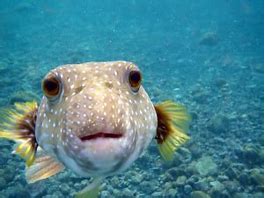
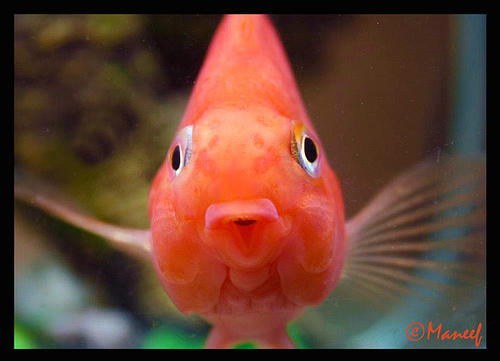
We don’t expect fish to look back, but some of the times they do, and some of the times it’s quite cute. Sometimes, we tap on the glass to try to get one fish to give us one quick look to acknowledge us in some quick, meaningless way. They usually swim away in quick, jetting motions, but some of the times they look back. “Look at this, Myrtle, he’s looking back at me!” we say to their casual, happenstance glance they offer us. When that casual glance holds, and that cute, little look back becomes a stare, it can begin to feel unnatural. Even though it feels a little odd at the outset, we stare back. We don’t have any reason for continuing to stare back, but we do, until we achieve some inexplicable and unnerving connection. If this odd connection continues, we think that they’re testing the boundaries and borders nature inflicted upon them, regarding our respective roles in the food chain. We know it’s foolish to assign human characteristics to such a brainless creature, but the otherwise enjoyable stare can lead us to consider questions that which we’ve never asked before.

Our first instinct is to believe the fish just happens to be looking in the general direction we’re standing in, and that the stare we share is nothing more than a happenstance glance. Something about this particular stare unnerves us though. We remind ourselves that they have no eyelids. They might have a membrane to protect their eyes from water, but they have no eyelids, so they cannot blink. They have pupil, and they can move their eyes, but this particular fish doesn’t even move his pupil. It’s staring right at us and through us.

What does it think it’s seeing? Is it really looking at us, or just toward us? We make a jutting motion toward the fish to establish the fact, in our minds, that it is indeed staring at us. Another, relatively embarrassing component of that motion involves our need to establish dominance, so the fish doesn’t forget what we can do to them if driven to act. The fish will react to our jutting motion, but what happens in our interiority if after the fish flinches, it assumes its former position and resumes staring? Do we complain to the management of the pet store? What if the fish stopped staring the moment we brought the manager over to the tank and it resumed staring after the manager leaves? It looks at us, as if it thinks it knows us, and it’s unafraid. There are times when it’s okay to remind other creatures that we’re their superiors, and there are times when we consider it necessary to do so. You wouldn’t be so bold if I reached into your tank, grabbed you, and did awful things to you? we think its way. We think that hard, as if to send a telepathic message. If that message is receive, the fish remains unmoved by that threat.

We know we can’t do such things, no matter how long this thing looks at us. We know those looks the other patrons of the pet store will give us if we do. We also know what we would go through on the drive home, in bed, staring up at the ceiling, remembering what a fish drove us to do. We know no one would understand, and something about that fish’s stare suggests that it knows that too. At some point in this staring contest, it strikes us that the hundreds of thousands of years of our respective conditioning inform both parties who is superior. Yet, this means nothing to this particular fish. Its stare suggests that it is challenging that conditioning, because it knows there’s nothing we can do about it.   

Pet psychologists tell us that if we own a dog who is particularly disorderly and disobedient that one of the ways to re-establish dominance is to engage it in a staring contest. If confronted by a wild animal, they tell us, the worst thing we can do is look that animal in the eye, because both parties know, on some primal level we know nothing about, that we’re challenging their essence, and any hint of this challenge enrages such beasts.

If we try to engage in a staring contest with a lion, in the lion’s den at the zoo, most lions won’t even bother looking back at us. They have hundreds of people confidently challenging them in this way every day, and both parties know there’s nothing they can do about it. They can charge the borders of their enclosure, and if you’ve seen a gorilla do this, it can be intimidating, but both parties know, on some level, that we’ll walk away laughing at their meager attempts to challenge us. That interaction is flipped by some measure, because we’re challenging their physical superiority. We’re informing them that we’re not afraid of them, but when we’re the superior in every way, as we are with the fish, what goes through us when they stare at us so long that it starts to become uncomfortable? Is it mere happenstance, or is the fish challenging our nature? Are we so confident in our stature that we continue to stare back? How long do we participate in this staring contest, to establish our superiority, and what happens if we lose?

After such a devastating loss, what happens the next time a host asks us what we think of their brand new aquarium? More often than not, we don’t invest ourselves in situations like these, but there are days when we’re feeling particularly vulnerable. There are days when the “theys” of our lives break us down, and we feel relatively small and insignificant, so we approach that trapped fish with a smile, because we know that they are a they that is unquestionably inferior to us, but there is always one fish who won’t bow down to us. These meager, inconsequential, and perhaps coincidental challenges that we dream up can affect us so much that the next time a friend invites us to look at their fish in the fish tank they have in their home, we hesitate. We know that if we begin shrieking, the fish wins. Our reputation would not only suffer at the hands of our host, but the ten people interested in her retelling of the story. Offering our host, a simple, “No thank you,” might open a big bag of questions we don’t want to answer. Yet, acquiescing to their request might bring us right back to that day at the pet store when a fish’s stare served to undermine our confidence. When we glance over at our friend’s tank, considering her proposal, we see those probing eyes, and we remember the day when we thought we knew our place in the animal kingdom. We remember how confident we were in our respective roles in the animal kingdom before that staring contest began, and though we know we can’t put all the blame for our insecurities at the fins of that fish in the pet store, its rebellious stare unearthed something in us that we never confronted before. We know how revealing it is to have a staring fish lead us to such existential questions, but it shook our confidence down to its foundation, and we politely refused our host’s request, fearing what another loss might do to our confidence.