Too Many Movies, Too Many Tropes I: The Heist Movie


How do you know when you’ve watched too many movies? Some of us know the patterns and themes so well that the joy of discovery in most films is so gone that we probably won’t be able to thoroughly enjoy another movie until dementia kicks in.

The only thing we love more than puzzles and patterns is being able to figure them out. Our favorite classic and mainstream rock songs follow a A,A,B,A,B,C,B, and B verse-chorus song structure where A = verse, B = chorus, C = guitar solo. Steve Martin once said that three beats are funnier than four. Those of us who are not in these industries usually don’t see these patterns and structures for what they are, but we love knowing what will happen next. When it happens the way we predict, we richly reward those who make us feel smart, so they keep following the patterns. When we reach a point where we watch too many movies, however, we know the beats, patterns and structures so well that the joy of discovery diminishes.

We all have past times, and I spent my youth trying to watch every movie ever made, and the VHS movie rental stores in just about every strip mall in my big town/small city came very close to helping me achieve that. In the 80s and 90s, we could grab our groceries on the way home from work, buy a pizza, and rent a movie without walking a block. We did D) all of the above on weekends and some weekdays. It was so convenient that it was a little too convenient. It wasn’t as convenient as clicking a mouse, but you get the point. 

We had cable TV back then, and about forty different channels, but there was “nothing on!” so often that we rented movies to fill the gap. We ended up watching so many movies that we watched too many, and I can now look at the year a movie was made, its genre, and the superficial characteristics of the actors involved to tell you who is going to be the good guy, the most no nonsense, yet incredibly intelligent member of the crew, and who will end up being the bad guy. I can also pretty much tell you what rhetorical devices they’ll use to progress the plot, the tropes (i.e. recurrent themes, literary devices, and cliche) they’ll drop, and its conclusion. When we reach this point of watching too many movies, a genre such as the heist film, becomes so formulaic that our pleasure of discovery evaporates. 

Heist Films

“We don’t do this for the money,” is a trope that the typical, archetype character who masterminds a bank robberies issues to his naive apprentice who doesn’t understand why the money they stole is now a secondary concern.

Heist movies fall under the action genre, so no one expects the complexities inherent in a James Joyce novel, or a plot as rich as Oedipus Rex or The Alchemist. We just want action, a whole lot of fun, and some semblance of contextual logic. And that’s where they lose me, the logic, because if I were to rob a bank, I would do it to grab as much money as I could in the precious few moments I have. The movie bank robbers do that to complete the action sequence, but once the bank robbery scene is over, the money becomes a secondary concern to them for the rest of the film. 

“It’s not about the money,” the Joker said in The Dark Knight (2008) while burning a massive pile of cash. “It’s about sending a message.” Most screenwriters don’t have the characters in their script say this specific line, but they send the message through various scenes.  
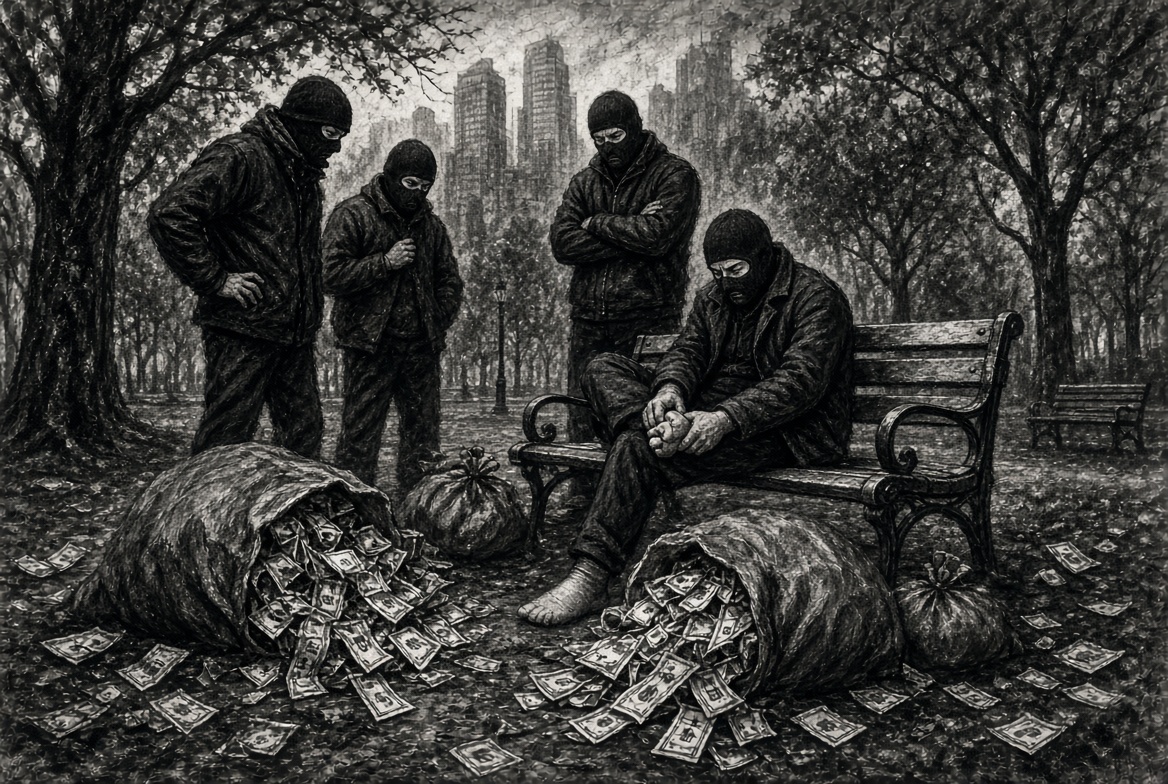
Soon after the bank robbers celebrate their successful theft, they abandon the money when one of their fellow crew members is wounded or captured. “Can’t they help their crew member AND keep the money?” I whisper to my fellow movie goers. “It’s not all about the money, Larry,” someone will invariably say. It isn’t, and I get that, but these guys just risked their lives, their livelihood, and their freedom to steal this money. Label me with whatever pejorative you choose, but if one of my crew stubs his toe, I will cater to his needs AFTER placing the money in a very secure place.

If a romantic interest is endangered, or a personal code is tested, all of that money is left behind without reservation. Just about every movie ever made contains a love interest, and what kind of man would worry about their money when their love interest is in danger? If the filmmaker doesn’t have the mastermind do something, like throw all of his money off a bridge to save her, they’ll lose about 75% of the audience. I get that too, but again, can’t he find a way to save her AND the money?  

The money is a literary device, a MacGuffin, that filmmakers employ to define the character of their characters, and virtuousness thereof, but the paradox is that real life bank robbers only resort to robbing banks as a desperate effort to get money. The movie depicts these characters as clean cut, intellectual types who have a lot going on in life, and they just happened to choose bank robbery as a profession rather than becoming an electrician, a plumber, or a bus driver. Yet, even though they’re not as desperate as the typical bank robber, we’re talking about a lot of money, and my guess is most crews would experience a lot of dissent when the mastermind instructs them to give it all up.   

The primary reason movies about bank robbers are not about money is because we’re not about the money, and we find the pursuit of money icky. Movie bank robberies are about loyalty to our fellow man, the excitement of the plan to defeat a federal bank’s high tech security system, and the chase that follows. The money they make is nice of course, but heist movie filmmakers depict those who seek to quietly enjoy it, or use it to secure a comfortable retirement as suckers, squares, and rubes who believe in the power of the almighty dollar.  

The greater sentiment that is that these nuanced and virtuous fellas are not about living materialistic lives, and they find the thought of living like Bill Gates or Mark Zuckerberg abhorrent, because Capitalism is soulless. This is made abundantly clear throughout the movie, but the crew could used some of the money they successfully stole to afford themselves a decent lifestyle while planning their next heist. “That’s not what this is all about!”  

These movies are about the slick and smooth mastermind, and his ability to research the details of the bank’s security system and locate its primary weakness. They’re about the mastermind and his crew executing that plan, but it’s mostly about the crew members, and how he assembled them for this one, last big hit. One of the crew members, the getaway driver, knows how to drive cars fast, and when I write fast, I mean fast. Another crew member knows how to handle himself in stressful situations, but he can be a little trigger happy, and the mastermind takes a moment out of the planning stage to virtue signal to those in the audience that he doesn’t want anyone hurt. He does this by cautioning his trigger-happy friend about controlling his violent impulses during this heist. The final, missing piece is Schmitty the long-since retired safe cracker who is the only one who knows how to crack the otherwise uncrackable safe that this bank has.  
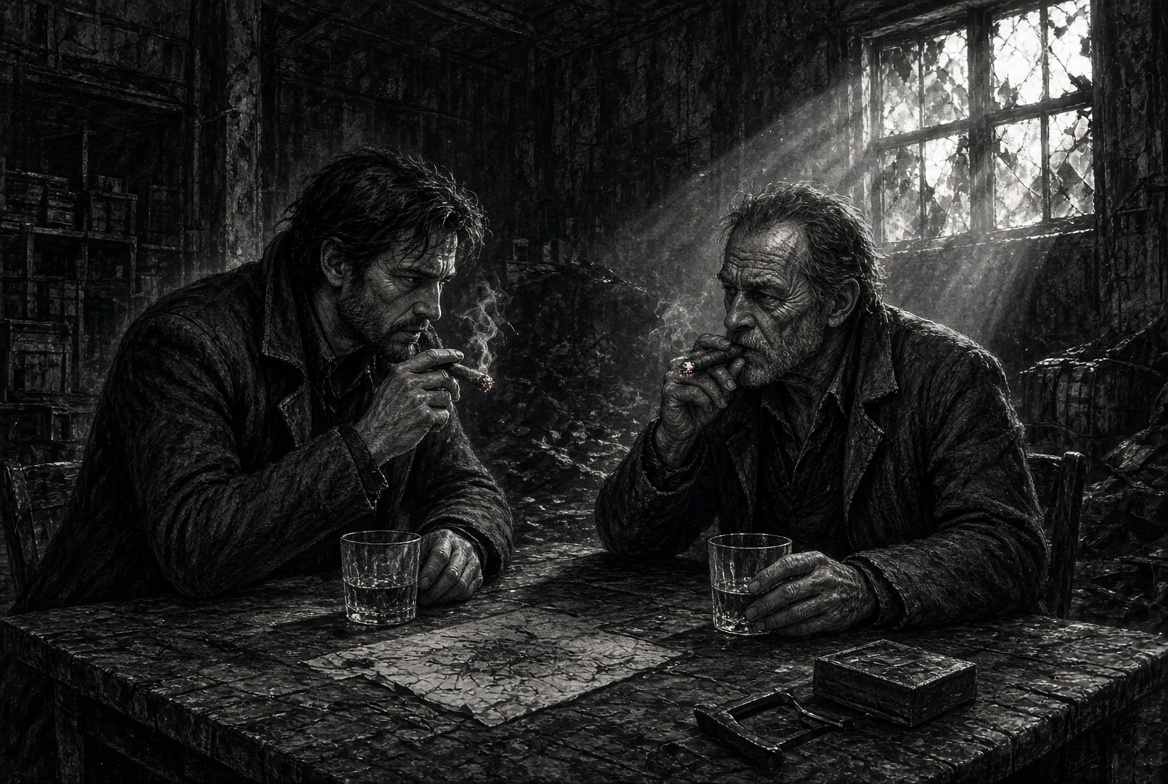
The mastermind and Schmitty sit in an abandoned warehouse smoking cigars, drinking whiskey, and talking and laughing about old times, when the mastermind turns to him, “Do you think you can do Minneapolis again?” the mastermind asks. 

“That was a lifetime ago, MacDavid,” Schmitty confesses. “I’m retired, and I have grandkids. I’m old is what I’m saying, and the ears ain’t what they used to be.” 

 “We could really use you here, Schmitty!” the mastermind replies. “If you have one more in you, we could really use you.” The scene closes with no definitive answer from Schmitty, but he reappears later, to dramatically announce his decision with a leather-crackling bro hug.   

Depending on the gritty nature of the heist film, no one gets hurt during the robbery, and as all heist movie fans know by now, most of the money the bank holds is FDIC insured (It’s not. The Federal Deposit Insurance Corporation insures against various forms of bank failure, not bank robberies.) With that misinformation, those of us in the audience think bank robberies are the perfect crime, and we wonder why we don’t rob banks often. It seems like such a victimless crime.  

As we’re nearing the close of this heist pic, we’ve spent the last eighty minutes trying to keep our mind in the off position, because we know it’s about action and fun, but that contextual logic keeps nipping at our heels like a Chihuaua. They’ve pounded this idea that it’s not about the money so often that we ask, why did they take it? Why didn’t they just live their virtuous lives without the distasteful need for money? That’s just snarky, you say, and I agree. How about the movie makers have their characters run into the bank guns-a-blazing, point their guns at people in a menacing manner, and scream, “Everybody down. Everyone on the floor!” If they don’t have a Schmitty, they can find the vice president of the bank and force him to open the vault, and then once they have all of those piles of money sitting right in front of them, they walk away. They walk away without touching that money! Message achieved! Virtue unlocked! Take that! materialistic, greedhead who thinks it’s all about the money! By filming the scene this way, the filmmakers could provide a a culturally relevant statement against the system and the man who try to convince us that it’s all about the money.

“Why did we go through all that again?” the naive, unsophisticated young lad asks the wily, veteran bank robber who just masterminded a non-monetary robbery. 

“Because it’s not about the money, Chet,” the mastermind says with a squinty-eyed look and a grimace of disdain. “It’s never been about the money, and if you can’t see that at this point, get out of my car!”  

I could see writers and directors creating a character who disabuses the notion that his decision to become an animal husbandman was not about the money. “It’s not about the money, Chet. It’s about them,” he says with a loving gaze sent out to his cattle, “and if you can’t see that, get out of my barn!” I can see movies about individuals in various medical fields, areas of law, and even those involved in selling insurance saying it’s not about the money as much as helping people, but the idea that a bunch of bank robbers are somehow more interested in righting cultural wrongs, civility, and the plight of their fellow man over money just doesn’t square with me. And if you’re going to argue with me about movie makers sending important messages out to the greater culture, I won’t hear it, because I want a contextual alternative delivered by one of the characters in the movie. I don’t want subtext, meaningful omissions, or the slick, cool guy mastermind shaking his head saying, “You just don’t get it, Chet, and you probably never will.” I want an alternative specifically stated, but I know that no movie maker will answer because there is no viable alternative that an audience will buy.  

And that, fellow heist film fans, is the core of the “It’s not about the money” heist film philosophy. We don’t want our heist films to be simplistic, of course, and a dirt bag robbing a bank just for the desperate need for more money would be too simplistic for us to watch and too simplistic for a screenwriter to write. Screenwriters want it complicated, they love twists, complicated, conflicted characters, and a deep, rich plot they consider a reflection of them. The other, less complicated reason is that we don’t want to spend our hard-earned money watching a movie that is all about the money, and the moviemakers want to appeal to our worldview that the simplistic pursuit of money is just plain icky. The final, idealized statement that it’s not about the money is supposed to make us go, “Awww!” with a heartfelt smile. We could call the movie production studio’s writers and directors illogical, ideological, or even pathological for continuing to perpetuate this trope, but we’re the ones who rent, buy, and now click on their movies so often that they continue to create them with this heartfelt premise in it … for the money.       

The Wars of the Wonderful


“The test of a first-rate intelligence is the ability to hold two opposed ideas in the mind at the same time, and still retain the ability to function. One should, for example, be able to see that things are hopeless and yet be determined to make them otherwise.” –F. Scott Fitzgerald an excerpt from The Crack Up.

Author Francis Scott Key Fitzgerald’s (AKA F. Scott Fitzgerald) quote isn’t just wonderful, it’s the product of multiplying wonderful sentiments. Wonderful writers don’t write these things to us. It’s a competition among their peers to be crowned “Most wonderful”.

We saw this in high school, during the “Mr. Wonderful” pageants, that the rest of us called drinking parties, in which the jocks would try to impress upon the available women at the party the idea that not your typical dumb jock. Their comments are just as general, and just as uninformed, but everyone who hears them considers them brave for saying, “What everyone else is afraid to say.” They praise them for their “ability to hold two opposed ideas in the mind at the same time, because … at least they had the courage to say it.” Say what, we ask. No one knows, and no ones cares. It’s more important that they said it than what they actually said. 

In one of these pageants, a 2016 awards show, a star declared, “The world is B.S.!” If one definition of B.S. is nonsense and the other is a more direct definition of fraudulent, or inept behavior, I wondered if the star was attempting to pit these definitions against each other. Her argument was either the most ingenious I’ve ever heard or the dumbest. We’ve all heard stars say things about the treatment of people at awards shows, and it might be unfair to pick on this one, but was she more informed and determined to make them otherwise, or was she just saying it to say something important. Even though stars are generally as uninformed as everyone else, they’re usually more pointed and specific with their concerns. This star proclaimed that our entire planet is not doing things the way she would proscribe for it to “un-B.S.” itself. To be clear, she didn’t say B.S., she used the humdinger, one of the real naughty words, to provocatively say that inhabitants of earth aren’t doing things right. 

Some reviewers viewed her statement as “a controversial one from a strong woman,” “valuable,” and “it still resonates!” Reviewers then interpreted her open-ended comment in long form. “What she was trying to say was …” which often leads to them clarifying her comments in a way that says more about the clarifier than the actual author of the quote. If someone said that the inhabitants of the world are BS, we can assume that it bothered everyone from her intended targets to the ones with whom she presumably pledges allegiance, but the old adage applies here. If she offended everyone with her statement, she offended no one, because we all know she was talking about some other side. If she was talking about the planet, we also have to wonder how many species, plant or animal, she offended. 

“Are you talking about us?” the Jade Plant, otherwise known as the Crassula Ovate, probably asked. She may have even offended the macaw, who were in the process of making some really powerful changes in their infrastructure to provide a better world for their fledglings. Like most Hollywood stars, macaws don’t offer a solution, because they don’t have any. They just repeat what they’ve told.

If I wrote, “The world is hopeless,” or “The world sucks!” and “We should try to fix it” right here, how would you reply?  

“What did you just say? We should try to…what were the words you used again, fix it? Has anyone ever considered that before?” 

If the world is broken, and we imply that someone fix it, in the most general way possible, shouldn’t we try to figure out who broke it first and how? If we don’t, what good are the fixes? The problem with attempting to properly source a problem is that proper investigations can end up demonizing the wrong people, the people who had the best intentions, and the methods they used that ended up leading to greater corruption and devastation. It’s best to keep our complaints general to keep the focus on those complaining, because complaining is provocative and beneficial. The nature of proposing solutions, however, can prove messy and loaded with unintended casualties through friendly fire. Proposing generic solutions can also make us feel better, but does it do anybody any good, and will our solutions eventually prove worse than the problems? The big problem with most proposed solutions is they don’t try to source the problem first, and they often make none of the people happy none of the times. 

Sending money, blindly, is the best way we’ve found to mollify all parties concerned. Money does not blame, it only helps, unless that money is stolen by the bad guys who tend to use all that well-meaning to further their goals. 

The peacocks and penguins hold charities, galas, and other fundraisers, and when the banquet employees begin tearing the façades down, everyone knows who gave what. Donations have a bad tendency to leak, to clarify the line between charity and publicity. Wonderful people don’t talk about the source of the problem, because no one really knows what it is. If we do find out, and we openly address it, we unwittingly reveal some vulnerabilities in our character. Then when we send money to fix the problem, and the problem gets worse, the recipients of our charity direct their ire at those who report that the problem is now worse. 

I’m not going to pretend that I know how to fix the world’s problems, who would? Answer, those who play dress up and pretend. “But they’re using their platform to bring attention to a cause.” True, but let’s go back to the wonderful people in the jock world. They want to prove that they’re not as dumb as everyone thinks. They have important ideas they learned at a cocktail party, and they’re not afraid to share it in a “something meaningful, important and controversial” college party where everyone is drunk, because it does wonders for their public relations scores. So, they play dress up and use their platform to address problems of the world, of which they know little-to-nothing. They just provide such in-depth analysis as “The world is B.S.!” or “One should be able to see that things are hopeless and yet be determined to make them otherwise.”

Other pretend people, leaders of local, special interest groups, then tell us that wonderful people shouldn’t try to solve their problems. It does no good, they say, to involve ourselves in their problems, because we don’t understand all the complexities involved. They then mock those who do try by saying that they’re trying to save people, and they say that word in the most condescending manner possible.

I don’t know when genuinely trying to save other people in anyway we can became a bad thing. They talk about it as a savior’s mentality, and I can discern some meaning when it comes to movies, books, or other entertainment venues, but when an individual does whatever they can to help another person, why is that a bad thing? I’m not sure if this new method of assassinating another’s motives and character is to further promote guilt, or if they want to encourage blind giving, but the driving force for criticizing those who try to help others genuinely confuses me. 

They say that not only do they not want us to save them, but they don’t need it. I have no problem with someone saying, ‘you don’t know what you’re talking about,’ because I don’t, but if someone tells me to send money, back away, and shut up, and let me handle it, I can’t help but think they’re suggesting we avoid investigating their results or holding them accountable for their actions. I also have no problem with someone saying, “I’m on the ground. You’re not. You don’t understand the depth of the problem as well as I do.” Because, again, I have no idea what I’m talking about, but I guess you’re going to have to define involvement for me. At some point they’ll drop an “It’s complicated” on us. It’s not complicated, if you sincerely don’t want us to help you, and you just want us to blindly give, you do what you do to help your fellow man, and we’ll monitor, investigate, and we’ll hold you accountable if you can’t or won’t fix the problem. “Ok, but be forewarned, you could make matters worse.”

Most wonderful people have the typical bad guys in mind when they talk about the problems of the world. If they dug deep, they might find that some of their guys are the source of the problem, so they don’t dig. They just proclaim that the world is full of problems, and we fawn. They don’t want to play the blame game, because, at this point (the point of obfuscation and diversion), who cares who caused the problem, let’s just fix it. Let’s not fight and argue, let’s fix the problem. Ok, but if we don’t properly source a problem, from A to Z and back to B, we’ll just be papering over the problem with duct tape and chicken wire, so we can plant a “fixed” flag in it that will probably blow over if a wind over 20 mph hits it. Even if we can pinpoint the exact problem, and the solution is surprisingly simple, everyone tells us it’s so much more complicated than all that, and no matter how much money we send, it never gets fixed, and that might be one of the reasons why the world is B.S.  

19th Century Medicine: Be Grateful


“When it comes to modern medicine, do you ever feel grateful?”

“I mean, yeah, but that’s like being grateful that Jupiter doesn’t fall off its axis. We know the catastrophe that would happen if it wasn’t there, but it’s always been there, so it’s tough to remain grateful for it.”

“Are you grateful for your good health?”

“Yeah, of course, but again, that’s like being grateful for good weather. We don’t notice it until the bad weather hits. We have to constantly have our perspective adjusted to appreciate health, wealth, and weather.”

“Because after reading Thomas Morris’ The Mystery of The Exploding Teeth, I went real grateful that I didn’t end up in a different time. I know what you’re saying about it’s always been there, but damn, you read what those 19th Century doctors were doing to their patients back then, and it seems like they were just guessing most of the time.”

“Look, our moms took us to the doctor, and he fixed it. It’s what they do. I never considered myself ungrateful, or taking it for granted, but it’s their jobs.”

“Fair enough, but did you ever have something your doctor couldn’t fix? Did you ever have something the doctor couldnt even source? It’s scary stuff, brother, let me tell you. They put us through an array of tests, they prescribe stuff, just to see what works, “Take two of these and call me in the morning.” What if nothing your doctor tries, works? Who do you blame? We don’t blame the researchers for their inability to develop that perfect pharmaceutical cure to what ails us, we don’t blame innovators for failing to develop technological advancements necessary to find out what’s wrong with us, and we don’t blame modern medicine for being as yet ill-equipped or ill-informed to deal with our mysterious ailment. We blame our doctor. Our doctor is the hero or the zero, because they are our face of modern medicine. They’re who we see when we think of medicine. If you’re the one they can’t cure, it would be difficult for you to be grateful for the advancements of modern medicine, but the rest of should remember that for everything we can’t cure yet, the list of what we now can should earn a whole lot of gratitude. You’re right, it’s difficult to be grateful for good health, or life in general, but reading through a brief history of 19th Century medicine should remind us all to be grateful that we are not living in constant pain, and that our species managed to survive at all.”  

Previous generations reminded us to remain grateful, “Always be grateful for the times you live in, because I’ve seen worse, and my parents saw far worse.” They don’t understand our technology, and the machines their doctors put them through overwhelm them. “Don’t take it for granted,” they say. The lead by example in this dictum, because they can’t believe they’re still alive, relatively healthy, and pain-free. No matter what they say or do, however, we were born with this technology, and we can’t help but take for granted what has always been there for us.

Author Thomas Morris might provide a better perspective for why we should be grateful, by “gently mocking” the medical practitioners of the 19th Century for their practices and procedures. Before gently mocking them, however, Morris adds two qualifiers every writer who compiles such material for a book should add before gently mocking prior eras for their lack of scientific knowledge:

“The methods they used were consistent with their understanding of how the body worked, and it is not their fault that medical knowledge has advanced considerably since then.”

It’s not their fault, I would add, and it’s wasn’t their doing. The doctors, family practitioners, or ear, nose, and throat specialists of the era were handcuffed by the constraints of knowledge at the time, and as Morris adds they performed admirably under such constraints.  

We could use the hindsight of modern medicine to call early 19th century medicine something of a guessing game, but will 23rd Century medical professionals think the same thing of 21st Century medicine? Western medicine has come a long way in 200 years, and Morris’ book emphasizes that, but professionals in various medical fields admit that Thomas Morris could write a second book called The 21st Century: We Don’t Know What We Don’t Know. As detailed in a Mental Floss article there are still numerous fundamentals we still don’t understand, including: why we cry, why we laugh, why we sleep, why we dream, why we itch, and how we age. These matters might seem insignificant in terms of greater physical health, but as the greatest mind of the 15th century, Leonardo da Vinci, once said, some of the times the questions we ask are more important than the answers, because the right questions could lead to questions we didn’t even consider asking before, which could lead to an answer even the most learned mind didn’t see coming.

The 19th Century medical professionals had precedent, studies, and literature to study and guide their decisions, but the precedents they followed, like ours, were as flawed as they were.

Thomas Morris, prefaces a quote from an article James Young Simpson, the pioneer of chloroform anesthesia, writing, “[Simpson] cautioned that it was unwise to be too hard on the “extravagance and oddity” of their methods, adding presciently:

Morris’ qualifiers illustrate how annoying it is to read modern authors assume a level of authority, even intellectual superiority, over the most brilliant minds of another era without qualifiers. These modern authors critique past knowledge and technology from the pedestal of modern research, acquired knowledge, and technology as though they had something to do with it. Few of these authors acknowledge that they, like the rest of us, are the beneficiaries of modern advancements, even though they have not personally contributed anything to the difference between the eras.  

That being said, we all know the line: “those who don’t learn from the past are condemned to repeat it.” There’s nothing wrong with mocking and ridiculing the past, because it makes the art of teaching history more entertaining, and we find mockery entertaining, but the author of such playful scorn should provide some sort of context.  

Thomas Morris pursuit of this is also admirable in another way, as it displays a takeaway, we can’t help but reach by the time we finish his book, gratitude. How many minor ailments (and there’s no such thing as minor when we’re suffering from them) can we magically resolve with two aspirin, ibuprofen, or a series of prescribed doses of antibiotics? How many procedures (currently considered routine) cure what harms us? How grateful are we to the technological innovators, doctors, and all of those who played roles (be they unwitting or otherwise) in the trial-and-error processes involved in research that have contributed to the progress medicine has made in such a relatively short time. It’s relatively difficult to be grateful for life, but as Morris’ book alludes, we should be grateful that our ancestors survived at all. We wouldn’t have the luxury of regarding our modern medicine as commonplace if they hadn’t, because as incredible as the human body is, it’s possible, and even probable, that we shouldn’t be here.

How did our ancestors survive the plague? World History Encyclopedia lists cures such as rubbing bare chicken butts on lesions, drinking chopped up snakes, and/or crushed unicorn horns as some of the more popular remedies at the time. They also list drinking crushed emeralds, arsenic, and mercury straight, with no chasers. How did they/we survive? 

The Native Americans of this era loved tobacco, and they used it medicinally. They used it to achieve a spiritual connection, prayer, and ceremony. They used it on wounds, infections, for headaches, sunburns and other skin issues. They also used it as a pain reliever to relieve toothaches and earaches. They also used it to revive the dead.

, In the 1970s, Cardiopulmonary Resuscitation (CPR) was widely taught and accepted as the standard emergency procedure to use when someone stops breathing. This may have started in the 19th century, but they added a twist. The twist, as stated in Other periodicals suggest that physicians played around with blowing tobacco smoke into the mouth and nose. Influenced, perhaps by the Native Americans preference for tobacco products. The Native Americans, the Catawba in particular, had a twist, in that they didn’t believe blowing smoke in the mouth and nose effective. They taught medical professionals of western origin that blowing smoke in the rectum would prove more effective in reviving the individual. My guess is that as much as they admired the Catawba, the western doctors wanted to trial and error this themselves. They did, and they found it more effective. I don’t know about you, but I would love to read the notes that led them to accept smoke enemas, or glisters, as the published standard emergency procedure in the 1700s. It was believed the smokes warmth, irritation, and nicotine would stimulate the heart and respiration.

“The nicotine in the tobacco was thought to stimulate the heart to beat stronger and faster, thus encouraging respiration. The smoke was also thought to warm the victim and dry out the person’s insides, removing excessive moisture.”

The “How did we survive?” head-shaking laughter the follows hearing such measures might cement the fact that no one ever tries to pass such foolish nonsense along again. While we’re laughing, however, let’s keep in mind how much information, innovation and technology benefits our definition of modern know-how. We could go through that list, but even if we bullet-pointed it, it would be so lengthy that our eyes might glaze over, and we might accidentally dismiss a most vital discovery, such as the germ theory.

How did we survive the years preceding someone’s idea that they might be able to scientifically confirm the idea that the onset and spread of disease might have something to do with microorganisms, pathogens, and germs. They suggested that eating spoiled food, drinking stagnant water and poorly preserved alcohol, among other things could cause disease and the spread thereof. Modern readers might “Of course!” such findings now, but it rocked the scientific community at the time. Although the records show that the idea that microorganisms might be the cause for the spread of disease dates back to ancient civilizations, the scientifically-backed idea was credited to Louis Pasteur and Robert Koch between 1860 to 1880, and that was probably made so late in the 19th century that we can guess that it wasn’t fully implemented by family doctors (AKA Ear, Nose, and Throat doctors, or ENT) until the early 20th century. Think about how many lives have been saved by the idea that stagnant water, spoiled food, and fermentation of wine could cause diseases. This first officially documented scientific discovery also paved the way for the first official, scientific discovery of the first, widely used antibiotic penicillin by an Alexander Fleming.   

The ENT doctor is our face of modern medicine, much like the police are the face of law in our experience. Your friendly member of the police enforce laws passed by our federal government and our state legislatures. If we examine the processes by which our doctors and policemen work, they are at the bottom of a large, complicated pyramid, but they take all the abuse from the public for silly laws and incorrect medical procedures, cures, or advice they offer us. Doctors have nothing to do with the research that helps them make determinations on what courses to follow or prescriptions to write. They also use the technological innovations created by others to pinpoint our ailment, so while we could say they are beneficiaries of modern medicine, future experts might say our modern physicians were captive to the limits of 21st century medical knowledge at the time.    

Do we expect our ENT doctor to perform research in a lab before they diagnose us? Do we expect them to trial and error the medicine they prescribe? No, they have to act on the knowledge of those who specialize in those areas, and the 19th century ENT doctors and surgeons were no different. 

How many modern patients enter a general practitioners’ office, see a specialist, and undergo the array of tests we currently have at our disposal, and we still don’t know what’s wrong with them? We hear it all the time, patient A entered the office with a condition that mystified the most brilliant minds of medicine who examined her, and she died before anyone could properly source her ailment. I’ve known such a situation personally, and I’ve witnessed it intimately. I only write that to suggest that my empathy goes out to victims, family members of victims, and anyone who knows someone who has experienced such a matter, but there are times when no one is to blame. When we’re in such a desperate state, or grieving the loss of a loved one, our first inclination is to blame someone for not recognizing her ailment sooner. We blame her doctors, her doctors blamed the specialists, and they all quietly threw their hands up in the air in frustration. Who was at fault, or is anyone? Our advances in modern medicine, since the 19th Century have been so remarkable that they lead us to believe that we’re at the final frontier. We think if her parents could’ve only found the most brilliant mind of medicine, with all of latest technology available to them, and all of the information research has provided, we think she could’ve been cured. This isn’t to say there hasn’t been instances of malfeasance and misfeasance in the medical community, but as opposed to the TV shows we watch, some of the times even the most brilliant encyclopedic minds of medicine won’t know, because we don’t know yet. That’s the harrowing, humbling truth that no self-respecting doctor, or anyone else in the medical field, will admit is that in some cases the science just isn’t there yet. 

If we were able to interrogate a family doctor, a surgeon, or someone else in the medical profession of 19th Century, I imagine a confident professional of that era might say, “Mock away, we deserve it on some level for our lack of knowledge, but you cannot say it was for a lack of trying. We cared deeply what happened to our patients, from the little, old ladies who complained about chronic ailments to devastated small boys, and everyone in between. These were not only our patients, they were our neighbors, and members of our community seeking our knowledge, guidance, and medical assistance to relieve them of horrific illnesses and injuries, and we did our best, with our era’s best knowledge, technological advancements and research, to help them in every single way we could. It’s not what you have today, so mock us all you want, but you cannot say we weren’t trying.”

Anytime I read such a compendium, one of the first things I think about is time machines. We all love the speculative concept of going back in time to talk to long-dead relatives, historical figures, and to experience our romanticized notion of living, if only for a moment, in a different time. The implicit warning books like The Mystery of The Exploding Teeth leave is, if some brilliant mind ever develops the technology to travel back in time, that pioneer taking one giant leap for mankind should check, recheck, and triple check to make sure they get one key component of their technology perfect before we enter into their machine: make sure we can get back. The authors of speculative fiction devote very little space to this need to get back to the present. It’s not very sexy, and no matter how much an author of fiction loves their character, they’re not concerned with the ramifications of their character getting stuck in another time period. They can play this short-term game with their characters, because their characters aren’t real. A real character who knows anything about the research, technology and science that influenced the decisions made by the medical community of the 19th Century should make getting back their primary concern, because while they will experience worldwide, historic fame for the technology of their contraption, if they’re not able to get back, they might not get to enjoy that fame for long.