Rilalities IV: The Rilalities


6175ASTTEDLThe Rilality for Album of the year goes to… Sufjan Stevens Illinois.  I know it came out in 2005, but with every critic going bonkers over it back then, I decided I would hate it circa 2005-2006.  In 2013, I realized I was wrong.

Runner up: Secret Chiefs Book of Souls Folio A. The most original album of the year by a mile. Folio A, like all Secret Chiefs’ albums, has very few lyrics.  So, if you’re a lyrics guy, this album isn’t for you. It does have some of the most complex arrangements I’ve heard on an album since… the last time Trey Spruance decided to put out a Chiefs’ album in 2004.

(For a longer review of this album, go here

In the age of iTunes, it appears that either it’s difficult for some artists to make complete albums, or it’s become increasingly difficult for me to listen to them, because iTunes has spoiled me into making my own shuffle albums out of the artists’ best individual tunes. ITunes has also opened my eyes to the filler that an artist loads his albums with, and I don’t listen to those individual tunes as often as I once did, just because they’re from “my guys”.

2013 was also a year where I moved past some of my guys, and once you’ve made the move past some of your guys, it’s difficult to go back. I used to hate it when people told me that they’ve just moved past Led Zeppelin. “They’re great and all, and I spent years listening to them, but I’m just done with them.”  How can one move past Led Zeppelin I wondered. Then I did, and then I moved past Radiohead, Alice in Chains, Verve, and Soundgarden. The latter three groups regrouped, and I tried to get back into them, but I realized that in some manner that’s hard to describe, I’ve moved on. I moved on in a manner that if they came out with the most brilliant album they, or anyone else, could produce, I wouldn’t think it wasn’t as good as the body of work they produced back when they were my guys. The groups I listen to now may not be better, in the truest sense of the word, but they’re different, and when you move past a group you need something different.

You-Are-NOt-So-SmartThe Rilality for Book of the Year goes to… You are Not so Smart by David McRaney.  Again, it came out in 2011, but I’m not a professional critic, and as such I’m not held to time constraints.

Runner Up: I Wear the Black, by Chuck Klosterman.  I disagreed with Klosterman as often as I agreed with him, and that’s exactly what everyone should want in a book.  Klosterman is not meek when offering his opinions, unless he is criticizing staples in our society… like Bruce Springsteen.

The Rilality for the book of the year, next year, will probably go to: Going Clear by Lawrence Wright.  The award winning writer of the terrorism tome The Looming Tower may have even topped that book with this one.  I’m about halfway through this exposé on the religion, called Scientology, and I am obsessed. Wright is a ‘Just the facts ma’am’, Hemingway type of writer. For those that enjoy writing more in the  Doris Kearns Goodwin mode, you may not enjoy this style of writing.  For those curious about this religion –that were too young when the actual revelations occurred– this book is an account that is proving to be invaluable to this ever-curious reader that enjoys the ‘just the fact ma’am’ Jack Webb approach.

There are very few fiction writers that shocked me with their modus operandi in 2013. The last one to do so was Chuck Palahniuk. He was shockingly good, but something shocking isn’t always good. It may be that Palahniuk, and all other fiction writers have simply tripped my tripwire so often that I cannot be shocked by their prowess anymore, but I couldn’t find any piece of fiction shockingly well written in 2013.
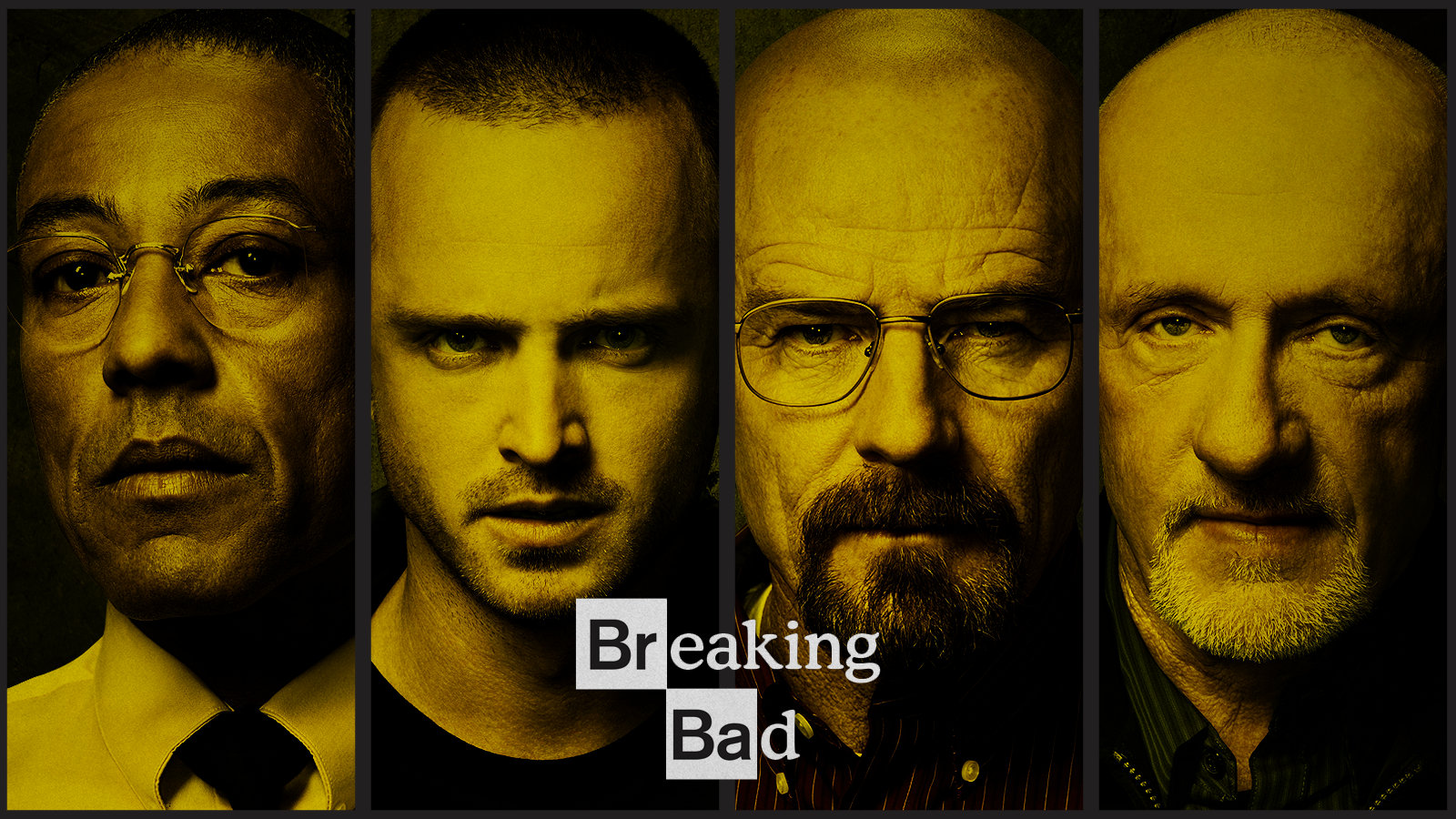
breaking_bad_by_motionshowcase-d5l3atmThe Rilality for TV show of the year goes toBreaking Bad. I would love to tell you the line that put the show over the top for me. I refer to it as the line, because the more I digested the subtext of what Walter White just said, the more my jaw continued to drop. Entertainment Weekly, Rolling Stone, and TV Guide focus on the moments of TV, but I focus on lines, and this was the best of the year in my humble opinion. It was such an incredible line that I wondered if Vince Gilligan, and his writers, had been sitting on the line for the past few seasons. I also wonder if Gilligan used the line in his pitch to the networks, as a way of summing up the series. I would love to tell you what this line is, but I don’t want to ruin it for all those people just now watching the series on Netflix, or DVD. The line needs to be heard, chewed, and digested individually for maximum effect. The line was so elemental to the series, that it separated Breaking Bad from all the gritty, new age style TV shows I have loved over the years, including, but not limited to, The Sopranos, Mad Men, and Justified.

One interesting nugget from the general reviews of this show was that some of the seasons were filler. My guess is that they probably were, but I have to wonder what the general perception of the show would be if it were but a three season series. “We want more,” might be the general outcry, and the five season arc seems more satisfying. I think The Sopranos followed a similar arc. The first two seasons are action packed, the studio AMC and HBO respectively, cried out for more seasons, and the writers happily complied by introducing filler seasons to complete the previously planned three seasons. It’s just a theory, of course, but I think all parties concerned feel more satisfied with five to six seasons than they would three. 

Runner up: Justified. Boyd Crowder may be one of the most original, and finely crafted, bad guys ever created for TV. I know, I know, Crowder was created by Elmore Leonard for the short story Fire in the Hole. I read that story, and I recognized the gestational elements of the Crowder character there, but Justified’s writers Graham Yost, Chris Provenzano, Fred Golan, and actor Walter Goggins have taken the Boyd Crowder character to a level I’m guessing Leonard had to find impressive.  (Leonard obviously didn’t see the same possibilities of the Crowder character that the show’s writers did, as Leonard killed the Crowder character off in that short story.)

The other characters—Marshall Raylan Givens, played by actor Timothy Olyphant, and Chief Deputy U.S. Marshal Art Mullen, played by Nick Searcy—are also great, and dynamic, and almost as impressive, but the deliniations between great movies and shows is always the bad guy, and there aren’t any better on TV today than Goggins’ Boyd Crowder.
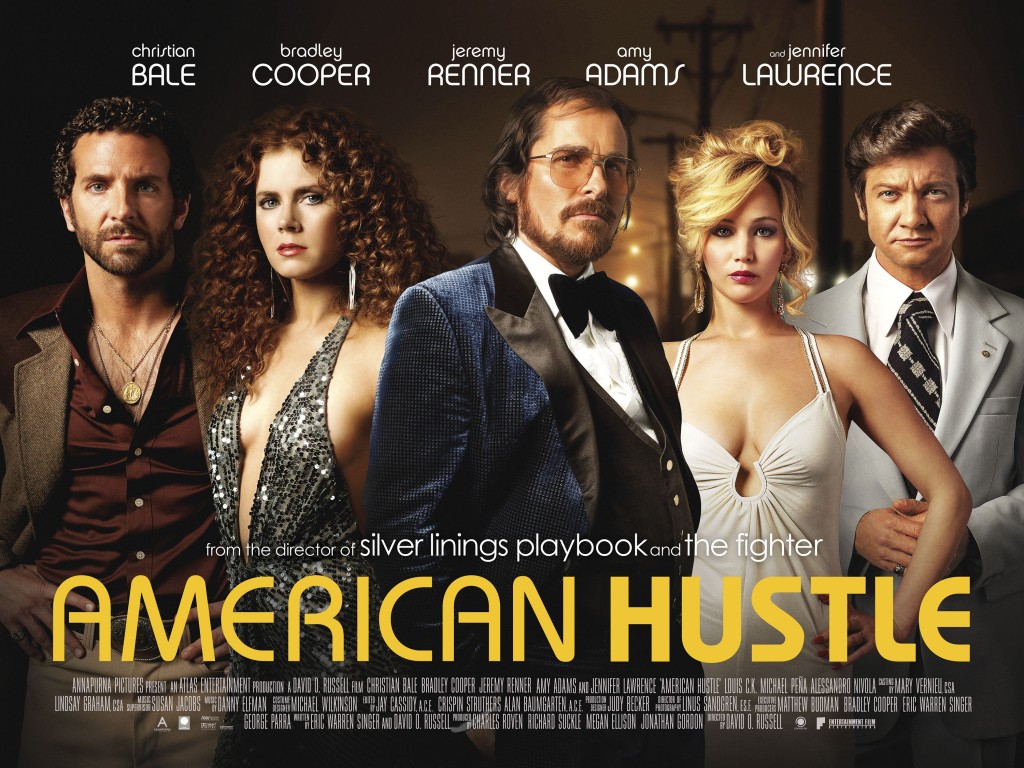
american-hustle-posterThe Rilality for movie of the year goes to… American Hustle. The movie wins based largely on the fact that I didn’t go to a lot of movies in 2013, and I wasn’t overly impressed with those I did. Bradley Cooper turned in a good performance, but Christian Bale did something different. It seems he does in just about every role he accepts, and that makes him the current, best actor in movies today.

Runner up: Blackfish. I may be biased in this area, since I’ve loved killer whales, Orcas, for most of my life, but when I started doing research on the elements in this movie, I knew that the movie makers reached me on a level that most don’t.

I’ve watched too many movies to continue to enjoy the important movies that I’m supposed to like, and I no longer watch actor vehicles that are done to impress Oscar voters. Most dramas seem to be as reductive in their problems as they do in their solutions. Action movies have a way of leaving me with the idea that I’ve already seen this movie so many times before. I see the formula from another action movie that influenced this movie, while I’m watching it. I spend the entire ninety minutes trying to shake off the idea that the original was better. This may give the reader insight into my age. It may also give readers some insight into what my fellow movie watchers, and TV show watchers, go through with me, but I have a problem shutting it off for just a little bit to enjoy most modern movies. Comedy, in general, is so derivative, and subjective that most movies now feel the need to go over the top to make their mark. Over the top can be funny, of course, but it’s difficult to maintain that level for an entire movie, and most of them do not do this well.

This may not be the best “best of” list for those seeking the best ofs, and if you want to consider it the cynical “best of” have at it, but I don’t consider most entertainment vehicles “must have, must see, must read, and must hear” anymore, and I find that the marketing departments that promote their vehicles in this manner tedious.


Rilalities III: Thoughts


Posted by Muyiwa Okeola

A Thought: Anti-religious people go nuts when the religious Creationists point out that there are gaps in Charles Darwin’s attempt to explain creation. “How could there not be gaps in his Theory of Evolution?” they ask. “Darwin was dealing with mid-19th century science.” They also caution that we shouldn’t insert God, or mystical miracles, into every gap we currently have in our current explanations, based on our current levels of science. The import of this message is that we have already filled many of Darwin’s gaps with our current levels of science, and we will fill even more as science advances in the future. Yet, some of these people, who place such prominence on science, are perfectly willing to fill the gaps of our current levels of science on global warming with the explanation that man did it.

On that note, how many future generations, with their progressed levels of scientific knowledge, are going to be laughing at global warmers in the manner we currently laugh at bloodletters and flat earthers? There were even some people, see Aristotle, who believed that a slab of beef spawned maggots. Scientists warn, based on these precedents, that we shouldn’t leap to conclusions, or fill the gaps of our current scientific knowledge, with explanations that support our personal agendas, but some of them claim that all the science is in on … everything, and there’s no need for more debate on the subject, no matter how we arrive at truths through the scientific method.

B Thought: We all learn lessons in life, no matter how old we are, and no matter how many times we have already learned those lessons.

C Thought: Debate matters of substance with enough people, and you’re bound to come across extremes. Those of us who discuss matters with representatives of the extreme faction of the other side, find it enjoyable to nuke their ideas out of the park with facts. If you seek such discussions often enough, however, you’re bound to run across the extreme faction from your side. Some of these people, unfortunately, go so far out of the parameters that you may initially think that the other side may be right about their characterizations of your side. They’re not. The person in front of you is simply a characterization of the extreme faction of your side that diverts themselves away from the important matters of the day with trivial matters. I don’t know if these people strive for the trivial, because they’re not able to compete in the knowledge of important matters, or they find the trivial more entertaining, but they are inordinately intrigued by the trivial, and they exist on both sides of the aisle

D Thought: Most artists have one masterpiece in them. Everything they do after that is, in ways large and small, derivative of that one master. Those of us who get excited when we experience a masterpiece, should understand how difficult they are to create. Most of us characterize the masterpiece as brilliant, and we think the next piece should be just as brilliant, and if it isn’t, “it sucks!” An overwhelming majority of us don’t know what it takes to create a masterpiece, much less something of an artistic nature, but we enjoy giving our uninformed opinions for the mileage they gain us.

E Thought: Some watched the movie version of Fight Club and fell in love with the romanticized notion of blowing up banks to finally achieve economic justice in this unfair system. The import of this dream is that those who are burdened by debt, would be no more, and we could reset the system to finally give the poor the chance they never had to be rich. In this dream, those who inherit money, would have to start over from scratch. Those who gain money by being lucky, or being in the right place at the right time, would have to do it again. Those who accumulate money by ill-gotten means, would have to start over from scratch, and those who haven’t been afforded a chance to succeed in our unfair system, would be able to have another crack at the system.

Let’s put aside the ridiculous notion that blowing up a couple branches, or a couple banks, that house a couple computers, can accomplish anything. Let’s say, for the purpose of this argument, that some Electromagnetic Pulse (EMP) bomb were able to comprehensively wipe out all data, and all Americans were afforded a restart. How depressing would it be, to these dreamers, to realize that people are, in fact, different? How depressing would it be to them that some people are more talented, more industrious, more ambitious, more creative, and more willing to risk it all for more? How depressing would it be for these people to finally achieve hope and change, only to realize that everything would eventually cycle back? How depressing would it be when all the same millionaires are the same millionaires and billionaires ten years after the EMP bomb occurred? It’s not only possible, it’s likely. Most of those who accumulate the millions and billions they do, do not do so by birthright. Most of them knew how the system worked so well that they could manipulate it again, if called upon to do so, and they might enjoy the challenge. In this post-EMP world, these people would know how to raise capital better than we would, they would know how to form coalitions better than us, and they would be far more willing than the rest of us to risk it all on some idea that they just thought up. We, theoretical dreamers, would be living in John Lennon’s Imagine world, while they would be re-invigorated to prove themselves all over again. This event would prove to be only be more depressing to those dreamers to eventually realize that they couldn’t do it yet again.

F Thought: One of the primary arguments against the stop, question, and frisk law, used by the police in New York City, is that it violates the Fourth Amendment, and it allows for some degree of profiling. Most of those that argue against this law do not want it finessed. They want it ended. An interesting aspect of the law, that I hadn’t considered before, is that some leaders have been screaming for generations that government do something about the crime that occurs in specific neighborhoods. They’ve said, for generations, that government leaders ignore the crises that occur in some crime-ridden neighborhoods, and they’ve said that the police virtually ignore those neighborhoods. Yet, when a government, and its police force, do attempt to do something, and that something is the stop, question, and frisk law, the leaders claim that it unfairly targets some in some specific neighborhoods where crime is the highest. The answer, of course, is that those leaders, screaming the loudest about the fact that the government wouldn’t do anything to solve crime, and that most police forces won’t even go into those neighborhoods, never wanted solutions. They just enjoy the fruits of the labor involved in screaming.

G Thought: Why do serial killers in movies, and on TV shows, turn the TV off when a news report of their spree makes it to air? I understand that the screenwriter is trying to establish the fact that the killer is not doing what he’s doing for fame. “This particular killer has a more gruesome motive,” the action of turning the TV off attempts to suggest. “His malady is so much deeper than all that. This particular killer is not your typical, garden variety serial killer.” In one particular show, Netflix’s The Fall, the serial killer plays with his child while the TV broadcasts a press conference with those in charge of the investigation detailing their findings, and he appears to be only symbolically interested in the broadcast. When it’s announced, by the serial killer’s wife, that dinner is ready, he shuts the TV off, mid-press conference, and takes the daughter to the dinner table. It’s cool that he doesn’t care, and it does characterize him as something different than what we expect, but shouldn’t that killer want to know how the law’s investigation is proceeding, so he can, at least, adjust his spree accordingly?

H Thought: Anyone who argues against the idea that most Americans are ignorant when it comes to the subject of Economics, needs to watch an episode of TruTV’s Hardcore Pawn. Pick any episode, and you’ll see a customer walk in with something of relative value, and you’ll hear them assign it value. “I want $100 for this ticket to (a concert by the band) Journey!” said one particular customer, on one particular episode. When she was asked how she arrived at that dollar figure, she couldn’t do it. When she was informed that she wouldn’t be getting $100, she was outraged. “I want $100!” 

These customers don’t care that they’ve just entered a pawn shop –that is not going to give them face value, much less fair market value, for their product– they just want their $100, and they usually “don’t care” because they don’t know. They know nothing about economics, bartering, or the fact that a pawn shop is in the business of making as much profit off their products as possible. They don’t even know enough to know anything about the bartering process involved in the pawn shop world, they just want their $100. I don’t want anyone to think that I approve of what they do on the show, or in their shop, for I think they shortchange most of their sellers, but if I were to enter this, or any pawn shop, I would walk in knowing that I probably wouldn’t receive the value that I assigned to this product. My goal would be to get something more than I fear I would get. And perhaps this fear, and this knowledge of how the pawn world works, would lead me to getting far less. Regardless, I can assure you that I wouldn’t be one of these crying and screaming idiots that ends up getting tossed out on their ear, on a nationally broadcast television show, or if I were, I wouldn’t be signing the release that allowed them to air it. It would officially be the most embarrassing moment of my life. To these people, apparently, it’s just another manic Monday.

Rilalities II


My Dog the Racist. My dog growled at a pedestrian walking up the block the other day. He then proceeded to bark two more times at the individual. The pedestrian was a black kid. Now you may say that my dog does not have the cognitive ability to be racist, but ignorance of the law is no excuse. You might believe that my dog doesn’t know the difference between a black kid, and any other kid, but I do. I know that any dog unfamiliar with the warnings of George Orwell needs to be taught that in their world, the black kid needs to be considered a non-person, as far as my dog is concerned. It does not reflect well on me, his owner, if he barks at anyone other than white males. I know barking at black people is tantamount to racial profiling, and that based upon my dog’s ignorant behavior he and I need to have an inter-species conversation on race if Dogswe don’t want to be considered cowards. In this inter-species conversation on race, I would tell my dog that it is not enough to say that some of the anuses you sniff are black dogs. Those are the excuses of scoundrels seeking a get-out-of-jail-free card on racial sensitivities. I would tell him that his barking could do great damage to that black kid’s self-esteem, and I would tell him that any future barking would be considered a hate-crime regardless of his intentions and motives, and that it could carry with it hate-crime punishments. I also know that no matter how confused my dog may be at a scolding, he will not be doing anything like this again in my home any time soon. 

Then...now...who cares?
Then…now…who cares?

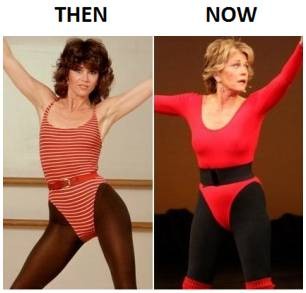
Haloed Hollywood.  A fawning Hollywood article fawned over the “Over forty!” bodies of some celebrities. The article focused its fawning on the bodies of Jennifer Aniston, Halle Berry, and Jane Fonda. One would think that a true feminist would read such an article and think that if these women worked half as hard on their minds, it would do a great deal to further the idealized image of a strong woman for those young females that look up to them. These same, young women will learn that if these women took that time to focus on cultivating their intellect, at the expense of their figures, fawning Hollywood writers wouldn’t care what they thought.

Those impish impoverished. It seems almost innate that those who receive some sort of government assistance despise those that assist them. Is this based on pride, or is it that if the assisted let up on the pressure, those who assist them won’t feel the need to assist them more?

Superior Inferiors.  Why is it that if an individual is struggling with a contraption, nine out of ten people would rather laugh than help the struggler in anyway? As an individual who has had more than his share of embarrassing moments struggling with contraptions, I’ve always considered it important to assist those that struggle in a manner I deem appropriate to the situation. The best thing I’ve come up with is to offer communal condemnation of the product:

“Those things are real sons a bitches,” I will say.

This subtle form of empathy seems to help the struggling individual far more than any physical assistance will, for most men don’t want physical assistance.  It often furthers their humiliation for someone to step in and fix the contraption for them in a manner that makes it look easy. My little subtle form of empathy not only lessens their feelings of public humiliation, but it keeps the hyenas —looking for any reason to start the laughing— at bay.

If that subtle form of empathy isn’t appropriate for the given situation, I will say:

“Hey, just to let you know, I could not have done that any better myself.”

The old adage: “Treat others the way you want to be treated” comes into play in situations like these for me. Others —the nine out of ten— get a lot of mileage out of watching another struggle … This is the case, more often, if the laughing hyena don’t like you in ways they won’t admit.

On that note, most find it more enjoyable to laugh at those they consider superior. Most people won’t laugh at an individual they consider inferior. It may increase their feelings of superiority to laugh at the inferior, but they often wait till later to laugh about it. If an individual is superior, in some ways, and they are struggling with a contraption, it is deemed acceptable at the time to laugh at them during their struggle. They can take it, the hyena thinks, they have an ego that might need to be diminished a little, and if they don’t, well, they’ll get over it. An inferior individual gains sympathy from onlookers for their difficulties not laughter.

Ah Hole Arrogance. It’s easy to spot arrogant, Ah holes in life, but what about the soft and squishy Ah holes? They’re out there. They just know how to conceal their nature better than arrogant types.

“Please call me Ernie,” they’ll say when they greet you in a formal setting.

‘Well, I wouldn’t be calling you Mr. Brubaker if it wasn’t my job to do so,’ I want to say.  I don’t say this, but to their utter frustration, I continue to call them Mr. Brubaker.

“Why do you continue to call him Mr. Brubaker,” fellow associates will ask me. “He said he prefers to be called Ernie?”

I can’t help but think that there is some kind of game being played here.  I can’t help but think my fellow associates are either excited that Ernie has allowed them to see themselves as an equal, or that they can’t wait until they have achieved Ernie’s stature in life, so they can copy his formula when they run into one they can deem subservient.

Whatever the case, Ernie is not trying to make you feel better about yourself so much as he is trying to lift his own stature by being ‘one hell of a good guy’ that decrees that you are permitted to be more casual around them … even if you’re not permitted to be by your boss.  It makes Ernie-types feel like a wonderful person to allow you this privilege, but it makes those that will call him “Ernie” look like a court jester that has just received permission to look the king in the eyes. At least arrogant Ah holes are in your face with their arrogance.

StefaniThe Confused Mind of a Cool Celebrity: We’re all fascinated with the lives and thoughts of celebrities. After achieving some fame in the group No Doubt, Gwen Stefani went back to her hometown in Orange County, the “OC”, California.  At one point in the concert, she shouted something along the lines of: “We’re happy to be back in the OC!” The crowd all leapt to their feet.  After allowing that applause to continue for a while, she said: “Settle down, it’s not that cool.” It was funny, in a nihilistic, apathetic manner, and the apathetic, cool kids in the crowd might have considered her off the charts cool for doing this, but I wonder how many of these kids had their minds changed by what Ms. Stefani said.  We’re all striving to be cool, and we don’t care who we have to diminish to get there.

I knew young people from Orange County, and while they were just as apathetic about their hometown as every other teen, they lived with this belief that, at least, they were cooler than all of those nerds from Omaha, Pocatello, and Morgantown. They lived with the belief that they were somehow superior, because they grew up in the hometown of the Beverly Hills 90210 and the “OC” television shows. They had L.A. and Laguna Beach, they were Hollywood, metropolitan, and they believed they knew things that hayseeds and hicks from the sticks could never know. So, like every teen, they had mixed and confused thoughts on the matter, but they told me that they were from the O.C. with a mixed measure of pride. So, when Ms. Stefani said this —in an obvious attempt to appear cooler than Orange County and all of its residents in a attendance— did she change any minds that night?

Most clear, rational thinkers know that Ms. Stefani is nothing more than a mindless celebrity who has a team of people around her that write songs, or complete the lyrics of those songs that she’s written, so that they come off as cool. She might be perceived as brilliant in some small corners of this society, but few of those outside the very young demographic would consider her to be an esteemed social commentator. Those that do, do so based on the fact that she’s so good looking, and we all want to know what it takes to be that good looking. She then takes advantage of this pedestal by crushing all of those that believe they have that affinity people feel being from the same locale. She rips them for believing that being from somewhere means anything, especially if you derive some sort of pride from it.

The import of Ms. Stefani’s message is that it’s not a hometown that makes a person cool is a good one, as it suggests that you’re going to have to work your tail off to create a niche. I believe that Ms. Stefani took this one step further, suggesting that  ‘you’re never going to be as cool as I am, just because you’re from the same place’.  I don’t know if Ms. Stefani is insecure in her status, if she feels a need to remind her fans that they are beneath her, or if she simply had some bad bacon that morning, but if she was able to convince a bunch of mindless twits that their hometown wasn’t as cool as they thought it was, how much of a reach would it be for these same people to vote for the person Gwen Stefani tells them to, based on the fact that the other guy isn’t cool? Before you say, “That’s a ridiculous leap,” scroll up and look at a photo of her again. She’s slender and very good looking.