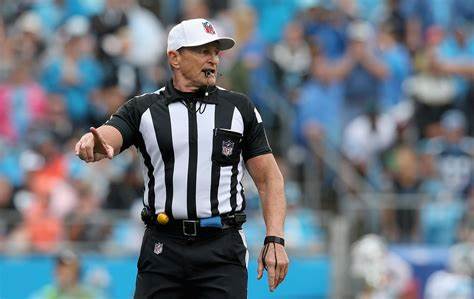
New NFL Rule Proposal on Penalties: “No Sizable Advantage”


“How many penalties are we going to call in this game?” the National Football League (NFL) fan asks when they watch a game now. We know we’re not alone when we say, “Something has to be done here. This is just getting ridiculous.”

“Don’t complain unless you have a proposed solution,” my 6th grade teacher said so often that it’s so ingrained that I wouldn’t write this article without a proposed solution.  

Have you watched an NFL game recently? Of course you have, we all have. Have you noticed the number of penalties called? Of course you have, we all have, dating back to our dads and our grandads. Our complaints usually center around three things: Too many rules, too many flags, and how all of the above often prevents the players from playing the game. We blame the on the field NFL referees, which is a little unfair, because it’s not their fault. They’re the face of the NFL rules developed and handed down by the NFL’s Competition Committee (NFLCC), and those rules are so numerous and restrictive that when officials don’t throw flags, players complain. They’ve become so accustomed to so many flags being thrown that when they’re not the players are shocked. We all are. In some ways, I think NFL officials would welcome a new rule by the NFLCC that takes some of the burden off them by reversing the current trajectory of annually adding so many rules that it inhibits the fans’ enjoyment of the game. Let these incredible athletes play the game to determine the outcome. The collective we should vie to go back to the day, not so long since passed, when the NFL, the NFLCC, and the NFL referee’s goal was for no one to know their name at the end of the game. That’s gone. It just is. 

Another point of emphasis we should add here, to sympathize with the average NFL referee, is that they, like most of us, are graded on performance. They are heavily scrutinized. They’re graded on accuracy of course, on calls made, on the flow of the game, on proper positioning and general professionalism. In the 2021 regular season of the NFL, referees made 11.8 calls per game, up 4% over 2020. In 2023, referees average around 12.5 calls per game. That .7 isn’t a huge uptick, but it does feel higher. 

The next question we have is has the NFLCC added .7 more penalties occurring on the field? Is there stricter enforcement of the rules, or are referees more scrutinized than ever before? After every game, referees are scrutinized on a play-by-play basis, and they receive a coaching session on how they could’ve called various plays better. At the end of the regular season, those referees with the highest grades make the post-season roster of referees. 

Somewhere, in the recent history of the NFL, the NFL’s Competition Committee (NFLCC) realized that they went too far making rules in favor of the offense. They realized that were making it almost impossible to play defense without some sort of penalty being called. It’s one thing to institute rules that protect players from injuries and potential injuries, but offense-friendly rules progressed so much that some former defensive stars of the NFL said things like, “I’m just glad that I don’t have to play in the modern game.” Some former defensive stars suggest that some of their hits, and the methods they used to defend a player, would’ve been legislated out of the game. (Think Rodney Harrison, Ronnie Lott, and Ray Lewis.) The NFLCC decided, in their infinite wisdom, to correct that unfairness, perceived or otherwise, by instituting more rules and more penalties, this time on the offense. That, of course, resulted in more flags, tons of them.

I don’t know if this was a general practice that dates back decades, but the current NFL players is now coached, in sessions, how to comport themselves according to the rules. In the past, I can only imagine, players went through drills and coaches said, “Yeah, that’s illegal now, according to the new NFLCC rules.” The players are now coached in closed-room settings put on by an instructor from the NFL. If this has always occurred and I’m unaware of it, that’s fine, but it appears as those there are so many rules now that the average NFL player has such a tough time keeping up with what’s legal and illegal that they need a closed-door session, put on by the NFL, just to keep up. 

There are now so many flags thrown a game that not only does it inhibit the game, but it gives the officials far too much power in determining the outcome of games, power I would guess NFL referees would gladly relinquish. Rather than pass more rules to counter the counter, I suggest that they institute the two new words sizable advantage to the 2023 NFL Rulebook.

Anyone who has watched the NFL for as long as I have, has blindly accepted meaningless and ticky tack penalties for most of our lives. We’ve seen them so often and for so long that we accept the idea that officials are going to make certain calls. We’ve accepted that a twitch by a left guard is a five-yard infraction called illegal motion, for example, but does that twitch give the offense a sizable advantage in that play? As I wrote, we’ve accepted this for so long that it’s accepted. Yet, if there is no discernible advantage, and the left guard returns to a stationary position, the 2023 NFL should not require that the official throw a flag under the new, 2023 no sizable advantage rule. The NFLCC should require their officials to determine if that twitch gained the left guard an advantage against a D-lineman, or does the D-lineman gain an advantage, based on the idea that the left guard just tipped him off regarding what direction the play is headed in? In my sizable advantage rule, if a referee throws a flag, a three panel replay review board would determine, via expedited review, if the offense gained a sizable advantage by the twitch. If they decide there was no sizable advantage, the officials pull the flag. One asterisk: if a D-lineman spots the twitch, they can come across the line and force the official to throw the flag, but they run the risk of the officials missing the twitch. Whatever the case, if that twitch that doesn’t draw the defense offsides, the twitch rule needs to go.

My new “sizable advantage” rule would receive applause and boos throughout the league, as officials would be calling it both ways of course. The call would be “expedited review claims that the offense did not receive a sizable advantage for the infraction, no penalty.”

The same process would apply to the “two men in motion” and “illegal formation” penalties. As long as both players become set before the snap, no “two men in motion” men in motion penalty will be called. As for the illegal formation penalty, one definition of it states that someone on the end of the line has to be equal to the center’s waist, near the line of scrimmage. As we saw in a Washington vs. NY Giants game, a touchdown was called back because a receiver was about a half a yard off the line of scrimmage. Say what you want about that penalty, but Washington received no “sizable advantage” by one of their receivers standing a half yard off the line of scrimmage. That particular play was a run up the middle, and the receiver played no role in it. The referee would then say, “Expedited review has declared no sizeable advantage for Washington on the illegal formation call, no penalty, touchdown Washington.”

In some instances, officials follow the current rulebook regardless the circumstances, and they slow the game down by doing so, in my opinion, because calling innumerable ticky tack rules often diminishes the game. The officials also make subjective errors all the time, and when they make such errors “we” call for more replay reviews. I don’t know why a fan would call for more replay reviews, but I understand that they, officials, and the NFL in general, want to get it right. If there are more replay reviews, they should all be by the new “expedited review” process we’ve witnessed in the playoffs in 2023. Expedited reviews can also be used to determine if the letter of the rules applied in this case, or if the subjective, discretion officials might be called upon to make when it comes to determining sizable advantage. The NFL needs to place three officials in the review room to make expedited reviews of various calls like, hands to the face, illegal contact after five yards, and all of the “ticky tack” holding calls on the offense and defense to determine if they provide a sizable advantage to one team or the other. If the advantage cannot be determined in an obvious and expedited manner, with a very specific and short time limit, the officials should probably, and unfortunately, default to the call on the field, as they do other replay reviewed calls. My standards of operations of NFL referees would be expressly interested in limiting the number of penalties, as such there would be no reviews, and no downgrades, of of referees for non-calls, unless they are deemed egregious missed calls. 

We could go through each individual penalty to determine some of the silly, “ticky tack” calls, but we would be here all day arguing about the definition of certain calls vs. sizable advantage. Yet, there is a “we all know it when we see it” principle to on the field calls that can be meted out in an expedited review process.

There is some frustration we feel when an NFL analyst, and former rules official in the booth arguing that a penalty should’ve been called there. Some of us, and I dare say a progressively growing majority, were done with that about ten years ago. “You actually want more penalties?” I scream at these two from the comfort of my home. “Just let them play!” I scream that, even EVEN when the calls benefit my favorite team. For most NFL fans, I realize their complaints are relative to their team and situational, but my bet is if the NFL sent out a survey that asked the question, “Do you want to see fewer penalties called, even if those penalties benefit your team,” the result, I think, would hover somewhere around 100%. If not, the future viewer at home would start citing the sizable advantage asterisk as often as they do the roughing the passer rule now.

The old adage “The best official is the one you don’t remember” is gone, it just is. The typical, modern NFL fan thinks that the NFL official currently wields far too much power in the game, because there are far too many rules that we’ve accepted for so long that we no longer question whether or not they provide a sizable advantage. I suggest the NFLCC steer the NFL in the opposite direction, for the first time in NFL history, and limit the number of penalties called in a game. As long as said penalty doesn’t result in an injury, or the possibility thereof, I say the NFLCC starts to review the number of penalties called and invokes rules like this one to diminish them going forward. The NFLCC needs to make a concerted effort to limit the number of calls in a game by invoking the “sizable advantage” rule that referees will enforce on the field. We understand that this is a subjective review that might make it harder to gauge and grade an NFL referee, but something has to be done here. The number of calls has been arcing upward for generations now to the point that the NFLCC rules are just taking some of the most compelling and fun elements out of the game. Most NFL players know that it’s a privilege and not a right to play in the NFL, and if they want to continue to play there, they have to conduct themselves according to the rules, but the average NFL fan doesn’t view it that way. We want to see the top athletes compete against each other to see who wins the game, and in an ever-progressing manner, the NFL referee is inserting themselves into the battle and helping decide the outcome. That’s not fair, and it’s not right to characterize it that way, but that’s the consensus, and even though the current monster of professional sports organizations, they still need to address the complaints of their customers. The consensus also has it that the current NFL referee is the bad guy, and the referees know it. My guess is that the modern NFL referee would not only see the logic in the new and improved “sizable advantage” asterisk, and they would probably go behind the scenes to encourage members of the NFLCC to approve it.

1919 The Black Sox Scandal: Eight Men Out


“Who is the bad guy?” is the first and last question we want to hear in any story. We used to love to root against bad guys, but some bad guys (e.g. Darth Vader and Joker) changed that dynamic. Some bad guys are so charismatic that we cheer them on as much, and sometimes more, than the good guys, but in most cases, we don’t want our bad guys complicated or conflicted, with a multi-layered narrative that leaves some doubt. We don’t want to think. We want Scooby Doo bad guys who only lament getting caught. Eliot Asinof’s 1963 book Eight Men Out: The Black Sox and the 1919 World Series does not satisfy this need. There are no heavy breathing bad guys encased in black metal in the tale, no maniacal laugher at the end, and no one specific person to whom fans, historians, or any of the players involved can point to when a kid allegedly says, “Say it ain’t so” in the aftermath of some members of the most talented team in Major League Baseball in 1919, the Chicago White Sox, confessing to fixing World Series before a grand jury.

If we are living paycheck to paycheck while our employer gets rich as a result of our efforts, our bad guy, in this tale, is the penny-pinching Chicago White Sox owner Charles Comiskey. We learn that Comiskey’s players were allegedly underpaid relative to the rest of Major League Baseball, and we paint-by-numbers after that. If we have preconceived notions about the various gambling institutions that prey on little guys, we believe notorious gambler Arnold Rothstein is the most evil man in the tale. And it was Arnold Rothstein, and his henchmen, who approached the White Sox players with this whole scheme, right? We now know that it was the players, led by Chick Gandil and Eddie Cicotte, who approached the gamblers with the idea of throwing the World Series for money. If we love sports, and we want to believe that all sports are on the level, we direct our ire at the players, saying, “No matter what, you don’t sacrifice the integrity of the game.”

The most devastating details of this scandal, we now know, involves the athletes, and the the reason these details are devastating is that the athletes on the field are our heroes, the good guys, and the face of the franchise. We get to know players through their play on the field, and we savor any details reporters unearth of their personal lives that let us believe we know them. We feel their successes and failures as if they are our own. We also identify with them as fellow victims in this worker v. owner dynamic. If they fall prey to some sort of scandal, we want to believe them so much that we’ll repeat their defense against such charges. There’s also little in it for management, and those in the media, to contradict them. We also know that most athletes have relatively short-term careers, and they spend so much time honing their craft that when their careers end they often have no other marketable skills. Most of us do not begrudge them getting as much money as they can when they can get it to prepare for their life after sports. We understand this from a distance, but to suggest that a professional athlete needs more money to pay the rent, the mortgage, or to feed their family often falls on deaf ears for most modern fans who hear modern athletes turn down multi-million dollar contracts, saying, “I need to feed my family” to garner public sympathy.

“Who is the bad guy?” Just about everyone who has heard about the 1919 Black Sox Scandal, or watched the movie Eight Men Out, knows this narrative: The players were underpaid by the Mr. Scrooge of this tale, owner Charles Comiskey, and they fell under the spell of Arnold Rothstein and his henchmen offering them thousands of dollars to lose the World Series. The narrative portends that when the players sought more money from him, Comiskey turned them down, and there were various examples of how this man pinched pennies, until the desperate players were approached some gamblers with an idea to purposely lose the World Series for money, once-in-a-lifetime money. This narrative depends heavily on that desperate characterization. They were depicted as desperate to feed their families, “as any good man would.” If we approached the baseball enthusiast at the end of the bar, 99% of them would list, “They were starving, and their little kids were starving. We can’t blame them for wanting to secure enough money to feed their families,” as the primary, underlying premise of The Black Sox Scandal. It’s what we’ve all been led to believe.

Yet, The Society for American Baseball Research (SABR) provides a list of the top paid players on the 1919 Chicago White Sox. It concedes that as with every professional sports team, then and now, the individual salaries of the 1919 White Sox were top heavy, and they also cite Asinof’s listings of salaries as a primary source for this information. Asinof listed the salaries, but he didn’t compare them to the rest of the league at the time. SABR did. SABR found that when compared to the league, five of the top White Sox salaries were in the top twenty individual salaries paid in Major League Baseball, in 1919, and that the White Sox, as a team, had the highest payroll in baseball at the time. So much for the “underpaid, perhaps criminally, underpaid White Sox players relative to the rest of the league” line. Eddie Collins (not one of the reported eight involved) and Eddie Cicotte (after bonuses) each made $15,000 a year compared to the most popular and highest paid player in the league Ty Cobb, who made 20,000 a year. The site suggests that while the average salaries of the White Sox athlete, in particular, and the rest of the Major League teams, in general, did not dwarf the average salary of the common citizen in the manner modern Major League salaries do today, with the top salaries of the top players being around $15,000.00 compared to the average 1919 citizens salary of $8,973.00, the site suggests that Comiskey’s purported greed is not nearly as scandalous as the movie, and much of history, have alleged.

Chick Gandil

The counterpoint that Comiskey was not unusually greedy among Major League owners should also be countered with the idea that Major League owners collectively colluded to keep salaries low. In 1919, Baseball had a Reserve Clause which prevented players from going to another team, even after the end of their contract, until they were offered an unconditional release. When they signed a contract, they were basically the team’s property. The only power a baseball player had, in 1919, was to hold out, or refuse to play, until they received pay they considered worthy of their talent. The latter was often at the discretion, some say whims, of the owner. In short, the player had little-to-no power in contract negotiations. They were subject to the absolute power of the owners, and we can assume that the owners colluded to keep salaries low, so low that many players had to find jobs during the offseason. It was unquestionably an unfair worker v. owner dynamic that wouldn’t be tilted back in the baseball players favor until the reserve clause was abolished in 1975. 

The system in place, in 1919, was undoubtedly unfair, but this idea that the White Sox players who signed up for the ploy to fix the World Series were all but destitute compared to the rest of the league, and that they felt it necessary to go to the gamblers to feed their families just doesn’t stack up for some of the players, like Cicotte, were earning almost double what the common man made in the era. Another future Hall of Famer, catcher Ray Schalk (not implicated in the Black Sox Scandal), was the 13th-highest-paid player in the league at $7,083. Chick Gandil, the primary organizer of the scandal, may have had a reason, with his $3,500 a year salary, and his eventual $35,000 pay out from the Rothstein-led gamblers (equivalent to $522,000 in 2020), but the rest of the scandal participants reportedly only received $5,000 each or more (equivalent to $75,000 in 2020).

The following is a list of the White Sox players involved in the scandal, and the reported amounts they received for fixing the 1919 World Series. Keep in mind that the average salary of the average citizen in the United States of America, in 1919, was $8,973. Unless otherwise listed, the players involved reportedly received $5,000 a piece for fixing the 1919 World Series when the gamblers promised them $20,000 a piece.

  1. “Shoeless” Joe Jackson ($6,000).
  2. Eddie Cicotte ($15,000 salary) (received $10,000 before game one).
  3. Chick Gandil ($3,500 salary) ($35,000 for organizing the fix).
  4. Swede Risberg ($3,250 salary) (received 15,000 for his role in the fix).
  5. Buck Weaver (7,250).
  6. Claude “Lefty” Williams ($3,500).
  7. “Happy” Felsch ($3,750).
  8. Fred McMullen ($3,600).  

***

The other idea that sports’ fans want to believe, in reference to the Black Sox Scandal, the biggest scandal in sports in the early part of the 20th century, is that it was a one-off, an aberration in the rich tradition of baseball before and after the scandal-ridden World Series. We prefer our stories in neat, tight little packages that have a beginning, a middle, and an end. Before reading this book, I thought I knew everything there was to know about the scandal, because I watched what I considered the comprehensive story in the movie. The movie depicts the gamber’s influence on this World Series as a sort of whim by Chick Gandil, as if he just thought of it out of thin air, but the movie fails to discuss how institutional gambling and gamblers were in the game of baseball prior to the 1919 season. Time constraints don’t allow a movie maker enough time to display a full narrative, of course, but one would think they might include some discussions revolving around how institutional gambling was in the culture of baseball during that era. The unfortunate fact, as laid out by Eliot Asinof, is that there was evidence of gambling, gamblers, and throwing games before the 1919 season. Some suggest that the “history of fixed ballgames goes all the way back to 1865.” Author William F. Lamb wrote that Eddie Cicotte, the first of the Black Sox players to admit to the 1919 conspiracy, said he and his teammates were “envious of the $10,000 rumored to have been paid Cubs players to throw the 1918 Series” against Babe Ruth and the Red Sox. The idea that gamblers had any influence over the game was rarely talked about, but most members of the media, and baseball insiders, knew it was going on. The culture was so pervasive that certain players traded techniques of fudging a game in ways fans, managers, and even some of their peers couldn’t see. 

Other than time constraints, we can guess that the movie makers also decided against bringing the whole house down by condemning an entire era in this manner, because most audiences don’t want to hear that. We don’t want to hear how players, on other teams, regularly threw regular season games, got caught, and were never punished. We don’t want to hear the fact that ballplayers accepting money from gamblers was so common that what the White Sox players did, didn’t necessarily stain the game at the time as much as it stained the World Series. The influence gamblers had on regular season games appears to have been so entrenched in baseball’s culture at the time that Chick Gandil may have considered throwing a World Series for money, for once-in-a-lifetime money, as nothing more than the next logical step. 

One of the primary antecedents of the scandal author Eliot Asinof suggests may have laid the groundwork for what would become “The Black Sox Scandal” was the federal government shutting down the race tracks in 1917. Asinof provides no reason why the federal government did this, but research dictates that it might have had something to do with the fact that the U.S. government needed more horses to use in combat in World War I. The gamblers who previously spent so much time at the race tracks that they purchased homes and apartments near the tracks, “converted their vast machinery of operation from horses to baseball” Asinof wrote in the aftermath of the racetrack shutdown. “By 1919, two years later, gamblers openly boasted that they could control ball games as readily as they [once] controlled horse races.” The idea that by 1919 gambling and gamblers was so pervasive in baseball that players, coaches, owners, and those in league offices knew about it, is also not discussed in the movie.

Fixing games was so commonplace by 1919 that players casually joked about techniques they would employ to fix games that weren’t apparent to fans, managers, owners, or even the media. Outfielders joked about getting “a bad jump” on the ball in the outfield, and infielders talked about making routine ground balls appear so difficult that a poorly timed throw to first appeared more reasonable. The idea that they joked about these techniques suggests that not only how easy it would be for a fielder to fudge a little, but that they developed these techniques over time. The rumors of players fixing games eventually reached members of the media. Eliot Asinof’s narrative suggests anytime representatives of the media tried to dig into these rumors, they were easily bought off, and instructed to stop digging. Buying their silence was done, according to Asinof, “for the good of baseball”. Whether their access to players was threatened or not, we can say that these members of the media played a role in this scandal in that if they weren’t so compliant they may have broken a story that prevented The Black Sox Scandal, but they didn’t put up much of a fight by some accounts.  

Charles Comiskey

The ultimate search for a bad guy leads us into a chicken and an egg scenario that asks which came first, the owner’s collusive efforts that kept players’ salaries low, or the influence of gamblers, and the enticement of their money. Evidence suggests that the owners underpaid the athlete first, and that drove them into the arms of the gamblers. At some point, the owners and all of their underlings caught wind of the players’ fixing games, and they did everything they could to sweep it under the rug? Did they do this to protect the integrity of the game, or did they see it as a way to continue to underpay the athletes? There’s a famous scene in this story that might have prevented the entire Black Sox Scandal. The best pitcher, and game one of the World Series pitcher, of the White Sox, Eddie Cicotte, allegedly approached owner Charles Comiskey, with hat in hand, asking for a bonus he thought he believed the owner and manager conspired to prevent him from attaining. SABR states that Cicotte was “Never promised a bonus that doubled his salary, certainly not one that doubled Cicotte’s salary” for winning 30 games in one season. Cicotte won 29 games that season, and the rumor suggests he was pulled from the 30th game before he could win it by rule. Baseball research suggests that Cicotte was pulled from that tenant-clinching game, because he wasn’t pitching well that day.  

If this particular meeting happened, we could speculate that Comiskey may have turned Cicotte down by telling Cicotte that he, like other players in the game, should seek that money “elsewhere”, with an unspoken wink and a nod to gamblers. We believe that Comiskey wanted to keep more of his money, of course, and he most assuredly knew his ballplayers were making more money under the table, so if this speculative scenario holds any weight, both parties walk away happy, corrupted but happy. If this never happened, then it pulls out one more leg out of the “Comiskey was the bad” guy argument.

We can presume that as long as their team won most of their games and stayed in contention to keep fan attendance high, the owners turned a blind eye to any hints of game fixing, and they benefitted by not having to pay their players top dollar. Accounting receipts for Major League Baseball are murky, but SABR suggests that owners were paying players approximately just under 33% of revenues, which they could get away with thanks to the Reserve Clause. Where did this revenue come from? TV revenue was still 45 years in the future, so while the Major League teams received some money from some media, the overwhelming source of revenue for all Major League Baseball teams was attendance, so the owners probably didn’t sniff around the dugout when their teams remained in contention to keep attendance high.

The final tally on the 1919 Chicago White Sox, the best teams of their generation, won only 88 games that year, 3.5 games ahead of the Cleveland Indians. They won enough games to win the pennant, in other words, but if they were the best team in 1919, it invites some speculation that they only won 88 games. We should also note that the season was shortened by the war department, from 154 games to 140, after playing only 125 in 1918. So, the White Sox probably could’ve won 10-12 more games of the 14 they would’ve played in a 154-game season, but that’s unprovable speculation.  

“Who is the bad guy?” Some of us enjoy saying, as Dave Mason sang, “There aint no good guy, there aint no bad guy. Theres only you and me and we just disagree.” Those of us who try to sort through the he said, he said of the Black Sox scandal might answer D, all of the above. If this is you, let me ask you a question, who do you care about most? Nobody cares about an owner, or a group of owners involved in a collusive effort, and nobody cares about a bunch of smarmy gamblers? The owner might be the bad guy if he deprived his players of a living wage that might cause their families to starve, but I think this article proves that, at the very least, Comiskey and the Chicago White Sox did not stand out in that regard, and if Major League Players were underpaid, in general, they knew this going in. We might care that one of the owners so deprived his players of money they earned by putting on athletic shows for the audience, but we only care about it in lieu of it driving the players to throw the World Series. It might intrigue us to learn how much Charles Comiskey made that year in an historical perspective, but other than that we don’t care. It also might intrigue us to learn how much Arnold Rothstein and the other gamblers made by selling their souls to taint the game, because we might ask them, in a rhetorical sense, if it all worth it? Did they make once-in-a-lifetime money, or did they make just enough to put a big, huge smile on their face. They obviously didn’t care about the integrity of the game, and we shouldn’t expect anything more from them. They’re the smarmy gamblers sitting on our shoulder trying to convince us to sell our soul for a couple bucks. We all know those types. The only ones we truly care about in this story are those with whom we identify the most, our idols growing up, and those most capable of letting us down. Fair or not, we have greater expectations of players to live up to our expectations. We know they’re human and prone to temptation, but what some of the eight players confessed to was inexcusable in many respects.  

The sad, tragic effect of the White Sox Black Sox scandal occurred after the commissioner banned the eight players involved in the scandal from Major League Baseball for life, thus effectively removing the greatest team of their generation from the list of contenders. Was it wrong for baseball’s commissioner to ban them for life? To answer that question, we ask another question: What if they hadn’t? To this day, sports fans question whether its athletes are on the take? These suspicions probably weren’t born the day the Black Sox Scandal hit the news, and they obviously didn’t die the day after the banning, but imagine how much fuel it would’ve been added to the conspiracy theorist’s fire if these players received nothing more than a slap on the wrist? The White Sox became a second-level team after some of their best players were banned for life and beyond, and the ban paved the way for Babe Ruth and the Yankees to begin their reign over baseball. The sad thing is that if these players were not involved in the scandal and thus banned from ever playing Major League baseball again, it’s possible that the White Sox might have been the team to rule baseball for the next thirty years, not the Yankees. That might be a bit of a stretch, as the Yankees made so many brilliant player personnel decisions that are too numerous to list here, over the next thirty years. The talent the Yankees “discovered” had nothing to do with the Black Sox scandal, so perhaps their dynasty was inevitable, but success often breeds success, and who knows where the White Sox could’ve gone with a World Series ring and that roster for the next five to ten years. At the very least, the scandal deprived baseball history of some of the most talented individuals’ of their era, as their future careers were both lost and scarred beyond repair, and some incredible games and pennant races between the Yankees and the White Sox. History being what it was, the scandal and the ban ruined the franchise for the rest of some of their fans’ lives, as the White Sox wouldn’t win a pennant for forty years (1959), and they wouldn’t win another World Series for another eighty-five years (2005). 

Living, Dying, and Getting a Haircut


The world has changed in many ways since I was a kid. One of the big ones is the return policy most department stores employ on most items. The stores still have a “no return” policy on some items, but back when I was younger, they erred on the side of no returns for just about everything. They put you through the wringer too. “Why are you returning this? What was wrong with it? According to section D sub point B of our return policy, there has to be something wrong with it for us to give you your money back. Was it the wrong size?” Ummm, yes, that’s it. “Then get another size.” I don’t want another size. “Well, you can’t have your money back on this item, unless you have a qualified reason listed under the return policy.” If this doesn’t read confrontational, go back and read it in the most confrontational, dismissive, and rude manner possible. After working in the service industry, I wondered who hired these awful, angry people, and did they analyze all of their employees and put the most confrontational ones on the returns desk? I still have anxiety issues whenever an item goes bad, doesn’t fit, or I somehow realize I’ve made a bad purchase. I mentally prepare for the battle that more often than not, doesn’t take place now. For those who still have issues returning items, I developed a battle plan.

Try to find the teenage male working behind the counter, if you’re returning an item. They don’t give a crud about the bullet points on the return policy of the company. The typical teenage male does everything he can to avoid confrontation. They might even speed through your transaction before the manager nears, in fear of doing something wrong. If there is no teenage boy available, go male over female, and young over old. If the only checker available is an old woman, either stand in the longer line, or just go home and come back another day. Older women tend to treat your return like a pop quiz on the laws and bylaws of the company’s policies on returns they’ve studied so well that they don’t even have to look them up.   

If you’re getting a haircut, flip it. An older woman has paid her dues, learned her craft, and studied the finer points of her profession so well that she treats every haircut like a pop quiz on cutting hair. She might not talk to you, but her skills and techniques are so refined that she may speed through your haircut without anything but the necessary Q&A’s. If you see a young, attractive female, she will talk to you, and if you’re lucky she might even lead you to believe that you’re young and attractive again, but you’ll probably walk out looking like Mo Howard from the Three Stooges. And wait in line or just go home, if the only available stylist is a twenty-something male, because they don’t give a crud. 

***

“I’m Geoffrey, Geoffrey Guardina, and I’ve been diagnosed with cancer,” Geoffrey said. Geoffrey caught me off guard with that unnecessary addition. I asked him a very pointed question about his kid. Geoffrey answered the question, but he basically since I have the floored me with that comment about his health. It caught me so off guard that I pictured myself having cancer, and I took a moment to thank The Creator that I didn’t. He had an unmistakable look in the space that followed. The look asked, how come he hasn’t said I’m sorry to hear that yet? His look condemned me. It’s social protocol for him to say that, yet he refuses.

I missed my spot, I admit that but I just met this guy, and he just talked about how he was his kid’s high school baseball coach. I didn’t expect him to pivot into a terminal diagnosis. He did, and I failed to fulfill my contractual obligation of social protocol.

“They’ve given me four years to live,” he added.

“I’m sorry to hear that.”

Who was wrong? Geoffrey told me he had a fatal condition about one minute and thirty seconds after our greeting. I did not fulfill my end of the social contract. Geoffrey presumably wanted to inform me that he was a fighter, and he expected all the kids on his baseball teams to be fighters. We could also say that death defines the life of a person soon after they learn that it will end soon. It defines a life as much, if not more than any accomplishment in life. Yet, I come from a long line of men who defined strength through silence. What’s the first thing they say about a person who died a long, slow death. “He knew for years that he was dying, but I never heard him complain.” A man who works his diagnosis into his intro probably does a whole lot of complaining. Regardless how I think Geoffrey Guardina reacted, it leads me to wonder how I will react to the news that I am informed that my time as a resident of Earth will end soon.  

***

WE want athletes to retire before they’re ready, so WE can remember how good they were. OUR ideal scenario involves them retiring one year too soon over one year too late, but some athletes love the game so much that THEY want to play one more year beyond their expiration date. WE find that absolutely revolting, because WE want to remember how great they were in their 20’s.

Nothing lights up message boards like a premier athlete who stays one year too long, and he becomes nothing more than one of the better players in the league. Due to the fact that some of us live vicariously through athletes, we take their desire to play one more year as some kind of personal insult.

“He was too old two years ago,” WE write on message boards. “Now MY lasting memory of him will be of him will be of him being a good player, but I wanted to remember him as great.”

Imagine you’re this professional athlete. You’ve sacrificed more than anyone knows. We rarely talk about the lonely, arduous hours spent in gyms and weight rooms. We rarely talk about how some of the best to ever play the game didn’t hang out with the fellas when they were teenagers. No one cares about the boring details of a gym rat, spending all of their free time doing something, anything they could think up, to get whatever edge they could find on an opponent. Some probably played some video games in their free time, but how many of the premier athletes spent a tedious amount of time studying game film, trying to spot a weakness or tendency of your opponent? We’ve all heard stories of athletes hanging out with their professional peers, drinking, doing lines, and groupies, but how many of them went to bed, because they believed sleep would help them heal and play at maximum efficiency. After all those sacrifices that didn’t feel like sacrifices at the time, because they loved the game that much, you turned 30, and a bunch of people who know nothing about the sacrifices you’ve made in life, and continue to make, to get better, are demanding you retire. They claim you’re doing it for the money, but you don’t need the money, and you haven’t for about ten years.

You love the game, and you’re not ready to end your career. You know your physical skills have diminished slightly, but you think you still have something in the tank, and you love the game. Isn’t that the most important thing? You love it more than the twenty somethings who coast on God-given talent. You remember when that was you, but you’ve mentally matured to the point that you’ve learned from past mistakes, and even though your physical skills have diminished a little, you’ve developed techniques to compensate for that. You think you can make up for diminished physical play with smarter play, and you finally appreciate everything you took for granted when you were a twenty something.

You were wrong, as it turns out. Your skills diminished more than you thought, and you realize that you are over-the-hill. Now that that’s clear, you can go into next fifty some odd years of life knowing you left the game on your terms, for the right reasons, and that you left it all out on the court or field.

Imagine being in your early 30’s, two years removed from being one of the best athletes in the world, and the sycophantic broadcasters who once called you one of the game’s greatest are now telling you to call it a career. NBC broadcaster Bob Costas was one of the worst, in recent memory, at doing this. He asked the question everyone was supposedly afraid to ask, but everyone asked. “Have you given any thought to retiring?” To listen to Bob Costas, every player should retire at 26, one year after the average physical peak, just so he/WE can remember them for who they were. The world according to Bob would have it that every aging athlete should be forced to retire after that championship game, so he/WE can live with the memory of them as champions. After listening to Bob Costas broadcast the 2022, American League Championship Series, some audience members stated that his performance suggested that he may have stayed one year too long. I instinctively blanched at the notion that anyone but the individual, and the individuals who sign their checks should decide when someone is done, until I remembered how often Bob spoiled an athlete’s jubilation by asking his sanctimonious questions. I now view it as karma.

Theodore Roosevelt once talked about how hard it was for him to deal with the idea that he peaked so early in life. (T.R. was in his early forties when he became president.) Imagine how difficult it must be to peak in our twenties, when most of us are too immature to process and appreciate, such is the life of the athlete. They still have fifty some odd years of life left, and active aging athletes learn how difficult that can be, secondhand, from those who’ve lived it. So, the athlete plays a year, or a couple years, longer than they should have. We don’t want to remember Franco Harris in a Seahawks uniform, Muhammed Ali v. Larry Holmes, Michael Jordan in a Wizards uniform, and Willie Mays looking lost in the outfield. With the perspective of time, we now know that the athlete doesn’t tarnish their moment in the Sun, but what does it say about us that WE continue to fear that it will? The aging athlete wants to arrive at the definitive answer that they’re done. Better that, they might think, than living the next fifty years, thinking they could’ve played one more. WE don’t think that way. WE think they should’ve retired a year earlier, so WE can remember how great they/(WE?) were in their prime. It’s their lives, and they sacrificed everything for the game, and they were so great at one time that someone is willing to pay them to see how much they have left. WE have nothing on the line, and they have so much. They’ve earned the right to make the decision when they are done. It should be none of our business, but WE make it our business every time an aging athlete decides to play one more year.