“Make football violent again,” was a hat the safety for the Minnesota Vikings, Andrew Sendejo, wore in an NFL training camp. The instinctive reaction we might have to such a call is that Sendejo is trying to be provocative, for no one who knows anything about violence would condone it in anyway. We might also say that, as a professional football player, Sendejo is setting a poor example for the youth who look up to him. Our society should be moving in the exact opposite direction, others might say, especially when it comes to young men.
An argument that condones violence in any way will never make its way to a broadcasting booth of any kind, unless to condemn it, but that doesn’t mean it’s without merit, when it comes to football at least. If the argument did make it on air, in some form, we have to imagine that the broadcasters would say, “I don’t condone violence, but …” to distance themselves from Sendejo’s argument, but there is a but argument that is worthy of some consideration. The but argument focuses on the unpleasant fact that some young men have violent impulses, and they need an outlet, or a ‘somewhat’ controlled and monitored environment, to indulge that primal impulse for violence. Most audiences don’t want to hear anything about that. They prefer a more rational discussion that focuses on ways to make would young men less violent in a way that might help make our world less violent. No rational discussion by a professional in any field would focus on the need for an outlet for violent activity.
The well-intentioned opponents of the game now know that football is too entrenched for them to make any strides with regard to banning football from the high school level on up. Yet, they are making strides at banning tackle football in youth groups, and they are using the banner of ‘player safety’ to lessen the impact of some of the more violent hits in the game from the high school level on up. Proponents of the traditional game know that some measures are required to make the game safer, as athletes become stronger and faster, but as these measures to remove violence from the game progress, proponents warn, ‘Be careful what you wish for.’
We’ve all heard horrific tales of the wide array of what can happen on a football field, and we’re all sympathetic to the players and their families affected by it. Among these stories, are those that involve brain injuries, including concussions and repeated severe concussions that could lead to CTE (chronic traumatic encephalopathy). We’ve heard that various forms of CTE have ruined lives. We’ve heard neurologists state that scientific studies of the harm football causes young people is now irrefutable. We’ve had neighbors tell us that these studies scare them so much, they won’t let their children play the game. The NFL has heard all of this too, and they’ve made substantial rule changes to try to lessen the violent impact of the game, in the hopes of influencing college football, and high school football officials to follow suit.
The ‘be careful what you wish for’ crowd has heard all of these arguments too, and they’re sensitive to them. No one wants to see a young life affected to the degree we’ve witnessed in far too many instances, but when esteemed neurologists list sports’ alternatives for concerned parents, proponents suggest that they fail to recognize the need young boys have to hit one another in a violent manner. Those other sports might satisfy the need young people have for competitive athletic activity, team play, and various other character-building exercises that build self-esteem, but they don’t satisfy the primal impulses young men have to commit violent acts on one another.
Those of us, who played an inordinate amount of unnecessarily violent, pickup games of tackle football, know that football was our favorite way to satiate that primal need for violence. We didn’t know anything about these beneficial qualities, and we didn’t know the possible harm we were doing to ourselves when we played these games, but we saw our non-football playing friends go out for the evening just to “crack some skulls.” We thought they were joking, or engaging in some false bravado, but they had all this pent-up rage, and this general sense of animosity and anger that they couldn’t explain. They needed to unleash in an impulsive, irrational manner. They wanted to hurt someone, and they always got hurt in the process, but they wore their bruises and open cuts as symbols of valor. They failed to adequately explain what a rush it was to the rest of us, because they probably couldn’t understand it well enough to explain it. The only thing they knew was that they gained respect from their peers for their violent tendencies, and it did wonders for their self-esteem. They also enjoyed an element of team spirit in some cases. Those fight nights gained them what the rest of us attained playing football.
“No one is saying that if we ban football or make it less violent, it will automatically lead to more violent young men, but if you think it will make them less violent, be careful what you wish for,” proponents say to parents who will not allow their children to play football. When our grade school banned football on the playground, we played kill the man with the ball. Our school administrators caught on, and they banned that. Soon after that, we played kill the man with the pine cone. If we dilute football to the point of hopscotch, proponents say, boys will find a way to hit each other, tackle each other, or some way to inflict pain on one another, because we cannot legislate the impulsive, primal nature out of boys and young men. Most parents, who raise their children in safe, happy climates cannot understand why they have violent tendencies, and we might not remember why we did, but football proponents suggest that the sport satisfies something in us that no other non-contact sport can.
Even though this impulsive need for an outlet to indulge violent tendencies has existed throughout human history, we have to imagine that B.C. humans didn’t want to discuss it in polite company either. The games the cavemen and the ancient Romans played were more violent, of course, and modern man might think he stands above that which occurred back then, and we might have a more advanced brain than those who sit below us in the animal kingdom, but the primal need for an outlet still exists in some. This conversation is so unpleasant and uncomfortable that the major broadcasts networks will never cover it on one of their pregame broadcasts, and I don’t think we’ll ever hear this as a topic on one of the all too numerous sports radio programs, because it feeds into the portrayal of young men as primal beasts. Yet, we all know this unpleasant side of young men exists, and if we don’t provide them a monitored, somewhat controlled method of channeling their impulses and needs, it might result in other unintended consequences our society doesn’t want to consider.
Before the Boston Red Sox won the World Series in 2004, Red Sox fans talked about something called The Curse of the Bambino, as if it was a real thing. Chicago Cubs fans talked about a billy goat and Bartman, and various other sports organizations’ fans developed their own myths for why the guys on their team couldn’t defeat the guys on the other team. No myth, in my lifetime, would prove as popular, or as profitable, as the The Curse of the Bambino however. Most people who watched baseball know of the sale of the greatest athlete of his generation, Babe Ruth, from the Red Sox to the Yankees, and it might be the one myth that has any merit, albeit in the short term.
At the point of sale, the Red Sox won five World Series, and the New York Yankees hadn’t won one yet. After the sale of Babe Ruth in 1920, and up until 2004, the Yankees won 26 World Series and the Red Sox didn’t win any. More important to this myth, the Yankees won four World Series between 1920 and 1932, with Babe Ruth, and the Red Sox weren’t even in contention. As anyone who knows anything about sports knows, winning breeds winning, and the Yankees went on an unprecedented run between 1936 and 1962 that some Red Sox fans attributed to the sale of Babe Ruth.
Was it a mistake to sell Babe Ruth, or do we fail to understand the logistics of the time? Most of us have experienced a bout of insomnia after making a crucial mistake, but how many of us have made a mistake so crucial that we couldn’t shake it? Most of us are blessed with a short-term memory, and we forget. We’ve all made mistakes though. We’ve made errors in judgment based on uninformed choices, and dumb decisions that seemed so right at the time. Most of us are able to move on in life, even after making decisions we deemed catastrophic at the time. Most of us have never made a decision, or series of decisions, that proved so catastrophic that people will be talking about them nearly one hundred years from now. Most of us have never had others characterize our mistake as one of the worst in human history. Other than those decisions made by the players involved in the Black Sox Scandal, there might only be one person, in baseball, who continues to be mocked, ridiculed, and derided over one hundred years after he made a series of historically poor decisions.
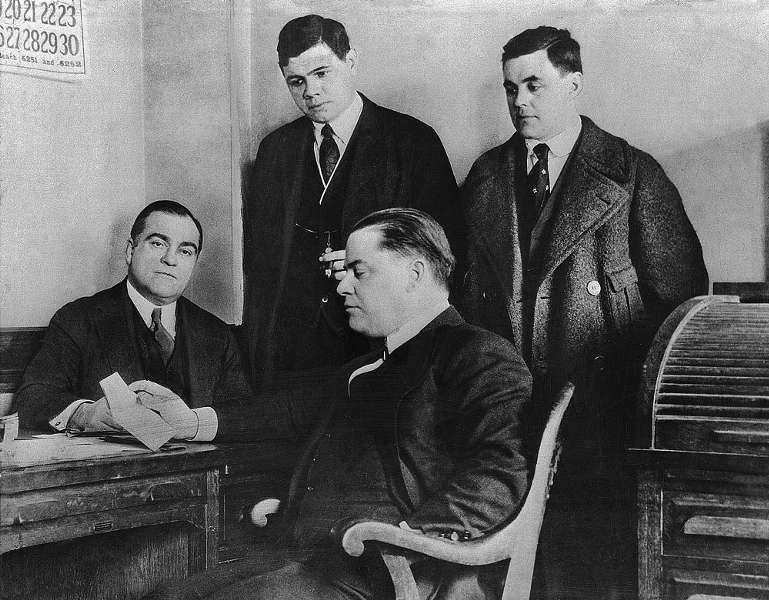
Ed Barrow, Babe Ruth, and Harry Frazee
Harry Herbert Frazee (June 29, 1880 – June 4, 1929) was an American theatrical agent, producer, and director, and he remained relatively successful in this field until the day he died. He also happened to be a successful boxing promoter who once landed one of heavyweight champion Jack Johnson’s matches. Harry Frazee then bought the 1915 and 1916 World Series champion Boston Red Sox, who won the 1918 World Series for him. After that World Series, Frazee sold a player who helped the Sox win those three World Series championships and the 1912 World Series championship. That error in judgement might’ve haunted any other normal man, but it was only the start for Harry Frazee. He proceeded down this road, selling and trading almost all of the best players on those teams. Yet, for all of those moves, and the successes of Harry’s life outside baseball, many believe his tombstone should read, “Here lies Harry Herbert Frazee, the man who sold Babe Ruth.”
Most writers love to write provocative articles from an angle no one has ever considered before. We enjoy taking a well-known story and providing a non-traditional angle on a story that opens our readers eyes to “the other side”. The other side of the story we now call The Curse of the Bambino involves a suggestion that the conditions surrounding Harry Frazee’s sale of Babe Ruth to the Yankees were a lot more complicated than most people know. The author of such a provocative article is then obligated to back up his assessment with data that supports his thesis. This thesis becomes more provocative when the author can provide data that most people don’t know.
The Curse of the Bambino, the book, suggests that the sale of Babe Ruth from the Red Sox to the New York Yankees prevented the Red Sox from winning the World Series from the point of sale in 1920 to the publication date of Dan Shaughnessy book of the same name in 1990 (the Red Sox finally won the World Series in 2004). Some of the authors, who attempted to write the other side of the sale of Babe Ruth and eight other players from the Red Sox to the Yankees, looked at the data from a baseball perspective, others chose a financial lens, and some had slide show presentations that suggest while history will never judge Harry Frazee kindly, the reactions to his sales and trades were evenly divided among fans and sportswriters at the time.
Anytime an author suggests a matter is far more complicated than we ever knew, our natural inclination is to weed through their narrative to find simple truths. One simple truth that permeates all of the articles written on this topic is that Harry Frazee made historical mistakes, and those mistakes led to the Yankee dynasty of the 1920’s and the early part of the 1930’s.
Another simple truth that is all but impossible to ignore is that the Red Sox won three World Series in four years before the sales and sale/trades, and they finished no higher than fifth in the thirteen years following the sales/trades. Other than a blip in 1925, a year in which Babe Ruth was injured, the Yankees finished no lower than third in their league, and they won seven pennants and four World Series championships over the same thirteen-year period, following the trades and sales. Another fact that’s impossible to ignore in all of the data is that among all the players involved, there were three people most responsible for this shift in the balance of power, Babe Ruth of course, Harry Frazee, and former Boston Red Sox manager-turned-New York Yankee business manager (general manager) Ed Barrow.
Those of us who enjoy reading authors take those simple truths and attempt to provide another perspective on them, enjoyed the article written by Glenn Stout titled Harry Frazee. In this article, Stout writes that TheCurse of the Bambino, and the subsequent demonization of Harry Frazee, was largely a myth created by writers to help Boston Red Sox fans explain their team’s disastrous loss to the Mets in the 1986 World Series. The thesis of the TheCurse of the Bambino was there was no other way to describe that inexplicable loss. Stout writes that 1986 Red Sox fans were looking for someone to explain the inexplicable to them. They wanted a scapegoat, and they found one in Harry Frazee. His actions, over sixty years prior, allowed them to think there was more going on than some clutch hitting by the Mets, and an error in game six of the series that led to the Red Sox defeat that year. It was, of course, the ghost of Babe Ruth haunting them.
Stout writes that Harry Frazee was not a greedy owner who wanted money more than a successful franchise. He writes that Frazee was independently wealthy from an early age, and he died that way. He also writes that Frazee was a wealthy and successful man before and after the trades that depleted the Red Sox and built the Yankees eventual dynasty. He writes that when Frazee died, a majority of the fan base, a majority of the sportswriters, and a majority in baseball didn’t hold him singularly responsible for the fall of the Red Sox. He states that while history might make Frazee appear incompetent, the reality of the situation that occurred during the 1920-1923 period was a lot more complicated than most people know.
To illustrate his point, Stout wrote a book with Richard A. Johnson called Red Sox Century, in which they provide a note Harry Frazee wrote to explain that the sale of Babe Ruth was based on Ruth’s contractual demands, and “[Ruth’s] disruptive influence on the team, and the fact that [Ruth] had “jumped the club” at the end of the 1919 season.” In the book, they also provide Frazee’s frustrations with The Bambino:
“While Ruth without question is the greatest hitter that the game has seen,” Frazee wrote in a 1,500-word statement. “He is likewise one of the most inconsiderate men that ever wore a baseball uniform.”
The Red Sox owner said Ruth had “no regard for anyone but himself” and was a “bad influence on other and still younger players on the team.”
He continued: “A team of players working harmoniously together is always to be preferred to that possessing one star who hugs the limelight to himself. And that is what I’m after.”
The sale of Ruth aside for a moment, Glenn Stout attempts to defend the fire sale of the other eight players by writing that the minor leaguers the Red Sox received in those subsequent trades didn’t pan out, as some of them suffered career-ending injuries.
Injuries are a part of the game, of course, and they can make owners and General Managers look bad when they make deals for players who were injured so early in their careers that they appear anonymous to history. This attempt to defend Frazee is valid, until one asks the question how many minor league prospects end up reaching their full potential? How many minor league prospects weren’t as talented as scouts projected, how many were unlucky with injuries, and how many simply didn’t have the drive to pursue their talent to its fullest extent? Whatever that answer is, it surely pales in comparison to the prospect of whether or not the players who played a primary role in at least one World Series victory if not three, might succeed. Stout does not specifically address this particular idea in his defense of Frazee.
Stout also writes, “no one could know that Babe Ruth would become Babe Ruth”. Fair enough, but at the point of sale in 1919, Ruth played six seasons for the Red Sox, and in that brief span, he set the record for home runs in a season twice, and he led the league in eight different batting categories in 1919, the year before Frazee sold him. He was also a dominant pitcher early in his career, before he switched to hitting.
As one of his peers, Rube Bressler said in his interview for the book The Glory of Their Times “[Ruth] played by instinct, sheer instinct. He wasn’t smart, he didn’t have any education, but he never made a wrong move on a baseball field. He was like a damn animal. He had that instinct. [Animals] know when when it’s going to rain, things like that. Nature, that was Ruth!”
Stout’s point that Frazee couldn’t know Ruth would be one of the top five players of all time is valid, but it sounds like if Frazee wanted to know the potential The Babe had to be great, all he had to do was ask around. Some of those who provide an alternative view of this story suggest that Frazee saw how undisciplined Ruth was, and how unintelligent he was, and he figured that Ruth’s 1919 season was a peak performance, and he wanted to receive peak value for his services.
Stout, and numerous others, state that the previous owner of the Red Sox was calling in Frazee’s loan, and that Frazee was in a tight spot financially. If Frazee didn’t pay the loan back that year, he might have lost the franchise. Yet, Stout and others assure us Frazee was never personally broke and none of the sales between the Yankees and Red Sox involved Frazee’s attempts to enrich himself personally. If that’s the case, and I appreciate the author’s attempt to dispel this notion, I cannot understand the deals Frazee made with the Yankees following the Ruth sale. If those latter deals involved Frazee’s continued efforts to save his franchise, one would think he might dip into his considerable personal finances and help the Red Sox over a temporary blip. I prefer to think, as Daniel R. Levitt, Mark Armour, and Matthew Levitt write, that Frazee became addicted to making deals with the cash rich Yankees to help him resolve the Red Sox short-term debts and help make the Red Sox franchise more profitable for him.
Those of us who know history, cannot put blinders on. No matter how many alternative “time and place” perspectives various writers put before us, we know that Frazee sold Ruth for money, and no matter how much money he received from that sale, it paled in comparison to the money Ruth would’ve eventually generated for Frazee, and the Red Sox, in the coming years. Stout’s argument that, “no one could’ve known that Babe Ruth would’ve become Babe Ruth” is a decent one when we think about how many could’ve been should’ve beens dot baseball history, but Frazee received $100,000 and a loan of $300,000 from the Yankees for the services of Babe Ruth.
At this point, and I think this is crucial to determining how Frazee sold Ruth to the Yankees, we can speculate that this wasn’t the initial offer from the Yankees, and we can guess that Frazee and his people tried to drive that initial offer up by detailing for the Yankees Babe Ruth’s current, 1920 market value versus a detailed prospective forecast on Ruth’s future and marketable prospects to drive that price up further. We can speculate that in those dark room negotiations, Frazee and his people displayed intimate knowledge of Ruth’s current and future market value to persuade the Yankees to pay more for Ruth than any major league franchise had ever paid for a single player before. Other reports from baseball insiders of the day state that many around the league considered the Yankees fools for paying that much money for one player, and we can only guess that the Yankees initially considered Frazee’s proposed price tag insane, how did the Harry Frazee and his advisors convince the Yankees to pay that much?
Harry Frazee tried to feed into this with his explanation for selling Ruth, “With this money the Boston club can now go into the market and buy other players and have a stronger and better team in all respects than we would have had if Ruth had remained with us.” Sportswriters and fans believed this at the time, for they probably shared the sentiment that one man does not a team make. With the amount of money the Yankees were paying, many inside baseball thought Frazee got the better end of the deal, but no one could’ve predicted how addicted Frazee would become to using the Yankees’ money to escape debt. No one, it seems, except Ed Barrow.
***
Ed Barrow
Authors Daniel R. Levitt, Mark Armour, and Matthew Levitt introduced this name Ed Barrow to us in an article titled Harry Frazee and the Boston Red Sox. Ed Barrow, they state, played a prominent role, perhaps the most prominent role, in the sales/trades the Red Sox made to the Yankees following the sale of Babe Ruth.
“[Glenn] Stout and [Richard A.] Johnson claim that Frazee made sound baseball deals with the Yankees and that he could not have foreseen what the trades would do for either club,” Daniel R. Levitt, Mark Armour, and Matthew Levitt write. “This argument does not hold up. Ed Barrow, manager of the Red Sox from 1918 through 1920, left the Red Sox to become general manager of the Yankees. Barrow knew the Red Sox players as well as anyone, and he spent the next few years grabbing all of the good players, like future Hall of Fame pitchers Waite Hoyt and Herb Pennock, catcher Wally Schang, shortstop Everett Scott, third baseman Joe Dugan, and pitchers Joe Bush and Sam Jones, among others. In fact[,] Barrow liked his former players enough that he got the Yankee owners to give Frazee $305,000, convincing evidence that both teams agreed that the talent [from the trades] was imbalanced. To argue that Frazee made good deals is to suggest both that Barrow and the Yankees somehow lucked into their dynasty and that the money was not the central piece of the deal for Frazee.”
In my opinion, the answer to the many questions we have regarding why Frazee sold so many players to the Yankees revolves around the question why Ed Barrow quit his job as Red Sox manager to become the business manager (general manager) of the Yankees? An answer to that question involves the insider information Barrow had about Harry Frazee, the debt the Red Sox were experiencing in those years, and how Frazee planned to resolve that debt.
Before Ed Barrow left the Red Sox in 1921, we can assume that for most of his three year tenure, he was satisfied to be the Red Sox manager, and that if it were up to him he would’ve spent the rest of his baseball career as their manager. He led the Red Sox to the 1918 World Series championship after all. When Frazee sold The Babe, it probably came as a shock to Barrow, but we can guess that Frazee sat him down and explained to his manager why the sale was necessary. When Frazee sold four more players, we can guess that Barrow required a more detailed explanation, as Frazee opened the books for him to show the manager the finite details of the debt Frazee incurred as owner of the Red Sox. This moment, right here, resulted in the changing of the tide in baseball more than any other. We can be sure that Frazee and Barrow had many such talks over the years, and that Barrow walked away knowing that Frazee desperately wanted to make the Red Sox financially profitable, and/or he fancied himself a wheel and dealer who could build his own winner, as opposed to inheriting one.
Ed Barrow also knew, as many did at the time, that due to the “Black Sox Scandal” and Frazee’s disputes with American League Bam Johnson and the other teams in the American League loyal to Bam that Harry Frazee was limited to dealing exclusively with the Yankees. (Note: There is a consensus among the writers of the articles I read on this particular topic that these circumstances forced Frazee to deal exclusively with the Yankees for that reason. The idea that Frazee and the Red Sox could have dealt with a team in the National League is not mentioned in any article I’ve found, and there is no reason listed for why this wasn’t a possibility for him.) Whatever the case was with Frazee, we can also presume that in his closed-door meetings with Barrow that Barrow saw the writing on the wall for the Red Sox franchise, and his owner’s willingness to sell his team down the river for large sums of cash.
As anyone who has experienced debt knows, if we find one way to resolve some of our debt, we are prone to follow that path wherever it leads to hopefully become debt-free. Barrow may have experienced some disgust when Frazee began selling his 1918 World Series Champions, but he was probably one of the few who knew the situation so well that when the Yankees general manager died in 1920, Barrow probably raced down to the Yankees front office to pitch them on how he, if hired as their next general manager, could persuade Frazee to sell more players to the Yankees and help them build a dynasty.
As the new business manager (later termed general manager) for the Yankees, Ed Barrow helped the owners of the Yankees engineer four subsequent trades with Frazee and the Red Sox that involved 12 players and $305,000 “to help Frazee recover from debt”. As the Levitts’ and Armour article suggests, the idea that Barrow convinced the Yankees to add $305,000 to the deal provides compelling evidence that both teams knew the Red Sox were getting the raw end of the deal. If we are to believe the writers who write from another perspective, it’s simplistic to say that Frazee made these maneuvers for the money, and “the reality of the situation was a lot more complicated than most people know”. If he didn’t need the money, as they write, and it was his goal in life to continue to own a profitable, winning major league baseball franchise, then he was either an incredibly poor business man, or someone who did not know baseball very well. Whatever the case was, Barrow knew who he was dealing with, and he knew how to convince Frazee to sell/trade twelve more players to the Yankees.
When Barrow’s new team, the New York Yankees, won their first World Series two years later, in 1923, four of the eight starting, position players were from the Red Sox, and four of the five starting pitchers on that championship roster were former Red Sox players. The Red Sox finished last in the American League that year, and “their skeletal remains would be the doormat of the league for years to come.” With this team of former Red Sox players, Barrow would oversee the Yankees win six more pennants, and three more World Series. During his tenure as general manager, the Yankees would win a total of fourteen pennants and ten World Series. This level of success, initiated by Barrow’s maneuvers with Frazee, would lead many to call Barrow an “empire-builder for the first quarter-century of the Yankees’ dynasty.” These sales/trades also landed Ed Barrow in the baseball hall of fame and Yankee Stadium placed a plaque of him in center field.
As Harry Hooper, the center fielder for the ‘15,’16, and ’18 World Series champion Red Sox, states in an interview, in the book The Glory of Their Times, “The Yankee dynasty of the twenties was three-quarters the Red Sox [dynasty lineup] of a few years before. All Frazee wanted was money. He was short of cash and he sold the whole team down the river to keep his dirty nose above water. What a way to end a wonderful ball club.
“Sick to my stomach at the whole business,” Hooper added, as he followed Ruth’s hold out with a hold out of his own just to get out of Boston before it all came crumbing down. After the holdout, Frazee sold Hooper to the Chicago White Sox.
It would be devastating to any franchise, of any sport, to sell one of the top players of his era, who would go on to become one of the top five greatest players to ever play the game. Yet, even selling a once-in-a-generation talent like Babe Ruth is not enough to sink a franchise for eighty-four years, in the manner The Curse of the Bambino suggests. It’s even difficult to believe that Ed Barrow taking advantage of Frazee to the point of selling/trading twelve other players over the course of three years can curse a franchise for that long, but winning breeds winning. In the course of those eighty-four years (1918-2004), the Red Sox did have some high quality, competitive teams. Various Red Sox teams won division titles, pennants, and they competed for the World Series in 1946, 1967, 1975 and 1986 only to fall short. The Yankees, of course, would win 26 World Series championships in the same time-frame, and they would appear in 39 World Series. Many of those Red Sox teams were unlucky, but unlucky is difficult to grasp when it occurs over the space of eighty-four years and the score with their cross town rivals is 26-0 in World Series championships. Some people need an explanation, any explanation that would explain the bizarre plays and unlucky events that lead to a championship drought, and the 45% of the population who believe in ghosts thought they found that reason in Babe Ruth, Harry Frazee, and The Curse of the Bambino. Now that it’s over, and the Boston Red Sox soaked the curse for all that it was, what do Red Sox fans talk about now that the franchise has won the World Series four times since 2004?
We should applaud anyone who volunteers to coach kindergarten football. It’s not easy, it’s a learn-as-you-go job, but it is rewarding and fun. In their own intangible ways, these kids appreciate what you’re doing for them. Most of them want to play football, and in some ways, they’re receptive to what we’re saying, because they want to learn the game beyond what they see on TV.
In my year-and-a-half of teaching kindergarten kids the game of football, I developed a few rules, based upon trial and error. Two quick notes before we continue: These are tidbits and observations, nothing more and nothing less. I will also use the term “tackle” to describe the act of pulling a flag, as this discussion focuses on flag football.
Be a Coach with a Plan. Enter your season with a plan. Develop a few bullet points, or talking points, that you want your team to know by season’s end. These bullet points should focus on teaching the kids some of the fundamentals of playing football. Walk into your first meeting with the team thinking that if you can teach them a couple of things that will stick, your season will be a success. Accomplishing this, of course, requires repetition. My advice to the new coaches is to watch some YouTube videos on “coaching kindergarten flag football”. Some of these videos provide some very helpful drills a coach can run in practice, and they offer some simple plays to run. Some of these plays involve simple fakes, reverses, and some simple passes. This leads us to rule#2:
Keep it simple. If this is your first season with a fresh group of youngsters, you’ll witness more organized teams pull better fakes and more complicated plays. I don’t know if they practice more often, or if they stick together for years, but in my experience, it’s best to keep all plays as simple as possible. Again, the best thing you can do, as a kindergarten coach, is teach them the basics of the game.
We’re talking about practice. Some leagues require one mid-week practice. Anyone who has worked with kindergartners knows that coaches need to make their practices simple, active, and participatory. If you are a born leader with a commanding presence, and your team is largely comprised of good kids, they might behave 51% of the time, but those who enter into this with the idea that they can manage adults, and they have a well-behaved child, might be in for a shock when they try to corral 10-to-12 other peoples’ kids at the same time. They’re not bad kids, but they are kids, kindergarten aged kids. My advice is to try to diminish the chaos is try to develop drills and activities that don’t let the kids stand around idle. If there is some idle time for some of them, you might want to develop an activity until their turn arrives. (Some examples are jumping jacks and other forms of running in place. Whatever we do, we want to keep them moving.) If you’re lucky, another parent will volunteer to assist you. If that’s the case, divide the team into offense and defense for drills, then allow them to scrimmage. Drills are important, but they do create a line of kids with nothing to do until it’s their turn. Kids will also run around and pull each others’ flags off. A rule we incorporate is, if you pull someone’s flag, while playing around, you have to put it back on.
No Juking. When game time rolls around, one of the most important rules we try to teach the kids is, “When you have the ball, don’t try to juke, shimmy, or shake your opponent.” Most kids want to flash the dreams they have of becoming an NFL running back, but at this level we need to teach them that the key to scoring more touchdowns is to run straightforward as much as possible. “How difficult it is for you to pull flags when someone is running past you?” we ask them. “You have one, quick chance right? The toughest flags to pull are those on someone who is running as fast as they can. When you run your fastest, it’s just as tough for the other team to tackle you.” Another reason for this bullet point is that when the child starts juking they never stop. This can lead to a huge loss of yards, and more likely the child exhausting themselves by attempting to run the miraculous run that can last a minute and a half for a two-yard gain.
Two hands. Two eyes. “When you catch the ball, use two hands and two eyes. Look the ball in.” We institute this rule to try to prevent them from running before they catch the ball. (Once they secure the catch, we can tell them to run, but this happens so infrequently that we should be able to get away with only preaching those first two steps for at least half the season.
On defense, we teach the principle of “side integrity”. It might sound like a complex concept for kindergartners, but that might be why they like it. Our advice to our outside defenders (linebackers or corners), “Don’t let the ball carrier run outside of you, because if they get past you, it’s probably a touchdown.” We line our outside defenders outside the furthest player on the other team, and we stress that they not let the runner outside of them, even if they don’t make the tackle. 4b) “When the other team tries to block you inside, watch the ball, and the minute it moves outside your blocker, use a spin move on the blocker to get outside of them. (Some of the kids love the idea of a spin move, as we can tell them NFL players use it to get past blockers. It also seems tricky and an advanced concept to the kids, and some of them use it quite well. They are also quite proud when they do it well, regardless if they make the tackle.) “Even if you don’t make the tackle,” we tell them, “you need to push the runner inside to the rest of your teammates.”
Safety. We established the position of Safety as the most important position on the defense. As a result, every kid on our team wants to play Safety. (It might also have something to do with the idea that kids don’t like being blocked.) Based on the idea that this became the most prized position on defense, we developed a rule, whoever made the last “tackle” on the last play becomes the safety on the next play. Everyone wanted to be safety, so they strove to make the tackle. (This also ended the “Can I play safety?” yells that occurred after every play.)
Back at Practice. When you’re done with the repetitious drills, in practice, let the kids have some flag football fueled fun. We call one of these games Sharks and Minnows. The shark(s) (two if you have over seven participants and one if you have less) start in the middle, and they try to pull the flags of all of the other players (the minnows). When a shark “tackles” a minnow that minnow then becomes a shark, and they join the shark(s) in trying to tackle the other minnows remaining, until there is only one minnow left. Other than teaching them how to pull flags, the game also teaches them the concept of boundaries, as we set up four-to-six cones to mark out of bounds.
First game. Your first game will probably be a disaster, if you’re a new coach starting out with a bunch of newbies. It’s important that we do two things here. First, during the game, we need to compliment the players for every good play they make on the spot. A casual high five with a “there you go Joey!” will do wonders to lift that morale and self-esteem. When the game is over, remain enthusiastic, regardless of the outcome. You will learn some things about your team, and the game itself, after your first game, and you will need to make some necessary adjustments, but try to stick to the tenets of your game plan. At this level, if you’re in it to win it, you’re probably in it for the wrong reason.
Plays. In this, my first season, I flirted with dropping the whole notion of plays, as they only invite more questions and different levels of chaos, but just handing the ball off on every play doesn’t teach kids the fundamentals of the game very well. On the subject of plays, I don’t think it will shock the potential volunteer to learn that if you plan to have a playbook, the goal should be to as simple as possible. I thought adding a simple reverse would fall under this heading, until I witnessed one in real time. (Picture a herd of wet cats attempting to run to the source and away from it at the same time.) I also added a pass play, in which the receiver runs a simple curl route. I thought this was a simple enough play, until I saw it play out live. (If the coach is lucky, they’ll have one player who can throw and one player who can catch. It’s the coach’s job to determine who can do this with some modicum of success.) The goal here is not necessarily to achieve a good play, a touchdown, or a win. We just want to put every player in a position to succeed, and if a player doesn’t throw or catch well, they might become demoralized. The coach should also prepare for the idea that most players won’t know what they’re supposed to do on any given play, so you’ll have to provide individual instructions to each player before the snap, and you’ll have to tell them where to stand. Again, the coach will have to accomplish this while trying to keep the referee happy by getting your players to the line and pulling off a play in time.
Repetition. The kindergarten coach should prepare to repeat their very specific instructions throughout the season, and answer all questions that follow. The most popular question a coach will have to answer in each huddle is, “When do I get to I score a touchdown?” My pat response is, “That team over there is not going to let you score a touchdown. You have to go get it, when it’s your turn.” The reason we must continually express the idea of turns is that once they score a touchdown, they want to do it on every play, and as many times as we express the idea, most kindergarten-age children don’t fully comprehend the idea of taking turns, or if they do, they don’t prefer it.
One voice in the huddle. “Coach! Coach! Coach!” is something every kindergarten, flag football coach will hear in a huddle, on just about every play. When the coach responds, they are likely to hear classic gems like, “I have a new shirt,” “I felt a raindrop,” or “I have a loose (or new) tooth.” Then there are the most common questions that follow every play, “When do I get the ball?” and “When do I get to score a touchdown?” The other comments I’ve heard are, “I don’t have a mouthpiece,” and “how come you’re not wearing sunglasses today?” Some of the kindergarten children repeat the shouts of “coach!” so often, while you’re attempting to tell the players involved in the next play how to run it that by the time we get to their question/comment, they forget what they wanted to ask/say. Once we complete that exercise, and get the kids to the line of scrimmage, ready to run the play in the time allotted by the referee, be prepared for them to forget everything you just said. Even when we keep it as simple as possible, by telling them to hand the ball off and run left, they often run right about 50% of the time. (Hint: point the direction of the play out to them. It’s okay to remind them at the line which way they should go, because chances are most of the kindergartners on the other side of the ball aren’t listening to you either.)
“We can only have one voice in the huddle,” is something we say in the huddle. Some comply, but most forget these instructions when the next play rolls around. I’ve instructed them to keep all comments and questions related to football, but they’re kindergartners. One important note to add here is the patience and understanding a flag football coach must employ. Remind yourself, throughout the game, that they’re kindergarten kids. Most of them have the retention levels of a goldfish, and they can’t remember what we said five seconds ago.
Injuries. Anytime kids are involved in a game that involves running, they will inevitably run into one another. Most volunteer coaches have no experience in such matters. The simplest thing to do is address each injury on the spot. Depending on the severity of the injury, of course, our goal should be to diffuse the minor injuries that occur in a game. Ask the injured player if they are okay, where they are hurt, and what happened. Most kids need nothing more than a couple plays off, and a drink of water, and they are okay. We might also need to address the fact that the other kid didn’t injure them on purpose. It was just a part of the game.
Displays of Anger. The coach will also have to deal with the emotional aftermath of a child having their flag pulled. To us, this is part of the play. Person A runs down the field, person B pulls their flag, and the play is over. To the kindergarten mind, this is a humiliating condemnation of their athletic ability. They might regard it as an unfair part of the game, or the coach’s fault. At times, they will express their anger. When we experienced such a display, we simply moved on and let his parents handle the matter. As a voice of authority, on the field, the inclination might be to correct that child’s behavior in some way, but we have to remember that these are other people’s kids. It might embarrass us to have one of our team members act this way, but we have to respect our boundary while trying to keep control of the individual players. The best advice I provide the disappointed kids who don’t succeed on a play is to have a short-term memory. “Try your hardest on every play, but if you don’t succeed, employ a ‘next play’ mentality.” Also, if they gained any yards, focus them on that. This mindset requires repetition. I developed this short-term mindset after years of playing recreational sports. It worked well for me, but it’s often too complex for the disappointed, kindergarten mind to comprehend.
Winning and Losing. We all have egos. All coaches want their game plan to work, and we want our coaching techniques to result in wins. A season and a half of kindergarten coaching have taught me to control what I can control. Let the players worry about winning and losing. We should also make sure we take turns giving the ball to each kid. Not only is that what they signed up for, but it maintains their focus. I try to compliment each player on their strength and ignore any weaknesses they might have. This keeps them happy, focused and interested. The most important ingredient is to try to keep it fun for the kids. Structure is vital, of course, but we need to institute a balance of fun and structure.
Dealing with Kids. After dealing with these kids one hour a day, for six weeks, I now have profound respect for anyone who chooses a career that requires them to deal with kindergarten age children full-time. If, at one time, I considered my son’s teachers unreasonably strict, by instituting a level of structure to try to establish some level of order, I now empathize. “Could you take care of Johnny today? I can’t deal with Johnny today,” I heard one kindergarten teacher say to their assistant. I was shocked at the time, because I thought it meant the kindergarten teacher couldn’t control her class. I now have a couple of Johnnies that I only deal with for one hour a week, and if I could have one on-field assistant answer the questions, and tend to, just one of my Johnnies, I probably wouldn’t be writing this piece to voice my frustrations.