Football 101: Stratagies


“Why do they continue run the ball into the middle of the pile?” a friend of mine once asked after watching a running back crash into the line for a two-yard loss.  “If they are going to run, why don’t they run around the pile?”

As with any sports-related questions, the answer involves a number of variables, and specifics regarding the strengths and weaknesses of the respective players on the offense, from the abilities of the Running Back, to the ability of those on the offensive line to block for him.  The offense also has to gauge the speed and ability of the defenders to beat them to the corner. Long story short, the offense would love to run around the corner.  It would also love to gain a ton of yards up the middle.  Even if it doesn’t, however, a run up the middle serves a purpose.

350px-Linemen.svgIt may also sound elementary to suggest that the offense wants to have every single defensive player confused, but that is the purpose of the run up the middle.  For those that love chess, even an unsuccessful run up the middle can be the equivalent to sacrificing a pawn to get the opponent to move themselves into a weak position.

If the offense attempts to run up the middle often enough, it hopes to create enough confusion in the minds of the defensive backfield that they make an erroneous first step up and in to stop that run.  One erroneous step may be all that’s needed for the timing of the offense’s passing game.  Creating confusion in the minds of the all of the defense is important, of course, but it is crucial to the success of the offense that those players that are positioned in what is called the defensive backfield –the linebackers (LBs), the free safety (FS), and the Strong Safety (SS) in the diagram above– be confused.

The players in the defensive backfield are unblocked on the line of scrimmage and they have free reign as to how they are going to approach the next play.  If they are confused and they make an incorrect guess, holes in the defensive backfield will open up for the offense to exploit in the passing game.

The timing of most offenses require a successful running game, but even a less than successful running game can open up holes for a Quarterback to pass in, if the members of the defensive backfield are required to step up and in to assist the front four defenders (the defensive line) in their attempts to stop the run.  So, the next time your team continues to make futile attempts to run the ball into the middle of the pile, wait for the next play before you kick that hole in the wall.  If that Quarterback fakes the ball to the Running Back, (a play-action fake is what it’s called) and the Linebackers take a step up and in to stop that play, you’ll realize that the Offensive Coordinator (the coach that decides which plays the offense will run) made that previous call to set up this pass.  For when that Linebacker steps up and in to stop that running play from going into the middle again, he opens up a *hole behind him that the Quarterback will pass the ball in.  (*This hole is also called a lane and/or a window.)

The offense must keep the defense guessing whether the offense is going to run or pass.  You may hear a broadcaster refer to this as “keeping pressure on the defense” or “keeping the defense on their heels.”  They may also refer to the defense stepping up and in as “the defense cheating” or the defense “creeping”, and that the offense must have a better mix of run and pass to prevent that.

As a result, if an offense has a decent mix of running yards gained and passing yards gained, that team wins more often than not.  Some offenses don’t need a perfect mixture, but most of them need just enough to establish a threat of something different to keep the defense guessing.  Most of them will acknowledge that they are not going to achieve a perfect mix of yards gained, based on the defenses’ proficiency, or their own deficiencies, but they know that they will be required to have a number of attempts in one of these two strategies to establish the necessary threat.  It is for this reason, that you often see networks provide graphics that suggest when a Running Back attempts to run the ball a certain number of times (regardless the amount of yards he gains) the percentage of victory for that team is high.

The chess match of play calling, and alignment, will often bear fruit in those seconds that occur just before, and immediately after, the snap.  This is where you’ll hear the term “cheating” used most often.  If members of the defensive backfield step back in the moments before a ball is snapped, or immediately after the snap, they are cheating back, believing that a pass will occur.  The more common use of “cheating”, however, occurs when the members of the defensive backfield creep up and into the line of scrimmage, believing that a run will occur.

Therefore, when an offense continues to “waste” a play by running the ball up into the middle of the line, for a futile two-yard gain, and they continue to do it without much success, you can be sure that they are attempting to prevent the LB’s, the FS, and the SS from sliding back into the holes that the Quarterback wants to throw the ball into.  To further this deception, a Quarterback may fake a hand-off to that Running Back to get a crucial one-to-two step creep, or cheat, up and in from the members of the defensive backfield.

“When are ‘we’ going to just admit that we can’t run the ball?” a novice fan may scream at the television.

Long story short, few teams can afford to just give up on the run.  Most offenses are not so loaded with talent that they can succeed with a play that the defense knows is coming.  Some are, of course, but what works for one team, will not work for the other, and vice-versa.  It’s a chess match.

Football 201: Prevent Defense Prevents Victory

“The only thing the prevent defense prevents is victory,” one fan said, quoting color commentator John Madden’s oft used condemnation of this defensive alignment.  

In week five of the 2015 season, the Atlanta Falcons allowed the Washington Redskins to march down the field, about forty-five yards in twenty-five seconds, to score a game-tying field goal.  The prevent defense failed once again.

The message boards on various Atlanta Falcons’ sites blew up with people screaming at the Atlanta Falcons Defensive Coordinator Richard Smith for allowing this to happen by employing the “disastrous” prevent defense in the closing moments of regulation.

“Why do they keep trying this?” Another fan asked.

That question goes to the heart of the answer: It works … most of the times.

“If you’re winning a game,” John Madden once said to add to his complaint, “You’re winning, because of your defensive strategy.  Why would you change that successful formula up in the closing moments of a game?”

John Madden was well known for speaking the language of the common man, and the common man has asked this question so often that it has earned an answer from a common man that has answered this question so often in his head that it’s percolated to a boil.

The Redskins had twenty-five seconds to get a field goal.  They completed three passes to get their field goal kicker in place for a fifty-two-yard field goal.  He made it.  Game tied.  The prevent defense failed, and Atlanta had to resort to an interception in overtime to defeat the Redskins.

It didn’t have to be that way, according to the common man, fan’s complaints on various Atlanta Falcons’ sites.  If the Falcons had had the courage to stick with the defense that had bottled up the Redskin passing game for much of the game, they wouldn’t have had to cross their fingers with hope that something miraculous would happen in OT.

On any given play, in a game of evenly matched opponents, one long pass can change the dynamic of a game.  Due to the nature of most offenses, they limit their attempts at such a pass to four-to-five times a game.  The risk of attempting this pass is such one that most offenses prefer to stick with the package of plays they have designed for short yardage gains, as most offenses don’t operate well in the desperation of third and long.

When an offense takes the field, down three points and twenty-five seconds left, they enter the “nothing to lose” chapter of their playbook.  We have nothing to lose now, so why don’t we try to throw the ball forty yards on every play.  Why wouldn’t we take the risk, since the rewards of our normal package are gone now?  We just need one of these plays to succeed.  If this were a game of Russian roulette, and success was defined as shooting yourself, wouldn’t you increase the number of bullets in that gun if given the choice?  You would have nothing to lose by doing so.

The Defensive Coordinator’s job at this point is to limit the chances of this one play succeeding.  He’s willing to concede that the offense will succeed with a couple of passes over the middle, but he needs to do everything he can to prevent the possibilities of that one huge play succeeding.  The answer to that is a prevent defense.

“I know all this, and everything you’ve just written is obvious,” some would say, “What’s also obvious is that the prevent defense never works.”

“If it never works, why do defensive coordinators around the country, and at all levels, keep using it?”  Answer, it is successful … most of the times.  A Defensive Coordinator would not put his job on the line, by placing his defense in a prevent alignment just ‘cuz, or just because others do it, or because it’s some sort of tradition.  The difference between you, the fan, and a John Madden calling a coach out when it doesn’t work, is that the Defensive Coordinator knows his flow charts and algorithms, and he knows that the statistical probabilities suggest that in this situation the unpopular prevent defense is the right call.

The prevent defense may give up some passes over the middle, and that may have cause your heart to flutter, as your defense surrenders thirty yards, and the other team gets a little too close for comfort, but they need forty-five.  They came up fifteen yards short, they lost.  Your team won, and they do, more often than not, by employing the prevent defense in the closing moments of a game.  That didn’t happen in the Atlanta vs. Washington game, but it does … most of the times.

If it had succeeded, as it often does, no one would’ve said a word, because the idea that a defense should be able to stop an offense from going forty-five yards in twenty-five seconds is not remarkable enough for commentary.
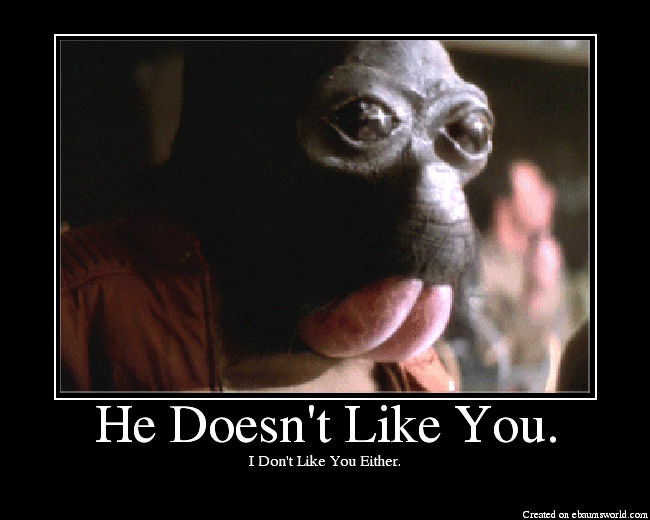
Someone Doesn’t Like You


“Somebody doesn’t like me. Shhh! Don’t tell anyone it might be perceived to be a comment on my character.”

All apologies to Larry David, but robust research suggests that most people like us far more than we think. Anyone who watched David’s brilliant comedy Curb Your Enthusiasm knows that David is pretty, pretty, PRETTY sure nobody likes him. His little secret, one he shares with everyone he encounters, is he doesn’t care.

The rest of us care, but I don’t. “Yes you do, and you know it.” All right, but what did I do or say to cause them to not like me? Am I saying it now? I don’t care. “Yes, you do.” Is my hair in the right place? Are my clothes fashionable? Do I have the correct opinion on this matter, and if I don’t, will they respect me in the morning if I change that opinion to get them to like me more? “Shut up and listen.”

That’s one of the fundamental keys to getting people to like you, if you care. Listen to them, make them feel interesting, and they’ll be more apt to find you interesting. An enthusiast on this topic suggested there are three words to achieving this, “Tell me more.” My personal variation of those three words is “Are you serious?” That drove my dad nuts, “Yes, I’m serious. You think I’d joke about something this serious?” He said that all the time, but most people know that my “Are you serious?” acts as a conjunction, or an active listening prompt, to inform the listener how interested I am in their story. It’s my personal favorite active listening prompt. Whatever yours is, enthusiasts encourage us to use them often in conversation, if we want people to like us, because there’s nothing a person loves more than thinking another someone is interested in what they have to say.  

Even with that, there will always be someone, somewhere (“I see you”) who just doesn’t like us. We would love (and I do mean LOVE!) to hide behind the teenager’s, “I don’t care what anyone thinks!” righteous banner, but we know better now. We know we care, but we don’t know what to do about it?

HeDoesntLikeYouThe first thing to do is nothing, because there is always going to be someone who doesn’t like us for who we are, what we look like, and a number of other superficialities for which we have no control. They are members of a group, and it may not matter to us what group they are in, but it’s vital to those who don’t like us to maintain that for which they stand. It is a fundamental tenet of their personal constitution, and an essential part of their identity. It’s the “I might not have done much with my life, and I’m probably not the type you might call intelligent, successful or happy, but at least I’m not one of you!” group mentality for which they stand. In cases such as these, we should do nothing, because there’s nothing we can do, but we shouldn’t change what we do, who we are, or how we speak, because if we bend to these terrorists, they win. If that sounds like something a teenage, righteous warrior might write on a bathroom wall, it is, but once we get past the best swear words and the exclamation points following their potty prose, we do find a germ of truth in it.

Have you ever heard someone compliment another with a, “She’s so nice that if people don’t like her, there’s probably something wrong with them!” That’s really the nut of it all, as far as I’m concerned. If you’re nice and pleasant, and you manage to avoid the narcissistic tendencies of waiting for a speaker to finish, so you can start talking and actually listen to what they say, and they still don’t like you. There’s probably something wrong with them.  

Humans are hardwired to adjust however. The others in our lives are our critics, and we should be open to their criticism in the sense that some portion of it might be constructive. In our never-ending quest to be liked, however, some adjustments turn out counterproductive, for if this person has a psychological underpinning that causes them to dislike us, they’ll just adjust their reason for not liking us accordingly, and they’ll have less respect for us for adjusting in the first place. If we can clear the fog we created, with the underpinnings of our own insecurities, we might find pleasing nuggets from that robust research that declares most people like us, and there could be something wrong with those who don’t. 

I have often found that upping the ante on the characteristic they dislike not only puts an end to this vicious cycle, but it subverts the prejudicial judgements they’ve made. Most observers subconsciously find that they respect a person more for not adjusting, and not conceding to the hard wiring of human evolution. We call this the “suck it!” strategy.

The “suck it!” strategy relies on the idea that we’ve established the fact that we are already pretty, pretty, PRETTY nice and likable. If we’re not likable, and this person’s judgments are corroborated by others, such that it might form something of a consensus of thought, we may want to consider adjusting. If we are a well-liked person, however, we should be who we are to the people who surround us, and group thought might eventually sway our critic to the idea that their prejudicial notions about us are wrong.

Every situation is different, of course, and there have been times when I’ve gone beyond the complaints the person who dislikes me makes. I don’t do this on purpose, but it excites me when certain people don’t like me, and I consider it a challenge to maintain my stance in the face of the wind they’re trying to blow my way. I’ve made minor changes to complaints about my attitude and personality when those complaints were verified and bolstered by others, but I can’t remember ever changing in a way that I considered an extension beyond my personality to the point that it cannot be maintained over the long haul.

As for the ‘do nothing’ advice, I’ve often found that with the relative nature of taste there’s not a whole lot we can do about someone choosing to dislike us. Most people usually formulate a prejudicial opinion of us before they’ve ever met us. We’ll know this is the case, if the hand we shake is cocked and loaded with a question like: “Is it true that you said (or did) this …?”

The base of the word prejudicial is prejudge, and we are making strides in our society to avoid such judgments. We are trying to avoid prejudging people, but we are selective in our attempts to rid it from our culture. Chances are, if you are a human being, living in the 21st century, you’re being judged, and prejudged as often as any man in any century, but we don’t discuss such things, lest we be judged, or prejudged, for doing so.

If prejudging people is such an anathema, one would think that the simple act of declaring another prejudicial would be enough to diffuse everything that follows. What we see instead, are people who get more upset over a prejudicial opinion than an informed one. As discussed, it’s human nature to care. It’s quite another to obsess over it.

“I know,” they will say, “but how can she form an opinion of me based on …” This sentence is usually concluded with “based on something they heard from a third party” or “based on our very brief encounter.”

“They can’t,” I say. “They do not know you. So, why are you getting so upset about it?” 

This speaker was excessively beautiful, and a number of people despised her for it. “Why do you like her? Why do you talk to her so often?” To which I said, “Why don’t you?” The reply was often something like, “I don’t know, I just don’t like her.” One person suggested that I talked to her because she was so beautiful, and I replied, “Is that why you don’t?” There are no concrete, general answers is the answer, and talking about it is often as pointless as thinking about it, or writing about it, but this happens all the time. The problem for you, is that it’s happening to you now. You catalog everything you said to this person who doesn’t like you, and you come up with nothing. She doesn’t like you because you’re beautiful and anything that comes out of her mouth will only serve her cause. There’s little-to-nothing you can do about it, except be who you are and let her change her mind, if she decides.  

If a person knows us well, and issues an informed opinion, it can be devastating, but the person who makes a snap judgment of us, based on a couple here’s and there’s, should be dismissed to whatever degree we dismiss uninformed opinions. This is hard, because it’s hard to believe that we’re nice and everyone should like us. It’s much easier to believe that we’re flawed, because we all know that there’s something to improve upon. We just don’t know what it is, and maybe she does. 

What we’re talking about here is psychology, both on a macro and macro level. The basis for modern day psychology is about 150 years old. The idea of the study may date back to Ancient Greece, but the incarnation we know today, an in-depth study of the choices that we make, and why –my preferred definition– is relatively new.

“She only says that, because she’s jealous,” is the fallback position for most of us who have to deal with the fact that someone don’t like us. It’s a snap judgment that may have more merit, if we attempt to seek in-depth psychological answers about them.

The extent of our knowledge of psychology often begins and ends with that Psychology 101 course we took in college, and that course likely focused inordinate attention on the study of dots, swirls, circles, and other such tricks of the mind to test perception. There is some ontological value in that study, of course, but it just seems like such a waste of time compared to the far more important study of human interaction, and how we can learn to dot the I’s and cross the T’s of the five W’s of social interaction and psychological warfare. It seems to me that there is a dearth of understanding of psychology in some, which results in very little desire to dig deep into another’s psychology to understand them better.

The study of the swirls and circles have some invaluable traits, as they teach us perception, perspective, depth, and the value of how the human mind perceives visual images. When we view the characteristics of others, for example, the images we see tend to derive from the point of origin, until the motion of the arrows could be said to form an oval between us. This is called psychological projection, or the ability to better see another’s weaknesses through comparative analysis.

Political partisans are often the first to call me a partisan, for example, people who need the last word are often the first to accuse me of being a person who needs to have the last word. Their accusations may be true, but they’re often the first to spot it, because they are viewing us from their perspective.  

If we are going to have some sort of long form engagement with this party, we may want to understand their psychology better. We should be prepared to be wrong in our assessments for we have our own subjective agendas and our own base from which we view others, but we should study them anyway, and adjust our analysis according to our findings.

After our initial analysis of this other person is complete, and all of our adjustments have been made, we may want to focus some of our attention on the third party who was informed by this other person of their decision to dislike you. It’s possible that the third party plays no role in this, other than being a third party, but is it possible that that person played an instrumental role in this other person not liking you. It’s possible that we may be a perceived threat in the relationship they have with this third party, and they have an agenda that this other person fears we may expose. It’s also possible that they’re insecure people and they fear that we’re better. Whatever the case is, it’s possible that we may never be able to entirely figure it out, and their insecurities are such that they’ve overestimated us, but they don’t want to take that chance.

“I don’t know why,” we’ve all heard others say about others. “I just don’t like them.” Perhaps the people who don’t like us are saying these same things about us. Perhaps they can’t put their finger on why they don’t like us. They just don’t.

If they do know why they don’t like us, they’re probably not going to tell anyone, for that might reveal something about them. They may also avoid revealing the exact reason, because they enjoy watching us flop around like a fish on shore, trying to figure it out.

If it’s true that robust research finds that most people like us, why are we bugging with those who don’t? It’s all about us, we do it to ourselves. Is the driver behind our desire to have everyone like us all of the time ego, or is it based on our insecurities? We don’t really know, but it bothers us when one person in the group makes that face whenever we talk. We know that face. Hell, we make that face when that person we don’t like for reasons we cannot articulate speaks. We do it to ourselves. The idea that not everyone is going to like us, is something we probably figured out in second semester of the tenth grade when that one kid told us off for being who we are. We thought there were very specific reasons he didn’t like us, but he would never tell us what they were, and it drove us insane. The one thing we noted in this particular specimen was that he just enjoyed getting under our skin. She was anecdotal evidence for the question why do some people not like us, but it’s possible that she enjoyed being anecdotal evidence. She probably just enjoys being the face on our ceiling, as we fight through the insomnia her words have caused us.

Is Theodore Roosevelt the Batman?


“It takes more than that to kill the Batman!” is not an exact quote from Theodore (Teddy) Roosevelt’s campaign speech in an auditorium, soon after being shot by a would be assassin, outside a Milwaukee hotel, but it is close. Many of the details of the Batman story are close, so close to those in the former president’s story that many claim that it the inspiration for the creation of the fictional character we now call The Dark Knight.

The most impressive of the correlations involves the death of a parent, and the post-traumatic growth that followed:

Bruce Wayne lost both of his parents before he was a teenager, and Teddy Roosevelt lost his father when he was nineteen. In H.W. Brands T.R.: The Last Romantic, Brands alludes to the fact that most young men, on the precipice of becoming adults, deify their father. If that father dies prematurely, as in the case of Theodore Roosevelt Sr., the characteristics of the son’s deification becomes locked in. The contrast being that no matter how great a father is, if he lives throughout their son’s maturation, that son is prone to find some weaknesses in his father’s lessons, advice, and in the man’s general arguments. This progression doesn’t necessarily say anything about either party, but it’s a natural evolution based on the experiences the young man has and some elements of rebellion. Roosevelt was not afforded such natural, mature comparisons, and that coupled with his grief and sorrow, may have resulted in a subjective deification of his father.

Courtesy of Enhanced Buzz

As a result, both Teddy Roosevelt and Bruce Wayne, spent much of their life trying to live up to their deified images of their father. Yet, if one were to compare the bios of these men, and their fathers, it could be said that they more than surpassed the actual accomplishments of their fathers.

The point is not the line-by-line comparisons, of course, but the post-traumatic mindsets that resulted from them, and it could be said that the fictional Wayne character might never have become Batman were it not for the death of a father, and Roosevelt might never have become the president were it not for the idealized images leading to a legacy he created for the man that he spent his entire life pursuing, and never catching … in his mind of course.

This post-traumatic angle of the Teddy Roosevelt story, going so far beyond surviving a tragedy, to thrive as a result of it, was so engaging to one writer, a Paul Levitz (who spent forty-two years writing for DC Comics), that he believed he could use it as a fundamental, driving force for his characters in a manner that would connect with his readers.

The following was said by Theodore Roosevelt Jr., but all fans of The Dark Knight Trilogy, and Batman fans in general, could imagine Bruce Wayne saying it to his butler, Alfred, in the many shared chunks of dialogue devoted to discussions of Thomas Wayne, Bruce’s father.

“My father, Theodore Roosevelt, was the best man I ever knew. He combined strength and courage with gentleness, tenderness, and great unselfishness. He would not tolerate in us children selfishness or cruelty, idleness, cowardice, or untruthfulness.”

Theodore Roosevelt Sr. also taught Teddy that the best way to overcome the debilitating childhood illnesses that kept the young man indoors most of the time, and the best way to overcome bullies, was to strengthen his way through it.

“You have the mind but you have not the body,” Theodore Roosevelt Sr. told Theodore Jr. “You must make your body.” 

Theodore Roosevelt Sr., purchased a home gym for his son, and hired a boxing coach to teach the son how to fight, and Teddy Roosevelt would later use all of that to achieve a runner-up spot in a Harvard boxing tournament.

Fans of The Dark Knight Trilogy could say that stark similarities exist between that father-to-son advice, and the resultant training scenes, in the first installment of the trilogy Batman Begins. Similar advice was provided to Wayne by the Ras al Guhl character, played by actor Liam Neeson, as opposed to Bruce Wayne’s father. *Side note: Jonathon Nolan, brother of The Dark Knight creator Christopher Nolan, and co-writer of the other two installments of The Dark Knight movies, states that the Ras al Guhl character, in the Batman Begins installment, was based on Al Qaeda leader Osama bin Laden, and the bin Laden crusade to “heal the world” through terror.

It has been noted in many places that Christopher Nolan, in particular, based his The Dark Knight version of the Batman, in part, on Teddy Roosevelt. Also, as noted below, he thought that the entire Batman story was derived from Roosevelt’s biography. It was also noted, in this article, that both Nolan brothers suggested that the best way for actor Christian Bale to learn more about the Dark Knight character they drew up, was to read Edmund Morris’ biography of Theodore Roosevelt The Rise of Theodore Roosevelt before they began shooting the first installment of The Dark Knight Trilogy.

Christopher Nolan Noted:

“Batman’s not as unique as people think. (Co-creator of Batman) Bob Kane’s Gotham is New York and Batman has a direct historical precedent in Theodore Roosevelt. His father, Theodore Roosevelt Sr., had been one of the city’s preeminent philanthropists — having found and funded the New York City Children’s Aid Society, the Met, and the American Museum of Natural History, to name a few of his charitable works — and died in a way (Author Edmund) Morris contends traumatized his son: sudden, in nature, from a cancer whose existence he’d hidden, and mere hours before Theodore returned from Harvard. In 1884, his beloved mother and wife died in the same house, on the same day. A bereft Roosevelt set out for the Dakota Territory soon thereafter. He spent his time in the hinterlands learning how to be a proper policeman, then applied those lessons when he became president of the New York City Police Commissioners in 1895. Like Batman, Roosevelt employed bleeding-edge technology into his crime-fighting: under his watch, telephones were installed in precincts, bicycles were deployed on beats, and various criminal identification systems, like Bertillonage, were monkeyed about with.”

The bleeding edge technology, Bertillonage, involved using anthropometry, or biometrics, such as size, shape, some rudimentary elements of psychology, and other dimensional descriptors. It was based on the biometrics researcher, and French police officer Alphonse Bertillon who applied the anthropological technique of anthropometry to law enforcement creating an identification system based on physical measurements. Anthropometry was the first scientific system used by police to identify criminals. Before that time, criminals could only be identified by name or photograph. The method was eventually supplanted by fingerprinting. Roosevelt wasn’t the first to use such techniques, obviously, but we can say that he tried to bring the latest and greatest technology to his police officers to aid them in their crime-fighting efforts. In the Dark Knight, head of research, Lucius Fox, introduces Bruce Wayne to various crime fighting tools in the form of the modern bleeding-edge technology and various gadgets that he can use in his covert, crime-fighting efforts.   

Those who are familiar with the general story of the Batman will also note the importance the role of police commissioner played in the stories of the two. Teddy Roosevelt was a police commissioner who didn’t just vow to clean up the city, he went undercover, as a policeman, to see to it that his officers were doing their job in a thorough and honest manner. What does undercover mean when it comes to Roosevelt? Some say he walked patrol, late at night, to make sure his officers weren’t sleeping on street corners or loafing on the job. Bruce Wayne went more literal in his undercover status to work hand in hand with Commissioner James Gordon to clean up the city.

Both men also considered it vital to their legacy to have a self-appointed successor to carry out their proposals, and both were let down by that successor. Bruce Wayne was let down by Harvey Dent, and Roosevelt felt he was let down by his chosen successor, President William Howard Taft.

Soon after volunteering to not seek reelection for president that would have led to him being in office for eleven years, as a result of the assassination of his predecessor, William McKinley, Roosevelt would learn that his chosen successor, Taft, did more than break a number of promises that he made to Roosevelt. Taft, according to Roosevelt, broke a number of campaign pledges he made to the American people, pledges that were in line with many of Roosevelt’s progressive policies. Taft replaced much of Roosevelt’s cabinet, after promising that he would not do so. Taft replaced key ambassadors with people that Roosevelt informed Taft he hated, and Taft ended up crediting his electoral victory for president to his brother, not Roosevelt, the man who had mentored him for the position.

The stories of Roosevelt’s unhappiness with Taft would culminate in Roosevelt breaking his pledge not to run for president again, running against his Taft in Taft’s attempt to be re-elected, in the Republican primary, and then in a third-party of progressives, who called themselves the Bull Moose Party, in the general election.

On that election trail, Roosevelt would declare that Taft was “disloyal” and a “Great pink porpoise of a man”. The latter may have been an insult directed at the much talked about weight of the man, but the former, “disloyal” part of the characterization, could be interpreted as Roosevelt saying that Taft, his successor, was two-faced. Harvey Dent, Bruce Wayne’s chosen successor for cleaning up the city became the arch-villain Two-Face.

T.R.’s bullet-wholed shirt

Roosevelt may never have donned the tights, simple cloth, polyester, sculpted latex, rubber, neoprene skin, fiberglass, nylon, and metallic mesh built into it, that the various men that would play the role of Batman would wear, but in a Milwaukee speech that he delivered, with a would be assassin’s bullet still lodged fresh in his fourth right rib, on an upward path to his heart, Teddy Roosevelt included the line:

“It takes more than that to kill a bull moose.”

Bull Moose, Batman, the phonetics are close, but how close are they? Is it possible that co-creator Bob Kane considered making the bat man, a bull moose, to inexorably link the two and leave no mistake to the origin of Batman, or were the logistics of having a man become a bull moose too untenable even for a comic strip? Or, is this an example of the informal fallacy, equivalent to the Texas Sharpshooter Fallacy, in which a shooter fires a number of shots into a barn and circles a target around the largest cluster of shots after the fact? Are there perceived patterns, in other words, that focus on the similarities and ignore the differences? Was the model for the creation of the Batman more personal to Bob Kane and Bill Finger, and we’ve determined those similarities mirror Roosevelt’s in so many ways that we’ve determined that he was the model?

Some of the links made here, and elsewhere, are somewhat specious, but the quotes from those who proved instrumental in the various versions of the story, and the coincidences are so great that one has to think that if The Joker had performed enough research on Theodore Roosevelt Jr., he may have found the answer to the question that plagued him: “Who is the real bat man?”