I never considered the possibility that I might be witnessing a physical manifestation of me –that speculative writers might call a doppelganger– dancing on the dance floor. I did not expect this kid to take to a corner, open up an NFL preview guide and eat an entire bag of soda crackers, while listening to the band Kiss. I don’t know what I would’ve done, if that happened, as I had already reached a frequency of thought I might never have reached on my own –thanks to that near impenetrable, crusted shell of good and bad memories that prevents, and protects, the human mind from seeing who we were when we weren’t paying attention– just watching the kid. By watching the kid, to the point of an unusual, momentary obsession, some part of me thought I might be able to answer some unanswered questions I had from my youth.
 I wasn’t watching the kid at first. He was the bride’s son, from a previous marriage, and as distant from my attention as every other participant in the wedding ceremony. He did little to nothing to stand out, in other words, until he took to the dance floor.
“Look at the kid,” I heard some wedding patrons whispering to others. “Look at Kevin!” I heard others say. I was already watching him. I thought everyone was. How could one avoid it, I wondered, this kid was putting on a show.
There was a ‘something you don’t see every day’ element to this kid’s step that challenged the audience to look away. He didn’t look out into the audience, he didn’t smile, and he did not attempt to communicate with us in a manner I suspect a well-trained dancer might. There was, however, an element of showmanship in his step that should not have occurred in a normal nine-to-ten-year-old’s “conform as opposed to perform” step.
The kid’s shoulders dropped low in his dance step. I don’t know what this suggested exactly, but he did appear more comfortable on the floor than any of the other kids his age. His handclaps were also a little harder than the other kids were. I don’t know if it was the volume of Kevin’s claps, but the other kids appeared to be struggling to follow the beat, or his beat. His gyrations were so out of step with the rest of the participants that those of us not in the wedding party had trouble stifling our giggles. This kid was dancing.
“Who’s the kid?” I asked my uncle.
“That’s Kevin,” he said. “The bride’s son.” His smile mirrored mine, and those of all of the whisperers watching.
After I asked that question, I realized I was one of those whispering and pointing at Kevin. My initial assumption was that everyone watched this kid in the same manner I was, with one bemused eyebrow raised, but the sheer volume of whisperers called to mind the first time I heard Miles Davis’ Kind of Blue. Some consider that album a masterpiece. Some called it Davis’ Sgt. Peppers. I liked it, but I wasn’t sure it was a masterpiece. The structure seemed so simple. I discovered its simplistic brilliance after repeated spins, but the point is I may not have listened to it a second time if group thought hadn’t conditioned me to believe that there was something I was missing out on.
It was this fear of missing out, FOMO in common parlance, that prompted to continue to watch this kid. I knew as little about dance as I did jazz, so I figured it was possible that I was missing something.
“Why are we watching this kid?” I asked my uncle.
“Because it’s cute.”
 My Uncle gave me a look that informed me that we shouldn’t try to make more out of it than what it was. He then went back to watching the kid, and he even regained an appreciative smile after a spell.
There was no simplistic brilliance going on in this moment, in other words, it was just cute to watch a young boy carry on in a manner that suggested he knew what he was doing. The kid didn’t know how to dance, most nine-to-ten-year-old boys don’t, but the effort he put into it was cute.
Anyone that focused attention on the kid’s step –as opposed to the surprising amount of bravado he displayed by attempting to dance– knew that the kid didn’t know what he was doing. He had no rhythm, no choreography, and no regard for what others might think of the fact that he had no knowledge of the crucial elements of dance. The latter, I think, was the point, and it was the reason we were watching him.
My guess was that at some point, someone somewhere had informed him that free form dancing has no choreography to it. You just get out there, lower your shoulders a bunch of times, throw your arms about, pick your feet up, and jiggle every occasionally. It’s free form dancing. A trained chimp could do it.
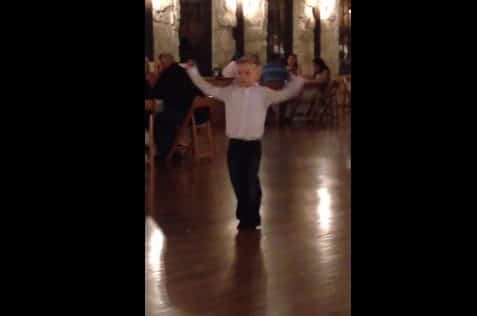 When the kid made a beeline to his chair the moment this obligatory dance concluded –a dance I assumed his mother had forced him to participate in– I imagined that some people might have been shocked at the manner he exited. I laughed. I thought it added to the spectacle. I laughed loud, believing that those that laughed while he danced would share my laughter. They didn’t. I received confused looks from those around me. His beeline exit did not elicit shock, or any other response. They’d moved on. I tried to, but I was fixated on this kid.
Some may have characterized this kid’s exit as a statement regarding what he thought of the art of dance, but I didn’t think that captured it. I thought that a desire to watch how this party would unfold fueled this kid’s exit.
The kid’s exit suggested that he was one that preferred to watch. It was aggravating to those of us that watched his initial dance steps and thought he had something to offer to this otherwise routine wedding reception. He didn’t appear to be the least bit embarrassed by his performance, so why would he prefer to watch?
Psychologists state that we have mirror neurons in our brain that seek enjoyment from another’s perspective, and that that enjoyment can be so comprehensive that we may reach a point where we convince ourselves that we’re the ones performing these actions. Others describe it as a frequency of thought, or a through line to a greater understanding of being: being funnier, more entertaining, and better in all the ways an insecure, young man thinks that his elders are better. Honing in on this frequency is something that TV watching, video game playing nine-to-ten-year-olds know well. It goes beyond the joy of watching others make fools of themselves, for entertainment purposes, to a belief that when watching better performers attempt to be entertaining, we’ve achieved that level ourselves without having to deal with all the messy details involved in the trials and errors to get to that point.
I knew, even while I was doing it, how odd others might find it that I was obsessing over the actions of a nine-to-ten-year-old boy, in such an innocuous moment of the boy’s life, and I attempted to look away several times. Every time a member of the party made some kind of misstep, however, this kid would draw my attention by laughing harder than anyone else would. My guess was that the relief that he wasn’t one of those in the position to commit such errors fueled that raucous laughter. This kid would laugh so hard at every joke that it was obvious he wanted to be louder than any others laughing.
“He’s attempting to cross over,” I thought.
“What’s that?” my uncle said.
“What?” I said. “Nothing.”
My uncle’s ‘What’s that?’ is often characterized by a preceding pause. The pause suggests that either they know that you’re talking to yourself, and they’re looking to call you out on it, or they believed the comment was situational, until they chewed on it for a bit and realized they couldn’t place it.
Whatever the case was, I hadn’t intended for anyone to hear that thought. I was embarrassed. I was embarrassed, but I also wondered if I intended to think that aloud, so that I might have it on the record if it went down the way I thought it would.
What I would not tell my uncle, for fear of being deemed one that is far too interested in self-serving minutiae, was that this ‘cross over’ is the Houdini milk can of the observer’s world. It is an attempt to establish one’s self as a participant in the minds of all partygoers without participating.
The initial stages of a crossover are not a difficult to achieve. Anyone can shout out comments, or laugh in an obnoxious and raucous manner that gains attention. The crossover does require some discretion, however, for it can be overdone. When one overemphasizes an attempt, they could run the risk of receiving a “We know you were there. You wouldn’t shut up about it” comment. The perfect crossover calls for some comments and/or attention getting laughter interspersed in the emcee’s presentation to lay the groundwork for the stories the subject would later tell others regarding his participation.
“He knows what I’m talking about,” the groom, acting as the emcee of the event, said at one point. He was alluding to Kevin, and Kevin’s over-the-top laughter.
It would be almost impossible for me to know if this kid achieved a total crossover, for I had no familiarity with the family, and I would have no opportunity to hear the kid’s after-party stories. The kid did accomplish an excellent first step, however, thanks to a groom that, I assume, had spent the last couple years trying to have the kid accept him as an eventual stepfather.
The answer to why I was so obsessed with a 9-to-10-year-old crystallized soon after the groom’s comment. Kevin’s mother called upon Kevin for increased participation. The kid waved her off. He waved her off in the manner I waved off so many of my own calls for increased participation. It dawned on me that my preference for observation went so deep that it was less about fearing increased participation and more about a preference for watching others perform that was so entrenched that any attempts to have me do otherwise could become an obnoxious distraction.
That’s me in the corner I thought. That’s me in the spotlight, losing my sense of belonging.
“You were just integral to the party,” I wanted to shout out to that kid with such vigor that I would’ve revealed myself. “Why would you prefer to sit on the sidelines of your mother’s wedding?”
Could it be that this preference for observing has something to do with the idea that we’ve all been participants and observers in the audience at various points in our lives, and we’ve all witnessed this idea that those roles can somewhat interchangeable in people’s memories? Unless the participants are so over-the-top funny, entertaining, or in all other ways memorable, observers have can manipulate the memories of participants, if they know how to enhance their role as an astute observer.
When one is an athlete, for example, the members of the audience may cheer their athletic exploits in ways that display the pride they might feel through vicarious connections. When an athlete commits an error, or underperforms in any way, they may feel sorry for the athlete, but they won’t associate with them in any meaningful way. They may not disassociate themselves from the athlete, depending on the error, but the error allows them to believe that put in the same position as the athlete was at the time of the error, they would not have committed it. ‘All you had to do was catch the ball,’ is something they may say, ‘and it was hit right to you.’
Some may view the desire to view an activity, as opposed to partaking in it, as a bit of a cop out. It may have been a cop-out for this kid, just as it may have been for me, but I do have fond memories of various events that I refused to participate in, in the same manner this kid might have of his mother’s wedding. I laughed with my fellow party goers, as we all recalled those past events that took place with fondness, and I did offer funny anecdotes to those conversations, but my role was often limited to that of an observer. Actual participation in these events was the furthest thing from my mind.
If this kid shared as many traits with me, at nine-ten-years-old, my guess was that he was already documenting stories that he would retell for years. Some of these stories might involve slight exaggerations regarding his role in them, but my guess is that few listeners would have the temerity, or the memory, to dispute him. Some of his versions of the story may offer interesting insights, and if those little vignettes involve creative, entertaining nuggets, they might become a part of the narrative in a manner that listeners to join him in making the leaps of re-characterizing his actual involvement.
If this kid manages to accomplish this, and he gets so good at it that others start corroborating his version of other events, he may make the leap to an almost-unconscious discovery of a loophole in his interactions that provide him a future out on all requirements of participation.
If he already does this, on a conscious level, and his evolution is so complete that he’s already choosing vicarious participation over actual participation on a conscious level, then that is where the similarities end. I thought he was too young for all that however, but I did consider the idea that he might be slipping into an all too comfortable position where he is neglecting the importance of participation on purpose.
The problem that I foresaw for him, a problem I now see as a result of watching him act out a page in the first chapter of my autobiography, was that he was learning what to do and what not to do through observation alone. I considered this portal equivalent to the type of learning one can experience while watching too much TV and playing too many video games, with all the same vicarious thrills of victory and dissociative feelings of failure. I also thought that he would come to a point where he had problems learning the lessons, and making the vital connections, we only make by doing. If I had been in a position to advise this nine-to-ten-year-old of the lessons I’ve learned, but did not heed at his age, I would’ve shouted:
“Get back on the dance floor, kid! I don’t care if you were already out there. Get out there and do it. Then get out there and do it so often that you tailbone is on the line and you’re making an absolute fool out of yourself. Then, when that obnoxious observer steps up to laugh at you for making such a fool of yourself, you can turn on them and say, ‘At least I was out there. Doing it! What were you doing? Sitting on your can watching me!’”
If you enjoyed this piece, you might also enjoy the other members of the seven strong:
He Used to Have a Mohawk (This is not a prequel to this piece, but it is another story that occurred in the same wedding.)
A Simplicity Trapped in a Complex Mind



 Rilaly