
We love octopuses! Clicking on this article is a tantamount admission on your part that you probably love learning about the octopus as much as I do. To say they’re fascinating creatures is an understatement. To those of us who love lists, and we all love lists, we might list octopuses as our second favorite animal, but there are so many unique features and unique personalities animals possess that it’s difficult to narrow down the rest of that list.
If we read through one of those top ten most fascinating animals lists, we learn that most animals have one, maybe two, fascinating features, but there are three animals that have such a wide array of unusual characteristics that they’re the most fascinating. The platypus has so many different features that they confused zoologists for decades, and the history of that confusion is so compelling to me that I would list them as my third favorite animal. The octopus might have the second most unique features that continue to fascinate everyone from those of us on the lower rung of enthusiasts to specialists, such as Marine Biologists, Neuroethologists, and Cephalopodologists. (Did you know there was a profession that focused specifically on cephalopods? Neither did I. They’re rare, but they are out there.)
There is one animal more popular than the octopus, the platypus, the monkeys, the lions, gators, and panda bears. Don’t see where I’m going, I’ll give you two hints: every animal has a love/hate relationship with them, and when archivists compile a list on the subjects of most books, fiction and non, this species dominates the list, and it’s not even close. If you guessed humans, you’ll get nothing, and you’ll like it.
Even those of us who love the octopus and the platypus so much that we want to write something about them know that if we’re going write an article about them, we better involve humans in some way, shape or form. Most people aren’t so interested in octopuses that they’re going to click on an article about them if that article is solely about the octopus. Such an article would feel too dry and “too sciency”. In this vein the inclusion of a human interest angle might be the difference between hard and soft science. Writers of soft science articles know that to personalize an article, we have to include people in some way.
This problem is somewhat similar to one that plagued famous author Kurt Vonnegut. His problem wasn’t related to octopuses, or articles about them though. His problem involved a dog, or a problem he had with his dog that he perceived to be a problem. Vonnegut’s perceived problem was that his dog was too human. The dog loved being around humans too much for Vonnegut’s taste. The dog was so happy around them that he wanted to be around them all the time. The problem, Vonnegut perceived, was that he felt his dog was spending so much time around humans that he was losing touch with his canine nature. Mr. Vonnegut thought this was his fault, because he rarely put his dog in canine environments. He believed his dog should explore its canine nature more by interacting with other dogs more often, so that it could remember where it came from.
 To rectify this, Vonnegut took his dog to a dog park to introduce him to the wonderful world of canines. The dog initially greeted those other dogs in the park with pure joy and excitement, and he did everything a dog typically does when it meets a new dog. When that initial euphoria died down, Vonnegut’s dog turned to the dogs’ owners, the new humans there were to meet in the park. For the rest of their stay in the dog park, the dog’s attention remained stubbornly exclusive to humans. His dog only wanted to meet, greet, and play with the humans who were in the park. Vonnegut was a little frustrated. He tried to do everything he could think up to get his dog to play with other dogs, but the dog only wanted to play with their owners. “As frustrated as I was, I kind of understood,” Kurt Vonnegut wrote, “for I, too, spent a lifetime trying to understand these curious creatures.”
 The moral of this story, for me and other young, aspiring writers, is that although creative writing is one of the freest art forms ever created, it does have one concrete, almost inescapable rule. No matter what the subject matter is, the writer had better find a way to involve humans, if their target audience is the human demographic. If we’re going to make a cartoon about dogs, sea creatures, or monkey, for example, we’ll have to anthropomorphize those animals. We’ll have to have them speak, typically in English, have them interact in ways humans understand, and even include some sociopolitical inserts that we all know plague the puffer fish. Even if humans are not our target audience, a writer may not want to take the chance of writing about other animals in the most authentic manner they can conjure up, devoid of human interest, because most animals are as fascinated with humans as humans are, as Kurt Vonnegut found that day in the dog park.
If a writer is going write about something relatively obscure, like the octopus, they better find some way to tie their story of that octopus into the human experience, if they hope to capture the human demographic. The writer may want to find a way to compliment their fellow humans for the various ways in which they co-exist with this cephalopod mollusk. The writer may want to find a zoo that declares the octopus to be their most popular attraction. They may even want to find a way to compliment their fellow humans for the ingenious ways in which they serve the subject of their piece to their fellow humans for consumption, or use them in various medicinal products if there are any.
If the writer seeks to condemn their fellow man for all the ways in which they harm, or otherwise destroy, the cephalopod mollusk, and its environment, on the other hand, they may want to find creative ways of telling their fellow humans how evil the are. Humans love that too. It makes them feel guilty and powerful at the same time.
If the writer’s research does not support such material, the writer may want to write about their personal experiences they’ve had with the subject. Humans, for whatever reason, enjoy reading about another human’s process. We enjoy silly, little anecdotes about how the writer grew up with an octopus wall tumbler toy, and how the writer’s obsession with the octopus grew by leaps and bounds after those formative years. Humans may want to read about some interactions the writer has had with the species they plan to cover, and how that octopus displayed cute, anthropomorphic characteristics. The human-interest angle is what they call it in the biz, and if a writer is not willing, or able, to add some element of humanity in their documentary, book, or article, they may want to find another way to make a living.
 The Plural War: The ideal plural tense of the word octopus is octopuses. Some reports suggest the plural tense Octopi “was created by English speakers out of a mistaken belief that the word octopus was of Latin origin and hence pluralized with an -i. But the word octopus comes from ancient Greeks, where its plural is octopodes, and though it came to English via scientific Latin, it was never a native Latin word and didn’t exist in that language until scientists borrowed it from the Greeks in the 18th century (and if it were a Latin word, it would take a different form and would not be pluralized with the -i ending).” So, while the word octopi “can’t be justified on an etymological basis, it is not wrong. It is old enough and common enough to be an accepted variant.” Those of us who loath the idea of accepting a variant, because it’s common, might prefer to use the plural form octopuses based on its Greek origins, or octopodes if we’re trying to sound professorial, but we should not correct our peers when they say octopi. It’s not incorrect, but it’s not as correct as the other two, and its asterisk is arrived at by common usage. The only definitive point I arrive at is that I agree with those attempting to learn the English language when they suggest that it is one of the most confusing languages to speak for all of its various rules and acceptable variants.
- Octopuses have no bones. This makes them a very tasty morsel for the many predators in the ocean. Their survival, therefore, depends on a number of ingenious tactics. The most fascinating of which is the pseudomorph. Most people who watch documentaries on the octopus have witnessed the “inking” defense in which an octopus leaves a cloud of ink in its trail, then switches directions after they leave an ink cloud to confuse a pursuing predator. The pseudomorph is similar, but more complex, in that it contains mucus. The mucus gives the excreted defensive substance a little more staying power than the typical ink cloud, and it gives the octopus enough substance to create an image that mirrors its own. The pseudomorph, also called the “blanch-ink-jet maneuver”, is what many researchers believe is a self-portrait the octopus leaves behind to further confuse the predator. It may not be a self-portrait as rich in detail as those Van Gogh left behind, but it’s similar enough to serve its purpose of confusing predators. Predators have been so confused by this image that not only does it alter their attack, but some have attempted to bite the pseudomorph with the mistaken belief that it is the octopus.
- Octopus’ ink can also cause physical harm to enemies. The ink, reports the Smithsonian, “contains a compound called tyrosinase, which, in humans, helps to control the production of the natural pigment melanin. When the ink is sprayed in a predator’s eyes, however, tyrosinase can cause a blinding irritation. It also garbles the predator’s sense of smell and taste.” The defensive concoction is so potent, in fact, that if the octopus doesn’t escape the cloud that they create, they could die. As we’ll learn in Octopus Nuggets II, there are fascinating and illuminating reasons these otherwise defenseless globs of boneless matter have survived a reported 296 million years.
- A Sodahead.com commentator states that the octopus has separate and distinct brains in each of its arms, as “two-thirds of an octopus’ neurons reside in its arms, as opposed to its brain. As a result, one arm can be sent out on a task of opening a shell fish, while the octopus, and the other seven arms, are busy doing something else. The arms even react to stimuli after they’ve been completely severed. In one experiment, severed arms jerked away in pain when researchers pinched them.”
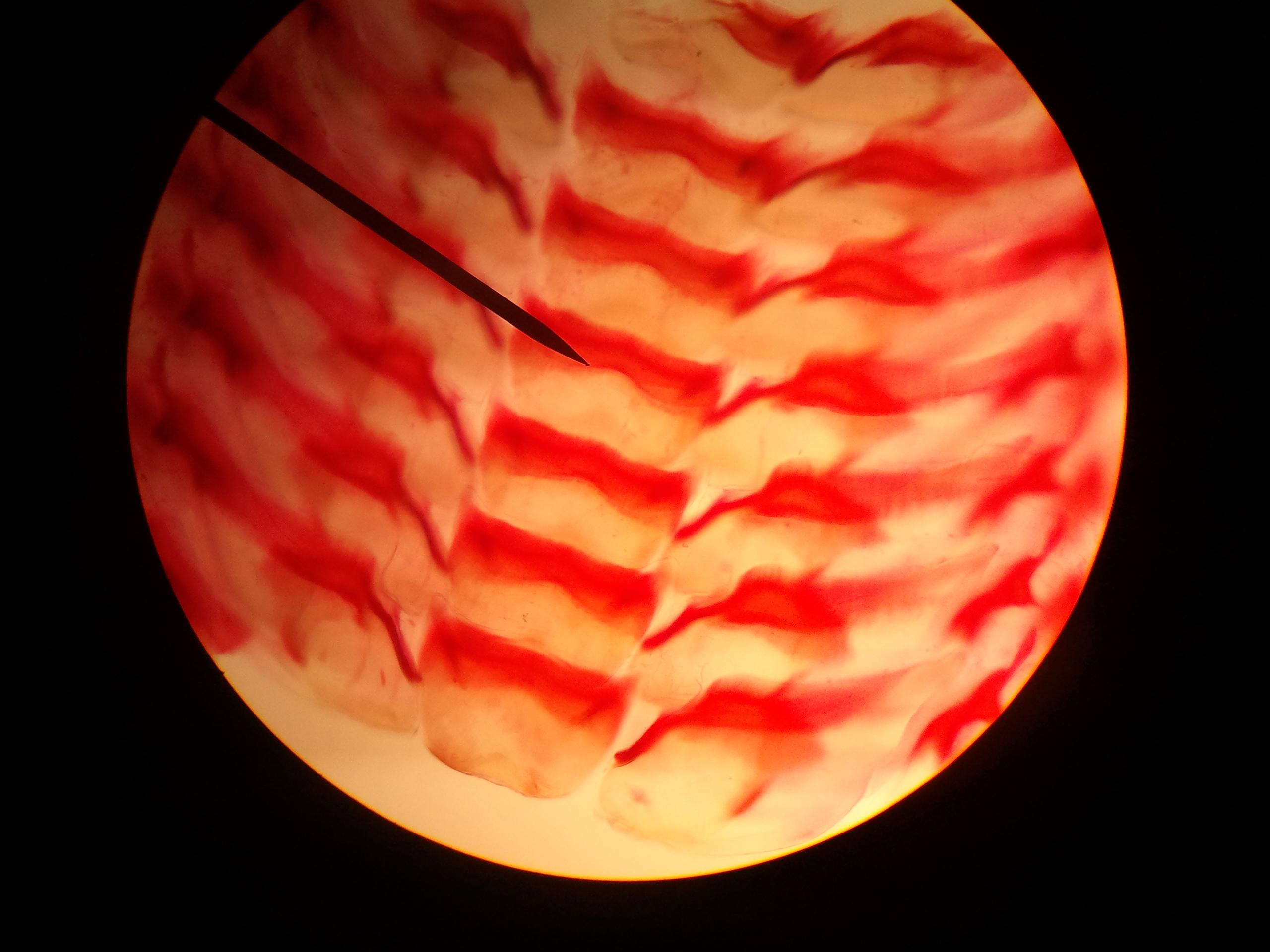
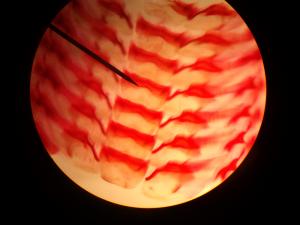 When an octopus comes upon a clam shell, it immediately attempts to rip it open with its many incredibly strong arms acting in unison. If the octopus is not strong enough to rip it open, it drills a hole in the top of the clam with its tongue and injects a neurotoxin to stun the clam into opening up. The word tongue, is used here for the purpose of human understanding, for experts claim that even though it sits in the mouth of the octopus, it is inaccurately called a tongue. The radula has numerous, minute, horny teeth (pictured here) that the octopus grinds on food for the purpose of breaking it up.
- The octopus has three hearts. Two of the hearts work exclusively to move blood beyond the animal’s gills, while the third keeps circulation flowing for the organs. The organ heart actually stops beating when the octopus swims, explaining the species’ penchant for crawling rather than swimming, which exhausts them. It also has excellent vision in that it can see long distances, but it is basically deaf.
- Jacque Cousteau has an interesting story involving a friend named Gilpatric. Gilpatric decided that he wanted to keep an octopus as a pet. Knowing the intelligence and strength of the octopus, Gilpatric presumably decided that it didn’t matter how smart the mollusk was if he put a heavy enough lid on top. A short time later, he discovered the aquarium was empty. After searching through his house, he finally found the octopus going through his library book by book, turning the pages with its arms.
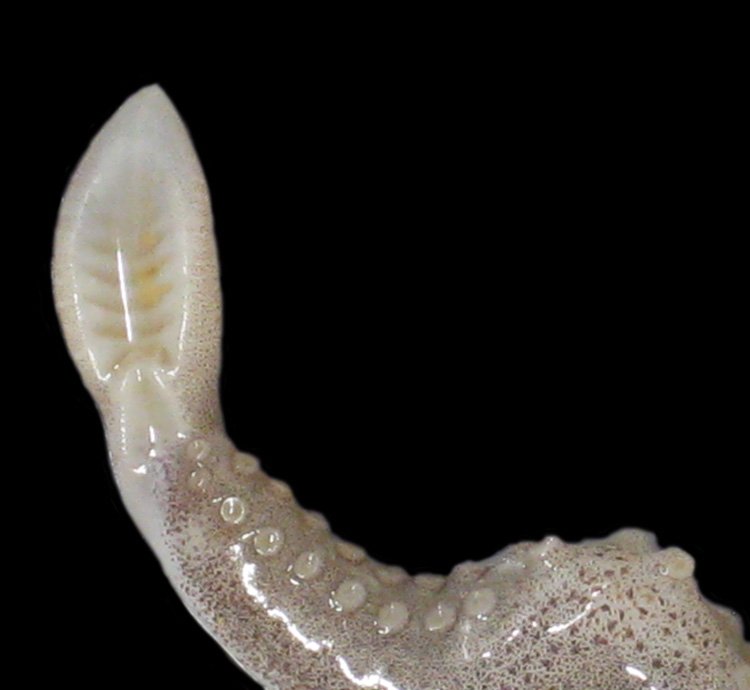
- Male octopuses have a sex organ at the end of one arm, the
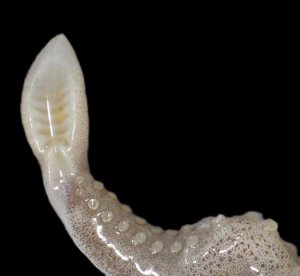 (the sex arm). This gives octopuses a number of options when it comes to the act of reproduction. They can do it in the traditional manner, but due to the fact that the male’s hectocoytlus arm has a funnel–mantle locking apparatus that keeps it lodged in the pallial cavity of the female, the male octopus will most likely lose that arm in the process. As a result of this eventuality, some male octopuses decide to forego what they must sense is going to be a painful, and humiliating, process by simply detaching the sex arm and giving it to the female to do with what she pleases. (If this option were available to humans, some might wonder if it might solve the conflicts that arise between the genders, or if it would only make matters worse. Others claim to know human males that already engage in this process to avoid the pain and humiliation involved in the process.) Another option that octopuses have at their disposal is to build homes so close to the female that all the male has to do is stretch his hectocoytlus arm into the female’s home and hand her the spermatophores necessary for reproduction.{1} The female then accepts the spermatophores with her right arm. (Researchers do not know why it is exclusively the right arm, but they do not connect it with the reasons that most cultures will only shake with their right hand.)
 - There is something of a contradiction concerning the male’s life after reproduction. Some sites state that the male octopus wanders off to die after reproduction, and others claim that the male will have many mates before dying. Does the male octopus engage in a flurry of reproduction, with various females, in the space in time in which it senses their fertility, or does the male’s death fluctuate within the species? If anyone knows the answer to these questions, feel free to reply to this post with that information.
 The females can lay up to 400,000 eggs, which they have been known to hang from the ceiling of their homes in a manner that resembles translucent, beaded curtains. The mother then obsessively guards her eggs to a point that she actually stops eating. This does not lead to a death by starvation, however, as it has been determined that her body begins to undertake a cellular suicide that begins in its optic glands and ripples throughout her tissues and organs until she is dead. One could guess that this might be the direct result of not eating, but researchers insist that this is not the case.
- Regardless when an octopus succumbs to death, or how, it appears that even if an octopus manages to avoid reproducing throughout the course of their lives, the maximum life expectancy of a wild octopus is around five years.

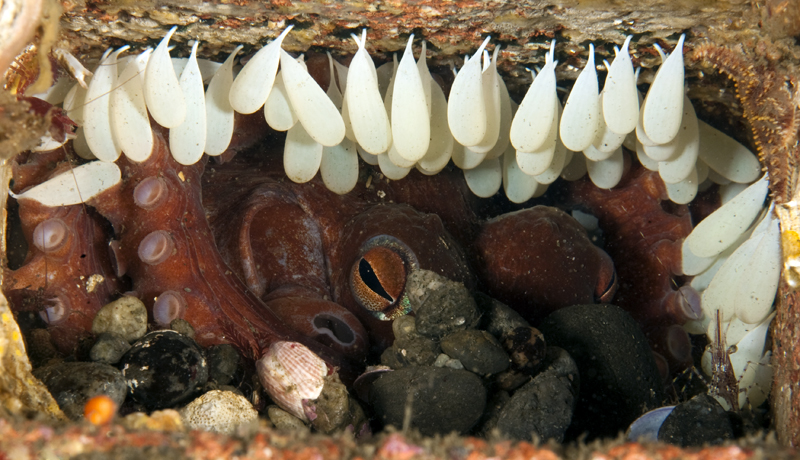
To the untrained eye, this invertebrate appears to be little more than a large lump of flesh, but further inspection reveals that they are an incredibly complex species that survives and thrives with a utility belt of tools at its disposal to defend and attack. And fossil records indicate that this complex mollusk may date back to the Carboniferous period, some 296 million years ago, and that these findings indicate that the being hasn’t changed much at all during this time period.
__________________________________________________________
Further Reading on this subject: Octopus Nuggets II
{1} Horowitz, Kate.10 Hidden Talents of the Octopus. Mental Floss. May 2015.Pgs., 36-37.Print.


 If the reader is anything like my informed consumer friend who insisted on informing me about the natural byproducts of my strawberry shake, and the reader is interested in trivial information about consumable products, that reader already knows about the number of websites that will feed the need. These websites provide tidbits and warnings about just about every product and service available to mankind, updated on a daily basis. If the informed consumer is so interested in such information that they feel an overwhelming need to share, just know that an ever-increasing segment of the population has already reached that fight-the-yawn tipping point, because most of this information proves to be little more than a conglomeration of trivial concerns, if not contradictory.
 Rilaly