Life is not random, some say, it is choreographed by a controlling force with a master plan that we may not understand at first, but will eventually come clear when we look back and see the final portrait. For others, life is a random series of moments, equivalent to an abstract pointillism painting. This belief suggests that we’re simply here one day, talking to our friends, gone the next. Human life has more meaning than the life of the badger in the arena of consciousness of life, but little more than that. The primary difference, for these people, comes from the act of looking at life, examining it with strained eyes, until we see a purpose that we believed was there all along. No matter how one looks at it, we can all agree that these moments of life are finite, and that it is an abuse to waste them. The latter becomes all the more clear when we’ve survived a death-defying incident.
An abstract pointillism painting
Part of the allure of the story of the vampire is the dream mere mortals have of being immortal, so that these moments of life can be infinite. These dreams only become more profound as we age, and the realization of our own mortality becomes more substantial –and the idea of eventually becoming inconsequential, even to those that love us most, haunts us– we dream of immortality. The dream of immortality is one thing, the non-fan have argued, but the actuality of it would be quite another.
The import of the allure of the vampire story is the question that fascinates us, “What would you do if you knew knew that you were going to live forever?” The less obvious question, asked by cynical viewers/readers of the story is, “Why would you do it?” How exciting would the bungee jump be to the person that knew there was no chance they were going to die? The primal fear of falling would surely affect some vampires, as they were all mortal once, but if you can’t even be superficially wounded, much less mortally, how much allure would there be in the “death plunge” of the bungee jump?
In most incarnations of the story, the vampire is not only immortal and invulnerable to superficial injury, they can even manipulate situations to a point where they wouldn’t have to experience emotional pain. Through the power of their eyes, most vampires can convince mere mortals to do their bidding. As a result, no girl can ever dump them; no bully can pick on them; and no moron can ever do anything to mess their life up. In most incarnations of the vampire story, the use of this power is selective, so as to allow the mortals involved in the story to do things that give the story greater drama, but the cynics in the audience wonder why the vampires don’t just turn on their eye power and persuade the girl to love them. (I know most vampire stories involve the vampire wanting organic love from the girl that results from the mortal deciding to love them, but the very idea that they can circumvent this process by turning on their eye power diminishes this to a tool used by the author of the story to provide drama.) We cynics understand that thread of the story that the greatness of love lies in its achievement for the vampire, but when he is utterly devastated by the failure to do so, the vampire doesn’t have to experience that devastation. The vampire has a plan B. The eyes. Just flick on that power.
Mere mortals have no idea if the girl is going to love us in real life, and we have no plan B if she doesn’t. We are pretty sure that we’re going to survive the bungee jump, and the roller coaster, as they offer some comfort of being a controlled environment, but there is some fear –that results in some adrenaline– involved in the idea that we’re not 100% positive. If you were 100% positive that you weren’t going to die, or even receive some painful superficial wounds, why would you do it? Would there be any sense of accomplishment in achieving love from another, if you knew that you had such a solid plan B that you could convince the girl to love you, regardless what she decides.
Some of us have had near death experiences, from a car crash that first responders informed us should’ve resulted in the end of our moments; we’ve been informed that if our death-defying incident had occurred inches to the left, or right, we would no longer be here to talk about it; and others have had incidents that require no such explanations of how close they’ve come. Those that have survived the latter speak of a sense of euphoria that overwhelms them and profoundly informs the rest of their life. This sense of euphoria, they say, does not last forever, or as long as it probably should, but for the short time you’re immersed in it, your second lease on life can be euphoric.
In an attempt to explain this blast of euphoria that comes from being unsuccessfully murdered, author of the collection of essays We Never Learn, Tim Kreider, uses the plot of Ray Bradbury’s The Lost City of Mars to illustrate: “A man finds a miraculous machine that enables him to experience his own violent death over and over again, as many times as he likes –in locomotive collisions, race car crashes, and exploding rocket ships– until he emerges flayed of all his Christian guilt and unconscious longing for death, forgiven and free, finally alive.”
In the essay, Reprieve, Kreider explains that after it was deemed that he would survive the attempt on his life, he considered everything that followed as “Gravy.” A term he derives from a man, author Raymond Carver, that was also granted a second lease on life.
Quoting from the proverbial “food tastes better” template of survivors, Kreider states that he did things he wouldn’t have done in his pre-murder attempt life, and what was once deemed troubling, dramatic, and consequential in the first life, became trivial in the scope of having survived. Kreider claims he even developed a loud, racauos laugh, in his reprieve, that caused “People to look over to make sure I was not about to open up on them with a weapon.” He claims that laughter could be heard when he complained to a friend, “You don’t understand me.”
The friend responded: “No, sir, I understand you very well –it is you who do not understand yourself.”
Whereas most survivors perceive divine intervention in their narrow escape, Kreider states that even in the midst of his euphoria, that “Not for one passing moment did it occur to me to imagine that God Must Have Spared My Life For Some Purpose. I was not blessed or chosen, but lucky.”
I wish I could recommend the experience of not being killed to everyone. It’s a truism,” he basically states, that motivates most thrill-seeking adventurers to attempt what are basically “suicide attempts with safety nets”. “The trick,” he writes, “Is to get the full effect you have to be genuinely uncertain that you’re going to survive. The best approximation would be to hire an incompetent, Clouseauque (Inspector Clouseau, played by Peter Sellers, in the movie The Pink Panther) hit man to assassinate you.
“It’s one of the maddening perversities of human psychology that we only notice we’re alive when we’re reminded we’re going to die, the same way some of us appreciate our girlfriends only after they’ve become exes.” Kreider writes of his terminally ill father, writing that while in his last days: “(The man) cared less about things that didn’t matter and more about the things that did. It was during his illness that he gave me the talk that all my artist friends have envied, in which he told me that he and my mother believed in my talent and I shouldn’t worry about getting “some dumb job.””
But, Kreider writes: “You can’t feel crazily grateful to be alive your whole life any more than you can stay passionately in love forever—or grieve forever, for that matter. Time makes us all betray ourselves and get back to the busywork of living.”
The latter quote reminds one of a guest on The Tonight Show in which this guest talked about a love that spanned decades. She claimed that her husband provided her a white rose every day, and that the two of them never fought. In the aftermath of that interview, host Johnny Carson turned to his sidekick Ed McMahon and said something along the lines of: “It’s a beautiful story, and I wish I had the same (Carson was married four times), but I can’t help but thinking how boring it would be to never fight for that many years. I’m not calling her a liar. I believe her. I just think it would be boring.”
In great loves, and great lives, life can experience great highs and great lows, but the great highs cannot be fully appreciated without the contrast of great lows.
I don’t know why we take our worst moods so much more seriously than our best,” Kreider writes, “Crediting depression with more clarity than euphoria. We dismiss peak moments and passionate love affairs as an ephemeral chemical buzz, just endorphins or hormones, but accept those 3 A.M. bouts of despair as unsentimental insights into the truth about our lives. It’s easy now to dismiss that year (following the survival of the unsuccessful murder) as nothing more than the same sort of shaky, hysterical high you’d feel after getting clipped by a taxi. But you could also try to think of it as a glimpse of reality, being jolted out of a lifelong stupor. It’s like the revelation I had the first time I ever flew in an airplane as a kid: when you break through the cloud cover you realize that above the passing squalls and doldrums there is a realm of eternal sunlight, so keen and brilliant you have to squint against it, a vision to hold on to when you descend once again beneath the clouds, under the oppressive, petty jurisdiction of the local weather.”
We all love to quote Murphy’s law: “Anything that can go wrong will go wrong.” It’s important to prepare for things to go wrong, of course, but is it a truism that everything will go wrong, or is it a “maddening perversity of human psychology” that we only notice things when they do? If the petty jurisdiction of local weather provides us with clear and 60, how long will we remember that versus -2 and 10 inches of snow? And how beautiful is clear and 60 when all we’ve known, all week, is -2 and 10 inches? How beautiful, conversely, would clear and 60 be if we could use the eye power of the vampire to have clear and 60, 365? The dream would be one thing, the reality quite another.
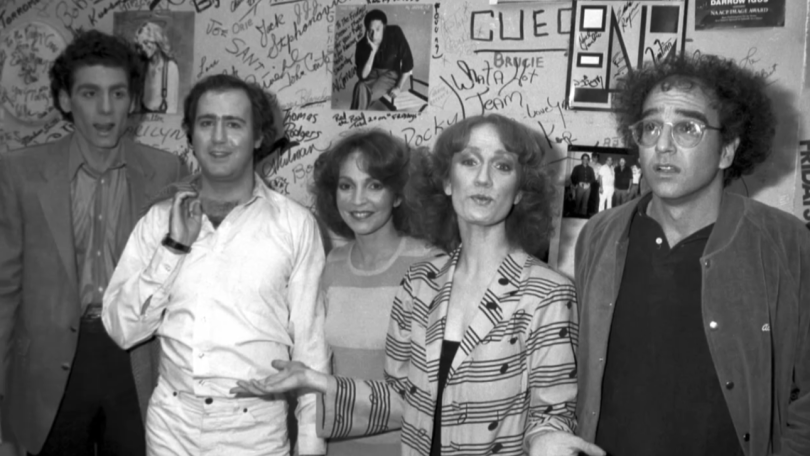
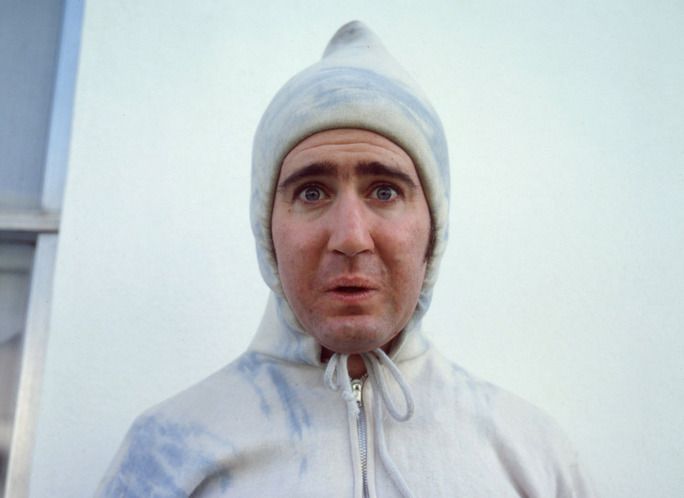
On the timeline of comedy, the subversive nature of it became so comprehensive that it became uniform, conventional, and in need of total destruction. Although the late, great Andy Kaufman may never have intended to undermine and, thus, destroy the top talent of his generation, his act revealed his contemporaries for what they were: conventional comedians operating under a like-minded banner. In doing so, Andy Kaufman created a new art form.
Some say they enjoyed Andy Kaufman’s character on Taxi, and they enjoyed some of his other performances in tightly scripted roles as a comedic actor, but his solo stage performances weren’t funny. They weren’t funny. They were unfunny, and they were so unfunny they were hilarious. If you saw his act, and I did on tape, you knew he wasn’t going for funny. He stood on stage in the manner a typical standup comedian would, and the audience sat in their seats as a typical audience will. The lines began to blur almost immediately after Kaufman took the stage. What is the joke here? Is he telling jokes? Am I in on it? They didn’t get it, but Andy Kaufman didn’t want us to get it. After he became famous, more people started to get it, so his act evolved, naturally, to wrestling women.
After reading every book written about him, watching every YouTube video on him, and watching every VHS tape ever made with him in it, I gained some objectivity. My guess is that he wasn’t talented enough to succeed as a “conventional artist”. He didn’t have oodles of material to fall back on, and he wasn’t a prolific writer. He wasn’t a one-trick pony, but he wasn’t a thoroughbred who could have a long, multi-faceted career either. Whatever it was that he did, it was something we had to see, and he did it better than anyone else ever has. If you don’t “get it”, and few do, then you never will. That’s not intended as a slam on the reader, because he didn’t want us to get it. Andy Kaufman’s M.O. was a little bit childish and narcissistic, but in many ways his “overly simplistic” acts somehow ended up redefining and revolutionizing comedy. If you saw it back then, you see it now all over comedy.
Those of us who had an unnatural attraction to Kaufman’s game-changing brand of unfunny comedy now know the man was oblivious to greater concerns, but we used whatever it was he created to subvert conventional subversions, until they lost their subversive quality for us.
Those “in the know” drew up very distinct, sociopolitical definitions of subversion long before Andy Kaufman. They may consider Kaufman comedic genius now, but they had no idea what he was doing while he was doing it. I can only guess that most of those who saw Kaufman’s act in its gestational period cautioned him against going overdoing it.
“I see what you’re trying to do. I do,” I imagine them saying, “but I don’t think this will play well in Kansas. They’ll just think you’re weird, and weird doesn’t play well on the national stage, unless you’re funny-weird.”
Many of them regarded being weird, in the manner embodied by his definition of that beautiful adjective as just plain weird, even idiotic. They didn’t understand what he was doing.
Before Andy Kaufman became Andy Kaufman, and his definition of weird defined it as a transcendent art form, being weird meant going so far over-the-top that the audience felt comfortable with the notion of a comedian being weird. It required the comedic player to find a way to communicate a simple message to the audience: “I’m not really weird. I’m just acting weird.” Before Kaufman, and those influenced by his brilliance, broke the mold on weird, comedians relied on visual cues, in the form of weird facial expressions, vocal inflections, and tones so weird that the so-called less sophisticated audiences in Kansas could understand the notion of a comedic actor just being weird. Before Kaufman, comedic actors had no interest in taking audiences to uncomfortable places. They just wanted the laugh.
One can be sure that before Andy Kaufman took to the national stage on Saturday Night Live, he heard the warnings from many corners, but for whatever reason he didn’t heed them. It’s possible that Kaufman was just that weird, and that he thought his only path to success was to let his freak flag fly. It’s also possible that this is just who Andy Kaufman was. Those who haven’t read the many books about him, watched the VHS tapes, the YouTube videos, and the podcasts had no idea what he was doing, but he had enough confidence in his act to ignore the advice from those in the know. We admirers must also concede that it’s possible Kaufman might not have been talented enough to be funny in a more conventional sense. Whatever the case, Kaufman maintained his unconventional, unfunny, idiotic characters and bits until those “in the know” declared him one of the funniest men who ever lived.
The cutting-edge, comedic intelligentsia now discuss the deceased Kaufman in a frame that suggests they were onto his act the whole time. They weren’t. They didn’t get it. I didn’t get it, but I was young, and I needed the assistance of repetition to lead me to the genius of being an authentic idiot, until I busied myself trying to carve out my own path to true idiocy, in my own little world.
Andy Kaufman may not have been the first true idiot in the pantheon of comedy, but for those of us who witnessed his hilariously unfunny, idiotic behavior, it opened us up to a completely new world. We knew how to be idiots, but we didn’t understand the finer points of the elusive art of persuading another of our inferiority until Kaufman came along, broke that door down, and showed us all his furniture.
For those who’ve never watched Andy Kaufman at work, his claim to fame did not involve jokes. His modus operandi involved situational humor. The situations he manufactured weren’t funny either, not in the traditionally conventional, subversive sense. Some of the situations he created were so unfunny and so unnerving that viewers deemed them idiotic. Kaufman was so idiotic that many believed his shows were nothing more than a series of improvised situations in which he reacted on the fly to a bunch of idiotic stuff, but what most of those in the know could not comprehend at the time was that everything he did was methodical, meticulous, and choreographed.
Being Unfunny and Idiotic in Real-life Situations
This might involve some speculative interpretation, but I think Andy Kaufman was one of the first purveyors of the knuckleball in comedy. Like the knuckleball, the manner in which situational humor evolves can grow better or worse as the game goes on, but eventual success requires unshakeable devotion to the pitch. The knuckleballer will give up a lot of walks, and home runs, and they will knock the occasional mascot down with a wild pitch, but for situational jokes to be effective, they can’t just be another pitch in our arsenal. This pitch requires a level of commitment that will become a level that eventuates into a lifestyle that even those closest to us will have a difficult time understanding.
“Why would you try to confuse people?” they will ask. “Why do you continue to say jokes that aren’t funny?”
“I would like someone, somewhere to one day consider me an idiot,” the devoted will respond. “Any idiot can fall down a flight of stairs, trip over a heat register, and engage in the fine art of slapstick comedy, but I want to achieve a form of idiocy that leads others to believe I am a total idiot who doesn’t know any better.”
For those less confident in their modus operandi, high-minded responses might answer the question in a way that the recipient considers us more intelligent, but those responses obfuscate the truth regarding why we enjoy doing it. The truth may be that we know the path to achieving laughter from our audience through the various pitches and rhythms made available to us in movies and primetime sitcoms, but some of us reach a point when that master template begins to bore us. Others may recognize, at some point in their lives, that they don’t have the wherewithal to match the delivery that their funny friends employ, particularly those friends with gameshow host personalities. For these people, the raison d’être of Kaufman’s idiotology may offer an end run around to traditional modes of comedy. Some employ these tactics as a means of standing out and above the fray, while others enjoy the superiority-through-inferiority psychological base this mindset procures. The one certain truth is that most find themselves unable to identify the exact reason why they do what they do. They just know they enjoy it, and they will continue to pursue it no matter how many poison-tipped arrows come their way.
An acquaintance of mine learned of my devotion to this pitch when she overheard me contrast it in a conversation I had with a third party in her proximity. I did not want to have that conversation with the third party so close to her, but my devotion to the pitch was not so great that I was willing to be rude to that other person. What she overheard was a brief display of intellectual prowess that crushed her previous characterizations of me. When I turned back to her to continue the discussion she and I were having prior to the interruption, her mouth was hanging open, and her eyes were wide. The remark she made in that moment was one she repeated throughout our friendship.
“I am onto you now,” she said. “You are not as dumb as you pretend to be.”
The delicious moment of confusion occurred seconds later, when it dawned on her that what she thought she figured out made no sense in conventional constructs. 99% of conversationalists pretend to be smart, and the traditional gauge of the listener involves them defining the speaker’s perceived intelligence downward, as they continue to speak and leak their weaknesses in this regard. What I did was not reveal some jaw-dropping level intellect but a degree of knowledge that served to upend her traditional study of those around her to define their level of intelligence.
She looked at me with pride after she figured me out, but that look faded when she digested what she thought she figured out. Who pretends to be dumb and inferior? was a thought I could see in the fade.
What are you up to? was the look she gave me every time I attempted to perpetuate ignorance thereafter. The looks she gave me led me to believe that everything she thought she figured out only brought more questions to the fore. I imagined that something of a flowchart developed in her mind to explain everything I did and said to that point, and that each flowchart ended in a rabbit hole that once entered into would place her in a variety of vulnerable positions, including the beginning. She pursued me after that, just to inform me that she was onto what I was doing, until it became obvious that she was the primary audience of her own pleas.
I’ve never thrown an actual knuckleball with any success, but watching her flail at the gradual progression of my situational joke, trying to convince me that she was now above the fray, cemented my lifelong theory: Jokes can be funny, but reactions are hilarious.
The point is that if you devote yourself to this mindset, and you try your hardest not to let your opponents see the stitches, you can convince some of the people, some of the times, that you are an idiot.
The Idiotology
Some idiots purchased every VHS tape and book we could find on Andy Kaufman, and we read every internet article that carried his name to try to unlock the mystery of what he was trying to do. We wanted those who knew him best to tell us why he chose to go against the advice of those in the know and if it was possible for us to follow his indefinable passion to some end. We followed his examples and teachings in the manner of disciples, until it became a lifestyle. Andy Kaufman led us to believe that if we could confuse the sensibilities of serious world just enough that it could lead to some seminal moments in our pursuit of the idiotic life.
If our goals were to be funny, we would’ve attempted to follow the trail laid by Jerry Seinfeld. If our aim was only to be weird-funny, we would’ve adopted the weird-funny voice Steve Martin used in The Jerk. If we wanted to be sardonic or satirical, we would have looked to George Carlin for guidance. We knew we weren’t as funny as any of those men were, but we reached a point when that didn’t matter to us. When we discovered the unfunny, subversive idiocy of Andy Kaufman, however, it filled us like water rushing down the gullet of a dehydrated man.
“How did the unfunny idiot reach the point where it no longer mattered that others considered them funny?” the reader might ask. “How did you reach the point where that bored you?” The natural inclination most might have is that we think were so funny for so long that we sought something more. This was not the case for us, as most people, especially women, never thought we were funny. The answer, if there is one, is that, like Andy Kaufman, we might not be as funny or as talented as our friends, but we choose not to see it that way of course. The unfunny idiot is just thrilled as anyone else when others find them funny, even by conventional means, but there’s something different and unusually thrilling to us when we deliver a crushing haymaker that no one finds funny, per se, and most people consider idiotic. “Okay, right there, you said it, you said it,” an especially perspicacious individual might say, “You find it unusually thrilling. Why?” When pressed to the mat, and if we do it long enough someone will call us out on it and interrogate, until they help us arrive at an answer, such as, we don’t know, but we were probably just wired a little different.
Most of our friends considered us weird for the sake of being weird, but they don’t recognize the depth charges until they’re detonated. If we do it just right, and knuckleball slides under the bat perfectly, they’ll see it for what it is. They might not understand it, but they’ll get it. They won’t feel foolish for not getting it, because you were the idiot in that scenario, but they’ll eventually see that you weren’t being weird just for the sake of being weird.
The Disclaimer
If the goal of the reader is to have their friends and co-workers consider them funny, adding Kaufman’s knuckleball to your repertoire will only lead to heartache and headaches. What we advise, instead, is for the reader to focus on adding more traditional beats and rhythm to their delivery, and they should learn how to incorporate them, on a situational basis, into conversations. This gets easier with practice and time. Quality humor, like quality music, must offer pleasing beats and rhythms that find a familiar home within the audience’s mind. (Some suggest that the best beats and rhythm of humor come in threes. Two is not as funny as three, and four is too much more.) To achieve familiarity, there are few resources more familiar than that which comes from sitcoms and standup comedians that everyone knows and loves. We should also copy the template our friends lay out for a definition of what’s funny. There’s nothing an audience loves more than repeating their jokes, rhythms and beats, right back at them. If the joke teller leads into the punchline with a familiar rhythm and lands on the line in a familiar beat, the audience’s reward for figuring out that beat will be a shot of dopamine, and the joke teller’s reward is the resulting laughter. To keep things fresh, the joke teller might want to consider providing their audience a slight, yet still pleasing, twist at the end. The latter can be funny as long as the punchline is a slight slide away from expectations.
If, however, the goal is to be an unfunny idiot who receives no immediate laughter, the joke teller still needs to adhere to the standardized rules of comedic beats and rhythms, and they need to know them even better than students of traditional humor do. As any gifted practitioner of the art of idiocy will tell those willing to listen, it is far more difficult to find a way to distort and destroy the perception of conventional humor than it is to abide by it. This takes practice and practice in the art of practice, as Andy Kaufman displayed.
The rewards for being a total idiot are few and far between. If we achieve total destruction or distortion of what others know to be the beats and rhythm of humor, a sympathetic soul might consider us such an idiot that they take us aside to advise us about our beats and the rhythm of our delivery. For the most part, however, the rewards idiots receive are damage to their reputations as potentially funny people. Most will dismiss us as weird, and others might even categorically dismiss us as strange. Still others will dismiss us as idiots who know nothing about making people laugh. Most will want to have little to nothing to do with us. Women, in particular, might claim they don’t want to date us, declaring, “I prefer nice, funny guys. You? I’m sorry to say this, but you’ve said so many weird things over the years that … I kind of consider you an idiot.”
We can’t choose our co-workers. The hierarchy not only chooses them for us, they choose who we sit near. If you’ve ever worked in an office, you know that you’re probably closer to the person you sit near than most of your family for as long as you sit near them. You can choose your friends and associates, but you can’t choose your family or your co-workers. Those of us who have been a part of a large, multi-national corporation, on a long-term basis, have found that the lines between family and co-workers often become blurred.
“There are times when we may find ourselves closer to our co-workers than our family, and the simple reason for this is that we’re around them more often,” a boss of mine once said.
In the course of our tenure at the firm, we will sit next to a wide variety of office workers who reveal their eccentricities over time. The ratio of odd ducks may not exceed those in the general public, but when we get to know them more intimately, it seems like it. When we switch to the overnight shift, we encounter a Star Wars Cantina of odd ducks on a nightly basis, and the attempts to overlook their eccentricities becomes their part-time job. We can try to ignore it and hope it goes away, because we have to work with these people at least forty hours a week. Forty hours a week doesn’t seem like a large block of time, until you’re doing everything you can to enjoy your day at work. Moderation is the key for if you become too sympathetic to their plight, to the point that you begin to believe that they’re all victims of circumstance, it may lead you to becoming one of them. The difficulty of maintaining objectivity is made all the more difficult by the players involved, and their unintended desire to top the most extreme eccentricity we’ve ever heard. If we manage to escape this exercise untainted, we will walk away from the experiences mumbling we can’t choose your co-workers.
The Office Party
A Case of Mistaken Identity
Rhonda told my girlfriend at the time, that she saw me at a bar that was well-known in our city for being a low-rent meat market. When my girlfriend confronted me with this, I told her “I’ve heard of it, but only because there’s a Dairy Queen across the street.” The next day, my girlfriend informed me that Rhonda stated that it wasn’t just that saw me there, she stated that the two of us engaged in a short but polite conversation. I reiterated the fact that I’d never been to that particular bar. When Rhonda later found out that there was another person working at our company who had the exact same name as mine, she conceded that it may have been a case of mistaken identity. I accepted this at face value, at first, until I chewed on it for a second.
“Wait a second, didn’t she say she had a conversation with me that night?” I asked. “How can one have a conversation with another and believe it’s someone else, based on their name? How drunk was she?”
It’s important to note, here, that my relationship with Rhonda went beyond a name basis. The two of us spent three months working across the aisle from one another in the company. And … and those three months were her first three months with the company, and she had tons of questions, and I was the senior agent on that team whose primary duty it was to answer those questions. In these two respective roles, the two of us had over 100 exchanges in those three months.
“It’s not a case of mistaken identity,” I said. “She’s out to get me. She wants to break us up, or something.”
“Rhonda doesn’t think that way,” my girlfriend at the time stated. “It’s just Rhonda. She’s kind of a ditz. I’m embarrassed that I ever believed her over you. Forgive me?”
Of course I forgave her. How could I hold her responsible for another person’s fables and foibles? I didn’t forgive Rhonda however. I knew Rhonda was a bit of a ditz, but I wasn’t buying the “It’s just Rhonda,” excuse regarding the accusation she leveled against me, and I thought less of her and my girlfriend for believing her. I thought Rhonda was out to get me, and I carried that particular grudge against her for days, until I discussed the situation with Dan.
“It is just Rhonda,” Dan said to confirm my girlfriend’s characterization. “I can tell you all you need to know about Rhonda in one brief, little story. Rhonda found out that $600.00 was missing from her checking account, and she could not explain that missing money. She knew that she didn’t do it, and her daughter said that she didn’t withdraw the money either. Rhonda was so convinced that something nefarious was going on that she took her complaint up the corporate chain to the bank’s vice-president (VP). Once seated across from that seat of power, Rhonda proceeded to berate this woman for her bank’s apparent lack of security. ‘Do you just let anyone walk into your bank and withdraw money from various accounts?’ Rhonda asked the VP. In her portrayal of the conversation, Rhonda then proudly informed her audience that she informed the VP that the bank would be pulling all of the bank’s security tapes, and that it had become her mission in life to get her $600.00 back if it killed her, because she knew, knew that she didn’t do it, and she didn’t believe her daughter, the only other person with access to her account, did it. She stated that she would’ve remembered withdrawing $600.00, because $600.00 was all she had in that account, and her $500.00 rent was coming due, and she wouldn’t just withdraw her rent money for reasons she couldn’t remember. She informed the bank VP that she had nothing to show for that $600.00 withdrawal, and if she had been the one to withdraw the money she “sure as hell” would have had something to show for it. It was a serious charge, of course, and the VP told Rhonda that she considered it so serious that she would make it her top priority to find out what happened.
“The bank VP, being a responsible VP, responded to Rhonda’s complaints by pulling the bank’s tapes on the date and time of the withdrawal, and she called Rhonda in a couple days later to watch the tape and show her that it was, indeed, Rhonda withdrawing those funds.
“Now,” Dan continued. “I’m sure that that bank VP privately accused Rhonda of all the same ulterior motives that you just did two minutes ago, but the one thing neither of you account for is her stupidity, an inexplicable, almost unprecedented, embarrassing amount of utter stupidity that is just Rhonda.”
We’ve all heard about faulty eye-witness testimony that has led to some convictions, but when we read the shockingly high number of cases that were predicated on key eye-witness testimonies and later overturned with DNA evidence, we wonder if these people were lying. We can only guess that an overwhelming number of these eye-witnesses “Saw it with my own eyes.” Rhonda thought she saw me, and she was willing to go to battle over the idea that not only did she see me, she talked to me. When she found out this guy with my exact name, same spelling and everything, worked at our company, her faulty eye-witness testimony went into hyper drive.
How often does our memory betray us? I could tell you a number of stories about my faulty memory on some life-altering events. You might be sympathetic when I reveal the details, or you might not. You might consider me just stupid, or you might suggest that I had motives for my poor memory in certain situations. How could you confuse such details? Was I trying to be more dramatic, funnier, or more interesting? No, I just messed up some details. It just seems impossible to believe that some memories are that bad, but some of them are, and as impossible as it is to believe faulty eye-witness testimony might play a role, some of the times it does, and we have to account for that.
A Reaction
I strolled into work one day to find Bill and Jim riding around on a guest’s sit down scooter in the back office of the front desk of a hotel. This scooter was motorized and very similar to that which can now be found at your neighborhood Walmart. Jim rode around on this motorized scooter, like a little kid with a new toy: laughing, beeping the little horn, and hooting, and hollering, and waving his pretend hat around like a cowboy in a rodeo.
“That’s hilarious,” I said watching Jim go crazy.
“Yeah,” Bill said. “Too bad there’s a limit to the fun … It’s an old lady’s cart, and it’s limited in how fast it will go.”
“Whaddya mean?” I asked Bill, as Jim began to dismount. “These things are universal. There’s no such thing as an old lady’s model. There’s an accelerator switch that goes from turtle to rabbit.”
When it was my turn on the scooter, I turned the accelerator switch from turtle to rabbit. Just before I went on my first ride, I saw Bill and Jim’s imagination light up. I took one run through the back office to gain a little comfort with the scooter, and its new speed, and in my second run, I began yelling, “How do you stop this thing? I’m out of control.” I then crashed into one of the telephone operators that had been sitting in her chair.
The telephone operator’s initial alarm could not be faked, but as she read my face, her alarm softened. “Jack ass!” she said with the remnants of a smile lifting the corner of her mouth.
Bill and Jim were out of control with laughter. I thought of making a couple more runs. It was, indeed, a blast, but the performer in me couldn’t see how I could top the hilarity of first run, however, so I dismounted.
Bill replicated my run, when his turn arrived, by screaming the exact same words, “How do you stop this thing? I’m out of control,” and he ended up crashing into the exact same operator’s chair in the exact same manner.
“Look,” someone who just entered the back office area said when Bill was in the midst of his run. “Bill figured out how to make the scooter go faster.” The person who said this just happened to be the most attractive female employee in the hotel, and I had spent weeks trying to impress her. When Bill crashed into the very same operator’s chair as I had, she laughed hard and she said, “You are just crazy” in an affectionate manner.
“I did that,” I told Bill in a manner that I hoped would affect this girl’s impression of me. Bill stopped right in front of me, looked up and grinned. “I figured out that switch,” I said. “I made it go faster. I — you even ran into ran into the same operator’s chair in the exact same manner I did.” Bill just sat there and grinned up at me. I knew that declaring propriety of a joke was a fool’s errand, and as a result I didn’t do it often, but this woman was so good looking, and she laughed so hard that I couldn’t help but ask Bill for my proprietary interest back. He just sat there and smiled at me.
I got credit from the schlubs at the front desk, but when the best looking girl at the hotel stepped in the back office, she only saw Bill doing it. “You know I did that first,” I said like a five-year-old trying to reclaim a good boy deed. I hoped that this incredibly beautiful woman would hear this and know that I was the funny one here, and that Bill had just copied a run that led her to laughter. I didn’t care about schlub laughter. I wanted beautiful woman laughter.
Bill’s smile increased, until he was beaming at me. At one point, his beam increased to the point that he started to turn red. My competitive urges began to grow, until I began disliking this character named Bill. I never cared for Bill before this moment, but the two of us managed to have a working relationship with one another. This particular incident was just beyond the pale. He was the beneficiary of excellent timing though, and he knew it. When he continued to smile at me, and beam, and go red with glory, I considered the fact that I had underestimated how loathsome a creature he was, soaking up more than his share of glory. I was getting fired up, trying my hardest to look away. I was fighting the urge to call him a dirty name, at this point, and his prolonged, unusually long stare was only making me more angry. I imagined that this altercation might progress into something physical, when a third party stepped in to interrupt us:
“Okay Bill, settle down.” The third party then said in a very soothing voice, “You know you need to refrain from getting too excited.”
“What?” I asked the third party person. “What’s going on?”
“He’s having a seizure.”
The Mess
Standing behind the front desk of a hotel, a woman named Jenny asked a porter named Jack to clean up a small nugget of trash she saw in the foyer of the hotel.
“Yuck, Jenny I think it’s poop,” Jack said leaning down to look at a small particle on the floor that was at the bottom of the ballroom announcement board.
“It’s not poop Jack,” Jenny replied. “Just clean it up.”
Jack went overboard. He insisted on it. He went into the back and grabbed a tissue. Jenny was somewhat frustrated by this, but she did not say a word as Jack collected the particle in front of the announcement board with a tissue and threw it in the trash can.
Minutes later, the front desk housekeeper began bending down to make quick dabs and wipes with a washcloth on the floor in front of the front desk area, and she proceeded to do this down the hall. “What are you doing?” I asked her.
“Someone spilled coffee on their way down the hall,” she said cleaning a trail of brown dots. “Happens all the time.”
Minutes later, a gift shop employee approached me saying, “I need you to accompany me out to a car.” What? “Just come on!” she said. “I’ll tell you outside.” At the car, she informed me that a guest knocked on the stall of the bathroom, asking the gift shop employee if she worked for the hotel. When the gift shop employee told her that she did, the guest informed her that she had had an accident. The guest asked the gift shop employee to go to her car and retrieve a coat for her. Fearing a lawsuit, or that this was some kind of ruse perpetuated by a guest who might claim that she stole something out of her car, the gift shop employee asked me to witness her going into the guest’s car for the guest’s coat.
Unbeknownst to me at the time, the customer also asked the gift shop employee to retrieve a to-go shopping bag for her. Once the guest had her London Fog, knee-length coat on, sans the underwear and pants the guest now had in the to-go bag, the gift shop employee informed me, the guest decided to stop, en route to the exit. The guest proceeded to shop in the gift shop for a full fifteen minutes, “Like nothing happened,” the gift shop employee informed me. She was wearing a London Fog length coat that stretched to her knees, but she had nothing else on below the waist, due to the mess she was purported to have made in her undergarments and in her pants.
“She must be used to it,” the gift shop employee surmised.
The Obnoxious Email
One of my fellow email customer service agents quit the job that required her to answer emails from customers, because she couldn’t handle the swearing she encountered via the confrontational emails that she received.
“It’s an email,” I told her on numerous occasions. “Prior to this job,” I informed her, “I’ve experienced face to face confrontations with angry, swearing customers, and I’ve even had some of them throw things at me.” I informed her of some of the abusive phone calls I’ve taken over the years in which I’ve had my life threatened. “And these are just emails.” I told her that some customers will do everything they can to get under your skin and rattle you. “It’s the nature of the customer service industry,” I said. “Compared to a person trying to dress you down, face-to-face, and an irate customer that won’t let you get a word in with their less personal phone calls, an abusive emailer is nothing. It’s impersonal, and they know it. The anonymity allows them to think they can write anything, and it has no reflection on them. Just ignore it, and don’t take it personal.” I said the latter in a dismissive manner that suggested that once you get over this hump, you’ll be looking back on all of this with laughter.
“I can’t ignore it,” she said. “And to be quite honest, I don’t know how you all can?”
“Just laugh at their feeble attempts to prove that they’re mad,” I said the latter in a derisive tone that mocked their attempts to appear emotional via email. In my attempts to lead her into dismissing these silly people who get emotional in emails, I was informed that I was acting in a manner that she considered dismissive of her complaint. “It’s a mindset that you have to have in the customer service industry. Always remember that they don’t know who you are. They’re angry people who want to have something to be mad about. You’re just the unlucky person that happens to be on the other end of their rage. You’re an anonymous worker for the company. Their grievances aren’t with you, or even company. Their complaints are with the life fate has dealt them. In the end, be happy that you’re not them, and you don’t have to live with them, and that it’s just an email. Most of us have experienced a lot worse.”
“I couldn’t do it,” she said greeting me months later, after numerous counseling sessions. She was quitting the company. “I couldn’t ignore it,” she added. I couldn’t help but think less of her, as she told me how much my efforts to console her meant to her, and she said all that with tears in her eyes. To say that I was shocked does not do it justice.
From that point forward I took what I considered inconsequential complaints from fellow employees more serious, and I realized that we’re all different, and we all have different thresholds, and some of us define Darwin’s theories on natural selection and survival of the fittest better than others.
The Identifiable Characteristics Inherent in the Penis
Working in the intangible world, employees are often required to require some customers send the company a form of identification to prove their identity, if those customers hope to continue to do business with the company. In one of the replies to such a requirement, a customer sent an image of his penis. Next to the picture were the emboldened words, “This is me!” and an arrow pointing to the image. I’m not sure if this customer was sending a rebellious statement in regards to our company’s policies and procedures, or if he believed that this would fulfill our company’s requirement for identification.
Putting Down the Dog
Sitting next to a person for forty hours a week, can lead one to think that they know everything they want or need to know about their co-workers. Some are tempted to believe that they know that person better than that person’s family and friends do, but most of us know that this is a silly conceit, as it is impossible to know a person in such limited constraints. In the day-to-day interactions we have with them, however, we hear intimate details we believe they do not share with family and friends, and this can lead us to the temptation that we think we know them better.
The friend that led me to realize the limits of my powers of observation, informed me that she had to put the family dog put down over the course of the prior weekend. In the midst of my sympathetic response, she said:
“It’s a dog. You men get so attached to dogs. You’re all so ridiculous.”
I agreed, and I made a joke about the inherent loyalty men have for a dog versus what they should have for a spouse. Unbeknownst to me, at the time, this otherwise meaningless joke changed the dynamics of our conversation. I only gained the full breadth of this change in hindsight, after her full confession was out. She laughed a little at that joke. She presumably considered that joke a statement of solidarity she and I shared on the issue. She opened up after that joke.
“My husband’s so upset,” she said. “He thinks I did it, because the dog was messing all over the place.”
“Well,” I said. “That’s grief. Maybe that’s how he’s dealing with it, by blaming you.”
“No, he’s right,” she said, “but it wasn’t just one mess here and there. The dog was going all over the place. Every time I came home and opened my door, I smelled urine. Our whole house smelled like dog urine, and I couldn’t handle it anymore.” The look on my face affected hers. “I told him and told him to take care of it. I told him to train the dog better,” she expounded. “I told him that maybe he should race home, during his lunch hour, to let the dog out one more time, but he didn’t do it.”
A lengthy answer of this type requires repetition. Even if the listener heard everything the speaker said, they need the speaker to pull quote their answer.
“Wait a second,” I said. “You said he was right. What was he right about?”
“I put the dog down,” she said. She then put a hand up to caution me against proceeding before she could answer in full. “But it was not an impulsive decision. This dog had been having trouble with its urinary tract for months. I told my husband to take care of it. He said he would, but he either wouldn’t or he didn’t, so I did.”
“Who are you?” I asked. When I asked this question, it was framed in the comedic rhythm that many sitcoms use to condemn another in a soft fashion and allows the target of the accusation an easy exit. She flinched in a manner that informed me that she might have never heard the joke delivered that way before. “What did you say to your husband’s accusations?” I asked her.
“I told him that the vet said the dog suffered from some debilitating disease,” she said. “I can’t even remember what I said that disease was. I made something up.” She then laughed.
Again, I heard everything she said, but in order to process this information my processing center required repetition. “What did the vet say the disease was?”
“There was no disease,” she repeated. Her tone was one of impatience, as if to suggest I wasn’t getting it. “The dog wasn’t suffering from a disease, and it did not have infections in the urinary tract. It was just old, and it couldn’t control its bladder anymore.”
Some writer’s discretion was involved here, as I did not include all the blank stares I offered this woman, as she detailed her weekend activities. In those blank stares, I characterized her through her actions. I considered her act so heartless that I couldn’t comprehend it, but I didn’t want to bore the reader with the innumerable blank stares I offered her. The next question I’m sure a reader might ask is why didn’t I call her out or condemn her action further. All I can say is that I thought I was being subjected to the ‘awful to the extreme’ joke. Women perform this joke more often than men for whatever reason, and I’ve fallen for the ‘awful to the extreme’ joke so often that I was on guard. I’ve condemned people for actions so completely that when they say, ‘I didn’t really put my dog down. I was joking. I cannot believe you would think that I would do something that awful … You can be so naïve some of the times,’ I felt like a fool for overreacting in such a manner, and I didn’t want to overreact in this situation.
Another element that drove the stupor and prevented me from questioning her further was that I am constantly confronting new ‘awful to the extreme’ exaggerations of human compassion. I am amazed at the irrational compassion some people direct to alleged victims they’ve never met in life to the point that they believe some outrageous claims based on some form of emotional allegiance. My friend who put down her dog was so lacking in empathy that it was another hill for me to climb to understand how lacking in empathy some people are. I tried to understand, but I didn’t do that well in the time and place. I tried so hard that I asked her about this situation numerous times. I didn’t recognize how persistent I became to have her assure me that she was not joking, that it affected our relationship. I didn’t even know that she was avoiding me, until I asked her about it, again, and she said:
“You really need to get past the whole dog issue.”




 Rilaly