Secret Chiefs 3 Book of Horizons: Folio A


“This isn’t Westoxification, this isn’t Drupad — it’s not Ram Naryan, its ROCK!”—Trey Spruance

Anyone who attempts to review a Secret Chiefs 3 (SC3) album has their hands full. How does one describe such vast music in a short article, and keep it concise enough to maintain a reader’s attention? Is SC3 classical? No, but it does contain elements of classical music. These elements may not be recognizable to fans of Mozart, Bach, and Beethoven, but they do carry the same revolutionary spirit that followed those composers in their era. Will SC3 remind a listener of Arab, or Middle Eastern, music? Yes, but as the guitarist (and leader) of SC3, Trey Spruance, will tell you, if you played SC3 in any Middle Eastern country, “They would consider the music as foreign as your mother and father would.” Is the philosophy of SC3 based on Spruance’s interest in Persian philosophy? Yes but not directly, as Spurance stated:

secret_chiefs_promo“It solved a philosophical riddle that I had always needed to find an answer to, and Secret Chiefs is the musical expression, the exploration of those thoughts.”  
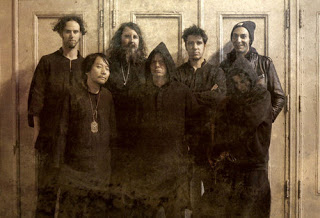
Is the music similar to the type of music Ennio Morricone used in the soundtrack to The Good, the Bad, and the Ugly? Yes, but we cannot listen to SC3 without hearing the evolution, and personalized interpretations, of Morricone’s general ideas.

As Greg Prato, of AllMusic.com, writes, “(SC3) is a combination of Ennio Morricone movie scores, world music, experimental noise-rock, and heavy metal.”{1}

Blake Butler, of Allmusic.com, described SC3 as, “Indian/Asian-sounding melodies overlaid with wildly cavorting, techno rhythms and a tiny bit of metal, infused with a sense of mystery and paranoia from the thematic artwork based on number theory and assumedly Hindu belief systems.” He has also basically said that he didn’t think there would be much of a market for this kind of “skewed version of Indo/Pak music.”{2}

As with most artists, when Trey Spruance is confronted with anyone attempting to classify his creation, he finds such attempts limiting to the scope of SC3 music. He prefers to refer to SC3 as technologized music, that is contemporary Middle Eastern music, combined with a discernible western influence.

Spruance, as indicated by this War and Peace length explanation of the totality of his vision, has as much difficulty describing the music of SC3 as any reviewer, or blogger. He is either being sardonically complex, when describing his philosophical approach to music, or it is so infused by a multitude of influences that cannot be condensed to a simple chapter … of War and Peace. {3}

The History

For those unfamiliar with the band(s) Secret Chiefs 3, they arose out of the ashes of the late great Mr. Bungle. They are, basically, Mr. Bungle without lead singer Mike Patton. They are, largely, the work of Mr. Bungle’s guitarist and keyboardist Trey Spruance with the  assistance of two other Chiefs, formerly of Mr. Bungle, bassist Trevor Dunn and drummer Danny Heifetz.

The reports of the Mr. Bungle’s demise have it that Mike Patton could no longer deal with the work ethic of some of the members (see Spruance) of the band. The reason we can specify Spruance, in our interpretation of these relatively vague Patton complaints, is that Patton worked with Dunn and Heifetz soon after Bungle’s breakup. On that charge, history has vindicated Patton, judging by the number of bands, and the total number of projects Patton has involved himself in in the intervening years, versus those of Spruance.

Spruance, for his part, has argued that while he considers most of Patton’s post-Bungle works interesting, quality works, he thinks some of them sound rushed, and that they probably could’ve been perfected with time. Thus, it could be said that, at the very least, Spruance’s approach to music is more methodical and patient than Patton’s. One has to hope that the breakup of one of the best American bands wasn’t as simple as that, and that doesn’t appear to be the case with Spruance, as he stated that Patton was an egomaniac who wanted everything done his way:

“Patton’s subsequent resentment towards me is a fairly predictable outcome. You don’t stand up to him and stay off his (dung)-list. A bummer, yeah, but it’s essentially a self-protecting reflex action – something I don’t really feel a need to hold against him too much. He has his way. It won’t change.”

That having been said, it appears as though time does, indeed, heal all wounds, as Mike Patton is the vocalist on one of the best tracks of Book of Souls: Folio A: La Chanson de Jacky. This song marks the first time that Patton and Spruance have worked on a released track together since Mr. Bungle’s demise in 2004. It is a cover song of a 1965 Euro song that has a feel –or to use an old, hippie adjective– a vibe that would have fit in quite nicely on Patton’s Mondo Cane.

The wait

Those who loved the SC3 album The Book of Souls: Book of Horizons later learned that it was the first of a trilogy that we assumed would be available later that same year, or soon thereafter. Patient fans soon began to think that they may not live long enough to see the completion of that trilogy, started in 2004. It appears as though that day has finally arrived, as Folio A is the first part of a two part release that will be followed by the release of Folio B, which Spruance declared to be soon to follow. Longtime fans hope that soon to follow does not amount to another ten years.

“Time scales don’t really apply to Secret Chiefs 3,” Trey Spruance.

Between the two Book of Soul albums, SC3 fans have been treated to a greatest hits album, Path of Most Resistance, a couple EPs, a brilliant soundtrack for a movie-never-made called Le Mani Destre Recise Degli Ultimi Uomini, and an interpretation of John Zorn work’s Xaphan Book 2—The Book of Angels Volume 9. The latter work put to rest any speculation that Zorn and Spruance were still feuding over The Weird Little Boy session. Spruance claimed there was never a feud between the two of them, but that he didn’t care for Zorn’s free form jazz, and that he simply preferred to work in tighter arrangements. This begs the question, had Spruance never heard Zorn’s work, or his style of production, before this project? (Note: Zorn produced Mr. Bungle’s 1991 self-titled debut.) Weird Little Boy was released in 1998, and it is exactly what Spruance complains about: free form, unfocused, and nonsense, music that is John Zorn (and jazz in general) at his worst, in this author’s relatively informed opinion.

The Music and Philosophy of Book of Souls: Folio A

For those familiar with prior Chiefs’ seven releases, Folio A has the vibe that was originally unearthed in most of the songs on the landmark, Mr. Bungle release California. Spruance, of course, states that the artistic impulses behind SC3’s music began years before Mr. Bungle, but those who are used to reading artists describe their productions, know that very few artists will allow a simple description to go by without, at least, attempting to add some form of complication to it. If the impulses began before Mr. Bungle, it’s safe to say that they saw greater maturity, and probable fruition, during Mr. Bungle, particularly the California sessions.

Longtime listeners hate to admit that they enjoy the familiar sounds on an otherwise complicated barrage of music hitting you over the head, but there are times when a listener needs some sort of familiarity as an introduction to the music. SC3’s version of the Theme from Halloween, titled Personae: Halloween is such an intro for uninformed listeners, and those having a little trouble digesting the complicated Folio A album may want to consider listening to this song as an intro. All of the SC3 songs on the Foilo A album have the IndoPak/Euro feel to them, with an ever present Ennio Morricone feel attached.

There are six short tracks on Folio A that provide elaborate radio station identifier sounds, but it’s the other seven that will probably form the base of long time listening for any fan.

Trey’s careful, methodical approach takes what could be discerned as chaos on first listen, but the music eventually grows on you, until the careful structure comes out on repeated listens. Folio A has a base sound, in other words, but each song depends on the varying approaches brought by each sub-band within the band.  As Spruance describes:

“UR is sort of a rock version of Western tonality, and Traditionalists is more of a cinematic, soundtrack thing, whereas FORMS harks back to an earlier age of Western music, sort of a late romantic era being played by automated machines, band organ, that kind of thing. 

“Ishraqiyn is more the quasi-Pythagorean tonalities, referring to the more Eastern tonal system. Holy Vehm is sort of crushing those things together in a violent collision, and Electromagnetic Azoth is actually the center of the whole thing, distributing all the different tonal systems and sometimes coming out seemingly chaotically, but it’s actually very structured. Electromagnetic Azoth is the band that takes the seed motifs and distributes them to the different bands. So the different band’s tonal approaches are used to reinterpret each motif.”

Seven different bands (six sub-bands), seven different ideas, and seven different approaches to seven different songs, (Ishraqiyn and UR each have two songs on the latest LP) for a unified whole. This could lead to chaos, but as described earlier, Spruance has carefully, and methodically, worked them into a structured umbrella.

Spruance described this approach to Progsphere as such:

“There might be one motif, or ‘theme’ for each of these (songs), a philosophical concept that gets tossed around in the music. It gets redistributed around, think of it like filters or a prism; how a prism reflects different colors, but takes in one force of light that gets refracted, it’s like that. Scattering the lights into different modalities, that’s the best way I could describe it.{4}

In an attempt to describe how he approaches the instruments that he plays throughout all of the SC3 albums, Trey said:

“I’m not really an instrumentalist. I’m more of a composer, so that wasn’t going to be fulfilling to me (to simply play, and progress, with the guitar). So I started studying the musical systems of antiquity to try to understand what made them tick and what they were invoking.”

I don’t know if I’m alone with such concerns, but in the last couple of years I’ve found it relatively depressing to learn how little some of my favorite artists had to do some of their best works. With some artists, it’s obvious how little they had to do with the work that happens to carry their name, but there were others that I always believed had near-dictatorial control of their projects. I found it relatively depressing to learn that some of them came into the studio at the 11th hour and wrote some lyrics, and put some cherries atop the pie. I could list names here, but that isn’t what this is about. It’s more about celebrating the standards set up by those few micromanagers who say that if my name is going to be on it, I’m going to micromanage this thing to death, until it reaches my definition of artistic truth. Spruance, Patton, and John Zorn (other than most of his over 20 Book of Angels projects) appear to be these types of artists.

“I feel like I have to take on all of the burden myself; micromanage everything. If you’re going to be putting in a million hours into making this record, if your heart’s not into it, then it’s not going to have any power to it.”

As I said, it’s difficult to review this music. As with most other music, a reviewer can say that when one listens to this music I’m reviewing, they’ll hear a dash of artist A, a mixture of artists B and C, and a heavy dose of artist D. A listener just can’t do that with the Secret Chiefs 3, if their frame of reference is largely western rock. I suppose if one grew up on Morricone, Persian, Arab, and other Middle Eastern music, they could say that it’s derivative, but I would find that surprising. Trey has said that his audience is all over the map, logistically, and demographically, but I have a hard time believing that young westerners, who prize rebellion from parental concerns for their musical identity, will find much appealing in SC3’s music. I’m guessing that the majority of Sc3’s demographic is composed of forty-somethings who are tired of all the typical music out there. For it’s not music that will tick off anyone’s parents, but it may cause them to worry about their child’s mental stability after the kid closes the door and cranks it.

{1} http://www.allmusic.com/album/second-grand-constitution-and-bylaws-hurqalya-armarillo-mw0001016363

{2} http://www.allmusic.com/album/book-m-mw0000591048

{3} http://www.markprindle.com/spruance-i.htm

{4}http://www.prog-sphere.com/interviews/an-interview-with-trey-spruance-of-secret-chiefs-3/#sthash.7E1f9dF5.dpuf

Andy Kaufman lives! Long live Andy Kaufman!


Andy Kaufman is alive!  “Who?” Andy Kaufman. His daughter just said it, and his brother was by her side when she said it. Andy Kaufman is alive. I just knew it. I knew it all along. “Who’s Andy Kaufman?” Andy Kaufman? Everyone knows Andy Kaufman. The guy who sang the Mighty Mouse theme on SNL… The guy that used to purposely anger audiences with his da da antics… Tony Clifton (allegedly)… The guy that wrestled women? The guy that wrestled Jerry Lawler?  The guy that played that foreign guy in the show Taxi?  “Oh!  Latka Gravas!  The guy that Jim Carrey played in Man in the Moon!  He died?”

AndyThose of us that have, at one point in our lives, entered the inner sanctum of Kaufman fanatics find it hard to believe that most people have either forgotten who Andy Kaufman was (other than the guy that played Latka, the guy that R.E.M. sang about, or the guy that Jim Carrey played), or have never heard of him.

This may be due to the fact that Andy Kaufman died (allegedly) in 1984, nearly thirty years ago, and that an entire generation has been born in a Kaufman-less world. This may also have something to do with the fact that he was more of an irritant than a comedian, or entertainer, and irritants usually don’t achieve the kind of popularity, or longevity that comedians and entertainers have. But, you argue, Kaufman may have been the most popular, most successful irritant of all time. True, I would say, but even the most successful irritant’s act is going to get old soon after everyone gets on board.

A career comedian, like a Steve Martin, or a Richard Pryor, learn to adapt and evolve throughout their careers. Even an entertaining funnyman, like a Tom Hanks, learns that one-act careers in Hollywood do not last long.  The cynical can say that these three, and others like them, adapted their act for financial reasons, but Steve Martin would tell you that the whole white-suit, arrow-through-the-head thing simply got old on him after a while, and he wanted to branch out artistically. Kaufman, it should be said, by any die-hard fanatic that watched In God We Tru$t, or Heartbeeps, simply didn’t have the chops to make such a transition. It’s a tough admission for any Kaufman fanatic to make, but repeated viewings of these movies, and some of the other less-than-successful things Kaufman did, will cause even the most die-hard fan to admit that even if he had lives, his career was not long for this world.

The current, most popular irritant, Sasha Baron Cohen, made one successful movie, but that appears to have only let the world in on his act, and he has yet to make the impact he made in that first movie. Kaufman enjoyed his time in the spotlight, and he made the most of it.  He did things, bizarre things, famously irritating things, throughout the course of his career, that are transcendental. Some could say that the makers of Jackass, the aforementioned Cohen, Pee Wee Herman and Chris Elliott have Kaufman to thank for their careers. Some have said that Kaufman opened the doors to the bizarre, in an individualistic fashion, that can never occur in the same way again.

The only reason a one-time Kaufman fanatic is detailing the man’s limits, and relative anonymity, is the line that his daughter (allegedly) delivered, at the annual Andy Kaufman Awards, that Kaufman faked his own death to “enjoy a life outside the limelight.” 

My reply to this line, if I were there, would be that he seemed to be doing fine, in that regard, as it was. Other than some Letterman, and Dangerfield, appearances, it doesn’t appear that Hollywood was knocking down Kaufman’s door. His act appeared to be waning soon after he accomplished his personal dream of headlining Carnegie Hall, after he appeared in some B movies, after he jumped into the ring with Jerry Lawler, and after achieving the goal of accomplishing an inter-gender belt in wrestling.

Was he a genius?  I think so, but I also know that his “irritant” act was limited. Could he have adapted, and progressed, and evolved his act? Possibly, but the groundwork he laid didn’t appear to be adaptable to evolution. The point is that Kaufman appeared to be sliding towards total anonymity as it was, and if that’s what he actually wanted, he would not have had to step too far to the left to achieve it. 

If this alleged daughter had stepped to the stage of the annual Andy Kaufman Awards show and said, “Andy faked his own death in a desperate attempt to forestall the demise of his career, and when that didn’t work, he decided to call it a day and move on in life” I might have believed the charade. No one would say such a thing at an Andy Kaufman Awards show, however, for that would’ve cast Kaufman’s entire career in a negative light, and it would’ve made the act of faking his own death appear desperate and sad. The whole Kaufman schtick, that he didn’t care about his career, would’ve been dispelled, and his fans would’ve walked away disillusioned. 

If his alleged daughter had been instructed, regardless of the light it cast on his celebrity status—something Andy was known to ridicule and personally damage for fun—to say something along the lines of: “Funerals have such a bizarre, romantic attachment to them that we all dream of dying for one day just to see how much people care about us. When Andy successfully faked his own death—through losing a massive amount of weight to appear cancer-ridden, and eventually achieving a depth of meditation only he could achieve where he slowed his breathing to a point that even fooled medical examiners—he realized the depths of cruelty that such a joke could have on his family and friends. After doing it, he saw the depths of sorrow he caused, and he knew he couldn’t reverse the joke for fear of spurning those loved ones that were in such despair over his death. The only reason he decided to come forth now, is that his father died this Summer. Ladies and gentleman, I give you Andy Kaufman…”  He then walks across the stage. 

If this alleged daughter had said such things that cast “his joke” in a desperate light, and then a remorseful light, and if Andy had actually walked across the stage, I might’ve believed it.          

As Bob Thompson, a professor of pop culture at Syracuse University, is quoted as saying in a CNN piece:

“Andy Kaufman was often about doing an awful lot of stuff and enduring an awful lot of hatred and scorn before the punch line ever arrived, if it ever did.”

“Think about it: The setup comes in 1984 and the punch line gets delivered nearly 30 years later.

“You so want it to be true because it would be one of the greatest things to ever happen in the history of comedy,” he says. “It would be the longest joke ever told.”

It would be longest joke ever told, but would it achieve the longest laugh? Kaufman would surely land a spot of Piers Morgan for his accomplishment, but how many people would watch?  Not even a Kaufman interview could get too many people to watch that show. He would surely write a book. He could call it the longest (or greatest) joke ever told, but how many people would buy it? The audience of the longest joke ever told would probably be limited to forty-somethings and fifty-somethings who grew up in an era where the name Kaufman made headlines, but even their participation in the story would probably be limited to clicking on the story. Most of them probably wouldn’t even finish the entire article. They might lift an eyebrow, some of them might smile when remembering his antics, and some of them might even guffaw for as long as it took them to finish the article, but their reaction would be limited to that which occurs with any passing fancy. It would probably be limited to a single exchange in the office: “Did you see that Kaufman faked his death?” “Yeah, I read that article.” How many people are just dying to find out that Andy Kaufman is still alive? It’s probably a lot fewer than one would think.

The Moral of Captain Phillips: More Guns, Less crime


The takeaway that most will probably have, after watching the movie Captain Phillips, is that none of this would’ve happened if the crew of the MV Maersk Alabama had had a gun on board.

Photo by Michael Buckner/Getty Images for CFN

The natural reaction to such a statement, by a member of the anti-gun contingent, would be that having a gun on board would’ve only exacerbated the already violent incident that occurred aboard the MV Maersk Alabama (the Alabama). True, any viewer would have to admit, if that member of the crew had used that weapon at an inopportune moment.  If the crew had waited until the pirates were on board, and a shootout was inevitable, more violence, and more death would’ve occurred. Anyone who watched the account detailed in the movie, however, knows that there were a number of opportune moments where the appearance of a gun would’ve put an end to the incident, or prevented much of what happened from even occurring.

There is a scene in the movie where Captain Phillips attempts to scare the approaching Somali pirates off by faking a radio exchange between he and the U.S. military. In this faked exchange, that was transmitted to the pirates, Captain Phillips used his voice to speak to the fake officer, and he altered his voice to sound like a U.S. military officer responding. It was an ingenious ploy, but it proved ineffective.

Following the failure of this ploy, most uninformed viewers probably thought displaying guns was the next, natural progression, to intimidate the pirates with a display of strength. Why doesn’t Phillips instruct his crew to line up on the bridge of the shipping container with AK-47s pointed at the pirates? Wouldn’t that discourage the pirates from boarding the Alabama if they knew that the shipping container’s crew could match their arsenal? Wouldn’t it have even discouraged the pirates if the crew lined the bridge with Colt .22’s pointed at the the pirates, even though the Somali pirates had AK-47s? It’s a political axiom among some citizens, some paid consultants on 24-7 news networks, and some politicians that more guns equal less crime. This idea is also in the risk, benefits algorithm that most criminals use to determine if they should commit a crime, and which victims make for softer (i.e. less risky) targets.

Contrary to the anecdotal evidence provided in movies, most criminals don’t enjoy the idea of an old-fashioned, mano-y-mano duel to determine who is the better man. Most criminals, as opposed to the anecdotal evidence provided in movies, don’t seek to validate their mental, or physical, prowess by engaging in a battle with worthy adversaries. Most criminals don’t seek a “real-life” chess match with a brilliant crime solver, tha leads them to being caught, only to have the criminal turn to the crime solver saying, “Good show, jolly good show.” Most criminals are thugs that want money, easy money, and they search for that sizable advantage –like a mountain lion surveying possible prey– that allows them to obtain the most money with least possible risk.

There are, as has been suggested elsewhere, debatable points regarding the actual incident, Captain Phillips’ account, the crew’s account, and the account put forth in the movie. One thing that is not debatable is that the incident would not have been near as harrowing, dramatic, or worthy of movie production in Hollywood if, at least, one of Alabama’s crew members were permitted to carry, and fire, a gun.

That story would’ve gone something like this: Somali tugboat approaches container ship, Phillips eventually recognizes that this interaction may not be coincidental, or harmless, Phillips warns pirates in a number of ways, Phillips and crew then exhaust maritime and personally devised tactics to dissuade pirates from coming on board, and pirates, desperate for easy money, test these tactics and prepare to board the ship. While attempting to board, pirates are then shot. Roll credits. There’s no room for creativity in such a story, and no interpretations of the mindsets of the players involved. There’s no good guy/bad guy drama to detail, no harrowing survivor stories to reveal the human survival instincts, no need for any creative hijinks that lead to a good guy victory, and likely no movie. That story would just be too simple: trained crewman pulls gun, warns bad guys by displaying gun, shoots bad guys when all warnings prove ineffective, and bad guys die. Roll credits.

In the movie, there was no talk among the pirates regarding the fact that most cargo ships don’t carry guns. There is no talk, on the net, regarding whether or not these pirates, or all pirates, know which shipping companies allow container ships to carry guns, and which do not, but one has to guess –based on the fact that this is their chosen “trade”, and that they don’t want to die, or get shot– that they know.

Some reports have it that international laws prohibit container ships from carrying guns, but most have it that no such laws exist, and that each shipping container is allowed to carry guns, according to the shipping company’s discretion. The company that owned the MV Maersk Alabama, is the Waterman Steamship Corp., and a current report by Ben Hart of Conservative HQ suggests that “the crew is suing this shipping company for $50 million for gross negligence, alleging “willful, wanton and conscious disregard for their safety.”” {1} There is no mention of the fact that this “willful, wanton and conscious disregard for their safety” is specific to Waterman Steamship Corp. prohibiting its shipping containers from carrying guns, but one has to guess that’s mentioned somewhere in that suit.

Some opinions have it that most shipping companies have deemed it cheaper, as an overall expense, to simply pay pirates their ransom requests than it would be to train a gunman on board their ships. This sounds a little conspiratorial, but it contains enough probable truth that it’s worth reporting as a possibility. Other theories have it that allowing a trained gunman on board elicits a measure of accountability, or liability, on the part of the shipping company if anything should happen to probable pirates, or the crew, in a shootout. One other theory has it that training an individual to use a gun, a probable staple in any insurance plan, would cost the shipping company some of their profit. All of these possibilities discount the value of human life, and the human suffering that can result from such incidents, but one can guess that such a shipping company would not suffer from bad press from the anti-gun media for their general prohibition of guns on their shipping containers.

If there were any pre-boarding conversations among the Somali pirates, about the possibility of guns on board the Alabama, I’m guessing that that chunk of dialogue was purposely omitted from the movie script. The reasons for that are simple: Such an inclusion would be one of the only things that audiences talked about while exiting the theater, and the discussion involving the tactics Captain Phillips used to survive would be ancillary to the “If they had just had a gun, none of that would’ve been necessary” conversations. It would also go against the Hollywood crew’s politics to leave their audience with such a moral, and the movie probably never would’ve been made. As actor Tom Hanks ruefully claimed, this harrowing story carries a politically incorrect, and pro-gun, message with it.{2}

There are some people who simply abhor guns, however, and some of their reasons are apolitical. Some of them have personal experience with guns changing otherwise negotiable incidents into irretrievably violent ones, and those of us who see guns as a natural conclusion of such incidents, must respect those opinions when they’re based on personal experience.

The British Navy has recently found a defense for these people, and possibly all shipping companies, fearing pirate intrusion into their shipping lanes: The “Britney Spears” defense.

Britney Spears, reports the Metro, is the secret weapon of Britain’s Royal Navy merchant officer Rachel Owens to scare off pirates. Ms. Owens cites the singles Oops! I Did It Again and Baby One More Time as being particularly effective in this regard.

Ms. Owens, who regularly guides huge tankers through these waters, said the ship’s speakers can be aimed solely at the pirates so as not to disturb the tanker’s crew.

“It’s so effective the ship’s security rarely needs to resort to firing guns,” said the merchant officer. “As soon as the pirates get a blast of Britney, they move on as quickly as they can.

“Her songs were chosen by the security team because they thought the pirates would hate them most.

“These guys can’t stand Western culture or music, making Britney’s greatest hits perfect.”

Steven Jones, of the Security Association for the Maritime Industry, added:

“Pirates will go to any lengths to avoid or try to overcome hearing Britney’s singles. I’d imagine using Justin Bieber (singles) would probably be against the Geneva Convention.”{3}

Although these humorous tactics are listed as effective, we don’t know how effective they are, as they are listed as effective tactics without numbers. We do know that the appearance of a gun thwarts any subjects of questionable means. We also know that we don’t live in a perfect world in which the tactics and techniques that captains employ work 100% of the time, as opposed to what some television shows and movies might suggest. Moments such as the one captured in this movie often progress past checkers and chess style maneuvers to brutal realities, and all players involved should at least prepare for the worst case scenarios to occur. In the case of the MV Maersk Alabama, it appears as though some of the players involved did not prepare the crew for the crime committed here.

{1}http://www.conservativehq.com/article/15113-why-heck-was-ship-unarmed-ben-hart-reviews-%E2%80%9Ccaptain-phillips%E2%80%9D

{2}http://www.michaelmedved.com/column/dangerously-gun-free-high-seas/

{3}http://metro.co.uk/2013/10/27/britney-spears-songs-used-to-scare-off-pirates-in-somalia-4163217/