It might sound ridiculous to suggest that the history of human sacrifices involved politics, but to my mind, everything from human sacrifices to modern political theory boils down to the blame game. The United States has a long, documented history of national, state and local office holders blaming someone else for their failures. Inept leaders of other countries blame other countries for their failings, and some of them even seek to blame factions within their own country to explain away their failures, so no one holds them accountable. This version of the blame game often leads to the genocidal slaughter of their fellow countrymen, which often leads to civil unrest, civil wars, and wars with another country. Modern politics, and human nature, is such that politicians often take all the glory for everything good that happens during their reign, and they blame someone else, anyone else, for anything bad that happens, as a desperate means to shift blame and maintain power. If a group of people, a culture, or a society doesn’t know other countries exist, to whom do their leaders shift blame when situations turn desperate and dire: the gods.
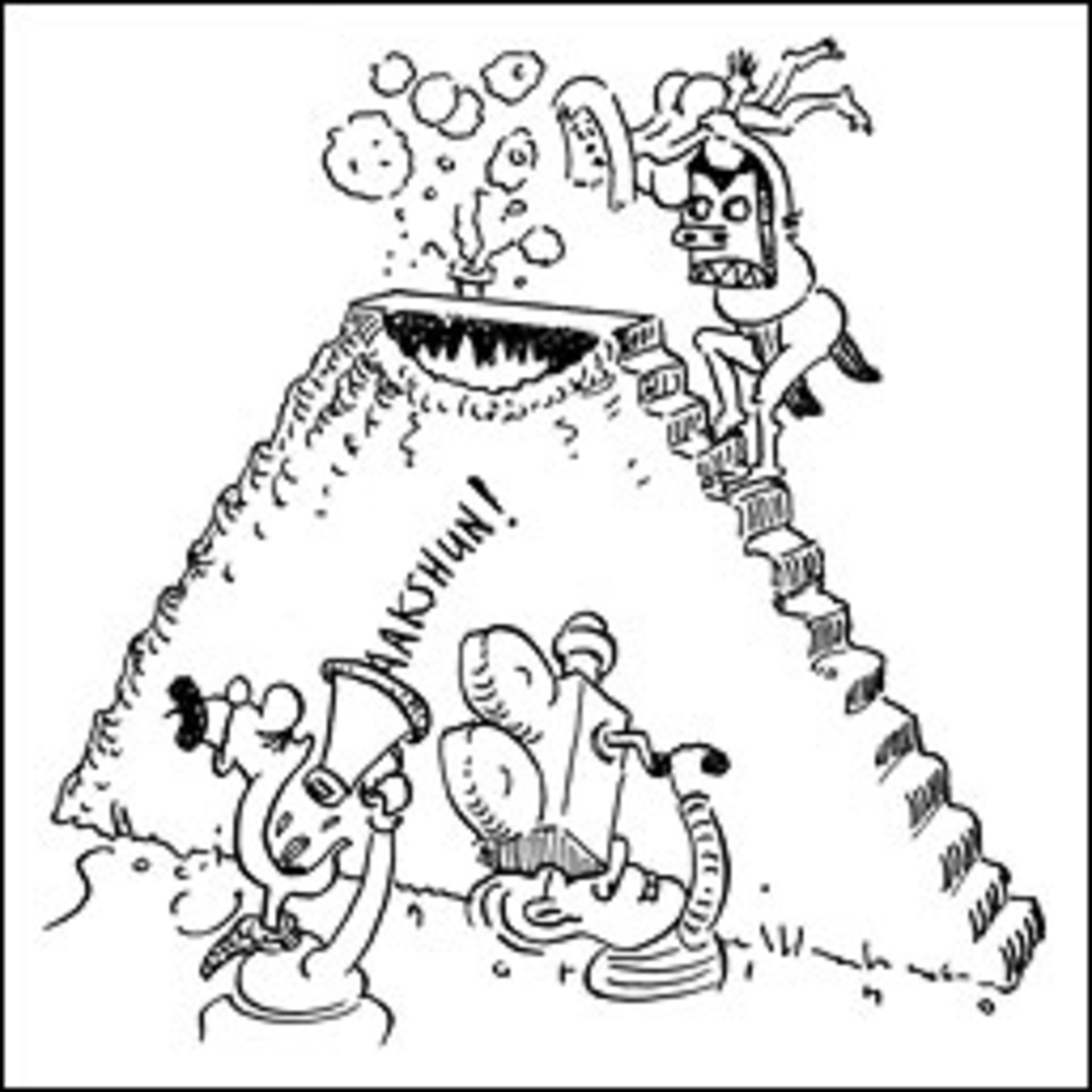 “The gods are angry,” Chief Emmitt says in his State of the Tribe Address. “I mean look at our year-over-year yields in corn and soybean, they pale in comparison to 2022. The Dore family, over here, have sacrificed more than their share of prized goats, and the Stanislavs tried all the rain dances they have in their arsenal to appease the gods, and they’re just not working this time for whatever reason. We’re not sure if we’re doing our rain dances correctly, but we have nothing to compare it to.
“The point is we’re trying,” the Chief continued. “We’re all trying as hard as we can to bring rain. Our administration has tried as hard as could to do something, anything we can think of, but nine out of ten of our best and brightest economists are now saying that without citizen sacrifice some of their beloved family members all of our efforts will prove fruitless. No one wants to do this, but we need to look within ourselves and call on our friends and family to join together to help their fellow man through these dire times.
“To appease the gods, we all need to be more like our friend and neighbor, Barney Ruffalo. Stand up Barney! Barney told me, the other day, that he knows how much the gods have sacrificed to give the Ruffalo family the precious gift of life. He knows that the gods have blessed him with four beautiful daughters, and he has agreed to share his wealth with us by awarding our tribe his beloved Audra for appeasement. Barney told me, just the other day, that the gods have given him so much that he feels it’s time for him to give back. Please join me in giving Barney a huge round of applause.”
We can dismiss such notions, and ways of life as primitive, but they were still human, and humans have a whole lot of human nature in them. Human nature does not necessarily equal intelligence, of course, and we can debate whether the primitive things primitive man believed define how primitive they were, but they still displayed a level of intelligence greater than the other animals. They learned how to create fire, how to use tools, and they employed some mathematical principles and science to build homes, cities, and pyramids. They eventually developed complex forms of communication, and some of them engaged in various forms of art. They also developed various complex forms of trade and historically beneficial trade routes. We can also guess that even though we regard many of their practices as brutal, they displayed acts of sympathy, empathy, and some acts of kindness with their fellow countrymen and tribe members to elevate them intellectually and emotionally in the animal kingdom. No matter how many arguments we put forth in their favor, however, we can’t ignore the fact that they insisted that human sacrifices would help them improve crop yields. Why? The people were starving and desperate, and my guess is their leader needed a scapegoat.
Group thought and historical traditions passed down from ancestors often inhibits rational thinking, but we have to believe that there were some thinkers in these cultures who considered the whole practice wrong, ill-conceived, and illogical. Those people were probably considered troublesome ninnies for focusing too much on the bottom line.
“I know we’ve all arrived at this notion that sacrifices are mandatory, but if they are, shouldn’t we see some blanking results?” this ninny probably said after their initial sacrifices didn’t pay off. “We’re sacrificing our children, for what? Rain? I don’t see rain, do you? And why women? It just seems so arbitrary that we select our most beautiful young, virgin women for these sacrifices. Does Chief Emmitt select them because they’re more fertile and bountiful, with the hope that that will translate into greater soil fertility and more bountiful and consistent yields of high quality? Or, is it just sexier to sacrifice our young, beautiful people? Is it about soil fertility and consistent yields or is it more about the show?”
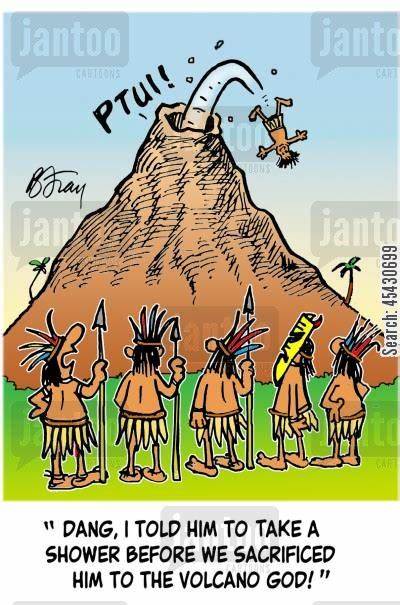 Did they try sacrificing males in the beginning, and the gods replied was that those were just a bunch of fellas. “If you truly want ample soil fertility, through rain, to produce a better harvest, you’re going to have to fork over that gorgeous, little girl trying to hide behind her daddy. She would be a prized possession worthy of me.”
There were probably some, because there are always some in every culture, who enjoyed the inherent violence involved in throwing virgins into active volcanos. They probably wouldn’t talk about it in polite company, because how do you bring that up casually, but there was a secret part of them that found it kind of fun. There were probably others who considered the whole event, and the theater involved, a little exciting. We have to guess that these ceremonies were well-attended. I mean how often does one see a woman thrown into an active volcano? It was probably the antecedent to must-see-TV. Being the humans they were, we can also guess that some complained about their seats. “I was there, but I ended up behind that Monroe kid, and his over-sized melon, so I couldn’t see squat.” At that point in their history, they accepted the fact that sacrifices needed to happen, so why shouldn’t they be there to enjoy the show.
“Hey, the Andersons are going aren’t they?” Mike Phillips said, during a disagreement with his non-compliant wife, “and they’re pretty smart people, right? Well, they’re basically convinced that it’s mandatory for the future success of our people. So, whaddya say we get the good lawn chairs out.”
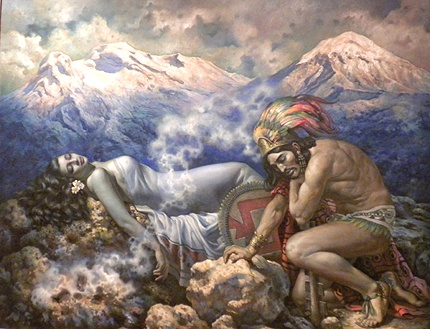 Were those who threw the virgins into volcanoes considered specialists in their field, or were they nothing more than anonymous and replaceable executioners? If it was the former, what kind of qualifications did the chief and his council seek for their specialists? Did the chief and his special advisers conduct numerous interviews and review resumes, or did they have tryouts? If Clark couldn’t hit lava with a ninety-pound woman, because he didn’t have the upper body strength, did they turn to Tommy, because not only did Tommy have the strength, but during tryouts he proved that he didn’t mind all the crying and screaming on the way up the mountain? If Tommy secured the position, how long could he do it? Even the coldest, darkest SOB eventually develops a conscience. They were primitive, but they were still humans with human nature in them. Did Tommy have an experience that sat on his soul? Did he still have nightmares about the time he was commissioned to throw a thirteen-year-old into a volcano after she developed such a cute relationship with his little brother? Did those constant images play on his mind so often that the nightmares led to a level of insomnia that played on his otherwise fragile mind until he was eventually fired? At some point, the Chief and his council knew that Tommy was no longer up to the job, but they were faced with the question, how do you replace such a sadistic person to carry this out?
Why active volcanoes? I realize that they thought the volcano reached into a deeper part of the earth, but why did it have to be active? If the practice of human sacrifice was to fulfill a need, why didn’t they just shoot the virgin in the heart, or slit her throat? Some argue that while there is archeological evidence to suggest that human sacrifices happened, there is no evidence of the practice of throwing virgins in volcanoes. Proponents state that there is some documented evidence of third-party hearsay provided to explorers and missionaries, but opponents are skeptical, stating that the primary sources likely embellished the nature of the sacrifice to entertain these new faces.
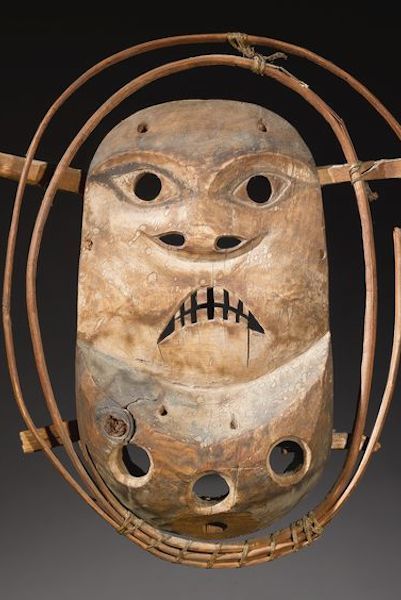 Regardless the method of human sacrifice, the archeological evidence suggests that most human sacrifices were quite theatrical. If they needed human sacrifices to appease the gods, why were they so theatrical? Any time modern man performs a religious service, they do so with some theater, or if you don’t care for the word theater or theatrical, how about ceremonial? Any time a human attempts to praise God or address Him in some sort of ritual, they feel the need to be ceremonial. Did primitive man perform theatrical rituals of this nature in the beginning, or did they amp up the theatrical nature of their human sacrifices over time, and did they do so to create a show that entertained the people? Did the Chief and his advisers think that they needed more theater to etch “the show” into the minds of future voters, so they would remember the Chief’s efforts come election time? (There probably weren’t elections, but every leader faces some level of scrutiny from their people and they must always be wary of uprisings.) How did they progress to all future shows involving players wearing spooky and theatrical masks and war paint, and when did they decide to add musical enhancements to their production, to add an aura to the ceremony and complete the sensorial elements of current and future productions?
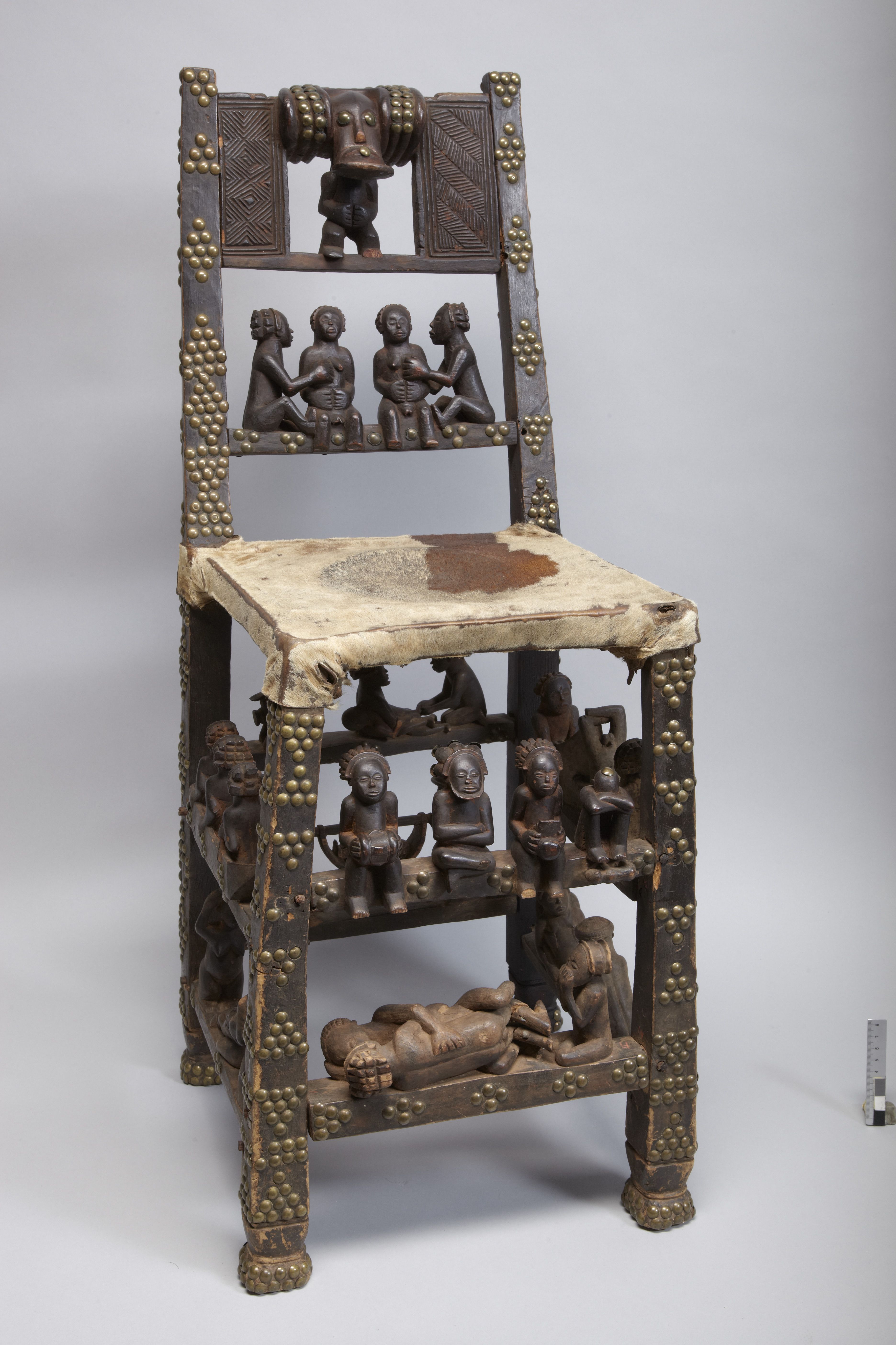 As with all leaders, Chief Emmitt’s reign was tumultuous and it remained precariously balanced on a fault line between factions seeking to unseat him. That also explains why the Chief, and his advisers, commissioned their laborers to create an ornate chair from which he would oversee the events. They needed to enforce, or reinforce, the Chief’s leadership mystique, and the memorable methods he used to try to solve their problems? No matter how great “the show” was, however, the Chief could not silence those factions vying for his throne. They continued to sow discontent among the citizenry.
“I know the gods sacrificed their lives to give us life, but why does Chief Emmitt always pick our Eastside daughters for sacrifice? Is it because we Eastside farmers traditionally produce lower yields? I mean, those Westside guys have natural advantages, living next to the basin and all. It just seems a little unfair, is all I’m saying.”
###
“There had to be a first,” George Carlin wrote on the act of sacrificing humans. Human sacrifice was a traditional ritual that, in some cultures, dated back hundreds to thousands of years, but as with everything else, there had to be a first. There had to be a first leader, and a cadre of advisers, who persuaded their people that sacrificing prized livestock was no longer cutting it. How does that leader convince his group that, for the betterment of their society, mothers and fathers were going to have to step up and start sacrificing their children? How does a leader convince his people that sacrificing children is the next logical step?
My bet is Chief Emmitt had some smarmy policy adviser step up to reveal the harsh truth of the situation to him, “The people are against you, and our internal polling suggests that you’re going to lose your throne in the next election. To prevent that, we have to face some facts here. The whole bread and circuses campaign we devised has run its course, because the proverbial bread just isn’t there any more. Our people are starving, and no amount of entertainment will resolve their hunger. There’s obviously nothing we can do to make it rain, but I’ve devised a strategy we can employ to silence them until the next election, and hear me out before you poo poo it. We could try throwing our people into active volcanoes? We can start by throwing our more obnoxious people in, like that Murray kid, but we’ll evntually have to work our way up to our more precious people, people that everyone likes, such as women, young, fertile, and virgin women. It’s not a true sacrifice if you’re not sacrificing, right? We can tell them that by doing so, we’ll be appeasing the gods, so they’ll finally make it rain.”
“What if it doesn’t work?” the Chief probably asked. “What if it doesn’t rain? The people will say I killed innocent children for no reason.”
“That’s kind of the beauty of this,” Smarmy Adviser replied. “There’s no such thing as ‘it didn’t work’. If we throw a virgin into the volcano, and that doesn’t bring the rain, we can say that that means the gods aren’t satisfied yet, and yet is the key word. We will need to expound on yet, by saying yet means that we’re making strides, but the gods aren’t satisfied yet. It’s obvious to us now that they’re not satisfied with just one virgin. The gods are obviously calling for a second virgin, or a third, and we will probably have to keep throwing virgins into volcanos until the gods are happy, and they make it rain. You are, in essence, blaming the gods without doing it directly. The people will say, “Chief Emmitt is trying, but the gods obvious aren’t satisfied yet.
“And if we do it right, our administration will get all the credit when it does rain,” Smarmy Adviser continues, “They’ll say that thanks to Chief Emmitt’s patient policies we now know that one virgin a quarter doesn’t satisfy the gods. We now know that the gods require four virgins a quarter. All hail Chief Emmitt!”
If Chief Emmitt finally achieves what his smarmy adviser suggests for his tribe, and it rains, and he’s the hero, the next question his award-winning economists will ask is what then? Is there an amount of rain the villagers and tribesmen consider adequate? More is always more, in the minds of most voters, as long as it doesn’t flood. And if it does flood, they’ll know that they probably sacrificed too many virgins, and they’ll cut back accordingly next quarter.
“It will involve a systematic approach,” Smarmy Adviser will say regarding the question of flooding, “and we might need to monkey around with it to hit a sweet spot for our base. We might eventually need to create some kind of human sacrifice to corn yield ratio over time.”
If they achieve the desired results, what then? If more is always more, wouldn’t some factions call for five sacrifices in the following quarter? If four produced the desired yield, what would five arrive? If Chief Emmitt, and his advisers, try to quell such talk, does that provide candidate Lloyd a campaign issue in their next debate?
“Chief Emmitt employed the ‘hard times call for strong measures’ campaign, and I think we can all agree that he achieved what he set out to do,” candidate Lloyd opens, attempting to attract Emmitt voters without insulting them for voting Emmitt in the prior election. “I can do better. Let’s look at the PowerPoint presentation I put together. As you can see here, Chief Emmitt produced a quality yield for us in quarter four with four human sacrifices a quarter. Chief Emmitt achieved quarterly results that no one can balk at, but now, now, he calls for an end to all human sacrifices? An end? Why would you propose that Chief? Those policies worked. Human sacrifices worked. Look at the numbers. He wants to change policies, just when times are good? Shane, you farm what 84 acres? You cannot be happy to hear that.
“Now, let’s look at my prospective map, which consists of a projected eight sacrifices a quarter, and …” candidate Lloyd says flipping the page. “Take a look at those projected yields. Phillip, I know you’re the type of guy who always wants to do better. You believe in the more is more principle, wouldn’t you love to add a little something, something in your kid’s stockings at the end of the year? By my projections, not only will we be able to satisfy our needs, until we’re all fat and happy, but we’ll be able to begin exporting our excess crops to neighboring tribes. If you elect me, we will implement policies that will lead us into a bartering era with the hunting tribe with our excess crops. I think we can land enough buffalo and deer carcasses in 2024 to put meat on our tables three to four times a week. And I’m not just talking about putting meat on my table as your chief. I’m talking about all of us eating meat three to four times a week.
“Chief Emmitt is a great leader, and he knows how to make the gods happy. I would never question the results he achieved in 2022. I’m just asking you to ask yourself a question, as you look around at your neighbors, and as you look within your own home, do you think we can do better? I think you can, I think we can, and I think I can lead us into a level of prosperity we’ve never experienced before. Vote Lloyd for chieftain at our next fireside chat, and I promise you that if you’re willing and able to throw a couple more of your daughters into volcanoes, we’ll see a 2024 that we never dreamed possible.”
If there had to be a first leader who enacted such desperately violent policies, there also had to be a first time a leader gave this whole sacrificing-for-better-harvests ruse up for what it was, in their transfer of power discussions with the incoming chief.
Chief Emmitt did just that with Chief-Elect Lloyd, “Just so you know, this whole human sacrifice for rain thing, was a ruse. I know it, and you know it. We developed it to maintain power over the people and focus their attention on themselves and their relationship to the gods, so that they wouldn’t blame our administration for things that we honestly couldn’t control. You can’t make it rain, I can’t make it rain, and even the rain dancers cannot make it rain. Our people are so irrational at times. Perhaps it’s our fault for convincing them that we were all-powerful, I don’t know, but they believed it. They blamed us for a lack of rain. Then, when it finally rained, they gave us all the credit for it. Your little campaign to increase human sacrifices per quarter, to produce more rain, won the election for you, congratulations and all that, but you basically took our ruse and advanced it. I just want you to know, and I hope you know it already, that if you sacrifice eight women a quarter, as you said in your campaign, you’re basically propagating our sham, and if you come for my daughters, I’ll expose you as the shyster that you are.”



 Rilaly