And Now for Something Completely Different was the title of Monty Python’s 1971 movie. With so many different people out there, how can anyone still be different? “Be yourself, everyone else is already taken,” is attributed to Oscar Wilde, but some refute he said it. Thelonius Monk said, “A genius is the one most like himself.” What if I’m like everyone else? How do I strive to be different and avoid being different for the sole purpose of being different? Different, becomes more different when it escapes the same cocoon.
***
When I watch Jeopardy! I probably get 7 out of 10 questions, but when I stop to talk to a neighbor I’ve lived near for four years, and I talk to him an average of two times a week, I struggle to remember his name.
***
I have no ability to fix my own car. Three of the four automobiles I’ve owned have been lemons. My truck started almost every day for 22-years. After 22-years, the looks of a car begin to subside, no matter how much you general maintenance you apply, it’s not going to look new forever. Even though driving a sun-bleached truck damaged my image a little I held on tight, because it always started. I try to inform my son to gain knowledge, so you’re at the mercy of another as rarely as possible, I have nothing to teach him. My car starting almost seems like a miracle to me. I know it’s not on one level, but I close my eyes and turn the ignition, as if the sounds of an engine turning is magic. I wish I gained basic automotive knowledge, but if you want it bad enough, you go get it. I obviously never wanted it bad enough, so when it doesn’t start I have to financially plead with others to make it happen and trust that they know what they’re doing.
***
The “I was so drunk one night that I …” stories were some of my favorites at one point in my life. Other people still enjoy those stories, from the past. If we’re still drinking heavily, “I’m drunk right now!” (Cue the laugh track), it’s not as funny. I will write something most won’t about their drinking years, I enjoyed them, and I had a lot of fun. We spent years talking, drinking, followed by more talking and more drinking, but for the life of me I can’t remember what we were always going on about.
Luke was loaded the night he met Laura. Laura was beautiful, so beautiful that she was normally out of Luke’s reach, but she was drunk too. She was so drunk she was into Luke’s jokes. Luke, it should be noted, was a very funny person, a naturally funny man, but his humor rarely translated to women.
I don’t know the difference between a good-looking guy and the average to below average, but as funny as Luke was, women didn’t gravitate to him the way they would’ve if he was as funny and gorgeous. Why does the caged bird sing, because he’s not as gorgeous as the high school quarterback who can sling.
When Laura didn’t move away from him after his first few jokes, Luke moved in. He spent the rest of the night closing. Luke knew Laura had a few drinks in her, but he had no idea how loaded she was, until vomited on him. She didn’t get any on him, but the effect was the same. Luke was a real trooper though, he kept kissing on her. He said he didn’t remember much from that night, except that her vomit tasted like peppermint schnapps. Is that romantic or erotic?
***
When I was young and drunk, party hosts used to try to prevent me from leaving their party. They said things like, “If you leave, what will we talk about?” They stopped short of calling me the life of the party, but their attempts to get me to stay always boosted my self-esteem. Flash forward a couple years, and hosts were a lot more understanding when I told them I was preparing to leave. My most recent examples of this progression involved hosts saying, “All right then, see ya later” when I informed them I was preparing to leave, and they were looking over my shoulder before they hit the word then.
***
“Hey Gary,” Chad said. Chad was waving at me, in a parking lot, from his one-ton truck, as if we were two long lost friends. It confused me, because we were never friends, but we did have a long since lost relationship of sorts.
“Hey Chad,” I said. “How are you doing?”
“I just got gastric bypass,” Chad said leaning out the window. He lifted his shirt to show me his scars. The smile on his face was one normally associated with showing off a child’s baseball trophy.
“Who is the bad guy?” is the first and last question we want to hear in any story. We used to love to root against bad guys, but some bad guys (e.g. Darth Vader and Joker) changed that dynamic. Some bad guys are so charismatic that we cheer them on as much, and sometimes more, than the good guys, but in most cases, we don’t want our bad guys complicated or conflicted, with a multi-layered narrative that leaves some doubt. We don’t want to think. We want Scooby Doo bad guys who only lament getting caught. Eliot Asinof’s 1963 book Eight Men Out:The Black Sox and the 1919 World Series does not satisfy this need. There are no heavy breathing bad guys encased in black metal in the tale, no maniacal laugher at the end, and no one specific person to whom fans, historians, or any of the players involved can point to when a kid allegedly says, “Say it ain’t so” in the aftermath of some members of the most talented team in Major League Baseball in 1919, the Chicago White Sox, confessing to fixing World Series before a grand jury.
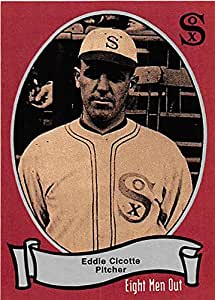
If we are living paycheck to paycheck while our employer gets rich as a result of our efforts, our bad guy, in this tale, is the penny-pinching Chicago White Sox owner Charles Comiskey. We learn that Comiskey’s players were allegedly underpaid relative to the rest of Major League Baseball, and we paint-by-numbers after that. If we have preconceived notions about the various gambling institutions that prey on little guys, we believe notorious gambler Arnold Rothstein is the most evil man in the tale. And it was Arnold Rothstein, and his henchmen, who approached the White Sox players with this whole scheme, right? We now know that it was the players, led by Chick Gandil and Eddie Cicotte, who approached the gamblers with the idea of throwing the World Series for money. If we love sports, and we want to believe that all sports are on the level, we direct our ire at the players, saying, “No matter what, you don’t sacrifice the integrity of the game.”
The most devastating details of this scandal, we now know, involves the athletes, and the the reason these details are devastating is that the athletes on the field are our heroes, the good guys, and the face of the franchise. We get to know players through their play on the field, and we savor any details reporters unearth of their personal lives that let us believe we know them. We feel their successes and failures as if they are our own. We also identify with them as fellow victims in this worker v. owner dynamic. If they fall prey to some sort of scandal, we want to believe them so much that we’ll repeat their defense against such charges. There’s also little in it for management, and those in the media, to contradict them. We also know that most athletes have relatively short-term careers, and they spend so much time honing their craft that when their careers end they often have no other marketable skills. Most of us do not begrudge them getting as much money as they can when they can get it to prepare for their life after sports. We understand this from a distance, but to suggest that a professional athlete needs more money to pay the rent, the mortgage, or to feed their family often falls on deaf ears for most modern fans who hear modern athletes turn down multi-million dollar contracts, saying, “I need to feed my family” to garner public sympathy.
“Who is the bad guy?” Just about everyone who has heard about the 1919 Black Sox Scandal, or watched the movie Eight Men Out, knows this narrative: The players were underpaid by the Mr. Scrooge of this tale, owner Charles Comiskey, and they fell under the spell of Arnold Rothstein and his henchmen offering them thousands of dollars to lose the World Series. The narrative portends that when the players sought more money from him, Comiskey turned them down, and there were various examples of how this man pinched pennies, until the desperate players were approached some gamblers with an idea to purposely lose the World Series for money, once-in-a-lifetime money. This narrative depends heavily on that desperate characterization. They were depicted as desperate to feed their families, “as any good man would.” If we approached the baseball enthusiast at the end of the bar, 99% of them would list, “They were starving, and their little kids were starving. We can’t blame them for wanting to secure enough money to feed their families,” as the primary, underlying premise of The Black Sox Scandal. It’s what we’ve all been led to believe.
Yet, The Society for American Baseball Research (SABR) provides a list of the top paid players on the 1919 Chicago White Sox. It concedes that as with every professional sports team, then and now, the individual salaries of the 1919 White Sox were top heavy, and they also cite Asinof’s listings of salaries as a primary source for this information. Asinof listed the salaries, but he didn’t compare them to the rest of the league at the time. SABR did. SABR found that when compared to the league, five of the top White Sox salaries were in the top twenty individual salaries paid in Major League Baseball, in 1919, and that the White Sox, as a team, had the highest payroll in baseball at the time. So much for the “underpaid, perhaps criminally, underpaid White Sox players relative to the rest of the league” line. Eddie Collins (not one of the reported eight involved) and Eddie Cicotte (after bonuses) each made $15,000 a year compared to the most popular and highest paid player in the league Ty Cobb, who made 20,000 a year. The site suggests that while the average salaries of the White Sox athlete, in particular, and the rest of the Major League teams, in general, did not dwarf the average salary of the common citizen in the manner modern Major League salaries do today, with the top salaries of the top players being around $15,000.00 compared to the average 1919 citizens salary of $8,973.00, the site suggests that Comiskey’s purported greed is not nearly as scandalous as the movie, and much of history, have alleged.
Chick Gandil
The counterpoint that Comiskey was not unusually greedy among Major League owners should also be countered with the idea that Major League owners collectively colluded to keep salaries low. In 1919, Baseball had a Reserve Clause which prevented players from going to another team, even after the end of their contract, until they were offered an unconditional release. When they signed a contract, they were basically the team’s property. The only power a baseball player had, in 1919, was to hold out, or refuse to play, until they received pay they considered worthy of their talent. The latter was often at the discretion, some say whims, of the owner. In short, the player had little-to-no power in contract negotiations. They were subject to the absolute power of the owners, and we can assume that the owners colluded to keep salaries low, so low that many players had to find jobs during the offseason. It was unquestionably an unfair worker v. owner dynamic that wouldn’t be tilted back in the baseball players favor until the reserve clause was abolished in 1975.
The system in place, in 1919, was undoubtedly unfair, but this idea that the White Sox players who signed up for the ploy to fix the World Series were all but destitute compared to the rest of the league, and that they felt it necessary to go to the gamblers to feed their families just doesn’t stack up for some of the players, like Cicotte, were earning almost double what the common man made in the era. Another future Hall of Famer, catcher Ray Schalk (not implicated in the Black Sox Scandal), was the 13th-highest-paid player in the league at $7,083. Chick Gandil, the primary organizer of the scandal, may have had a reason, with his $3,500 a year salary, and his eventual $35,000 pay out from the Rothstein-led gamblers (equivalent to $522,000 in 2020), but the rest of the scandal participants reportedly only received $5,000 each or more (equivalent to $75,000 in 2020).
The following is a list of the White Sox players involved in the scandal, and the reported amounts they received for fixing the 1919 World Series. Keep in mind that the average salary of the average citizen in the United States of America, in 1919, was $8,973. Unless otherwise listed, the players involved reportedly received $5,000 a piece for fixing the 1919 World Series when the gamblers promised them $20,000 a piece.
“Shoeless” Joe Jackson ($6,000).
Eddie Cicotte ($15,000 salary) (received $10,000 before game one).
Chick Gandil ($3,500 salary) ($35,000 for organizing the fix).
Swede Risberg ($3,250 salary) (received 15,000 for his role in the fix).
Buck Weaver (7,250).
Claude “Lefty” Williams ($3,500).
“Happy” Felsch ($3,750).
Fred McMullen ($3,600).
***
The other idea that sports’ fans want to believe, in reference to the Black Sox Scandal, the biggest scandal in sports in the early part of the 20th century, is that it was a one-off, an aberration in the rich tradition of baseball before and after the scandal-ridden World Series. We prefer our stories in neat, tight little packages that have a beginning, a middle, and an end. Before reading this book, I thought I knew everything there was to know about the scandal, because I watched what I considered the comprehensive story in the movie. The movie depicts the gamber’s influence on this World Series as a sort of whim by Chick Gandil, as if he just thought of it out of thin air, but the movie fails to discuss how institutional gambling and gamblers were in the game of baseball prior to the 1919 season. Time constraints don’t allow a movie maker enough time to display a full narrative, of course, but one would think they might include some discussions revolving around how institutional gambling was in the culture of baseball during that era. The unfortunate fact, as laid out by Eliot Asinof, is that there was evidence of gambling, gamblers, and throwing games before the 1919 season. Some suggest that the “history of fixed ballgames goes all the way back to 1865.” Author William F. Lamb wrote that Eddie Cicotte, the first of the Black Sox players to admit to the 1919 conspiracy, said he and his teammates were “envious of the $10,000 rumored to have been paid Cubs players to throw the 1918 Series” against Babe Ruth and the Red Sox. The idea that gamblers had any influence over the game was rarely talked about, but most members of the media, and baseball insiders, knew it was going on. The culture was so pervasive that certain players traded techniques of fudging a game in ways fans, managers, and even some of their peers couldn’t see.
Other than time constraints, we can guess that the movie makers also decided against bringing the whole house down by condemning an entire era in this manner, because most audiences don’t want to hear that. We don’t want to hear how players, on other teams, regularly threw regular season games, got caught, and were never punished. We don’t want to hear the fact that ballplayers accepting money from gamblers was so common that what the White Sox players did, didn’t necessarily stain the game at the time as much as it stained the World Series. The influence gamblers had on regular season games appears to have been so entrenched in baseball’s culture at the time that Chick Gandil may have considered throwing a World Series for money, for once-in-a-lifetime money, as nothing more than the next logical step.
One of the primary antecedents of the scandal author Eliot Asinof suggests may have laid the groundwork for what would become “The Black Sox Scandal” was the federal government shutting down the race tracks in 1917. Asinof provides no reason why the federal government did this, but research dictates that it might have had something to do with the fact that the U.S. government needed more horses to use in combat in World War I. The gamblers who previously spent so much time at the race tracks that they purchased homes and apartments near the tracks, “converted their vast machinery of operation from horses to baseball” Asinof wrote in the aftermath of the racetrack shutdown. “By 1919, two years later, gamblers openly boasted that they could control ball games as readily as they [once] controlled horse races.” The idea that by 1919 gambling and gamblers was so pervasive in baseball that players, coaches, owners, and those in league offices knew about it, is also not discussed in the movie.
Fixing games was so commonplace by 1919 that players casually joked about techniques they would employ to fix games that weren’t apparent to fans, managers, owners, or even the media. Outfielders joked about getting “a bad jump” on the ball in the outfield, and infielders talked about making routine ground balls appear so difficult that a poorly timed throw to first appeared more reasonable. The idea that they joked about these techniques suggests that not only how easy it would be for a fielder to fudge a little, but that they developed these techniques over time. The rumors of players fixing games eventually reached members of the media. Eliot Asinof’s narrative suggests anytime representatives of the media tried to dig into these rumors, they were easily bought off, andinstructed to stop digging. Buying their silence was done, according to Asinof, “for the good of baseball”. Whether their access to players was threatened or not, we can say that these members of the media played a role in this scandal in that if they weren’t so compliant they may have broken a story that prevented The Black Sox Scandal, but they didn’t put up much of a fight by some accounts.
Charles Comiskey
The ultimate search for a bad guy leads us into a chicken and an egg scenario that asks which came first, the owner’s collusive efforts that kept players’ salaries low, or the influence of gamblers, and the enticement of their money. Evidence suggests that the owners underpaid the athlete first, and that drove them into the arms of the gamblers. At some point, the owners and all of their underlings caught wind of the players’ fixing games, and they did everything they could to sweep it under the rug? Did they do this to protect the integrity of the game, or did they see it as a way to continue to underpay the athletes? There’s a famous scene in this story that might have prevented the entire Black Sox Scandal. The best pitcher, and game one of the World Series pitcher, of the White Sox, Eddie Cicotte, allegedly approached owner Charles Comiskey, with hat in hand, asking for a bonus he thought he believed the owner and manager conspired to prevent him from attaining. SABR states that Cicotte was “Never promised a bonus that doubled his salary, certainly not one that doubled Cicotte’s salary” for winning 30 games in one season. Cicotte won 29 games that season, and the rumor suggests he was pulled from the 30th game before he could win it by rule. Baseball research suggests that Cicotte was pulled from that tenant-clinching game, because he wasn’t pitching well that day.
If this particular meeting happened, we could speculate that Comiskey may have turned Cicotte down by telling Cicotte that he, like other players in the game, should seek that money “elsewhere”, with an unspoken wink and a nod to gamblers. We believe that Comiskey wanted to keep more of his money, of course, and he most assuredly knew his ballplayers were making more money under the table, so if this speculative scenario holds any weight, both parties walk away happy, corrupted but happy. If this never happened, then it pulls out one more leg out of the “Comiskey was the bad” guy argument.
We can presume that as long as their team won most of their games and stayed in contention to keep fan attendance high, the owners turned a blind eye to any hints of game fixing, and they benefitted by not having to pay their players top dollar. Accounting receipts for Major League Baseball are murky, but SABR suggests that owners were paying players approximately just under 33% of revenues, which they could get away with thanks to the Reserve Clause. Where did this revenue come from? TV revenue was still 45 years in the future, so while the Major League teams received some money from some media, the overwhelming source of revenue for all Major League Baseball teams was attendance, so the owners probably didn’t sniff around the dugout when their teams remained in contention to keep attendance high.
The final tally on the 1919 Chicago White Sox, the best teams of their generation, won only 88 games that year, 3.5 games ahead of the Cleveland Indians. They won enough games to win the pennant, in other words, but if they were the best team in 1919, it invites some speculation that they only won 88 games. We should also note that the season was shortened by the war department, from 154 games to 140, after playing only 125 in 1918. So, the White Sox probably could’ve won 10-12 more games of the 14 they would’ve played in a 154-game season, but that’s unprovable speculation.
“Who is the bad guy?” Some of us enjoy saying, as Dave Mason sang, “There ain’t no good guy, there ain’t no bad guy. There’s only you and me and we just disagree.” Those of us who try to sort through the he said, he said of the Black Sox scandal might answer D, all of the above. If this is you, let me ask you a question, who do you care about most? Nobody cares about an owner, or a group of owners involved in a collusive effort, and nobody cares about a bunch of smarmy gamblers? The owner might be the bad guy if he deprived his players of a living wage that might cause their families to starve, but I think this article proves that, at the very least, Comiskey and the Chicago White Sox did not stand out in that regard, and if Major League Players were underpaid, in general, they knew this going in. We might care that one of the owners so deprived his players of money they earned by putting on athletic shows for the audience, but we only care about it in lieu of it driving the players to throw the World Series. It might intrigue us to learn how much Charles Comiskey made that year in an historical perspective, but other than that we don’t care. It also might intrigue us to learn how much Arnold Rothstein and the other gamblers made by selling their souls to taint the game, because we might ask them, in a rhetorical sense, if it all worth it? Did they make once-in-a-lifetime money, or did they make just enough to put a big, huge smile on their face. They obviously didn’t care about the integrity of the game, and we shouldn’t expect anything more from them. They’re the smarmy gamblers sitting on our shoulder trying to convince us to sell our soul for a couple bucks. We all know those types. The only ones we truly care about in this story are those with whom we identify the most, our idols growing up, and those most capable of letting us down. Fair or not, we have greater expectations of players to live up to our expectations. We know they’re human and prone to temptation, but what some of the eight players confessed to was inexcusable in many respects.
The sad, tragic effect of the White Sox Black Sox scandal occurred after the commissioner banned the eight players involved in the scandal from Major League Baseball for life, thus effectively removing the greatest team of their generation from the list of contenders. Was it wrong for baseball’s commissioner to ban them for life? To answer that question, we ask another question: What if they hadn’t? To this day, sports fans question whether its athletes are on the take? These suspicions probably weren’t born the day the Black Sox Scandal hit the news, and they obviously didn’t die the day after the banning, but imagine how much fuel it would’ve been added to the conspiracy theorist’s fire if these players received nothing more than a slap on the wrist? The White Sox became a second-level team after some of their best players were banned for life and beyond, and the ban paved the way for Babe Ruth and the Yankees to begin their reign over baseball. The sad thing is that if these players were not involved in the scandal and thus banned from ever playing Major League baseball again, it’s possible that the White Sox might have been the team to rule baseball for the next thirty years, not the Yankees. That might be a bit of a stretch, as the Yankees made so many brilliant player personnel decisions that are too numerous to list here, over the next thirty years. The talent the Yankees “discovered” had nothing to do with the Black Sox scandal, so perhaps their dynasty was inevitable, but success often breeds success, and who knows where the White Sox could’ve gone with a World Series ring and that roster for the next five to ten years. At the very least, the scandal deprived baseball history of some of the most talented individuals’ of their era, as their future careers were both lost and scarred beyond repair, and some incredible games and pennant races between the Yankees and the White Sox. History being what it was, the scandal and the ban ruined the franchise for the rest of some of their fans’ lives, as the White Sox wouldn’t win a pennant for forty years (1959), and they wouldn’t win another World Series for another eighty-five years (2005).
Joggers and those who take regular walks know that they’ll step in something sooner or later. I see historical nuggets in much the same way. When we read and research matters of history, some of it will find its way into the grooves in our shoes and stick and some of it is so old or cold that it just falls off. That being said, I don’t think a display of nugget knowledge is a display of intelligence, but a byproduct of interest. Those who are fans of the show Friends, or Jennifer Aniston, could probably tell me a number of interesting little nuggets that might shock me. I happen to be interested in the history of the United States through its presidents, and the following is a list of the nuggets that have stuck through the years. I’ve known these little nuggets for so long that I assume everyone knows them, but when I provide the big reveal, the reactions. They either think I’m a huge nerd, a vat of useless knowledge, or an interesting conversationalist. I add the latter as a narcissistic possibility, but I’ve rarely seen evidence of it on my audience’s faces. They usually pause politely and carry on the conversation I interrupted as if I didn’t say anything.
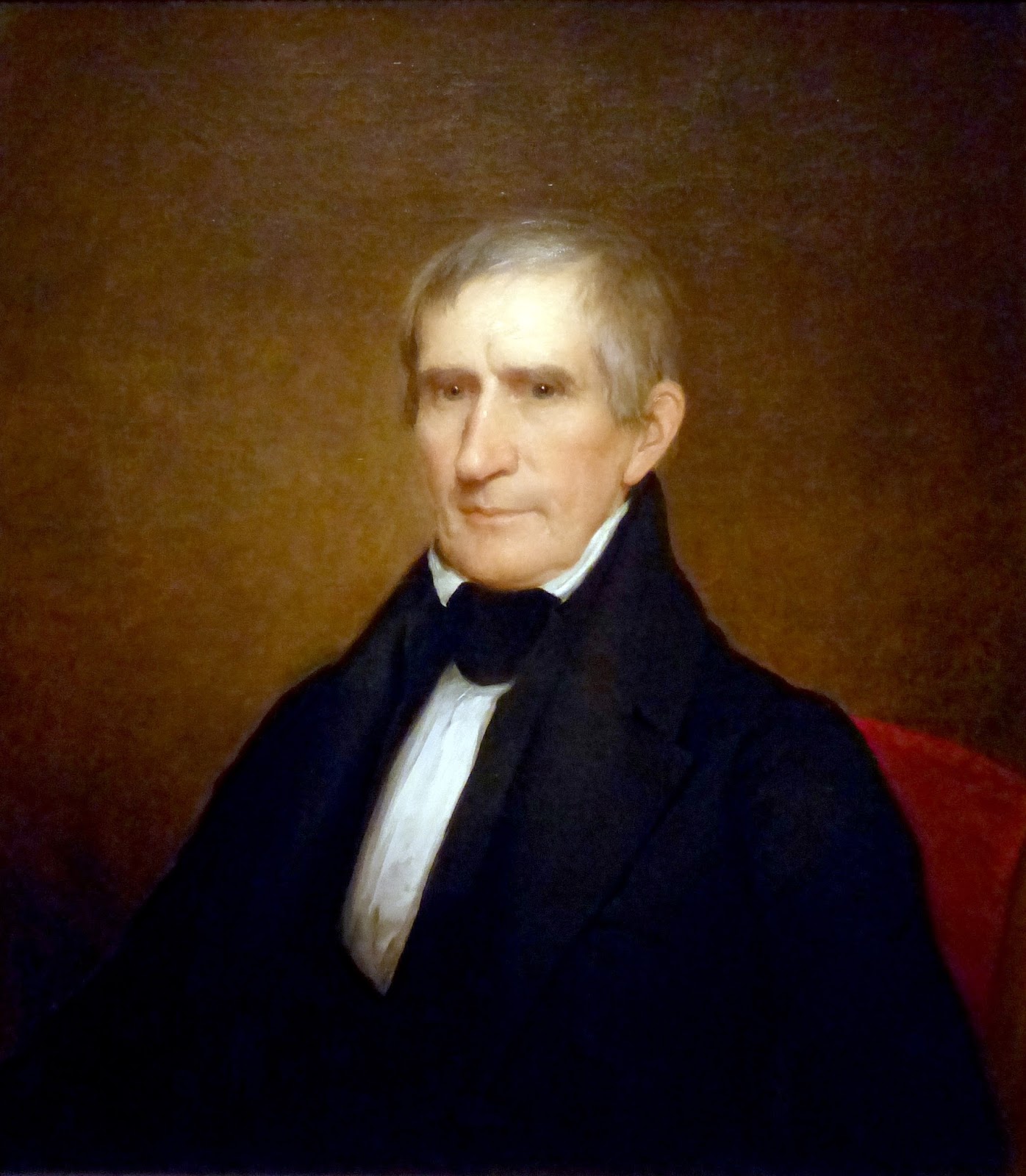
William Henry Harrison
“Tippy canoe and Tyler too,” my great-aunt sang for no reason.
“What is that?” I asked her.
“It’s a saying,” she said. “I don’t know where it came from, and I don’t think anyone does. It’s just something to hum.”
My great-aunt was old when she sang that, and I was accustomed to old people knowing everything about everything, but she didn’t know the origin of a song she sang all the time.
Decades later, I learned that Tippy Canoe and Tyler too was a song used to influence the 1840 presidential campaign of William Henry Harrison and vice-presidential candidate John Tyler. They nicknamed William Henry Harrison Tippecanoe, because he led the forces that defeated Tecumseh on the Tippecanoe River, and John Tyler was the other guy on the ticket, the candidate for vice-president, or the “too”.
James K. Polk
Though one of the country’s shortest presidents at 5’8″, Polk accomplished the “no small feat” of annexing Texas, New Mexico, Oregon, and California. Polk was instrumental in acquiring more than 800,000 square miles and expanding the country by roughly one-third.
Presidential candidate Polk won his election by pledging to reduce tariffs, reform the national banking system, expand the country, and that he would accomplish all that in four years. He pledged he would not run for reelection.
Polk was one of the few presidents to accomplish all of his core pledges while in office, and he accomplished the latter after his term ended, and he did not submit for reelection. While in office, Polk was well-known as a workaholic, working to accomplish all of his campaign pledges. Some suggest that he worked so hard, and for so many hours, that his four years in the White House wore him out. He died months after leaving office of cholera on 15 June 1849 at the young age of fifty-three.
James Knox Polk is rarely listed among the great presidents by non-historians. Historians often list him in the upper half, some list him in the upper third. He gets high marks for crisis leadership and administrative skills, but he fails in other areas, according to historians. Yet, he often gets lumped in with the relatively forgettable presidents that took office after Andrew Jackson and before Abraham Lincoln.
Theodore Roosevelt
Needless to say, campaign speeches are vital to every presidential campaign. With modern technology, a presidential candidate can deliver speeches in his basement, but candidates did not have such luxuries in 1912. The only way, save for print, for a candidate to deliver his message, display his charisma, and woo prospective voters, was to take a train, or whatever lesser mode of transportation they could find, to stop in various locales and speak directly to voters. The various campaign speeches a candidate delivered across large and small pockets of the nation were sink or swim for him.
That said, we can bet that candidates toughed it out through a case of a sore throat, a flu, and other, more severe illnesses or minor broken bones to speak to the public. As tough as those candidates needed to be, I don’t think voters was prepared for:
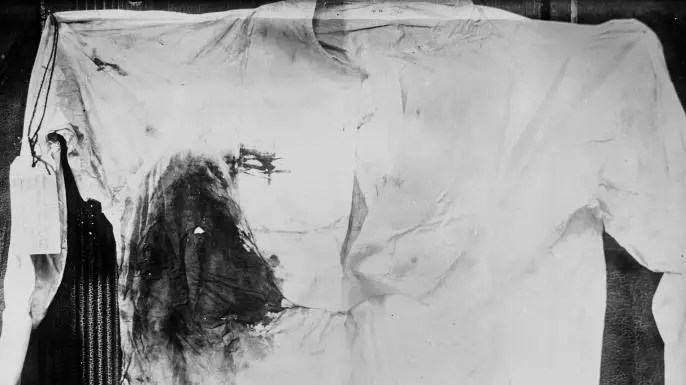
“I don’t know whether you fully understand that I have just been shot,” Theodore Roosevelt informed an audience in Milwaukee, after asking for silence. To confirm what he was saying, Roosevelt unbuttoned his vest to reveal his bloodstained shirt. “But it takes more than that to kill a bull moose.”
To reassure them that he was able to deliver the speech, he said, “Fortunately I had my [50 page] manuscript, so you see I was going to make a long speech, and there is a bullet—there is where the bullet went through—and it probably saved me from it going into my heart. The bullet is in me now, so I cannot make a very long speech, but I will try my best.”
As History.com furthers, the projectile had been slowed by his dense overcoat, steel-reinforced eyeglass case and the hefty speech squeezed into his inner right jacket pocket.
The unsuccessful assassin, “John Schrank, [was] an unemployed New York City saloonkeeper who had stalked [Roosevelt] around the country for weeks. A handwritten screed found in his pockets reflected the troubled thoughts of a paranoid schizophrenic. “To the people of the United States,” Schrank [wrote]. “In a dream, I saw President McKinley sit up in his coffin pointing at a man in a monk’s attire in whom I recognized Theodore Roosevelt. The dead president said—This is my murderer—avenge my death.” Schrank also claimed he acted to defend the two-term tradition of American presidents. “I did not intend to kill the citizen Roosevelt,” the shooter said at his trial. “I intended to kill Theodore
Bullet Holes in Speech
Roosevelt, the third termer.” Schrank pled guilty, was determined to be insane and was confined for life in a Wisconsin state asylum.
Roosevelt tried to use the story of the assassination attempt to secure a third term as president. He did so as a third-party Progressive candidate that they nicknamed “The Bull Moose Party”. He was successful in splitting the Republican vote, squashing his frenemy, William Howard Taft’s reelection bid, but all his efforts did, in reality, was allow one of the worst presidents to ever sit in Washington D.C. to take office Woodrow Wilson.
James Garfield
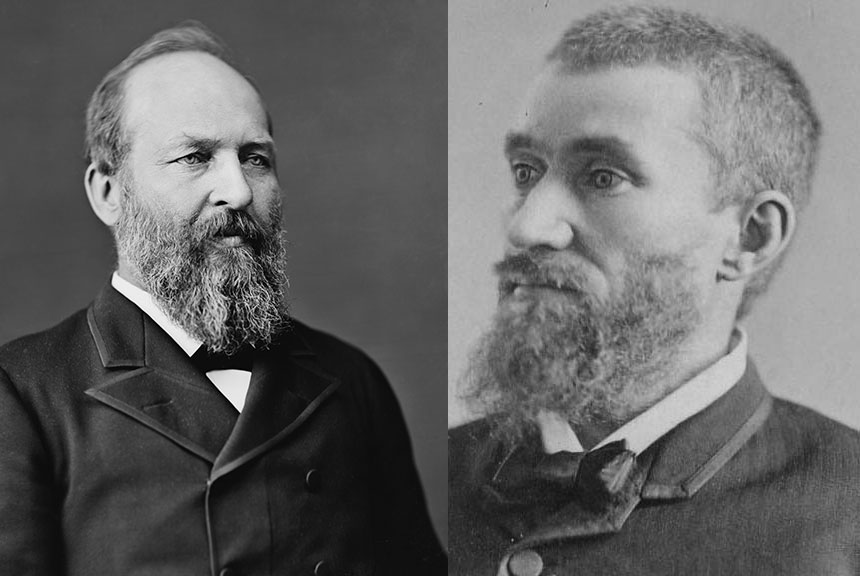
Garfield and Guiteau
As with presidents William Henry Harrison, Warren Harding, and to a lesser degree John Kennedy and Abraham Lincoln, Garfield’s tenure as president is better known for his death than his tenure in office, as he was assassinated while in office. Some historians say that this is one of the biggest tragedies in U.S. History, because Garfield’s potential to be one of the presidents on the Mt. Rushmore creation (that occurred much later), is high. Due to the assassin’s bullet, and his doctors historical ineptitude, James Garfield served a mere six months in office, and historians say he was only in peak form for three-to-four of those six months.
A self-avowed communist named Charles Guiteau shot President Garfield, claiming “I am a Stalwart and [Vice-president Chester A.] Arthur is president now!”
History.com notes, “Doctors were unable to locate the bullet in [Garfield’s] back. Even inventor Alexander Graham Bell (1847-1922) tried–unsuccessfully–to find the bullet with a metal detector he designed.” Medical professionals would later say that if Garfield’s doctors simply left the bullet in Garfield’s body, as they later would with Theodore Roosevelt, Garfield’s chances of survival would’ve greatly increased. On September 19, 1881 — 79 days after the shooting — President Garfield died of a ruptured splenic artery aneurysm due to sepsis and pneumonia. It is believed that Garfield probably would have survived his wounds had he been treated properly.
This was well-known at the time, as evidenced by Charles Guiteau’s attempts to avoid a death sentence, saying, “I did not kill Garfield after all, his doctors did. I just shot him.” As the Crime Museum notes, Guiteau’s bid was unsuccessful, and he was executed on June 30, 1882, less than a year after the shooting. This defeat did not depress Guiteau however, as he danced to the gallows and recited a poem, before waving to the crowd, and shaking hands with the executioner.
***
Charles Dickens provided the best line to describe the present state of the human being, “It was the best of times. It was the worst of times.” How can both exist at the same time? It can’t, but it does, in the present. In the present, you might sing “I got to admit it’s getting better, a little better all the time,” but you can always find someone who sings the, “It can’t get no worse,” part of the refrain.
If you’ve ever discussed the issues of the day with your grandpa, you’ve heard him say something along the lines of, “That’s exactly what we were obsessed with when I was younger. Let me guess, fall of the Republic? Most divisive issue of our day? Yep, yep, that’s exactly what we said.” If you’ve ever discussed the wonderful advancements your generation has made with him, he’s probably said something along the lines of, “Well, when you don’t know the difference, you find a way.” You walk away thinking the good times and the bad times are probably a bunch of hype that you bought into.
Pick the issue, and you’ll hear people take conflicting opinions sometimes in the same sentence, “The technological advancements we’ve made in the present are greater, by leaps and bounds, but I worry about AI.” The same conflicting opinions revolving around the nature of presidential elections we’ve had, occurred some 200 years prior in 1825. Our present suggests it couldn’t get much worse, and that the Founders messed up presidential elections by creating this device called the Electoral College. The 1825 presidential election between Jackson and Adams occurred while most of them were still alive, thirty-seven years after The Constitution was verified, and other than a brief entry by Alexander Hamilton in Federalist 68, that discusses the virtues of popular will, I find no letters that state anything specific about the errors of the Electoral College. They probably didn’t love the idea, but they compromised to make sure smaller states felt greater representation in the decision of their leader. Remember, the Founders were overly sensitive to cries of lack of representation after they were denied it by the monarchy. This lack of representation and the mess that followed in the Jackson v Adams presidential election of 1825 happened in their lifetime, and they probably saw the elements of their Constitutional solutions as the lesser of two evils.
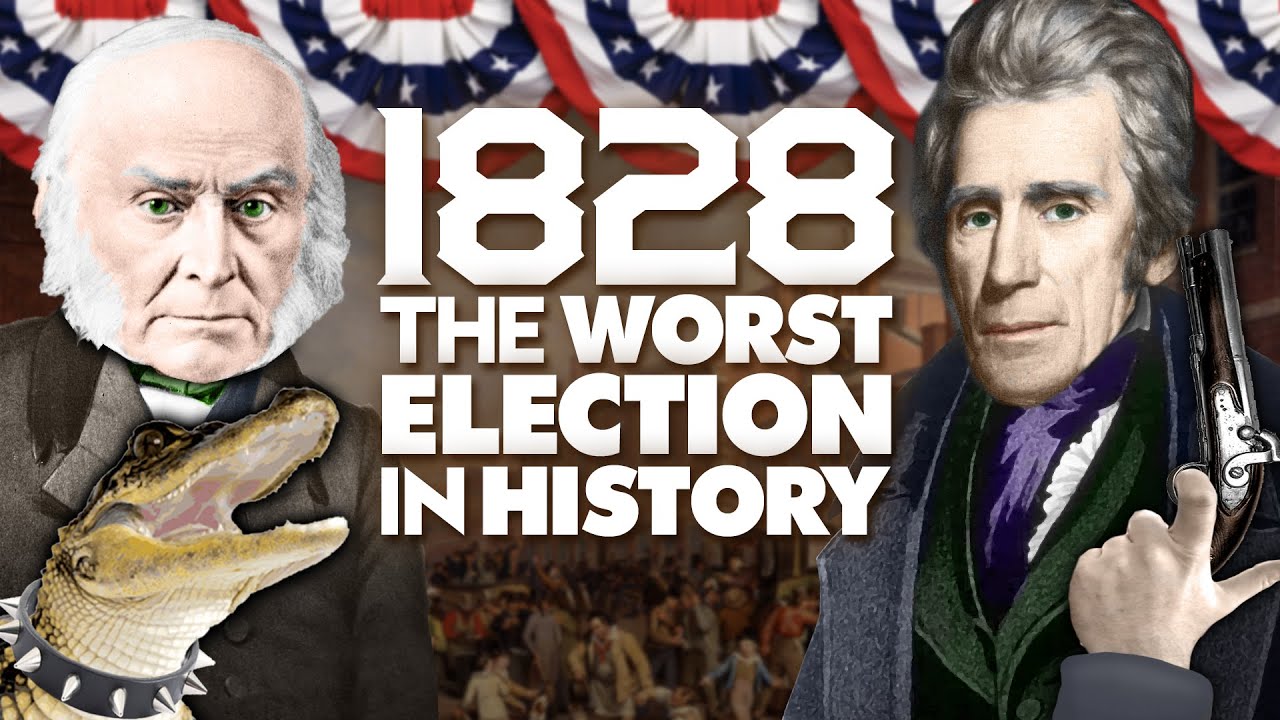
Andrew Jackson V. John Quincy Adams
In 1824, the nation was just coming out of the “Era of Good Feelings” after James Monroe (1817-1825) led an era of peace in the aftermath of War of 1812, and he led the country to a period of true strength, unity of purpose, and one-party government, after the death of Alexander Hamilton and his ideas of Federalism.
Those good feelings of unity ended quickly in the ensuing 1825 election race between John Quincy Adams and Andrew Jackson. The country appeared as divided as its ever been with Andrew Jackson winning a plurality, but not a majority, of either the popular and the electoral votes. This election pushed the country into its first dispute between the Electoral College and the popular vote, as neither Jackson nor Quincy Adams accumulated the plurality of votes needed to secure the 1825 presidential election. As Tara Ross reports, this election was between Secretary of State John Quincy Adams, Secretary of the Treasury William Harris Crawford, Speaker of the House Henry Clay, and Tennessee Senator Andrew Jackson. This conflict resulted in the first time in the young Republic’s history that no presidential candidate secured enough Electoral votes, so, as the 12th Amendment dictated, it was on the House of Representatives to elect the president.
The House of Representatives were given three options: Adams, Jackson, or Crawford. The Constitutional provision did not allow Henry Clay to be considered because he placed fourth.
The latter note proved crucial to the final outcome allegedly, because knowing that he had no avenue for victory, Henry Clay, the Speaker of the House, allegedly entered into a “corrupt bargain” with John Quincy Adams. The “corrupt bargain”, as Jackson supporters theorized, was that Clay met privately a month before the House vote. In that private meeting, Jackson and his supporters allege that Clay informed Adams that he would throw his powerful support, as Speaker of the House to Adams if Adams would use the victory to later nominate Clay to a cabinet position. Adams, for his part, denied the allegation, but Clay’s support gave Adams the 13 House votes Adams needed to secure the presidential election.
Jackson conceded to the peaceful transition initially, until Clay was nominated to arguably the most prestigious position in the cabinet, Secretary of State, three days later. Jackson, and his supporters viewed that appointment as proof that a “corrupt bargain” had been made.
Adding fuel to the fire, reports later emerged that Clay initially tried to strike a deal with Jackson, but Jackson refused to “go to that chair” except “with clean hands.” Had Adams taken a deal when Jackson would not? As with modern politics, Adams never admitted to anything, and no reporters in the era ever uncovered a truth or any evidence that would incriminate or absolve Adams. Hence, even with 200 years of hindsight, “We shall probably never know whether there was a ‘corrupt bargain,’” historian Paul Johnson concludes. “Most likely not. But most Americans thought so. And the phrase made a superb slogan [in the 1828 Jackson v Adams rematch].”
Some allege that this idea of a “corrupt bargain” not only cost Quincy Adams his reelection in the 1828 rematch with Andrew Jackson, but it severely damaged the future political career of Henry Clay too. In this era, the Secretary of State was viewed as a natural stepping stone for the presidency, as four of the seven previous Secretaries eventually sat in the highest office in the land. Clay’s resume not only listed House Speaker and Secretary of State, he was a Congressman, and a Senator before rising to prominence. He helped found both the National Republican Party and the Whig Party. He was well-known as the “Great Compromiser” and was part of the “Great Triumvirate” of Congressmen. He also received Electoral votes for president before the 1825 election. On his resume alone, Clay was a could’ve been should’ve been who never was president. He would rue the day he accepted the Adam’s appointment, because whether it was true or not, the charge of the “corrupt bargain” stuck to him throughout his political career.
If you’re as interested in U.S. History through relatively obscure presidents as I am, read Obscure Presidents part I