“Listen Daphne,” the character Frasier Crane said, in an episode called We Two Kings, episode ten of season ten, “is your mom partial to a traditional Cornwall dressing, you see I’m thinking it would go splendidly with the twelve-pound Hungarian goose that I’m serving,” he adds the latter with a excited survey of the room to encourage joy.
Niles and Daphne counter that they are planning on celebrating Christmas at their apartment to celebrate their first Christmas as a married couple, and they invite Frasier to partake in their celebration. Frasier argued that it’s been a Crane family tradition to have Christmas at his place. To which, Niles responds:
“Frasier you’ve had Christmas for the past nine years.”
“Yes, but we agreed we’d have Christmas here in its traditional setting.”
“Yeah, well, maybe it’s time to start a new tradition,” Niles says.
“But I’ve had new stockings loomed for everyone,” Frasier says. “Now there you see, you made me spoil the surprise, and did no one hear me say that I have ordered an Hungarian goose?”
As is typical of Kelsey Grammer, he delivers a pitch perfect line. He stresses the word (‘an’), and he punctuates the word goose with a pleading tone that asks his audience (Niles and Daphne) to recognize the import of what he’s saying. We don’t know how many takes Grammer used to hit that line that perfect, but the finished product will live on in television history as far as I’m concerned, as one of the best one-liners Grammer ever delivered.
Some proper grammar enthusiasts might argue that Grammer used improper grammar when he issued this historically hysterical line in the situation comedy Frasier. The grammatically correct use of definitive articles states that we use (‘a’) before vowels and an (‘an’) before consonants, but as with everything in the English language, there are exceptions. The letter (‘H’) is just such an exception. When the (‘H’) is silent, as it is in the word hour, we use (‘an’) even though (‘H’) is a consonant. “It will only take me an hour to complete this article.” If the (‘H’) is pronounced, as in “I always wear a hat when I write”, (‘a’) is the proper definite article to use. The exception to the (‘H’) exception occurs when the accent is not on the first syllable of a word, because the pronunciation of the (‘H’) is downplayed in words where the accentuation occurs after the first syllable, and it renders it closer to the silent (‘H’) rule. Unless, they argue, we’re using some words like historian or habitual, in which (‘a’) is the preferred variant.
We also have other exceptions regarding the sound in certain other words. We don’t say “He has a MBA”, for example, because it sounds like a (‘E’) exists before the (‘M’), or (em-bee-ay). It just sounds wrong to say a MBA, even though the initials begin with an (‘M’). So, the rule states that if it sounds like a vowel precedes the consonant, then we use the definitive article (’an’).
One rule of thumb on the use of definitive articles, says June Casagrande, from The Glendale Newspress, “[I]t’s a mistake to choose based on anything but sound.” So, if it sounds wrong, it probably is? Well, (‘an’) Hungarian goose doesn’t sound correct, even if the stress is found on the second syllable, and if we extend Ms. Casagrande’s quote out to other strict to casual rules of usage, so many of them just don’t sound correct.
Anytime I sort through the rules of grammar and spelling as it pertains to the English language, I think of two people: a foreigner I knew well who told me that English might be the hardest language in the world to speak on a casual level. “I did well in my ESL (English as a Second Language) class,” she said, “but talking to English speakers in this country is so confusing. There are so many exceptions and rules, even in casual conversation, that I just want to pull my hair out. Talking to you, a writer who obsesses over such rules, is even more nerve-wracking. I don’t think I’ll ever get it,” the woman, who speaks seven other languages to near fluency, told me. The other person I think of is Norm MacDonald who, when confronted with the idea that the English language might be one of the hardest languages to learn, he said, “Really, because I think it’s pretty easy.”
Was Kelsey Grammer grammatically correct when he said the line, “An Hungarian Goose”? The Word check program I’m using to write this article suggests that the definitive article (‘an’) is incorrect in this case. Yet it allows me to write both ‘a historian’ and ‘an historian’ without notification of error. “Correct me if I’m wrong, but the stress on Hungarian falls on the second (gar) syllable, and if that’s the case doesn’t it render the (‘H’) equivalent to silent in the phrase and an (‘an’) is more correct in this case?” signed Confused.
On the surface, it appears that only skilled comedians and comedic actors can explain why some words are funnier than others. They don’t know squat, I suggest, until they try it out. Standup comedians test their material constantly, and comedic actors sort through their numerous takes, with directors and writers, to find the right sentence, the perfect pitch, and everything else that produces a finished product to which we marvel. We can only wonder how many takes it took Grammer to try to hit that line perfect, but when he hit a hard (‘an’) in the line and punctuated the word goose with a distinct plea in his voice, I think it was as close to comedic perfection as the skilled comedic actor ever achieved. Steve Martin suggests that comedy is similar to music in that what works in comedy is often based on rhythms and beats. In this frame, the syllables involved in the words an Hungarian goose are funnier than Danish hen ever could be, even if Grammer dropped the line in the exact same manner. So, if anyone who wants to debate whether Grammer should’ve said (‘a’) Hungarian goose, I would introduce them to another exception to the rule, and I regard this an exception to all rules of usage in the English language, “If it works, and it’s that funny, you can go ahead and throw all of your rules of usage right out the window.
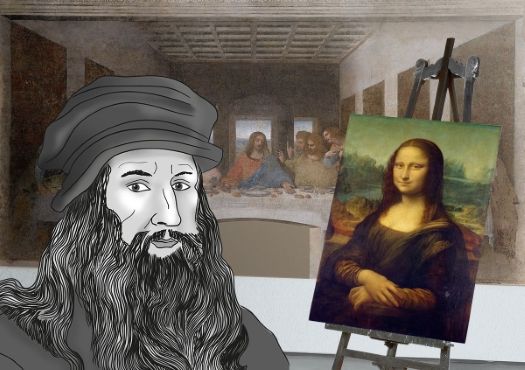
“If you love that book on Van Gogh that much, you should try reading Walter Isaacson’s Leonardo da Vinci,” I told a person who was pitching a VincentVan Gogh book to me. I normally don’t care for people who say, “You think that’s great, you should try this,” but I was so enamored with Isaacson’s book that I couldn’t keep quiet about it.
“At some point in his younger years, da Vinci probably saw someone paint most beautiful eyes he ever saw. At some point, he probably saw someone paint the most enigmatic smile ever created, and he had to top them,” I said. “Either that, or he saw the extent of his talent at some point in his life, and he wanted to go deeper to better understand what he wanted to portray.
“However he arrived at this point, Leonardo da Vinci became an artist who could no longer just paint a smile. He couldn’t just paint eyes. He wanted, needed, to understand the inner machinations of the muscles and tendons involved in the smile and the mechanics of the eye to make them appear as alive and realistic as possible. Due to constraints of his era, he had to hire grave robbers to exhume bodies for him (some suggest he ended up carving up thirty bodies), so he could dissect them to help him understand our anatomy on a deeper level to understand how these components of our face worked together to form something as complex as a smile. In the early years of this pursuit, the grave robbing had to occur under the cover of night, because it was deemed illegal by the Catholic Church to dissect a human body, unless it was being performed by a qualified physician.
Da Vinci had to go deeper into channels that you and I would never consider to perfect his brand of visual manipulation that might lead us believe that the eyes were following us around a room. Leonardo’s methodology was that the difference between a talented artist, and one who seeks perfection is not the big things, it’s all the little, insignificant things that you and I would never consider. “It is necessary for a painter to be a good anatomist,” da Vinci wrote, “so that he may be able to design the naked parts of the human frame and know the anatomy of the sinews, nerves, bones, and muscles.”
“Oh my gosh,” my Vincentvan Gogh loving friend said. “I had no idea, and I’m an art enthusiast. I’ll bet most people who haven’t read that book don’t know that.”
“His work on these cadavers was in service of his art,” I added, “but he became so obsessed with it that my guess is that much of what he uncovered was useless to him professionally. He might have started this process in service to his art, but I’m guessing that his curiosity overwhelmed him when he started finding answers. I’m guessing that he carved up the first cadaver to find an answer, then he found it, and he dug deeper and found other answers to questions he never asked before. He found some answers to irrelevant minutiae that intrigued him so much, and he became so obsessed that he probably forgot the original reason he paid the grave robbers to exhume bodies, and he became less of an artist seeking answers to artistic questions and more of a scientist.”
The latter was an opinion that Isaacson would correct. “Da Vinci was never less of one or more of another. He sought to infuse science and math into his art. From the anatomical perfection he sought in the Mona Lisa to the mathematics of perspective he used in The Last Supper, da Vinci was always seeking a hybrid of the three.”
“The point,” I would counter, “is there had to be a point of origin for his fascination with science and math. If there wasn’t, if he was always fascinated with science and math, there had to be a point where he decided to incorporate these disciplines into his grand visions of art. I understand that he eventually achieved a hybrid, but there had to be a point where he said if I’m going to realistically portray water flow, I need to gain firsthand experience and knowledge. In doing so, he was so fascinated with his findings that he forgot to complete the paintings he was commissioned to complete.”
Some say that Leonardo da Vinci was such a curious person that he made it his goal to ask himself one hundred questions a day. You’ll note that it wasn’t necessarily his goal to find one hundred answers a day, though that was, of course, part of it. Those who love da Vinci suggest that he thought questions led to other questions, and that if he asked enough questions they might lead to other questions, until he arrived at an answer to a question he never considered before. Da Vinci’s was an ego-less approach to problem solving that most of us can’t do without attaching our questions to personal beliefs, conventional wisdoms, and other such biases. My guess is da Vinci kept asking himself questions to attempt to drain them of any personal convictions he might have on a subject. Then when he arrived at answers, he immediately went about trying to disprove them. He didn’t invent the step we now include in the scientific method, but he turned the practice into an artform in his own pursuits.
When Leonardo da Vinci approached something as simple as water flow, we can guess that by the time he seriously sat down to understand it, he had all of the conventional thoughts of the day running around in his head. He probably read as many books on it as were available to him at the time (if there were any), and he talked to any experts he could find whom he considered far more intelligent than he. At some point, he either thought they were all wrong on the subject, or he felt he needed to verify their answers for himself. Either way, Isaacson details some of the observations da Vinci made, and some of the experiments he conducted to understand it better. Da Vinci wasn’t the first to study water, of course, nor was he the last, but we have to believe that he was one of the few. We have to imagine that few have endured the hours, or an accumulation of months and probably years trying to understand it, because it comes equipped with one powerful deterrent: it’s boring. Even before the advent of radio, TV, the internet, and smartphones gave us all something to do to stave off boredom, studying water had to be pretty low on the list of things for anyone to do on otherwise boring Saturday afternoon. How much time did da Vinci sit outside watching water, how much time did he spend conducting experiments to understand the true nature of water? How much of his life did he devote to trying to arrive at an answer that no one would ever care about, even if he did publish his findings? Even if all he did was accurately portray the flow of water in one of his paintings, it probably only satisfied da Vinci and a small cadre of art enthusiasts who focus on the tiny minutiae that separates the talented from the brilliant. How many of his patrons would recognize such minute detail, and laud him for it? Was there anything more than a personal reward for the laborious study he put into making sure a couple of brushstrokes were accurately portraying what he discovered to be a truth about water? The only thing more boring than studying water to find the greater truths about it, as Isaacson’s book illustrates, is reading about it.
Perhaps the only interesting element of da Vinci’s study of water is why was he inspired to pursue it when many considered the topic so thoroughly explored? At what point do relatively uninformed people become so informed that they are confident enough to question the conventional information of their esteemed peers on a subject? We can only guess that he was intimidated by the experts’ intellect in his formative years, but he progressed beyond that. We all go through these progressions in varying ways. We all accept what our parents say as fact, but we begin to question them when at a certain age. Our parents are our primary authority figures, for much of our lives, and they’re our go-to for answers. When we find out they’re wrong on some things, we naturally assume they’re wrong about everything. We know our parents, and we know their vulnerabilities. Most experts’ vulnerabilities are not as available to us, so we cede authority of a subject to them on the subject to which they claim authority. Some of us don’t. Some of us, such as Leonardo da Vinci, don’t pursue knowledge to prove anyone wrong, but we find intimacy with the truth when we investigate a matter for ourselves.
The questions da Vinci had about water were probably just as numerous as the ones he had about achieving flight, nature, and the numerous other answers to such detailed questions that no one, in his time, had ever asked before. Thus, a number of his findings were so far ahead of their time that when we eventually discovered his journals, and we deciphered them in a mirror, because he wrote them backwards, we discovered advances he made that were centuries prior to the same ones made by renowned scientists. As Momento Artem writes in The Clocktower, “It’s believed that if [da Vinci] released [his journals] during his lifetime, they would not only have changed renaissance science and medicine but also the scientific and medical worlds we have today.”
How many people died as a result of a procedure called bloodletting? If da Vinci released his journals on the heart, and his subsequent theories on blood flow, during his lifetime, or we discovered them sooner, they might have disproven the theories behind bloodletting and spared the millions of patients who followed the useless and hopeless pain of the procedure.”
Knowledge can be a powerful thing. It can ingratiate people to us, in a “I can’t believe you know that” frame, but it can also turn people away “Mr. Smartypants here, thinks he knows everything.” Leading anatomists of his era probably would’ve done everything they could to discredit da Vinci for providing data that might prove them wrong, if he published these journals. The religious institutions of his era surely would’ve declared his views of the human body as a beautiful, self-sufficient machine blasphemous and heretical. How many political and medical industries would’ve been destroyed and presumably rebuilt, based on his findings? One thing we know about human nature, no matter the era, is that people don’t enjoy finding out they are wrong. Many of da Vinci’s tests, findings, and theories arrived at by scientific methods bore fruit, of course, but if he permitted publication of his findings, da Vinci probably would’ve been a pariah in his era. It’s possible he would’ve been exiled, excommunicated, or executed for publishing his findings, as they were the most popular methods those of his era had for dealing with those with whom they disagree, but the other method they had was various forms of book burning. Would da Vinci have been declared such a blasphemous heretic that the religious community, the medical community, and all of the politicians who supported them probably would’ve branded da Vinci’s work in such a way that we wouldn’t have any of his great paintings or his journals? How likely is it that popular opinion might brand da Vinci’s work in such a way that anything he did would be branded in such a light that they would’ve approached the owner of the work with torches to destroy it?
No matter how we characterize da Vinci, it’s obvious he considered himself a one man show. He didn’t accept an idea based on politics, religion, or what was widely accepted in the scientific community as a truth either. Nor was he married to his own ideas. As with most great scientists, he made a number of false assumptions that led to numerous mistakes. When he recognized those mistakes, his journals note his frustrations by saying things like, “impossible to know”. Those of us who love reading about the brilliant minds of history, and have read almost all of Isaacson’s books, know that even acclaimed geniuses make huge errors, and/or declare a subject “impossible to know”. It’s as if they’re saying, “If I can’t figure it out, it’s impossible to know.” Unlike most people, however, da Vinci didn’t let himself get in the way of him eventually finding an answer, or the truth. His notes detail an impatience with the project and the very human frustration of not being able to find the answer quickly, but they also inform us of a resolve that might have superseded most of his peers in eventually arriving at answers that still shock the world. It shocks us that he arrived at some unprecedented conclusions, because we consider his resources and the conventional wisdoms of his era. He didn’t care, to some degree, if his findings offended the politicians, the religious, or his friends. I write to some degree, because there were reasons why he never published the work, and there were reasons why he wrote it all backwards.
The knowledge I have on art, in general, and da Vinci in particular, barely scratches the level of novice. So, I assumed that my art enthusiast friend knew more about Leonardo da Vinci than I ever would. When you’re a novice with a particular obsession, you assume everyone knows more than you. Novices don’t know where they first heard the nuggets of information they share. We can’t remember where our fascination started. We read books, little nuggets on various websites, and we watched bios and documentaries, and we compiled so much over the years that much of Isaacson’s book was rehash. When I dropped these little nuggets on this art enthusiast, I expected her to nod and usher me forward with leading questions to information Isaacson unearthed that she didn’t know. Her amazement at what I considered elementary knowledge of da Vinci informed me that some of the times the relatively useless trivia we have swimming around our heads can be surprising bits of information to the unsuspecting.
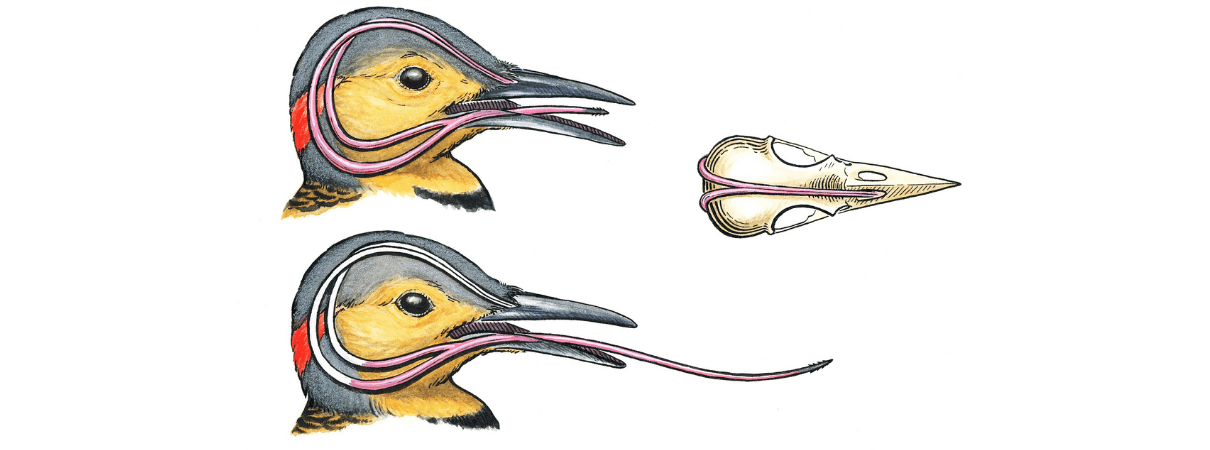
“Describe the tongue of the woodpecker and the jaw of the crocodile,” Leonardo da Vinci wrote as a reminder to himself in his Codex Atlanticus.
How many of you are curious about inconsequential matters? Let’s see a show of hands. How many of those curiosities will end up serving something greater? Some will and some might, you never know. We could end up studying something largely consider inconsequential that ends up helping us understand ourselves better, our relationship to nature, and all of interconnected facets of our ecosystem. What seems inconsequential in the beginning can prove anything but in other words, but what would purpose could the study of a bird’s tongue serve a 16 th century artist?
“Everything connects to everything else,” a modern da Vinci might have answered. There is no evidence that the 15th and 16th century Leonardo da Vinci ever said, or wrote, those words, and it’s likely apocryphal or a 20thcentury distillation of Leonardo’s notebook passages on the unity of nature, such as the earth-man analogy he made in the Codex Leicester or water’s role in the Codex Atlanticus. So, the answer is da Vinci studied the woodpecker’s tongue to try to find a greater connection, right? Maybe, sort of, and I guess in a roundabout way. When we study da Vinci’s modus operandi, we discover that his research did involve trying to find answers, but his primary focus was to try to find questions. He was, as art historian said, Kenneth Clark said, “The most relentlessly curious.” That characterization might answer our questions with a broad brush, but it doesn’t answer the specific question why even the most relentlessly curious mind would drill so far down to the tongue of the woodpecker for answers. For that, we turn back to the theme we’ve attributed to da Vinci’s works “Everything connects to everything else.” He wasn’t searching with a purpose, in other words, he was searching for a purpose of the purpose of the tongue.
We’ve all witnessed woodpeckers knocking away at a tree. Depending on where we live, it’s probably not something we hear so often that it fades into the background. When we hear it, we stop, we try to locate it, and we move on. Why do they knock? Why does any animal do what they do? To get food. Yet, how many of us have considered the potential damage all that knocking could have on the woodpecker’s brain? If another animal did that, it could result in headaches, concussions, and possible long term brain damage. How does a woodpecker avoid all of that? Prior to writing this article, I never asked how the woodpecker avoided injury, because I never delved that deep into that question, because why would I? As with 99.9% of the world, I just assumed that nature always takes care of itself somehow. As curious as some of us are, da Vinci’s question introduces to the idea that we’re not nearly as curious as we thought.
Was da Vinci one of the most relentlessly curious minds that ever existed, or was he scatterbrained? We have to give him points for the former, for even wondering about the woodpecker’s tongue and the crocodile’s jaw, but the idea that he we have no evidence that he pursued these questions gives credence to the latter.
Did he find the fresh carcass of a woodpecker to discover how long the tongue was relative to the small bird, and its comparatively small head? Did he initially believe that the extent of its functionality involved helping the bird hammer into wood, clear wood chips, and/or create a nest. If his note was devoted to what he saw the bird do, he probably saw it perform all of these chores, coupled with using it to retrieve ants and grubs from the hole its knocking created. If da Vinci watched the bird, he probably saw what every other observer could see. It doesn’t seem characteristic to da Vinci to leave his conclusions to superficial observations, but I have not found a conclusion in da Vinci’s journal to suggest that he dissected the bird and found the full functionality of the tongue. There were no notes to suggest da Vinci found, asIFOD.comlists:
“When not in use, the woodpecker’s unusually long tongue retracts into the skull and its cartilage-like structure continues past the jaw to wrap around the bird’s head and then curve[s] down to its nostril. In addition to digging out grubs from a tree,the long tongue protects the woodpecker’s brain. When the bird smashes its beak repeatedly into tree bark, the force exerted on its head is ten times what would kill a human.But its bizarre tongue and supporting structure act as a cushion, shielding the brain from shock.”
Brilliant musicians dive deep into sound, acoustics, and how they might manipulate them in a unique manner to serve the song. Writers pay attention to the power of words, as we attempt to hone in on their subtle yet powerful forms of coercion, and the power of the great sentence. Artists, in general, seek to achieve a greater understanding of little relatively inconsequential matters for the expressed purpose of gaining a greater understanding of larger concepts, but a study of the woodpecker’s doesn’t appear to serve any purpose, large or small.
The idea that he was curious about the tongue is fascinating, as it details the full breadth of his sense of curiosity, but it still didn’t appear to serve a purpose. The only answer Walter Isaacson wrote for da Vinci’s relentless curiosity was:
“Leonardo with his acute ability to observe objects in motion knew there was something to be learned from it.”
There is no evidence to suggest that Leonardo da Vinci regretted the idea that he didn’t create more unique paintings, but I would’ve. If I worked as hard as da Vinci obviously did to hone the talent he did, I would regret that I left so few paintings for the historical record. (Though he may have created far more than we know, art experts are only able to definitively declare that da Vinci created 15-20 paintings.) Thus the price we art aficionados pay for da Vinci for stretching himself so thin ( as discussed in Walter Isaacson’s Leonardo da Vinci), is relatively few paintings.
“You could say that,” we might say arguing with ourselves, “but if he wasn’t so relentlessly curious about such a wide range of what we deem insignificant matters, the relatively few works we now know likely wouldn’t have the detailed precision we now know.” If he wasn’t so relentless curious about the particulars of the manner in which water flows, and the effects of light and shadow, the techniques he employed (sfumato andChiaroscuro) might’ve taken future artists hundreds of years to nuance into its final form. Da Vinci did not discover these techniques, but according to the history of art, no one employed them better prior to da Vinci, and the popularity of his works elevated these techniques to influence the world of art.
Arguments lead to arguments. One argument suggests that thirty quality artistic creations define the artist, and the other argument suggests that one or two masterpieces define an artist no matter how many subsequent pieces he puts together. An artist who creates a Mona Lisa or a The Last Supperdoesn’t need to do anything else.I understand and appreciate both arguments, but we can’t fight our hunger for MORE. When we hear the progressions that led to The Beatles “The White Album”, and then we hear “The White Album” we instantly think if those four could’ve kept it together, or Come Together one more time, we could’ve had more. If Roger Avary and Quentin Tarantino didn’t have a falling out after Pulp Fiction, they could’ve created more great movies together? If Franz Kafka could’ve kept it together, and devoted more of his time to writing, it’s possible that Metamorphosis and The Trial wouldn’t be the two of the far too few masterpieces he created.
The rational side of me knows that more is not always more, and that the “Everything connects to everything else” theme we connect to da Vinci’s modus operandi informed the art we now treasure, and I understand that his obsessive pursuit of perfection led to his works being considered the greatest of all time, but I can’t get past the idea that if he wasn’t so distracted by everything that took him away from painting, we all could’ve had so much more. Yet, I reconcile that with the idea that that which made him is that which made him, and he couldn’t just flip that which made him into the “off” position to create more art.
Why did da Vinci pursue such mundane matters?Author Walter Isaacson posits that da Vinci’s talent “May have been connected to growing up with a love of nature while not being overly schooled in received wisdom.” On the subject of received wisdom, or a formal education, da Vinci was “a man without letters”, and he lacked a classical education in Latin or Greek. As with most who rail against thosewith letters after their name, da Vinci declared himself “a disciple of experience”. He illustrated his self-education by saying, “He who has access to the fountain does not need to go to the water-jar.” He who has access to primary sources, in other words, doesn’t need to learn about it throughthe second-hand knowledge attained in text books. Da Vinci obviously suffered from an inferiority complex in this regard that led him down roads he may not have traveled if his level of intelligence was never challenged. His creative brilliance was recognized and celebrated, as da Vinci knew few peers in the arena of artistic accomplishment. We can guess that his brilliance was recognized so early that it didn’t move his needle much when even the most prestigious voices expressed their appreciation for his works. Yet, the one thing we all know about ourselves is that we focus on our shortcomings, and while we celebrate his intelligent theories and deductions, we can only guess that those with letters behind their name dismissed him initially. “What do you know?” they might have asked the young da Vinci, when he posed an intellectual theory. “You’re just a painter.” Was he dismissed from intellectual discussions in this manner early on in life? Was he relegated-slash-subjugated to the artistic community in his formative years, in a way that grated on him for the rest of his life? Did he spend so much of his time in intellectual pursuits, creating and defeating intellectual boogie men in a manner that fueled a competitive curiosity for the rest of his life?
Even today, we see brilliantly creative artists attempt to prove their intellectual prowess. It’s the ever present, ongoing battle of the left vs. right side of the brain. The brilliant artist’s primary goal in life, once accepted as a brilliant artist is to compensate for his lack of intelligence by either displaying it in their brilliant works of art or diminishing the level of intellect their peers have achieved. Is this what da Vinci was doing when he laid out a motto for all, one he calledSaper vedere(to know how to see). He claimed that there are three different kinds of people, “Those who see by themselves, those who see when someone has shown them and those who do not see.” In this motto, da Vinci claims his method superior, which it is if one counts consulting primary sources for information, but why he felt the need to pound it into our head goes to something of an inferiority complex.
One element that cannot be tossed aside when discussing da Vinci’s relentless curiosity is that he was born into a comfortable lifestyle. The young da Vinci never had to worry about money, food, or housing. As such, he was afforded the luxury of an uncluttered mind. When a young mind doesn’t have to worry about money, food, or achieving an education to provide for himself and his family, he is free to roam the countryside and be curious about that which those with more primary concerns do not have time to pursue. Isaacson’s writing makes clear that although Leonardo da Vinci was an unusual mind on an epic, historical scale, the privilege of thinking about, and obsessing over such matters can only come from one who has an inordinate amount of free time on his hands. Perhaps this was due to his privilege, his comfortable lifestyle, or the idea that he didn’t have much in the way of structured schooling to eat up so much of his thoughts and free time in youth.
Having said that, most modern men and women currently have as much, if not more, free time on their hands, and we could probably compile a list of things we wonder about a thousand bullet points long and never reach the woodpecker’s tongue, the peculiarities of the geese feet, or the jaws of a crocodile to the point that we conduct independent studies or dissections. We also don’t have to do primary research on such matters now, because we have so many “jars of water” that we no longer have the need to go to the fountains to arrive at ouranswers.
Consider me one who has never arrived at an independent discovery when it comes to nature and animals, as I don’t seek primary source answers on them. I, too, am a student of the jaws of water that various mediums, be they documentaries on TV or books, but I am a student of the mind, and I do seek primary source information on the subject of human nature. On this subject, I do not back away from the charge that I’m so curious about it that I exhibit an almost childlike naïveté at times, but reading through Leonardo’s deep dives makes me feel like I’ve been skimming the surface all these years. I mean, who drills that deep? It turns out one of the greatest artists of all time did, and now that we know the multifaceted functions of the woodpecker’s tongue, we can see why he was so fascinated, but what sparked that curiosity? It obviously wasn’t to inform his art, and there is nothing in da Vinci’s bio to suggest that that knowledge was in service of anything. He was just a curious man. He was just a man who seemingly asked questions to just to ask questions, until those questions led him to entries in journals and paintings that we ascribe to the theme everything connects to everything else.



 Rilaly