The Death of the Novel


“There’s nothing to say that hasn’t been said before,” Terence in the second century B.C.

“Everything that needs to be said has already been said. But since no one was listening, everything must be said again.” –Andre Gide

“The idea that everything has already been said has already been said.”

We’ve said it before, and we’ll say it again, someone needs to artistically slaughter the traditional novel, the novelly novel, out in the street for all to see. That which was once so important to us, is now dead. Writers will keep writing novels, and readers will keep reading them, but the era of the novel, as a cultural touchstone, has been on artificial life support for some time now waiting for someone to pull the plug, so we can reframe the real and rebirth it. Some young, ambitious kat needs to step up to the plate and destroy the art form in such a glorious way that its readers know there’s no turning back.

We pick up a book now, in our local bookstore, and the back jacket makes it feel so real, so vibrant and so cutting edge. Then we see it, the dreaded words “a novel” on the cover. We used to think that all it would take is one exciting, “I just can’t put it down” novel to reignite our passion for the novel, but we’ve read too many paint by numbers’ narrative conventions to believe that will happen. We’ve read too many authors depict wonderful and beautiful landscapes, in captivating wordscapes to want to go through it all again. We’ve read too many authors sort through romanticized sentiments in relatable conversations with side characters to give us a sense that they’re all a lot more like me than I ever considered possible. We’ve read too many authors deploy shadowing techniques to display how clever their main character is by showing us how dumb her side characters are. We put that novel back on the shelf, because we now know that in the author’s attempt to wow us with their artistry, they will attempt to please all of the people all of the time.

Our complaint might not be with the novel alone, but the novel used to be our favorite form of expression. The novel allows its author the sort of in-depth analysis of the human mind for which no other art form has the patience. The novel permits us to live, breathe, and be the character. In the more visual mediums, we might arrive at more immediate entertainment, but they fail to capture the intimacy of a great book. For most of my life, there was nothing better than a great book, and I was always reading one. As I write this, I haven’t read a novel in five years, and that was some light fare compared to my unusual favorites. 

Perhaps we’ve read too many novels at this point, but we can spot an author’s agenda a mile away, and most of us don’t want to know what the author’s agenda is. On the off chance that we enjoy it in some manner, her cloaked positions will strike us as derivative and redundant, and we will spend the breadth of the novel thinking we could’ve written it better. Typically, her main characters will be remarkable faultless, and her bad guys bumbling fools. She will engage in tired tropes, such as children being smarter than adults are, and everyone else knowing more about “the industry” than the CEO who spent 25 years in it. Bad guys gotta be bad and good girls, gotta be good. It’s so tired now that we need some new author to have the audacity to shake it up and teach us something different about ourselves.

In the same way Sam Raimi and the Coen Brother’s “Shaky Cam” killed the typical horror movie, essays, philosophical tracts, and the internet ruined the novel. The novel no longer feels as real or as relevant as it once did. It no longer feels substantial, engaging and cutting edge. It could be as simple as short form vs. long form, but we don’t think so. We think it has more to do with our hunger for some version of an author punching reality into our jugular.

The novel died right after we said, “The novel is not dead!” The writer who pines for a best-seller list might say such things, but does an artist who uses the novel as an expressive art form? After reading a novel, we should charge its author as an accessory to its murder. The reader should despise them for violating the conventions they hold dear. The writer should exhaust the reader’s anger until the reader grows to love them. “I see what you’re doing now, but it took me a while sheesh!” should be the first words that come out of her mouth when she’s done being so irritated with the writer that she put the book down numerous times (in absolute frustration) before she finally finished it.

“Don’t insult the reader,” the writing magazines advise. “Pay attention to your reader.”

Those of us who come from a punk rock school of writing think the modern writer should learn all of the novel’s conventions for the sole purpose of violating them more creatively, and we think they should know them so well that they boldly change them in an atypical fashion. If you think you know what this means, invert that thought, and give that a try. Insult the reader, we say, anger them, and make them despise us for writing what we wrote. We need to confuse, confound, and control the reader’s mind, until they come back begging for more. Could one book do all this? It would have to be an incredible book. I’m more inclined to believe it might take a movement, similar to what punk rock and grunge did for hard rock. 

“I did this for me,” we should tell those writing magazines. “By giving you me, I’ll give you you,” as author David Shields would say.

Even if our subject matter is pleasing, we should write in a way that makes the reader uncomfortable. As boring as most novels are, some earn our hard-earned money. Some offend our sensibilities so much that we find them thrilling. We’re on the edge of our seat wondering how this book is going to offend us next. We finish the book on a spiritual high, only to learn that our compadres have their thumbs adamantly pointed down. “I found it so repugnant that it made me feel uncomfortable,” they said. “Me too!” we say from a 180-degree different standpoint.

Your job, as a writer, is to take us to uncomfortable places. Tap into some uncomfortable places in our psyche and force us to explain them. “I’m not a bad guy.” You’re not, but you could be, if I placed you in such an uncomfortable position that you thought about it. “But I enjoy laughing, and I enjoy it when some beautiful text makes me feel wonderful about myself.” Is wonderful what you’re feeling, or is it publicity? How loud do you shout it out? What’s the difference between charity and publicity? That’s it, right in the jugular. Does it hurt? It’s supposed to hurt. A great writer shouldn’t address what we want. They should address need. Novel writers did that at one time. They’re a dying breed now.

We enjoy labeling eras. How about we label this era the era of same same? This is an era of “if it works, try, try, and try it again.” It’s a little narcissist to list the authors who killed the novel as an art form, but let’s just say that they might’ve been there for a rebirth, but they never did anything to help it mature. This sentiment might lead some to consider us jealous that other writers succeeded beyond us. We can assure you this is not the case, as we want some great author to mess the mainstream up with a hyper-real novel that shakes up our whole world. Yet, it’s impossible to defeat that charge, so let’s focus on an analogous comparison.

I loved the authors in question for a time, as much as I once loved Metallica. I loved the Master of Puppets and …And Justice for All albums. I don’t listen to their other albums, but I have no problem with them trying to make a buck on subsequent albums. I just don’t buy them. Other people were angry that Metallica didn’t close up shop after Justice. Why? Let people buy their other albums, let Metallica get rich. We don’t have to listen to their other albums. We have nothing against a guy trying to make a buck in any other field, but art is special. An artist has an added responsibility to the art form that made them rich. After an artist creates their masterpiece, they need to dabble in the art form to expand it and enrich it. To my mind, the great artist creates a masterpiece, and then they spend the rest of their life trying to destroy it. They should appreciate the masterpiece for everything it was, and they should never insult those who loved it and made them what they are, but they should feel a personal vendetta to top the masterpiece. They might never again create another masterpiece, but they should do whatever they can to create the uniquely spectacular after the fact.

The authors in question often come out with a book a year that duplicates the formula of the masterpiece. How many great books does one author have in them? They write one great book, sign a huge advance for another, and in their desire to make that publisher happy, they create the derivative and redundant, and everyone is happy and no one is. “It’s not as good as his masterpiece,” we say. “How many sequels are?” they reply, laughing all the way to the bank, trotting upon the art form as they escape. The question the reader asks themselves is do we want the author to destroy their masterpiece in their next outing, or do we want to remember them as they were, in the manner of the great athlete.

“Punk rock died when the first punk said, “Punk’s not dead.””

If punk rock wasn’t dead, they should’ve killed it. Those who loved punk rock should’ve planned some bloody, very public, ritual death. Never Mind the Bullocks should’ve been the only punk rock album ever made. One album of absolute anarchy and everything after it mimicked the premise and became commodity. The Sex Pistols were a horrible band, and Never Mind the Bullocks was a horrible album, but those who loved it, loved the definitive punk rock album for what it was. It stood for nothing and something that shouldn’t last. If it does last, it sounds more orchestrated and contrived in every form that follows, thus violating everything for which it stood. Everything you believe in is wrong, and all of that nonsense. The whole motif of that album and the movement it started was that everything is dead.

The novel is dead long live the novel. The truth is dead long live the truth. We should have an artistic labeling process that mirrors the Motion Picture Association of America. An M, signifies the author’s masterpiece, a DR designation informs the reader of the subsequent works from the author that are derivative and redundant, and a US rating informs the reader that the novel in question is not a masterpiece, but it is unique spectacular. Such ratings might help us avoid reading another book by an author, other than their best books. 

Tell the truth, then take it out to the side of the barn and kill it. Don’t try to recreate and recapture. It’s retread. Eat the truth and let it work its way through the digestive system and ask others what they think of it.  

“Jazz as jazz—jazzy jazz—is pretty well finished. The interesting stuff is all happening on the fringes of the form where there are elements of jazz and elements of all sorts of other things as well. Something similar is happening in prose. Although great novels—novelly novels—are still being written, a lot of the most interesting things are happening on the fringes of several forms.” –A review of Reality Hunger on Goodreads.

When we read a great novel by an author, do we seek light entertainment, or entertainment-lite, or do we seek truth when we read a novel? Why then do we read 20 to 30 novels by the same author? How many unique novels does one author have in them? I wasted some of my life doing this once. I spotted the author’s template, and I kept reading. I didn’t violate my rule when I did this. I created the rule. I’d never do it again. I hear a song on the radio I might enjoy, and I flip the station. I’ve heard it too many times. I know every lyric, every beat, pause, bridge, and drum and bass exchange by heart. I change the channel just to avoid redoing what I’ve done a thousand times before. When we spot the template, be done with it. End it now. The author revealed the essence of their truth in that one great book. How many times can they recapture that magic, how many times can we join them before it becomes redundant. They know, and we know, that we enjoy patterns, but how many patterns can we enjoy before we end up chasing our own tail with brainless, puppy like enthusiasm?

“All an author needs is one great book,” Truman Capote.

“Everyone has one great book in them,” Ernest Hemingway.

Hemingway tried a novel approach to achieving the unique novel after he wrote a masterpiece. He destroyed his life … numerous times. He divorced, remarried, and drank his way to total destruction to pave a path to a new novel, until he decided to destroy his life in an ultimate manner. We might not want to follow Hemingway’s path of destroying his own happiness to achieving creativity, but someone needs to find ‘the road not taken’ to put an end to everyone chasing their tails in novel form.   

Mr. Fehrley was not Just a Dog


“It’s just a dog,” he said. “We can’t help but grow so attached to dogs that we end up loving them, but in the end, they’re just dogs.”

Just a dog? Just a dog?!” we say. “Do you have any idea how much I loved that dog?” In their reaction to our defensiveness, we see that while we all grieve in own ways, some of us console in our own ways too.  

Years prior, I took a vacation. I had another dog that I had to kennel him for that time. “What if he comes back different?” I asked in a rhetorical manner. “I’ve heard it happens. I’ve heard that some dogs don’t want to play as much when they come back from a kennel stay. What if my dog is different when I pick him up?”

“Get a different dog,” he said. When I argued, he added, “What is a dog’s job? Their job is to play with you, let you pet them, and provide some companionship. If you pick up your dog, and he’s not doing his job anymore, get another one.” This unemotional, almost mathematical response did not come from Siri or Alexa, but from a living, breathing human.

“When your child begins to turn on you, in all of the rebellious ways our offspring will, are you going to get another child?”

“A child is a complicated human being,” Alexa and Siri, disguised as a human, said, “but a dog is just a dog.”  

In science, a dog is just a dog, and he shouldn’t matter as much as human do in our pack. In mathematical principles, a dog has a lesser denominator. When they remind us of the equations involved, it should console us to know that math and science offer more permanent and indestructible solutions that contain order and eliminate the random matters that are so difficult to control, and chasing an emotion like happiness is a messy, chaotic proposition that never ends well.  

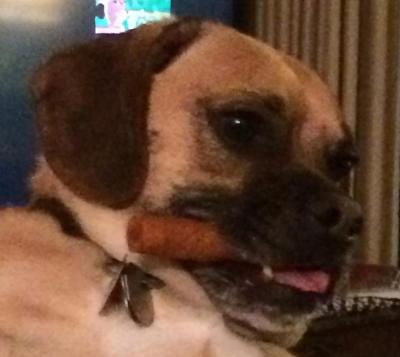
Contrary to his anthropomorphic name, Mr. Fehrley was nothing more than a dog who managed to carve out a prominent role in our lives, our family, and a prominent and permanent place on my list of best friends of all time. As painful as the shock and awe of his demise was to us, we all knew we would have to move on in life. As Franz Kafka once wrote, “Everything you love will probably be lost, but in the end, love will come back in another way.”

Denial, anger, bargaining, depression, and finally acceptance are the traditional stages of grief. Everyone grieves in their own way, and some of us go through reeling, feeling, dealing, and healing. In the dealing stage, we accept the idea that “Everything [we] love will probably be lost,” and that it’s the nature of existence for survivors to be left behind, but for some reason the math doesn’t make it any easier to sort through all of the messy emotions involved in trying to achieve the healing stage.  

We’ve all experienced loss of loved ones, and as painful as the reeling stage is of it is, we know we’ll recover. We’ll never forget, but we will move on. When we make some strides to move through the reeling and dealing stages, the pain of routine takes its place. The immediate memories strike us during the reeling period, but when we encounter the little moments of routine, they can prove just as emotionally crippling in the healing stage.

We had a morning routine with Mr. Fehrley, a treats routine, the routine of the “bye-bye” car rides, the long walks to the fence, and the night routine. When the morning after arrived, it dawned on us that there was a gap in our being that we never knew existed until he filled it by resting between our legs on the ottoman. When the time for the other routines arrived, and the new dog didn’t respond with puppy-like glee, we realized that we made those routines so exciting. When the wound is still fresh, our routines of life feel just a little more empty, and boring. If we explain this to anyone outside our home, they might smile politely, and they might recognize the power of routine through those they have with their own dog, but they’ll never understand how important these little routines were to us.  

Mr. Fehrley was just a dog, but I never realized how affectionate he was. I never realized what a luxury it was to have a dog who always wanted to be around me, leaning on me, and touching me. I sit on the couch now, and no one leaps into my lap anymore. I go out to the backyard, and no one wants to join me, and no one even notices when I’m gone. I return home, and no one is overjoyed to see me. These are but examples of what a dog can add to a person’s life, and if the reader has a dog who is so affectionate that it can be annoying at times, I tell you to appreciate it for what it is. It doesn’t last forever, as we all know, but we should all take a moment to create a memory we’ll wish we created when they’re gone. 

We had a basketball routine. Every time we went to play basketball at the park, we almost always brought Mr. Fehrley along. Mr. Fehrley stayed on the outskirts of court, sniffing everything available to him, running in circles for no apparent reason, peeing, pooping, and playing with imaginary friends.

“Aren’t you afraid he’ll run away?” an observer asked when he noticed that Mr. Fehrley wasn’t leashed, and that he stayed within certain parameters. There was no accusation or condemnation in the man’s voice. He was in awe of the discipline Mr. Fehrley displayed by not running off. 

“He ran off before, numerous times, and we had a number of reactions. One of them was to leash him up. Another was to take him home and not take him on such outings again for a while. After a number of these incidents, he learned that if he wanted to go along with us and remain unleashed he would stay within certain defined parameters.”

It might seem far-fetched to say that a dog can learn lessons in this sense. Most people don’t think a dog can associate not going out with us as a punishment for a momentary, small transgression. Most people don’t think a dog could make that type of connection, especially when an amount of time between outings occurs, but I’m telling you, as I did the observer that day, Mr. Fehrley did make those connections.

A friend of mine once said, “A dog spends their whole life trying to make us happy.” Based on the actions and behavior of my dog at the time, I disagreed with her. Mr. Fehrley taught me that he learned when we’re happy, he’s happy. Mr. Fehrley was a bright dog who learned his lessons well. He was, by far, the best dog I’ve ever owned.

“My dog would never stay like that,” this observer added. “You give him an inch of freedom, and he strives to take a mile.”

The initial instinct is to regard that comment as a compliment to the manner in which I raised and trained Mr. Fehrley to stay within imposed limits. If I didn’t train him to learn those imposed limits, through repetition, I wouldn’t have been able to do half of the things I did with him. I would’ve had to leave him at home in the manner everyone else leaves their dogs at home when they go out to do such things. Yet, when a dog passes away, and the cavalcade of emotions penetrates all of our vulnerable nerves, we think back on these conversations, and we wonder if we trained him so well that we trained him too well. Did we deprive him of some initiative, and did we inhibit some of what it means to be a dog?   

I initially thought the reeling stage would be the most painful part, but as with the progression of a physical injury, the healing stage proved almost as painful as the reeling stage. The realization that all of the routines we built up for ten and a half years were over proved to be one of the more painful elements. 

We had our little fella for a glorious ten and a half years, so it would prove difficult to appreciate him to the level I wish I would have every day for that long, but I regret some of the moments when I could’ve appreciated him more. Weather permitting we took this little 33lb, Puggle everywhere we went. Friends laughed at us for feeling guilty on those occasions when we had to leave him at home alone. Someone once said, “When I die, I want to come back as your dog.”

As happy as Mr. Fehrley was, and we provided him a fun, full life, I wasn’t spared the road of regret I feel that I took him for granted in some ways.

***

Justanswer.com suggests that there are approximately 68 million domesticated dogs fulfilling families in the U.S. alone. Even if we wonder how they arrived at such a figure, we all know that the figure is very high. What role do these dogs play in all of these households? Visit a home without children, and the dogs’ roles tend to play a more prominent role in that household. Even in homes with children, however, dogs play a prominent role. As kids love their dogs as much as adults do. Most of us love our dogs almost as much as we love our children, but we might never know the prominence they have in our lives until they’re gone.

If you’re anything like me, one of the first things you do when you enter someone’s home is seek out their dog. If you love dogs that much, you’re bound to encounter a dog you don’t enjoy. Some say they’ve never met a dog they didn’t like. I’ve met two. I thought their owners, guardians, or whatever people prefer to call human companions were relatively nice people. I later found out I was wrong, and I realized that our relationships with dogs tend to be symbiotic in that a dog can define a person in some ways, and a person can define a dog in some ways. Our personalities rub off on dogs, and their personalities rub off on us.

How much time do we spend around our dogs? How much time do we spend playing with them, talking to them, petting them, taking them to parks for walks, and everything else to shape and mold them? Dogs notice things. They pick up on behavioral cues, patterns, and routines, and they learn how to behave to get along with us better. If we say hello to everyone we encounter in a park, for example, they will too. If we’re confrontational people, our dogs might be more confrontational. How often do our neighbors have to raise and develop crazy dogs before they realize they’re the problem? 

Have you ever met a neighbor you initially considered relatively stable and friendly, only to find out their dog was out of control? Did it shape how we viewed that person? There’s usually a reason a dog is so out of control, and when we find out that that neighbor has another side to him, a nutty, out of control side, when he isn’t leaning over the fence for a chat, we learn to read our tea leaves better. We learn to pay more attention to their dogs. Our personalities help define our dogs, and they define us, and everything in between.

As we often say of those who pass, Mr. Fehrley died doing what he loved best. He died chasing a squirrel across a street. If you were lucky enough to know Mr. Fehrley, you knew that chasing squirrels was his joie de vivre (exuberant enjoyment of life), and he loved it so much that it became his raison d’être (the most important reason or purpose for existence). To deprive him of that would’ve been the more responsible thing for me to do, and I was warned, but I didn’t want to deprive him of that joy. 

Years prior, I saw a junkyard dog check both ways before crossing the street. The junkyard dog was everything you’d imagine. It had various sores, patches of hair, combined with some spots of mange and bald spots, and it also walked with a noticeable limp. I never saw a dog check both ways before crossing a street before, and I considered hilarious at the time. The more I thought about it, however, the more I considered it a little sad. This dog, obviously, had no one to protect it from harm. It obviously had to learn, from firsthand experience, how painful cars can be when they hit. The key to the junkyard dog’s survival involved checking both ways before walking across the streets cars drive on. Mr. Fehrley never checked both ways of course, because he didn’t know any better, because he never had to develop that survival skill. I did that for him. So, I could wallow in the misery that I forgot watch for him that one, fateful moment, or I could think about all the times I prevented him getting hit. Developing coping mechanisms such as this one help, as does having a family with which to share the pain, but when incidents like these happen, we all go through them alone. 

The Quest for the Great, First Sentence


This sentence, right here, is so difficult to write that it’s been known to cause stress, anxiety issues, depression, alcoholism, and in some prolonged cases even suicide. Why is the first sentence so important to writers? If that first sentence wasn’t intriguing or alluring in anyway, you might not be reading this sentence. The subject matter, combined with a great title, are vital to attract, developing a level of consistency will keep them coming back, but they might not read an article from the greatest writer who ever lived if their first sentence isn’t engaging enough to keep them wanting more. 

I wrote a great sentence once. After I wrote it, I couldn’t believe I wrote it. I kind of wrote it on auto-pilot, but when I was done, I took some time out of my day to stare at it and appreciate it. I was so proud. Wow, I thought, what a great sentence, and I wrote it. It can take writers hundreds to thousands of words to say what we want to say. Every once in a great while, we do it in one clear and concise sentence. When that sentence falls out of our head, no matter how hard we worked to achieve it, it almost slips out the witty womb.

The problem, I realized soon after I spent a minute appreciating it for what it was, was that that great sentence didn’t happen until I was all but done writing that article. I put in so much work into writing the article, that when the sentence arrived, I was mentally exhausted. Nearing the end of an article gives the writer as much a sense of completion as reading it does the reader. I’ve said what I wanted to say, and now…I’m…done with it. Wait a second, that was pretty good. That’s really good! 

As great as it felt to write such an incredible sentence, I felt like I was wasting it by putting it in the conclusion. Writers know that if we’re lucky enough to have a reader click on my article, most of them aren’t going read all the way through to the conclusion. With that in mind, I tried something revolutionary, for me anyway. I put that glorious sentence in the intro, and I rewrote the entire article to retrofit it. I rewrote an entire, 2,000 word article to show some sense of appreciation for whatever forces led me to create one great sentence. I also did it because great sentences don’t come along every day, and when they do, we need to build a proper shrine to them. Even though I worked my damn tail off to showcase this sentence, I’m still not sure if I paid it proper homage.  

***

Wait a second, I know what you’re saying about the difficulty of finding Great Sentences and all that, and the glory that follows, but you’re suggesting that I put a conclusion into the intro? “Is it a Great Sentence?” I understand, but don’t you agree that intros and conclusions have decidedly different feels and beats. “Is it a Great Sentence?” Yes, but certain beats and feels have a welcome mat feeling to them, some act as a quality bridge from on paragraph to another, and others just have a wrap up, parting feel to them. “Is it a Great Sentence? Just answer the question. 

“You get what I’m saying here, but your internal struggle will not permit you to put a conclusion into an intro.” It just feels like it would be breaking some kind of cardinal rule of writing to do so. “You don’t waste a Great Sentence by putting it in the back nine, and to every question you ask now, until the end of time, I’ll put, “You don’t waste a Great Sentence!” on repeat, in the manner of the refrain Chuck Palahniuk built for Fight Club: “You don’t talk about Fight Club!”    

The basic definition of a sentence is a string of words used to express a complete thought. There are only so many words an author can use in the English language an author can use to express a thought, some guess that that number is somewhere below 800,000. So, how does a writer achieve the difference between a proper sentence and a great one? It’s an impossible question to answer, as it’s so relative to the subject matter, the goal of the piece, and the manner in which we build a shrine to it after it occurs to us. The difference, in my humble opinion, is more clever than humorous. Humor is great, and it makes your article engaging and memorable, but clever, unique, insightful, and provocative are the crown of the realm. If you can achieve all that with a sharp level of brevity, the world will click a path to your door. “Brevity is the soul of wit,” as the bard once wrote. Seven words is better than eight, and if you can accomplish a profound, provocative point in fewer words all the power to you.  

Your definition of a Great Sentence you wrote is no better than mine, and vice versa. It’s not a competition. It’s an internal excavation process. As opposed to most other areas of life, I don’t view the creation of a Great Sentence in terms of competition. The best, and somewhat flawed analogy, I have for this is golf. 

I don’t know how anyone else analyses their frustratingly infrequent great shots in golf, but I don’t watch my shot thinking that, right there, was so much better than Larry’s. I just wallow in the glory of my great shot, and all of the horrible shots I took prior to that one won’t permit me to view that shot with any level of arrogance. All of the horrible shots I’ve taken in life have also beat me down to the point that it would be almost silly for me to think I might be a good, competitive golfer. I have had some really good shots though, and when they happen I might take a second to admire them, internally reward myself for finally getting one right, and I will then relive it as often as I can. 

There might be some level of competition in golf when it comes to comparing scorecards, but there are no members of a defense trying to curve that golf ball on the tee before we hit it, no one is trying to block our shot, and depending on how we golf, no one will try to tackle us to prevent us from getting to the ball. As with writing the Great Sentence, golf involves the struggle to synthesize the mind and body for the perfect hit. 

No matter how much experience, or training golfers and writers have, a great drive or putt, like a great sentence, surprises us as much as it does everyone else. We know when we hit it perfect, but if we knew how to perfect the mechanics of the shot, we’d do it every time out. 

A great sentence is a relative term, defined by the writer, as the perfect way of summarizing and synthesizing everything we want to say in a few words. It is also the payoff for all the hard work we’ve done leading up to it. When we put in all the hours of reading others’ works and writing our own, we hope that there will be some kind of payoff, or an ultimate clarification. Writing, or at least my writing, is as much about discovery as it is for readers, and the payoff for all the hard work I put into writing the article is that one Great Sentence that clarifies everything I was trying to convey, wraps it up, and puts what I consider a not too tart, not too sweet, Goldilock’s strawberry atop the pie.   

Some call the quest for the great first sentence, The Blinking Cursor Syndrome (cue the foreboding piano keys), others call it conquering the blank page and punching the plain parchment. It is a block, but I think it differs from the infamous writer’s block. I think writer’s block is more a movie contrivance, a trope if you will, than a reality. It portrays the character of the story, who happens to be a writer, as a complicated genius, or someone who’s lost it. We do have to be sympathetic to moviemakers for it wouldn’t be very interesting to watch a writer write. It’s much more dramatic, complicated and intriguing to watch a writer who lost it or can’t find it. True writers, I think, write through blocks, but the difficulty of finding that great, first sentence is real.

The quest for a great first sentence proved humbling for even the best writers. They sorted through hundreds to thousands of words to find the best combination of words before they find something they think hits it just right. Some of the most seasoned writers talked about the difficulty of writing great sentences, and how if they write one great sentence a day, it’s a good day, and most of them figure that about 1% of the sentences they write are great sentences. If that’s the case, what percentage of that percentage proved great enough to be a provocative, engaging first sentence? Some of the most famous writers have admitted that they spent so much time trying to find that perfect combination of words to start a new book that they turned to chemical enhancement as an aide. Before we condemn this for what it is, it does make sense in that they’re trying to approach the material from a fresh perspective, even if it is an altered state. By doing so, they’re also admitting that they couldn’t find it in their normal state, something with which we can all empathize, so they sought the altered state for assistance. They must have had precedent for this, or why would they continue to do it?  

Even for them, the greatest writers who have ever lived, I suspect that the Great Sentences did not arrive in the early gestation periods of the birthing process. Every writer has probably arrived at a great sentence or two in the first draft, but it happens so rarely that they can’t remember it.

Great sentences, in my experience, arrive after the framework is complete. In the beginning, we’re reporters. “Just the facts ma’am.” We’re reporting research, or just reporting our idea. There’s very little room creative writing, until we reach a point where we’re somewhat satisfied with the foundation we’ve laid for our story. This part of our process involves self-imposed stress, anxiety, and whatever we have that drives us to get it right. Once that is accomplished, and we start the cumbersome, and never-ending process of editing, revising, deleting, and rearranging, we relax intomore creative and more emotive state of mind, until we achieve a perfect conjugal symbiosis of a physical and chemical peak that  produces life.

In the final stage, we’re done with all the work, and we think, “What’s the perfect way of wrapping all this up?” That search is so much more relaxed, and when that “Aha!” moment finally arrives, and the writer writes a sentence that could be one of the best lines they’ve ever produced, it can change the theme and the entire scope of a project. It can also lead us to believe that every hour we spent writing to that point was a waste, unless we use it to help us find a better story or article than the original one we wrote.

“Was it a Great Sentence?” I know it when I see it, and yes, that was a great sentence. “Then rewrite the whole article accordingly.” I was done though, or so close to done that I felt done. Now, you’re saying I should rewrite everything? “If you write it, they might read.”

The internet is a blessing and curse for modern writers, as we now have greater access to more readers than anyone in history. The curse is that everyone else knows that same luxury. How do we separate ourselves from the pack, that overcrowded pack, and write a quality article that attracts some attention? A remedy, as opposed to the remedy, might be to take that one Great Sentence you wrote and worked your tail off achieve and put it into the most attractive spot in your article, the beginning. 

The problem arrives after we supplant that first lede with the original conclusion, and we need to create a new conclusion. What would happen if we arrived at a better sentence in that second conclusion, better than the first? Should we supplant the new lede with this second conclusion? Should we rinse and repeat, in other words, and keep repeating this cycle until we have a 2,019-word article of overlapping conclusions? I’ve yet to encounter such a problem, but if my next, edited conclusion is better than my first, I would go back and do it all over again, as often as it works. This process doesn’t always work, of course. As I wrote, some conclusions assume too much to be quality intros, but I think that in the age of hyper AD-HD, internet readers, writers have to do whatever we can to attract readers and keep their attention, and this was but one way I found to do it when I was writing an article and I created one beautiful and intoxicating Great Sentence.