Scat Mask Replica V


Turtle Porn. We’ve all read reports from conservation biologists detailing the trials and errors involved in saving a “critically endangered species like the Yangtze Giant Softshell Turtle”. Some of us might view such a chore as thankless and not very rewarding financially, but for these people it’s a passion. Most passionate people have, at least, one or two stories to tell about moments they’ve experienced in their field that define their reason for being, what the French would call their raison d’être. Others spend their careers chasing such moments. For a conservation biologist, zoologist or anyone else involved in the field, the idea that they might one day play some role in saving a species would be that raison d’être. Reading the note in the accompanying photo, even the most casual observer can’t help but feel that passion coming off the plaque.

Courtesy Henry Doorly Zoo

Perhaps no story better illustrates the frustrations of working with animals in this manner better than the tale of Lonesome George. Lonesome George was a “Pinta Island giant tortoise who lived in captivity in the Galápagos for 41 years, as biologists tried to coax him into copulating with a female of a closely related species. His caretakers tried just about everything—they even considered showing him videos of tortoise pornography (though it’s not clear if that ever happened). But the 100-plus-year-old George just wasn’t in the mood. He died in 2012, taking his species with him.”{1}

Numerous testimonials from conservation biologists inform us that as common as these captive breeding programs are, they don’t work near as often as some might think. The frustrations of years of such failures probably lead to feelings of such hopelessness that end when the male Yangtze Giant Softshell Turtle finally violates the sanctity and purity of the female. When that moment happens with a critically endangered species, one can only imagine the euphoria that must occur in those observation rooms. Those involved probably lose all sense of professional decorum, as they begin unleashing all of that frustration by using crass words to describe the moment of truth. We can also imagine that they try to abide by a self-imposed governor placed on any displays of jubilation, as a viral video of such a celebration might cast the entire profession in an awkward light. We can also guess that colleagues in these fields try to hold one other in check by mocking and ridiculing those who get a little too excited. “Did you see Darren when the pandas started going at it? He was out of control. I bet he doesn’t get that excited in his own situations.” 

Baseball is boring. Anyone who has any appreciation of the history of baseball can’t help but feel nostalgic when they enter an old Major League baseball stadium. When we smell the peanuts, the hotdogs, and something we can only guess is the smell of age-old soda drying on the ground, associations between game and country come to mind. When we hear the crack of the bat, as the players take batting practice, we think of all of the great players who stood astride home plate waiting for their pitch. When the warmth of the summer sun hits us, we think of the associations most Americans have with summer and baseball, and it makes me feel a part of something larger. When the players take the field, we take some pride in knowing their names and a little bit about their history. We also know that every team has a scouting report on their tendencies, and that this will dictate how the opposing team pitches to them and plays them in the field. “It’s a chess match,” we tell our friends.  

In that first inning, we watch the best players in the game do battle, and we understand what the sportswriters are talking about when they write about the historic lore of the game. It’s an experience that anyone who hasn’t been to one of the older ballparks must experience for themselves. Those of us who have been to a number of them know this magical feeling. We see it, we feel it, and we get it. By the time the third inning rolls around, however, these qualities begin to wear thin. We’re not short-attention span types, but the game just isn’t one that can captivate an audience for three hours. It might have something to do with the uncomfortable seats, the pace of the game, or the awful concessions most baseball stadiums provide, but by the fourth inning most of us want to be anywhere else. By the time the sixth inning rolls around, the children around us are so bored that they’re screaming and few adults are still paying attention to the game. I’ve witnessed a grand slam to win a ballgame with two outs in the bottom of the night, and I saw an extra-inning, game winning home run to complete the cycle on another night, and I almost failed to calculate how historic those moments were, because by the time they occurred I was so bored I almost missed them. The baseball purists might not be, but anytime I think of hard-core fans, I remember something a hard-core race car fan said, “We watch the first five laps and the last five. No one I know watches all of them from the edge of their seat.”  

Eating your appetite. When we are younger, we eat anything and everything, all the time. Eating is just something we do when we’re young. Ask a teenager their favorite places to eat, and they will inevitably list off the top five fast food restaurants. They don’t appreciate the quality of food they eat. They just eat. They’re not especially hungry when they grab a sandwich en route to a meal. They just eat it. They eat while they watch TV, when they drive, and so they have something to do with their hands. When we’re young, we eat because we’re bored, because it’s there, and because everyone else is doing it, but we offset all of this eating with rigorous physical activity.

As we age, and our rigorous physical activity begins to slow as much as our digestive system does, we limit our eating. Some of us start by eliminating snacks, or we change our snacks to healthier fare. Some of us even go so far as to eliminate entire meals, so that we’re only eating once, or twice a day. By doing so, we make mealtime an eventful moment of our day, and for some it becomes the most memorable moment in a given day. Then we talk about past meals, and we labor over deciding future ones. “What are we going to eat?” “Where are going to go?” and “When are we going to eat?” We don’t know what we want to eat yet, but we want it to be tastier than the meal we had yesterday. We want something that might help make today even more special. Once we finish that meal, we are often disappointed, because it wasn’t as great as the other meals we’ve had.

We still talk about french dip we had the other day at the corner deli, and we use all of our creative skills to describe it, “I was literally and actively walking down the sidewalk, and I just happened to literally look up and see the sign Corner Deli. I didn’t think too much of it at the time, but then I literally ordered the french dip sandwich. You haven’t tried it? Oh, you simply must,” we say to the uninitiated. “The meat is so tender, and the au jus is to die for there.” Some of the young people at the table might listen to such observations, if they have nothing else to distract them. Some of them might even begin to mimic them, but no matter how they might react, they don’t care as much as we do. They just want this whole dining experience over, so they can do whatever it is they do to make their day eventful. For us, the meal is the event. “You don’t know how to eat,” we say to them to try to establish some level of appreciation in them. They might want steak, but it’s only because we place so much value on it.

If we grill the most beautiful, tasty filet mignon, a cow has ever produced for their nourishment, they might say, “It’s good,” after they search for a suitable response between shrugs, but they say it with the same emotions they say things like, “The grass is green, sky is blue, and I love you.” They may not even look at us when they answer, and they might not answer us at all, if we fail to inform them how rude it is if they don’t. To us, this is such a delicious slab of meat that we will remember it for weeks. We also think that, at the very least, people our age should treat it the same way, until we witness one of them eat a sandwich on the fly. I can appreciate it when Seinfeld says adults don’t lose appetites, but when one of my peers eats an apple on the way to the restaurant I don’t think that they’re ruining their appetite by doing so, but I can’t help but think they’re diminishing the event status of our meal tonight.

Literally and actively. The next generation has probably been twisting and turning the language to have others take them serious for as long as humans have been alive. The next generation is insecure and they don’t think anyone will take them seriously, or find their stories funny, because few people do at this point in their lives. I empathize with their plight for when I was a member of the next generation I always thought I was missing something. I didn’t know what it was, of course, but I thought I needed to add something extra to generate interest and/or laughter. For my generation, it was all about cussing. We relied on swear words, delivered in a confident rhythm, to give our stories provocative punctuation. I don’t know if the comparative prevalence of swearing in movies and TV shows makes it passé to cuss now, or if young people don’t cuss around me now that I’m old, but the young people I know don’t swear as often as we did.

The problem for them, as I see it, is how does one punctuate a story without swear words if they want to provoke a response from an audience? If they tell us a relatively common story about how they noticed that the stop sign of at the end of their block was upside down the other day, for example, they know that they won’t receive quality reactions if they tell such a story flat. They know they need to spruce it up a little. When my generation told such a story, we said, “I was walking down the street the other day, when I noticed the [insert the popular swear word of the moment] stop sign was upside down.” I don’t know if we felt compelled to add the swear words to acquiesce to the rhythms to which our peers were accustomed, or if we thought adding them would attach some gravitas to our stories, but we added them whenever and wherever we could. The special ingredients this next generation adds to their stories now are the infamous –ly words. Thus, the new way to add provocative import to one’s otherwise banal experiences is to add an adverb. “I was actively walking down the street when I literally noticed that the stop sign at the end of our block is now upside down.” I might pay too much attention to linguistic trends in the popular culture, but I’m curious about how such trends start, and what the user hopes to accomplish with them. The next generation obviously uses the –ly words to affect the rhythm of their stories, but I don’t think the words provide the provocative punctuation they seek. The only rationale I can find for adding these –ly words as often as they do, is that they seek to add gravitas to their stories in a way they might not otherwise achieve. When I listen to them, however, I hear the effort more than the story, and it distracts me so much that I can’t take them seriously.   

{1} https://psmag.com/environment/is-breeding-endangered-species-in-captivity-the-right-way-to-go

Falling Down Manholes


“Tragedy is when I stub my toe. Comedy is when you fall into an open manhole and die.” –Mel Brooks

I’ve never fallen down a manhole, but I have to imagine that it hurts. “Um, yeah,” Mel might say, “That’s what makes it funny.” So, to be truly funny, someone has to get hurt. “Well, you put it like that, it sounds sadistic. It’s not sadistic, it’s human nature. It’s the fuzzy line between comedy and tragedy that dates back to Aristotle and Ancient Greece.”

It might be a little humorous to see a faceless entity falling into a manhole on one of those video montages, but what if we know the guy? Does that make it funnier or more tragic, or is there a middle ground that reveals this unusual relationship between comedy and tragedy? If we find a tragic incident like that funny, what is funny, what’s tragedy, and what’s the difference?

Laughing at other people’s pain is just kind of what we do. We might not want to admit it, but in many cases it’s so funny that when someone calls us a heartless SOB, we can only laugh with acknowledgement. Is it our dark side coming out, or is it just human nature?

I’ve met the opposite, the few, the proud who don’t laugh, because they don’t think it’s funny. They don’t even smile or joke about it later. They’re not virtue-signaling either. They just don’t think it’s funny. One of the few I met was a first responder who she witnessed so much pain and sorrow that she no longer considered even trips and stumbles humorous. What’s the difference between a first responder and the rest of us, they run into a burning building, and we run away. There are very very few who would actually stand outside a burning building and laugh, but seeing another’s worst moment can be so shocking that some of the times we don’t know whether to laugh or cry, and laughter is our go-to. If we worked with tragedy as often as first responders, would it lead to a certain diminishment of this shock factor, or are those who deal with tragedy on a daily basis attracted to their professions because they are inherently more compassionate?

I’ve never seen someone fall down a manhole, but odds are against them falling clean, in the manner Yosemite Sam does, and most of them aren’t mumbling comedic swear words on the way down either. Most of them fear that they are going to damage something severely by the time they hit bottom, and that fear will probably produce blood-curdling screams. They might not have enough time to fear death, but anyone who has fallen from a decent height knows that it’s scary, and they probably aren’t going to be able to laugh about it for quite some time. The question is will we, the witnesses of the event, be laughing? If we weren’t there, and our only attachment to their incident is their harrowing retelling of the moment, will we be laughing? 

If our friend walks away from the fall with some superficial bumps and bruises, that might be funny, but what if he chipped a tooth? What if he took a nasty knock on the head, or broke an ankle? What if his injuries were so severe that he required first responders to free him? Does the severity of the moment, and the eventual injuries, align with the comedy, the tragedy, or does it brush up against our definition of the fuzzy line that we try to erect between the two to try to keep them separated?

Before you answer, think about how you might retell the story. When we tell a story, we might not always be looking for a laugh, but we want a reaction. To get the best reactions, standup comedians advise to always be closing. A great closing involves a great punchline of course. If punchline is the wrong word, how about punctuation, and what better punctuation would there be than adding that the subject of our story was forced to endure a prolonged hospital stay that involved tubes and machines to keep the victim alive? “They’re saying that the nasty knock on the head could leave him mentally impaired for the rest of his life?” That might be extreme, as few would find mental impairment funny, but where is the line or the lines of demarcation that define comedy and tragedy in this matter?

The initial sight of Jed lying at the bottom of the sewer might be funny, unless he’s screaming. What if he’s hurt? How can he not be? We laugh. We don’t mean to laugh. We don’t want to find this funny, but we can’t stop. Some of us might wait to find out if Jed’s okay before we laugh, and some of us might wait until he’s not around, so when we can retell the story of his fall and laugh with others. Most of us will laugh at some point though. It’s our natural reaction to something tragic.

Laughing, or otherwise enjoying, another person’s pain is so common, that the Germans, developed a specific term for it: schadenfreude. Is our laughter fueled by the relief that it’s not happening to us, is it human nature, or is it the result of comedies and comedians molding our definition of what’s humorous by twisting dark, tragic themes into something funny? The advent of slapstick comedy occurred long before we were alive, but I don’t think anyone would argue that comedy has grown darker and more violent over the decades. We now consider some truly brutal acts hilarious. Have comedy writers changed our definition of humor, or are they reflecting the changes in society? It’s an age-old question. Would the Abbot and Costello fan consider it hilarious if someone fell in a manhole, what would the Mel Brooks fan think, or a Will Farell fan? Are such incidents funny in a timeless manner, or have comedians upped the ante so much, and so often, that our definition has darkened with it? Whatever the case is, incidents such as these reveal the relative nature of humor, the fuzzy line between tragedy and comedy, and how we find comedy in others’ tragedies. The purposeful melding of the two even has its own genre now: tragicomedy.

Emergency: Tongue Stuck on Pole

My personal experience with the fuzzy line between comedy and tragedy, didn’t involve falling into a manhole, but licking a pole. I was in the fifth or sixth grade, old enough and smart enough to know better, but young enough and dumb enough to do it anyway on one of the coldest days in February. I wasn’t old enough, or sophisticated enough, to consider the fuzzy, philosophical line between comedy and tragedy, but I knew everyone would be laughing uproariously if they saw me stuck on that pole. I also knew an overwhelming number of my classmates would not share a “Well, at least you’re okay” sentiment when it was over. I knew this wasn’t one of those types of mistakes. I didn’t know a whole lot about human nature, but I knew how much we all crave stories of pain and humiliation, because I did. I laughed harder than anyone else when Andy walked into a pole, and he hit it with such force that the impact broke his glasses in two. I just happened to be in the perfect position to see the incremental progressions of Andy’s instinctual reactions. I saw Andy’s eyes close on impact, followed by the scrunched expression of pain. In the midst of my laughter, Andy’s face turned from pained to embarrassed as everyone else attempted to soothe and coo him back to respectability. Andy’s embarrassed expression focused on me, the only person laughing, and I couldn’t stop. When his embarrassed expression evolved to one pleading me to stop, I just walked away, because for reasons endemic to my evil nature his mental emotional pain proved more hilarious to me than the physical.   

Some might call it heartless, others might suggest that anyone who would even smile at such a thing is lacking some levels of compassion, but I think it’s just kind of who were are and what we do to one another, and we don’t always do it with malice either. Some of the times, we laugh because that’s just what we do. 

I didn’t stand there and think about all this while stuck in the moment of course. The only things I thought about were how am I going to rip myself free and how much is it going to hurt? When I thought about the physical pain, though, I knew it would pale in comparison to the emotional and mental anguish that would occur soon after someone saw me like that. I ripped my tongue off the pole. I don’t remember exactly how long my it hurt after I ended up ripping several layers of my tongue off, but it hurt so bad that I thought I should’ve given more thought to an alternative. I also thought that even if I went on to accomplish historically great things, and I came back to my grade school to meet my classmates, one of them would’ve said, “Weren’t you the guy who was stuck on a pole when we were kids?”

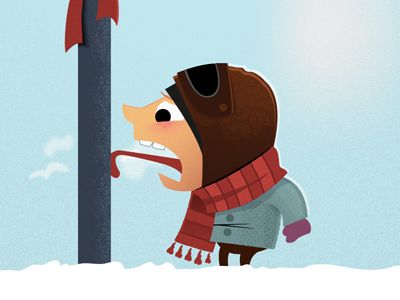
I’ve since read local news stories of other kids stuck on a pole, and they always include a photo or a video of the kid from The Christmas Story in it. One of these stories involved a kid notifying his teacher, and the teacher, who presumably failed to consider the idea that a warm cup of water could free the kid, ended up calling first responders to set the kid free. I still cringe when I put myself in that kid’s place, and I think of all the people standing around this kid. I cringe when I think about the teachers who would never forget this incident, and while they may have been more compassionate in the moment, they probably couldn’t help but laugh behind a hand every time they saw him. This information would’ve eventually filtered out to the students, because how many times does a big old fire engine pull up to a school, and when it does everyone would want to know why, and someone would find out. The first and last question I’d have for this kid if I ever met him is, what were you thinking?

I have to imagine that this victim was either much younger than I was at the time, or that the severity of his incident was much worse. For if all of the circumstances were even somewhat similar, then I have to ask him why he didn’t just rip themselves free? My empathy goes out to him if he feared how painful that would be, but he had to consider all the ridicule, teasing, and bullying he would endure in the aftermath. Even if he feared the pain so much that he wanted an adult to come along and find a less painful solution for them, I would love to ask him if it was worth it. 

Does getting a tongue stuck on a pole compare to falling down a manhole? It does not, when comparing the possible injuries, or other painful consequences, but I would submit that it does when it comes to the probability of embarrassment. I write that because the embarrassment of getting your tongue stuck to a pole has a storied tradition of humor, a tradition enhanced by the movie A Christmas Story. The humor is now an agreed upon universal, further enhanced by the relatively minor, but painful lessons attached to it.  

One of the first faces I pictured when I got stuck to that pole was Steve’s. I knew Steve would be waiting with bated breath for any details of my tragedy, and I knew his audience wouldn’t be able to restrain themselves from laughing at his displays of cruel and clever creativity. I didn’t know what nicknames or limericks Steve would develop, but I knew he would develop something. Steve was our class clown, and he was always developing material on someone. I considered all the excruciating pain I experienced in the aftermath of ripping off layers of my tongue off worth it for all the reasons listed above, but most of all I knew Steve wouldn’t have this material on me.

We’ve all heard talk show guests talk about how they were the class clown in their school. We all smile knowingly, picturing them as children dancing with a lampshade on their head and coming up with the perfect sarcastic responses to the teacher that even the teacher considered hilarious. When we hear this, we nod, because we figure he was the class clown, because no one gets that funny overnight. They explain that they discovered an internal need to hear laughter, by whatever means necessary, at a very young age. Those of us who knew a class clown, like Steve, saw some of this good-natured humor, but we also saw what happened when Steve ran out of good-natured and fun material. We all knew the minute Steve ran out of material, he would begin looking around for victims, and I was always one of his favorite targets. Anyone who has spent time around a class clown, or a group of class clowns, knows that their stock and trade involves insults. I didn’t spend ten seconds stuck on that pole, but picturing Steve’s mean-spirited smile, after delivering a dagger that had its tip dipped in this material was the image that consumed me and convinced me that I made the right decision later.    

We all enjoy making people laugh, but some of us have a deep psychological need to make people laugh, and they don’t care who has to get hurt in the process. Based on my experiences with class clowns, I can only guess that those who would fashion a career out of it, such that they were so successful that they ended up in a late night talk show chair talking about it, probably learned early on that no matter how you slice it, if someone falls down a manhole, or gets their tongue stuck to a pole, there’s comedy gold in there waiting to be excavated. They may be too young to know anything about the complexities inherent in the symbiotic relationship between comedy and tragedy at the time, but at some point they realized that anyone can get a laugh. To separate themselves from the pack of those vying for the title class clown, those who would use that title to future success in comedy learned that they would have to spend decades learning the intricacies and complexities of their craft, as everyone from the Ancient jesters to Mel Brooks did. They also learned that for all of the complexities involved in comedy, one simple truth they learned in fifth to sixth grade remains, if one wants to go from humorous titters to side-splitting laughter someone has to get hurt.

Stuff Stuck in the Orifice: The 2018 Edition


My guess is that human beings have been jamming foreign objects so deep in various orifices that we require assistance throughout our history, but we didn’t have a Consumer Product Safety Commission’s database catalog them until recently. We also didn’t have writers like Barry Petchesky from Deadspin.com condense that database of emergency room (ER) visits to entertaining bullet points until more recently. For most of human history, we didn’t know the luxury of having skilled professionals trained in removing such things for much of human history, so we can only guess that the cavemen who experimented in this manner paid dearly for their curiosity. We can also guess that these incidents, coupled with the threat of predators and their dietary habits, are all reasons that the cavemen worshiped the elder members of their clan who lived to fifty. I think everyone and their kids listened to this people, because they wanted to know their formula to living to fifty.

1) Petchesky’s select version of an otherwise lengthy database begins with the people who stuck things so far in their ear that they needed to go to an emergency room to have it removed. If the person who “Was cleaning ear with Q-Tip, accidentally walked into wall, [and] pushed Q-tip into ear” was a caveman, I don’t think he would’ve been one of the few to live to fifty. Whatever the Q-Tip of his era was, he would’ve walked around with it in his ear for the rest of his life, and it probably would’ve led to an infection that brought him down. Either that or he and his buddies might have developed some form of surgery to remove it, and he probably would’ve died during that surgery or from its aftereffects. 

2) The best “verbatim” quote in Petchesky’s summary, and he claims they are all quoted verbatim, is from an ER attendant who wrote, “Popcorn kernels in both ears, ‘feeds her ears because her ears are hungry’” in the ER report for the patient. The obvious question here is why would anyone use such a line to explain their situation? The less obvious and more humorous question is why would ER personnel write that into their report? How much grief did they have to deal with after writing it?

Anytime a person involved in the field of medicine writes such a report, their professional reputation is on the line. Attending physicians, insurance company agents, and fellow ER personnel read these reports, and I’m guessing that attempts at humor do not go over well. Years of training have shaped such reports in this manner, and all ER personnel know they could get fired by sprucing them up for entertainment purposes. It’s their job to stick to the facts when they write these reports, and their only defense to the interrogation sure to follow is, “That’s a direct quote.” We can also guess that the ER attendant asked the patient if they want to revise their characterization of the incident. “Are you sure this is what you want going into your final report? A number of people are going to see this, and they’re going ask both of us a lot of questions.”

3) Another thing that struck me throughout this report is how do people fit such things in their ear? I’ve never tested the capacity, or threshold of the orifice leading to my ear canal, but I’ve seen the toy mouse, and I have to imagine that getting it in so deep that they required a medical procedure to get it out required a great deal of time and effort on their part. They might also walk out of the ER saying something along the lines of, “I really need to find a hobby or something to fill up some of my free time.”

4) In the nose section of this report, we encounter some incidents that we can lay at the feet of human error. We don’t know why someone would put a rubber band up their nose, but we can guess it involved doing some kind of parlor trick. As for the butterfly, the cotton ball, and the paint, these are all unusual things to have near the nose, but they’re not freakish. My guess is Petchesky wanted to lay a relatively common foundation to build a rhythm for, “Sneezed and a computer key came out the right nostril, sneezed again and another one almost came out.”

Those of us who have viewed these lists for years now know that some people have a propensity for sticking unusual things up in their body. One thing to keep in mind throughout this list is not only did this person stick a computer key in their nose, but they stuck it so far up there that they needed someone schooled in medical procedures to retrieve it for them. Another thing we can speculate about, based on some of the items on this list, is that a greater percentage, if not all, of them didn’t go to the ER right away. They were probably so embarrassed by their action that they left it in there hoping that they might find a way to get it out themselves, or that it might work its way out in some more natural way. At some point, they realized that wasn’t going to happen, and they couldn’t live with the pain anymore. The way this person addressed their computer key sneezes, it sounds as if they are more accustomed to computer key sneezes than the rest of us are. The next logical question is, “How did they get in there?” Some ER attendants probably ask such questions, but some don’t. Those who don’t probably want to avoid pursuing the matter to avoid further embarrassing the patient.

5) Petchesky includes the “gum, gum wrapper, and gum in wrapper” incidents of things stuck up a nose as if they involved three separate incidents in emergency rooms throughout the country, but what if they weren’t. What if this prospective “America’s Got Talent” nominee managed to put all three in her nasal cavity in an attempt to outdo the friend who could tie a cherry stem in her mouth, but she was unable to extract the fruits of her labor?

6) The final one, listed under things stuck in nose is “piece of steak.” I file this one under simple human error too, because of the errors we all make while eating. We all make such mistakes, and they’re always a little surprising when they happen. How many full-grown adults, with decades of practice chewing on things, still bite their lip or the lining of their mouth when they eat? How many of us still attempt to speak while chewing in a manner that opens our epiglottis in a way that causes us to cough and choke. Most of us are able to hit our mouths with whatever we put on the end of a fork, but with the ratio of eating to incidents, what are the chances that someone could miss so badly that they end up putting a forkful in their nose on accident? They’re remote, perhaps infinitesimal, but they’re not impossible. Perhaps this person was so engaged in conversation, while eating, that they went a couple degrees too far north. I understand that this particular person put it so far up that they required medical assistance to get it out, but we don’t know what their conversation was about either.

7) The first item on the list of things stuck so far down the throat that it required medical assistance is banana. I know what happened here, because I’ve been that guy who was so habitually tardy that my job was on the line. I’ve woken up, while on probation, with so few minutes to spare that I dressed, grabbed my keys and my wallet and rushed out the door. I’ve been so late that I accomplished whatever rudimentary grooming I needed in the car, on the road to work, and I’m sure it showed. Buttoning a shirt eats away precious seconds on these mornings, so I don’t button until I’m halfway to work. I’ve even learned how to button with one hand while driving with the other. I don’t shower on these mornings, of course, so I have to follow the age old ‘spit on the hand and pat down whatever hair is sticking up’ on the road to work. In the midst of such mornings, we grab whatever quick food we can find and stick it in our mouth to shut the stomach up. For those of us who place ourselves in such circumstances, chewing is a luxury for those who have seconds on spare.

8) The next entry in the throat category is, “Throat lozenge still in blister pack.” How many of us have chewed on a lozenge at one point or another? We didn’t just swallow it. We chewed on it. I blame the manufacturer, because they package these lozenges in such pleasing colors that they look tasty. The first time this patient took a lozenge on his own, he chewed on it and consumed the foul liquid inside. When he informed the person next to them how awful the liquid tasted, the other person said, “You’re not supposed to chew on them. You’re supposed to swallow it whole.” This patient mistakenly conflated the word ‘whole’ to mean including the blister pack.

9) I’m guessing the person who swallowed the “mood ring” was depressed. I’m guessing that their lover dumped them, and that they believed in the mood ring’s suggestions to such a degree that when it suggested they should be happy, they internalized it to see if it could change their emotional interiority.

10) As for the items stuck in the male reproductive organ, we can only guess that the guy who stuck a pipe cleaner so far in so far that he required physical assistance to get it out, is a clean freak who never forgets to clean behind the ears. He probably uses a paper towel to open the doors of public restrooms. He probably soaps himself between the toes, and he has spent a lot of time searching for nooks and crannies that could become gross if left unattended, until he ended up in an emergency room.

11) The guy who had a straw reach an inextricable location in his reproductive system doesn’t understand the hoopla surrounding the anticipation portion involved in the act of love-making routine. Some find the moment before punctuation so exhilarating that they try to make it last for hours. This guy is one hundred and eighty degrees different. He and his lover tried to find a way to be more expedient.

12) We’ve all had lovers cheat on us, and we’ve all thought about the perfect way to exact our revenge. The guy who required medical assistance to remove six to seven BB pellets from his reproductive organ, decided that the next time he and his lover were involved, he was going to blow her head off.

13) The person who put a billiard ball in their rectum is a trick shot artist, and in the world of trick shot artists, there’s very little room for originality. Most trick shot artists are simply showing the world that they can duplicate the tricks Minnesota Fats and Willie Mosconi did fifty years ago. There is no room for originality in this world, because there is only so much one can do with ten balls and a pool table. This guy thought he was really onto something, but he failed miserably.

14) The poor patient who “sat down on the sofa and accidentally sat on a ball point pen,” only to have it lodge so far up his rectum that he required medical assistance is now suing the pen manufacturer. He doesn’t want any money. He is suing for one symbolic dollar to direct our attention to his primary goal of forcing the manufacturer to put a very specific warning on their package. His goal is an altruistic one, in that he doesn’t want others to have to suffer his (now very public) humiliation.

15) Amateur astronomer Gil Burkett’s excitement was understandable. He thought he was going to be famous. He thought he just discovered a new planet. He was so emotional that he couldn’t contain himself. He began jumping up and down, all over the place, screaming with joy. In his reckless and irrational exuberance, he landed on the “leg of a telescope”, and after he put some effort into extracting it, he realized it was so far in his rectum that he knew he would need medical assistance to retrieve it. If that wasn’t humiliating enough, Gil consulted four other amateur astronomy society websites, while waiting for the EMTs, and he found that a previous astronomer already named the planet.

16) The first time we introduce some intoxicants to our system, we will receive the greatest high we will ever experience with that particular intoxicant. Every drug effects our system differently, but from what I’ve read on the subject, that first high is almost impossible to reproduce for some of them. Most of us either don’t know that, or we don’t consider that when we attempt to reproduce that first experience. We fall prey to the notion that if we do more, it won’t just reproduce it, it might outdo it. Drug users refer to this pursuit as chasing the dragon.

Firsthand knowledge eventually teaches us that in the interactions between body and intoxicants, more is not always more. After we reach this depressing conclusion, we seek alternative routes to the great high. Some who enjoy intoxicants gain some education in their pursuit of a great high. They learn basic knowledge of nutrition, as they seek to replace what their drug of choice depletes, they learn about chemistry, and they learn a surprising amount about their biology. They learn, for example, that the various ways of taking their drug of choice orally allows the liver to distill some of its impurities. The liver does this to protect the body, of course, but some of those impurities can increase feelings of intoxication. By one way or another, we learn that taking an intoxicant through the rectum is a way to circumvent the liver. In their quest to utilize that alternative route, and achieve their greatest high ever one patient “pushed drugs up rectum using a lighter, was able to retrieve the drugs bag yet believe lighter got stuck.” Another person, “Took a soda bottle with Fireball whiskey via his rectum, stuck bottle in rectum and squeezed.”

17) We can also find some elements of this pursuit in those who use sexual toys. When users upgrade to larger toys or pursue greater depths, they seek to achieve the arousal they probably experienced the first time they experimented, or they try to outdo the last time. This is probably what happened when Neil stuck a “vibrator in rectum and tried to remove it with screwdriver and lacerated rectum; object in colon now.” He probably tried to outdo previous experiences with his toy, when he discovered the painful difference between far, farther, and too far.

18) Neil’s dilemma also brings to mind a nagging question I had reading through this list. I understand that no one would be on this report if they didn’t require medical assistance, but how much effort did they put into removing these items themselves? We’ve all met people who aren’t embarrassed easily, and they seemingly have no problem telling another person “they got a toothbrush stuck in their rectum after jumping on the bed.” If you’re sitting next to such a person in the waiting room, and you ask them why they’re here, these types provide far more information than you care to hear. “Aren’t you embarrassed?” you ask them. “Well, why are you here?” they’ll ask you in reply. No matter what you say in response, they will respond, “Aren’t you embarrassed?” They will tone their response with a whole lot of sarcasm to mock you and your original question. You could tell them that you fear you’re exhibiting early signs of the Ebola virus, and they would still respond in that sarcastic manner, to imply that the reasons the two of you are in there, are more similar than you ever considered.

Readers perusing such a list can’t help but place themselves in the shoes of the victims in such scenarios. It’s difficult to imagine us doing some of these things, of course, but if we did, what would we do? Most of us would be so embarrassed that we would do anything and we could think of to avoid the embarrassment of having to look people in the face, while telling them what we’ve done. We don’t know how much physical pain we would be willing to endure to avoid it, but we would probably test our threshold. We would likely consider that pain secondary to the painful embarrassment of telling another person what we did. We all know that doctors, nurses, and various other ER personnel probably see more in one month than most of us will see in a lifetime, but they’re people too, and in their off hours, they surely think this stuff is funny. They probably say something along the lines of, “Oh yeah, the job is incredibly stressful, long hours, and all that, but there are some moments. There are moments that make it all worth it. Just the other day, there was this one guy who …”

Neil and I probably share the “I don’t ever want to be that one guy who …” mentality. Neil probably said something similar to himself before reaching the point of desperation where a screwdriver appeared to be a reasonable solution. “This thing is coming out!” Neil probably said with visible determination.

How many hours of digging and painful scraping did Neil have to endure before finally realizing he was doing more harm than good, and we have to think of this in terms of hours, because the thought of leaving something as large as a vibrator in there for days is unimaginable and anything longer seems so impossible that its unfathomable. Would Neil be able to find a pain-free way to sit in his office chair, if some of it is sticking out, and we have to imagine that some of it is sticking out. Would he be able to find a way to deflect questions if this dilemma lasted for days? As cringe-worthy as these questions are, we also have to factor in all the scraping Neil did in his efforts to end this dilemma. How early on did the idea of removing it with a screwdriver hit Neil? If it was the first day, we have factor that into the equation. He may not have lacerated the walls of his rectum, for that probably didn’t happen until his embarrassment and the resultant frustrations got the best of him, but we do have to factor this into Neil’s dilemma.  

One other question I have on this subject is, did the ER attendant have to inform Neil that the item in question reached his colon, or did Neil already suspect as much? Neil obviously knew the item was irretrievable, or he wouldn’t have lacerated his rectum, and he wouldn’t be in the ER, but was there a particular sensation he felt when it reached another level? Did it feel like the item reached a shelf beyond his reach?

19) The guy who put a “significant amount of string” so far into his rectum that he couldn’t get it out without assistance is another curiosity for me. Was this just another boring Tuesday for him, was he measuring his depth in Mark Twain fashion, or was he desperately constipated? If I were the ER attendant on staff, I think my curiosity might overwhelm professional discipline. Once we worked our way past the procedural Q&A’s, I would have to ask him why he stuck so much string up his rectum. The two of us could probably chalk “a little string” up to an embarrassing and perverse curiosity, but I would have to know what drove him to continue past those levels to one we both agreed was significant.

I also wonder about the process involved in the word ‘significant’ making it into the final report. If the ER personnel see as much as these reports suggest they do in one year, I’m guessing that superlatives to describe such incidents almost become passé over time. The words, “If you think that was as a lot, you should’ve seen what I saw last night” probably get passed around ER break rooms all the time. ER personnel probably grow so competitive in this unspoken manner, over time, that they become reticent to introduce adjectives like “a lot” when describing the amount of blood they saw, or the word “unusual” when describing a smell coming from some organ, because they know their peers will call them out on those adjectives. That peer pressure likely effects the manner in which they write reports over time. Thus, when they find some string, they simple write “some string” to provide a succinct description of what they’ve found. When they find “a lot” of string, they probably don’t have a personal or professional measurement to distinguish it from “some” string, but they know it when they see it. With that in mind, how much string do seasoned veterans of emergency rooms have to find in a rectum before they allow the words “a significant amount of string?” into the final report? Barry Petchesky’s list of reports the Consumer Product Safety Commission’s database does not provide clarity in this regard, but my guess is that the addition of the word significant is an indicator that we’re no longer talking about inches here but feet, and likely yards. If the ER patient declared that a significant amount string was in his rectum, we can guess that the ER attendant probably checked him. “I’ve witnessed a significant amount of string before, and trust me you likely don’t have that much in there. Why don’t we just write “a lot” for now, and we’ll address the verbiage later.” I don’t know how much editing goes on in the process, or how vital the terminology would be in such a case, but I’m guessing that most emergency rooms undergo a number of unofficial and professional series of checks that occur before a medical report ends up on an insurance agent’s desk. At this point, we can guess that the operating doctors and nurses have their say, based on their own individual experiences, before the description “a significant amount of string” ends up in the final report. If everyone agreed that it was a “significant amount of string”, we can also guess that in post op, some wisenheimer dropped some joke about magicians pulling handkerchiefs out of their pockets.