To those, like me, who have lived their whole life in America, we take it for granted that America is the envy of the world. Some might view this as propaganda, some sort of hype, or marketing tool that America has generated on a false premise. America does have her faults, of course, for it is and always has been run by, and for flawed humans, but if you’ve ever run into a first generation American who knows how flawed humans running a country can be. They might even paraphrase Winston Churchill by saying, “America might be a horribly run country, but it’s better than anything else we’ve tried.
One thing that I think that should put naysayers, and those of us who might take America’s place in the world for granted is that it didn’t have to go this way. A couple of elections here and there might have changed the course of the country dramatically.
There have been times, in our nation’s history when we needed a strong man who played with a bold hand at times and a soft touch in others to solve the country’s problems. Some would argue that no one did both better than Abraham Lincoln did during his tenure in office, in his quest to end the Civil War and slavery. There have been times when our nation laid in the balance, and we needed a Lincoln to come along and do what he could to preserve what George Washington, John Adams, and all The Founders envisioned. There have been other times, times far less documented in historical records, when our nation needed a humble leader who displayed restraint in times of national scandal and turmoil.
Whenever we talk about the history of America, we usually focus on Lincoln, The Founding Fathers, the Roosevelts, and the rest of the more prominent presidents who have shaped our country in profound ways, but there are many lesser-known presidents who have affected the nation in various, individual ways. If Lincoln lost his bid for president to Stephen A. Douglas our country might be very different. If Grover Cleveland lost his bid for re-election to Benjamin Harrison a second time in 1892 would our country be different? In what ways would the country be different if Calvin Coolidge lost his bid for re-election to John W. Davis? Some argue that no American legislation, and no executive orders are set in stone, and they can be righted, or sunk, by subsequent administrations. While that is true, there is the matter of precedent, and there is the question of how much damage could be done in the interim. If Lincoln lost to Douglas, and the Civil War and slavery lasted beyond 1865, how much further damage would’ve occurred in this country without the skilled Lincoln at the helm? Some of us might argue that America isn’t as great as others suggest, and that it never was, but if Lincoln lost his election, it’s likely that there wouldn’t be a United States as we know it today.
Were it not for the statesmanship restraint displayed by a Calvin Coolidge, we might be a less free nation. Quiet, obscure presidents, like Coolidge, quietly vetoed legislation and exhibited restraint throughout their tenure. Restraint, vetoing legislation, and acting in a manner to preserve individual freedoms is less sexy than winning wars, ending slavery, or passing sweeping legislation and pressing the thumb of government on the throat of individuals and businesses for the purpose of helping other people, but the imprint it left might be just as profound.
Our nation’s history is composed of the strong, Lincoln types and the quiet, Coolidge types who have shaped our country in unique ways, and on this President’s Day I thought we should all be reminded how we came to be the nation we are today, through the more obscure presidents (and Lincoln) that helped guide us to modernity.
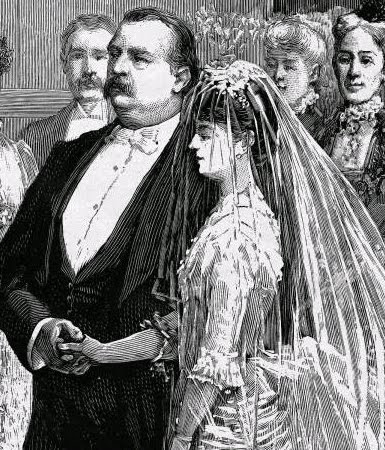
1) Stephen Grover Cleveland (March 18, 1837 – June 24, 1908)
The 22nd and 24th President
Cleveland was a Democrat who served the American people from 1885–1889 and 1893–1897 in non-consecutive terms. President Grover Cleveland was the only president to do so.
Stephen Grover Cleveland was one of three presidents (Jackson, FDR) to win popular vote for president on three different occasions, but he lost, in the second election, to Benjamin Harrison in the Electoral College tallies. He was the only Democrat to defeat a Republican for office during the period of Republican domination that dated back to Abraham Lincoln’s first electoral victory. He was the second president to marry while in office, and the only president (as depicted above) to marry at the white house. During his tenure, he and the Republican Congress, admitted North Dakota, South Dakota, Montana, Washington, Idaho, Wyoming, and later Utah to the union. His last words were “I have tried so hard to do right.”{1}
Ronald Reagan may have been the president who “tried to give the government back to the people” but some argue that Grover Cleveland was the first of two presidents of the 19th and 20th centuries –Calvin Coolidge being the other– to accomplish the feat. By the time their tenure ended, the size and scope of government was more limited than when they began their terms.
Others spoke of limiting the size of government, and the others failed. Cleveland’s first goal was to end the spoils of the political system. He did not fire the previous administration’s Republicans who were doing their job well, but he cut down the number of federal employees, and he attempted to slow the growth of what he perceived to be a bloated government. He attempted to always place appointments in positions based on merit, as opposed to the usual spoils system that dictated position holders in previous administrations. He also used his veto power far more than any other president of his day. Although Cleveland was a Democrat, he was one the few who sided with business. Cleveland opposed high tariffs, free silver, inflation, imperialism, and subsidies to business, farmers or veterans. His little battles for political reform and fiscal conservatism made him an icon for American conservatives of the era. Cleveland’s reform ideas and ideals were so strong and influential that a reform wing of the Republican Party, called the “Mugwumps”, bolted from the GOP ticket and swung to his support in 1884.

2) Abraham Lincoln
The 16th President.
Lincoln was a Republican who served the people from March 4, 1861 – April 15, 1865.
Abraham Lincoln, it could be said, is our most famous president. If one were to chart fame by the number of books written about an historical figure, Lincoln has had more books written about him than any other president. By some accounts, he has had more written about him than any historical figure alive or dead save for Jesus of Nazareth.
His fame is derived from serving as president during The Civil War, and the fight to abolish slavery. Lincoln’s fierce abolitionist views were so well known that some suggest that his election victory led the South secede. He used a heavy hand in some cases, such as the unconstitutional suspension of habeas corpus, and he used a deft hand in his attempts to end slavery. Fierce abolitionist Frederick Douglass viewed Lincoln with impatience initially. Douglass favored a firm hand. He wanted to, by whatever means necessary, quickly obliterate, on moral grounds, the Democrats who opposed ending the institution of slavery. As we discuss in another article on this specific topic, Douglass eventually saw the errors of that method. Ronald E Franklin characterizes Douglass as eventually, “Celebrating Lincoln as the perfect, God-appointed man for a task that, had the abolition of slavery been his first priority, he could not have accomplished.” This other article provides the full breadth of Douglass’ characterization of Lincoln’s political maneuvers.
We now have a number of definitions of Lincoln’s motivations, but James Buchanan’s mismanagement of a decades-old disaster landed on President Abraham Lincoln’s desk soon after he took office. The country rested on a precipice of tearing apart. If Lincoln was too firm, he might have lost the country, and thus any sense of a mandate, if he was too soft, he might have lost The South. History will probably argue his tactics until they lay our great-grandchildren to rest, but through compromise and subtle, brilliant maneuvers, Abraham Lincoln managed to both end slavery and save the union.
In the Washington V. Lincoln debate over who was the greatest president, the tale of the tape for both is long and mighty. In my personal opinion, Washington is given too much credit for being the first to set such and such a precedent. Washington was, indeed, a great leader of the country, but he was the first president, so I think we give him too much credit for setting precedents.
Quick Quip: Democrat rival in the 1960 election for the President Stephen A. Douglas once called Abraham Lincoln two-faced. “If I had two faces,” Lincoln replied, “do you honestly think I would wear this one?”{2}
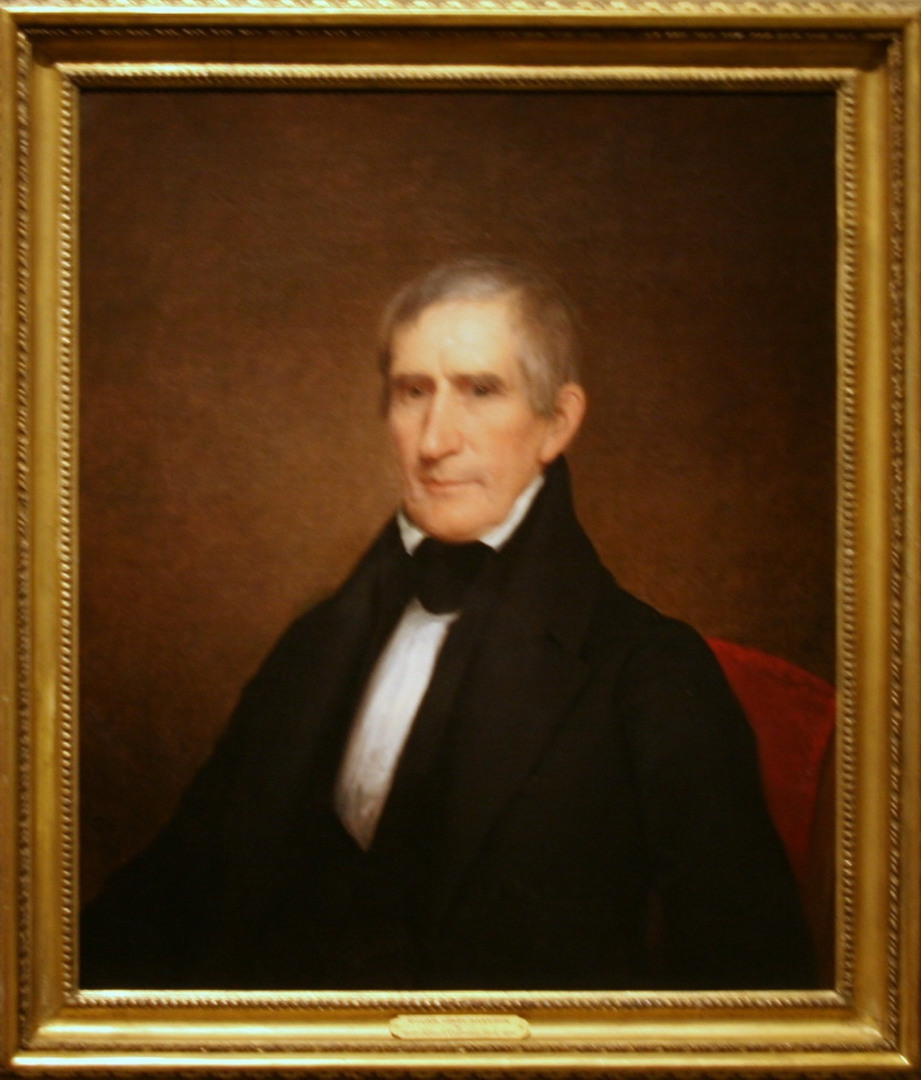
3) William Henry Harrison
9th President
Harrison was a member of the short lived Whig party, and he served the people as president from March 4, 1841 to April 4, 1841
William Henry Harrison is most famous for dying after serving one month in office as president. He took the oath on a cold and rainy day, and he refused to wear a coat or a hat. He also rode into the inaugural on horseback rather than in the closed carriage that had been offered to him. He then proceeded, after the oath, to deliver the longest inaugural in American history. It took him almost two hours to complete it. He then rode away from the inaugural on horseback. Some believe that this reckless regard for his health brought on the illness that his sixty-eight year old body could not recover from, but historians make note that the illness did not set in until three weeks after the inaugural. Regardless how he contracted the cold, it progressed into pneumonia and pleurisy. His last words presumed to be to his successor John Tyler were: “Sir, I wish you to understand the true principles of the government. I wish them carried out. I ask nothing more.” {3}
Quick Quip: There was some debate over whether W.H. Harrison’s 8,460 word inaugural address (the longest in history) led to his demise. Harrison refused to dress appropriate for the forecast cold rain, or follow any of advice of those concerned with his well-being. As a result of his demise, Harrison’s grandson Benjamin Harrison, made sure his own inaugural was a little over half what his grandfather’s was.

4) Martin Van Buren
8th President
Van Buren was a Democrat that served the people from March 4, 1837 to March 4, 1841.
Van Buren is regarded, in some quarters, as the father of the Democrat Party, even though Andrew Jackson was the first Democrat to be elected president. He was the first individual born as a U.S. citizen to be elected president. He was the first non-British, non-Irish man to serve as president. He was Dutch. He was also the first self-made man to become President: all earlier Presidents had acquired wealth through inheritance or marriage, while van Buren was born into poverty and became wealthy through his law practice. Van Buren’s presidency was marked by a depression, named the panic of 1837, that lasted throughout his presidency. As a result of this, Van Buren issued a statement that is also famous regarding his tenure as president: “As to the presidency, the two happiest days of my life were those of my entrance upon the office and my surrender of it.”{4}
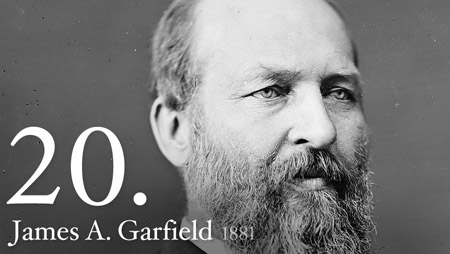
5) James A. Garfield
20th President
Garfield was a Republican that served the people from March 4, 1881 to September 19, 1881.
Garfield was another president known, in history, more for his death, than his life, or tenure as president. Garfield was taken down by an communist assassin by the name of Charles J. Guiteau. Though Garfield only had four months of health while serving the people as president, he did manage to give resurgence to the president’s authority over Senatorial courtesy in making executive appointments. He also energized naval power, he purged the corruption in the Post Office, and he appointed several African-Americans to prominent positions. During the eighty days in which Garfield suffered through the cruelty of the assassin’s bullet, he signed one, single extradition paper. Some historians have suggested that Garfield may have been one of our most talented and eloquent presidents had he lived long enough to expose this to the nation, but he was able to serve the nation in Congress having served nine consecutive terms, and he was able to do what he could in the short time that he served as president. Candice Millard’s brilliant book Destiny of The Republic captures the essence of Garfield with the quote: “Born into abject poverty, he rose to become a wunderkind scholar, a Civil War hero, a renowned congressman, and a reluctant presidential candidate who took on the nation’s corrupt political establishment.”
Knowing his death was imminent, James A. Garfield’s final words were: “My work is done.” {5}

6) Benjamin Harrison
23rd President
Harrison was a Republican that served the people from March 4, 1889 to March 4, 1893.
Harrison is most notable for being the grandson of William Henry Harrison, and the man that defeated the mighty Grover Cleveland in the Electoral College vote in 1888. Harrison’s tenure was also famous for passing the McKinley Tariff and the Sherman Antitrust Act. He was also famous for allowing federal spending to reach one billion dollars. Harrison also advocated for federal funding for education, he was unsuccessful in that regard. He also pushed for legislation that would protect the voting rights of African Americans. The latter would be the last attempts made at civil rights in the country until the 1930’s. Learning from the after effects of a long inaugural, courtesy of his Grandfather’s record long speech that some believe led to his death, Benjamin Harrison kept his inaugural address brief. Though historians tend to disregard Harrison as a prominent president, they regard his foreign policies as laying the groundwork for much that would be accomplished in the 20th century. {6}

7) Calvin Coolidge
30th President
Calvin Coolidge was a Republican that served the people from August 2, 1923 to March 4, 1929.
Coolidge would not stand a chance in today’s 24-7 news network, internet definition of politics. In the current climate of celebrity presidential candidates climbing all over one another for more air time, a better sound bite, and a better image, “Silent Cal” Calvin Coolidge would have been run over. In this age of bigger and better governments, where politicians on both sides of the aisle try to flex their legislative muscle in bill signings that are celebrated media events, Calvin Coolidge signed legislation into law in the privacy of the office. In a quote that could be attributed to the current, progression of big government, Calvin Coolidge said: “The requirements of existence have passed beyond the standard of necessity into the region of luxury.” Calvin Coolidge would be a laughing stock in our day and age, a man on the outside looking in, a statesman that would’ve faded into the woodwork of our society.
Social critic and satirist Dorothy Parker once said: “Mr. Coolidge, I’ve made a bet against a fellow who said it was impossible to get more than two words out of you.”
Coolidge’s famous reply: “You lose.”
After hearing that Coolidge passed away, four years after leaving office, Parker remarked: “How can they tell?”
Although Coolidge was known to be a skilled and effective public speaker, in private he was a man of few words and was referred to as “Silent Cal” in most quarters. On this reputation, Coolidge said:
“The words of a President have an enormous weight, and ought not to be used indiscriminately.”
Although known as a quiet man, Coolidge participated in over five hundred press conferences during his 2000 days as president, that is an average of one press conference every four days. Coolidge took over the office of president after his predecessor’s death, amid his predecessor’s controversy, that was called the Teapot Dome Scandal. The Teapot Dome Scandal was regarded as the “greatest and most sensational scandal in the history of American politics” until the media discovered the Watergate scandal. In the wake of this scandal, Coolidge told a reporter:
“I think the American people want a solemn ass as a President, and I think I will go along with them.”
Coolidge may have been the last statesman the American people had to serve as president. He was against the Klu Klux Klan, for instance, but he didn’t make grandstanding statements against the Klan, he just didn’t appoint Klan members to positions in his administration. This may seem to be such an obvious move that it’s not worth discussion, but the KKK had a lot of influence at this time in America, and Coolidge’s move caused them to lose much of it. Coolidge tried to take this one step further, calling for anti-lynching laws, but the attempts to pass this legislation were stopped by Democrat filibusters. He attempted to make war illegal in the Kellogg-Briand act, but that law proved ineffective. Coolidge was a laissez-faire president who didn’t believe that the federal government should have a role in farm subsidies or flood relief. As much as he wanted to help these people, he wanted to avoid setting the precedent of the federal government resolving problems that he believed could better be solved, on a case-by-case basis, locally. By the end of his administration, he achieved a tax bill that had all but the top 2% paying no federal income taxes. Coolidge disdained federal regulation and appointed commissioners that followed his philosophy that believed in state’s rights, and this caused a divide in historical opinion of his administration.
Some believe that this laissez-faire approach led to “The Roaring Twenties”, others argue that it led to “The Great Depression.” As with all matters such as these, the opinions are based on where the historian lies on the ideological divide. Some historians say that “The Roaring Twenties” was built on a bubble similar to the 1990’s tech bubble in that it wasn’t built on hard assets, and when that bubble did burst, as it did in the 90’s, a recession occurred as a result. That recession, say other historians, was prolonged into a depression that lasted to the forties by the recovery measures put in place by future administrations. The latter argument has it that the economy may have experienced a dip as a result of the bubble bursting, but the extended duration of this natural, down cycle was caused by the measures put in place by future administrations to recover from what may have otherwise been a temporary dip. Arguments such as these are impossible to resolve, however, because one cannot remove some facts to prove others.
Historians from both sides of the aisle have also defined his last words in varying ways. Those who oppose Coolidge’s actions, state that his last words were a lamentable admission that his limited government policies didn’t work. Those who favor his policies state that he was lamenting the course America was on, into a country of big government policies. They state that Coolidge’s administration was, itself, a temporary blip in a progression that Theodore Roosevelt started, and they suggest that based on everything Coolidge saw during his tenure, he foresaw this.
His last words were: “I feel I no longer fit in with these times.”{7}
Some presidents affected the course of nation in profound ways, others used underappreciated subtle, deft maneuvers to change the course of the nation and the federal government, and how it governs the people. Some of the presidents were overwhelmed and some were those right place, right time presidents who used their tenure to lay the groundwork for making this country the envy of the world. To those, like me, who might take this notion for granted, it didn’t have to go this way. Some of us find it interesting to note that if the wrong man were elected at the wrong time, even those presidents who don’t make “the greatest of all time” lists, this country could be a decidedly different one.
If you’re as interested in U.S. History through relatively obscure presidents as I am, read Obscure Presidents part II
{1}http://en.wikipedia.org/wiki/Grover_Cleveland
{2}http://en.wikipedia.org/wiki/Abraham_Lincoln
{3}http://en.wikipedia.org/wiki/William_Henry_Harrison
{4}http://en.wikipedia.org/wiki/Martin_Van_Buren
{5}http://en.wikipedia.org/wiki/James_A._Garfield
{6}http://en.wikipedia.org/wiki/Benjamin_Harrison
{7}http://en.wikipedia.org/wiki/Calvin_Coolidge#cite_note-128
 Rilaly