https://leonardodavincigallery.com/what-is-leonardo-da-vinci-sfumato-technique/

Da Vinci’s Sfumato and Chekov’s Razor


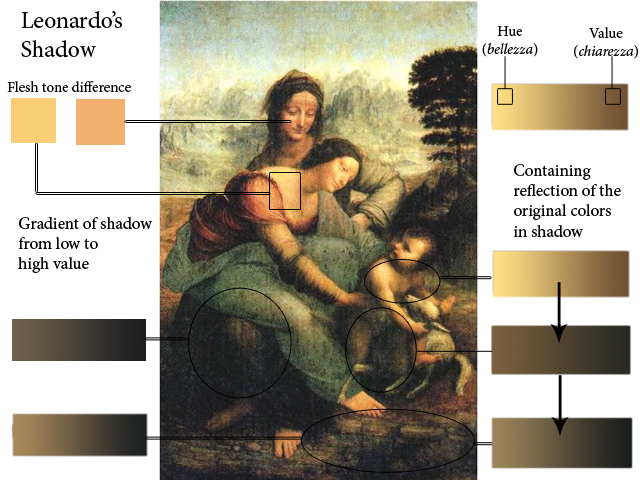
“Leonardo was so obsessed with using shadows and reflected light that he wrote fifteen thousand words on the topic, and that is probably less than half of what he originally wrote,” Walter Isaacson opined.

Using shadows and reflected light is a technique that doesnt have to be limited to painters or image creators, in my humble opinion. It can be used by article writers, novel writers, and just about every form of writing, if they’re not using it already. This mindset resulted from a technique da Vinci used in his paintings called sfumato, or “gone up in smoke”. I use it so often that I don’t think of it as a technique anymore, but I found it interesting to read the explorations of it by one most famous artists in history. The basic tenet of the sfumato technique, da Vinci made famous, was to avoid using specific and concrete lines in his paintings. This might not sound like a novel technique to the accomplished artist of the day, but it was groundbreaking in its day. Da Vinci did not invent this technique, as some evidence suggests it dates back to the chiaroscuro effects used by ancient Greeks and Romans, but da Vinci took it to another level.

When the writer begins writing a story, they characterize their main character with bold lines through unique, individualistic, and semi-autobiographical lines. The more an author explores that character, the more they chip away at strict characterization and allow their main character to breathe for themselves in a manner that adds dimension. They characterize with shading and reflection, or refraction through supporting characters, until they have done little to characterize the main character except through their interactions with others and events. Their main character becomes more prominent through these literary devices, until the central character becomes the literary equivalent to an eye of the storm.

A perfect example of this occurs in modern situation comedies. Most sitcoms have an “eye of the storm” character, we can characterize as the “us” character. The us character reflects us, but the us character also inadvertently defines the other characters as often as the other characters define him through interactions. The characters interact, and the us character is our way of dealing with all of their zany ideas and acts of the side characters, until we learn more us and all of the characters involved. Defining a character otherwise can leak into a term we want to minimize as much as possible. Think about that in terms of the sitcom. If the main character stood before the camera and told us about his likes, dislikes, and a little bit more about him, how boring would that be? It works in some cases, Larry Sanders, or The Office, but it doesn’t work in most cases. 

In most cases, we want to see characterization in action, we want to see what da Vinci called sfumato technique, or what we call the “show don’t tell” technique. The author uses supporting characters and setting to define their main character, and they use all of this to bring the events involved in their stories to bring them to life. The takeaway might be that the optimum characterizations are those characterizations that appear more organic to the reader. In other words, the author should be working his or her tail off to make the work appear so easy that the reader thinks anyone could do it.

Chekov’s Razor

Checkov’s razor is easy to understand. Write the first three paragraphs, pages, or whatever you need to familiarize yourself (the author) with your material and write the rest of your piece. Once the author is done with that piece, go back and delete the material that you had to write to start and start at the most compelling piece of your article. If you have germane sentences in that intro, save them, and work them into the body of the piece. Delete the chunk of exposition that it turns out was only written for you. Let the reader enjoy the rest. 

“But, wait, what if it’s brilliant,” we say to counter that argument. It could be, it might be, but it likely isn’t. Some of us get so locked in and locked up by the ‘we are a man of golden words’ notion. It’s the whole, ‘there’s no such thing as mistakes,’ philosophy, generated by artists the likes of Pablo Picasso and James Joyce. There are mistakes in writing, and leaving that big chunk of exposition at the beginning of your article is one of them.

“There’s no writer’s block. There’s lazy. There’s scared, but there’s no writer’s block. Just sit down and realize you’re mediocre and you’re going to have to put a lot of effort into this to make it good.” –Jerry Seinfeld

Writer’s block, according to Jerry Seinfeld’s definition, is the desire to start writing brilliantly. It’s the “If you can’t be the best, why do it?” block that inhibits writers from writing a single word, or the writing, deleting, writing, and deleting merry-go-round. It’s the dreaded, blank page, or the blinking cursor syndrome that prevents us from writing a single word. Jerry’s remedy is to accept the idea that you’re probably not half as brilliant as you think you are, and once you reach a point that you might be mediocre, it might be possible to write something that’s actually pretty good. My philosophy is similar, but I no longer think about greatness or mediocre distinctions. I just write until something good poops (and yes, I meant poops!) out.

We might call this the discovery phase. In the discovery phase, the writing is gibberish to everyone but the writer. This is the “all play no work” phase for most writers, as it allows us room away from our aspirations to true creativity. Some of the best room for creativity occurs when we have an ending in mind, as it’s fun to fill in the blanks. Filling in the blanks might also lead to a new ending. 

The takeaway for aspiring writers is to get the idea down before you forget it. Don’t worry about sequencing, chronology, grammar, spelling, or if this story is the base for the next great American novel. Just write it down and worry about all that later. Just write a bunch of gibberish down that only the writer understands, until the subject matter begins to open up to the writer. Once the author is in, the material might have the wherewithal to be in a near proximity to where a story lies, but the real story could take paragraphs, or pages, to develop.

Chekov’s razor focuses on threes, the first three paragraphs, and/or three pages of a manuscript, short story, or essay, but I’ve found this length arbitrary. When I begin a story, I think I have a full-fledged introduction on my hands. I don’t think anyone writes gibberish just to write gibberish, it feels like this could or should be the story at the time. I lock myself up when I try to determine if the writing is up to my standard, or if it’s going anywhere. I unlock myself by writing it all down, all of the important and unimportant that comes to mind, then I delete the unimportant.

Chekov’s razor comes into play when we go back and delete the unimportant. That is rough too, because all writers live with the “Golden words” mentality. Everything I write is not only good, it’s vital, and germane to the story. The writer needs to ask themselves am I a good writer or a good editor? The answer, if you’re going to try to write for others, is you’re going to have to be a little of both. Or, you can have a friend read it, or pay to have someone edit it for you. If you’re as megalomaniacal about your words as I am, you’ll either find a way or you won’t, and your work will suffer for it.  

In the course of writing past the blinking cursor stage, we discover pivot points that take us to the next stages of the story, but we don’t consider them anything more than what they are at the time. In the course of rewriting, however, we discover the pivot point is the story. The frustration falls on two tracks, the first is that we fell in love with that original idea, and it’s tough to just walk away. The other is that we “wasted” so much time writing “the other” story that we loved. When writers achieve the ultimate point of objectivity, when they realize story is sacred, they begin sacrificing all the information they love to leave information you will. 

Thus, I don’t believe there is magic in the power of threes in employing Chekov’s Razor to storytelling. A central idea, or pivot point arrives in the course of writing, but the point of Chekov’s razor is to dump and delete the useless information the writer used to write the story.  

An important note to add here is that if most authors work the same way I do, we do not write for the expressed purpose of finding the core of our story. Our perspective is, we think we already have the story, and that the only chore involves building upon it. The discovery of the core of story often humbles the author and slaps them back to the realization that no matter how many times we write a story, the art of writing involves mining the brain for ideas rather than having a brain loaded with brilliant ideas. That conceit eventually reveals itself to those willing to write a lot of material, and it’s up to the author to recognize the difference for what it is, if they want a quality story.

It happens in the course of writing it, editing it after we’re done, or in the daydreaming stage that can last for days, weeks, or months. I do not enjoy deleting the chunks of material I’ve written, and I don’t think anyone does, but the quality author will develop the ability to recognize what portion of the story is for them and which portion is for the reader, and they will crib note or delete the part of the story that is for them.

I don’t consider the revelation of these techniques a glamorization of my process. I think it demystifies the process by suggesting that anyone can do this, as long as they write as often as they need to discover what should become the central focus for the reader. Every author needs to move past their conceit of their self-defined brilliance to find the story they’re trying to tell, and learn how to work from within it.

As I’ve written elsewhere, the most prominent use of Chekov’s razor can be found in Franz Kafka’s Metamorphosis

The Best Piece of Advice I’ve Ever Heard


“You’ll figure it out,” Rodney Dangerfield informed a young, aspiring standup comedian who sought his counsel on “something in comedy.”[1]

Prior to this aspiring comedian approaching Rodney Dangerfield, we can guess that just about every comedian sought career advice from him. Not only was he one of the most successful standup comedians of his era, but he failed so miserably that he quit, and he didn’t just quit, regather, and form a comeback. He quit show business for ten years.

“To give you an idea of how well I was doing at the time I quit,” he recalled later, “I was the only one who knew I quit.”

Every comedian but they didn’t know what he figured out in his eventual comeback. They might have wanted to know what he figured out, how they could apply it to their act, or they might have wondered if he thought they should just quit too. The latter might have been the underlying question that no one asks aloud. “Now that you’ve seen my act, what do you think? How can I fix it, is it fixable, or “Should I just quit?”

The unknown, aspiring comedian who approached Dangerfield in this particular scenario was Jerry Seinfeld. We can guess that Dangerfield was probably trying to dismiss Seinfeld, hoping that yet another comedian would just leave him alone with their career-defining questions, or he found the answer to that question to be so loaded with variables, and so time consuming, that he didn’t want to go down that road with yet another aspiring comedian. Whatever the case, we can surmise that Seinfeld was disappointed by Dangerfield’s response, but Rodney probably thought it was the best piece of advice to hand out to anyone aspiring to be anything. We can probably translate his advice to “Hey, I had to figure this thing out for myself, and you do too. If you don’t want to, then you’ll have your answer.”

For all we know, Rodney sat in the audience during that Seinfeld’s act and decided that he didn’t know how to perfect it, fix it, or help Seinfeld personalize it better. We can guess that he didn’t think it was so bad that he didn’t know how to fix it, but that Seinfeld’s act was so unique and different from Rodney’s that that might have been the reason Rodney didn’t know how to fix it. Rodney might have even loved the Seinfeld’s act so much that he couldn’t wait to see how the comedian would fix all of the intricacies of the act. Perhaps he was a fan, and he didn’t want to meddle with another man’s act. Whatever the case actually was, “You’ll figure it out” seems dismissive, but as with all good advice and all perfect strawberries, it becomes tastier the more you chew on it.

Some advice is more immediate and usable. Former Major League pitcher Randy Johnson once talked about the advice fellow pitcher Nolan Ryan gave him. After watching “The Big Unit” pitch, Nolan informed him that the finishing step of his pitching motion should end approximately one inch further to the left. Randy said that that seemingly trivial piece of advice changed his whole career. He stated that he wouldn’t have accomplished half of what he did without it. He even went so far as to say he owed Nolan Ryan a lifelong debt for that career-changing advice. Some of us have received such advice, but for most of us, advice is more oblique and requires personal interpretation.

The best piece of advice I’ve ever heard combines an acknowledgment of the struggle to succeed with a notice that the recipients of such advice must find a unique, individualistic method of applying it. The best advice I’ve ever heard does not involve miracle cures, quick fixes, or the elusive true path to instant success “That can be yours for one low installment of $9.99!” Most of the best nuggets of information I’ve heard, such as “You’ll figure it out,” are so obvious that the recipient thinks they’ve wasted everyone’s time by asking the question.

The underpinning of “You’ll figure it out” suggests that there are no universal methods to achieving true individual success, especially in the arts. A struggling individual can watch a how-to video or read a training manual. They can study the various expert techniques and the experts’ interpretations of those techniques. They can internalize the advice offered by everyone and their brother, but at some point, individuals who hope to achieve true success eventually have to figure it all out for themselves.

Instant success is as rare in the arts as it is in every walk of life, but if an individual is lucky enough to avoid having to figure it out, they’re apt to find the level of success they achieve meaningless when compared to those who experience failure, adjust accordingly, and struggle to carve out their own niche.

In the course of my career in low-paying jobs, I worked with a number of flash-in-the-pan employees who didn’t think they needed to to figure anything out. They considered themselves Tom-Cruise-in-shades naturals. They were the high-energy, fast-talking, glamour types who focus so much energy on their new job that they burst out of the gate to thunderous applause. Trainers and bosses love them. “Look at Bret!” they say, high-fiving Bret in the hall, hoping to inspire everyone within earshot to be more like Bret. The one thing the powers-that-be do not see, or don’t know, is that these high-energy, fast-talking, glamorous, flash-in-the-pan types often burn out after reaching the immediate goals that define them as successful.

Those who experience a measure of instant success are often the darlings and studs of the training class. They can answer every question, and they often enter the training seminar with quotes on success from the famous and successful. They treat training classes as a competition, as one would an athletic event, and they’re not afraid to do touchdown dances soon after the release of the initial productivity numbers. They wear the clothes and drive the cars to foster the image. They may even go so far as to have someone in authority catch them reading a personal success guide that one of them may read to chapter two. Most of them won’t read that far, however, because most of them aren’t in it for the long-haul.

Bullet-point, large idea minds have no patience for the time it takes to figure out the minutiae the rest of us will pine over in the agonizing trial-and-error process. The instantly successful don’t heed Rodney Dangerfield’s advice to “figure it out,” because they already have it all figured out. Either that or they’ve done so much to foster the image of one who already has that they don’t want to stain that image with new knowledge. They seek the quick-learner perception, and most of what they attain after the flurry-to-impress stage lies in either the knowledge they dismiss as something they already knew or inconsequential minutiae. They just know what they know, and that’s enough for the show.

They are also not good at taking criticism, as most constructive criticism calls for a restart, and they’re much too smart for a restart. To be fair, some of this criticism is bestowed on quick learners by jealous types who enjoy feeling they have greater authority on the subject, but some of that criticism is constructive. It falls upon all of us to figure out whether we are receiving helpful criticisms or competitive insults. Some criticism should make us wonder if we’re deluding ourselves with the belief that we’re as accomplished as we think. Some suggests that to find success in our craft, we should humbly consider doing it like someone else. In some cases, the criticism is correct, for there’s nothing wrong with following a proven path to success. That advice can be right or wrong for us, but that is just something else we have to figure out.

✽✽✽

“Do you have any tips on how to keep writing?” a fellow writer once asked me. My first inclination was to tell him about a book I knew that covers this very topic. I empathized with the idea that writing has few immediate rewards, and I enjoyed the perception of being a writer who knows what he is talking about when it comes to writing. I never read that book about writing, but I was sure it was loaded with all the usual ideas: “Keep Post-it notes on hand, so you don’t miss out on those little inspirations that could turn into great ideas.” Another solid idea they offer is, “Write a story that occurred in your life, for your life is an excellent cavern that can be mined for constant gems.” Then there is the ever-present, “Read, read, and read some more.” I could’ve told that writer about that book I never read, but even if I did take the time to read it and I found it invaluable to me, my recommendation would have been half-hearted. Experience has taught me that true success in writing requires nuanced ingenuity and creativity, and the writer has to figure these elements of the process out for themselves. If they don’t want to go through that time-consuming and laborious process, they should go do something else. That idea would form my addendum to Dangerfield’s quote: “You’ll [either] figure it out … or you won’t, and if you don’t, you might want to consider doing something else, and you’ll need to figure that out too.”

✽✽✽

I’m quite sure Jerry Seinfeld, sought Rodney’s advice, because he knew all about Rodney’s well-documented failures. Seinfeld likely knew that Rodney was so frustrated with his inability to achieve anything in the field of comedy that he just quit, and he didn’t try again for almost ten years. Seinfeld probably thought Dangerfield could give him a shortcut out of his personal cocoon and transform into a bona fide star. “You’ll figure it out!” the answer Rodney Dangerfield offered to the young Seinfeld, alluded to that struggle a butterfly goes through in its efforts to escape its cocoon. Yet, as any nature lover knows, if an outside influence cuts the butterfly’s struggle short, it will not gain the strength necessary to survive in the wild.

On that note, some critics grow frustrated with the amount of self-help charlatans moving from town to town in their Miracle Cure stagecoaches, who promise placebo elixirs to those seeking advice. They should direct these frustrations, instead, at those seeking shortcut exits from personal cocoons. When Seinfeld approached Dangerfield, and the aspiring writer approached me, they sought an alternative to learning from experience and failure, but Rodney’s advice suggests that he never found one. “You’ll figure it out,” might sound dismissive, but it also speaks to learning from experience and failure, and the resultant, almost imperceptible adjustments a craftsman must make to separate their final product from all of the others. The final answer for those seeking a quick fix is that there is no perfect piece of advice that we can give another who is unable or unwilling to display the temerity necessary to endure the necessary elements of failing, learning from that failure, and making all of the frustrating, time-consuming, and tedious little adjustments that must be made along the way. The final answer will be the answer you find. The final answer is that the struggle provides answers. The struggle informs the craftsman whether or not they are capable of fixing what is wrong with their presentation, and if they are desperate enough to do what is necessary to carve out some individual definition of success in their craft, and if they aren’t, they’ll figure that out too.