“Laughter is the best medicine,” is something we say when everyone starts taking things far too seriously. Laughter can cure what ails us, but what happens when there is medicine or cure for laughter?
“Stop it!” we say when we see someone yawn an infectious yawn. “Stop it!” we say when we hear someone laugh an infectious laugh. What is an infectious laugh? Is it about quantity or quality? We know it when we hear it. “I love your laugh,” we say when we hear it. A genuine, full-on belly laugh cannot be faked, and when we hear someone who appears to be having one hell of a good time, we want in.
 If we’re the ones who have come down with a case of the giggles, our friends might laugh with us in the beginning, without knowing why. If we keep going, they start giving us looks. “Okay, it wasn’t that funny,” is something they might say to punctuate their confusion. That’s often our cue to stop, but we can’t, and we don’t know why. We can’t even remember why we started laughing in the first place. That’s a mean case of the giggles.
A mean case of the giggles starts when someone says or does something relatively funny, and relative is the key word, because some funnies aren’t as funny to anyone else but us. “That’s not hysterical?” we ask our other friends. “All right, well I guess you had to be there.” Those funnies have a time-and-place situational element to them.
“Yeah, be careful with those giggles,” a researcher in Psychiatry and Behavioral Science might caution us. “It is possible, if you don’t get control of yourself, that you could start a Mass Psychogenic Illness (an MPI), or a Mass Sociogenic Illness (MSI).” That warning alone could be so confusing that it might be an excellent cure for a case of the giggles, because what does that mean?
What causes the giggles? I’m not talking about a laugh, because we all have a laugh occasionally, but we can usually source it. A mean case of the giggles is usually irrational, and it often contains a time and place element to it. If it’s deemed inappropriate for us to laugh—let’s say in church, at a funeral, or a wedding—a mean case of the giggles can creep up in us. “Yeah, be careful with that too,” that researcher in Psychiatry and Behavioral Science cautions. “A mean case of the giggles can lead to involuntary complete bladder emptying, called giggle incontinence, or in some extreme cases gelastic seizures that medical researchers link to a benign brain tumor near the hypothalamus that is called a Hypothalamic hamartoma. They can also be caused by lesions in the frontal or parietal lobes, so if you start laughing so uncontrollably that it concerns you, you might want to consider getting yourself checked out by a neurologist.”
Those warnings could be so serious that they could kill our laughter, or they could be so confusing that they ignite it.
Point-blank, a mean case of the giggles makes no sense, but that’s what makes it funny. Most giggles start out that way—funny, or relatively funny—but very few of us have heard or witnessed something so funny that our authority figures aren’t able to stop us with a stern glare, or a few choice words sent our way.
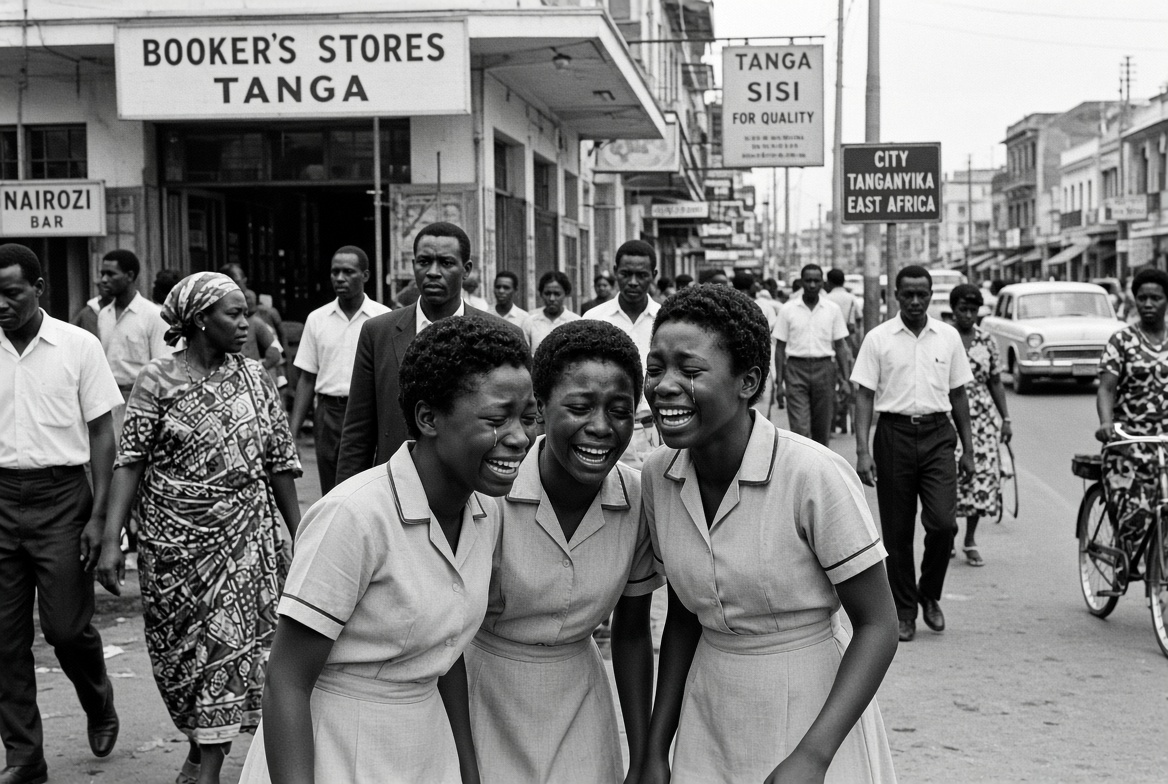 I’ve been in that situation. “Okay, that’s enough,” my dad said, and it was, but I couldn’t stop. We’ve all been there, but we haven’t had such an uncontrollable case of the giggles that our immediate authority figures had to call the local authorities in. We’ve never had such a mean case of the giggle that those local authority figures decided that our case of the giggles was so infectious and contagious that they should probably close our school, and the surrounding schools, to implement a desperate measure to keep our uncontrollable giggles from spreading any further.
No one knows what triggered it, but on January 30, 1962, three girls from the village of Kashasha on the western coast of Lake Victoria in Tanganyika (now part of Tanzania), near the border with Uganda, began laughing at something, and they couldn’t stop. We don’t know if the pupils in that class knew what the girls were laughing at and joined in, or if they simply caught the infectious case of the giggles that eventually led to an outbreak of mass hysteria that we now call The Tanganyika Laughter Epidemic of 1962.
That laughter began spreading to other schools in neighboring villages, notably Nshamba, and other schools after Kashasha closed its doors, roughly three months later, on March 18, 1962. Those schools sent their pupils home too. A second wave of the giggles hit when Kashasha reopened in May, forcing another closure. In total, the whole outbreak affected around 1,000 people (mostly young people, especially girls and young women), and it ended up closing fourteen schools. The school officials and other local leaders eventually managed to isolate it and keep it confined to an area of about 100 miles of the town of Bukoba.
The desperate school and local officials called Doctors A.M. Rankin, P. J. Philip, and others in to investigate. They were able to rule out infections of any sort, toxins, or neurological disease. They interviewed and worked with several victims and found that the symptoms included uncontrollable laughing and crying, restlessness, pain, fainting, and sometimes rashes or breathing difficulty. Some of the victims stated that their mean case of the giggles lasted a few hours, but other more extreme cases involved sufferers being unable to stop laughing for up to sixteen days. By the time they were done interviewing the sufferers, the medical researchers found that the average time for sufferers, in general, was about a week, often characterized by recurrences. The medical community on scene were also surprised to discover that the teaching staff of the schools were generally unaffected.
Historical researchers were also fascinated by this case of mass hysteria and/or mass sociogenic illness. After ruling several factors out, they focused on the time and place, situational element. These girls were pupils in a very strict mission school that focused on providing their students with the best climate for success. This is the goal of just about every school, of course, but the citizens of Tanganyika were experiencing freedom for the first time, as they just gained independence from Britain. Freedom is a great thing, of course, but it can also be a little scary in the beginning for those who have never known it.
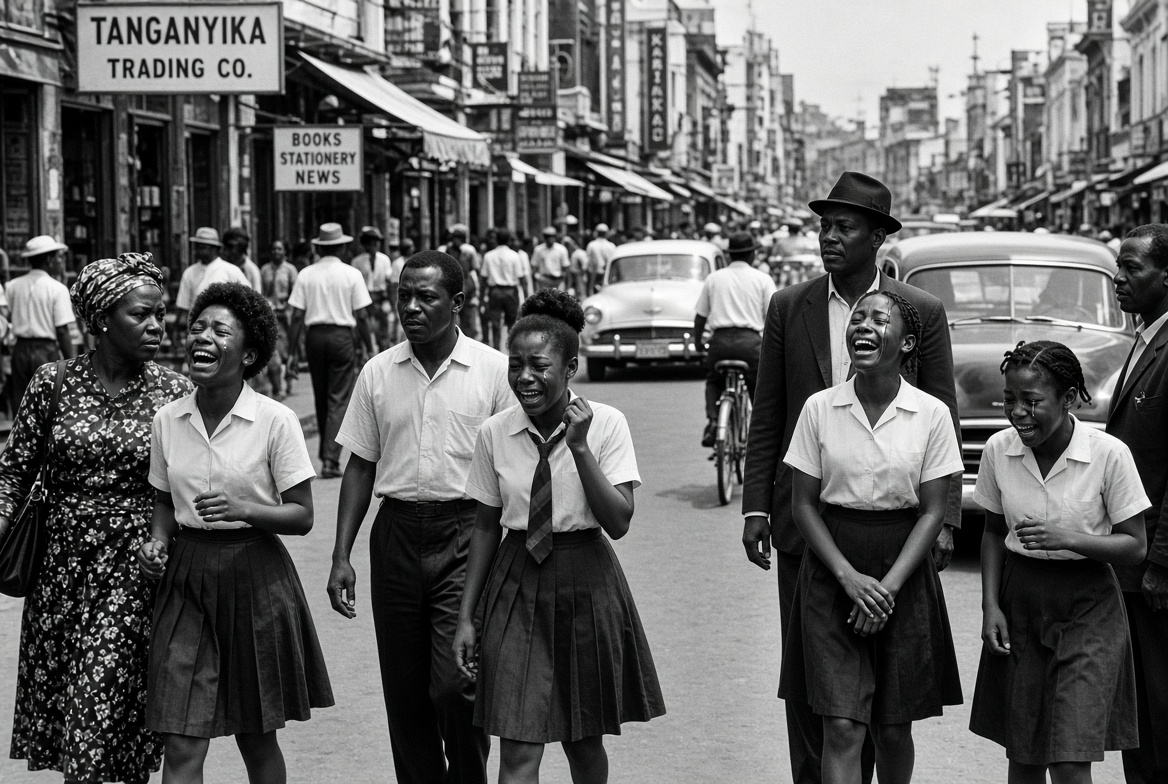 “You will now have opportunities we never did,” is probably something the girls of Kashasha heard so often from their parents and the other adults in their sphere of influence that they grew tired of hearing it. They were twelve- to eighteen-year-olds, and they probably felt a lot of pressure to take advantage of the freedoms the previous generation secured for them. Being that young, they probably couldn’t completely grasp the particulars of the change, but their parents could. Their parents and the adults in the community around them informed them that if they studied and succeeded in school, they could be anything they wanted to be. They were probably told that they could provide for the family, save communities, and the country if they learned how to succeed. That could be viewed as a beautiful thing, but it could also be a little overwhelming too.
What happened after one of these girls received a 100% on a very difficult, advanced math test? She studied her tail off for that test, and she just earned the best possible grade she could get. Is that a cause for celebration? Of course it is, and she enjoyed that moment for what it meant, in the moment. We could characterize this an annoying human trait, but the next question we ask someone who accomplishes celebratory achievements is, “Can you do it again?” “Who cares for now?” we want to ask. “Let’s celebrate this for another day.” It doesn’t happen. In the moments after our celebratory achievement, we feel the pressure build, and we can guess that these three girls felt more pressure than we’ve ever known. They probably thought they even though they weren’t capable of doing this long-term. They were thirteen- to eighteen-year-old girls. They were insecure about their ability to succeed beyond her parents’ wildest dreams. Those notions can be beautiful and scary at the same time. The pressure probably built with each new test, until they needed to hit a release valve of some sort.
Again, no one knows what incident triggered their giggles. Seeing how the various officials involved interviewed all of the subjects, they probably focused in on one girl, the girl who started it all. And she didn’t know how or why her mean case of the giggles started either. She probably felt so much pressure that anything could’ve started it. She probably reached a point where she didn’t know whether to laugh or cry due to the pressure she felt. When she and her two friends started giggling, their immediate authority figures probably let it go for a while, until the girls wouldn’t stop. “Ok, that’s enough!” they probably said. At this point, the girls wanted to stop, but they couldn’t. The situation escalated, and their confusing inability to stop followed suit. We’ve all been there to a much lesser level, but when we cannot stop, it’s not always about rebellion. Were the newly independent girls expressing a level of previously unknown freedom by rebelling against their authority figures by laughing harder? We don’t know, but my guess is that “laugh or cry” confusion intensified with the intense calls for them to stop. This relationship between the teachers and the administration’s frustration, in the early stages, probably only made this matter worse. We cannot blame the teachers and the administration, because who witnesses such a thing and thinks, “This could break out into a mass psychogenic illness, mass hysteria, or mass sociogenic illness?”
The Tanganyika Laughter Epidemic of 1962 lasted for eighteen months, but it eventually died out by mid-to-late 1963, and everyone recovered with no lasting physical or neurological effects. The historical record suggests that school closures temporarily interrupted local clusters, but it inadvertently helped the laughter spread by dispersing the affected students. There was no single “end date” or official all-clear—just a quiet subsidence as the social conditions that sustained the contagion eased.
There were no physical or neurological effects, but what about the long-term psychological effects? Imagine being one of the three girls at the center of it all. She started an epidemic that affected 95 of her classmates. She was probably afraid to even start laughing years, and maybe for the rest of her life, based on what happened during her young, formative years.
We’ve all heard someone with infectious laughter say, “You don’t even want to get me started.” Yet when we say infectious or contagious laughter, we’re usually talking about affecting a round bar table of four. These girls set off an outbreak that caused 95 of their school’s pupils to laugh so hard that at least one individual couldn’t stop for sixteen days. Then it spread to other schools in neighboring villages and a 1,000 young girls in total, until it formed a mass psychogenic illness that we still don’t totally understand. (To this day, we have not identified a single biological cause. Scientists generally consider it more of a psychological illness.)
This had to be so confusing and scary to these girls that the next time a family member or friend starts in on a joke, they said, “Stop, don’t, I don’t want to hear it.” It had to be so confusing and scary that they avoided watching situational comedies for the rest of their lives. When they decided to date, “finding someone funny” wasn’t in the top 100 bullet point characteristics they sought in a prospective mate. When they had a selection of books before them, they probably chose sad, tragic dramas, adventure books, and anything and everything but comedies, because they didn’t want to get started.
Laughter is so irrational that it’s often inexplicable. We again go to the “I didn’t know whether to laugh or cry” reaction we have to many otherwise confusing situations. If laughter is our go-to, imagine if we had a mean case of the giggles that lasted sixteen days. We might never want to laugh again, and it might be something we fear so much that we spend the rest of our lives trying to avoid hearing or seeing anything and everything that could be funny.
Laughter is the medicine we all need, is something we say when everyone starts taking things too seriously. It can cure what ails us, but what happens when there is no medicine, and no cure, for our laughter?

