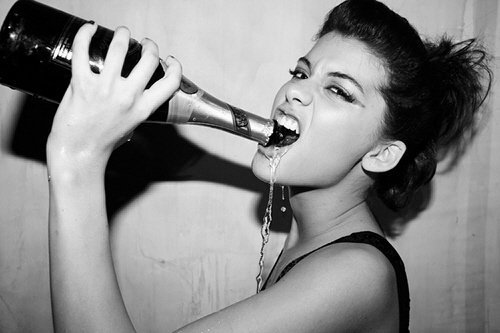
“There were only two people I couldn’t drink under the table,” Ozzy Osbourne once said. “(Lead singer of Motorhead) Lemmy Kilmister and Wrestling Great Andre the Giant.”
“I could so drink you under the table,” Angie said.
“I’m sure you could,” I said, and I turned away to do whatever I was doing prior to her challenge. That discussion was over … for me, but our friends stared at me, waiting for me to add something to it.
 Nat broke the silence, saying, “So, you’re chickening out? You’re chickening out to a drinking contest against a girl who’s … what are you Angie ninety-five pounds?”
I would love to write, right here, that I had a clever reply or something that put me back in a position of power. I didn’t. I said something along the lines of, “Well, I’m an extremely competitive person, and a light weight. That combination often leads me to drink so much that I’ll probably do something that we will never forget.”
“Isn’t that why we’re here, my brother?” Nat said with a gleam in his eye, “to do unforgettable things?”
“I’m talking about embarrassing, sloppy drunk things, like vomiting all over this beautiful carpet of yours. If I don’t vomit, and that alcohol stays in my system, I’ll probably fall into your precious glass table, pass out in your bedroom, or proposition one of your good friends. Depending on what I end up doing, you’ll all probably have a good laugh at my expense, but I will have to live with it. Admitting that a ninety-five pound girl could probably drink me under the table is the least humiliating course for me to take here.”
 If you’ve ever seen those Old West movies where a fella backs down from a shootout, you know the eyes I saw that day, those silent, judgmental eyes. Those eyes tell us that we’re not matching up, fitting in, and we just don’t have what it takes to be a fella. There were probably four people in the room at the time, but in my memory there were at least twenty, condemning me for my weaknesses. Even in the moment I knew that those judgmental eyes were much better than the eyes I would’ve received after that drinking contest, and all the things I would’ve said and done with massive amounts of alcohol unlocking them. “That man cannot handle his alcohol,” would’ve been the refrain they shared at work that Monday.
I’m one of those guys you hate playing with or against, because I don’t play games to have fun. I play to win, and if I don’t win, I freak out. It’s childish and pathetic, and I’ve learned to control it to a degree. I no longer make a spectacle out of myself anymore, but it’s still such a part of me that if I were involved in a game of Barbies, I might try to find some way to win.
I grew up playing every major sport except hockey, and I would throw tantrums if I lost. I’ve flipped playing boards, stormed out of rooms, and knocked something off the wall on my way out after losing games of Tiddlywinks and Chutes and Ladders. I know this about myself, and I know that if I entered into a drinking contest, a game I really don’t enjoy, I would have to win. I did it before, and if I felt some level of conquest or glory, I don’t remember it. The one time I did know the glory of victory, it was fleeting, as the embarrassment of blowing chunks across a table that sat before the couch I passed out in superseded it.
With as much training as I put in, you’d think I would’ve developed a greater tolerance to alcohol eventually. I never did. I don’t know if the ability to drink more than others has something to do with genetics, but if it does, how did my ancestors do? Alcohol and drinking were important when I was younger, but it was almost mandatory when they were young and kicking it. Did they avoid drinking alcohol? It might have had something to do with the pack my dad decided to run in, but when I was a kid, every adult I knew drank something. We all knew everyone’s drink of choice, because it defined them.
Our history with alcohol is not recent, as archeologists have found evidence of humans intentionally fermenting beverages as far back as 13,000 years ago. So, somewhere just below our hierarchal need for fire, was our need to get wrecked, and sometime shortly after we experienced the euphoria of killing brain cells for the first time, someone probably challenged someone else to a test of tolerance, and the victor felt vindicated. Did this help our species evolve, or did it inhibit evolution? Who cares brutha, why you always talking such nonsense? Let’s get ripped.
We tried –the United States, inspired by efforts in other countries tried— to curb our enthusiasm for alcohol, in a temperance movement that culminated in The Prohibition in the U.S. It failed in historic proportions, because “You can’t legislate morality.” That was the takeaway anyway, but the other takeaway might be that we love alcohol so much that we were willing to fight for it. We fought the law, and we won! We then celebrated that victory hard for nearly 100 years. (Recent polls suggest drinking alcohol is now down to 54% among young people, in favor of smoking pot.)
TIM
“We have food and beverages for everyone,” one of the primary organizers of our kid’s school event said after stepping to the fore, “but there is no alcohol.” The parents groaned, some sarcastically, others not, and the organizers apologized. I empathized a little, as school functions are almost always so painfully uncomfortable for parents who barely know each other that alcohol lubricates our anxiety.
I knew that of course, but as I worked my way around the social circles of parents in attendance, I was pretty sure that the “no alcohol” complaints were nothing more than conversation starters. Some were genuinely ticked off, however, and they reminded me of the kids at my friend’s seventh birthday party. We fellow seven-year-olds knew Scott Taylor’s parents were anti-sugar, because Scott was not allowed to eat the desserts on his lunch tray, so we’d trade him for his sugary snacks. Their sugar prohibition never affected us until we attended their son’s birthday party, and we learned that everything from the candy, to the birthday cake, and ice cream at the party would all be sugar free. And it was not surprisingly good, it was gross, and we were as disappointed, angry, and ready to revolt as those adults at the alcohol-free kid’s function, which is fine when viewed through that lens, but when we flip it around and compare the adults’ reaction to the kids’ it’s illustrative.
 Amidst our groans and complaints, that guy stepped forward. I’ve now been among parents at a kid functions often enough now to know they all contain that guy. That guy, in this alcohol-free production, was played by a man named Tim, and we began to view Tim as our superhero when he gathered us up and led us to his locked and loaded SUV. I didn’t hear the angels sing others swore they heard when Tim opened his hatchback to reveal three coolers. I also didn’t feel the warm, gold glow wash over me that others did when they saw the wide array of alcoholic drinks he had in them. I did find it hilarious that this forty-year-old man was so prepared for the administrator’s alcohol restriction that he loaded up his car before leaving home. Even though I wasn’t seeking alcohol as much as the other parents, I enjoyed being included in Tim’s select group.
I felt naughty too. I felt like a naughty teen sneaking hootch into the high school dance. I felt twenty years younger, and I must admit that when I mixed Tim’s naughtiness with the organizer’s lime-aid, it tasted so much better for all of those wrong reasons. It felt like we were undermining authority and challenging the establishment. The first sip tasted dangerous, and the second one had a shot of humor in it, but every drink after that tasted a little foolish. We were forty-year-olds at our kid’s function. What were they going to do to us if they caught us? Their best punishment, I decided, would involve them reminding us that we were forty-year-olds at a kid’s function.
What the administrators didn’t understand was that alcohol was never just a rite of passage for us, it was the reason to get together. Once we got together in that “Event of the week” there was always one party goer who drank responsibly. They drank in moderation. I met one woman who managed to milk a hard seltzer for two hours. When she was “done” she had a fourth of a bottle left. I’m a little embarrassed to write these lines now, but I thought there was something wrong with her. I thought she didn’t know how to live. We were entertaining, healthy, and young people, why wouldn’t she want to maximize all that while it lasts? “Don’t you want to have fun?” I asked her. “I mean c’mon.” She was an attractive, but I could’ve never imagined a relationship with her or anyone else who was alcohol-free.
The Definition of Drinking
We defined ourselves in drinking contests and games to try to outdo each other in the ancient tests of tolerance. Our definition of victory involved leaving our opponent so incapacitated that they lost control of their functions, fell off a chair, and ended up under the table. “Huzzah!” we shouted in unison, when the defeated vomited little orange pellets across the floor.
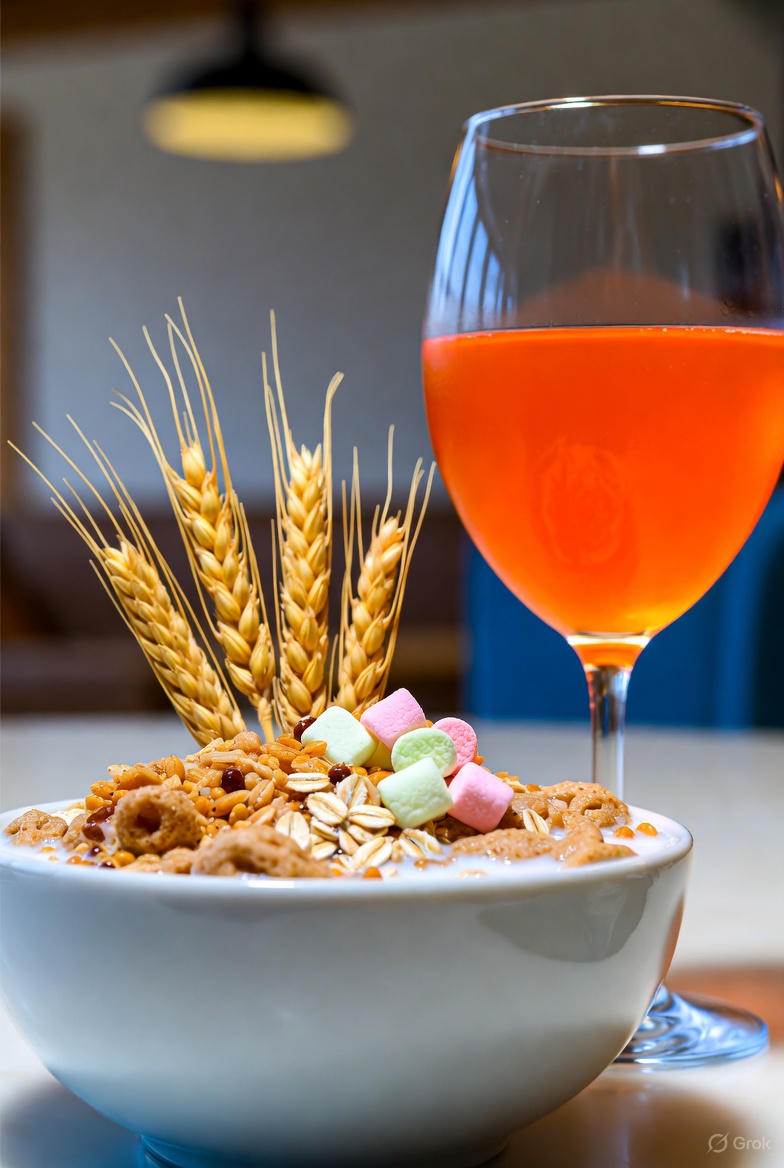
“I think it was cereal,” Patrick said.
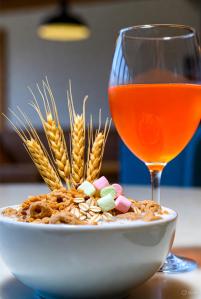 “Yeah, those little pellets were tiny marshmallows,” Brian responded. “I think the orange coloring was whatever he drank. Wasn’t he drinking orange coolers?”
The defeated never recovered his reputation, and the victor lived on his victory for months, as if drinking twenty beers in an hour was a physical accomplishment. It was a physical feat, but it was an unnatural one that required training, and no one wanted to watch a montage of his training exercises. No one wanted to see the man sitting quietly in his favorite Barcalounger sipping quietly between tears. We wanted to live the Bachelor Party (the 1984 film starring Tom Hanks) lifestyle, and this is how we imagined we were living.
I can’t remember all of the parties, but there were some killers. The one party I will never forget is my first adult, non-alcohol party. There were probably twenty people there, and no one was drinking. I asked where the beer was, and no one answered. I asked what was going on, and no one answered. Their silence was uncomfortable for both of us. We were in our early thirties, so we were still young enough to recover from whatever damage alcohol inflicted relatively quickly. We had no kids at the time, and a long weekend, so the idea that we were going to spend an evening around other adults talking about our day seemed inhuman to me. I realized that I didn’t like any of these people that much. We drank bottled water and other non-alcoholic refreshments, while talking about our day, as if it were a Thanksgiving Day reunion with the extended family. I hate to sound like an alcoholic, but this party was such an aberration that I talked about it for weeks. I wanted someone to back me up on what an aberration that was. I wasn’t ready to curb my enthusiasm just yet, and I couldn’t believe my friends were. I wanted to ask when the decision to go alcohol-free was made, and how come I wasn’t part of it?
It didn’t take long for me to recognize that there was something afoot. My friends were implicitly stating that not every get-together had to involve alcohol, and that there was probably something wrong with drinking massive amounts of alcohol. Though I was a little late to this particular party, we began drawing a new demarcation line in the sand. The hilarious hyjinx of the inebriated was becoming a little sad at some point. I should’ve seen that coming, because I saw my dad get wrecked so often that it wrecked our relationship, and most of my friends saw similar things with their parents. It wrecked us to chase our parents out of bars, to hear their alcohol-induced gibberish on the ride home, and it did some lasting damage to our relationship with them when we had to put them, our parents, to bed.
Now, we drank, and we wrecked our teens and thirties, but by the time we decided to have kids, we decided that we didn’t want to put them through the confusion and the role reversals we experienced. Our kids have never had to spend the precious hours of our childhood in a bar, bored, begging to leave. Our kids see us get together, and they see us drink a beer or two, but they don’t see their guides and role models getting hammered every weekend.
As we criticize our parents, and their generation, however, we should note that they saw things. We led cushy, comfortable lives because of them and thanks to them. We never knew The Depression, a real war, or any of the other things that they needed to forget, and we were too young to understand the what fors. All we saw was the drinking, the laughing, the absolute blast everyone was having, and all of the connections we made. We also saw the aftereffects, the “Don’t tell anyone about this,” embarrassing aftereffects. The chasing of imaginary windmills, the crying, and their inability to climb the stairs to get into bed. How does an adult ever reclaim their rightful place atop the hierarchy of a home after their kid has to clean up their puke, wipe their tears, and fight to get them into bed?
I could be off, but I think my generation were the pied pipers in the move away from alcohol. We give younger, twenty-somethings all of the credit for cutting ties to alcohol to 54%. They deserve some of the credit, of course, but we started to see the light and learn our own lessons, inspired by the idea that we didn’t want our kids to see us in weakened, pathetic states. Our kids never had to see us chase imaginary windmills, and they never had to sit in a sad, lonely, and pathetic dive bar begging us to leave. They didn’t have parents whose whole lives centered around alcohol.
Minimum Weight
Bob was an elegant drinker. He had fun, but he never made a fool out of himself, and he never had bad hangovers. He was the life of the party that I always wanted to be, but I was a sloppy drunk who could never handle his alcohol. I envied him at the time, but now that it’s all over, and we’re old, I wonder if Bob still has a problem with alcohol? My body informed me, early on, that we didn’t have either the genetic constitution, or the will to do what it took, to become a quality drinker, but he did it so well in the window in time that I knew him that I seriously wonder if he has a tough time quitting, cutting back, or leading a more responsible life?
Bob was a fun drunk for hours. The man could drink. I was a fun drunk for a little while, but my tolerance was such that I often turned the smiling faces in the room to cringes. Bob almost single-handedly proved that when it came to drinking games and contests, it didn’t matter how much I trained, I would have to artificially reengineer my genetic chromosomes to achieve the term lightweight.
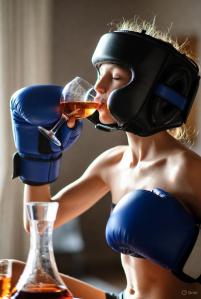 According to BoxBets.com, there are now eight weight classes listed below lightweight, including featherweight, flyweight, light flyweight, and minimum weight. In the drinking and drunk world, I would probably list myself somewhere between light flyweight and minimum weight, because I could probably handle most of the 90lb. females who’ve never had a drink, in the minimum weight class, but after witnessing my performances in those bouts, my manager would probably caution me against challenging for even that meager belt. My competitive spirit, combined with my stupidity, would have me challenging and winning that ignoble belt from a 90lb. female, but I would not do well among the 100lb., light flyweight females.
If a genie offered me a once-in-lifetime chance to fix 100 of my flaws, moving up in weight classes would not make it on that list. I enjoyed the way alcohol allowed me to shed inhibitions, and the laughing and fun that almost always followed beer consumption, but I never really enjoyed drinking it. I might be rewriting my past, but I don’t remember wanting to become a better drinker who could outdo opponents. I viewed alcohol as a social lubricant, and I considered it an opportunity to become someone else, anyone else, someone like Tom Hanks in the Bachelor Party.
I didn’t want to be a minimum weight of course, as that has connotations to lacking masculinity, but I never wanted to do what was necessary to become a heavy weight either. Even if I wanted to, I don’t think I would’ve been capable of it, as I think our constitutions are relative, based on genetics. Some of us will never be able to competitively run 26 miles, no matter how hard we train, some of us just don’t have the mental acumen necessary to compete in big-time chess matches, or the physical gifts some seem born with to dominate in fencing, and some of us have a genetic disposition that leads us to problems trying to outdrink a parakeet, no matter how hard we train.
I was a fun drunk, but I didn’t know when to say when, because I always wanted to have more fun, and more alcohol equals more fun when you get that close to having more fun. It made sense to me when I could see the crest of the hill on the horizon, until I looked around to see the sympathetic and horrified faces informing me that I was already careening wildly down the other side of that hill.
I silenced the room by conceding that Angie could probably drink me under the table. I damaged my man points, and there was a palpable sense that our mutual friends were embarrassed for me. They couldn’t believe that I would admit to such a thing, and they began attempting to impress each other with how much they could drink. I checked out of the conversation, because I fell for various peer pressure tactics so often in a previous life that the accumulation of decades of tiny doses of it inoculated me to immunity.
“I feel bad for people who don’t drink.” Frank Sinatra once said. “When they wake up in the morning, that’s as good as they’ve going to feel all day.” That quote is funny in a cringey sort of way, because we all know that alcohol makes us feel better. It makes us funnier, livelier, and more social. We also become “the drunk,” which can have negative and positive connotations. In this case “the drunk” is our other persona, and who we can become with a couple of belts in our system. The problem, we realize after several attempts, is that we can never become that person. We eventually have to return to that person who isn’t that funny, social, or as lively. We also know that we will never become the celebrated drinker who puts that other guy under the table. At some point, we need to learn to say something along the lines of: “I’m going to say no to your drinking challenge, because I’m just a casual drinker who drinks for fun. I can’t handle massive amounts of alcohol.”
Ozzy Osbourne said that he only met two guys he couldn’t put under the table, and while I would never belittle anothers’ accomplishments in life, I can’t imagine that being a note I would want that to be one of the things my family remembered about me. I had fun drinking alcohol, and I’m quite sure Ozzy, Lemmy, and The Giant had more fun than I did, but the two rock stars were informed that they wouldn’t continue to live if they continued drinking alcohol (there’s no documented evidence of such a warning issued to Andre). Ozzy eventually achieved sobriety late in life, but Lemmy refused to listen to the men in white coats. When they issued their warning, Lemmy switched from whiskey to vodka), and when they informed him that he needed to drink more water, he put an ice cube in his vodka. It’s funny, and some might raise a fist in solidarity for a man living, even in his last days, on his own terms. He openly bragged about drinking a bottle of Jack Daniels a day, and he died with one in his hand. He never apologized for his drinking habits, never quit, and he never said he regretted it. It’s not only possible it’s likely that that’s all true, and we’ve all known people like that, but I wonder if people like Lemmy, and the aforementioned Bob, knew they couldn’t continue to life with alcohol, but they couldn’t imagine life without it.






 Rilaly