Leonardo da Vinci’s Woodpecker


“Describe the tongue of the woodpecker and the jaw of the crocodile,” Leonardo da Vinci wrote as a reminder to himself in his Codex Atlanticus.

How many of you are curious about inconsequential matters? Let’s see a show of hands. How many of those curiosities will end up serving something greater? Some will and some might, you never know. We could end up studying something largely consider inconsequential that ends up helping us understand ourselves better, our relationship to nature, and all of interconnected facets of our ecosystem. What seems inconsequential in the beginning can prove anything but in other words, but what would purpose could the study of a bird’s tongue serve a 16 th century artist? 

“Everything connects to everything else,” a modern da Vinci might have answered. There is no evidence that the 15th and 16th century Leonardo da Vinci ever said, or wrote, those words, and it’s likely apocryphal or a 20thcentury distillation of Leonardo’s notebook passages on the unity of nature, such as the earth-man analogy he made in the Codex Leicester or water’s role in the Codex Atlanticus. So, the answer is da Vinci studied the woodpecker’s tongue to try to find a greater connection, right? Maybe, sort of, and I guess in a roundabout way. When we study da Vinci’s modus operandi, we discover that his research did involve trying to find answers, but his primary focus was to try to find questions. He was, as art historian said, Kenneth Clark said, “The most relentlessly curious.” That characterization might answer our questions with a broad brush, but it doesn’t answer the specific question why even the most relentlessly curious mind would drill so far down to the tongue of the woodpecker for answers. For that, we turn back to the theme we’ve attributed to da Vinci’s works “Everything connects to everything else.” He wasn’t searching with a purpose, in other words, he was searching for a purpose of the purpose of the tongue.

We’ve all witnessed woodpeckers knocking away at a tree. Depending on where we live, it’s probably not something we hear so often that it fades into the background. When we hear it, we stop, we try to locate it, and we move on. Why do they knock? Why does any animal do what they do? To get food. Yet, how many of us have considered the potential damage all that knocking could have on the woodpecker’s brain? If another animal did that, it could result in headaches, concussions, and possible long term brain damage. How does a woodpecker avoid all of that? Prior to writing this article, I never asked how the woodpecker avoided injury, because I never delved that deep into that question, because why would I? As with 99.9% of the world, I just assumed that nature always takes care of itself somehow. As curious as some of us are, da Vinci’s question introduces to the idea that we’re not nearly as curious as we thought.
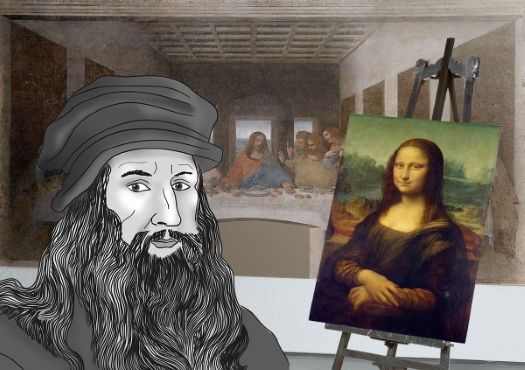
Was da Vinci one of the most relentlessly curious minds that ever existed, or was he scatterbrained? We have to give him points for the former, for even wondering about the woodpecker’s tongue and the crocodile’s jaw, but the idea that he we have no evidence that he pursued these questions gives credence to the latter.

Did he find the fresh carcass of a woodpecker to discover how long the tongue was relative to the small bird, and its comparatively small head? Did he initially believe that the extent of its functionality involved helping the bird hammer into wood, clear wood chips, and/or create a nest. If his note was devoted to what he saw the bird do, he probably saw it perform all of these chores, coupled with using it to retrieve ants and grubs from the hole its knocking created. If da Vinci watched the bird, he probably saw what every other observer could see. It doesn’t seem characteristic to da Vinci to leave his conclusions to superficial observations, but I have not found a conclusion in da Vinci’s journal to suggest that he dissected the bird and found the full functionality of the tongue. There were no notes to suggest da Vinci found, asIFOD.comlists: 
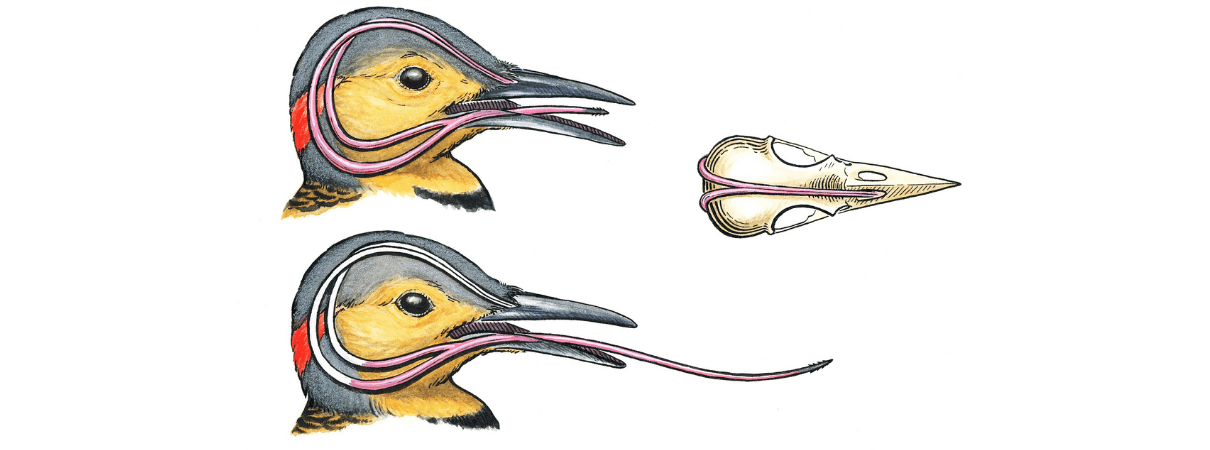
“When not in use, the woodpecker’s unusually long tongue retracts into the skull and its cartilage-like structure continues past the jaw to wrap around the bird’s head and then curve[s] down to its nostril. In addition to digging out grubs from a tree,the long tongue protects the woodpecker’s brain. When the bird smashes its beak repeatedly into tree bark, the force exerted on its head is ten times what would kill a human.But its bizarre tongue and supporting structure act as a cushion, shielding the brain from shock.”    

Brilliant musicians dive deep into sound, acoustics, and how they might manipulate them in a unique manner to serve the song. Writers pay attention to the power of words, as we attempt to hone in on their subtle yet powerful forms of coercion, and the power of the great sentence. Artists, in general, seek to achieve a greater understanding of little relatively inconsequential matters for the expressed purpose of gaining a greater understanding of larger concepts, but a study of the woodpecker’s doesn’t appear to serve any purpose, large or small.  

The idea that he was curious about the tongue is fascinating, as it details the full breadth of his sense of curiosity, but it still didn’t appear to serve a purpose. The only answer Walter Isaacson wrote for da Vinci’s relentless curiosity was:

“Leonardo with his acute ability to observe objects in motion knew there was something to be learned from it.”   

There is no evidence to suggest that Leonardo da Vinci regretted the idea that he didn’t create more unique paintings, but I would’ve. If I worked as hard as da Vinci obviously did to hone the talent he did, I would regret that I left so few paintings for the historical record. (Though he may have created far more than we know, art experts are only able to definitively declare that da Vinci created 15-20 paintings.) Thus the price we art aficionados pay for da Vinci for stretching himself so thin ( as discussed in Walter Isaacson’s Leonardo da Vinci), is relatively few paintings.

“You could say that,” we might say arguing with ourselves, “but if he wasn’t so relentlessly curious about such a wide range of what we deem insignificant matters, the relatively few works we now know likely wouldn’t have the detailed precision we now know.” If he wasn’t so relentless curious about the particulars of the manner in which water flows, and the effects of light and shadow, the techniques he employed (sfumato andChiaroscuro) might’ve taken future artists hundreds of years to nuance into its final form. Da Vinci did not discover these techniques, but according to the history of art, no one employed them better prior to da Vinci, and the popularity of his works elevated these techniques to influence the world of art.   

Arguments lead to arguments. One argument suggests that thirty quality artistic creations define the artist, and the other argument suggests that one or two masterpieces define an artist no matter how many subsequent pieces he puts together. An artist who creates a Mona Lisa or a The Last Supperdoesn’t need to do anything else.I understand and appreciate both arguments, but we can’t fight our hunger for MORE. When we hear the progressions that led to The Beatles “The White Album”, and then we hear “The White Album” we instantly think if those four could’ve kept it together, or Come Together one more time, we could’ve had more. If Roger Avary and Quentin Tarantino didn’t have a falling out after Pulp Fiction, they could’ve created more great movies together? If Franz Kafka could’ve kept it together, and devoted more of his time to writing, it’s possible that Metamorphosis and The Trial wouldn’t be the two of the far too few masterpieces he created.

The rational side of me knows that more is not always more, and that the “Everything connects to everything else” theme we connect to da Vinci’s modus operandi informed the art we now treasure, and I understand that his obsessive pursuit of perfection led to his works being considered the greatest of all time, but I can’t get past the idea that if he wasn’t so distracted by everything that took him away from painting, we all could’ve had so much more. Yet, I reconcile that with the idea that that which made him is that which made him, and he couldn’t just flip that which made him into the “off” position to create more art.

Why did da Vinci pursue such mundane matters? Author Walter Isaacson posits that da Vinci’s talent “May have been connected to growing up with a love of nature while not being overly schooled in received wisdom.” On the subject of received wisdom, or a formal education, da Vinci was “a man without letters”, and he lacked a classical education in Latin or Greek. As with most who rail against those with letters after their name, da Vinci declared himself “a disciple of experience”. He illustrated his self-education by saying, “He who has access to the fountain does not need to go to the water-jar.” He who has access to primary sources, in other words, doesn’t need to learn about it throughthe second-hand knowledge attained in text books. Da Vinci obviously suffered from an inferiority complex in this regard that led him down roads he may not have traveled if his level of intelligence was never challenged. His creative brilliance was recognized and celebrated, as da Vinci knew few peers in the arena of artistic accomplishment. We can guess that his brilliance was recognized so early that it didn’t move his needle much when even the most prestigious voices expressed their appreciation for his works. Yet, the one thing we all know about ourselves is that we focus on our shortcomings, and while we celebrate his intelligent theories and deductions, we can only guess that those with letters behind their name dismissed him initially. “What do you know?” they might have asked the young da Vinci, when he posed an intellectual theory. “You’re just a painter.” Was he dismissed from intellectual discussions in this manner early on in life? Was he relegated-slash-subjugated to the artistic community in his formative years, in a way that grated on him for the rest of his life? Did he spend so much of his time in intellectual pursuits, creating and defeating intellectual boogie men in a manner that fueled a competitive curiosity for the rest of his life? 

Even today, we see brilliantly creative artists attempt to prove their intellectual prowess. It’s the ever present, ongoing battle of the left vs. right side of the brain. The brilliant artist’s primary goal in life, once accepted as a brilliant artist is to compensate for his lack of intelligence by either displaying it in their brilliant works of art or diminishing the level of intellect their peers have achieved. Is this what da Vinci was doing when he laid out a motto for all, one he calledSaper vedere(to know how to see). He claimed that there are three different kinds of people, “Those who see by themselves, those who see when someone has shown them and those who do not see.” In this motto, da Vinci claims his method superior, which it is if one counts consulting primary sources for information, but why he felt the need to pound it into our head goes to something of an inferiority complex.

One element that cannot be tossed aside when discussing da Vinci’s relentless curiosity is that he was born into a comfortable lifestyle. The young da Vinci never had to worry about money, food, or housing. As such, he was afforded the luxury of an uncluttered mind. When a young mind doesn’t have to worry about money, food, or achieving an education to provide for himself and his family, he is free to roam the countryside and be curious about that which those with more primary concerns do not have time to pursue. Isaacson’s writing makes clear that although Leonardo da Vinci was an unusual mind on an epic, historical scale, the privilege of thinking about, and obsessing over such matters can only come from one who has an inordinate amount of free time on his hands. Perhaps this was due to his privilege, his comfortable lifestyle, or the idea that he didn’t have much in the way of structured schooling to eat up so much of his thoughts and free time in youth. 

Having said that, most modern men and women currently have as much, if not more, free time on their hands, and we could probably compile a list of things we wonder about a thousand bullet points long and never reach the woodpecker’s tongue, the peculiarities of the geese feet, or the jaws of a crocodile to the point that we conduct independent studies or dissections. We also don’t have to do primary research on such matters now, because we have so many “jars of water” that we no longer have the need to go to the fountains to arrive at ouranswers.  

Consider me one who has never arrived at an independent discovery when it comes to nature and animals, as I don’t seek primary source answers on them. I, too, am a student of the jaws of water that various mediums, be they documentaries on TV or books, but I am a student of the mind, and I do seek primary source information on the subject of human nature. On this subject, I do not back away from the charge that I’m so curious about it that I exhibit an almost childlike naïveté at times, but reading through Leonardo’s deep dives makes me feel like I’ve been skimming the surface all these years. I mean, who drills that deep? It turns out one of the greatest artists of all time did, and now that we know the multifaceted functions of the woodpecker’s tongue, we can see why he was so fascinated, but what sparked that curiosity? It obviously wasn’t to inform his art, and there is nothing in da Vinci’s bio to suggest that that knowledge was in service of anything. He was just a curious man. He was just a man who seemingly asked questions to just to ask questions, until those questions led him to entries in journals and paintings that we ascribe to the theme everything connects to everything else.

Guy no Logical Gibberish V


We’ve discussed the idea that the human inferiority complex could drive our belief that aliens from another planet are intelligent beyond our comprehension, but we’ve never discussed the basis of our comprehension. The natural instinct when discussing intellect is to gauge it by comparing it to our own. We could achieve some level of comparative analysis by giving the aliens an I.Q. test, but we might consider that an unfair standard by which to judge someone or something from another planet, depending on the test. Another definition of intelligence might be the ability of a being to harness their surroundings to use them for a designed purpose. An example of this might be when humans use every natural and manmade element at their disposal to create a product. When an alien aircraft lands on earth will the product that transports them be born of greater intelligence or just different intelligence, based on different elements from their home planet?  

Abbot and Costello vs. The Alien Amazons

Are individual, modern comedians funnier than the comedians of, say, the 1930’s? Or are they just different? When we watch Abbot and Costello today, we probably don’t find them as hilarious as our grandparents did. A current teen, who has an altogether different frame of reference, might not even find them humorous. Some comedy is timeless, such as the Who’s on First? routine, but Abbot and Costello had a different frame of reference, a different base, and a different mainframe from which they operated.

When a radically new comedian, such as a George Carlin or Andy Kaufman took the stage, they were so different initially that we consider them brilliant and ingenious. Are they that brilliant and ingenious, or do they just change (sometimes radically) the landscape and language of comedy?

Is a Jimmy Fallon that much funnier than Jack Benny was, or is the comedy of a Jimmy Fallon more of a product of a different era that Jack Benny helped define in some ways? If we were able to flip them around on the timeline, and Jack Benny was everything the modern Jimmy Fallon is, would we regard Fallon as funnier than Benny? This switch would have to incorporate the time and place elements of comedy, the influences that led Fallon to the stage, and all of the prior comedians who changed the face of comedy prior to Fallon. If we incorporated all that into a more modern Jack Benny, would we regard him as funnier than a 1960’s Jimmy Fallon?

When the aliens touchdown on our planet, will they be superior intellects, or will their knowledge be so different that we don’t know how to comprehend their intellect? Will they be carbon-based, as we are, or will they be silicon-based, as some science fiction films theorize? Some scientists deem that impossible, as a Scientific American piece suggests that “silicon oxidizes, and it cannot support life.” What if the aliens introduced us to their line of alien products, our intrigue would initially lead us to believe that they’re intelligent beyond our comprehension, but what if their home planet operated from an entirely different periodic table? We assume that all life, comes from the shared mainframe of the periodic table, but when we find out that’s not the case, it will shock us, and lead us to marvel at whatever they do outside human comprehension. When, and if, we find out our assumption that all life operates from a shared premise was incorrect, we’ll be shocked into believing that they’re better and superior, when it could be as simple as just being different.

***

If you’ve read as many interviews with musicians as I have, you’ve run across the one-more-song phenomenon. I’ve read numerous musicians say they sweat blood and tears to compile enough songs to complete an album, only to have some record executive say, “It’s great and all that, but there’s something missing. We need an oomph song to put it over the top. Do you have one more song in you? We want another song to help unify the album thematically. Put simply, we want a hit.”

The musicians greet this directive with resentment and disdain, as they regard the exec’s request as flippant, as if it’s so easy to just write another song, and a hit song at that. The idea that the record exec would approach the main songwriter in such a flippant manner builds resentment between the two, until the songwriter approaches the other musicians and the producer with the request, “It looks like we need to go back to write another song,” in tones that mimic and mock the record exec. “We need a hit, so let’s go back to the studio and write a hit, because we obviously didn’t do that the first time out.” If you’ve read as many interviews as I have, you know that this musician eventually reconvenes with the other players in the studio, and they resentfully write “another song to appease the masters of their universe” and they haphazardly, and almost accidentally, create a song that ends up defining their career.

The conditions of the creation of this throwaway song are such that the artists involved often end up despising it throughout their career. Almost every musician wants the deeper cuts they spent decades compiling to define them and their brand, yet every audience member wants to hear “the hit” that the band probably spent three days writing, composing, and singing. The song has no meaning to them, yet they’ll spend the next twenty years playing it in concert so the audience will feel like they got their money’s worth. 

I’ve read about this happening so often that I think there’s something to it. It can be as simple as the difference between writing a complicated song about the fall of the Roman Empire and a simple ditty they write about their walk to Burger King. For some reason the Burger King piece hits, and their artistic dissertation on the Fall of Rome falls by the wayside. I don’t think it’s breaking news that most silly, little ditties about love and rocking every day and partying every night sell well and the important pieces usually do not. It might have something to do with the fact that people work so hard in their daily lives that when they get off work, they don’t want to think anymore. It might have something to do with the messenger, as opposed to the message. “Who’s this guy, a rock star? I’m not going to take the views he develops between bong hits too seriously.” The difference might also have something to do with the artist, as they try so hard to write an important piece that they try too hard, and it shows.    

It’s so difficult to predict what will hit, and most of my favorite artists often say they don’t even try anymore. They probably started out trying to appeal to our interests, but they realized that the best course of action is to create the best art they can, and if the audience loves it that’s gravy. When it happens with a song, story, etc., that didn’t require any effort on their part, the artist can feel the frustration in their answer. The complicated, brilliant works required them to jump through all the hoops of creative expression, and it was as difficult for them to be covert as it is to be overt at times, so they seeded and spruced their creation through the gestation cycle, until they decided it was ready to enter the birth canal. Pffft. Nothing. Then they wrote that little ditty about something interesting that happened to them on a walk to the local Burger King, and everyone went crazy. Writing the former was hard, as the perspective changed six different times, and the artist went through as many as twenty-five edits before they finally reach some form of satisfaction. When they wrote the Burger King ditty, they did it in a day, and they didn’t care about it as much. They’re all their babies, of course, but the artist works so hard on some of their material that they find it depressing when no one recognizes them for how important, intelligent, and well-informed they are. What does any of this mean? No one knows, and fewer care. As I wrote, it might have something to do with an artist trying so hard to write important and meaningful art that their effort shows. It might also have something to do with the fact that these simple little ditties, filled with silly and stupid lines, are more pleasing to hear, and read, because all we really want in life is to do is dance.  

Smashing Pumpkins’ Cyr Will not be Mellon Collie


“It’s not Mellon Collie and the Infinite Sadness,” will be the theme of the critical reaction to the new Smashing Pumpkins new album Cyr. The songs we’ve heard from this upcoming album thus far aren’t too bad, but they’re not Mellon Collie. At this date, some 25 years since its release (!), Billy Corgan probably has a love/hate relationship with the album called Mellon Collie and the Infinite Sadness. We can guess that he loves the fact that he created what many call a masterpiece, for not many artists do, but he probably hates that everything he created lives in its shadow.

We all have varying tastes, of course, and some might say they prefer one of the other Smashing Pumpkins’ albums, but even they would admit Mellon Collie and Siamese Dream had special, timeless, and transcendental qualities about them that are difficult to recapture. Some of us call them masterpieces in their own right, and others say they are the products of Billy Corgan’s creative peak.

What is a creative peak? It is as difficult for artists to create, as it is to maintain. It is equally as difficult for the rest of us to explain. We can say that our reaction to it was a time and place phenomenon, and we could say that Billy Corgan’s creation of it had something to do with this phenomenon too. The finished products, coupled with the worldwide reaction to them might have satisfied Corgan’s need to prove himself, and he’s never been able to duplicate that inner drive. Those of us who have never accomplished such feats don’t know how hard it must be to recapture the elements that drove Corgan to create these albums. I don’t intend that to be a commentary on Billy Corgan’s work that followed, for I think most of his work post-Mellon Collie has been better than the vast majority of his peers, but he set such a high bar for himself with Siamese Dream and Mellon Collie. Every artist goes through peaks and valleys, and most of them cannot explain them. We can’t explain them either, as I wrote, we couldn’t explain why we prefer some art to others, but we know it when we see/hear it, especially in hindsight.

When creative peaks prove as fruitful as Corgan’s was, most of us laymen just assume that they will last forever, and when they don’t, we express our disappointment by saying, “It’s a good album, but it’s not as good as their masterpiece. It’s almost like they’re not trying anymore.” Everyone assumes that Kurt Cobain would’ve just gone on, had he lived, writing top-notch albums, but as Cobain wrote, “Teenage angst has paid off well. Now I’m bored and old.” It was almost as if he was preparing us for what was going to follow, if he lived of course.

If we lump Siamese Dream in with Mellon Collie, and we add Aeroplane Flies High and Pisces Iscariot into the mix, I think we can say that Billy Corgan had an enviable five-year run. Some of the songs on those latter two productions were definitely B-sides, but if we removed some of the top-notch songs on Aeroplane, we might be able to put together two high quality albums. We diehard fans have done so on blank cassette tapes and MP3 playlists. It just seems unfair to compare everything he’s done since, and everything he will do in the future to that creative peak, but such is the nature of art.

Billy Corgan and Co. were a songwriting machine from roughly 1993 to 1996. It was an incredibly creative period for Billy Corgan, Jimmy Chamberlain, and James Iha. (I’m sure Chamberlain, Iha, and D’arcy had more creative input than reports suggest, but from what I’ve read Corgan was the maestro/dictator in the studio.) Personally, I loved the album Gish, and I devoured that album before Siamese Dream’s release, but I wouldn’t put on the same shelf as Mellon Collie and Siamese Dream. I realize that some of the material on the boxset likely predates Siamese Dream, so let’s be generous in our estimate and say this creative period stretched out over a five year, incredibly prolific creative peak. How many musicians would give whatever remains of their otherwise damaged livers for 1/5th of the creative output the Smashing Pumpkins had in those five years? Personally, I think it was one of the most prolific periods of music for one artist in rock history, but I think it’s fair to say that the high bar Corgan set during this period ended twenty-five years ago.

I remember when the Smashing Pumpkins released the single Ava Adore. Oh boy,we thought, here we go again. The leap wasn’t as great as the one between Siamese Dream and Mellon Collie for some of us, but we all fantasized that the single was a sign that this peak would last far longer than we thought it would after the Pumpkins released a double album of material followed by a boxset. Siamese Dream was, after all, the opposite of a sophomore jinx. Once Siamese Dream hit our tape deck, it rendered Gish obsolete, and any flirtation we had with the idea that there might be a junior jinx ended the moment we heard the single Bullet with Butterfly Wings. So, when the single Ava Adore came out, it seemed feasible that Corgan was simply a hard rock/pop prodigy who would blow us out of the water every two to three years until the end of his life.    

How could one man, and his band, release so much material in such a small amount of time, and come up with yet another great album? The answer was he couldn’t. The peak was over. I still think that if Corgan saved about eight of the best songs on Aeroplane Flies High, and combined them with the six best songs on Ava Adore, I think he could’ve satisfied critics and fans so much that they would’ve listed Ava Adore as his third best album and part of the creative peak. What motivated Corgan to release the boxset, I suspect, was that he wanted to put Mellon Collie, and everything attached to it, behind him. I think he wanted to defeat the idea of a creative peak in his own mind and challenge himself with a restart.   

***

When critics savaged R.E.M.’s first effort without Bill Berry, 1998’s Up, Michael Stipe complained that he thought Up was a great album. He said that critics unfairly compared Up to their previous five albums, i.e. their creative peak. He said something along the lines of, “If an up and coming band created Up, you critics would be salivating all over it, but because it wasn’t Automatic for the People, Monster, or New Adventures in Hi-Fi, you think the album stinks.” Perhaps Stipe and Co. were frustrated that the high bar they set for themselves that couldn’t be maintained forever, or that they felt like the critics helped cut that peak short prematurely. It’s also possible that the departure of Bill Berry was more profound than anyone imagined. Whatever the case was for them, the critics were right, as Up proved the creative peak was over for R.E.M. They would release four more albums and except for a few singles here and there, those albums only provided further evidence that peaks end for every creative artist.

Stipe’s greater question is worthy of exploration however. How would we regard albums like Ava Adore or Machina, if they came out before Mellon Collie or Siamese Dream? It’s impossible to answer of course, but it’s an interesting question.

Artists can artificially attempt to realign the stars back to the configuration they experienced during their peak. They can bring back ex-members, hire the producer who helped finesse their masterpiece, and they can go back to the basics, after expunging their need to experiment. They can eat nothing but bacon and drink nothing but the flavor of Snapple they drank when they created their masterpiece, but something will forever elude them.

Our immediate reaction to a new Smashing Pumpkins album now is, they just lost it, whatever it is. They can write some great singles here and there, but as far as writing awe-inspiring magic that drove them to create deep cuts and B-sides that are better than most bands’ hit singles, those days are over. The greater question I would ask is, “Did they ever have it?” The answer to that question, to my mind, is an undeniable, “YES! Yes, they did. For five years, Billy Corgan and Co. created some of the most beautiful, most aggressive, and most pleasing music some of us have ever heard.” For all of the comparatively greater praise devoted to bands such as Guns N’ Roses, Metallica and Nirvana, they only had two influential, transcedental albums. As great as Mr. Bungle and Soundgarden were, they only came out with two fantastic albums. How many great bands came out with songs that blew our minds, but they failed to follow those great songs up with enough deep cuts to make a great album? It’s debatable, but I would suggest that great singles blind most people to the fact that most of the albums they were on weren’t as great as we thought they were.

In some ways, legends like The Beatles, Queen, David Bowie, and Led Zeppelin spoiled us by setting such an unreasonable standard for the rest of the bands in music by having more than two great albums. For those who are lucky enough to have more than one great album, they should go on to make the best music they can, but they should know that they will probably never be able to recapture that ‘time and place’ magic that usually only happens once in a lifetime. If it happens twice, live it and love it for as long as it lasts, for it will probably never happen again. This note also goes out to all critics, fans, and everyone in between who judge decent to good albums on the basis that they’re not as great as the albums these artists produced during their peak. How many of our favorite artists never made one great album, top to bottom?

As one reviewer on Allmusic.com wrote, “You can’t blame Billy [Corgan], he already did his best.” This reviewer reminds me of other non-creative types who have never created one piece of art. The implicit suggestion some make is that once a creative peak ends the artist should just quit. They should just ride off into the sunset, collect their royalty checks and consider their life a life well lived. They do the same with athletes. They suggest that after a professional athlete wins a championship that he should just retire. They proved that they did the best they could with their talent, and we all know that it’s downhill from here, so we want them to quit so we can live with a fond memory of them. What we forget when we make such self-serving requests is how hard it is to accomplish great artistic and athletic feats. They require massive amounts of practice, time spent doing this while their friends did something else, and a level of commitment and passion that critics and fans will never understand. That passion doesn’t just end even if they come to terms with the idea that they’ve peaked. The passion is their reason for being, and we don’t have to pay tickets to see them do it, but to call for them to end their career is self-serving. I think the passion and love that drove Bill Cogran to create the masterpieces Mellon Collie and Siamese Dream is obvious in the beautiful music he’s created since, even if what he captured during that five-year peak isn’t.