“Are you going to watch the NFL draft tonight?” John asked me.
“Of course,” I said, “and I’ll probably shout, ‘I want a divorce from this Gawdforsaken franchise’ again this year. It’s an annual tradition in my household.”
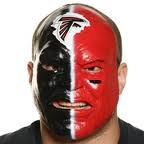
Are you strapped into the fandom of a futile franchise? “What do you mean strapped?” The first image we have of being “strapped in” is that of a pilot, heading upward in for a flight into the wild, blue yonder. Now picture a pilot being strapped into a vessel headed downward. That is the futile flight the passengers on board the Atlanta Falcon have experienced lo’ these many years.

Why do I continue to cheer the Atlanta Falcons on forty-eight years after I randomly chose to cheer them on when I was nothing but a seven-year-old, stupid kid who randomly pointed at them and said, ‘That’s the team I will cheer on.’
“You don’t choose your favorite team,” says a sentiment in Korean sport, “your team chooses you.” I get that, if we’re from Foxboro, Santa Clara, Cleveland, or the surrounding areas, it kind of makes sense. We have regional pride, personal history, and social bonds formed by everyone who forced us to cheer on the local team. What if we’re from an area, three to four hours’ drive time from the nearest professional organization, how they choose us?

I was seven-years-old when I chose the Atlanta Falcons as the team I would cheer on for the rest of my life. I didn’t choose to cheer them on for the rest of my life, but that is what happened. The stadium the Falcons call home is fourteen hours’ drive time from where I live, I didn’t know anyone who cheered them on, and I’ve met very few fellow fans since. My dad didn’t know much about professional football, and he admitted he’d barely even heard of the Falcons. The Falcons also didn’t have any of my favorite college football players on their roster at the time, and they’ve only had a handful of them since. I had little-to-no connection to the Falcons at the time, and I still don’t in all the ways we’ve outlined here.
We All Like Winners
The first thing the uninformed, unaffiliated seven-year-old fan routinely does is cheer on the team their dad does. If they are unable to formulate that connection, they choose to cheer on one of the closest teams they can find. The final determining factor for them is the success of the team. When you’re seven-years-old, your favorite team says a lot about you, and you want people to think you’re a winner. In the 70s, everyone’s favorite team was either the Steelers or the Cowboys, or if you were naughty, you cheered on the Raiders. Those teams were the winners in the late 70s, our formative years, and everyone I knew selected one of those three teams. I met a few Vikings fans, but the general sentiment on them was that they weren’t good enough to win the Super Bowl. I knew one Dolphins fan, but he received some grief for cheering on a franchise whose time had passed.

I decided to cheer on a team who didn’t have a past, a present, or future. A website called Quick Report lists the Atlanta Falcons as “the fourth worst NFL franchise of all time.” Another outlet called The Top Tens rates the Atlanta Falcons franchise as the 46th worst franchise in professional sports.
My favorite characterization of me is that I chose a team, independent of any influence, as a testament to the strong sense of individuality I obviously exhibited at a very young age. They were mine, all mine, and I didn’t have to share them with anyone, because no one else wanted them. Did I have an enviable streak of individuality at a young age? I did not when it came to books, music, movies, and other entertainment mediums. I liked what the cool kids told me to like, and when they turned on those players in the industry, I turned with them. I was not immune to peer pressure by any means, but I chose to thwart it in this one instance. Does that make sense to you, because it doesn’t to me.
The only theory I have that makes any sense is color. I liked the pretty colors they wore on their uniforms. The Atlanta Falcons franchise chose to wear Red, white, and black. These were the same colors as my favorite college football team, the team that represents my states, and the university I attended. I’ve only purchased four cars in my life, all of them were either red or white, with black trim. Those colors obviously appeal to me. If you’ve followed the history of the Falcon’s uniform choices, however, you know they’ve switched the color of their uniforms from black and silver to now black, red and silver. I didn’t switch with them or from them. Why?
Philosophical and Emotional Layers
The next logical entry is the “lovable losers” tag that we used to apply to the Chicago Cubs franchise. I submit that the worst business move the Cubs ever made was winning the 2016 World Series. Why, because a large segment of the nation, outside Illinois and the surrounding region, cheered the Cubs on because they were lovable losers. They won the World Series in 1908, and they waited 108 years to win it again. Five generations of Cubs’ fans knew nothing of championship rings, and they loved it. They loved it so much that if we were to talk about their latest losing streak, their foibles in the post-season, the Cubs’ fan might chuckle with us. They knew all about it, and they loved it so much it was almost a crafty marketing gimmick, enhanced by the stories of jinxes, including the Curse of the Billy Goat, the Black Cat Incident, Steve Bartman Incident, and the Bernie Mac Jinx. The Falcons are nearing sixty-years as a franchise, and the franchise has the Eugene Robinson incident and, of course, 28-3.

If the Atlanta Falcons fan, the WE, can make it past 28-3, what does that say about us? It suggests resilience, loyalty, and a sense that we’re all sharing in the struggle. Unwavering support is a badge of honor. If you’re a superfan, it becomes a part of who you are. It’s not just a preference, or it no longer is, it’s a reflection of your values, memories, and experiences. I becomes we, they becomes us, and those guys become our fellas fighting in the fields for glory.
“I think we’re going to draft an Edge rusher this year,” we say, “because that’s been our greatest need for almost a decade.” Again, I know very very few Falcons’ fans in my locale, about fourteen-hours’ drive time from my home, so when I say, “we” and “us,” I’m not sharing a perspective with anyone I know, except the far-flung writers on a Falcons message board.
When a team like the Falcons become us/we, the theys on message boards drop “28-3!” on us in a snarky, smug way that attempts to force us to probe the tapestry of our being. The truly sad thing is that it took me a while to realize that the personal pain I felt, after that infamous choke job, was actually and factually absurd. It took me a while to realize that I wasn’t actually on the field, missing a crucial block, throwing a crucial interception, snapping the ball with too much time on the clock, and electing to pass rather than run. I didn’t personally do any of that, I see that now, but I didn’t see that their (not our in this particular case) loss was not a reflection on my character. I actually had nothing to do with that loss. If it’s hard for you to grasp the idea that a rational, logical person couldn’t easily separate himself with the failure of images of football players on TV, you’ve never been, or known, a superfan.
As difficult as it can be for a superfan to disentangle himself from the emotional entanglements that emphasize his existence, I am making strides. I now write things like this, “I realize I know little-to-nothing about the day-to-day decisions on personnel and any of the intricacies involved in their decision-making process. I’m not there for the day-to-day, I don’t see these players in practice, and I don’t know them personally.” I wrote on “our” Atlanta Falcon’s bulletin board, “but I think the decision they made was a mistake.” In that disclaimer, I effectively gained some psychological distance from the ‘us, we, and our’ lexicon we superfans usually use.
I dropped that disclaimer on the billboard page many times, because I was trying to objectively say that I know my opinion is not only relatively and comparatively uninformed, and I know my opinion doesn’t matter, but I have to write it somewhere. No one ever replied to any of my posts. My guess is that this disclaimer might have been a buzz kill, because we all kind of know we don’t know squat, compared to the owner, the GM, the coach, and all of those in the hierarchy responsible for personnel decisions, but no one admits it. Such a disclaimer might also “pop” the delusion that we all know what we’re talking about, because we read it, watched it, and saw it in the games, so we know. Their ambivalence to my posts might also have something to do with the idea that it’s so obvious that we don’t know what we’re talking about that it really doesn’t need to be said.
Here is another element to the post 28-3 Falcons’ loyalty, if we’re going to vicariously partake in whatever glory they achieve in victory, we must also commiserate with them in pain. Wrong, watching football on TV is supposed to be something we do to pass the time, and it should provide entertainment to our lives, nothing more and nothing less. Wrong, it’s not entertaining, it’s football. It’s not life and death, and some part of me knows that, but it’s often the difference between a smile on the face for the rest of the week, and a “We suck!” Mr. Grumpy Face week.
“I look forward to [the offseason],” a man named Ryan Ray says in the GQ article cited aove, written by Tom Lamont. “The six to eight weeks when I don’t have to focus on anything to do with this football club. I long for it.” Ray also said, “Sometimes I wish I could just sit there without any bias [while watching a game], without any interest—but it’s not me. I’m tribal.”
I’ve been there Ryan Ray, and I feel you. I’ve watched numerous football games involving other teams, and I know how entertaining this game can be, when I have no rooting interest. I wish, like Ray, I could have fun watching a Falcons’ game and appreciate them from a distance. I wish I could sit back and appreciate the athletic exploits of Falcons’ players the way normal folks do, but when Falcons’ players succeed it’s nothing more than a relief that they didn’t fail yet again. I marvel at other players play at peak performance where the difference between winning and losing can be mere inches, or the subtle juke the runner puts on a defender that only a true fan of the sport can appreciate. When it’s all on the line, and my bias is in full force, I only experience abject failure, misery, and roughly three hours of what it must feel like to have clinical depression.

“If they make you so miserable, why don’t you just switch teams?” the non-sports fans might ask from Mount Simpleton. My dad asked me this question referencing the video games that made me scream like a lunatic. “If they make you this miserable, why don’t you just shut it off?” We laugh so hard at his simple-minded question that we didn’t even bother answering him. He didn’t get it. ‘You can’t just shut a game off, because you lost,’ was probably what we should’ve said. ‘That’s the whole reason we keep playing, to eventually and finally beat it. If you’re a gamer, you know this mindset without knowing that beating a game easily and often is actually kind of boring. If you can find a game that is so hard IT CHEATS! that’s the game you will play, to figure out, forever. We don’t quit working after we make our first million, that’s just the start, we don’t dump a lover when they start acting obnoxious, because their drama kind of, sort of makes them more dramatic, traumatic, and interesting in a way that’s tough to describe, and we don’t stop cheering for a professional sports team just because they’re 114 games under .500, and 10-14 in the playoffs without a ring. That’s the very reason to continue to cheer them on for life, because it says something about our character that we stay loyal to them no matter what. “NO MATTER WHAT happens!” Even if it means upping our Tricyclic Antidepressants (TCAs) and Monoamine Oxidase Inhibitors (MAOIs) on those three special Sunday hours. It’s all worth it. “No, it’s not!” It is to me, is what I’m telling you. Wait, what we’re talking about again? Oh right, shut up!
We’re passionate “prisoners [who are so] accustomed to our jails that we refuse means of escape,” Lamont writes, “Logic is not meant to be a part of the true fan’s equipment.”
If we did our research, and we do, every year, we find that some teams just do it better. That’s rough, tough, and difficult to accept, so we think, “They CHEAT!” They don’t, but it’s easier to say that “and I can back it up!” than it is to sit through the incredibly long and boring NFL Draft and know that some teams obviously have better scouting staff members, General Managers, coaches, and all of the others in their hierarchy who help select the best player for their team. It’s easier to suggest something nefarious is going on than to admit that the franchises in Kansas City, Philadelphia, and San Francisco are going to make “the perfect” decision for their team for the next four-to-five years.

“Why can’t we find those guys?” we shout at the screen every year. We’ve even gone so far as to hire those who used to make those draft picks for their other franchises, and they somehow lose that magic touch when they go to work for us? How does that happen for 58 years?
“On paper,” Lamont writes, “Intense fandom is absurd.”
If the Atlanta Falcons were a company that had a fifty-eight-year record of making poor decisions, I would’ve sold stock in their company so long ago I wouldn’t even remember owning it. If it were a TV show, movie franchise, or band that put out an inferior product year after year, we would’ve stopped enduring their stench of failure long ago. If our child continued to make such poor decisions, we’d have a “Come to Jesus” sit down moment with them. If it were a spouse, we might divorce them. Why don’t we seek a divorce from our team?
Lamont, quotes a therapist, saying, “People often seek me out because they are feeling stuck in a painful emotional pattern that just won’t let go.” She was probably speaking more generally, but we could easily attribute that quote to our super fandom. The therapist also said when she heard of some suffering from a mean case of super fandom, it reminded her of the mindset of those in a cult.
She described a commonly reported reason that people give for staying in cults: the sunk cost fallacy. “People can’t leave because they’ve spent so much time and money and energy,” she explained. I read this, and I reread it, and it tells me that some of our deepest affiliations aren’t calculated but emerge from the fabric of our lives.
She later regretted likening it to extraction from a cult. “The situation,” she said, “had more in common with addiction, the high highs, the low lows, the swearing-offs, the shame-inducing returns to the cookie jar.”
“There is a fascinating page on NamuWiki, the Korean-language Wikipedia, that outlines the philosophical case against abandoning one’s team,” Lamont writes. “The act is known in Korea as 팀 세탁—team laundry—and it is understood to involve a paradox. You care enough [that] you want to put an end to your suffering, [but you also] care enough [that] you can’t.”
Some of us grow wiser as we age, and we learn when, where, why, and how to expend our resources. When it comes to sports, I’ve learned, and I’m still learning, with massive amounts of failure in this regard, how to not care so much. Wisdom has taught me that it’s just better for my mental well-being to if not “turn it off” as my dad might suggest, but to lower the volume on all my caring. The Salvation Army suggests that “caring is sharing”, and it’s true in most cases, but caring can be scary at times too. It should be fun to watch “my” guys play football, but it’s not. I do not enjoy it. So, I tape the game on the DVR, and I go outside and play catch with the boy. Then, I check the score of the game on one of my devices. If I find that we won the game that day, I watch the game and vicariously partake in the joy of victory. If they lose, I delete the entry on my DVR. Seeing the final numbers (the score) on a screen, gives me even more distance from the foolish notion I have that some of this final score if “my fault”. It’s also so much less painful than watching their total destruction, or long, slow destruction occur in real-time. If I were part of self-help Falcon fan group session, I would suggest all participants engage in this behavior for better mental-health.
Some of our more obnoxious group members might suggest for even better mental-health, we should all consider a messy, complicated divorce from the “fourth worst NFL franchise of all time” and “the 46th worst franchise in professional sports”. If some of them could do it, I might applaud them, because I wouldn’t be able to do it. I will continue to cling to the handrail of this slowly sinking ship, in this tragic movie of my demise, where everyone in the audience is screaming, “Just jump off!” I’ve spent so much time, energy, and misspent passion on this inept franchise that even if you were to offer me a life raft, I might say, “Eh, I think I’m doing just fine right here.”
This might come as a shock to most superfine, but it doesn’t really matter what team we choose to cheer on. When fair weather fans tell me why they switch teams with regularity, they basically say, “I choose to cheer on winners, because I’m a winner.” I could say, ‘I’d like to see the science behind that,’ but I know it’s such a ridiculous statement that it’s not even worth challenging. Yet, is saying, ‘I choose to stick by my team no matter what happens, because it’s a testament to my character,’ just as ridiculous? Yes, it is. It makes no sense that I could never follow through on a complete divorce either, even though the temporary separations I’ve achieved over the years have proven great for my mental health. It’s illogical, absurd, and whatever adjectives we apply to superfans, but it is a part of our personal constitution that we stay loyal no matter what happens, and we think less of those who don’t.
 Rilaly