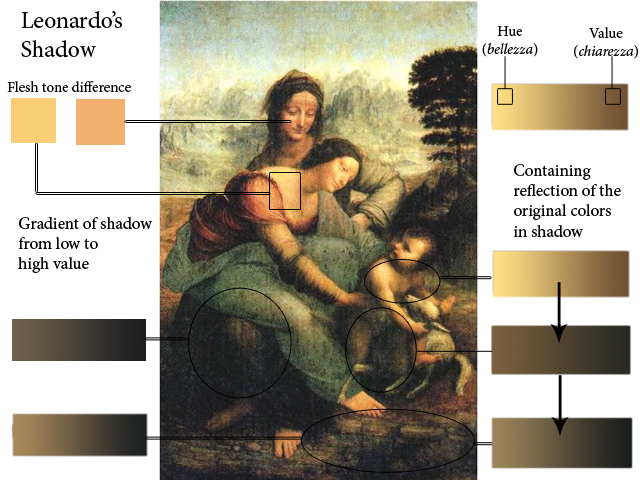
“Leonardo was so obsessed with using shadows and reflected light that he wrote fifteen thousand words on the topic, and that is probably less than half of what he originally wrote,” Walter Isaacson opined.
Using shadows and reflected light is a technique that doesn’t have to be limited to painters or image creators, in my humble opinion. It can be used by article writers, novel writers, and just about every form of writing, if they’re not using it already. This mindset resulted from a technique da Vinci used in his paintings called sfumato, or “gone up in smoke”. I use it so often that I don’t think of it as a technique anymore, but I found it interesting to read the explorations of it by one most famous artists in history. The basic tenet of the sfumato technique, da Vinci made famous, was to avoid using specific and concrete lines in his paintings. This might not sound like a novel technique to the accomplished artist of the day, but it was groundbreaking in its day. Da Vinci did not invent this technique, as some evidence suggests it dates back to the chiaroscuro effects used by ancient Greeks and Romans, but da Vinci took it to another level.
When the writer begins writing a story, they characterize their main character with bold lines through unique, individualistic, and semi-autobiographical lines. The more an author explores that character, the more they chip away at strict characterization and allow their main character to breathe for themselves in a manner that adds dimension. They characterize with shading and reflection, or refraction through supporting characters, until they have done little to characterize the main character except through their interactions with others and events. Their main character becomes more prominent through these literary devices, until the central character becomes the literary equivalent to an eye of the storm.
A perfect example of this occurs in modern situation comedies. Most sitcoms have an “eye of the storm” character, we can characterize as the “us” character. The us character reflects us, but the us character also inadvertently defines the other characters as often as the other characters define him through interactions. The characters interact, and the us character is our way of dealing with all of their zany ideas and acts of the side characters, until we learn more us and all of the characters involved. Defining a character otherwise can leak into a term we want to minimize as much as possible. Think about that in terms of the sitcom. If the main character stood before the camera and told us about his likes, dislikes, and a little bit more about him, how boring would that be? It works in some cases, Larry Sanders, or The Office, but it doesn’t work in most cases.
In most cases, we want to see characterization in action, we want to see what da Vinci called sfumato technique, or what we call the “show don’t tell” technique. The author uses supporting characters and setting to define their main character, and they use all of this to bring the events involved in their stories to bring them to life. The takeaway might be that the optimum characterizations are those characterizations that appear more organic to the reader. In other words, the author should be working his or her tail off to make the work appear so easy that the reader thinks anyone could do it.
Chekov’s Razor

Checkov’s razor is easy to understand. Write the first three paragraphs, pages, or whatever you need to familiarize yourself (the author) with your material and write the rest of your piece. Once the author is done with that piece, go back and delete the material that you had to write to start and start at the most compelling piece of your article. If you have germane sentences in that intro, save them, and work them into the body of the piece. Delete the chunk of exposition that it turns out was only written for you. Let the reader enjoy the rest.
“But, wait, what if it’s brilliant,” we say to counter that argument. It could be, it might be, but it likely isn’t. Some of us get so locked in and locked up by the ‘we are a man of golden words’ notion. It’s the whole, ‘there’s no such thing as mistakes,’ philosophy, generated by artists the likes of Pablo Picasso and James Joyce. There are mistakes in writing, and leaving that big chunk of exposition at the beginning of your article is one of them.
“There’s no writer’s block. There’s lazy. There’s scared, but there’s no writer’s block. Just sit down and realize you’re mediocre and you’re going to have to put a lot of effort into this to make it good.” –Jerry Seinfeld
Writer’s block, according to Jerry Seinfeld’s definition, is the desire to start writing brilliantly. It’s the “If you can’t be the best, why do it?” block that inhibits writers from writing a single word, or the writing, deleting, writing, and deleting merry-go-round. It’s the dreaded, blank page, or the blinking cursor syndrome that prevents us from writing a single word. Jerry’s remedy is to accept the idea that you’re probably not half as brilliant as you think you are, and once you reach a point that you might be mediocre, it might be possible to write something that’s actually pretty good. My philosophy is similar, but I no longer think about greatness or mediocre distinctions. I just write until something good poops (and yes, I meant poops!) out.
We might call this the discovery phase. In the discovery phase, the writing is gibberish to everyone but the writer. This is the “all play no work” phase for most writers, as it allows us room away from our aspirations to true creativity. Some of the best room for creativity occurs when we have an ending in mind, as it’s fun to fill in the blanks. Filling in the blanks might also lead to a new ending.
The takeaway for aspiring writers is to get the idea down before you forget it. Don’t worry about sequencing, chronology, grammar, spelling, or if this story is the base for the next great American novel. Just write it down and worry about all that later. Just write a bunch of gibberish down that only the writer understands, until the subject matter begins to open up to the writer. Once the author is in, the material might have the wherewithal to be in a near proximity to where a story lies, but the real story could take paragraphs, or pages, to develop.
Chekov’s razor focuses on threes, the first three paragraphs, and/or three pages of a manuscript, short story, or essay, but I’ve found this length arbitrary. When I begin a story, I think I have a full-fledged introduction on my hands. I don’t think anyone writes gibberish just to write gibberish, it feels like this could or should be the story at the time. I lock myself up when I try to determine if the writing is up to my standard, or if it’s going anywhere. I unlock myself by writing it all down, all of the important and unimportant that comes to mind, then I delete the unimportant.
Chekov’s razor comes into play when we go back and delete the unimportant. That is rough too, because all writers live with the “Golden words” mentality. Everything I write is not only good, it’s vital, and germane to the story. The writer needs to ask themselves am I a good writer or a good editor? The answer, if you’re going to try to write for others, is you’re going to have to be a little of both. Or, you can have a friend read it, or pay to have someone edit it for you. If you’re as megalomaniacal about your words as I am, you’ll either find a way or you won’t, and your work will suffer for it.
In the course of writing past the blinking cursor stage, we discover pivot points that take us to the next stages of the story, but we don’t consider them anything more than what they are at the time. In the course of rewriting, however, we discover the pivot point is the story. The frustration falls on two tracks, the first is that we fell in love with that original idea, and it’s tough to just walk away. The other is that we “wasted” so much time writing “the other” story that we loved. When writers achieve the ultimate point of objectivity, when they realize story is sacred, they begin sacrificing all the information they love to leave information you will.
Thus, I don’t believe there is magic in the power of threes in employing Chekov’s Razor to storytelling. A central idea, or pivot point arrives in the course of writing, but the point of Chekov’s razor is to dump and delete the useless information the writer used to write the story.
An important note to add here is that if most authors work the same way I do, we do not write for the expressed purpose of finding the core of our story. Our perspective is, we think we already have the story, and that the only chore involves building upon it. The discovery of the core of story often humbles the author and slaps them back to the realization that no matter how many times we write a story, the art of writing involves mining the brain for ideas rather than having a brain loaded with brilliant ideas. That conceit eventually reveals itself to those willing to write a lot of material, and it’s up to the author to recognize the difference for what it is, if they want a quality story.
It happens in the course of writing it, editing it after we’re done, or in the daydreaming stage that can last for days, weeks, or months. I do not enjoy deleting the chunks of material I’ve written, and I don’t think anyone does, but the quality author will develop the ability to recognize what portion of the story is for them and which portion is for the reader, and they will crib note or delete the part of the story that is for them.
I don’t consider the revelation of these techniques a glamorization of my process. I think it demystifies the process by suggesting that anyone can do this, as long as they write as often as they need to discover what should become the central focus for the reader. Every author needs to move past their conceit of their self-defined brilliance to find the story they’re trying to tell, and learn how to work from within it.
As I’ve written elsewhere, the most prominent use of Chekov’s razor can be found in Franz Kafka’s Metamorphosis.
 Rilaly