Norm Macdonald Could’ve Saved the World


There was something different about Norman Gene Macdonald (Norm). He was funny, but there are a bunch of different flavors of funny. Norm was the type of funny we might only see once to thirty-four times before we die. Stick with me here for just a second, and four-thousand words. There have been a bunch of guys who tried to save the world, and we all gathered together to listen to them. We followed their prescriptions for a better world, and where did that get us? Some of them cured stuff, technologized stuff, and said some profound things to change things temporarily, but after they died we all went back to the world they lived in. So, what if we tried something so unusual that it changed us. I’m always on the lookout for something different, and why aren’t you? Nobody says they’re the same as everyone else. Everyone says they’re different, but they’re all different in the same ways. “I’m different! I don’t know listen to the man or nothing.” Who’s the man, I don’t know, but the band Anthrax says he puts you in detention. Norm had no authority, and he didn’t want it, so why should we give him the keys to the castle? Well, we’ve tried everything else, and nothing has worked so far. Why wouldn’t we try something different? Just to see if it works. I watched, read, and listened to Norm a lot, and I thought he was so different that he might just be the type who could’ve saved the world.

Norm wasn’t that guy of course. He was a type who’d much rather go boozing and gambling when he wasn’t on a stage. He had that self-destructive gene that seems imprinted in his type, but what if he wasn’t? What if he was the type who could analyze us, undress us, and leave us feeling so naked with a few words that left us laughing our socks off, and we felt so foolish in our certitude and convictions that we changed just a little bit?

In our modern geopolitical world, with all of our political ideas and ideals, we’re just certain that we’re right and they’re wrong. We’re the most advanced people in the world, because we’ve learned. What have we learned? Who are the they that were better than? Other countries, other parties, other people, or the past? We might not be better than present tense people, but we’re definitely better than the past. Ok, but didn’t they think the same thing when they were in their present? They were as certain as we are that they they were better than people from the past, and they probably were, but they didn’t account for us, the people of the future. We’re the people of the future, but we think we’re the people of the present, and we are, but are we so right on, right now, that people in our future won’t think they’re superior to us, mocking us, and deriding us for our convictions? They won’t, because we have science, and we know our science. The past had gaps in their knowledge, and we filled it. We think we’ve filled those gaps so well and so thoroughly that people of the future won’t have anything to fill. “What are you going to fill?” we ask. “It’s already full.” Norm didn’t just fill the bad gaps that ignorant people believe, he filled the gaps of the good stuff that we love, want to believe, and we need to believe for our own superiority, or if he didn’t fill those gaps, he asked us to ask ourselves if it was at all possible that we might still have gaps in our understanding that future man might come along and fill and ask us why we were so stupid that we thought there weren’t any gaps. Then, there’s that truly humiliating question everyone hates and no one wants to hear, questions that make us question everything we hold dear, what if we, the people of the present turn out to be wrong about all the this and that’s that are so decided that we don’t even consider them this and that’s anymore? 

What if we missed our chance at a real game changer, because we were looking for some charismatic type who wanted things. If you have a guy who wants things, you know him, because he’s a lot like you, because you want things too. Norm didn’t appear to want anything more than to sit around and think things. Was he lazy, and did he lack ambition? Yes. He had no material desires, he didn’t do much to foster what could’ve been a better career, and he didn’t openly wish for a happy death. He basically said once we’re all dead no one is going to remember us, “So, who cares if you do things or don’t do things.” People might be sad for a while after we die, because it will be a tragic thing, and they might bring up some of the things you did and didn’t do, but after a while your name will not come up as often as it once did, until no one remembers that you were ever here. So, enjoy your life, and do and don’t do what you want.

To illustrate Norm’s point further, I saw a picture of my great-great grandfather. I didn’t even know he existed. I sort of knew that he had to exist, because for me to exist, he had to exist, but I saw a man who very loosely reminded me of former president James Garfield. I saw another great-great grandfather on the other side, who looked like Abraham Lincoln, people apparently told him he resembled Lincoln on a daily basis (sans the beard). Other than fancying the notion that I might be a descendent of two former presidents (imagine how much better my story would be if that were the case, or how comparatively depressing), I thought about how my great-great grandchildren wouldn’t exist if I didn’t exist. “I’m responsible for your existence!” You think they’ll be grateful? If they see a picture of me, they might “huh!” me and toss me aside to look at pictures of people they do know. (If they even notice a picture of me in a cloud of millions of unlabeled iPhone pictures.*Note to self: Label your photos.)

Not a Wonderful Guy 

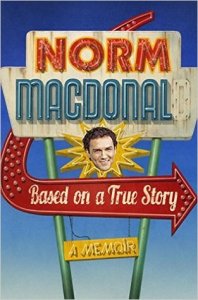
Norm didn’t write Based on a True Story: A Memoir to further his career. He wanted to write a book, and he wanted to get loads of money for it, but career advancement was about as far from a goal as it could be. What was his primary goal? What’s the primary goal of any celebrity writing a memoir? They want you to think they were one hell of a good fella or female throughout their life. 99.9% of Hollywood, political, etc, memoirs drift around various definitions of ‘wasn’t I wonderful?’ Some are direct. They’ll tell you about that time they donated to charity, interactions they had that lead you to believe they had wonderful intentions, or how comparatively awful everyone else around them was. Reading through good, old Norm’s book, we get the idea that Norm didn’t care about any of that. His closest friends, peers, and cultural commentators will tell you that the only thing Norm cared about was being funny. He didn’t care about money or fame, everyone writes that in their book, so you’ll find them wonderful, but in a strange, almost unsettling way we think Norm didn’t care about any of that. He cared about being funny. He didn’t care if you thought he was funny, as long as it was funny. Most of his friends and peers label Norm a comedian’s comedian, which in my estimation means he strove for comedic purity. How does an artist near the point of purity, at least internally? We ask those in the craft that who are pursuing the same thing. It might sound elitist, and it is, but if our goals in life revolve around making the best horseshoe known to man, we might not care what our customers, the laypeople, think, if those in our field of expertise consider those horseshoes the best they’ve ever seen.

Most artists use the memoir as a vehicle to promote their career, or their image, and the idea that while they may appear to be a little quirky to the naked eye, deep in their heart, they want you to know they are actually a very wonderful person. No matter how apathetic, somewhat cruel, and insensitive an author of such material is, the unspoken rule of such comedy is that the author breaks down the fourth wall, in some manner, to let you in on the joke and in on idea that they’re actually pretty nice and very wonderful people who care. Norm Macdonald, the character that he has created for this book, and all of the layers in between, does not seem to care that you get any of that. Most authors that approach a style similar to the book, qualify their motivations for doing what they did with follow ups that redound to the benefit of the author. Norm Macdonald does not appear to care why the reader bought his book, about their outlook on him, or if that reader feels good about themselves, and their world, when they finish the book.

Norm’s Untimely Timelessness: There are no timely elements in this book. Norm Macdonald appears to feel no need to convince us that he is actually very smart, savvy, or anything more than he is. There are no subtle approaches to timely or timeless notions that inform the audience that Norm is compassionate, empathetic, or nuanced. Norm was one of the few celebrities that did not care to tell you what he thinks about pressing or non-pressing matters of the day, and I’m not really sure he cared what he thought either.
29937870Norm was Always an Old Man

Norm was an old soul. He probably sounded old when he was very young. (How many modern books, Based on a True Story: A Memoir, invoke the word “Hoosegow”?) Norm’s dad was old when Norm entered into the world, so Norm spent most of his youth in the company of old men who knew manual labor for the majority of their lives. Norm surely went through the stages of rebellion we all go through to unshackle himself from parental influence to form an individual identity. He probably mocked his old man in various ways, and he surely rejected the old man’s ways of thinking for a time, but by the time we met him, circa aged thirty-one, he came back around to his Hoosegow talk. A more insecure comedian and cultural commentator might try to sound more hip, cutting edge, and nouveau to appeal to the audience. Norm’s voice employed an old man, old world influence that served to intrigue rather than confuse. If the reader is the type that needs some sort of qualifier, or apology, for the somewhat cruel, and insensitive scenes, takes, and reactions that occur throughout this book, it can be found somewhere in the kind, pleasing Midwestern sounding voice that Norm, and his ghost writer Charlie Manson, employed.

I knew nothing of Macdonald’s upbringing, prior to the reading of this book, and I didn’t care about it either. After reading the initial chapters of this book, however, I found myself relating to the rhythms and lexicon Norm learned from the old, hired hands he knew growing up. His dad, my dad, and their friends were old, no-nonsense men that had an old world, no-excuses, masculine structure to their being that is too often lacking in today’s culture. The locale of Macdonald’s rearing was far different than mine as it turned out, but the details of his maturation were so similar to mine that I was surprised to learn we didn’t grow up the exact same time and place. This could be as a result of Norm’s better-than-expected ability to relate to the reader, or his ghost writer’s ability to translate Norm’s thoughts into a book that I found my voice in. The ghost writer is renamed Charlie Manson for the purpose of this book (not that Charlie Manson, the other one.)

Norm on Sex

Norm enjoyed talking about sex, but he did so in a manner that is almost 180 degrees different from any cultural commentator. He talked about sex as if it were nothing more than a stage in life, as opposed to the customary way we have of referring to it as if it is life. He talked about the routine elements of sexual actions, and he talked about the routine immaturity of the act. In an online collection of his jokes, he talked about having sex in his youth, and how he grew out of it to some degree.

“I don’t care for sex. I find it an embarrassing, dull exercise. I prefer sports, where you can win.”

Even though Norm submitted his unique take on not enjoying sexual activity, he admitted to being human in this regard:

“This is the amount of time you think about sex: every once in a while. The problem becomes, when you think about it, it’s all you can think about. It encompasses your whole brain. You’re like a werewolf or something. Usually you’re a civilized human being, but then every couple of days, you’re like “Arrrgh.” Then you’ve got to close the blinds.”

As for the routine nature of it, Norm suggested that he, like all of us, tried to shake the routine of sexual activity up and try something different every once in a while:

“Sex couldn’t be simpler. I think there’s only like five things you can do in the whole thing. You ever think you invented a sixth? Then later you go, “Ah, in all humility, I guess that was pretty close to number five.”

“My wife dresses up like a nurse; then, I dress up like a nurse, also. And then, we don’t even have sex, either. We just sit behind this huge, semicircular wooden desk and get annoyed when people buzz us for juice.”

The bits above are funny, but they don’t really cut to the heart of Norm’s unique, refreshing views on sex in the manner Norm opened up about it on a transcript from a talk show:

“I find sex very repetitive and dull and kind of pointless.” Norm said he finds it a childish desire which he’s spiritually outgrown. I find sex to be a very filthy act in the sense of being shameful. Sex is an activity we don’t do in public due to its intrinsic shamefulness.” He quotes scripture saying, “When you’re a boy, you do boy things. I know most people are children for their whole life, and [sex is] a way of having fun.”

The Out-Joke

When the cavemen drained all of the comedic value out of punching each other in the face, an enterprising young caveman comedian probably tried violating his tribe’s taboo by punching women in the face. And before you say jokes like that only attract troglodytes, remember that was Mujmuj Kandar-Smith’s key demographic. Once they moved past those jokes, and the jokes about the limbs they lost in their Sabertooth Tiger hunts, they probably turned to self-effacing humor. The key to really good self-effacing humor is that it allows us to laugh at ourselves through the vulnerability of the comedian, yet most standup comedians are not of such strong constitutions that they can handle an audience laughing at them, so they cloak it in a type of humor that asks us to laugh with him, as opposed to at him. They’re letting the audience in on the joke. It’s the “aren’t I silly, aren’t we all just silly” approach that carefully approaches their foibles in a way in which we can all laugh at ourselves, so that we’re not just laughing at the comedian. Norm perfected the art of not allowing the audience in, so that the audience uncomfortably enjoys laughing at Norm. Norm didn’t invent this form of comedy, of course, as his most immediate predecessors might be David Letterman, Andy Kaufman, Chris Elliot, and perhaps Will Farrell. Yet, Norm may have even carved out his own niche in this niche in this form of comedy with his old timey lexicon that led us to believe we were laughing at our dad, our grandpa, or our predecessors. We also know that his social commentary was delivered in a tongue-in-cheek manner. In the character Norm developed, onstage and off (with this book) the reader is not so sure if it’s all good. The narrative of Based on a True Story: A Memoir leads the reader to feel sorry for the character, while laughing at his naiveté, and his inability to abide by social norms.

Norm was a Savant

Norm Macdonald didn’t do well with some basic simplicities of life. He never learned how to drive. Some, who knew him well, said that he had some difficulties with what we might consider normal human interaction, or he wasn’t gifted in this arena. When he failed to understand the consequences of his actions, some assigned motives to his actions. Others, those who knew him best, said that was just Norm. Yet, his peers suggest he might have been a comedic savant, or an individual with detailed knowledge in some specialized field. Norm was a brilliant satirist, a gifted jokester, and well-read history buff, but it appears that he was missing some ability to make links. He made a joke one time, on Adam Carolla’s podcast that he ate Count Chocula for dinner and generally had the diet of a seven-year-old child. Was it intentional, whimsical, or did he have such tunnel vision that he failed to understand some of the complexities to keep up with the rest of us. I wouldn’t say I know a truth, of course, but there is evidence of a complex understanding of the greater things in life, in the mind of Norm Macdonald, coupled with an almost child-like naïveté in matters we consider simple.

Norm was Different

Monty Python had a slogan that prefaced much of their material, “And now for something completely different.” For those of us who pine for something different, this book contains stories, reactions, and anecdotes that I have to imagine most authors, and almost all celebrities do their best to avoid. I have a sneaking suspicion that Macdonald’s public relations people asked him to include the “Based on” words to the title of his book. I have a sneaking suspicion that Norm wouldn’t mind it one bit if the reader believed this was the true story of Norm Macdonald’s life. Something tells me that his people, friends, associates, and business partners cautioned him to bolster the doubt regarding the material, because too many people might believe it’s his true story, and that this book may do some damage to his career.

Norm was a Closer

Norm’s good friend, Dennis Miller, said, “Always be closing” on a daily basis on his talk-show. As such, “Based on a True Story: A Memoir” is either building to a close throughout the various chapters, or its closing throughout. When it’s not strict to script of the respective story, hilarious anecdotes break the story up so well that one has to gather one’s self and remind themselves where the narrative was heading. The anecdotes appear to be accidental humor in other words. In the beginning of this book, I began highlighting some of the jokes believing that they would be precious jewels that I would have to remember. I do this with all provocative lines and paragraphs, but as I continued throughout the book, I gave up, knowing that when one highlights too often, the portions that are highlighted begin to lose value.

Norm Macdonald was Norm Macdonald

Norm Macdonald does whatever the hell Norm Macdonald wants. Is this a true narrative, Norm not does appear to care what the reader believes one way or another. Is this a readable narrative that involves the time-honored traditions of storytelling, Norm doesn’t appear to care. The storytelling format does have a Fear and Loathing in Las Vegas feel to it, but other than that it does not follow the rules of any celebrity memoir that I’ve ever read. He may have informed us of some true facts regarding his upbringing, and the many things that have happened to him along the way, but he doesn’t care if the readers knows the difference, or, apparently, if those distinctions could lead to some damage of his career as an entertainer. As a result, I would say that this is by far the best celebrity memoir I have ever read, but I have the feeling Norm wouldn’t care what one way or another.

Norm Macdonald Could’ve Saved the World

With all of his flaws, and according to friends, family and peers, the flaws were numerous, he probably wouldn’t have been elected a world leader, but how many world leaders are so flawed that their handlers do much of the public affairs and public relations work? He couldn’t have been elected to anything, because he wouldn’t take it serious enough. Yet, in those spare moments when the real Norm Macdonald stepped up to the plate to drop some truly profound nuggets on us, I thought this man is one of the more unusual thinkers I’ve ever heard. He was, by many accounts, the smartest guy in the room who tried to conceal his intelligence for reasons of humility, and he fell prey to the notion that smart people aren’t cool. He didn’t care about that, and he obviously did at the same time. It was so surprising to me that when I heard him talk serious, I wondered if the alternative sides of Norm Macdonald could’ve done something historic if he wasn’t so lazy and apathetic about all the things we consider so serious.

*I’ll refer to Norm Macdonald as Norm throughout this article. It’s not intended as a note of familiarity, though I do feel as if I know him as an audience member, I had no personal ties to him in anyway. I also don’t intend it as a lack of respect, as one would if they took the time to wrote his name in full, or labeled him Mr. Macdonald. I’ll refer to him as Norm throughout this article purely for readability.

A Book Review: of Brett Martin’s Difficult Men


Difficult menBrett Martin’s book Difficult Men, is a writer’s dream, in that it finally gives credit where credit is due. It doesn’t give undue credit where so many other, lesser periodicals, give credit, to the stars. It doesn’t give undue credit to the directors of the individual episodes, the “brave” networks that eventually broadcast them, or that individual studio exec that provided the show its green light. It does give credit, finally, to those who rarely receive the amount of credit they are due in the court of public opinion, the writer. Martin is more specific in his dispersal of credit when he says it’s not just any writer that deserves credit for the success of these shows, it is the writer, the creator, the head writer, the emperor of the room, or what he calls the show runner.

“The show-runner,” writes Martin in a GQ piece, “is this era’s version of the Creative Titan.”{1}

The amount of credit currently given to star James Gandolfini, for the success of the show The Sopranos, is entirely disproportionate to the amount of credit owed show runner David Chase; Jon Hamm’s acting ability, and his rugged good looks are a reason that people tuned into Mad Men, but the overall quality of the show is primarily due to the writing, and the obsession, of show runner Matthew Weiner; and Bryan Cranston isn’t Breaking Bad as much as Vince Gilligan is. Martin does give some credit to the stars, and to some of the individual writers of individual episodes, and to some of the other behind-the-scenes players of each show, but he maintains that these shows wouldn’t have been a fraction as good as they were, if they were in less capable hands than those listed as creator, or show runner.

This isn’t to say that Martin’s book Difficult Men is as obsessed with credit dispersal as I am. He simply focuses his narrative on the history of these show runners, and the work each of them did throughout the life of the project in question. The rest of us can’t help but be obsessed with credit, especially when so many of our friends misdirect it to the stars.

James Gandolfini is the face of The Sopranos, of course, and Jon Hamm is the face of Mad Men, so most of us can’t help but associate them with the shows, and subsequently give them all the credit. Just as we can’t help but believe Basic Instinct is Sharon Stone’s movie, and her coming out vehicle, and the movie where she showed a vital organ. Very few people have even heard of Joe Eszterhas and Paul Verhoeven. Everyone knows that Christopher Reeves was Superman, but how many people know the name Mario Puzo? How many people, on that note, know what Mario Puzo’s relationship to “Marlon Brando’s” The Godfather is? How many of those who love Entertainment Tonight, and their red carpet interviews, know anything about what happens behind the scenes of their favorite movies and TV shows, and how many would care if they did?

Those of us who care, and wish the creative types received more credit in the public arena than they do, have tried to stay in tune with the creative drivers of the projects we love, and we subsequently became obsessed with knowing which party deserves the credit for each production. Martin’s book Difficult Men informs us that we have been wrong in our credit dispersal when it comes to TV.

Prior to reading this book, I assumed that in TV, like the movies, the directors rule. Those of us who love movies, for example, know that a Scorsese movie is almost always great, regardless of the star who leads it, the screenwriter who writes it (unless it’s Scorsese), or any of the behind the scenes players involved in it. Therefore, we obsessives have habitually searched through the credits of TV shows to see who the director was to determine if that show will be any good or not. Martin informs us, through a Matthew Weiner quote, that movie goers are dead wrong in their assumption that directors have the same amount of power in TV that they do in the movies.

Those of us that love books, also lived with the somewhat sanctimonious assumption that individual writers were more of an essential ingredient to TV shows, but we didn’t put enough thought to the concentration of power that had to be assumed by the head writer, or “emperor” of the writing room, to keep it all consistent.

Here’s what most of us thought. We knew that there had to be an “emperor” of the writing room, but we thought that an individual writer, of an individual episode, simply handed the finished draft to the head writer, and that head writer then either outright rejected it, or added a few notes here and there to spruce up the final product. We thought that the head writer acted in a manner similar to an editor of a freelance magazine, and he would continually reject an individual writer’s product, until it was perfect. We also knew each episode had a “writing room’s” influence on the finished product, but we had no idea—as in the case of Weiner and Mad Men—that the head writer, or the show runner, rewrote an average of eighty percent of every episode that was handed to him. We were the ones trying to dissuade our star-obsessed friends of the notion that the stars were the end all of a given product, and that it had more to do with the individual writers. Yet, we were even wrong by a matter of degrees. Martin writes that a show runner is, in general, and specific to these particular shows, the person that dreamed up the general premise of the show, wrote the show’s bible, and controlled and edited every aspect of that show.

Martin’s description of the process is as follows: The writing team meets behind closed doors, they put in an ungodly amount of hours trying to come up with ideas for each individual episode. One writer will then eventually take the lead on an episode, and he and the rest of the writing team will eventually come up with a 40-50 page script. Once they have completed this script, the show runner will walk into the room, take the script to his office, and rewrite 80% of it, on average. For most shows, the next step in the process involves a debate between the studio execs, network censors, and the show runner over what they believe will be popular and acceptable to audiences and sponsors. With these three particular shows, however, the show runners state that this part of the process rarely involved much in the way of this intrusion.

Show runner of AMC’s Mad Men, Matthew Weiner, illustrates his role as the show runner in the following description:

“Over 80 percent (of writing on TV) is rewriting, and if I’ve rewritten more than 80 percent of a writer’s script, I’m going to attach my name to it. If I keep 20 percent or more, of one of my writers’ scripts, I’ll give them a lone writing credit. Basically, it’s a question of ego. I can’t stomach the idea of someone not knowing that I was involved in it. For the well-being of my daily interaction with the people I work with, I felt it best not to have to watch somebody go up and get an award for something I had written every word of. I’m not Cyrano de Bergerac.”

The one asterisk to the process described above, for these three particular shows, is Breaking Bad, as show runner Vince Gilligan regards the process as a more democratic one than Weiner, Chase, or even Deadwood’s creator David Milch do.  It should also be mentioned, in this paragraph of asterisks, that Brett Martin’s Difficult Men covers a number of other shows in Difficult Men, including: The Wire, The Shield, Six Feet Under, and to a lesser degree Deadwood and Dexter. All of these shows, writes Martin, comprise what critics call the Third Golden Age, but I regard The Sopranos, Mad Men, and Breaking Bad as the triumvirate of it.

Another little talked about aspect of these three shows, that turned out to be essential to the show’s long term success, was the main star’s willingness to acquiesce to the show runner’s ideas of where the character should go. Most stars are not willing to concede characteristics of “their character”, because it will reflect upon them more than the show runners. Most stars are not willing to put themselves in compromising positions, and they’re not brave enough to look bad on screen with the fear that it could affect the rest of their careers. Cranston, and to some degree Gandolfini, weren’t afraid to have themselves portrayed on screen in their underpants, which Vince Gilligan says is a “pretty good physicalization of their fearlessness.” These stars had to be willing to be very “un-starlike” for these particular shows to have the kind of flawed weaknesses that eventually made them monumental.

As stated throughout Difficult Men, the egomaniacal nature of the show runners was paramount to the success of these shows. It dictated to the stars that they would acquiesce, but it also dictated to the networks that they would have to acquiesce too. Had any of these show runners sacrificed their egos, and gone with the “suggested” tweaks of the studio execs that eventually rejected these shows—just to finally get their project made—these shows surely would’ve been different, and possibly drained of most of the value they eventually brought to TV.

One cannot entirely blame those studio execs who passed on these shows, as they had their own bosses to answer to, their sponsors to satisfy, and their audiences to avoid offending. To get these particular projects made, the studio runners needed a vulnerable network that was less concerned with controversy, and ratings, and in having “some say” in how the finished product would appear.

“In TV, as nowhere else, the writer is king—none more so than those emperors of the air that control every aspect of an ambitious, ongoing cable drama,” Brett Martin writes in the GQ article.

I’m embarrassed to say that I never heard of this term “show runner”, until I read this book, but I did have an idea that there had to be an “emperor” of the writing room. I had these ideas of how a show was created, but I never really focused in on it, until HBO informed me, in their ad campaign, that I should watch Deadwood, because its creator, David Milch, used to work on The Sopranos. AMC ran a similar campaign for Mad Men, saying its creator, Matthew Weiner, wrote for The Sopranos. Other than maybe Steven Bochco, I can’t remember a creator given such prominence in a show’s ad campaign, and Bochco largely created shows that I didn’t watch. I did watch The Sopranos, however, and I was willing to watch any show attached to it in anyway, especially when the ad campaign centered around the show’s artistic creativity and not the stars. The only reason AMC used the campaign they did, writes Martin, is that they couldn’t think of another way to market a show about ad men sitting around a table talking sales.

As the title of this book suggests, the stories of these three shows involve difficult, uncompromising, and flawed males, but the real story, or the story behind the story that is not commonly talked about with these shows, involves the difficult, uncompromising, and flawed males behind the scenes that got these shows made, and finessed, until they achieved the creator’s idea of perfection.

Portions of this book are devoted to the stars of the shows, but if you are purchasing this book to learn more about them, you’re probably also going to be disappointed, especially if your perspective is that they are strictly star-driven vehicles. And you’re probably going to be just as disappointed by the limited amount of space Martin devotes to Gandolfini’s psychosis, the Tweet page devoted to showing Jon Hamm crotch shots, and Bryan Cranston’s comfort level with being shot in his underwear in various episodes of Breaking Bad. That having been said, Martin’s book Difficult Men, and his perspective, is probably not what most readers would  expect, nor—sadly—enjoy, but it’s fantastic.  No reader, who makes it to the end of this book, could mistake it for a gossip piece that focuses on the daily lives of stars. It is about the creative process. It’s about quality TV.  It is about how one show, The Sopranos, influenced some relatively vulnerable cable TV networks to pursue other, similarly “important” shows, until a Third Golden Age of television was born.

Consider the Lobster: A Review


Consider the Lobster starts out as most brilliant, pop psychology books do from an angle we may have never considered before. Since this book is a collection of divergent essays, it should be reviewed chapter by chapter and essay by essay. The first essay Big Red Son involves comedic talk of the porn industry. To be fair to the author, David Foster Wallace, this essay was first written in 1998, and some may conclude it unfair to declare it dated, but I didn’t read this until 2012, so I am forced to say that this material has been mined for all its worth at the time of my reading. (See Chuck Palahniuk’s Snuff.) The second chapter Some Remarks on Kafka’s funniness… whets the appetite. The general theme of this chapter “that humor is not very sophisticated today” has been mined by those of us obsessed with pop culture, but Wallace does get some points for listing the specific problems with the current sense of humor that doesn’t understand the sophisticated and subtle humor of author Franz Kafka. He says: “Kafka’s humor has almost none of the particular forms and codes of contemporary US amusement.” This launches the Wallace into a detailed list of complaints about contemporary humor brought to the homes of TV watchers.

David Foster Wallace

“Kafka’s humor has almost none of the particular forms and codes of contemporary U.S. amusement. There’s no recursive wordplay or verbal stunt-pilotry, little in the way of wisecracks or mordant lampoon. There is no body-function humor, nor sexual entendre, nor stylized attempts to rebel by offending convention. No slapstick with banana peels or rogue adenoids. There are none of the ba-bing ba-bang reversals of modern sitcoms; nor are there precocious children or profane grandparents or cynically insurgent coworkers. Perhaps most alien of all, Kafka’s authority figures are never just hollow buffoons to be ridiculed, but they are always absurd and scary and sad all at once.”

The point that Wallace attempts to make is that his students don’t understand Kafka’s absurdist wit, because they are more accustomed to being spoon-fed their entertainment. They’re not accustomed to having to think through something as complex as Kafka’s central joke:

“That the horrific struggle to establish a human self-results in a self whose humanity is inseparable from that horrific struggle. That our endless and impossible journey toward home is in fact our home.”

The chapter is worth reading not for its “When I was a kid, we had to walk ten miles to school” style of complaining about the youth of the day, but the illustrative manner in which Wallace complains about humor in general. A complaint this author laments may not be generational.

The fourth chapter may be the selling point for this book. In it, Wallace describes a war that has been occurring in the English language for a couple generations now. Wallace calls it a Usage War. The Usage War describes how one side, the more traditional side, AKA the prescriptive side, pleads for a return to traditional English. He talks of the other side, the more modern side that describes itself as a more scientific study of the language, updating our usage on a more inclusive plane. The latter, called the descriptive side, calls for more political correctness in its language. It calls for a more comprehensive list of words and usage that incorporates styles of language such as Ebonics and words that are more commonly used, such as “irregardless”. Previous to this reading, I heard that tired phrase “everything is political”, but I had no idea that that phrase could be extended to dictionaries. The author’s reporting on this subject is excellent. It is informative without being biased, and it is subjective with enough objectivity to present both viewpoints in a manner that allows you to decide which side is more conducive to progress in our language.

Wallace is not as unbiased in his John McCain chapter however. He makes sure, in the opening portions of an article –that was paid for by the unabashedly liberal periodical Rolling Stone— that his colleagues know that he is not a political animal (i.e. he is stridently liberal). He lets them know he voted for Bill Bradley. Other than the requisite need a writer of a Rolling Stone article feels to display their liberal bona fides, it’s not clear why Wallace included his opinion in a piece that purports to cover an election campaign. If I were granted the honor of being paid to cover a Nancy Pelosi campaign, for example, I would not begin this piece with a couple of paragraphs describing how I feel about her politics, but such is the state of journalism in America today…particularly in the halls of the unabashedly liberal Rolling Stone.

To have such an article begin with a political screed that is different than mine, would normally turn me off, but I’ve grown used to it. (I know, I know, there is no bias.) The real turn off occurs after the reader wades through the partisan name-calling, to the languid dissertation on the minutiae involved on a campaign bus. If you’re ever aching to know what goes on in a political campaign, I mean really aching to know, this is the chapter for you. I would say that most are curious about the machinations that occur behind the scenes, but I would say that most of those same people would have their curiosity tested by Wallace’s treatment here. He wrote that the editors at Rolling Stone edited the piece. He wrote that he always wanted to provide his loyal readers a director’s cut. After reading through the first twenty pages of this chapter, I was mentally screaming for that editor to step in and assist me through the piece. It’s not that his writing is poor, of course, nor that it’s entirely without merit, but you REALLY have to be one who aching to know the inner workings of a campaign. You have to want to know bathroom difficulties —such as keeping a bathroom door closed on a tour bus— you have to want to know what reporters eat, why they eat it, and when. You have to want your minutiae wrapped up in minutiae, until your eyes bleed with detail. I have a cardinal rule about never skipping passages. I live with the notion that I can learn something from just about everything an author I deem worthy writes, and I deem Wallace to be a quality writer with an adept and varying intellect, but I had to break my cardinal rule with this chapter. It was a painful slog.

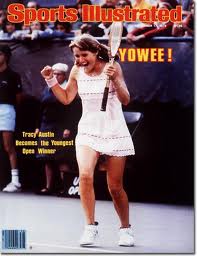
As for the chapter on Tracy Austin, Wallace laments the fact that championship level athletes aren’t capable of achieving a degree of articulation that he wants when he purchases one of their autobiographies. Tracy Austin, for those who don’t know, was a championship level tennis player. Wallace purchased her autobiography hoping that, as an adult long since removed from the game of tennis, Austin would be able to elucidate the heart of a champion. He hoped that Austin would be able to describe for us what went through her mind at the moment when she achieved the pinnacle of her career, and he wanted to know what she thought about the accident that led to her premature retirement. He wasn’t just disappointed, he writes, in the manner that he is disappointed with sideline interviews that are loaded with “we give it 110%, one game at a time, and we rise and fall as a team” style clichés. He sums up his disappointment with the following:

“It may well be that we spectators, who are not divinely gifted as athletes, are the only ones able truly to see, articulate, and animate the experience of the gift we are denied. And that those who receive and act out the gift of athletic genius must (out of necessity) be blind and dumb about it—and not because blindness and dumbness are the price of the gift, but because they are its essence.”

imagesCAY91IXCWe talk about athletic accomplishment. They do it. We analyze and speculate about their prowess. They exhibit prowess. We concentrate on the arena of the mind, and their concentration lies in physical prowess. We, non-athlete types, think about the things they do, we fantasize about them, and they do them. We think about how glorious it would be to sink a championship winning basket over Bryon Russell, Michael Jordan just does it. We wonder what Michael might do if he missed that shot. Michael didn’t think about that. We think about, and write about, that incredibly perfect and physically impossible baseline shot of Tracy Austin just made. She just does it. We see the replays of their exploits endlessly repeated on Sportscenter, and we hear almost as many different analyses of them. We then think about these plays from all these varied angles that are provided, and we project ourselves onto that platform. We don’t think about all the rigorous hours a Jordan and Austin spent preparing for that moment, we simply think about that moment, and what it would mean to us to have conquered such a moment. So, when one of these athletes steps away from that stage to offer us a few words about that moment and those few words center around the “I just did it” meme, we are profoundly disappointed. To paraphrase Yoda, “They don’t think, they do, or they do not.” They use the force granted to them though spending a greater percentage of their lives in gyms, on tennis courts, and in weight rooms. They concentrate on muscle memory to prevent the mind from interfering with their eventual completion of the act. If we, non-athlete types, were in a similar situation, we might think about the significance of the history of the game, the profundity of the moment, and how this moment might affect the rest of our lives. We might also think about how many people are watching us, if Bryon is a better athlete than we are, and if he will block our shot. We think about what our peers are going to say about this play after the game, and we become so immersed in the enormity of the moment that we probably think too much to make the shot. The point is that they’ve made that shot so many times, in so many different ways, in practice and in games, that they simply rely on muscle memory to make the championship shot. They may think about that shot, as long as it takes them to project it, but once they step on the court, they go on auto-pilot and complete the mission. They would probably love to give Hemingway-esque descriptions of their game, that satisfy us all, because they know it might land them an announcer job of some sort, but there is a reason Joe Montana, Michael Jordan, and so many other top-shelf athletes that broadcasters would’ve paid millions for never ended up with a job in a booth. There’s a reason Larry Bird and Magic Johnson were two of the greatest of all time, but they weren’t great coaches. There’s also a reason, and a number of reasons why they could accomplish what we never could.

I used to wonder what announcers were talking about when they said, “He’s too young to understand what this means.” This kid, as you call him, has been playing this game his whole life for this game, and he’s lived the life of the championship level athlete, which means sacrificing the norms of daily life that his peers knew, and he’s done all that for “this” moment. What do you mean he doesn’t know what it means? It dawned on me, after a couple struggles with it, that this kid doesn’t know what this moment would mean to the announcer … and, subsequently, those of us at home watching. In that post-game interview, then, we’re looking for something, some little nugget with which we can identify. When we get phrases from the cliché vault, we’re so disappointed that they didn’t put more effort into helping us identify with their glory, or our sense of their glory. We’re frustrated that they couldn’t reach us on our level. Yet, as Wallace states, it is the essence of a championship level athlete to be “blind and dumb” during the moments that define them, and we all know this to one degree or another. We’ve all seen these championship level athletes being interviewed about their individual moments thousands of times, so why do we continue to be so frustrated with them, and does this continued sense of frustration begin to say more about them or us?