“I’m Just Too Dumb!” 


“Hey Patrick come over here and check out our sinkhole,” Hector said when he spotted his neighbor walking outside. Patrick walked over and looked, because who wouldn’t want to look in a sinkhole? He looked from a careful distance, made a comment that I can’t remember, and he began walking away. “Wait, Patrick, you really gotta see this thing,” Hector urged. “C’mere.” 

“I saw it,” Patrick said. “It’s a sinkhole Hector. I’ve seen sinkholes before. It’s not a circus exhibit.”

“C’mon,” Hector said, “I’ll hold your hand, if you’re afraid of falling in.”

“You don’t understand, I will fall in. I’m just that dumb,” Patrick said, dropping his new favorite line on those of us standing around the sinkhole.

“No, you won’t. They’ve cordoned off the dangerous spots, so we know how close we can get,” Hector said, noting that he already called the police, and they put yellow tape around the weak spots. “Just don’t cross the tape.”

“Trust me,” Patrick said. “I’ll fall in. I’m just too dumb.” 

Patrick loved that line. He dropped it so often, in so many situations, that it kind of  became his catch phrase. Why did he love it? I wasn’t there when he first heard it, but I wonder if he thought it was so hilarious that he would start using it. Did he think it was so hilarious because he could relate to it? Did he think it applied to him so well that he thought he should start using it? He might have started using it because he found it funny, but he began using it so often that I think he now believes it. 

“Be careful what the brain hears you say,” a friend of mine said when I told her this story. “It might start to believe it.” 

Others can convince us of just about anything, if they repeat it often enough, but can we convince ourselves of something if we repeat it often enough? If we hear someone else’s schtick, and we love it for being such a great, self-deprecating line, can we accidentally convince ourselves that of something like being so dumb that we might do something that could cause ourselves irreparable harm? It’s possible of course, but is it probable? I would say this is not a joke, but it probably started out that way to Patrick, until he accidentally convinced himself that not only is he dumb, he’s so dumb that if he doesn’t check himself, and his brain, he’s probably going to end up in an emergency room saying, “I told you. I told you how dumb I was. Why didn’t you listen? Why didn’t I?” 

I’m not exactly sure why I considered Patrick’s “I’m too dumb” joke so funny. He dropped this line on me several times, in casual conversations, and I always enjoyed it. We’ve all heard people drop variations of self-deprecating humor, but Patrick’s delivery was so pitch-perfect that I can’t but think he believes it on some level. He was so flat and straight, and nothing about his presentation suggests that he’s seeking laughter. Does that make his joke better, yes it does, but does he deserve credit for his ability to deliver a joke, and is it possible for someone to deliver a joke that well without some belief in it?  

To arrive at answers that plagues us, we need a control group. When research scientists attempt to arrive at answers regarding psychological complexities, they divide their group into subjects and a control group. Patrick is a jokester, always telling jokes, and he’s a pretty funny guy, but he has one flaw. He laughs harder at his jokes than anyone else does. To understand if he is kidding, and by how much, we need to study the methods, patterns, and reactions he has when telling his other jokes. Following his other jokes, he drops a “I mean, C’mon, right?” followed by laughter. He pumps his head back, and his eyebrows go high on his head as he laughs. When he drops his “I’m too dumb” jokes, however, he doesn’t laugh, and his head goes down in the manner a dog’s might to signify submission. Is this part of his schtick? Does he do that to sell the joke better? Patrick is funny, but he’s not that funny. He does not apply such subtle intricacies to any of his other jokes, even the other self-deprecating jokes he tells. I don’t think it would take a team of research doctors to find that the reason Patrick tells this joke so well because he believes it. 

For all the reasons listed below, reasons I imagined later, this instance at the sinkhole struck me as particularly hilarious. Patrick added to the comedic nature of his joke by putting greater distance between he and the sinkhole. He walked away from Hector’s home, and off Hector’s lawn, and he then went into his home. I don’t know if he locked the door, but my guess is he did to presumably place one more obstacle for him to cross to get back to the hole. I presume Patrick did this, because he no longer trusts his brain to help him avoid an impulse that might cause him harm. Those of us standing around this sinkhole in Hector’s lawn could only presume that Patrick lost all faith in his brain’s ability to protect him from harm.  

I flashed to Patrick falling in the hole, a near bottomless pit in Patrick’s imagination (it was about three feet deep), looking up at us saying, “See, gawdangit, I told you how dumb I was.”

“Listen, I have two kids to raise, and they count on me to be there for them in so many ways,” I imagine Patrick pleading if Hector pressed him further. “If I start following whatever impulses my insufficient brain provides, I’m going to leave my wife a single-parent, and I’m not going to do that to her or my beloved children. I have to learn to reject whatever temptations I encounter to protect my body, so I’m there for them throughout their maturation.” 

We’ve all heard psychologists talk about a person being at war with their brain. It’s a deep, complex topic they use to describe those with seriously troubling psychological issues. Patrick doesn’t have those, but he does appear to be in conflict with his brain on a level that he describes with repetitive jokes. At one point in his life, I think Patrick decided to wage a cold war against his brain. A cold war, by our definition, involves “threats, propaganda, and other measures employed just short of open warfare.” Or, as others put it more succinctly, “Waging war without firing a shot.” At some point, Patrick’s internal forces decided to mount an internal coup against the brain, because those mechanisms decided that the brain no longer had their best interests in mind. 

One of the primary directives of the brain is to protect us. It protects us from heights, guns, and the prospect of encountering large, man-eating animals through chemical compounds that induce fear. When we fear, we learn to employ various defensive measures, including creating distance from the temptation, to prevent what the brain suspects could cause bodily harm. Over the years, we learn what to eat and drink, and what we do and think to prevent bodily harm. The brain instinctively knows, and learns, what can cause death. What isn’t so obvious are the irrational fears we develop for the dark, ladybugs, and inanimate objects.
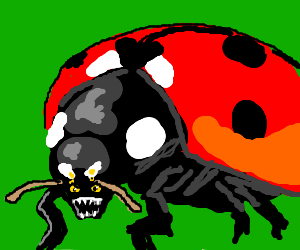
Why are we so afraid of insects, even relatively harmless insects such as the ladybug, at a young age? We don’t know what a ladybug is when we’re young, or if we do on some rudimentary level, we don’t know the extent of their abilities. This is the fear of the unknown. As we age, we learn that most animals and insects have an instinctual fear of humans, and it  provides us a level of comfort when we’re walking down the sidewalk, and they clear the way for us. Some of the times, insects occasionally land on us in their confusion, and our young, fantastical mind can interpret that as purposeful, especially when the ladybug begins to crawl up our leg in a manner we could further interpret as a purposeful violation of the parameters we thought we had with insects. We convince ourselves that they’re not afraid of us anymore. They’re crawling up our legs with a specific purpose in mind that we don’t even want to imagine, and that leaves us paralyzed with fear.  

At some point in our maturation, our brain learns the parameters of threats against the body. There’s nothing to fear from ladybugs, even those that appear to violate the parameters of the relationship we have with insects. We’re quite sure that there are some anecdotal tales of a ladybug causing human deaths, but they’re so few that we know there’s little to fear from them. There are, however, a number of tales told of spiders causing death, but not as many as those from the mosquito archive. Yet, the number of people who fear spiders far outweighs those who fear mosquito. The whole world of fearing spiders involves their creepy nature, their physical appearance, and the techniques they use to poison their fellow insects and eat them.     

At some point in our search of what to fear and what we learn is relatively harmless, the brain plays tricks on us. We fear the relatively harmless, clowns and cotton, yet we don’t fear some of the things that can actually harm us, and kill us, like driving ninety miles an hour down the interstate. 

“I like to tease my fears,” a friend told me. “I prefer to live dangerously. It’s a rush to put your life on the line by skydiving from a plane, or bungee jumping, and bungee jumping is actually a lot more dangerous than people know.”

“So, you consider jumping from 50 to 500 feet with nothing but a cord tied to your ankle dangerous?” I asked sarcastically. The fact that she felt the need to tell me that bungee jumping was dangerous suggested to me that most people she knows have tried to argue against her position, and if that ain’t the brain messing with people, I don’t know what is. 
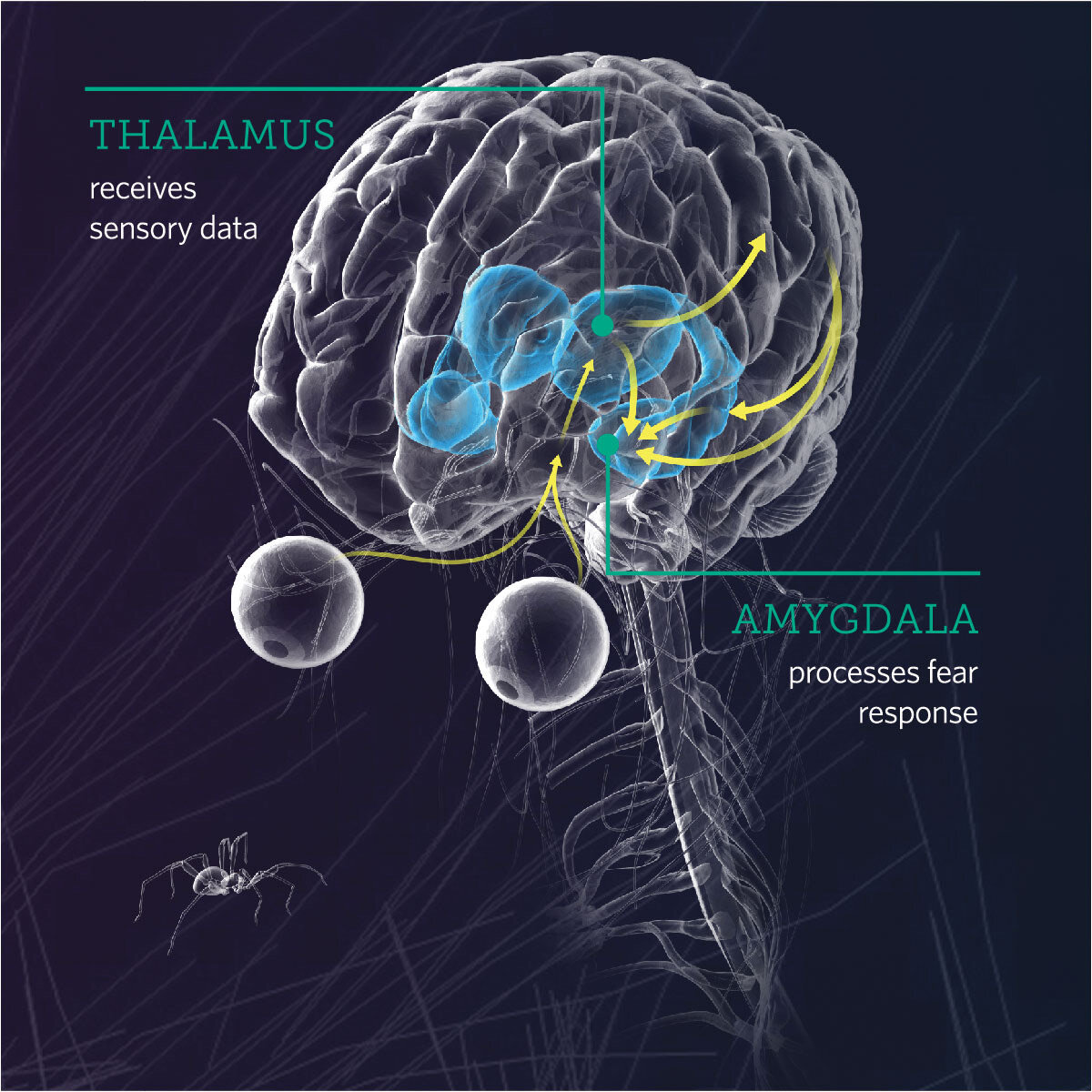
Patrick’s brain has obviously spent a lot of time messing with him in this manner, trying to convince him that nothing is as dangerous as they say, and his brain has obviously done this so often that Patrick just doesn’t trust it anymore. We’ve all heard that those working a police beat believe half of what they see and none of what they hear, but I’ve always assumed that was intended to illustrate their trust of what others do and say. Others can deceive us into accepting what we know is not true, but can we do this to ourselves? Are we at war with our own brain in relatively benign situations such as our approach to a sinkhole? There’s knowing and not knowing, of course, but as Patrick said he’s seen sinkholes before, so he presumably knows how to approach it. He just doesn’t trust his instincts, and he’s skeptical of what he might do. 

We all engage in self-deprecating humor, and we all enjoy the fruits of a person showing that he doesn’t take himself too seriously. As I’ve written many times and many ways, be careful with this comedic tool, because your audience might begin to believe it. Patrick’s use of self-deprecating humor seemingly adds another layer of caution, be careful how often you use it, because you might start to believe it.   

Patrick is not a dumb man, and if we are ever tempted to join him in the belief that he is, all we have to do is talk to the man for about forty-five minutes to learn how knowledgeable he is on so many different and diverse topics. Somewhere along the line, Patrick heard someone say that they were “so dumb” that they might not be smart enough to prolong their health and well-being. Patrick obviously considered that so funny that he began using it, and he saw how this exaggeration of the typical self-deprecating joke comforted his audience. It obviously comforted him too, to a degree, to think that he wasn’t all that. At some point, he began to fear that he might actually be “so dumb” that he could find a way to convince himself that he might cross that yellow, police tape to end up in a bottom of a sinkhole without knowing how it happened or why he did it, because his brain is now so deficient that it might lead him to him harming himself in some life-altering manner. Faced with such internal strife, Patrick decided that it was just safer for him to walk away, enter his home, and lock the door to try to prevent his kids from being fatherless children. “Trust me, I will fall in,” he warns us, and presumably himself, “because I’m just that dumb.”  

The Power of Forgetting


The tenets of psychology, namely those of Sigmund Freud, teach us that we must deal with every tragedy, and every moment of despair, if we ever hope to get past them.  If we ever hope to move beyond them we must be honest about them, confront them, and analyze them ad nauseum, until we achieve greater mental health.  Some of the times, that’s not true.  Some of the times, it’s better to forget.

ForgetAre you a bad person?  Most people don’t think that they are, and if they did they probably wouldn’t tell you.  But how does one become a bad person?  What’s the difference between a fully formed, moral adult and a bad one?  Some would say that a bad adult is created through a series of events that have happened to them, or the way in which they dealt with them, or remember them.  Some would add that it’s the decisions that we have made in life, based on the series of events that we have experienced.  Others would say that it’s a great stew of the conscious and subconscious decisions we make on what to remember, and what to forget, and that that forms the core of who we are?

This relatively new belief in the healing powers of the mind to forget seems to go against one hundred years of psychological teaching, particularly those involving the philosophies of Freud.  Freud taught us that the path to mental health involved remembering every excruciating detail of our lives, until we reached a point of exhaustion where those details could be properly analyzed and interpreted.  He then wanted us to focus on why we remembered these details, how they should be remembered, and when they should be remembered most often.  Anyone that has visited a counselor, of any stripe, has experienced this concentration.  Most of us have wanted the counselor to move on, but the counselor decided that that the particular event in question was crucial to our growth, and it may very well be the case, but we’ve decided to move beyond it to some degree.  We decided, whether consciously or subconsciously, to forget the event and its effect on our lives.  The psychological community is now correcting itself and realizing that there may have been an element of truth to our complaints.

The psychological community has, in fact, become so entrenched in this apparent evolution of thought, that when they now run across a patient that is not able to forget certain events, after extensive counseling and other treatments, they now believe there may be something fundamentally wrong with that patient’s brain.  It’s an almost complete reversal of everything Freud, and the 100 years of psychology that followed, theorized.

If you’ve ever been under the influence of a heavy drug, say morphine, as a result of an injury or surgery, chances are you’ve relived a horrific moment of your life in explicit detail.  You always remembered that horrific incident on a certain level, as it affected everything you did in its aftermath, but you didn’t remember it on that “enhanced” level, with that kind of detail, until your mind was brought to another state.  Those of us that are blessed, and cursed, with excellent memories found it a little troubling that we forgot anything involving that horrific incident.  If you’ve ever experienced such a moment, you’ve experienced this idea that the mind is keeping certain secrets from you, to protect you from the life you may have lived if you were cursed with living with these details at the forefront of your mind every single day.

Romantic populists provide us with powerful conceits: “I think about the Holocaust every day!”  While most of us think that’s a bunch of hooey, it does give the provocateur a degree of cache we’ll never know.  “How do you know I don’t?” they might ask defensively.  We don’t, of course, but we do know that doing so would make them incredibly miserable people to be around.  We could tell them that they’re probably doing a disservice to the memory of those survivors when they don’t move on and live the lives the Holocaust victims had unceremoniously, and horrifically, taken away from them.  We could say that relatively few of them would’ve wanted to see our lives so burdened by their demise.  We could say that at some point, they would’ve wanted us to just move on.  The truth, for most people, is that they don’t dwell on the negative as often as they purport.  The truth is that the brain works in its best interests, as all organs do, to remove those toxins that might hinder peak performance.

The mind is a powerful tool.  The mind can juggle a multitude of memories.  Some have guesstimated that we can quantify the number of memories any brain can hold at three trillion, others gauge their guesses in terabytes and petabytes, and others say that it’s not quantifiable.  Whatever the case is, most people agree that our resources for memory are limited.  The mind can remember the Pythagorean Theorem, Walter Payton’s career rushing total, Eisenhower’s farewell speech on the military industrial complex, your distant cousin’s birthday, or that wonderful time you spent with your family at the lake, but it can also forget.  It can purposefully forget.

This power to forget can, at times, be as powerful a tool to your furtherance as the power to remember.  To those of us that live relatively happy lives, it could be said that the mind provides the soul a crucial ingredient that it needs to move on, when it decides to forget.  To say that the mind is simply blocking out certain memories seems a bit simplistic when it comes to forgetting those moments of despair, where all hope is lost, and where a person believes that they can no longer go on.  It seems the mind is making crucial, and subconscious, decisions to simply filter out such information to provide the soul some relief from all the guilt and sorrow of the event.

“It is surely human to forget, even to want to forget.  The Ancients saw it as a divine gift. Indeed if memory helps us to survive, forgetting allows us to go on living. How could we go on with our daily lives, if we remained constantly aware of the dangers and ghosts surrounding us?  The Talmud tells us that without the ability to forget, man would soon cease to learn. Without the ability to forget, man would live in a permanent, paralyzing fear of death.  Only God and God alone can and must remember everything.”{1}

The mind also juggles inconsequential items.  Some of us remember all the lyrics of the Britney Spears songs from 1999, but most of us have forgotten them.  Most of us only remember the video, the skirt, and the ponytails.  Very few of us remember the role Archduke Ferdinand played in the outbreak of World War I, but when we had to remember it for the test, it was at the forefront of our minds.  It could be said that the mind only has so many resources –like any laptop, cell phone, or camera only has so much memory– and if we want to add new applications we must clear some extraneous information that we no longer use to provide room for it.  Most of us have forgotten more than we remember about the trivialities of life.  But, the psychological community is largely unconcerned with these occasional slips of the mind.  They’re far more concerned with the remembering and forgetting of crucial information of their patients.  Both, they feel, are mandatory for mental health and vital to mental hygiene.

Are you that annoying type of person that just keeps bringing a horrible memory up to your loved ones?  Have you ever heard the phrase: “Isn’t it time we moved on?” from them.  They say this with loads of sympathy and empathy, but they also say it with some degree of determination.  Those of us that have been hit with this question were almost as devastated by the question as we were the actual event.

“How can you move on?  How can you just forget something like this?” You ask.  “How can you not want to talk about it nonstop?  How can you not want to get to the core of this matter and how it affects every day of your life?” 

You want to deal with it, get to its inner core, and learn that all of those affected are just as affected as you are?  They aren’t.  They’re saddened by it.  They’re lives will never be the same as a result of it, but their mind is telling them to clear the resource pool for an eventual return to happiness, and you just keep bringing them back.  Repeated requests to remember are rejected, until one person gets angry.  They’re tired of you bringing it up at every get together.  They want to move on, but you won’t let them.  The mind has a lot of power invested in remembering, but it has as much power invested in assisting us to forget.

Are you that bad person we discussed earlier?  Are you generally mad?  Suspicious?  Distrustful?  Sad?  Are you someone that cannot let go of the fact that you weren’t raised in a happy, functional home?  Are you someone that feels that you were not afforded the luxuries that most of the people around you took for granted throughout their youth?  Are you someone that dumps a prospective lover before they can dump you?  Are you haunted by the fact that you didn’t spend enough time with a recently deceased loved one?  Or, are you a good person that is generally happy?  Do you consider the path to happiness trying to be better today than you were yesterday?  And is all that defines your demeanor based on your memory of a life well-lived, or could it be said that you’ve forgotten a lot of the events of your life that could be making you a miserable person to be around right now?

Fear Bradycardia and the Normalcy Bias


[Scene] Everybody’s favorite clown, Dougie, ventures out a little too far in the lake.

“Didn’t you hear the old, Native American woman say something evil lurks in that there lake?” one of the great-looking people on the shore screams. Dougie ignores them, apparently unaware of the golden rule of modern cinema: Always listen to Native Americans, especially if they’re old and speak in hallowed tones. “You’ve gone too far, Dougie!” the great-looking people on the shore continue to shriek. “Come back!”

“C’mon, you chickens!” Dougie says, backstroking leisurely. “It’s fun, and there’s nothing evil out here!”

The music that cues Dougie’s impending doom spills out of the Dolby surround sound. A subtle roar follows, and those of us in the audience tense up. We grip the armrests so tight that our forearms flex. We join the gorgeous people on the shore, mentally screaming to Dougie to try to get him out of the water. We then join the collective hysteria that erupts when the water of the lake begins to swirl.

“Dougie, please!” we shout in unison with the great-looking people.

“Aw, shut it!” Dougie says, waving off the warnings. 

The trouble is the character actor who plays Dougie is unattractive and chubby, and those of us who have watched thousands of movies know our horror movies, and we know casting. We know unattractive and chubby types are doomed soon after they accept their role in a movie. 

The monster roars to an impossible height. Dougie looks up at it, and as his fate becomes apparent, he screams. Is the monster evil, or is it just hungry? We don’t know, and we don’t care. It’s going to eat Dougie, the comedic foil in our movie. The monster takes its time, so we can see the full breadth of its horror. It gnashes its teeth a little. It swivels its head about. It looks menacingly at Dougie. Dougie continues to look up and his screaming continues until the monster lowers onto him and bites Dougie’s head off. The idea that this macabre scene took a full thirty seconds leaves those of us who have watched too many horror movies nonplussed.

“Why didn’t he just move?” monster movie aficionados have asked for decades. “Why did he stay in the water, screaming, for thirty seconds? Why didn’t he just swim away?” We can live with the fact that the monster would naturally move through the water much quicker than Dougie, since the monster is aquatic and Dougie is not. We can also live with the fact that Dougie probably didn’t have much of a chance the moment he jumped into the water. Still, we horror movie aficionados would love, just once, to see victims do a little more to prove that they, like all humans, share an inherent survival instinct.

When I later learned that actors have to stay on their mark, I was a little less disgusted with the actors who played Dougie roles. I still want them to move, but I now know they must obey the director who commands them to stay in a designated spots for the decapitation scene. This cliché scene may strike horror in some, but I would venture to say that either the terrified are under the age of 30, or they haven’t watched enough horror movies to know the premise. For those of us who have crossed both thresholds, we know it’s just plain irrational that a person wouldn’t move or do something to get away from a menacing monster. We certainly wouldn’t just stand in one spot, looking up, screaming, at the person, place, or thing looking to seal our fate.

Or would we, author David McRaney asks. McRaney claims that not only are Dougie’s reactions normal, but they are a lot closer to a truth than anything monster movie aficionados might expect. In McRaney’s incredible book, You Are Not so Smart, he suggests that the one conflicting detail of this monster scene that might counter how we think we would react in a similar moment of unprecedented horror is Dougie’s screaming.[1]

Those of us who don’t study psychology in a professional setting know what we know. We know there are two basic reactions to catastrophic, chaotic moments: action and non-action, or as we like to call it acting and choking. Those who act may also be broken down into two categories: The selfish who fight to save themselves and the martyrs who act in a heroic fashion to save others. Either way, casual, non-psychology types insist there are but two reactions to such situations. Either the individual involved in the situation does something to save their lives, and the lives of those around them, or they choke.

McRaney argues that there is a third reaction, though casual, non-psychology types are more apt to view this course of action as little more than an extension of choking. Psychologists call it fear bradycardia. The difference between fear bradycardia and choking is that a victim of fear bradycardia experiences a heart deceleration, as opposed to the acceleration we might expect in a traumatic situation. An acceleration of the heart could lead a potential victim to fumble about and select an incorrect reaction, or choke, but a deceleration might lead the potential victim to freeze up in a manner they call attentive immobility. Fear bradycardia is a reflex, an involuntary, automatic instinct that often occurs in moments of unprecedented chaos and horror, heaped upon the unprepared.

Put succinctly, fear bradycardia is the idea that in our movie not only will Dougie not scream or scramble out of the way, he will reflexively stop moving and simply stay put, hoping beyond reason, for the best possible outcome. The normal reaction one might have to surviving a plane crash, for example, is to unbuckle and exit plane. We suspect that we might need a moment to deal with the most terrifying thing that ever happened to us. We might also need a moment to come down from the absolute horror we experienced going down, and we might also need another moment to deal with the euphoria that follows when we realize that we just survived one of the most horrible accidents that could ever happen to a human, but we suspect that we will eventually come to grips with it and exit the plane.  

The concept psychologists are describing, when they talk about the term fear bradycardia, suggests that we will remain frozen beyond the normal moment necessary to deal with the situation. It suggests that if the plane is on fire, in our scenario, and other survivors are screaming that the plane is going to blow, we might not do enough to assure our survival, as we will remain frozen hoping that this moment simply passes. This fear bradycardia reaction involves an automatic, involuntary instinct that exists in all of us. Some refer to this state as tonic immobility, but no matter the name, it falls under the umbrella of another psychological term, normalcy bias.

McRaney details several incidents in which people experienced fear bradycardia: an F5 tornado in Bridge Creek, Oklahoma, survivors of floods, and even the infamous 9/11 Trade Center terrorist incident.

According to some first responders, the one commonality in most similar tragedies is that victims wander about in a dreamlike state. These first responders say that their first responsibility is to shake survivors out of this state, so they can hopefully achieve full consciousness and save themselves. For even if their world is falling down around them, most survivors shut down and go to a safe, more normal space in their minds, if no one is around to shake them out of it.

In the aftermath of the 9/11/01 terrorist action, most first responders spoke of the calm that evacuating survivors exhibited. They stated that most of the survivors obediently followed instructions, without any panic, allowing for a safe exit that ultimately saved many lives. The first responders we saw interviewed on the news stated that the heroic first responders provided a model for proper evacuation procedures.

Other first responders agreed with that sentiment, but they added that the unspoken sense of order among the survivors was so calm and quiet that it bordered on eerie. Very few survivors were screaming, they said, and though there wasn’t room to sprint, there is no record of anyone pushing, shoving, or doing anything out of the ordinary to get out of the burning, soon to be falling buildings. There is no record of survivors complaining about the slow, orderly exit, or attempting to find their own alternative exit, if there was one available. We might think these are normal, human reactions to such a horrific episode, but the limited records we’ve found suggest no such incidents occurred.  

McRaney cited some of the accounts first responders of 9/11/01 reports of some survivors taking a couple extra, crucial moments to complete the log-out procedures on their computers. With first responders screaming out instructions, some survivors stopped to gather their coats. Other first responders made note of the mundane conversations some survivors shared with their coworkers on the way out of the office. Why would a survivor of one of the nation’s worst tragedies talk about adding marshmallows to a flan cake recipe, or the reason their favorite player missed a dunk last night? To try to establish some level of normalcy amidst the chaos happening falling down around them.  

Those of us on the outside looking in might view this as absolute lunacy. If I were in that situation, we might think, I’d be running, screaming, and I might be crying. I might even knock an old lady down in my departure, but I would do everything I could to get out. I don’t care what this author says I’m all about survival brutha.

Television shows and movies depict such drama on a regular basis, and we’ve all watched how they play out on our screens, be it some horror flick with a monster and a Dougie or our favorite cable news program’s recreation of a tragedy. We’ve all placed ourselves in the shoes of the characters involved in such stories, and we know we would do things differently. We’ve all shouted these condemnations at our various screens when the Dougies just sit there as a monster nears them, and we all know how we would’ve reacted before the menacing monster bites our head off. The central question of McRaney’s thesis, however, is this: While we might think we know how we would act, unless we’ve experienced such a moment in our lives we can never really know.

“If you haven’t experienced a true tragedy,” McRaney writes, “You can never know how prepared you will be, and you can never know how you’ll react. The ideas we have about how we will react may be lies we’ve told ourselves so often that we might end up not knowing the actual truth until it’s too late to rectify it.”

Shutting down computers, gathering coats, and having mundane conversations are automatic, involuntary responses that occur because of this dream-like, faux normal state we defer to when it becomes clear that no amount of rationalizing will ever render the horrific, unprecedented, chaotic moment normal. We shut down to block out the flood of external stimuli that might otherwise cause us further panic.

“The people in the World Trade Centers on 9/11 had a supreme need to feel safe and secure,” McRaney writes. “They had a desire to make everything around them go normal again in the face of something so horrific that their brains couldn’t deal with it in a functional manner.”

As stated previously, most casual, non-psychology types might characterize this as choking in the clutch, but McRaney states that it goes beyond this, because they do not freeze as a response to panic. “It’s a reflexive incredulity,” McRaney writes, –attributing the term to Amanda Ripley– “that causes you to freeze up in a reflexive manner. This reflexive incredulity causes you to wait for normalcy to return beyond the point where it’s reasonable to do so. It’s a tendency that those concerned with evacuation procedures –the travel industry, architects, first responders, and stadium personnel– are well aware of, and they document this in manuals and trade publications.”

Sociologists McRaney cites say, “You are more prone to dawdle if you fail to follow these steps and are not informed of the severity of the issue.” Failing to gain the necessary information leads to speculation and to the inevitable comparisons and contrasts of other more familiar incidents.

Men, in particular, seem to have an almost imbedded desire to rationalize fear away. Fear, by its very nature is irrational, and most men feel it incumbent upon them to keep fear a rationalization away. In the face of a tragedy that alarms most, the rational, no fear, man is prone to say, “This is bad, sure, but it’s not as bad as a previous experience I once had?”

Their preferred culprit for unwarranted fear is the media and politicians. “Fear equals ratings,” we say to tap into cynical truths, “and they want to keep us in a constant state of fear, so we’ll vote for them.” There is some truth to that, of course, but it’s also true that the terrorist incident on 9/11/01 was one of the most horrific to ever happen in our country.

“That is true, but there was just so much fear they spread that I smelled the politics of it all,” some cable news viewers said around 9/11/01, “and we should all start viewing the hype of politicians and media players as nothing more than that, hype.” Most of us recognize that some media outlets and politicians make their bones on promoting fear, but at times, a bit of fear –an emotion that can ignite awareness– might save our life.

For these reasons and others, it is crucial for a city facing an ensuing crisis to allow the local media to inundate us with reports of that impending storm, because the media needs to help us redefine our norm. It is also a reason for those of us who make fun of our friends for paying attention to the flight attendant’s pre-flight instructions, to drop our macho façades and listen. We may also want to drop the pretense that as frequent flyers we are prepared for anything. We must redefine our sense of normalcy in preparation for the many things that could go wrong in the air or upon our return to ground.

In spite of McRaney’s findings, I still find it hard to believe that the movie scenes that depict the near-catatonic reactions Dougie displayed as the monster neared him are closer to the truth than I am about how most people will react. I live with the belief that a survivor’s instinct will kick in for anyone facing impending doom. As those dumb enough to corner a badger into a corner know, most beings will do whatever it takes to survive, and I believe that the human being, regardless how chubby or unattractive they are, have that same instinct. The difference might be that the badger hones those skills more frequently, but we’ve all experienced mini-disasters and personal traumas in our lives, and most people have a decent batting average when it comes to reacting to them. Will that be enough to avoid experiencing fear bradycardia, tonic immobility, reflexive incredulity, or any of the normal bias tendencies we have in the wake of a horrific incident? We don’t know, and we won’t know until the decisive moment reveals if we are so ill prepared that we fall prey to automatic and involuntary instincts that result from lying to ourselves for so long that we end up rationalizing ourselves to death.

[1]McRaney, David. November, 2011. You Are Not So Smart. New York, New York. Penguin Group (USA) Inc.