“Hi. My name is Rilaly, and I’m a cynic.”
 I’m in recovery, which as any alcoholic will tell you is a stage in a process of trying to deprive ourselves of something we used to really enjoy. I never set out to enjoy ruining someone’s optimistic joy, but it felt so right to blast someone out of the water for saying something so nice about a person, place, or thing that I felt sophisticated and intelligent when I wiped that stupid and sanctimonious grin off their face. It wasn’t an emotional compulsion that drove me to do it, or medical, it was rhetorical.
“Don’t you just hate happy people?”
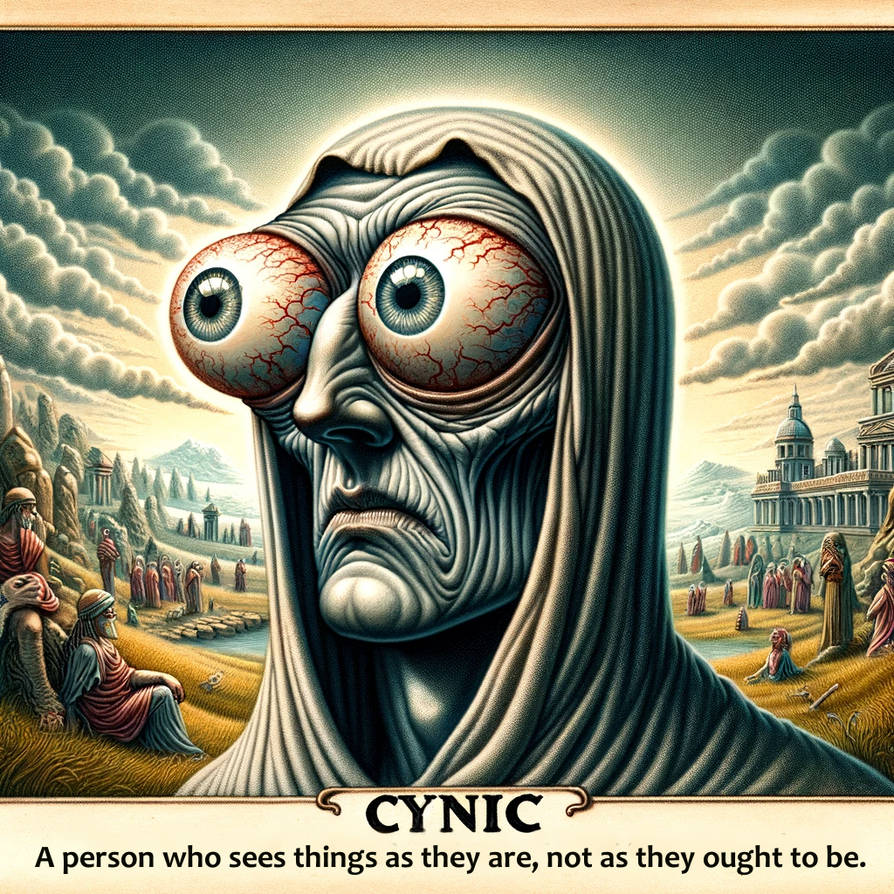 Very few people actually drop that line, but how many of us think it? Being right and wrong isn’t the primary driver of the cynic. We just want to put a chink in the silly narratives naive people have believed for so long.
Most cynics would tell you that’s a bunch of bilge. “It’s all about facts, and if you can’t see that, you’re naive. Science and Math. That’s what we rely on.” But what if we’re wrong? What if the optimists could provide incontrovertible evidence of our errors, what would we say? We’d smile a chagrined smile and walk away, saving our ammunition for another day, because if we learn how to sing the song, we can never be truly wrong.
“Cynicism is not necessarily equal to or greater than intelligence,” is the mantra we cynics use in our sessions. “It’s camouflage we use to conceal what we don’t know.”
I loved that phrase until fellow cynic, Julie Anne, obnoxiously argued that, “We need to remember that just because it’s negative doesn’t necessarily mean it’s true.”
Did you have to reread that line? I know I did, rather I had to ask Julie Anne to repeat it as if I didn’t hear it the first time. It’s one of those down-the-stairs comments that doesn’t land until we’re walking away from it and into someone with that stupid grin on their face. When we run into that happy person who believes in things, they say things like, “I believe most people are good, until they prove me wrong.” Yow! Kabang! We hit them with our best shot, and we hit them with something negative that isn’t “necessarily true.” The argument about whether people are generally good or evil is difficult to prove, of course, but our certitude often relies on what appeals to us most, which basically proves Julie Anne’s line of thought.
 We all start out naive. We believe our parents are good people and excellent stewards and beacons, until they prove us wrong. We believe our teachers have our best interests in mind, until our tweed and elbow patches professor opens his lecture with, “Everything they taught us in school was wrong!” Cynicism almost feels like evolution at a certain point, until even the most optimistic learn to frame their optimistic beliefs with proper qualifiers, like, “I’m not saying the world doesn’t suck, but …” It’s their way of trying to express themselves without everyone dogpiling them with synonyms of naive, and there’s nothing worse than being called naive.
Several individuals saved us from the dreadful indignity of that embarrassing label by introducing us to the comfy confines of cynicism. Once we gave the ‘everyone is awful’ idea a test drive, we discovered no one would call us a fool ever again. It’s foolproof. It might not necessarily be true, as Julie Anne would remind us, but being wrong is far better than being foolish.
 We reserve the term fool for people who believe in people, places, and things. Once we became cynical, we joined in on the laughter, “How could they actually believe in that?” we asked our fellow cynics. We felt like we finally belonged. We found it much safer to believe most people are full of crud, and everyone from our parents to religious people to world leaders, and the most virtuous and honorable are probably a bunch of hypocrites who go home and beat their wives … when they aren’t our cheating on them (cue the laughter). “Imagine being them,” we say to conclude our laughter with the laughers, “believing that most people have the best intentions.” The comfy confines of cynicism aren’t limited to laughter and a sense of belonging, as it can provide a compelling sense of spiritual fulfillment when we learn how the world works, the real world.
The way the world works is so overwhelming and confusing when we’re young that it becomes our life’s mission to try to understand it. Our friends, and our unsafe, adult entertainment comedies taught us all of these delicious decoders that we couldn’t wait to use on those who don’t know. When we eventually crossed the sootstone arch (as opposed to the pearly gates of the optimistic believers) into the real world, we realized that if donned cynical camouflage it concealed what we don’t know, and we couldn’t wait for our peers to recognize how prepared we were. Our curtain raiser was directed at The Big Guys, because The Big Guys are honored, respected, and admirable, and their teardown is much more valuable to those in the know.
“I heard the rumors, Danny,” Andrew Wood once wrote in a song called Mr. Danny Boy.
After hearing that song, I did some research on Mr. Danny Boy, and I discovered it was about a man named Mr. Danny Thomas, who was considered one of the most honorable, admirable, and virtuous men who ever lived. I believed those rumors, because who wouldn’t? The naive didn’t. They thought he was honorable, admirable, and virtuous.
 As with every characteristic, we strive to be the most. We want to be the funniest person in the room, the richest, the strongest, and the best-looking. We may not strive to be the most cynical in the same vein, but we strive for the most sophisticated in our knowledge. And what do cynics do when we encounter their competition? We don’t strive to be more cynical, we call our fellow cynic out.
When we relentlessly go after the Big Guys, for example, there will always be some guy who seeks to diminish our “Most cynical” crown with the joke, “You just hate that guy, just admit it. The guy could cure cancer, and you’d still have a problem with him.” That guy, in this particular scenario, is Amos Muzyad Yaqoob Kairouz, (aka Mr. Danny Thomas). All right, he didn’t cure cancer, but the incredible strides this man made during his life were largely unimaginable before he started in. He founded St. Jude’s Hospital, which has a documented history of making a significant dent in the number of children who suffer from, and die, from cancer.
When I hear that, my cynical side immediately rears its ugly head and says, “Ok, but Danny Thomas was an actor, and a celebrity. He dealt in a world of make-believe, so I’m guessing he didn’t actually found St. Jude’s Hospital. He didn’t found it in the way we normally associate an individual founding a hospital. He was probably a celebrity figurehead who attached his name to a process that was already in place but needed the type of funding a celebrity can attract by attaching his name to the founding. He probably took a photo with a massive pair of scissors, cut some tape, and raised a whole bunch of money for the hospital by doing so.”
Every celebrity seeks to show the public “another side” that displays the idea that they are well-rounded, sympathetic, empathetic, and heroically altruistic. In my humble opinion, that level of cynicism achieves a decent scorecard in most cases, but not here. Records state that Mr. Danny Thomas was actually a hands-on founder of St. Jude’s Hospital. Records state that St. Jude’s came into existence because Danny Thomas willed it into existence through decades of personal labor, fundraising, organizing, and strategic decision‑making. Records also indicate that Mr. Thomas involvement was not just some celebrity endorsement or involving a some sort of superficial or symbolic attachment. Records state that when it came to the founding of St. Jude’s Hospital, Danny Thomas was the man.
Defeating cynical sides, as they rear their ugly heads, is equivalent to that old childhood game Whack-A-Mole, as they help me appear smarter and more sophisticated in the way the real world works, in a way the average joe never will. One little head pops up and says, “Well then he probably found a way to turn this founding into some sort of money-making venture.” Another one pops up and says, “He probably benefitted from it financially in someway we’ll never know.” Again, we might be able to say that about most celebrity-backed ventures, as even the most charitable celebrities get paid administrative fees for handling the various activities of their altruistic venture, they get paid for speaking engagements on behalf of the charity, various appearance, they get their travel to and from paid, and/or some “other expenses” that aren’t illegal, but they’re dubious bullet points that the dubious-minded can recite when that debate arrives. Again, not here. There’s no credible evidence — none — that Danny Thomas ever profited or benefitted financially from St. Jude’s in anyway. Every historical record, nonprofit filing, and investigative report shows the same thing: he founded the hospital, built its fundraising arm, and spent decades raising money for it without ever taking a salary or receiving any financial benefits for those efforts.
Some records suggest St. Jude’s Hospital has helped save or ease the suffering of hundreds of thousands of children through direct treatment, and millions more through research that raised global survival rates. I’ve performed searches through search engines, and AI, asking for holes in this narrative. I’ve asked AI to approach the narrative regarding Danny Thomas founding St. Jude’s Hospital from a cynical perspective and provide for me information that a skeptic could latch onto when they’re seeking to know the real story behind Danny Thomas and St. Jude’s hospital, and AI can find no holes.
Yet, if you were alive during the early 90s after Mr. Danny Thomas died, and commentators were largely immune from character defamation lawsuits, you heard the rumors from standup comedians, shock jocks on the radio, and/or the cynical grapevine that grew from the fertilizer they created. You heard the rumors, and you laughed, because you knew there had to be more to the story. You also loved hearing the rumors, because they validated and vindicated what you thought all along. There had to be something.
Even if those rumors had any basis in fact—which they didn’t, according to every substantial news source, historical document, and/or any source that we might call substantive—the product of those rumors made substantial philanthropic and altruistic efforts and commitments to try to help children survive their fight against cancer.
“He wasn’t all that virtuous, let me tell you something,” those hanging from the cynical grapevine yelled with glee. “Let me tell you something ...”
“But Danny Thomas’s goal,” we should’ve said but didn’t, because we didn’t want to damage our cynical bona fides, “was to help kids suffering from cancer.”
“I know, but I just can’t stand it when someone thinks they’re all high and mighty.”
“Fair enough, but what does it say about you that you prefer to focus on the rumors as opposed to his considerable effort and commitments to help kids fight cancer?”
“I see the world in black and white,” is the preferred mantra of the cynic. “I can’t help it, I’m a facts-oriented person.”
I know that line, because I lived with it for so many decades that I will forever be in remission, but I’m trying. I’m trying to see some light in the darkness of the cozy comfort of cynicism. I’m also trying to learn that “Just because it’s negative doesn’t necessarily mean it’s true,” but it just feels so facts-oriented to believe the worst of humanity, until they prove me wrong.


 Rilaly