The Beauty and the Not Ugly 


Women love a funny guy, but there’s one thing they love more than a funny guy, a guy who considers them funny.
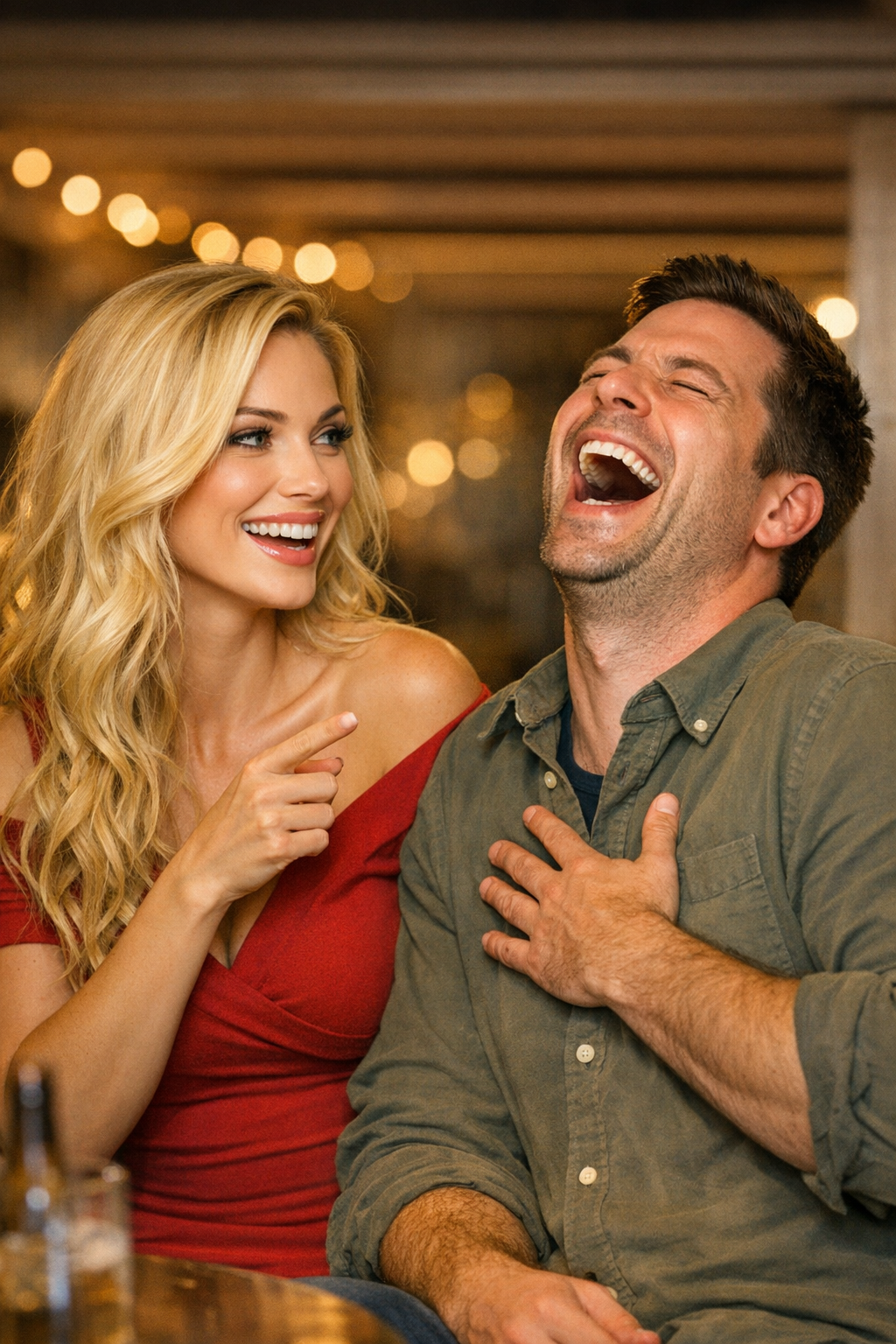
I found this out when an extremely attractive woman named Julie agreed to go out with me. On this date, she informed me that I was “not ugly.” The idea that she and I were operating from opposite poles of the beauty spectrum was obvious to anyone who saw me walking into a restaurant with her. “What is HE doing with HER?” was such an obvious question on the faces of the other patrons in the restaurant that if one of them gave voice to their look, I wouldn’t have been too surprised.

I wasn’t sure whether I should feel more insulted or complimented by those looks, but I really enjoyed playing the “HE” role for the first time in my life. I wanted to be seen with Julie in public more than once, and then I wanted to do some awful things to her in private. After she allowed both without a fight, I let her make condescending assessments of my physical appearance without a fight.

And I don’t think I would’ve been able to do any of that if I didn’t laugh at just about every joke she told. Based on my very brief dating experiences with Julie, my first piece of advice to my not-ugly-guy contingent is if you want to date excessively beautiful women, be funny. If you’re not funny AND you’re not ugly, however, you won’t have a shot in hell dating a woman as beautiful as Julie, and I don’t care what those loser-dates-the-lovely-lady, 90s movies taught us about hope. There is no hope, because the excessively beautiful just have far too many options. They won’t even look in our general vicinity, because they don’t want to get us started.

I wouldn’t have had a shot in hell at dating Julie either if I hadn’t accidentally discovered an end around, loophole, or whatever you want to call it in the not-ugly-and-the-beautiful natural laws of dating: Beautiful women love it when men find them funny.

I know what you’re thinking right here, you’re thinking I faked it to try to seduce her. I had no master plan, and I have no talent for deception, and you can ask anyone who has ever played poker, chess, or any game with me that requires some form of deception. I cannot bluff. I learned at a very young age what a horrible liar I was, and how much I hated getting caught in a lie. I felt so bad about lying that I made the decision that I wouldn’t go through what I assume good liars have to go through to get better at it. Long story short, my laughter was not fake or deceptive. I genuinely considered her funny, but I must admit if a guy, or a not ugly woman, told the exact same jokes Julie did, I would’ve been much more critical. I was so attracted to Julie’s physical appearance that I found her jokes funny. Was I giddy? I think I was as giddy as a schoolgirl who has such a huge crush on a cute boy that she giggles at everything he says. It’s an embarrassing admission, but it worked. 

It worked, because Julie, like everyone else in the world, loves it when someone considers them funny. The one caveat I would tell any man who tries this is that you will have to avoid the temptation of telling your own jokes, and that’s tougher than you think. When the jokes start flying, we get caught up in the moment. We want to add a nugget here and there to the tail end of their joke, or we might be the type who just wants to keep the jokes going, so we add our little bits. Don’t! They don’t like that. They only want us to laugh at their jokes. My little, tiny attempts to add to the levity in room revealed to her that not only was I not ugly, but I was not funny too, which led her to decide that I was not dating material.  

It’s no secret that we all love it when someone considers us funny, but if you’re not ugly, and you have regular interactions with someone who is so far out of your league that you don’t have a chance in hell of being seen in public with her, try laughing as hard as you can at her jokes. It might not work, depending on how far down the not ugly scale you are, but if you’re scraping the bottom of the barrel, what do you have to lose?  

The Not Ugly Limelight

I had a moment in my not-ugly life when I thought I might be attractive. It was a strange, almost inexplicable time that happened when I was barely a teenager, in the seventh grade. Three eighth grade girls and a couple of seventh grade girls expressed interest at the same time. This all too brief window in time made no sense to me, until I later learned that planets transit through zodiac signs to create aspects that affect an individual’s natal chart to trigger, amplify, or challenge energies. When I heard this, I rejected the notion outright, until I remembered this moment in my life. These weren’t the typical girls either, they were the most popular, best looking girls in the two grades. I don’t understand how the movements of celestial bodies could affect what we think, how we act, or how we verify it, but I’ve found no satisfactory explanation this. My guess is that my otherwise excessively pale face probably had some color to it for that brief moment in time, and that combined with the fact that someone convinced me that the center-part of my hair was no longer working for me. Not only did I start parting on the side, but I decided to start feathering my hair. I still don’t know if it was Uranus in retrograde, or my side part, but I do know I didn’t sell my should to the devil to experience what only the beautiful know for an all too brief moment of my life, but having this many females attracted to me at the same time never happened before all that and it hasn’t happened since. 

That’s right, my idea of what it must feel like to be a sex symbol peaked at age thirteen. When I received hints of their attraction, I decided that I was not going to get excited just because some girl just happened to look in my general direction, then at me, then lock eyes with mine, and smile. I simply pretended that it wasn’t happening, because I wasn’t going to allow my overactive imagination to begin interpreting what I thought I was seeing. I also didn’t want my aspirations to meet the tenets of the “The Bigger they are the Harder they fall” analogy. It took more than a couple of instances for me to realize these looks weren’t coincidences, this wasn’t a dream, and I wasn’t imagining it. I was shocked, stunned, overwhelmed, and a little terrified. I didn’t know what was happening, I didn’t know how to act, or if I should do something to end it before they found out I wasn’t who they thought I was. I wanted it to last, of course, but I had no idea how I could make this intoxicating idea that girls, real, live girls were actually interested in me, last. It was the closest I ever came to knowing what a Beatle, Elvis, and Marlon Brando must go through when multiple women are attracted to them, and I did not handle it well.  

I didn’t have to stress about it too long, however, as it ended almost as quickly as it began. Before I could consult with someone, or something, like a TV show, or an astrology reading, most of it was over. I don’t know if the tan faded, the hair wasn’t quite right, or the planets transited across other zodiac signs, but my options were limited to one girl: Rhonda.  

Now, when I say I was only left with Rhonda that might sound like I settled, but Rhonda might have been the best looking girl of the bunch. She was so beautiful that I remember having trouble getting to sleep when I thought of her. I couldn’t believe a beautiful girl found me physically attractive. It eventually became known, through intermediaries, that she wanted my phone number! Holy Larry! I thought this would prove to be an epoch in my timeline, a B.C./A.D. life-altering moment. It might have had a lot to do with my age I was at the time, how impressionable we all are at that age, or a reflection on how boring my life has been since, but the time I spent waiting for that phone call were some of the scariest, most exciting moments of my life.

The phone call obviously went well, as Rhonda and I shared approximately three more phone calls. I never thought this would last forever, but when she passed final judgement on me with a, “You’re boring!” ruling, the click on the other end of the phone reminded me of sound of a gavel pounding. It hurt like the dickens. It taught me that what a woman says about you stings far worse than anything a fella can do to you. The more I thought about it, though, the more I realized that I knew nothing about her, and she knew nothing about me. We absolutely had nothing in common, and therefore nothing to talk about. I should’ve been more interesting, but I was a thirteen-year-old, and my idea interesting subjects involved the NFL, the music of KISS, and Evel Knievel. I wasn’t well versed in topics that females find interesting, and the wife might say that I’m still not great at it. 

In the world of beautiful women, I learned that I was not ugly, not funny, and not very interesting. I was not what they expected, and the one step forward two steps back taught me my station in life, until I met Joel. Joel was a not ugly, not funny, and not very interesting compatriot who moved effortlessly from one table to the other in a singles bar. The women at the first table politely informed him that he was not welcome at their table, and the next one purposefully continued the conversation they were having before he interrupted it. I don’t know what was said at a third table, but when he left the women were laughing, and he was a darker shade of red. Joel came back to us, the fellas, his home base after each rejection, and he chatted with us until he spotted another table of women he found interesting. “How do you do that?” I asked him. “How do you just move to another table after being rejected like that?” Joel responded, but I can’t remember what he said. If he said something profound to sum up a philosophy that motivated him, I would’ve remembered it, but far more important to me was what he did as opposed to what motivated him to do it. My takeaway was, there will be moments in our life when someone will reject us for failing to be who they expect us to be, but we should use it to become who we want to be. How do you use being not ugly, not funny, and not very interesting? That’s up to you to figure out and find out. 
Misty “The Witch” vs. Michelle “The Cyclops”


“I’m a witch,” Misty said to throw a big old matzo ball on the restaurant table between us. She didn’t throw that into her intro, but I learned that she was a witch before I learned that she was an Anderson, a Smith, or a Jones. If she mentioned her last name, I don’t remember it. I remember that she was a witch, however, because I never met a witch before, self-proclaimed or otherwise. It was also such a noteworthy characteristic to me, because it was to her. Being a witch was more important to her than being an Anderson, Smith or whatever her last name was. When I asked her what she did for a living, she answered, and when I asked her who her friends were, she answered that too, but she didn’t answer any of those questions with the same passion, spirit, or animated enthusiasm she had for her decision to become a witch. When I told friends, family, and co-workers about my date, I referred to Misty as Misty “The Witch”. When they found that characterization so entertaining, I kind of dropped back. I felt a little guilty for characterizing such a nice woman in such a manner, but when I dropped further back and put some thought into it, I realized that’s probably how she would’ve wanted it. 

Misty didn’t list this particular nugget of information on her online, dating profile. Who would? Green people who wear pointy hats probably don’t get asked out very often, but she wasn’t one of those typer of witches. “I’m a Wiccan,” she explained. “It’s a modern, nature-based pagan religion. I have a twenty-four quart, deep cooking pot, but I don’t own a cauldron. I own my own home, but there’s no candy plastered on the outside to lure unsuspecting children, and I don’t think I’ve ever cackled,” she said to try to put me at ease. 

I don’t know if it’s based on the shows we watch, but when we meet someone who thinks so different, 180 degrees different from us, we expect to learn that they made calculated, well-informed decisions in life, especially when it concerns spiritual and mystical pursuits. In my experience, most of them are like most of us. They drift around searching for something meaningful in life, to give their live meaning, until they find something. Some try to find something that aligns with their personal beliefs, others align their personal beliefs with something they found. In my brief interrogation of Misty, I found that she was a little of both. She decided to become a Wiccan for some of the same reasons I played Donkey Kong when I was a kid. She thought it sounded fun and cool. She was as uninformed, insecure, and vulnerable as the rest of us at one point in her life, then she joined that group. Did find a part of herself that she never knew in that group, and she loved being that in front of other like-minded people, or did she stay so long that she either conformed to group thought and became who they wanted her to be? Regardless, she developed strong bonds with her fellow Wiccans that lasted years.

As with most insecure and vulnerable people, Misty put her best foot forward on our first (and as it turned out our only) date. She threw that big old matzo ball out there with some conviction framing it. ‘I’m a witch, deal it!’ her expression said, and deal with it I did, in my own obsessively curious way. I don’t know what was on my face, but her smile told me she knew she struck a chord. 

“And now for something completely different,” I thought, recalling that old Monty Python line. I was so fascinated that I dove right in. I asked superficial questions, in-depth questions, and then questions that made her so uncomfortable that she laughed before answering them.  

Most of my questions were self-serving. I didn’t really care that Misty chose what I considered an alternative religion, but I did want to know why. I wanted to know why she joined, how her views changed over the years, and I wanted to see if her beliefs could challenge mine. The questions I asked weren’t the polite type everyone asks, and I didn’t ask leading questions to have her view me as compassionate or open-minded. I wanted answers to this curious, life-altering decision of hers, and I went for the jugular, asking questions that we’re not supposed to ask.

Most people refrain from asking uncomfortable questions, because they don’t enjoy watching other people squirm, but Misty made it quite clear she wasn’t a squirmer. She might have been squirming, uncomfortable, and vulnerable when we first met, but who isn’t? By the time I worked my way past the obligatory, nice questions and worked my way into the questions we’re not supposed to ask, Misty was chuckling (as opposed to cackling). Some of the questions I ask offend some recipients, and that’s fine with me, unless they offer me a specific reason for why the question hurt their feelings. It’s happened, and when it does I back off and apologize when warranted and without excuses or qualifiers. Most of the people who intrigue me enough to work past the initial questions, prove to me that they enjoy questions that test their meddle.   

“I don’t know how you get away with asking such things,” a witness to some of my questions said. 

“I think they know I’m just curious,” I said. 

Due to the fact that Misty loved talking about her decision, and I was absolutely obsessed with wanting to know what drove her to that decision, the idea she was a witch dominated our conversations. I was so excited by this conversation topic that Misty couldn’t tell if I was more interested in joining her religion or her, so she asked me if I wanted to join her religion. I said no. I told her I was just curious. She smiled at that. I didn’t know why she smiled at first, as I thought it should’ve disappointed her that I had no desire to become a warlock, but I realized that she thought she had her answer. It was an excited smile, until I eventually informed her that I wasn’t interested in her either. 

The Real Eye 

Michelle had no secret potions, magical spells, or natural elixirs to help me, but she did have “friends in the industry” who she thought might be able to help end my desperate search for a quality apartment at a reasonable rate. She said she knew people in real estate who specialize in helping prospective clients find quality apartments at below market rents. “My friend can not only help you find a top-of-the-line apartment,” she said, “but she will haggle with the landlord over rent, and her fee for doing so will be paid by a landlord who will be grateful that she found a tenant for them.” That made total sense to me. Who wouldn’t jump at such an offer, I thought, until Michelle brought up her finder’s fee. 

Your finder’s fee?” I asked. “What are you doing here? You’re not helping me find an apartment. You’re pointing me to someone who can. How much do you want for your ability to point?” 

“I tell you what,” she said with a grin. “You take me to lunch, and we’ll call it square.” 

In the space of fifteen seconds mired in uncomfortable silence, I developed about three different attack strategies to illustrate the absurdity of her proposal. These attacks would’ve also informed her that I wasn’t as naive as she thought I was, but I also knew that one of the only reasons she wanted to help me was that she appeared to have something of a crush on me. I ended that silent stand off with one word: “Fine!” 

Moments after we sat at the restaurant, Michelle wet her eye with a bottled solution, and that bottle was generic except for a small prescription tag. No big deal, I thought, until she put the solution in two more times before the server could take our drink orders. If she needs to water her eye once in such a short time span that’s a thing, because I don’t know when she watered it last, twice might suggest she’s experiencing a particular dryness, but three times is a big old matzo ball to put in the space between us.

“Why do you keep doing that?” I asked. I could’ve, and probably should’ve just ignored it, but I live by the rule that it’s better to ask questions, even embarrassing “I don’t want to talk about it” questions, than it is to remain silent about the elephant in the room, or a big, old matzo ball hovering atop a table. A matzo ball isn’t an ugly thing, and it isn’t beautiful. It’s also not a stand alone meal. It is what we make it, when we surround it with tasty items. Until we do that, it’s just a bunch of ground up crackers and eggs. If we avoid asking about it, or we purposefully avoid talking about it, it amasses its power through silence, until it’s the only thing we want to talk about, and it influences every conversation we have, until one of us develops the fortitude to address it. It gathers a life of its own in our conversations, until both parties are so uncomfortable that someone has to put a pin in it.  

“I have to. It’s what they call an ocular prosthesis,” she said, using the compassionate, sympathetic term for an artificial eye, “and if I don’t keep it wet, it gets irritated, it burns, and there’s a possibility that I could lose it.” 

As if to bolster her contention, she wet it a fourth time. I don’t know much about an ocular prosthesis, but I understand that we probably don’t have the technology at this point to have them produce their own liquid. I also understand why a sufferer needs to keep it wet, but I don’t know how often their physician directs them to wet it, but Michelle was dousing it at such regular intervals that it was obvious that she wanted us to address the matter before we moved on. 

“What happened?” I asked. 

“It was … a car accident,” she replied. She swallowed those words, as if they were so weighted with trauma that I should just drop it. My obsessive need to ask questions people are afraid to ask weren’t applicable here, because she did not choose a lifestyle, an alternative way of thinking, or a different religion. This injury was the result of an accident that obviously still haunted her and damaged her quality of life. She made it clear any questions would not be appreciated, except the look on her face suggested she did want to talk about it, but she wouldn’t answer any questions. It was so confusing that the tension couldn’t have been more weighted if she body slammed the carcass of her dead aunt on our table, wet and festooned with seaweed and added, “And I don’t want to talk about it.” She hit me from so many corners so quickly that I didn’t know how to approach this matter. I felt trapped between what I wanted to do, what she apparently wanted me to do, and what she apparently didn’t want me to do. I was so cautious that my sense of caution obviously spoke volumes, and it appeared to wound her.

Those of us who have been in life-altering, soul-crushing accidents know that the only cure is to relive an accident so many times, over so many years, that you’re eventually desensitized to it. The vein-straightening daymares and nightmares I had actually helped me drain the shock, but that took decades. Back when I was sitting in this restaurant with Michelle, I was still a mess of emotions on the topic car accidents. I developed my own I-don’t-want-to-talk-about-it phobia of car accidents. Even with all that, the idea that a car accident robbed Michelle of an eyeball rattled me.

I was a wreck mentally, on the topic, but she was physically impaired. What’s worse, I asked myself while she spoke. I still had all my appendages and organs in working order, but her impairment reminded me how easily our situations could be reversed. It wasn’t fate, I decided as she spoke, and it didn’t have anything to do with skills, smarts, or stupidity. The reason she sat on one side of the table without an eye, and I sat with two full functional ones, was luck. The officer at the scene of my accident told me that. “You’re lucky,” he said, “You could’ve and should’ve been hurt much worse.” Lucky, I thought, how could I be lucky? My mom died in this car accident. What’s the definition of lucky? Michelle, and her ocular prosthesis, gave me a definition of lucky.

Anything can happen in a car accident, could turn out to be an excellent, working title for the first chapter of my autobiography, and the exploration of the aftermath would’ve littered the next three to four chapters that followed. A driver can hit someone from behind, at a relatively slow speed, and both drivers could incur once-in-a-lifetime, freak injuries. It happens. It happens every day. It happened to Genie. Genie was a co-worker who became a good friend over time and through numerous conversations. Genie and I spoke at least once a day for about a decade. We became such good friends that I finally broke her down one day and asked her a question we’re not supposed to ask, “What happened to you?” 

“I got into a car accident.” Her words didn’t contain Michelle’s foreboding drama and trauma. Genie was a “just the facts” kind of gal. “I don’t remember anything about it, mercifully,” she added. “All I can tell you is what the policemen told my parents. I can tell you that I never sped. I memorized the speed limits of every street I traveled on. I never rolled through a stop sign, and I always turned on my blinker, even when it was obvious which way I was turning. The police say it was a simple fender bender that happens every day, but the force of the impact caused my head to hit in the windshield just so.” Genie didn’t add that the definition of “just so” would leave her with a lifelong mental impairment, but it wasn’t necessary for her to complete those dots. 

I thought about the terrifying car accident I was involved in that took my mother’s life. “You are so lucky you lived through this?” the one-scene officer said to presumably distract me from the fact that I just lost my mother. I also thought about Genie, and Genie’s lifelong mental impairment based on the fact that she hit her head on the windshield “just so”, and as those terrifying thoughts left my brain, I accidentally looked into Michelle’s fake eye. The trauma I experienced when someone said those words car accident my empathy went beyond anxiety to phobia.

“It was almost as if he intended to drive into me,” an elderly woman told the police officer, responding to the call of our accident. It was the elderly woman’s fault, as she crossed the centerline into my lane of traffic, but I could’ve avoided it. I, of course, did not intend to drive into her, but I choked, froze, or whatever you want to call it when I saw her headed toward me. My anxiety/phobia incapacitated me so much that I was not mentally capable of twisting the wrist in such a way that I would’ve avoided that accident, so I could see how she would come to that conclusion that I intended to drive into her. I remembered freezing, and I didn’t at the same time, as if I subconsciously edited that portion of that fender bender out to avoid me having to ask those questions about myself. A simple twist of the wrist would’ve avoided the accident. I wasn’t drunk, or in anyway impaired. I was just terrified. To my lifelong embarrassment, I choked, froze up, or however one wants to put it.  

Freezing up like that is so weird, and so embarrassing that we never talk about it. How does one talk about deep psychological scars that lead to an embarrassing silent scream that can cause it to appear that we’re intending to drive into another car? It’s so confusing that we choose not to deal with it or talk about it, until someone says something we’re not supposed to say, like, “There’s something wrong with you my man.” That’s something the careless say if we ever are dumb enough to reveal our wounds to them. “There’s something fundamentally wrong with you, something deep in your layers that you might want to seek counseling to rectify that before it’s too late.” 

Most good friends and family don’t say such things, but if we offer them our vulnerabilities, they duck into a hole and come out with eyes that say so much more. We all know that look. Michelle knew that look too, and she saw it when I looked into her artificial eye. 

Once I got over the daymare, Michelle started dotting her eye with the bottled solution again. I tried to be sympathetic, or empathetic regarding the nature of her injury, but I obviously couldn’t keep “the look” off my face. I don’t know what look I had on my face, but “the look” appeared to either disappoint or insult Michelle. I tried to get the look off my face, and I succeeded, then I failed. I tried talking over the the look, around it, with it, and through it with various conversation topics, but she just kept dotting. I could see her ingesting each look, and I knew that my looks meant more to her than any words I said. 

I knew Michelle had romantic aspirations long before our lunch, and I knew the looks I gave her put an end to that, but she wouldn’t stop dotting, and I couldn’t stop looking. 

After our lunch was over, I drove Michelle to the location of the cherry apartment she promised to help me find, and the real estate agent was there with her pitch. It was a cherry apartment, but I hesitated. I didn’t want to rent the first apartment on the agent’s list. I wanted a menu of options from which to choose, and these two women had me all hopped up on the idea that this real estate agent was something of a Helen Keller type miracle worker for those seeking quality apartments. I made a mistake believing that I might have a menu of options, and Michelle eventually seized on my hesitation. 

In the aftermath of the afternoon, I don’t think I devoted a half-hour of thought to any events that occurred that day. When I did think about it, I didn’t think good thoughts or bad thoughts. It was just something that happened. 

It wasn’t until about a week later, when I ran into Michelle, “Hey, whatever happened to that apartment?” I asked.

“Apartment?” 

“The one your real estate agent showed me,” I said. “If it’s still available, I think I’ll take it. Tell your friend.”

“I took it already,” she said. “I moved in yesterday. I’m living there now.” She searched my face for a look. I might be mischaracterizing it for my own narrative, but I think she was searching for a look of pain that matched the pain she presumably felt from my looks. I think she took the cherry apartment to spite me and the looks I accidentally gave her and her fake eye.    

Did Michelle sign that lease to be vindictive, I don’t know, but we’ve all had loads of people do some of the oddest things to “getevenwithem”. What was she getting even with, I wondered, because the worst charge you could make against me was that I unintentionally gave her looks I couldn’t control that she could interpret as condescending compassion. The funny thing about spiteful intent is that it rarely hits in the ways we dream up in vindictive daydreams. We dream up “When he finds out … Oh, it will be delicious” theatrical reactions. 

Michelle and her friend found me an apartment that I considered a cherry location. When she took it, I found another one. She basically forced me to do my own homework, which I started before she brought up her friend. Women have broken my heart more than once, two put a dent in my heart that might never heal, but Michelle did not accomplish either of those feats. I didn’t think about this moment for decades, until I sat down to write this. Now that I am thinking about it, I wonder if Michelle ever thinks back on her attempt to create this big, old matzo ball to place between us and deliciously alter our relationship in her favor. I wonder if she celebrates this moment as her victory now, or did that rational wisdom that only comes with age catch up to her to re-characterize her actions as a little pointless and pretty petty?