“You are a Nerd!” used to be one of the most damaging things you could say to another. They weren’t fighting words. They were more of a “You’re not one of us” charge that required a “What do you mean, I play sports, and I like girls” defense. If we left it out there, the charge stuck, and we didn’t want something like that sticking to us. The word nerd has experienced quite an evolution in its relatively short shelf life, to the point that we now profess our own nerdy, intellectual interest in the STEM fields (science, technology, engineering and math.) The word hasn’t quite made it to a-good-thing status, as we often use it in a self-deprecating fashion, but it’s no longer one of the worst things you can call another.
If we look up the history of most words, or their etymologies, we’ll find that most of them derive from Latin, Ancient Greece, Old, Middle and Late English, The Bible, or Shakespeare. Though there is some dispute over its point of origin, the word nerd is American made.
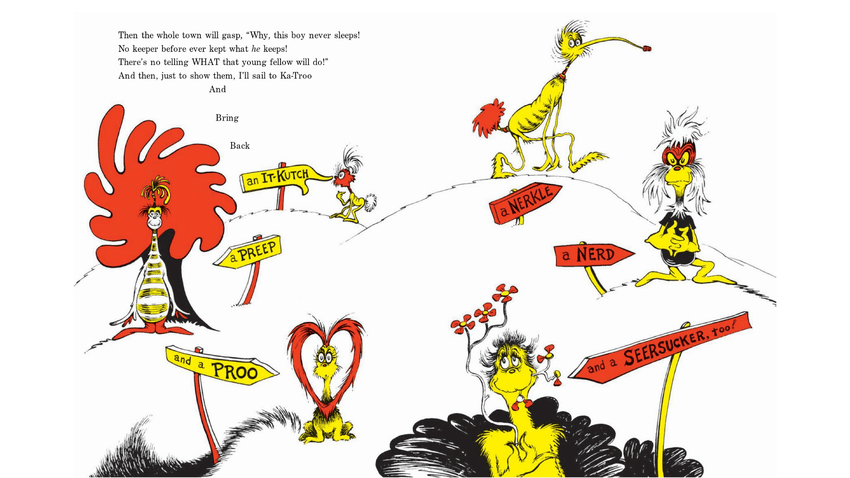 Some suggest nerd first appeared in Dr. Seuss’s 1950 book, If I Ran the Zoo:
And then, just to show them, I’ll sail to Ka-troo
And bring back an It-kutch, a Preep and a Proo,
A Nerkle, a Nerd, and a Seersucker, too!
Others argue that any time a word, or phrase appears in an artistic venue, it was probably in circulation long before it made that appearance, as most artists, Shakespeare included, probably heard the words they used long before they brought them to the masses. After Dr. Seuss brought the word to the masses, it apparently made the rounds, as Newsweek wrote an article that stated that in 1951 Detroit, “Someone who once would be called a drip or a square is now, regrettably, a nerd.” By the 60s the word took off, as it began popping up all over the place in print.
 Those who state that Dr. Seuss didn’t invent the word argue, “Dr. Seuss’s Nerd appears as more of a disapproving grouch than a drip or a square.” The etymologists took that note and began digging further. They found that one of Edgar Bergen’s ventriloquist dummies was named Mortimer Snerd. Modeled on a country bumpkin, “Snerd reminded listeners of a drip, someone who is tiresome or dull, and therefore—according to 1951 Newsweek—a nerd.”
I don’t have a personal theory regarding the etymology of nerd, but I can tell you how it penetrated the zeitgeist of my generation, and made its way into my neighborhood. Those in my demographic know where I’m headed, for they know that even if the term wasn’t born on the 70s-80s sitcom Happy Days, it was raised there. The etymology suggests that nerd might predate Happy Days by twenty years, which makes sense since the era Happy Days strove to duplicate was the 1950s.
Those of us who have attempted to pinpoint a word, or phrase, in our personal lives, know what a difficult job etymologists have. When we hear a new word, making the rounds in our inner circle, we ask our friends, “Where did you hear that?”
No one I know says, “My friend Billy says that all the time, and I thought I’d try it out.” Everyone strives to be considered the originator, or original in a more general sense. What do they say? They say, “I’ve been saying that for decades,” or, “Dude, I’ve been saying that for years.” They do not plant a flag in the term or phrase, but there is an implicit challenge to find someone who has been saying it longer than they have. Are they being dishonest? I don’t think so. I think it speaks to the nature of words and phrases, and how we absorb them into our vernacular without conscious thought. When we hear someone use terms, phrases, or sayings once, we might take notice. “Why did you say that?” we might ask. Most of us don’t ask that, because we fear the “If you have to ask…” response. By the time we hear it a fourth or fifth time, often from a wide variety of different sources, we just start saying it. Few can remember the first time they heard them, and even fewer remember the original source, so when it comes to idioms like nerd, etymologists can only source the first time it appeared in print or on the public airwaves.
Knurds on College Campuses
Most people aren’t interested in the history of words. If you’re at a party seeking party time conversation topics, the etymology of words might get you a lifted eyebrow, and that’s if you do it right. If you deliver what I’m about to tell you with pitch-perfect cadence, and you hit the final point without sounding too nerdy or professorial, you might get nothing more than a half-interested “Huh, I’ve never heard that before,” or some other polite response before moving onto something that interests them more. I did it last weekend. I told them about what I considered one of the most fascinating theories on the origin of nerd I’ve ever heard. I didn’t stopwatch the moment, or mentally document it in anyway, but I think I might’ve received a five-second reaction before someone changed the subject. “That’s it? That’s all I get?” That’s all I got, and I’m sure that one of them probably called me a nerd later for being so interested in something so inconsequential and nerdy. Some are interested of course, some study it so often that they’ve tried to find a way to make some money at it, and some do it so often that it’s grown into some sort of obsession. For the rest of us, it’s a casual, passing interests that serves as a momentary bridge between other topics.
If you’re one of the above, chances are you’ve found numerous academic, professorial breakdowns of the history of a word. Some of these breakdowns are so precise and exact that it’s both an illustration of how much hard work some pour into researching the information and how boring that research must be.
I’ve read through some etymologies, a number of them, and I’ve found them a useful cure for a mean case of insomnia. I understand that they are a ‘just the facts man’ information resource and hiring Jay Leno or Jerry Seinfeld to write for them might confuse their visitors more than anything else. I also understand that the etymologies of words are not fodder for creative writing, but if I were to put such a project together, my mission in life would be to try to breathe some life into their world to try to make them a little entertaining.
Impossible, you say? I introduce you to knurd, or as we know it nerd. Yes, nerd is the word, but one particular outlet posited a theory on the origin of the word that feeds into my notion that just because we’re involved in a scientific study of word doesn’t mean it has to be nerdy.
Nerd is the word we know and love today, and this theory states that the word began on college campuses with college students engaged in the time-honored pursuit of most college students of finding the best way to insult one another.
Quick, other than insulting one another, what’s the most popular activity on college campuses for those who try their hardest to avoid activities that add to the population, or subtract from it? If you were on the Family Feud, your first guess, and the number one answer would be … survey says, “Drinking alcohol.” College students drinking alcohol can, of course, subtract from and add to the population, but those results are rarely the goal. The goal, now that they’re on their own for the first time in their lives, is to try to find the best way possible to disappoint their parents. Drinking massive amounts of alcohol could also be said to be one of the top two ways to do something college students have wanted to do since they were five, run away from home, and they/we think the best way to do that is by destroying the brain cells that remember their childhood.
We’re all now coached to think that drinking alcohol leads to awful things, and it can, but it’s also fun, and it can lower the restraints of our inhibitions. (*Pot might accomplish similar elements, but I wasn’t part of that world.) Alcohol also provides a reason for college students to get together, i.e. parties, and the more they drink, the more fun they have, so they drink to excess. They get drunk, they love every minute of it, and they don’t want to feel guilty about it. The Poindexters of the world, talking about being responsible and reminding them that they’re wasting their college years by drinking so much alcohol that they may not be able to remember much of what they were supposed to learn that week, are the enemy. They’re responsible young men, and the only thing college students hate more than their parents, or the other authority figures in their lives, are responsible young men.
Responsible students see college as an institution that might be able to provide them the opportunity for a better future, and they fear that drinking too much alcohol might affect their academic performance. This drives drinkers crazy, because their goals are the exact opposite of those who go to college to learn stuff to prepare for the life beyond.
Most drinkers won’t say, “Who gives a crap about the future. I live for the now.” Most people, regardless of age, aren’t that bold, but they loathe responsible students who remind them of their failings in this regard.
This theory suggests that the drunks on college campuses loathed responsible young men so much that they developed a pejorative to describe those who wanted to refrain from drinking alcohol. They called them knurds. Knurd, as you’ll note, is drunk spelled backwards. Knurd is spelled different than the current incarnation of the word, but all idioms, pejorative names, and terms that penetrate the zeitgeist go through a life cycle in which their meanings progress and change (Think bad, gross, and sick), and some of the times the spelling of these words change. There is no evidence to prove, or disprove, the knurd theory, but it makes so much sense that it appeals, in so many ways, to those of us who enjoyed getting drunk in college and unwittingly carried on the tradition of calling those who didn’t a knurd.
We all know a nerd. Some of us knew so many nerds, and we liked them so much that we’ve just realized that there’s probably a reason we preferred being in their company so much. We were never a knurd, but we were nerds, are nerds, and forever will be, but within the ever-elastic definition is the prototype. We might not have known the history of the pejorative, but we don’t need to read through an etymological history to know a nerd when we see one. When we hear the word now, we picture the prototype: Oily hair, parted down the middle; a short-sleeved shirt, well pressed, with a pocket protector in the pocket of the shirt, loaded with pens, pencils; horn-rimmed glasses (I wore a pair in grades 1-5, thanks Mom!), a pre-pubescent squeak to his voice (and it’s almost always a male), and an overall uncomfortableness that leads them to avoid eye-contact. We all knew someone who fit the parameters, but did we create these extreme parameters to create a little distance for ourselves?
For all the nerds who went through its first unkind forty plus years, the last twenty have been more kind to them, as the word nerd has undergone a redefinition and a certain renaissance that cannot be denied. The pejorative has progressed from the worst thing you could call someone, to people dropping it casually to describe their unique obsessions, and onto it being a compliment used to describe the erudite and computer-oriented who know how to code and eventually used that knowledge to develop AI to change everything from our TVs, to our kitchen appliances, and our cars. Who would’ve guessed that in a classroom filled with jocks, popular and cool kids, and various incarnations of the class clown that it would be the socially awkward, painfully shy, prototype Poindexter, in the quiet back corner of the room, that we’d all grow up and want to be?
 Rilaly